

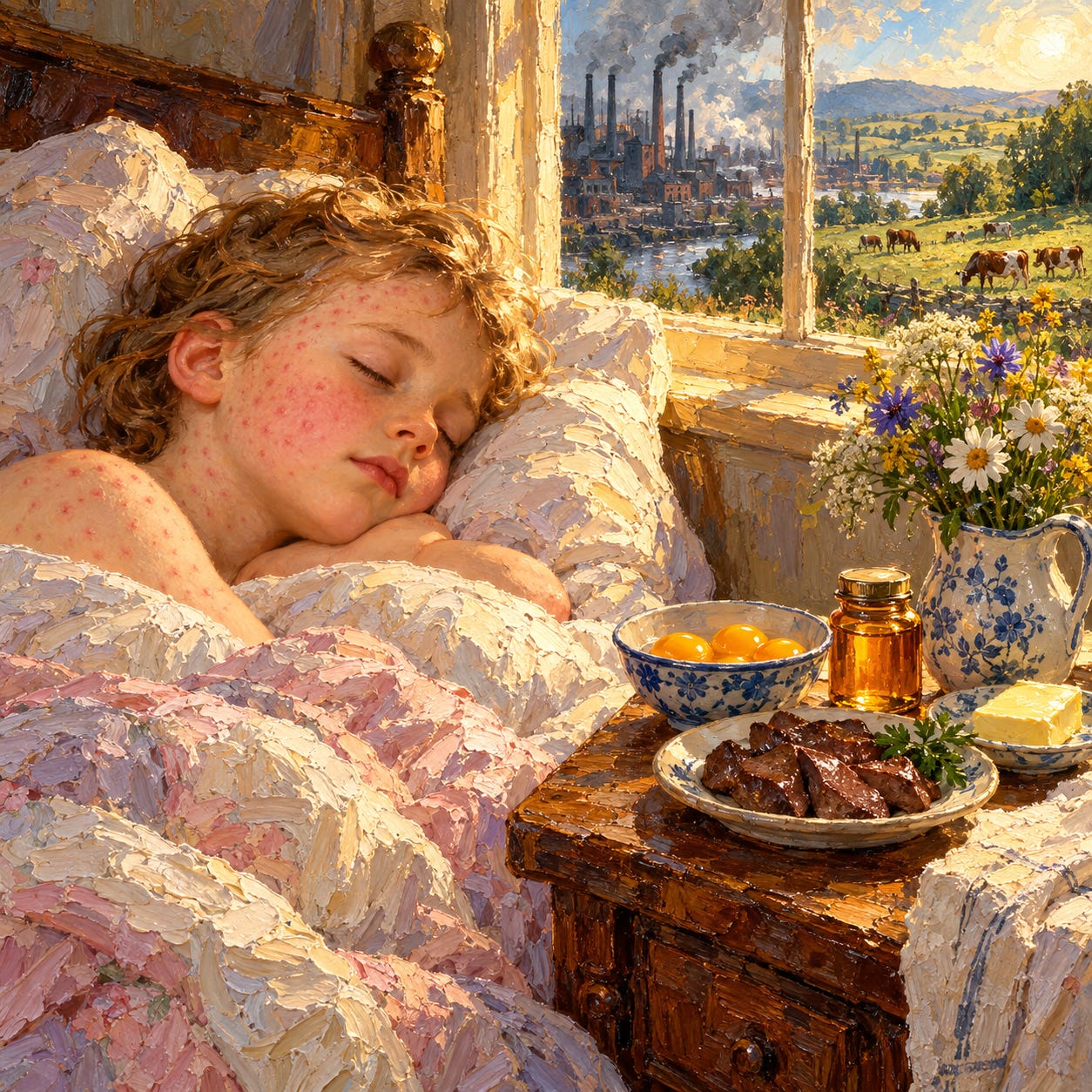
This essay operates in two registers. When establishment sources are being examined (the CDC’s own diagnostic guidance, the Cochrane review on vitamin A, Merck’s package inserts, the founding isolation papers, the German Federal Court ruling, the Mina 2019 antibody study), establishment terminology appears as the establishment uses it. When the terrain reading is being stated, the language shifts. “Measles” is the name medicine gives to an eruptive presentation pattern that follows a recognisable course; the essay treats the presentation as observable while declining the underlying pathogen claim, which the historical record shows was constructed rather than demonstrated. The two registers serve different argumentative functions.
At around 2am on a winter night in early 2026, seven-year-old twin brothers arrived at Mission Hospital in Asheville, North Carolina. Both had a fever, a cough, a rash, pink eye, and cold symptoms. They sat in one waiting room. Then another. Two hours and twenty minutes passed before anyone isolated them. Then two more hours ticked by. As the sun rose, an emergency room doctor finally called the state epidemiologist and described what he was seeing. The epidemiologist told him to quarantine the children. They were eventually diagnosed with measles.¹
The hospital was later cited by the Centers for Medicare & Medicaid Services with an Immediate Jeopardy penalty, their most severe sanction.¹ The reporting framed it as institutional failure. A hospital that should have recognized measles didn’t. But the KFF Health News investigation that followed revealed the deeper problem: most U.S. clinics and hospitals have never experienced measles cases.¹ The nation’s medical infrastructure was being asked to identify a disease that virtually no practicing doctor had encountered firsthand.
Buried in the expert commentary offered to explain the failure is a finding that dismantles the entire evidential basis for measles vaccination. It is one of twenty findings this essay walks through. Each of them is drawn from establishment sources or documented historical record. Each of them, considered on its own, would be enough to unsettle the standard story. Considered together, they do something more than unsettle it.
This work stays free because paid subscribers make it possible. They get the full book library, the Deep Dive Audio Library, and the Questions for Your Doctor, Before You Consent, and Package Insert series. No grants, no gatekeepers — your subscription is what keeps it that way.
Audio Deep Dive (for Paid Subscribers)
The Disease Was Already Gone
1. Measles mortality collapsed by more than 90% before the vaccine was licensed.
The death rate per 100,000 population from measles in the United States, plotted from 1900 forward, traces a steep downward line that reaches its floor years before any inoculation program existed.² By the late 1950s, the period of The Donna Reed Show, The Rifleman, and the educational pamphlets that described measles as a temporary nuisance, measles had ceased to be a meaningful cause of childhood mortality. The 1964 Merck film that would soon describe measles as “more than a nuisance” was produced at a moment when the disease it named had already stopped killing American children at any meaningful rate.
The mortality decline was driven by what drives most disease mortality declines: improved nutrition, improved sanitation, improved living conditions. Thomas McKeown documented the historical pattern; McKinlay and McKinlay in their 1977 paper for the Milbank Memorial Fund Quarterly applied his framework to specific American disease curves and found the same pattern across measles, scarlet fever, whooping cough, tuberculosis, and typhoid.³ In every case the mortality curve collapsed before the pharmaceutical intervention arrived. In every case the intervention was credited with the collapse in retrospect.
The 1963 campaign was not protecting American children against a lethal disease. The disease had stopped being lethal a generation earlier. What the vaccine inherited was a mortality decline already accomplished by the kitchen and the sewer. Improved food. Indoor plumbing. Refrigeration. Housing that kept families warm in winter. The pharmaceutical industry could not sell those. It could sell a vaccine, and it could sell one against a disease whose lethal reputation had been built during the tenement decades and whose actual mortality had already been resolved by conditions the industry had no product for.
The curve is public. It is in the CDC’s own vital statistics. It was reprinted by Furuse and Oshitani in Epidemiology and Infection in 2022.² Any reader can look at it. The reason most readers have not is that the curve is not shown in medical school, not shown in public health messaging, and not referenced in the vaccine advocacy that treats the 1963 introduction as the pivot on which measles mortality turns. The pivot was elsewhere. The pivot was food.
2. The variable that determines whether measles kills is the terrain of the child, not the alleged virus, and the establishment’s own literature admits it in the only language it has available.
The children who die of what medicine calls measles are, in the establishment’s own data, the children whose blood tests low for what the assay measures as retinol.⁴ The establishment classifies this as “vitamin A deficiency.” What the number actually tracks is the whole nutritional state of a depleted child: mineral density, fat-soluble cofactors, the enzymatic integrity of unprocessed food, the trace elements from mineral-rich soil, the whole matrix of what a body is built from. The retinol reading is one marker of a terrain in collapse. The establishment reads it as a single-compound deficiency because single-compound deficiency is the only framework its assays can measure.
The World Health Organization recommends administering isolated retinyl palmitate (”vitamin A supplementation”) to children with measles in the developing world precisely because the correlation between low retinol readings and severe outcomes is strong.⁵ The Cochrane review of these interventions found that two doses of the isolated compound reduced the risk of death and the rate of pneumonia-specific mortality, particularly in children under two.⁶ This establishes what the establishment reads as it: a pharmacologically active compound, administered in high dose, has effects on a depleted body. It does not establish that the body required that compound as a nutrient. What was administered was retinyl palmitate. What the child’s body actually needed was food.
The international comparisons confirm what the historical curves show. Measles mortality in malnourished populations (sub-Saharan Africa in the late twentieth century, refugee populations in any era) has run orders of magnitude higher than measles mortality in fed populations. The same alleged biology, the same alleged transmission, and outcomes that diverge by orders of magnitude depending on what the child has eaten. Within germ theory, this is difficult to accommodate. The variable that matters is the pathogen, and the pathogen is held to be constant. Differences in outcome then get attributed to the infinitely adjustable category of “immune status”: a placeholder that absorbs whatever the data shows. The terrain reading is more parsimonious. The body responds to the conditions it finds itself in. A well-fed body resolves a cleansing episode in a week. A malnourished body, asked to mount the same cleansing while already depleted, may not survive it.
Weston Price documented fourteen traditional populations across the globe in the 1930s, none of them taking supplements, all of them essentially free of the chronic diseases that plagued industrialized populations.³⁷ Their children moved through the eruptive childhood illnesses and recovered. What their diets shared was not any single isolated compound. It was mineral-rich, unprocessed food, drawn from soil and animals that had not yet been degraded by industrial agriculture: organ meats, egg yolks, butter from grass-fed animals, cod liver oil taken in its whole form, fermented dairy, seafood, bone broths. The compound the establishment isolates and calls vitamin A is one marker of one dimension of this kind of food. It is not the food. The children who died of what was called measles in the tenements of the industrial cities were not deficient in a compound. They were malnourished, chronically, in ways the establishment could measure only through the single markers its assays were designed to read.
The complications the 1964 Merck film invoked (bacterial pneumonia, encephalitis, blindness) were the complications of measles in populations whose terrain was already in collapse and in populations whose acute symptoms were aggressively suppressed. They were not the typical course of the illness in fed children whose bodies were permitted to resolve the episode. Cod liver oil, given to a child moving through a fever-and-rash illness, is one of the interventions traditional practice has used for a century. It provides retinol in the whole matrix, alongside the fat-soluble cofactors, the marine minerals, and the enzymatic integrity that isolated retinyl palmitate cannot approximate. The children who died were not dying of the virus. They were dying of what happens to a depleted body pushed to mount a full cleansing without the reserves to sustain it. The children who lived, and the vast majority did live, moved through the episode and returned to health.
The Diagnosis That Cannot Be Made
3. Institutional authorities admit measles cannot be diagnosed clinically.
Theresa Flynn is a pediatrician in Raleigh and president of the North Carolina Pediatric Society. In response to the Mission Hospital situation, she told KFF Health News: “There’s a word, ‘morbilliform.’ It means measles-like, and there are lots of viruses that can cause a rash that looks like a measles rash in children.”¹ In thirty years of practice, Flynn has never seen a case of measles.
Patsy Stinchfield is a former president of the National Foundation for Infectious Diseases and a nurse practitioner. She called the CMS penalty against Mission Hospital “extreme,” given how difficult the virus is to identify. Her assessment: “In the middle of winter right now, measles looks like every other viral respiratory infection that kids come in with.”¹
Jennifer Nuzzo, an epidemiologist and director of the Pandemic Center at Brown University, confirmed the problem from a different angle: diagnosing measles is “a major challenge.”¹
These are not fringe practitioners. Flynn leads the pediatric professional society of the state at the center of the 2024-2026 measles reporting cycle. Stinchfield led a national foundation dedicated specifically to infectious diseases. Nuzzo runs a pandemic center at an Ivy League university. If anyone should be able to defend the clinical diagnosis of measles, it is these three people. They cannot. Their statements were offered as explanations for why hospitals struggle to recognize measles. They did not intend to undermine the entire evidential basis for measles vaccination. But that is precisely what their statements do.
If experienced pediatricians in 2026, with the benefit of decades of medical training and institutional resources, cannot distinguish measles from other rash-and-fever illnesses by clinical presentation, then the general practitioners generating case reports in the 1940s, 1950s, and early 1960s had no chance. The differential diagnosis for the clinical presentation, as acknowledged by mainstream literature, includes rubella, roseola, scarlet fever, parvovirus infection, enteroviral illness, Kawasaki disease, drug reactions, adenovirus infection, and infectious mononucleosis. Each can produce rash, fever, cough, and conjunctivitis in various combinations. A general practitioner in a busy mid-century clinic was not carefully distinguishing between these entities. He was seeing a sick child with a rash and writing down the most common diagnosis.
Measles was a notifiable disease and triggered institutional attention; “viral exanthem of unknown etiology” did not. The system incentivised diagnostic specificity where none existed. The doctors were not incompetent. They were doing what medicine asked of them, with the tools they had. But those tools could not distinguish measles from its mimics, and no one pretended otherwise until the numbers those doctors generated became the foundation of a vaccination program that could not afford to have its foundation questioned.
4. Koplik spots fail both sensitivity and specificity tests.
The predictable defence against the argument above is Koplik spots. Named after Henry Koplik, who described them in 1896, these small bluish-white spots on the inside of the cheek have been called pathognomonic for measles: their presence supposedly confirming the diagnosis with certainty. They appear a day or two before the rash and were, for over a century, treated as the one clinical feature that separated measles from its imitators.
The defence fails on three grounds.
First, Koplik spots are absent in a large percentage of cases the establishment itself classifies as measles. Standard references place the figure at between 50% and 70%.⁷ A clinical marker absent in a third to a half of actual cases cannot serve as a reliable diagnostic tool. It guarantees systematic undercounting.
Second, Koplik spots are not specific to measles. A 2019 study published in Frontiers in Microbiology examined this question with a rigour never previously applied. Japanese researchers conducted a six-year national surveillance study covering 3,023 measles-suspected cases from 2009 to 2014, with PCR testing used to determine which virus was actually present. Koplik spots were observed in 717 of these cases. Among those 717 patients displaying Koplik spots, only 202 (28.2%) tested positive for what the researchers called the measles virus. Rubella virus was detected in 125 of the Koplik-spot cases. Parvovirus B19, human herpesvirus 6/7, and other agents accounted for a further 51.⁸ The study calculated the sensitivity and specificity of Koplik spots as a diagnostic marker for measles. Sensitivity: 48%. Specificity: 80%. A marker with 48% sensitivity misses more than half of actual cases. A marker with 80% specificity means one in five patients displaying it does not have the disease it supposedly confirms. The study’s own conclusion: Koplik spots “were not a specific manifestation of measles.”⁸
Third, the appearance of Koplik spots in non-measles illness had been documented decades earlier. Evans and colleagues reported Koplik spots in a patient with parvovirus B19 infection in the Journal of the American Academy of Dermatology in 1992.⁹ Annunziato had raised questions about the disease-specificity of Koplik spots as early as 1987.¹⁰ The Japanese study confirmed at scale what case reports had been suggesting for a generation.
The one clinical feature that supposedly elevated measles diagnosis above guesswork turns out to be neither sensitive enough to catch most cases nor specific enough to exclude other conditions. Every doctor who relied on Koplik spots to confirm a measles diagnosis had, at best, a coin flip’s chance of being correct. In practice, most diagnoses were made on the basis of rash and fever alone. The 1964 Canadian Medical Association Journal paper on measles diagnosis confirmed that the standard was clinical observation, not systematic examination for Koplik spots.¹¹ The spots were described in textbooks. Whether busy general practitioners routinely opened children’s mouths and examined their buccal mucosa with enough care to identify transient white specks on a reddened background is another question entirely.
5. The molecular tests the CDC now says are essential did not exist until the 1990s.
Before 1963, there were no molecular diagnostic tests for measles. No PCR. No antigen tests. No antibody tests as they are now performed. Diagnosis was based entirely on what a doctor could observe: the same symptom observation Flynn, Stinchfield and Nuzzo now admit is unreliable. The molecular diagnostic apparatus that the CDC now describes as essential became routinely available around the 1990s. The measles vaccine was introduced in 1963.
For the first three decades of the vaccine era, and for the entirety of the pre-vaccine era before it, no clinician had access to a reliable way of distinguishing measles from any other childhood illness that produced fever and a rash. Consider what this looks like in practice. A mother brings her child to a general practitioner in 1952. The child has a fever, a cough, a runny nose, and a red rash spreading from the face downward. The doctor examines the child, notes the symptoms, and writes “measles” on the chart. The diagnosis is reported to the local health department, which aggregates the numbers and sends them to the state, which sends them to the CDC. The national incidence figure is the sum of thousands of such encounters across the country, each one resting on a single clinician’s judgment call. No laboratory confirmation. No second opinion. No verification mechanism of any kind. The same procedure was still being followed in 1975. And in 1985.
The pre-1963 measles data is not weak. It is meaningless. There is no way to know how many of those cases were actually the same condition. The post-1963 figures face a different but related problem. Once molecular testing became the standard in the 1990s, the diagnostic criteria narrowed. Cases that would have been called measles in 1955, on clinical presentation alone, would not be called measles in 2005 without laboratory confirmation. The apparent decline in measles incidence is confounded by a simultaneous change in diagnostic criteria that occurred during the very decades the decline is attributed to the vaccine. Looser criteria before. Stricter criteria after. The comparison is not measuring the same thing at both time points.
The counting problem is not repairable. It is not that the numbers are slightly off. It is that no one knows, and cannot in principle recover, what fraction of the pre-vaccine cases labeled measles would have satisfied the laboratory criterion the establishment now requires, or what fraction of the residual post-vaccine cases labeled roseola, fifth disease, atypical rash illness, or non-specific viral exanthem would have satisfied it either. Every graph you have ever seen showing measles incidence falling after 1963 measures a diagnosis its own custodians now say could not be made.
The Virus That Was Never Isolated
6. The two pre-Enders “demonstrations” of measles causation were both blood-injection experiments.
The CDC’s history-of-measles page credits Francis Home, a Scottish physician, with the first demonstration in 1757 that measles is contagious. The page does not describe what Home did.
Home took blood from a person he judged to have measles and injected it into well people. Some developed a fever. Some developed a rash. He declared the result proof of contagion. In certain older texts the same experiment is called the first isolation of the measles virus, though nothing was isolated and no particle was seen.¹² The CDC’s own patient-information materials on the effects of receiving untyped blood (blood not matched by ABO compatibility) list the expected reactions: fever, chills, low back pain, nausea, dark urine.¹³ Rashes can occur even from correctly typed blood, arising from allergic responses to plasma proteins. Every symptom Home observed is a documented consequence of injecting one person’s blood into another. His experiment is a transfusion reaction. It is not a demonstration of transmission.
Between Home in 1757 and Peebles in Enders’ laboratory in 1954, the state of measles causation science advanced through a single landmark experiment. In 1911, John F. Anderson and Joseph Goldberger of the U.S. Public Health Service injected nine rhesus monkeys with defibrinated blood taken from four human measles patients. Four monkeys developed fever and rash.³⁸ The vaccinology reference work Vaccines, more than a thousand pages long, cites this 1911 experiment as the highest scientific evidence for measles causation prior to Peebles’ 1954 arrival in Enders’ laboratory. Anderson and Goldberger’s finding is what Home’s finding was: injecting blood from ill donors into recipients produces fever and rash in some recipients. The finding is a consequence of the injection, not evidence of what medicine claims caused the illness in the donor. From 1757 to 1954, the entire evidential foundation for the measles-as-transmissible-agent claim rests on two blood-injection experiments that produced exactly the reactions blood-injection is known to produce on its own.
The absence of a controlled demonstration of measles contagion is not unusual. It is the pattern for every alleged viral illness examined under experimental conditions. In 1918, at the height of what became known as the Spanish flu, Milton Rosenau at the U.S. Public Health Service attempted to transmit influenza from severely ill patients to healthy volunteers by every route he could devise. Rosenau’s protocol was exhaustive. Aerosolised lung material was sprayed into volunteers’ eyes, nose, throat, and lungs. Mucus from patients was instilled into the nose and swallowed; the initial dose was 1ml, then increased to 6ml when no illness developed. Nose-to-nose and throat-to-throat swabbing was performed to transfer secretions directly. Ten millilitres of blood from ill patients was injected. Filtered mucus was injected subcutaneously. Thirteen volunteers were placed in an influenza ward and instructed to shake hands with patients, talk with them at close range, and permit them to cough directly into their faces. One hundred volunteers in total, aged 18 to 25, in good health, none with a history of influenza. Not one developed the illness. The results were published in JAMA in 1919.¹⁴ Rosenau closed his article: “We entered the outbreak with a notion that we knew the cause of the disease, and were quite sure we knew how it was transmitted from person to person. Perhaps, if we have learned anything, it is that we are not quite sure what we know about the disease.”
The founding measles causation experiments (Home 1757, Anderson and Goldberger 1911) were blood-injection artefacts. The founding influenza contagion experiments failed. The alleged mechanism by which viral illness is said to spread has never been demonstrated under conditions that would satisfy any other empirical claim.
7. No controlled demonstration of measles transmission has ever been published.
Ask current AI models to produce a single peer-reviewed paper demonstrating child-to-child transmission of measles under controlled conditions (well children placed with an ill child, monitored for illness) and the answer comes back: no relevant information was found. The paper does not exist. This is not because the study would be hard to design. The design is straightforward: identify a child with laboratory-confirmed measles, place well children in proximity under standard household or classroom conditions, monitor for symptomatic illness and laboratory confirmation over the standard incubation period. Nothing about the design requires deception, coercion, or unusual resources. The study has not been performed.
The absence is not marginal. The claim that measles transmits from person to person is the load-bearing claim on which the vaccination program rests. If measles did not transmit, there would be no case for what the establishment calls herd immunity, no case for school mandates, no case for the entire public-health apparatus built around outbreak containment. The claim is central. The demonstration is missing. A century of institutional practice has proceeded on the assumption that the demonstration exists somewhere, and no one has looked closely enough to notice that it does not.
What does exist is observational epidemiology: patterns of illness clustering in space and time that are interpreted as evidence of transmission. But clustering is what you observe when multiple people share environmental conditions (shared food, shared water, shared indoor air, shared electromagnetic and toxic exposures, shared emotional stressors). Clustering does not distinguish transmission from shared exposure. Every claim of measles transmission is really a claim of clustering, reinterpreted through the germ-theory frame that assumes clustering must be transmission because germ theory does not have another category for it. The terrain reading has another category: shared conditions produce shared responses. No microbial vector is required to explain why children in the same tenement, or the same school, or the same barracks, sometimes fall ill together.
The absence of the controlled study is not evidence that the study would fail. It is evidence that no one funded, designed, or executed it, because the framework did not require it. The framework assumed the answer. The century of institutional practice built on the assumption is not evidence for the assumption. It is evidence of what a captured framework does with its own unexamined foundations.
8. Enders’ own 1954 paper contains the admission that killed the method.
Every claim about the measles virus traces back through one 1954 paper by John Enders and Thomas Peebles, “Propagation in Tissue Cultures of Cytopathogenic Agents from Patients with Measles.”¹⁵ The technique the paper describes has been the standard method for isolating not only the alleged measles virus but virtually every other alleged virus in the seventy years since.
The procedure works like this. Mucus from a patient said to have measles is added to a monkey-kidney cell culture. High concentrations of penicillin and streptomycin are added. Nutrient content is reduced. To the culture Enders added a medium consisting of bovine amniotic fluid, beef embryo extract, horse serum, and phenol red. Six sources of protein and genetic material were added before the cells broke down. When cytopathic effects appeared (the cells becoming giant, disorganized, and vacuolated), Enders declared the effects were caused by the virus he had been seeking. No control experiment was performed at the outset. The whole apparatus of viral isolation, from that day to this, rests on the assumption that whatever produced the cytopathic effect in the cultured cells must have been a virus present in the patient material.
In the paper itself, Enders warned that “cytopathic effects which superficially resemble those resulting from infection by the measles agents may possibly be induced by unknown factors.”¹⁵ Then he found the unknown factor. He acknowledged in the same paper: “A second agent was obtained from an uninoculated culture of monkey kidney cells. The cytopathic changes it induced in the unstained preparations could not be distinguished with confidence from the viruses obtained from measles.” He had run the procedure without any measles material at all. The cells broke down in a manner he himself described as indistinguishable from the “isolation” experiment. The mucus was not the independent variable. The technique could not distinguish between the thing it was looking for and background noise.
The observation should have ended the technique. It became the technique.
In work published in 1957, the virologist Gisela Ruckle independently reported the same finding: the cytopathic changes attributed to the measles virus appeared in uninoculated control cultures and in cultures inoculated with material from patients who did not have measles.¹⁶ By 1959, the position was openly acknowledged in the literature. Black, Reissig and Melnick, writing in Advances in Virus Research, stated: “Agents that are identical to measles virus in terms of their serological relationships, cytopathological effects and range of tissue culture susceptibility have been found in uninoculated cultures. In view of these complications, cultures of monkey kidney cannot be considered a suitable tool for the isolation or propagation of measles virus.”¹⁷ The technique that had been used to identify the agent was conceded by the field itself to be incapable of doing so. The field continued to use it. Enders won the Nobel Prize for his poliovirus work in 1954, the same year as the measles paper, and his methodology became the standard for virology worldwide.
If the alleged virus has never been separated from the cellular breakdown material it is supposedly extracted from and shown to exist as an independent entity, it has no confirmed genome. The sequences called the measles genome are computational assemblies from fragments of tortured cell cultures, reconstructed against a template. It has no confirmed proteins. It has no confirmed antigens. Every antibody test claiming to detect a response to the virus is measuring the binding of serum proteins to uncharacterized material the culture happened to produce. The molecular diagnostic apparatus does not confirm the existence of the entity it was built to detect. It presupposes it, then measures against the presupposition.
9. The “eradication” of a disease has repeatedly turned out to be its reclassification.
The polio case is the clearest instance and the pattern applies to measles.
Before the Salk vaccine was introduced in 1955, the diagnosis of paralytic polio was made on clinical grounds. A child presenting with fever, muscle weakness, and paralytic symptoms was diagnosed with polio. Cases were reported to health authorities and became part of the national incidence data. After the vaccine was introduced, the diagnostic criteria for paralytic polio tightened substantially. The Council of State and Territorial Epidemiologists and the World Health Organization changed the case definition to require laboratory confirmation, longer paralysis duration, and exclusion of other causes. Cases that would previously have been called polio began appearing under different labels: aseptic meningitis (inflammation of the membranes around the brain and spinal cord without an identifiable bacterial cause), Guillain-Barré syndrome (progressive muscle weakness and paralysis attributed to nerve inflammation), transverse myelitis (inflammation of the spinal cord causing paralysis), and (in the WHO’s global surveillance apparatus) acute flaccid paralysis (any sudden onset of muscle weakness and floppiness, especially in children). Suzanne Humphries and Roman Bystrianyk documented the substitution in detail in Dissolving Illusions, and the CDC’s own MMWR series on aseptic meningitis surveillance shows the corresponding rise in the alternative diagnostic categories during the years polio was declining.¹⁸ The 2018 study by Dhiman and colleagues showed the correlation persisting in contemporary India: as pulse polio vaccine frequency increased, so did non-polio acute flaccid paralysis rates, in a pattern the authors themselves described as concerning.¹⁹
The polio “eradication” statistics that made careers rest on a diagnostic reclassification that occurred at the same time as the vaccine’s rollout. The children who would have been called polio cases in 1954 were still there. Their diagnostic label had moved.
The pattern applies to measles. Cases that would have been diagnosed as measles under the pre-1990s clinical criteria (fever, cough, coryza, rash) now, under the laboratory-confirmation requirement, get sorted into other categories: roseola (attributed to HHV-6), fifth disease (attributed to parvovirus B19), atypical viral exanthem, non-specific viral rash, or “clinically compatible but laboratory-negative.” The apparent decline in measles from 1990 forward reflects, at least in part, this diagnostic sorting. The same fever-and-rash children keep presenting. They now leave the clinic with different labels.
The eradication story requires a stable diagnostic category over time. Measles has never had one. What has been eradicated is the label. What continues, at whatever underlying rate, is the phenomenon of children moving through eruptive fever illnesses that the terrain reading identifies as developmental cleansing episodes. The vaccine did not eliminate a disease. It presided over the reshuffling of a diagnostic category, and the reshuffling was called elimination.
10. The German Federal Court of Justice ruled in 2016 that six papers submitted as proof of the measles virus did not demonstrate its existence.
The German microbiologist Stefan Lanka offered €100,000 to anyone who could produce, in a single scientific publication, proof that the measles virus existed and could be measured. The physician David Bardens submitted six papers (Enders and Peebles 1954, Bech 1958, Nakai and Imagawa 1969, Lund et al. 1984, Horikami and Moyer 1995, Daikoku et al. 2007) and sued for the prize when Lanka declined to pay. The case reached the German Federal Court of Justice. Five court-appointed expert witnesses examined the six papers. The court ruled in Lanka’s favor.²⁰
None of the papers, the experts found, singly demonstrated the existence of the alleged measles virus. The genetic sequences attributed to the virus had been assembled computationally from fragments. The particles photographed under electron microscopy had not been characterized as infectious. The cytopathic effects had been observed in controls. Lanka kept the money.
The ruling is not fringe commentary. It is a decision of the highest civil court in Germany, one of the most scientifically credentialed nations in Europe, after examination of the primary literature by five independent experts appointed by the court. The Bardens side had every incentive to submit the strongest papers available: the papers most cited in the field, the papers virology considered most definitive. Those were the papers examined. Those were the papers found insufficient. The finding was not that the papers were poorly written or that Bardens had submitted the wrong papers. The finding was that the papers themselves, taken together, did not establish what the discipline claims they establish.
The ruling was almost entirely blacked out of English-language coverage. It was reported in the German press and covered in the terrain-medicine and health-freedom press. Mainstream English-language medical journalism did not report it. Mainstream English-language medical journalism has not reported it in the decade since. A high court ruling in a G7 nation, on a question central to a global vaccination program, has been treated as if it did not occur. The absence of coverage is itself evidence of how the framework maintains itself: findings that would unsettle the foundations do not get reported, and readers who do not know to look for them do not know they exist.
The Study That Reads the Other Way
11. The most-cited modern paper on measles “immune amnesia” reverses meaning when antibodies are read as breakdown markers.
The construct did not end with Enders. Each generation of virology produces papers claimed to confirm the framework. The most consequential contemporary example is a paper published in Science in November 2019 by Michael Mina and colleagues.²¹ The study reported that measles infection eliminated between 11% and 73% of what the authors called the “antibody repertoire” of unvaccinated children, and that recovery of this repertoire required re-exposure to pathogens in the environment. MMR vaccination did not produce a comparable loss.
The paper became a fixture of the pro-vaccine argument almost overnight. Natural measles, on the establishment reading, leaves the child in a prolonged state that the media called “immune amnesia,” vulnerable to secondary infections the shot would have prevented. Newspapers ran headlines. Pediatric societies issued statements. The paper is now cited routinely as the definitive answer to any parent who suggests natural measles might be preferable to the shot.
The reading is upside down.
What laboratory serology actually measures is protein reactivity in serum. Nobody has isolated an antibody in the sense a biochemist isolates an enzyme. The concept was drawn theoretically by Paul Ehrlich before it was demonstrated experimentally, and the direct demonstration was never completed. The proteins detected by antibody assays are non-specific breakdown products the body releases when tissues are damaged and metabolically stressed. They correlate, in most cases, with the degree of ongoing biological distress.
The correlations are stark once you look for them. AIDS patients, sick from many toxic and nutritional causes, run extraordinarily high antibody titers precisely because their tissues are breaking down at an extraordinary rate. Children born with agammaglobulinemia, congenitally unable to produce any of the proteins medicine calls antibodies, recover from childhood illnesses on the same timeline as any other child. The 1950 British Medical Research Council Report #272 on diphtheria found no correlation between circulating antibody count and susceptibility to the disease.²² The category the Mina paper measures is not a measure of protection. It is a measure of what the body is currently doing to break down and clear damaged material.
Read through that lens, the paper says what it actually shows. Children who pass through the acute episode called measles get better, and their circulating debris drops because they are no longer breaking down. The falling numbers are the biomarkers of recovery. Children given MMR maintain or increase their circulating debris because the shot introduces novel material into the bloodstream (the ingredients examined in the next section), keeping the body in a state of ongoing distress requiring ongoing repair. The maintained biomarkers are the record of that distress.
The paper is a measurement of who recovered and who did not. The recovered children look “immunosuppressed” only because they stopped generating the markers of active injury. The vaccinated children look “protected” only because their injury remains ongoing. The graph the establishment reads as vindication of the vaccine is a graph of who was still being poisoned six weeks later. The Mina paper is the modern renewal of the pattern Enders set in 1954. The framework produces the paper. The paper is read as confirming the framework. The alternative reading, which fits the data at least as well, is never offered inside the discipline that produced it. This is what a captured framework looks like at the level of individual publications. The construct sustains itself by rendering the reading of its own evidence unthinkable to those who work inside it.
What Is Actually in the Shot
12. Merck’s MMR is grown in cells derived from a fetus aborted in 1962.
The rubella component of Merck’s M-M-R II vaccine is propagated in the WI-38 human diploid cell strain.²³ WI-38 was derived from lung tissue of a female fetus aborted in Sweden in 1962. The cells have been propagated in laboratories for decades since; new abortions are not performed to manufacture each batch. But every dose of MMR administered in the United States traces its rubella component through a lineage of cell cultures descending from that 1962 abortion.
This is stated in Merck’s own package insert. It is confirmed in the CDC’s excipient summary. Trace residual DNA fragments from the WI-38 cells remain in the final vaccine. The manufacturer discloses this. The CDC discloses this. The FDA does not consider it a safety concern.
Most parents do not know. The information is not part of standard informed-consent conversations before vaccination. The Catholic Church has consistently expressed moral concerns about it. Orthodox Jewish and traditional Christian families have opposed the use of fetal-derived cell lines in medical products on religious grounds. Ohio Parents for Vaccine Safety and similar groups have documented the disclosure gap for decades. The information is available to anyone who reads the manufacturer’s package insert. Almost no one reads the manufacturer’s package insert. The disclosure is technically complete. The practical result is that the shot is administered to children whose parents have not been told what they are consenting to.
The chickenpox and hepatitis A vaccines are propagated in MRC-5 cells, derived from lung tissue of a 14-week-old male fetus aborted in the United Kingdom in 1966. The rabies vaccine, the shingles vaccine, and several other products in the childhood and adult schedules use the same cell lines. When the practice is examined, the standard institutional response is to note that “no new abortions are performed” and that “trace residual DNA is not a safety issue.” Both statements are true. Neither addresses what the practice is, or why the disclosure is buried in package inserts most parents will never see. The MMR your pediatrician administered to your child was grown in cells from a fetus aborted more than sixty years ago. The reason you were not told is that no one is required to tell you.
13. What Merck’s own package insert lists as ingredients in MMR.
Merck’s M-M-R II package insert states the composition of each 0.5 mL dose.²⁴
Sorbitol (14.5 mg). Sodium phosphate. Sucrose (1.9 mg). Sodium chloride. Hydrolyzed gelatin (14.5 mg). Recombinant human albumin (≤0.3 mg). Fetal bovine serum (<1 ppm). Other buffer and media ingredients. Approximately 25 mcg of neomycin. Residual proteins from the chick embryo cell cultures in which the measles and mumps components are propagated. Residual proteins from the WI-38 human cells in which the rubella component is propagated.
Each of these substances arrives in the child’s bloodstream via intramuscular injection, bypassing the digestive and mucosal barriers the body uses to regulate what enters circulation. Neomycin is an antibiotic to which some children are allergic; the package insert lists severe allergic reactions to neomycin as a contraindication. Hydrolyzed gelatin is a protein source derived from animal collagen; gelatin allergy is a documented cause of anaphylaxis following MMR administration. Sorbitol is a sugar alcohol used as a stabilizer; in intravenous administration, it has been associated with metabolic disturbances. Fetal bovine serum is a growth medium derived from calf blood; residual bovine proteins in the injection are foreign to human physiology and can provoke sensitization reactions of the kind Charles Richet described in his 1913 Nobel Prize work on anaphylaxis.
One thing the MMR does not contain is aluminum. MMR is a live attenuated vaccine and does not use aluminum adjuvants; those adjuvants are in other products on the childhood schedule (hepatitis B, DTaP, HPV, and others) that are typically administered alongside MMR at the same well-child visits. The child receiving MMR at 12 months is often receiving multiple other injections at the same appointment, and the cumulative load of novel materials arriving in the bloodstream on that day includes aluminum from the other products, gelatin and neomycin and residual proteins from MMR, and whatever else is on the recommended schedule for that visit.
The reader who wants to know what is actually in the shot need only read the package insert. The insert is public. The information is not hidden. It is simply not part of the conversation between the parent and the pediatrician, because the conversation between the parent and the pediatrician assumes the parent has already delegated the question of ingredients to the manufacturer, the regulator, and the professional societies. The insert exists so that the delegation can be formally complete. The parent was informed, in the sense that the information was available for anyone who chose to seek it out. The parent was not informed in any practical sense. What was injected into the child is what the manufacturer states was injected into the child. Most parents have not read the statement.
The Campaign Machinery
14. Measles has broken out in fully vaccinated populations for forty years, and the response has always been to add another dose.
In 1985, 44% of measles cases in the United States occurred in appropriately vaccinated children.²⁵ The vaccine that the campaign of the 1960s and 1970s had built its case around was, twenty years later, failing to prevent the disease it targeted in a substantial fraction of the children who received it.
In 1989, measles outbreaks occurred among fully vaccinated school-aged children across the United States. The 1989 Houston school study, later published in the peer-reviewed literature, documented 77 measles cases in fully vaccinated schools; 18% of pre-revaccination sera collected from vaccinated students showed no antibody.²⁶ The 1989-1991 national resurgence produced approximately 55,000 cases, 11,000 hospitalizations, and 123 deaths. Over 40% of infections were in appropriately vaccinated individuals. The CDC’s Advisory Committee on Immunization Practices responded not by questioning the vaccine but by adding a second dose. The two-dose schedule that has been in place ever since was the institutional response to the failure of the one-dose schedule.
The pattern repeated. In 2006, mumps outbreaks among two-dose-vaccinated college students prompted the CDC to recommend a third dose in outbreak settings. In the 2015 Disneyland outbreak, the CDC’s own MMWR report on 110 California patients disaggregated vaccination status as follows: 49 (45%) unvaccinated, 5 (5%) had one dose, 7 (6%) had two doses, 1 (1%) had three doses, 47 (43%) had unknown or undocumented vaccination status. The 43% “unknown” bucket is doing significant work in that reporting. Given US childhood vaccination rates run above 90% for MMR by school age, an outbreak population showing 45% “unvaccinated” is either concentrating in a genuinely unvaccinated subpopulation at extraordinary rates, or the classification treats certain groups as unvaccinated for this specific analysis. In practice, cases with documented vaccination whose classification the health department could not verify to its own tightened standard were bucketed as “unknown,” systematically understating the vaccinated fraction.²⁷ The fully vaccinated proportion of any modern measles outbreak is higher than the CDC’s own reporting rules make visible.
When the schedule fails, the institutional answer is never to question the schedule. The answer is always to add another dose, another booster, another catch-up campaign, another category of person who should now receive the same product that has just been shown to fail. The pattern is not specific to measles. It is the pattern for every vaccine on the schedule when it starts producing outbreaks in the population it was meant to protect. The disease breaks out. The dose count goes up. The framework survives.
15. MMR has never been tested against an inert placebo.
The randomized controlled trial against an inert placebo is the standard against which every other therapeutic intervention is measured. It is what allows a product’s effects to be distinguished from the effects of receiving any injection. It is what allows adverse events to be attributed to the product rather than to background noise. The MMR has never been subjected to it.
Merck’s M-M-R II package insert does not describe any safety trials against inert placebo. The mid-1970s pre-licensure trials, obtained through Freedom of Information Act requests and documented in Turtles All the Way Down, involved approximately 850 children. The control groups received other vaccines: MMR, MR (measles/rubella), or rubella-only preparations. None received saline placebo. The trial design cannot distinguish the effects of MMR from the effects of any other injected vaccine, and cannot distinguish adverse events caused by MMR from adverse events caused by injection in general.³⁹
The original 1971 MMR was tested against sibling control groups who received no injection at all. This violates both blinding (the sibling knew they had not been injected) and randomization (family clustering was preserved rather than eliminated). The design cannot distinguish the effects of the product from the effects of undergoing an injection procedure. ProQuad, Merck’s combined MMR-varicella product, was tested against MMR II plus Varivax administered together, not against placebo. The Varivax “placebo” used in that product’s own licensure trials was the vaccine formulation minus the viral component; adjuvants, preservatives, growth media residuals, and stabilizers were all present in the so-called placebo, meaning the trial could measure only whether the viral component added risk beyond what the other ingredients already contributed.
The consequence is that no dataset exists which would establish MMR’s safety profile against any meaningful comparator. When the establishment cites the vaccine as safe, the citation refers to trials whose control groups received other vaccines or the same vaccine minus one component. The trial that would separate the product’s effects from the effects of injection has not been conducted. It has not been proposed. It will not be conducted, because the establishment has taken the position that withholding a licensed vaccine from a control group would be unethical: a position that forecloses in advance the study design that would establish whether the licensed vaccine was worth withholding in the first place.
The MMR your pediatrician administered has never been compared to a saline placebo group. Every safety claim rests on comparison to other vaccines or to a formulation missing one ingredient. Every adverse event rate is a difference between two vaccinated populations, not a difference between a vaccinated and an unvaccinated population. The foundation of the safety claim is missing, and the establishment has structured its regulatory framework to prevent the foundation from ever being laid.
16. Merck’s own package insert lists SSPE among the vaccine’s post-approval adverse reactions, and genotyping has confirmed that vaccine-strain measles can cause fatal persistent brain infection.
Subacute sclerosing panencephalitis (SSPE) is the neurological complication of measles that the vaccine campaign has cited for sixty years as the reason children must be vaccinated. SSPE presents seven to ten years after acute measles as progressive neurological deterioration: personality change, cognitive decline, involuntary movements, seizures, coma, and death. It is the standard rhetorical weapon deployed against any critique of measles vaccination.
Merck’s own M-M-R II package insert, in the current revision distributed November 2024, lists the following among the adverse reactions identified during clinical trials or reported during post-approval use of the vaccine:⁴⁰
“Encephalitis; encephalopathy; measles inclusion body encephalitis (MIBE); subacute sclerosing panencephalitis (SSPE); Guillain-Barré Syndrome (GBS); acute disseminated encephalomyelitis (ADEM); transverse myelitis; febrile convulsions; afebrile convulsions or seizures; ataxia; polyneuritis; polyneuropathy; ocular palsies; paresthesia; syncope.”
The manufacturer places SSPE and MIBE (measles inclusion body encephalitis, a related persistent-infection complication) on the same page as the product it markets to prevent them. The rate at which each of these adverse reactions occurs is not disclosed. The reader will not encounter this list in a pediatrician’s office. It sits in the insert most parents never see.
The mechanism by which vaccine-strain measles can produce persistent brain infection has been documented by genotyping. Bitnun and colleagues, writing in Clinical Infectious Diseases in 1999, reported the case of a 21-month-old boy who died of MIBE 8.5 months after MMR vaccination.⁴¹ Nucleotide sequencing showed the viral genome recovered from his brain was identical to the Moraten and Schwarz vaccine strains, the strains contained in the vaccine he had received. The child had no history of wild measles infection. The attenuated virus in the vaccine had escaped attenuation, crossed the blood-brain barrier, and produced fatal persistent central nervous system infection. MIBE and SSPE are related conditions: both involve persistent measles virus in the CNS, both are progressive, both are fatal. The Bitnun case documents the mechanism in a form the establishment cannot dismiss, because the genome sequences are identical to the vaccine strains by direct measurement.
SSPE case series from the modern era continue to appear in populations with high vaccine coverage. Yilmaz and colleagues, writing in Brain and Development in 2006, reported nine SSPE patients under age four, six of them following a rapidly progressive course, at ages substantially younger than the classical seven-to-ten-year interval associated with wild-type infection.⁴² Ip and colleagues, in Pediatric Neurology in 2004, documented SSPE cases in Hong Kong and Macau with a prevalence of 5.5 per million children.⁴³ The condition has not disappeared with vaccination. In some populations it has become, on the timeline the manufacturer’s own insert now acknowledges is possible, a condition connected to what the shot delivered.
The vaccine can produce the category of complication it is claimed to prevent. The manufacturer knows and lists it among the post-approval adverse reactions. The Bitnun paper documents the mechanism by which vaccine-strain measles reaches the brain and persists there. The parents whose children have received the shot on the strength of the SSPE argument have not been told, because the disclosure sits in a package insert most parents will never read and in a specialist literature most pediatricians will never cite.
17. Merck’s own virologists filed a federal fraud suit alleging efficacy testing for MMR was faked.
In August 2010, two Merck virologists, Stephen Krahling and Joan Wlochowski, filed a qui tam action in the United States District Court for the Eastern District of Pennsylvania under the False Claims Act.²⁸ (A qui tam action is a lawsuit in which private citizens sue on behalf of the federal government to recover money the government has paid based on fraud; the whistleblowers receive a share of any recovery.) Their sworn allegations, made in a federal filing that remains public, describe a specific pattern of conduct they claim they witnessed firsthand in Merck’s laboratory.
The allegations, in summary: Merck’s mumps efficacy testing was failing to reach the 95% threshold Merck had committed to in its FDA-approved labeling. To rescue the number, laboratory staff modified the standard testing protocol by adding rabbit antibodies to the human blood samples being tested. The rabbit antibodies produced large numbers of false positives in the pre-vaccination samples, which artificially inflated the apparent post-vaccination seroconversion rates and preserved the 95% efficacy figure Merck reported to the FDA and the CDC. When the modified protocol still did not produce enough positive results, laboratory staff systematically destroyed or falsified data that contradicted the desired outcome. The whistleblowers describe specific meetings, specific instructions from supervisors, and specific data manipulations they claim to have witnessed.
The case has a litigation history worth reporting cleanly. Judge Jones II of the Eastern District of Pennsylvania denied Merck’s motion to dismiss in September 2014, finding that the whistleblowers had pleaded facts sufficient to sustain the fraud claim under the False Claims Act. The case proceeded through discovery. On summary judgment the district court dismissed the case on materiality grounds, finding that even if the fraud alleged had occurred, it would not have changed the CDC’s decision to purchase the vaccine. The Third Circuit Court of Appeals upheld the dismissal on August 6, 2024, on the same materiality grounds.
The court did not adjudicate whether the fraud occurred. The dismissal was on the legal question of whether the alleged fraud, if proven, would have been material to the government’s purchase decision, not on the factual question of whether the alleged fraud occurred. The whistleblowers’ sworn allegations remain in the public record. The internal Merck documents and depositions produced during discovery remain available. The specific protocol modifications the whistleblowers describe (the rabbit antibody spiking, the pre-vaccination positive results this generated, the destruction of contrary data, the pattern of institutional pressure to maintain the reported efficacy figure) are documented in the filings themselves.
The manufacturer of the vaccine used to prevent measles in the United States is the same company against whom two of its own virologists filed federal fraud allegations relating to the same product. The court ruled that the alleged fraud, even if proven, would not have changed the CDC’s purchase decision. That ruling settles the legal question of materiality. It does not settle the factual question of whether the manufacturer’s efficacy data was reliable. The reader is entitled to draw their own conclusion from what the whistleblowers documented.
The Body’s Apprenticeship and What Follows
18. The eruption is the body’s developmental apprenticeship in cleansing.
Every prior generation of children moved through a sequence of eruptive conditions: measles, mumps, chickenpox, rubella, scarlet fever, and the various eruptive presentations the establishment now groups under viral or bacterial labels. The sequence was not random. It was the body’s apprenticeship in cleansing: the developmental arc through which the lymphatic and fascial networks matured, the cleansing pathways were established, and the constitution that would serve a person across their life was formed.
The terrain reading of the eruptive conditions is straightforward. What medicine treats as the disease is the body resolving the disease. The fever is not the illness; the fever is the body burning through the toxic load that produced the illness. The rash is not the illness; the rash is the body pushing the load outward through the skin, the largest eliminative organ. The mucus, the cough, the diarrhoea, the vomiting: each is the body using a specific eliminative pathway to discharge what it cannot keep. The eruption is the resolution.
What the establishment calls measles, examined within this frame, is a particularly thorough cleansing event. The prodromal period (three to four days of fever, malaise, runny nose, watering eyes, the small white Koplik spots inside the cheek) is the body mobilising. The cleansing pathways are opening. The metabolism is rising. The lymphatic network is beginning to move what has been stored. The child is taken out of ordinary activity and placed into the rest the cleansing requires.
The fever climbs. Fever is metabolic acceleration; the body burns hotter so it can clear faster. The temperature that frightens parents is the temperature that resolves the episode. Suppressed with antipyretics, the cleansing slows; the load that would have been burned through is instead retained, and the episode that would have resolved in days drags on, recurs, or transforms into something the body now has to manage chronically.
The rash emerges, beginning behind the ears and at the hairline and spreading downward across the trunk and the limbs. The skin reddens, raises, becomes warm. What medicine describes as the eruption of viral infection through the skin is the skin doing what skin does: discharging the load the deeper tissues have moved outward. Then the resolution. The rash fades. The fever drops. The child sleeps long and deep. Appetite returns. Within a week of the rash’s first appearance, the episode is over and the child returns to ordinary life.
What has happened is more than the resolution of a single episode. The body has practised cleansing. The lymphatic pathways have moved, the skin has discharged, the fever mechanism has been exercised, the rest has been taken. A capacity has been used and, by being used, has been strengthened. The child who has moved through measles is not the child who entered the prodromal period. A constitution has been built. This is what the eruptive conditions were doing across childhood. Each was a different pathway and a different specific cleansing, and together they constituted an education in elimination. The body emerged from childhood with cleansing pathways that had been opened and tested. The establishment cannot describe this because the establishment cannot describe what cleansing is. Within germ theory, the eruptive conditions are gauntlets to be survived rather than processes to be undergone. Their elimination is presented as an unqualified benefit, and what was being apprenticed cannot be named because the framework that names disease as invasion has no place for the body’s own work.
19. Natural measles measurably lowers adult mortality from cardiovascular disease and specific cancers.
The negative case is that suppression of the acute cleansing produces chronic disease. The positive case is stronger and rests on establishment-funded epidemiology examining populations decades after their childhood illnesses.
The Japan Collaborative Cohort Study, published in Atherosclerosis in 2015, followed 103,836 adults for a mean of 19 years. Men with a history of childhood measles had significantly reduced cardiovascular mortality (hazard ratio 0.92). Men with a history of both measles and mumps had reduced mortality from myocardial infarction (heart attack) (hazard ratio 0.71). Women with a history of both measles and mumps had reduced stroke mortality (hazard ratio 0.84).⁴⁴ The study was not designed to test terrain claims. It was designed to look for correlations in a mainstream epidemiological framework. The correlations it found (adults who had moved through natural measles in childhood had lower rates of the diseases that kill most adults in industrialized nations) are what the terrain reading predicts and what germ theory cannot account for.
The cancer findings are similarly consistent. Newhouse and colleagues, in the British Journal of Preventive and Social Medicine in 1977, reported that a history of measles reduced ovarian cancer risk by 53% (relative risk 0.47).⁴⁵ Montella and colleagues, in Leukemia Research in 2006, found measles history protective against non-Hodgkin lymphoma.⁴⁶ Kölmel and colleagues, in two studies in Melanoma Research (1992 and 1999), found childhood measles, mumps, and chickenpox each protective against later melanoma.⁴⁷ Alexander and colleagues, in the British Journal of Cancer in 2000, found early childhood infection protective against Hodgkin’s disease.⁴⁸ Pesonen and colleagues, in Atherosclerosis in 2007, found that each additional childhood contagious illness reduced the risk of acute coronary events by 14%.⁴⁹
The convergence is striking. Multiple independent studies, in different populations, examining different outcomes, all point in the same direction: the childhood eruptive illnesses correlate with reduced adult chronic disease and mortality. The establishment reads these findings as anomalies to be explained away or as artefacts of confounding variables. The terrain reading reads them as the expected result of what item 18 describes. A body that moves through the acute cleansing in childhood emerges with cleansing pathways that continue to serve it. A body that never mounted the acute cleansing carries what it could not clear into adulthood, and the accumulated load manifests as the chronic diseases that kill most people in industrialized nations.
The evidence does not rest on Cowan, on the terrain-medicine literature, or on Weston Price. It rests on establishment-funded epidemiology, published in mainstream journals, using the establishment’s own methods. The findings have been available for decades. They have not been incorporated into vaccine policy because they cannot be reconciled with the framework that treats acute illness as damage to be prevented. The children spared measles in the 1960s were, at the same time, deprived of a protective effect the establishment’s own data now identifies.
20. Post-1963 cohorts carry chronic conditions that prior cohorts did not.
The cohort that came of age after the mandates carries a burden the prior cohorts did not.
Childhood eczema in the United States has risen substantially since the 1960s, with prevalence estimates in some studies tripling across the period.²⁹ Childhood asthma followed a similar curve, with prevalence rising sharply between 1980 and the mid-2000s.³⁰ Allergic rhinitis, food allergies (particularly the severe and life-threatening peanut and tree-nut allergies that mid-century pediatricians rarely encountered), and the conditions medicine groups under the chronic inflammatory label have all risen across the same decades.³¹ The curves are public. The rises are not contested.
The establishment’s preferred explanations cluster around environmental and microbial hypotheses: the hygiene hypothesis, dietary changes, indoor living, the loss of biodiversity in the gut microbiome. None of them addresses the cohort that stopped moving through the eruptive conditions in childhood and started living with chronic inflammatory conditions across the lifespan. The acute cleansing that prior generations underwent has been foreclosed. The chronic burden that prior generations did not carry has appeared.
The “everything changed in those decades” objection (that diet and environment confound any specific attribution to the schedule) closes when the cohorts that did not follow the schedule are examined. The Mawson study published in 2017 compared 666 homeschooled American children aged 6 to 12, of whom 261 were unvaccinated, 208 partially vaccinated, and 197 fully vaccinated.³² The unvaccinated cohort showed allergic rhinitis at 0.4% versus 12.7% in the fully vaccinated, allergies at 6.9% versus 21.8%, eczema at 3.5% versus 10.2%, and conditions diagnosed within the autism category at 1.2% versus 4.6%. The methodology has been attacked. The study has not been replicated by establishment-funded research, because establishment-funded research has not been designed to replicate it. What remains is what the data showed in the cohort it examined: the children who did not follow the schedule did not follow the disease curve either.
The Amish and other low-vaccination American populations show the same observational pattern, documented in survey work and clinical reports though not in establishment-funded epidemiology.³³ The Steiner-school cohorts in Europe, in which vaccination rates run substantially below the surrounding populations, show lower rates of atopic conditions and allergic sensitization across multiple peer-reviewed studies.³⁴ The cohorts that retained the eruptive conditions did not develop the chronic conditions at the rates the surrounding populations did.
The mechanism connecting the foreclosed apprenticeship to the chronic burden is the mechanism Herbert Shelton described in the early twentieth century.³⁵ The body cleanses acutely or it cleanses chronically. When the acute pathways are open and exercised, the load discharges in days. When the acute pathways are suppressed or never opened, the load is retained, and the body finds whatever pathway it can: the skin in eczema, the airways in asthma, the gut in food sensitivities, the joints in the conditions labeled chronic inflammatory. The disease has been displaced rather than eliminated. A generation was protected from a week in bed. The same generation lives with eczema, asthma, allergies, and the conditions medicine calls inflammatory and unexplained. The week in bed has been replaced by the lifetime of management.
Dr. Thomas Cowan’s own record from forty years of general practice adds a clinical dimension to the epidemiological picture: approximately a quarter of his patients were children. Three tetanus shots were given in the entire span. No bad outcome and no death occurred in any child from any so-called acute infectious illness.³⁶ His approach to a feverish child was nourishment (good fats, cod liver oil), supportive care (liposomal ascorbate, homeopathic remedies), and the parents’ understanding that they were watching a therapeutic process rather than an attack. The children moved through the episode and did not have it again.
What These Twenty Findings Establish
The twenty findings collapse to one. Measles is a name medicine gave to an eruptive presentation pattern it could not reliably distinguish from other rash-and-fever illnesses, attributed to an agent no controlled procedure has ever isolated, prevented by a product never tested against inert placebo and documented in the manufacturer’s own package insert as capable of causing the disease’s worst complication. What the campaign called eradication was the reshuffling of a diagnostic category during the same decades the intervention arrived. What the campaign eliminated was not a disease. It was the childhood process by which the body learns to cleanse itself. The cohorts that went through the process carried measurably lower rates of cardiovascular disease and specific cancers into adulthood. The cohorts that missed the process carry the chronic conditions those earlier cohorts did not.
Explain It To A 6 Year Old
Sometimes your body needs to take out the rubbish. It collects bits and pieces it doesn’t need, and every now and then it has to push them all out so you stay healthy.
When your body is doing a big clean-out, you might get a fever, which means it is getting hot to burn the rubbish away. You might get a rash, which means the rubbish is coming out through your skin. You might feel tired, which means your body wants you to rest in bed so it can finish the job.
Measles is one of the big clean-outs. Children used to have it for a week or so, lying in bed and being looked after, and then they got better. Their bodies had practised cleaning, and that practice helped them their whole life.
Long ago, when families didn’t have enough food or warm houses, measles was dangerous because the children were already weak. When families got more food and warm houses, measles stopped being dangerous. Children just had it for a week and got better.
Then a medicine was made to stop children from having measles at all. The grown-ups were told this was a good thing. But the children who never had the big clean-out also never got to practise cleaning. So their bodies carried the rubbish around instead of pushing it out.
Now those children are bigger, and lots of them have itchy skin, and tummies that hurt when they eat certain foods, and trouble breathing. Their bodies are still trying to take out the rubbish, but they never learned how to do it properly.
The week in bed used to be the lesson. Without the lesson, the rubbish stays.
In Print
The Unbekoming library is available in paperback, printed to order through Lulu and shipped worldwide. The shelf begins with the paradigm question underneath everything else — No Virus, the isolation problem, the collapse of virology’s foundational claims, and a disease-by-disease reappraisal — and moves through the suppressed compounds mainstream medicine set aside: The DMSO Book, Chlorine Dioxide: The Forbidden Remedy, The Iodine Book, and The Hydrogen Peroxide Book. Two more recover what’s still on the kitchen shelf: Baking Soda and The Castor Oil Book. Two more recover the minerals modern soil, water, and processing quietly stripped from the diet: The Magnesium Handbook and The Boron Book. Sitting alongside these is No Contagion, co-authored with Jamie Andrews — the case against germ theory itself, catalogued through 258 failed contagion experiments.
The critique books cover what medicine, dentistry, psychiatry, and veterinary practice have become. The Unvaccinated treats the completely unvaccinated as a comparison group across twenty chapters and five appendices. Medicalized Motherhood follows a woman through 123 documented interventions from teenage pill to postpartum discharge. Drilling for Profit treats cavities, gum disease, and crooked teeth as the dietary problem they are. What Your Vet Can’t Tell You applies the same critique to pets. Escape from Psychiatry documents the fabrication of the DSM and the specific damage of every major psychiatric drug class. The Vitamin K Injection covers what happens in the first hours of a newborn’s life.
The full shelf is at lulu.com/spotlight/unbekoming. A physical book reaches the person a Substack post never will — the skeptical relative, the friend who won’t click a link but might open a book, the visitor whose eye lands on a coffee table. Buy one to keep, and one to give away.
New Biology Clinic
For those of you looking for practitioners who actually understand terrain medicine and the principles we explore here, I want to share something valuable. Dr. Tom Cowan—whose books and podcasts have shaped much of my own thinking about health—has created the New Biology Clinic, a virtual practice staffed by wellness specialists who operate from the same foundational understanding. This isn’t about symptom suppression or the conventional model. It’s about personalized guidance rooted in how living systems actually work. The clinic offers individual and family memberships that include not just private consults, but group sessions covering movement, nutrition, breathwork, biofield tuning, and more. Everything is virtual, making it accessible wherever you are. If you’ve been searching for practitioners who won’t look at you blankly when you mention structured water or the importance of the extracellular matrix, this is worth exploring. Use discount code “Unbekoming” to get $100 off the member activation fee. You can learn more and sign up at newbiologyclinic.com
References
KFF Health News, “Hospitals Fighting Measles Confront a Challenge: Few Doctors Have Seen It Before,” February 25, 2026, https://kffhealthnews.org/news/article/measles-outbreak-cdc-carolina-sc-nc-vaccines/. Source for the Mission Hospital incident, the Immediate Jeopardy penalty, and the Flynn, Stinchfield and Nuzzo statements.
Centers for Disease Control and Prevention, Vital Statistics of the United States, mortality data series 1900–1965; Furuse, Y. and Oshitani, H., “Age-specific measles mortality during the late 19th–early 20th centuries,” Epidemiology and Infection 150 (2022), e90.
McKeown, T., The Modern Rise of Population (London: Edward Arnold, 1976); McKinlay, J. B. and McKinlay, S. M., “The questionable contribution of medical measures to the decline of mortality in the United States in the twentieth century,” Milbank Memorial Fund Quarterly: Health and Society 55, no. 3 (1977): 405–428.
Sommer, A. and West, K. P., Vitamin A Deficiency: Health, Survival, and Vision (Oxford University Press, 1996); Hussey, G. D. and Klein, M., “A randomized, controlled trial of vitamin A in children with severe measles,” New England Journal of Medicine 323 (1990): 160–164.
World Health Organization, “Measles vaccines: WHO position paper,” Weekly Epidemiological Record 92, no. 17 (2017): 205–227.
Huiming, Y., Chaomin, W., and Meng, M., “Vitamin A for treating measles in children,” Cochrane Database of Systematic Reviews, 2005, Issue 4.
Koplik Spots: StatPearls, NCBI Bookshelf, https://www.ncbi.nlm.nih.gov/books/NBK549793/; supporting data in Canadian Medical Association Journal, 2009, PMC2645467.
Aoki, Y., et al., “The Association Between Documentation of Koplik Spots and Laboratory Diagnosis of Measles and Other Rash Diseases in a National Measles Surveillance Program in Japan,” Frontiers in Microbiology, February 2019, PMC6387930.
Evans, L. M., Grossman, M. E., Gregory, N., “Koplik spots and a purpuric eruption associated with parvovirus B19 infection,” Journal of the American Academy of Dermatology 27, no. 3 (1992): 466–467.
Annunziato, D., on the disease-specificity of Koplik spots, 1987; referenced in Aoki, Y., et al. (2019).
Canadian Medical Association Journal 91 (November 14, 1964), on the clinical diagnosis of measles.
Home, F., Medical Facts and Experiments (Edinburgh: A. Millar, 1759). Cited on the CDC “History of Measles” page as the first demonstration of measles contagion.
Centers for Disease Control and Prevention, patient information materials on transfusion-related reactions.
Rosenau, M. J., “Experiments to Determine Mode of Spread of Influenza,” Journal of the American Medical Association 73, no. 5 (1919): 311–313. Eyler, J. M., “The State of Science, Microbiology, and Vaccines Circa 1918,” Public Health Reports 125 (Suppl 3) (2010): 27–36, PMC2862332.
Enders, J. F. and Peebles, T. C., “Propagation in tissue cultures of cytopathogenic agents from patients with measles,” Proceedings of the Society for Experimental Biology and Medicine 86 (1954): 277–286. Methodological analyzis and control-experiment discussion in Cowan, T., Breaking the Spell: The Scientific Evidence for Ending the Covid Delusion (2023), chapter 1.
Ruckle, G., “Studies with measles virus. I. Propagation in different tissue culture systems,” Journal of Immunology 78, no. 5 (1957): 330–340.
Black, F. L., Reissig, M., and Melnick, J. L., “Measles virus,” Advances in Virus Research 6 (1959): 205–227.
Humphries, S. and Bystrianyk, R., Dissolving Illusions: Disease, Vaccines, and the Forgotten History (Independently published, 2013), chapters on polio classification. CDC MMWR historical series on aseptic meningitis surveillance.
Dhiman, R., et al., “Correlation between non-polio acute flaccid paralysis rates with pulse polio frequency in India,” International Journal of Environmental Research and Public Health 15, no. 8 (2018).
Federal Court of Justice (Bundesgerichtshof), Germany, ruling on the Bardens v. Lanka measles virus case, December 2016. The Stuttgart Higher Regional Court’s February 2016 verdict in favor of Lanka was upheld on appeal after examination by five court-appointed expert witnesses. Discussion drawn from Cowan, T., The Contagion Myth (2020); Bailey, M. and Bailey, S., The Final Pandemic: An Antidote to Pandemic Pseudoscience (2023).
Mina, M. J., Kula, T., Leng, Y., et al., “Measles virus infection diminishes preexisting antibodies that offer protection from other pathogens,” Science 366, no. 6465 (November 2019): 599–606.
Medical Research Council, MRC Special Report Series No. 272 (1950). Findings on diphtheria antibody count and disease susceptibility discussed in Cowan, T., The Contagion Myth (2020).
Merck & Co., M-M-R II package insert; Centers for Disease Control and Prevention Vaccine Excipient Summary; Hayflick, L. and Moorhead, P. S., “The serial cultivation of human diploid cell strains,” Experimental Cell Research 25 (1961): 585–621.
Merck & Co., M-M-R II Prescribing Information, current version available via FDA and Immunize.org package insert archive.
Centers for Disease Control and Prevention, “Vaccine-Preventable Diseases, Immunizations, and MMWR: 1961–2011,” MMWR 60, suppl. (2011): 49–57.
Investigation of a measles outbreak in a fully vaccinated school population including serum studies before and after revaccination, PubMed ID 8483623.
Zipprich, J., et al., “Measles Outbreak: California, December 2014–February 2015,” MMWR Morbidity and Mortality Weekly Report 64, no. 6 (2015): 153–154.
United States ex rel. Krahling v. Merck & Co., Inc., Civil Action No. 10-4374 (E.D. Pa.); consolidated with Chatom Primary Care, P.C. v. Merck, Civil Action No. 12-3555. Motion to dismiss denied September 5, 2014 (Judge Jones II). Summary judgment for Merck subsequently granted; Third Circuit Court of Appeals affirmed on August 6, 2024. Whistleblower complaints and unsealed filings available via federal court records and legal databases.
Silverberg, J. I. and Hanifin, J. M., “Adult eczema prevalence and associations with asthma and other health and demographic factors,” Journal of Allergy and Clinical Immunology 132, no. 5 (2013): 1132–1138.
Akinbami, L. J., et al., “Trends in asthma prevalence, health care use, and mortality in the United States, 1980–2009,” NCHS Data Brief no. 94, May 2012.
Sicherer, S. H. and Sampson, H. A., “Food allergy: epidemiology, pathogenesis, diagnosis, and treatment,” Journal of Allergy and Clinical Immunology 133, no. 2 (2014): 291–307.
Mawson, A. R., Ray, B. D., Bhuiyan, A. R., and Jacob, B., “Pilot comparative study on the health of vaccinated and unvaccinated 6- to 12-year-old U.S. children,” Journal of Translational Science 3, no. 3 (2017): 1–12.
Generation Rescue, Amish vaccination and developmental disorder survey, 2010.
Alm, J. S., et al., “Atopy in children of families with an anthroposophic lifestyle,” Lancet 353, no. 9163 (1999): 1485–1488; Flöistrup, H., et al., “Allergic disease and sensitization in Steiner school children,” Journal of Allergy and Clinical Immunology 117, no. 1 (2006): 59–66.
Shelton, H. M., Human Life: Its Philosophy and Laws (1928) and subsequent works on natural hygiene.
Cowan, T., “Everything We Need to Know About Measles,” Wednesday Webinar, September 23, 2026.
Price, W. A., Nutrition and Physical Degeneration (Redlands, CA: Price-Pottenger Nutrition Foundation, 1939). Documentation of fourteen traditional populations examined across the 1930s, all essentially free of chronic disease, all consuming mineral-rich unprocessed foods without recourse to supplementation.
Anderson, J. F. and Goldberger, J., “Experimental measles in the monkey: a supplemental note,” Public Health Reports 26, no. 24 (June 16, 1911): 887–895; preceded by Anderson and Goldberger, “Experimental measles in the monkey: a preliminary note,” Public Health Reports 26, no. 23 (June 9, 1911): 847–848. Reprinted as a historical landmark in Public Health Reports 121, Suppl. 1 (2006): 51–57. Nine rhesus monkeys inoculated intraperitoneally with defibrinated blood drawn from human measles patients; four developed febrile response after five to seven days with varying degrees of rash. Cited in the vaccinology reference work Plotkin, Orenstein and Offit (eds.), Vaccines, as the primary evidential landmark for measles causation between Home (1757) and Enders (1954).
Kennedy, R. F. Jr., The Real Anthony Fauci (Skyhorse, 2021), and Kennedy, R. F. Jr., et al., Turtles All the Way Down: Vaccine Science and Myth (Children’s Health Defense, 2022). Documentation of MMR and MMR component pre-licensure trial designs, including the mid-1970s FOIA’d trials with vaccine-vs-vaccine control groups, the 1971 sibling-control design, and the ProQuad and Varivax trial designs. Consistent with the safety-trial critique in Geehr, K., Unavoidably Unsafe (2022).
Merck Sharp & Dohme LLC, M-M-R II (Measles, Mumps and Rubella Virus Vaccine Live) Prescribing Information, revision distributed November 2024, “Adverse Reactions” section, “Postmarketing Experience” subsection. Current version available via DailyMed (setid 0a9e384f-e717-436b-b9a0-15e53cef0862), drugs.com, and rxlist.com. Merck lists both subacute sclerosing panencephalitis (SSPE) and measles inclusion body encephalitis (MIBE) among the neurological adverse reactions identified during clinical trials or reported during post-approval use.
Bitnun, A., Shannon, P., Durward, A., Rota, P. A., Bellini, W. J., Graham, C., Wang, E., Ford-Jones, E. L., Cox, P., Becker, L., Fearon, M., Petric, M., and Tellier, R., “Measles inclusion-body encephalitis caused by the vaccine strain of measles virus,” Clinical Infectious Diseases 29, no. 4 (1999): 855–861, DOI: 10.1086/520449. Case report documenting fatal MIBE in an apparently healthy 21-month-old boy 8.5 months after MMR vaccination, with brain tissue nucleotide sequencing showing the recovered viral genome identical to the Moraten and Schwarz vaccine strains.
Yilmaz, D., Aydin, O. F., Senbil, N., and Yuksel, D., “Subacute sclerosing panencephalitis: is there something different in the younger children?” Brain and Development 28, no. 10 (2006): 649–652, DOI: 10.1016/j.braindev.2006.05.006. Nine patients under age four with SSPE, rapidly progressive course in six of nine.
Ip, P., Chung, B., Wong, V., and Chan, K., “Subacute sclerosing panencephalitis in children: prevalence in South China,” Pediatric Neurology 31, no. 1 (2004): 46–51. Territory-wide survey of Hong Kong and Macau, 1988–2002, identifying 10 SSPE cases, prevalence of 5.5 per million children. Companion paper: Chung, B. H., Ip, P. P., Wong, V. C., Lo, J. Y., and Harding, B., “Acute fulminant subacute sclerosing panencephalitis with absent measles and PCR studies in cerebrospinal fluid,” Pediatric Neurology 31, no. 3 (2004): 222–224.
Kubota, Y., Iso, H., Tamakoshi, A., “Association of measles and mumps with cardiovascular disease: The Japan Collaborative Cohort (JACC) study,” Atherosclerosis 241, no. 2 (2015): 682–686.
Newhouse, M. L., Pearson, R. M., Fullerton, J. M., Boesen, E. A. M., Shannon, H. S., “A case control study of carcinoma of the ovary,” British Journal of Preventive and Social Medicine 31, no. 3 (1977): 148–153.
Montella, M., Maso, L. D., Crispo, A., et al., “Do childhood diseases affect NHL and HL risk? A case-control study from northern and southern Italy,” Leukemia Research 30, no. 8 (2006): 917–922.
Kölmel, K. F., Pfahlberg, A., Mastrangelo, G., et al., “Infections and melanoma risk: results of a multicentre EORTC case-control study,” Melanoma Research 9, no. 5 (1999): 511–519; and earlier Kölmel et al. work published in Melanoma Research (1992).
Alexander, F. E., Jarrett, R. F., Lawrence, D., et al., “Risk factors for Hodgkin’s disease by Epstein-Barr virus (EBV) status: prior infection by EBV and other agents,” British Journal of Cancer 82, no. 5 (2000): 1117–1121.
Pesonen, E., Andsberg, E., Öhlin, H., et al., “Dual role of infections as risk factors for coronary heart disease,” Atherosclerosis 192, no. 2 (2007): 370–375. Related findings on childhood contagious illnesses and adult cancer inversely correlated in Albonico, H. U., Bräker, H. U., and Hüsler, J., “Febrile infectious childhood diseases in the history of cancer patients and matched controls,” Medical Hypotheses 51, no. 4 (1998): 315–320.
Measles and chickenpox — two diseases that were once completely normal and that children were encouraged to get — have been turned by Pharma into marketing tools for selling new products, such as vaccines, particularly the new shingles vaccine.
I’m actually working on a deep dive into measles, pulling on the various topics mentioned here, such as Enders and Lanka, to produce an exposé on all these measles cases occurring. But fundamentally, it goes back to the idea of an entire health industry profiting trillions of dollars off phony science:
https://unorthodoxy.substack.com/p/why-disease-causing-viruses-are-pseudoscience
https://unorthodoxy.substack.com/p/why-disease-causing-viruses-are-pseudoscience-93c
https://unorthodoxy.substack.com/p/healthcare-the-4-trillion-empire
Until society understands this, the system will continue to turn.
The hospital people did not recognize measles - and neither did the parents. The danger of 'eradicating' and 'vaccinating' are now starting to become clear. Simple childhood diseases are now considered dangerous and parents take their kids to the hospital instead of just letting them sick out. And of course, no doctor is doing home visits like when we were kids. Emergency rooms are IMO one of the most dangerous places to go. And quoting Dr Mendelsohn, hospitals are the temples of death. I was 6 when I got measles, mom immediately knew what it was, put me to bed, kept me warm, went for the doc, confirmation, and then sick it out! Took me 3 weeks.