

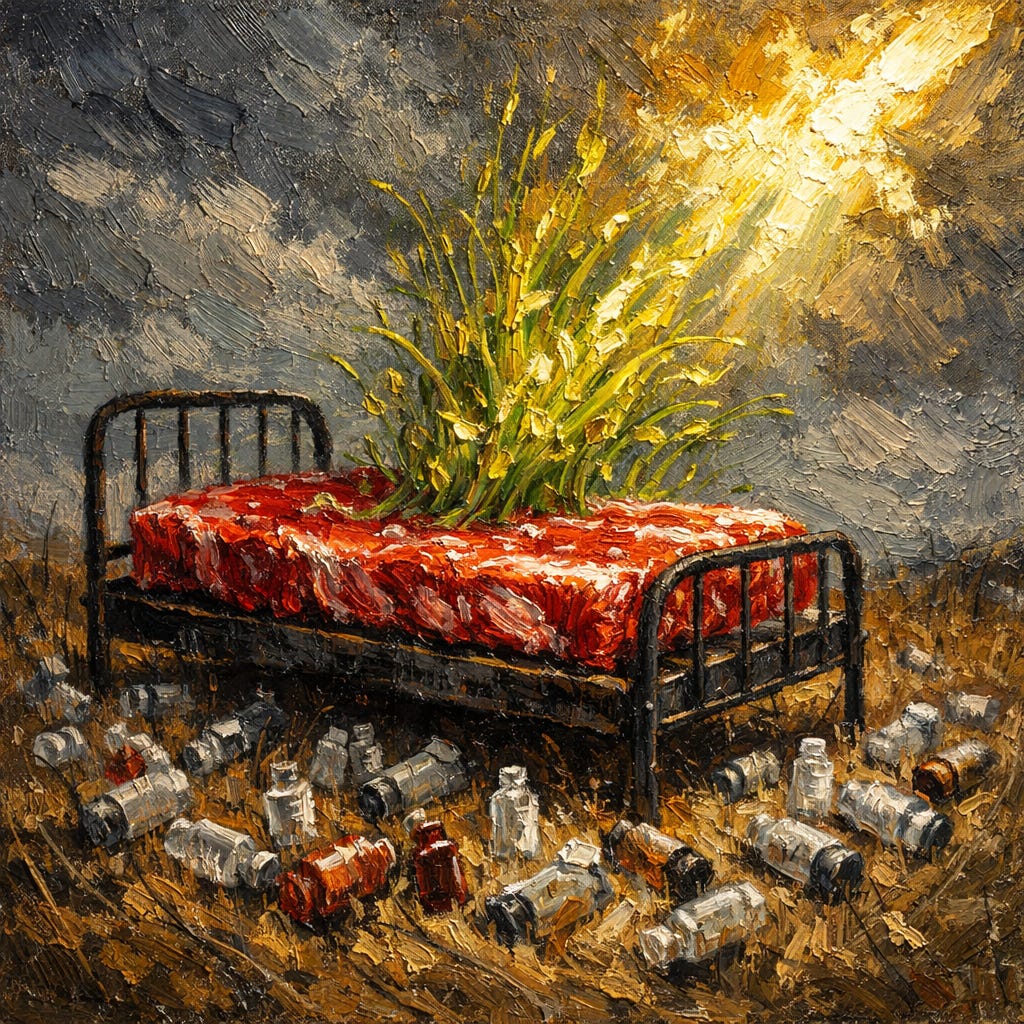
In the 1880s, an Englishwoman named Elma Stuart had been bedridden for nine years. She had consulted forty-three physicians across multiple countries. Not one of them restored her health.¹ The cure did not arrive from a hospital or a specialist. It arrived through a newspaper advertisement for a book by an American Civil War physician named James Henry Salisbury, who believed that most chronic disease originated in the gut — in the fermentation of starchy and sugary foods inside the digestive tract.²
Stuart adopted Salisbury’s dietary protocol. Within a year, she was well. She then spent the rest of her life writing about it.
Her book, What Must I Do to Get Well? And How Can I Keep So?, went through at least thirty-two editions between the mid-1880s and the turn of the century.³ The 25th edition, published in 1898, runs to nearly 400 pages of detailed instruction, personal testimony, clinical observation, and argumentation — written, as Stuart put it, “for the People, the so-to-speak, uninitiated — not for scientists.”⁴ This was not a medical textbook. It was a patient’s field report, written by a woman who had been abandoned by medicine and found her way back through food.

Support This Work
This work remains free because paid subscribers make it possible. If you find value here, consider joining them.
Paid subscribers get access to all books — including The DMSO Book, The Kitchen Remedies Guide, Chlorine Dioxide, The PSA Trap, Breast Cancer, and more — with 1-2 new books added each month. Plus the Deep Dive Audio Library: 180+ in-depth audio book summaries and discussions.
Pricing Update: The annual subscription moves from $50 AUD to $50 USD on May 1 — the first change in five years. Current paid subscribers keep their existing rate. Free subscribers can lock in the current price by upgrading before May 1.
The Woman
Stuart was no marginal figure. For eight years she maintained a close friendship with George Eliot — one of the greatest novelists of the Victorian era. Eliot called Stuart her “spiritual daughter.” Stuart’s tombstone at Highgate Cemetery, where they are buried side by side, reads: “whom for 8½ blessed years George Eliot called by the sweet name of ‘Daughter.’”⁵ Before her illness, Stuart lived in Dinan, France, where she was known as a skilled woodcarver and artisan.⁶
None of this protected her when chronic disease arrived. What struck her down would today most likely carry the label of fibromyalgia or chronic fatigue syndrome — conditions that modern medicine still cannot reliably diagnose or treat. Stuart’s description of her suffering is precise and unsparing. She writes of years of “eating her bread with tears” and “lying weeping on her bed through the long night hours in grief and pain.” She recalls being “supernaturally sensitive” to cold, sitting wrapped in furs on the hottest summer days, shivering at every breath of air, fleeing at the sight of an open window.¹
Forty-three doctors. Nine years. No relief.
The Treatment
A neighbour helped Stuart begin the Salisbury protocol — purchasing, grinding, and cooking all of her meals every day for seven months, until Stuart was strong enough to manage it herself. The meat was purchased daily, from animals slaughtered that morning, and ground fresh before cooking.⁷
The treatment rested on two pillars: lean minced beef and hot water. But Stuart is emphatic that people who reduce it to those two words have understood nothing. “Many persons seem to imagine that when they have said ‘mince and hot water’ they have polished off in a word the whole Salisbury treatment,” she writes. “They were never more at sea in all their lives.”¹
The Salisbury system was comprehensive. It governed what was eaten, when, how, and how much. It specified cooking methods with extraordinary precision. The mince must be beaten and stirred without ceasing, never allowed to remain on the bottom of the saucepan, cooked slowly over gentle heat for thirty to thirty-five minutes until it reached the consistency of “nice, soft, smooth putty.” Too firmly pressed and it tastes livery. Cooked too hot and it goes hard and granular. Stuart developed her own preparation methods over years of trial and error, eventually declaring: “I challenge the world to produce so perfect a food, one fit to tie its shoes, one any way near my Mince.”¹
Hot water was drunk in pints — four per day — at specific intervals: one and a half hours before each of the three meals, and again three or more hours after the last meal, always on an empty stomach. Stuart catalogues nine therapeutic functions for the hot water: washing out the stomach, stimulating the liver, promoting urine flow, driving peristalsis, liquefying the blood, clearing uric acid from joints, lightening the labour of the heart, soothing the nerves, and — “O boon unspeakable!” — inducing sound, refreshing sleep.¹
Beyond diet, the system demanded rest before and after meals, avoidance of worry during digestion, cheerful surroundings at the table, and a ban on reading while eating — “or the brain will steal from the stomach that which is required for the digestive processes.” Stuart insists that “the Alpha and Omega of this whole system” is that the doctor does not cure. Nature does. The patient’s resolution, intelligence, and perseverance determine the outcome.¹
The Theory of Disease
Salisbury believed that starchy foods, sugars, and fruits fermented inside the digestive tract, producing carbonic acid gas and other toxic byproducts that were absorbed into the blood and, over time, poisoned the organs. “The constant and long-continued fermentation of vegetable food, fruits and sweets in the stomach and bowels keeps the digestive organs all the time filled with carbonic acid gas,” he wrote.² He argued that human dentition demonstrated a primarily carnivorous design, and that the stomach was built for digesting lean meats.⁸ His prescription followed: remove the fermenting inputs, feed the body what it can actually process, flush the accumulated toxins with hot water. Medicines were beside the point: “Remember that medicines cure nothing; they simply aid in keeping the human machine in good running order while rigid and careful alimentation is effecting the cure.”¹
Stuart tested this against vegetarianism and fruit-eating through her own repeated experiments. After introducing fruit as a daily habit, “the speedy deterioration in the passages and blood as shown by the microscope, was very remarkable.” Neuralgic and rheumatic pains returned. Joints swelled. Sleep deteriorated. All symptoms vanished when the fruit was stopped, and “invariably reappeared when it was commenced as a habit.”¹
What Stuart Witnessed
The book is not merely personal testimony. Stuart became a lay practitioner of the Salisbury system, guiding patients through treatment by correspondence, requesting samples of their blood and secretions for microscopic examination, and catching dietary violations through these tests. She tells of writing to a distant patient that he was taking sulphur in some form. He wrote back astonished: “yes, I have taken for the last 3 years, by my doctor’s orders, a large sulphur lozenge every night of my life.” She tells of identifying strawberries in a patient’s samples before the patient remembered eating them. “The microscope,” Stuart notes, “was always very kind in supplying any little omission of the patient’s, and it had an excellent memory.”¹
She describes patients crippled by rheumatism recovering full mobility. Epileptics, taken off cereals and vegetables and fed on lean meats, “entirely overcame the fits.” She presents the treatment as effective against diabetes, consumption, Bright’s disease, gout, asthma, eczema, neuralgia, heart disease, and more. One testimony records a woman calling the book “my Life-preserver.” Another claims it is “working a revolution in medical and health questions, and is carrying health and hope where aforetime there was illness and despair.”¹
Stuart’s own recovery is the centrepiece. The woman who once sat wrapped in furs on summer days, terrified of open windows, eventually slept with windows open year-round, walked out in snow, and declared herself hardier than anyone she knew. Her complexion was smoother than in her first youth. Her capacity for work was enormous. She describes herself as “a pretty good advertisement” for the treatment.¹
The book’s voice is one of its real treasures. Stuart writes with energy, humour, and ferocity toward the medical profession’s refusal to engage with the evidence. When two doctors on a library committee had her book rejected and refused to give their names, she noted that “my little book never had so fine a compliment paid it as that ignominious kick-out from two pairs of medical boots.” When people told her they were “perfectly healthy” while suffering from indigestion and neuralgia, she offered half a crown for anyone who could name a single acquaintance in genuinely perfect health. “I have not yet been called upon to pay up.”¹
1898 Meets Today
The specific biochemistry Salisbury proposed — carbonic acid gas poisoning from fermenting starches — is not how contemporary science would frame the mechanism. But the core observation beneath his theory keeps resurfacing.
The carnivore diet community traces part of its lineage directly to Salisbury and Stuart.⁹ People eating exclusively animal products today report the same pattern Stuart documented over a century ago: resolution of autoimmune conditions, chronic pain, digestive disorders, and neurological symptoms through the elimination of plant foods. The Salisbury diet is recognised as an early version of the carnivore diet.¹⁰
Stuart was bedridden for nine years. She saw forty-three doctors. Not one asked what she was eating. Today, chronic fatigue syndrome still has no approved treatment and no laboratory test for diagnosis. Up to 80% of cases remain unrecognised.¹¹ Fibromyalgia patients are still handed pamphlets and told to prepare for a lifetime of pain.¹² Obesity affects 42% of American adults — more than double the rate in comparable nations. Diabetes prevalence has increased 26% in a decade. Chronic conditions account for eight of the ten leading causes of death in the United States.¹³
These are metabolic, autoimmune, and inflammatory conditions — the same categories Salisbury was treating with beef and hot water in the 1880s.
Stuart saw the resistance in her own time. She wrote that she saw “plainly and fearlessly that there exists therein at present much blameworthy and obstructive intolerance born of prejudice and of ignorance (of the true causes of disease), crying loudly for redress.”¹ The studies that would definitively test long-term elimination diets against chronic disease have never been funded. The absence of that evidence is not evidence of absence. It is evidence of a question that nobody with funding authority wanted asked.
That you have almost certainly never heard of this book — despite its dozens of editions, its detailed clinical observations, and its direct relevance to conditions afflicting tens of millions of people — says something about how medical knowledge actually moves through time. What gets remembered is not always what worked. What gets forgotten is not always what failed.
Near the end of the book, Stuart writes: “One cannot, as I have done, go in at one end of a sausage machine, and come out at the other exactly as one went in; — if one did, one would promptly require putting through again.”
She went in sick. She came out well. She spent the rest of her life telling anyone who would listen exactly how.
I was put onto this book by Dr. Marizelle | Undiagnosed.

References
Stuart, Elma. What Must I Do to Get Well? And How Can I Keep So? 25th ed. Wokingham: The Author, 1898. Available via Internet Archive (identifier: whatmustidotoge00stuagoog).
Salisbury, James Henry. The Relation of Alimentation and Disease. New York: J.H. Vail & Co., 1888.
“Elma Stuart.” National Portrait Gallery, London.
Stuart, What Must I Do to Get Well?, Preface to the Fourth Edition.
“Elma Stuart (1837–1903).” George Eliot Archive, edited by Beverley Park Rilett.
“Elma Stuart.” Exploring Eliot, 24 May 2021.
“What Must I Do to Get Well? by Elma Stuart.” Zero Carb Zen, 18 May 2015.
“The Allure of All-Meat Diets.” Food, Fatness and Fitness, 8 November 2016.
“What Must I Do to Get Well? by Elma Stuart.” How to Carnivore Blog, 8 March 2024.
“James H. Salisbury.” Wikipedia.
Scheibenbogen, C. et al. “Myalgic Encephalomyelitis/Chronic Fatigue Syndrome — Evidence for an Autoimmune Disease.” Autoimmunity Reviews 17, no. 6 (2018): 601–609.
“Chronic Conditions in America: Price and Prevalence.” RAND Corporation, 2017.
“How Has the Burden of Chronic Diseases in the U.S. and Peer Nations Changed Over Time?” Peterson-KFF Health System Tracker, 2025.
From my personal experience: carnivore may not work for everyone, and it most certainly did not work for me. I was on carnivore for 15 months and, by the end, looked like hell…and felt much worse. I gained 25 pounds, was heavier than ever before in my life, bloated with terrible digestion, and was nearly immobilized by fatigue and chronic joint pain. I then stumbled onto Dr. Peter D’Adamo’s Blood Type Diet. Bottom line up front: we’re not all the same (shock!). The Blood Type Diet accounts for our distinct differences in a way I had not encountered before. What I learned to my chagrin is that, as a Blood Type A, carnivore is catastrophic to my metabolism…and my experience validated that in spades. By switching to a more “plant forward” diet appropriate to my blood type, I experienced near-immediate, profound improvements in my health. I’ve been on Blood Type Diet for six months, have lost 30 pounds (the first 20 in four weeks), my BMI dropped from 25.6 to 22.0, at 68-years old I’m able to move again and I can do a daily 30-minute workout, as well as walk briskly three-to-five miles daily, and—most importantly—I feel SO much better. For the record, I sincerely believe that carnivore can and does work…if you are Blood Type O. See D’Adamo for more.
Interesting. I know of one person who consumes nothing but beef and water and proclaims this as her way to health. I have read Weston Price, but it did not strike me, that he promoted an all-meat diet. What I understood was, that we should eat what our ancestors ate. For 100+ years my ancestors ate potatoes and vegetables grown in their own yard, with very little meat, usually some bacon, bought raw, and cooked until tender. Grandfather spread the fat on bread. Of course this was before the boom of fattening products for pigs. I remember how different the bacon piece looked from what is now sold in stores. Hormones, vaccines, and recently GMO pigs from Canada, now allowed to be sold in the US.
As to the medical Mafia, they exactly remember what helps, and they forbid it!