

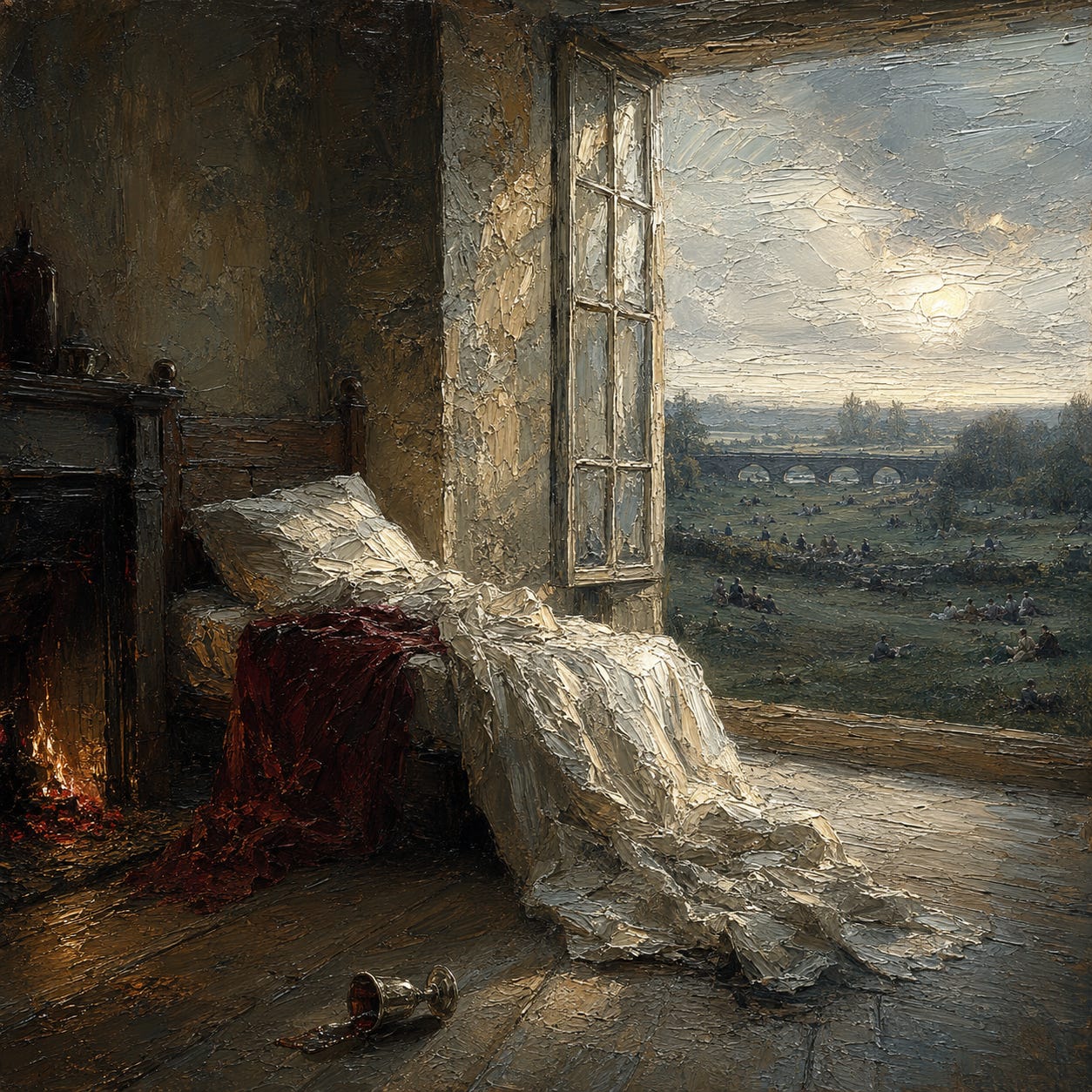
One hundred and fifty smallpox patients were carried out of Blandford into the fields on the night of June 4, 1731, when fire drove them from their beds. They lay under hedges and bridge arches for several days and nights in the open air. Only one died, a young woman already nearly expiring when she was moved. Thirty-five years later, in the same town, physicians treating an inoculation of three hundred and eighty-four patients closed the windows, stoked the fires, gave cordials, and lost thirteen. Every one of the thirteen was a paying patient. Of the one hundred and fifty parish poor inoculated in the same operation — patients who could not afford to demand the warm regimen — not one had the confluent form, and not one died. George Baker’s An Inquiry Into the Merits of a Method of Inoculating the Small-Pox, published in London in 1766, sets these two Blandfords beside one another and lets the arithmetic speak.
Baker wrote as Physician to Her Majesty’s Household and a Fellow of the Royal Society, positions of the highest professional standing available to an English physician of the period. He came to the subject through inquiry rather than advocacy — he had heard surprising reports of the operators working in several counties, and he set out to find what they were doing. His method throughout is documentary. He prints an eyewitness account by a friend who attended the operator’s house during his own child’s inoculation. He appends a letter from a clergyman whose three children were inoculated in the same house. He includes Dr. Pultney’s diagnostic letter on the Blandford failure, dated from Blandford itself in June 1766. He traces Sydenham across four successive editions of the Methodus Curandi Febres with Latin quotations at the foot of the page, showing a mind moving under experience rather than under theory. The pamphlet is short, roughly sixty-eight pages in small format, and every substantial claim carries a citation or a named witness.
At mid-century the treatment of smallpox in England was governed by a doctrine that had held for a hundred years: the poison must be driven from the heart to the skin by cordials, and its retrocession from the skin prevented by keeping the patient in close and heated air. Practitioners sealed the windows, banked the fires, piled on blankets, and administered spirits. The doctrine had the authority of Riverius and the long weight of nursing tradition behind it, and Sydenham had noted repeatedly that even physicians who knew better were forced to yield to it under pressure from families and nurses. Against this stood the inoculation operators — unlicensed men working outside the faculty, one of them practicing in the country town where Baker’s friend attended — who by 1766 had inoculated some seventeen thousand people with five or six deaths, using cold water during fever, forced walking outdoors during eruption, and open windows throughout. The success ran contrary to the theoretical account of what smallpox required. The Blandford disaster of April 1766 gave the warm-regimen party its opening to attack inoculation. Baker’s pamphlet was written to establish, from the documentary record, that the disaster indicted the warm regimen and not the practice.
The full summary unpacks the operator’s technique in detail — the two-week milk-and-vegetable preparation, the secret nightly powder that gave patients sore gums and salivated them, the moist lancet raising only the cuticle, the striking use of clear fluid from a donor’s arm taken before any pustule had formed on the donor. It follows Baker through the convergent revival cases: the young man at Bristol laid out on a table as dead; Mrs. Broderep’s servant in Ormond Street, taken for a corpse, placed by an open window in a shirt, who beckoned with his hand within the hour to prevent the attendants from putting him down again; the one hundred and twelve people inoculated in the northern Scottish isles in the middle of winter, some barefoot in snow, none dead. It examines the internal comparison at Blandford — the one hundred and fifty parish poor inoculated free of confluent disease, the thirteen paying patients dead — and Sydenham’s own Latin observation that the poor are spared because they scarcely have the opportunity to harm themselves. The doctrine that killed the thirteen at Blandford was the doctrine the Blandford fire of 1731 had already refuted, and the town had spent thirty-five years not learning what its own streets had shown it.
The rest of this summary — the analogy, one-minute elevator explanation, 12-point summary, Q&As, and Golden Nugget — is for paid subscribers.
Your subscription also unlocks every other book summary in the library, the Deep Dive Audio Library, my original books (new ones added monthly), and three series for the moments when a real decision is in front of you: Questions for Your Doctor, Before You Consent, and Package Inserts.