

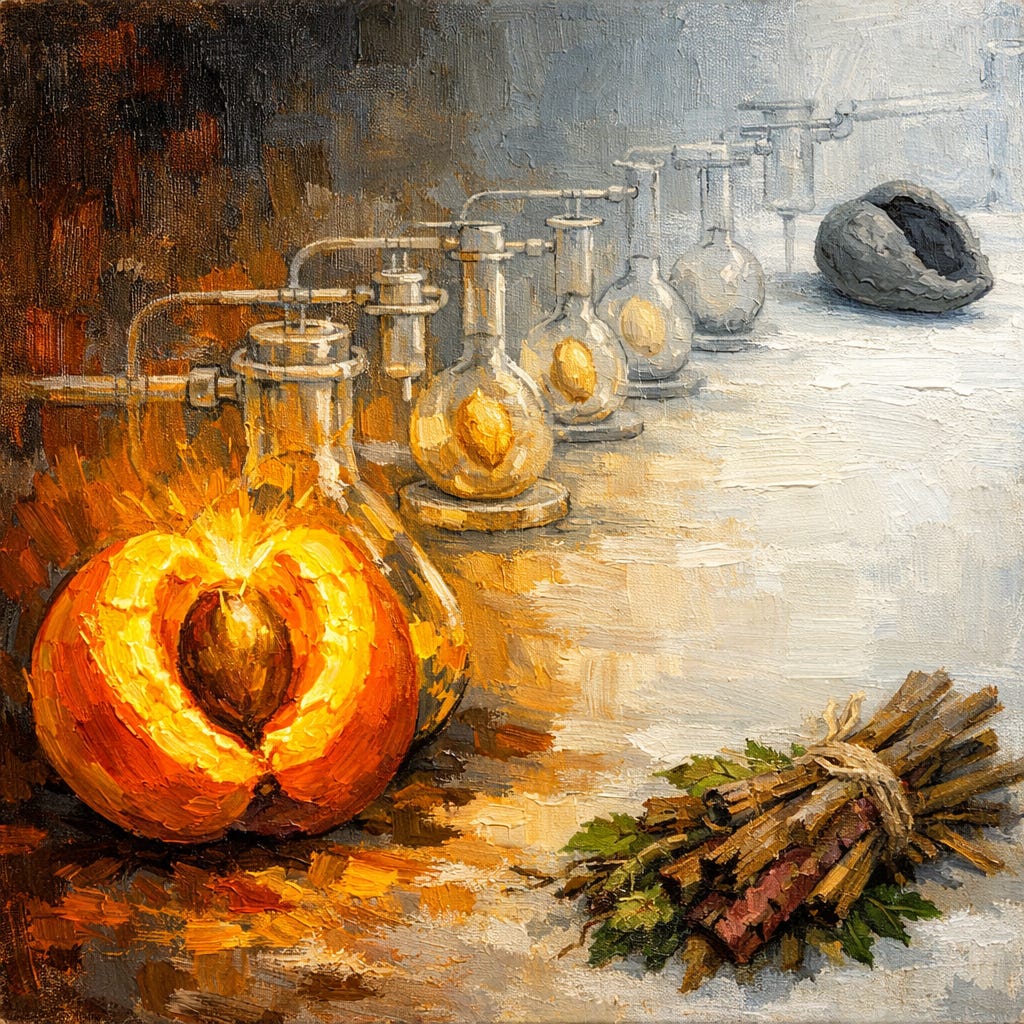
Preparations containing amygdalin — the compound later isolated from apricot kernels and named “vitamin B17” — appear in the medical record as far back as the first and second centuries AD. Emperor Shen Nung catalogued bitter almonds in the earliest Chinese pharmacopoeia. Celsus, Galen, Pliny the Elder, and Scribonius Largus all documented therapeutic uses of amygdalin-rich foods. Avicenna included them in medieval Arabic medicine. Peking man is thought to have eaten fruit kernels rich in the substance. For most of recorded history, nobody thought to ask what the “active ingredient” was. People ate the food, and the food was the medicine.
The modern chapter begins with the Hunzakuts, a population living in a mountainous kingdom near Pakistan, reported to be virtually free of cancer. Apricots and apricot kernels formed a staple of their diet to a degree unparalleled elsewhere in the world. The observation was documented by Leaf and Launois (1975) and Renee Taylor (1960), among others. Ralph Moss, in his exposé The Cancer Industry, noted that “a great deal of nonsense has been written about this ‘paradise’ principality,” some of it romanticising semifeudalism — but the observation itself, apricot kernels as dietary staple and low cancer incidence, he treated as legitimate and worth investigating.
Dr. Tom Cowan raised both apricot seeds and Essiac tea on his March 4, 2026 webinar, tracing the history from the Hunza observations through the Sloan Kettering scandal and his own decades of clinical experience. He ate three to four bitter apricot seeds daily for years. He recommended Essiac tea to patients with serious illness and watched many of them improve. But his deeper contribution was framing both medicines within a question that the medical establishment has spent half a century avoiding: why does a whole food that works get turned into an isolated compound that doesn’t?
It was investigated. What followed is a case study in how a natural medicine gets destroyed — not by proving it doesn’t work, but by redesigning the test so that it can’t.
Support This Work
This work remains free because paid subscribers make it possible. If you find value here, consider joining them.
Paid subscribers get access to all books — including The DMSO Book, The Kitchen Remedies Guide, Chlorine Dioxide, The PSA Trap, Breast Cancer, and more — with 1-2 new books added each month. Plus the Deep Dive Audio Library: 180+ in-depth audio book summaries and discussions.
Pricing Update: The annual subscription moves from $50 AUD to $50 USD on May 1 — the first change in five years. Current paid subscribers keep their existing rate. Free subscribers can lock in the current price by upgrading before May 1.
The Observation
The clinical evidence for apricot kernels and their derivatives accumulated steadily across more than a century. In 1844, the Russian physician Fedor Inosemtzeff treated a cancer patient with amygdalin for several months; the patient was declared cured. Arthur Harris reported in 1962 that of 82 patients treated between 1951 and 1953, three were alive and disease-free ten years later, twenty-four were alive with cancers under control, and fifty-five received temporary palliative benefit. John Morrone, also in 1962, documented dramatic relief of pain in ten cancer patients, with effects suggesting regression of the malignant lesion. Ernesto Contreras, working from Tijuana, claimed sixty-five percent of patients received some benefit, with approximately five percent of terminal patients “actually saved” — modest claims, honestly reported, never published in formal scientific journals.
The National Cancer Institute itself conducted a retrospective case review in 1978. Of twenty-two evaluable cases, two showed complete responses, four showed partial responses, nine showed stabilised disease, and three showed increased disease-free intervals. Eighty-two percent appeared to have had a beneficial response.
A critical detail often lost in the laetrile controversy: the treatment was never intended as a single substance. Moss documented this explicitly. Laetrilists, he wrote, “are not just advocating a single substance but, like the advocates of other unorthodox therapies, are proposing a new kind of treatment for the patient’s body and mind.” The laetrile protocol included whole apricot kernels and laetrile-rich foods — chickpeas, lentils, lima beans, mung bean sprouts, cashews, brown rice, millet, among roughly 1,200 different plants. It included pancreatic enzymes following the theory of Krebs Jr. and Beard, megadoses of vitamins A and C, selenium, the Contreras diet (which forbade alcohol, coffee, soft drinks, white bread, canned foods, and encouraged whole grains, fresh fruits, vegetables, herb teas), and holistic psychotherapy.
The observation was real. The food worked within a context. The question was what would happen when that context was stripped away.
The Sloan Kettering Chapter
In the fall of 1972, Memorial Sloan Kettering Cancer Center began testing laetrile. The request came from Benno Schmidt, head of the President’s Cancer Panel. The researcher assigned to the work was Kanematsu Sugiura.
Born in Japan in 1892, Sugiura had been brought to America in 1905 by railroad tycoon E. H. Harriman as part of the first jiu-jitsu team to tour the United States — they performed at the White House for Teddy Roosevelt. He stayed in America, began cancer research in 1912, and joined Memorial Hospital in 1917. By the 1970s he had completed over sixty years of uninterrupted cancer research and published more than two hundred papers. His superior, C. Chester Stock, wrote of him: “Few, if any, names in cancer research are as widely known as Kanematsu Sugiura’s.” A visiting Russian investigator said: “When Dr. Sugiura publishes, we know we don’t have to repeat the study, for we would obtain the same results he has reported.” In 1960, Emperor Hirohito awarded him the Order of Sacred Treasure, third class.
This was the most credible researcher the institution could have assigned to the question.
Earlier tests on transplantable tumors had shown nothing. Sugiura was given mice with spontaneous breast cancers — more clinically relevant models. His findings, recorded in a taped interview with Moss in 1974: small tumors saw growth temporarily halted for one to three weeks. Large tumors showed no effect on primary growth. But the critical result was in metastases. In untreated mice, approximately eighty percent developed lung metastases. In laetrile-treated mice, approximately twenty percent. A sixty-percentage-point reduction.
Treated mice appeared healthier and “friskier” than controls. No toxicity was observed — mice received doses as high as eight grams per kilogram per day, equivalent to roughly a pound a day for a human, with no acute or chronic toxic effects. In prevention experiments using mice from strains that develop cancer in eighty to eighty-five percent of cases during their lifespan, the results at eighteen months: controls had fifteen tumors out of thirty mice (fifty percent); laetrile-treated had six tumors out of thirty mice (twenty percent).
Sugiura was not alone. Lloyd Schloen reproduced his results in Swiss albino mice. All mice on the highest dose were healthy at sacrifice; all lower-dose and control mice were sick. In one small experiment combining laetrile with an enzyme — following Hans Nieper’s method — Schloen achieved one hundred percent cures. Elizabeth Stockert achieved twenty-five percent cures with a laetrile-enzyme combination. Franz Schmid, working collaboratively with Sugiura, confirmed the metastasis reduction: eighty percent in controls, forty-four percent in treated mice by Schmid’s count, thirty-eight percent by Sugiura’s, thirty-one percent by the Memorial Hospital Pathology Department’s independent reading.
Four researchers at the same institution, using different methods and different evaluators, all showing the same direction of effect.
The Burial
What happened next followed a pattern that anyone familiar with institutional science will recognise.
In the summer of 1973, Sugiura’s results leaked from Sloan Kettering and were used in a court case defending a laetrile practitioner. Robert Good, the institution’s president, initially expressed an open-minded attitude. In November 1973, Sloan Kettering sent Schloen to an international medical congress in Baden-Baden to report the positive findings. Every hour on the hour, Schloen received telephone calls from the institution instructing him to remove material from his presentation. There was not much left when he finished.
In January 1974, Arthur Holleb, executive vice president of the American Cancer Society, wrote to Good. Holleb’s letter, found in ACS files, said: “I wish I knew how one could better control the unfortunate and premature publicity which links my distinguished alma mater to the promotional side of these unproven methods.” The ACS was contributing approximately one million dollars per year to Memorial Sloan Kettering. The institution was running a five million dollar deficit.
On January 10, 1974, Good declared: “At this moment there is no evidence that laetrile has an effect on cancer.” Sugiura’s results had not changed.
What followed was a cascade of false public statements, each drawing authority from the institution’s enforced silence. FDA Commissioner Alexander Schmidt: “If there was one shred of evidence from animal or cell systems I would issue an IND.” NCI Director Frank Rauscher, on 60 Minutes: “Unfortunately, there’s no evidence at all.” Charles Moertel of the Mayo Clinic: “Extensive animal tumor studies conducted independently at two outstanding cancer research centers — New York Memorial Sloan-Kettering and the Southern Research Institute — have shown this drug to be totally without evidence of anticancer activity.” Every one of these statements was made while Sugiura’s positive data existed in the institution’s own files.
On July 2, 1974, a meeting took place at FDA headquarters — later obtained via the Freedom of Information Act. Good, Old, Stock, and Thomas were present alongside FDA and NCI leaders. Lloyd Old presented Sugiura’s data with charts. Agreements were reached: Sloan Kettering and the NCI would consider clinical trials; no regulatory barriers existed to studying amygdalin in humans; the FDA would “publicly endorse good research on amygdalin as in the public interest.” None of these agreements were honoured.
Two attempts were made to construct “blind” tests that would settle the matter. Both ended in controversy.
In the first, conducted at Daniel Martin’s Catholic Medical Center, Sugiura correctly identified which groups were treated and which were controls. Stock initially confirmed Sugiura was right. The administration then declared the experiment “invalid as a blind test” because “we’ve lost the blindness aspect of it.”
In the second, conducted at Sloan Kettering itself, treated and untreated animals were placed in the same cages. Sugiura had objected beforehand — he feared technicians would mix up injections, and that coprophagous control mice would ingest amygdalin from treated cagemates’ feces. The results showed anomalous tumor stoppages in the control group — forty percent versus twenty-seven percent in the treated group, the reverse of expectation. Sugiura’s assessment: “There’s something funny here.”
On June 15, 1977, Sloan Kettering held a press conference. One hundred reporters and half a dozen film crews attended. Good, Thomas, Stock, Martin, and eight other scientists sat on the dais. The official line: “Laetrile was found to possess neither preventive, nor tumor-regressant, nor anti-metastatic, nor curative anticancer activity.”
The first question from the floor went to Sugiura. “Do you stick by your belief that laetrile stops the spread of cancer?”
Sugiura: “I stick.”
Copies of the actual Sloan Kettering paper were stashed behind a curtain in an adjoining room and given to reporters only if they explicitly asked. A handful did.
On November 18, 1977, a group called Second Opinion — formed among Sloan Kettering employees who had been leaking Sugiura’s notes to reporters — held a press conference at the New York Hilton. They released a forty-eight-page report documenting errors in the institution’s paper, all of which “always seemed to be made to the detriment of laetrile and of Dr. Sugiura.” Ralph Moss identified himself publicly.
On November 19, 1977, Moss was fired. The official statement said he had failed “to properly discharge his most basic job responsibilities” — meaning, as he later wrote, “to collaborate in falsifying evidence.”
Sugiura wrote to the Second Opinion group: “Your critical review of my positive results and negative results of three investigators at Sloan-Kettering Institute is very well done and accurate. Please accept my sincere congratulations.”
By 1979, reporters seeking to interview Sugiura were told by him: “I am not allowed to talk about laetrile.” A few months later he was dead, at eighty-seven.
The Paper’s Errors
Second Opinion’s report identified a specific fabrication in the Sloan Kettering paper. The paper claimed that eight orthodox chemotherapy drugs were active against Daniel Martin’s mouse breast cancer model, making laetrile’s supposed failure “particularly significant.” Martin’s own earlier published papers, from 1970 to 1975, told a different story: “Cure has thus far been impossible to achieve by chemotherapy alone on large primary tumors. Hence, this most difficult methodology has been largely shelved.” Nineteen drugs and two immune-stimulating agents were described in his own publications as “quite resistant to influence by chemotherapy alone” and “ineffective in this spontaneous tumor system.”
A method that Martin himself had abandoned as useless had been taken down from the shelf specifically to test laetrile.
Stock’s response to the New York Times: “We accepted the statement from Dr. Martin as submitted. I did not check the original publications to be certain of the appropriateness of the statement. It should not have been used in the context of this report, and therefore it has been deleted.”
The president of the New York Academy of Sciences stated that the “misinterpretation by Dr. Martin was not excusable.”
The Reductionist Pipeline
The Sloan Kettering episode demonstrates how institutional power suppresses inconvenient findings. The next stage of the destruction operates through a different mechanism — one that looks like science rather than politics.
The mechanism is reductionism. It works like this: observe a whole-food benefit, then ask “what’s in it?” Identify a single compound. Synthesise it. Test the synthesised compound in isolation. When it fails — or performs far less impressively than the whole food — declare the original observation discredited.
Moss identified the critical distinction at the heart of this process. “Apricot pits are not ingredients of laetrile,” he wrote. “If anything, laetrile is an ingredient of apricot pits (kernels), which also contain other substances, such as enzymes, not found in purified amygdalin. (The whole kernel contains only 2 to 4 percent laetrile.)”
Each step away from the whole food introduces degradation. Ernst Krebs Jr., who first isolated laetrile, observed that commercial laetrile products — racemic mixtures — were less than one-third as effective as his original laevo-rotatory form. Moss noted this was “more than a quibble, as many substances are biologically active only in their left- or right-turning forms.” From whole kernel to crude extract to purified compound to commercial racemic mixture to synthetic product, the trajectory is one of progressive loss.
Harold Manner, chairman of biology at Loyola University Chicago, provided the experimental demonstration. He tested laetrile in combination with vitamin A and enzymes on mice with spontaneous mammary tumors. Laetrile alone produced no appreciable effect. The triple combination — laetrile, vitamin A, and enzymes — produced total regressions in seventy-six percent of cases, thirty-eight of fifty mice. The whole-food insight survived in Manner’s design: synergy among multiple components vastly outperformed the isolated compound. The medical establishment attacked Manner vigorously. Orthodox cancer researchers, Moss noted, “never availed themselves of the opportunity to refute his claims by reproducing his tests.”
The pipeline reached its terminal stage with the NCI/Mayo clinical trial of 1980–1981 — the trial that was supposed to close the book on laetrile. Charles Moertel of the Mayo Clinic was in charge. One hundred and seventy-eight patients with advanced cancer were enrolled, of whom one hundred and fifty-six were evaluable. Fifty percent progressed within one month. Ninety percent within three months. Fifty percent were dead before five months.
The results were widely reported as definitive proof that laetrile was worthless. The design of the trial received less attention. Sixty-six percent of patients had already received chemotherapy — damaging the immune mechanisms that the laetrile protocol was designed to support. Laetrile advocates disputed whether the substance tested was genuine amygdalin; the Committee for Freedom of Choice offered to provide free laetrile for the trial, and the offer was refused. Most critically, laetrile was tested alone — not as part of the holistic protocol of diet, enzymes, vitamins, and psychotherapy that constituted actual laetrile therapy as it had always been practised.
The pipeline, completed: observe benefit in whole-food context → isolate single compound → test it alone, outside its original context → declare it doesn’t work → retroactively discredit the original observation.
And underneath the pipeline, a circular logic that Moss identified with precision: refuse to test → declare untested → classify as unproven → use the “unproven” label to justify continued refusal to test. The FDA classified laetrile as a “new drug” despite centuries of documented use. The ACS maintained an “Unproven Methods” list that functioned as a blacklist. Judge Bohanon, ruling on the matter, observed “a disconcerting dearth of actual experience with the substance by such detractors” and noted that the issue remained “largely unresolved... in large part because FDA has prevented adequate testing on humans.”
The Epistemological Root
Tom Cowan, discussing apricot seeds on his March 2026 webinar, arrived at the same place through a different route. He ate three to four bitter apricot seeds daily for years. He recommended cancer patients eat between three and six. But he was explicit about what he was not doing: he was not taking “vitamin B17.” He was eating a whole food.
This distinction carries the full weight of his epistemological framework. In his 2026 New Year’s webinar, Cowan laid out the position directly: “I don’t eat oysters because they have zinc. I either eat oysters or don’t, and it turns out, I like to eat oysters because I think they’re a good food.” The same logic applied to apricot kernels. The question “what chemical does it contain?” belongs to a framework that assumes living things are reducible to their chemical constituents — and that framework, Cowan argues, is the foundational error.
He went further: “These bonds and these structures that we’re told make up living things, these are constructions of the mind. They are hypothetical stuff which we somehow have come to believe make up living beings. And I think living beings are made of energy and earth, water, air and fire, and not these hypothetical chemicals.”
From within this framework, the failure of isolated laetrile is not merely predictable — it is inevitable. A whole food operates as an irreducible totality. The apricot kernel contains amygdalin and enzymes and fats and fibre and compounds that have not been named, all functioning in relationships that cannot be captured by isolating any single element. Extracting amygdalin from the kernel is like removing a single instrument from an orchestra and expecting it to reproduce the symphony.
The reductionist pipeline does not fail because of bad execution. It fails because its foundational assumption — that the part explains the whole — is wrong. And this produces a secondary effect that may be more consequential than the primary failure: each time an isolated compound fails to perform, the failure is attributed to the original medicine rather than to the process of isolation. The whole food is discredited by the failure of its fragment. The pipeline functions as destruction whether or not the destruction is intentional.
Cowan’s explicit warning on the webinar was pointed: “I would never do vitamin B17, even in a pill form or certainly not IV.” His own clinical experience confirmed the pattern. He used laetrile extract from Mexico roughly thirty-five to forty years ago with cancer patients, and it “didn’t seem to do much.” The extract failed where the whole food continued to hold observational support. The terrain-theory explanation is that the whole food nourishes the body as a living system — supporting detoxification, providing synergistic compounds, working within the body’s own intelligence — while the isolated chemical does none of these things.
Essiac — The Pattern Resists
On the same webinar, Cowan turned to a second natural medicine with a different history — one that illuminates the laetrile story by contrast.
Essiac tea takes its name from the backwards spelling of nurse Rene Caisse, who practised in Ontario, Canada, in the early-to-mid twentieth century. Caisse attributed the formula to Native American medicine. The original composition was four herbs — burdock, slippery elm, red clover, and others — later expanded to eight in what practitioners consider the more complete version. The herbs were ground and prepared as a slurry, consumed at significant daily doses for three to six months.
In his interview with Jesse Chappus, Cowan described burdock specifically as “part of the Essiac formula” and identified it as “the blood cleanser — clean the poisons out of your blood.” Within the terrain framework, where cancer is understood as a toxicity problem rather than a genetic mutation, a blood-cleansing formula addresses the condition at its root rather than attacking a symptom.
Cowan reported that over the course of his career he had “personally seen and heard many stories” of people with significant illness, including cancer, who experienced “pretty dramatically improved outcomes from the very diligent use of EC.” He was careful to note that nothing works for everyone. But the pattern was consistent enough across enough cases over enough years to warrant serious attention.
Essiac’s survival may owe something specific to its resistance against the reductionist pipeline. Unlike laetrile, Essiac was never successfully reduced to a single active compound. The formula’s complexity — multiple herbs with multiple overlapping functions — defied the standard extraction protocol. No one could point to “the ingredient” and synthesise it. There was no amygdalin equivalent to isolate, test in isolation, and declare ineffective. The whole formula persisted because the reductionist approach could not get a grip on it.
This is worth pausing on. A natural medicine’s best defence against institutional destruction may be its irreducibility. The more complex the preparation — the more its effects depend on synergies among components rather than on a single identifiable molecule — the harder it is for the pipeline to process.
In early 2026, Cowan reported discovering a product from genuineec.com through a comment on one of his webinars. He assessed it as faithful to the original formula — “a sort of nasty tasting slurry” — and announced that he and his wife had begun taking it, planning to continue for at least a month and possibly six months, with the intention of reporting back on any noticeable effects. The recommendation came not from a clinical trial but from the oldest form of medical evidence: observation, accumulated experience, and personal willingness to test.
The Pattern as Principle
Two natural medicines, two trajectories. Apricot kernels were subjected to the full reductionist pipeline — isolation, synthesis, decontextualised testing, institutional suppression, formal declaration of worthlessness — despite positive results from the most credible researcher at the most prestigious cancer institution in the world. Essiac resisted the pipeline through irreducibility and persisted in practice through informal networks of patients, practitioners, and nurses.
The pattern has a structure: natural medicine shows promise → institutional science asks “what’s in it?” → a single compound is identified → the compound is tested outside its original context → it fails → the original medicine is discredited.
Sugiura himself saw the pattern. In his interview with Moss, he drew the parallel to William Coley’s bacterial toxins, which had been ridiculed for decades before the underlying principle — that polysaccharides from bacteria and mushrooms could inhibit tumor growth — was confirmed by mainstream research. “Amygdalin, too,” Sugiura said. “People now are laughing at that.”
The financial architecture reinforces the pattern without requiring conspiracy. The ACS was funding Sloan Kettering to the tune of a million dollars a year while the institution ran a five-million-dollar deficit. Bristol-Myers executives held positions as vice chairmen of the MSKCC board. The FDA’s drug review budget came predominantly from industry user fees. At the July 1974 FDA meeting, discussion turned to “cyanide-releasing drugs” that could be patented — the institutional interest in a patentable derivative rather than an unpatentable whole food. None of this requires anyone to be villainous. It requires only that institutions act according to their incentive structures, and that a reductionist framework provides the scientific cover for doing so.
The reductionist approach to natural medicine and the financial incentives of pharmaceutical institutions are not separate forces that happen to converge. They are two aspects of a single system. Reductionism provides the methodology — isolate, synthesise, patent. Financial incentives provide the motive. The “unproven methods” classification provides the enforcement mechanism. And the natural medicine, which worked as a whole food within a whole system of care, is destroyed — not by evidence against it, but by a process specifically designed to prevent evidence from accumulating in its favour.
The question the curious reader should carry forward is not “does laetrile work?” It is “why would anyone expect a synthesised fragment, tested alone in chemotherapy-damaged patients, to replicate what a whole food does within a whole system of care?”
Practical Guidance
Cowan’s recommendations follow directly from the analysis.
For apricot seeds: eat three to six whole, organically grown seeds daily, chewed and swallowed. Those with a cancer diagnosis might eat somewhat more. Cowan himself ate three to four daily for years. Do not take synthesised vitamin B17 in pill form or intravenously. The synthesised compound follows the same degradation pattern the essay has described — decreased effectiveness, increased side effects, including symptoms described as cyanide-like toxicity.
The cyanide narrative deserves direct address. Moss demolished it systematically. In 1978, an estimated fifty to one hundred thousand patients were taking over one million grams of laetrile monthly. Two, possibly three deaths occurred from accidental overdoses — in each case involving circumstances unrelated to normal oral consumption of whole seeds. The FDA’s claim that amygdalin “contains cyanide” is chemically misleading. Unless proper enzymatic conditions are met, Moss wrote, “cyanide is as firmly bound in the amygdalin molecule as a brick in a solid brick wall. One might as well state that table salt is poisonous because it contains chlorine.” Sugiura’s mice received eight grams per kilogram per day — the human equivalent of roughly a pound daily — with no toxicity whatsoever.
For Essiac tea: Cowan recommended investigating the EC formula, specifically the product from genuineec.com, which he assessed as faithful to the original preparation. The protocol involves drinking the slurry daily for three to six months. This is not a casual supplement; Cowan emphasised that the positive outcomes he observed over his career came from “very diligent use.”
The deeper principle beneath both recommendations is the one that runs through the entire history: trust the whole food. The apricot kernel is not a vehicle for delivering vitamin B17. Essiac is not a vehicle for delivering burdock extract. The medicine is the whole preparation, consumed within a context of nourishing food, clean living, and the body’s own capacity to heal. Every attempt to reduce these medicines to their isolated parts has produced the same result — diminished effectiveness and manufactured grounds for dismissal.
The history of laetrile at Sloan Kettering is, finally, a history of what happens when institutional authority encounters a medicine it cannot patent, within a framework it cannot control, producing results it cannot afford to acknowledge. Kanematsu Sugiura spent sixty years building a reputation for scientific integrity that his own institution then spent five years trying to bury. He was asked, in front of a hundred reporters, whether he stood by his results. His answer — “I stick” — is as good a place as any to end.
References
Primary Sources
Moss, Ralph W. The Cancer Industry: The Classic Exposé on the Cancer Establishment. Originally published 1980 as The Cancer Syndrome (Grove Press). Revised edition: Paragon House, 1991. Updated edition: Equinox Press, 1996. Moss was assistant director of public affairs at Memorial Sloan Kettering Cancer Center, fired November 19, 1977, for publicly associating himself with a report criticising the institution’s handling of laetrile data. All historical material on Sugiura’s experiments, the Sloan Kettering institutional response, the NCI/Mayo clinical trial, the Second Opinion report, toxicity data, and the financial architecture of the cancer establishment is drawn from this source, which includes FOIA documents, internal correspondence, taped interviews, and published papers.
Cowan, Tom. Weekly Webinar, March 4, 2026. Source for Cowan’s personal experience with apricot seeds, his clinical observations on Essiac tea, his caution against synthesised vitamin B17, and his recommendation of the genuineec.com Essiac product.
Cowan, Tom. New Year’s Webinar, 2026. Source for Cowan’s epistemological framework on whole foods versus isolated chemicals, including the discussion of vitamins as hypothetical constructs and the rejection of reductionist chemistry applied to living things.
Cowan, Tom. Interview with Jesse Chappus on cancer. Source for Cowan’s discussion of Essiac formula composition (burdock, slippery elm, red clover), burdock as blood cleanser, chaga mushroom, and the broader terrain-theory approach to cancer treatment.
Key Documents and Studies Referenced Within Moss
Leaf and Launois (1975) and Taylor, Renee (1960) — epidemiological observations on the Hunzakuts and apricot kernel consumption.
Harris, Arthur (1962) — clinical report on 82 laetrile-treated patients, 1951–1953.
Morrone, John A. (1962) — clinical report on pain relief in ten cancer patients treated with laetrile.
NCI retrospective case review (1978) — 22 evaluable cases showing 82% beneficial response.
Manner, Harold et al. (1978) — combination experiments (laetrile, vitamin A, enzymes) at Loyola University Chicago, 76% total regressions.
Moertel, Charles et al. (1981) — NCI/Mayo clinical trial of laetrile, 156 evaluable patients.
Second Opinion report (November 18, 1977) — 48-page document identifying errors in the Sloan Kettering paper on laetrile.
FDA meeting minutes (July 2, 1974) — obtained via FOIA, documenting agreements to support laetrile research that were never honoured.
Holleb, Arthur, letter to Robert Good (January 1974) — found in ACS files, expressing concern about publicity linking MSKCC to laetrile.
Bohanon, Judge Luther (1977) — 20-page ruling noting “a disconcerting dearth of actual experience with the substance by such detractors.”
Markle and Petersen (1977) — sociological analysis of the laetrile controversy as an attempt at paradigm creation.
New Biology Clinic
For those of you looking for practitioners who actually understand terrain medicine and the principles we explore here, I want to share something valuable. Dr. Tom Cowan—whose books and podcasts have shaped much of my own thinking about health—has created the New Biology Clinic, a virtual practice staffed by wellness specialists who operate from the same foundational understanding. This isn’t about symptom suppression or the conventional model. It’s about personalized guidance rooted in how living systems actually work. The clinic offers individual and family memberships that include not just private consults, but group sessions covering movement, nutrition, breathwork, biofield tuning, and more. Everything is virtual, making it accessible wherever you are. If you’ve been searching for practitioners who won’t look at you blankly when you mention structured water or the importance of the extracellular matrix, this is worth exploring. Use discount code “Unbekoming” to get $100 off the member activation fee. You can learn more and sign up at newbiologyclinic.com
It's a bit crazy that the medical industrial complex told people to avoid apricot seeds because of cyanide but then recommend some of the most toxic substances on earth(chemotherapy) as their perferred treatment for cancer. That's the money talking.
To be blunt, "Cancer" is a resource extraction and population control methodology. When you consider the promotion of early screening it becomes sinister. Wait until they automate fake DNA diagnosis, and customized RNA poisons. Frankly, life was a lot more fun before I started seeing through all the inversions.