

Author’s Note
This essay pushes the origin story of American medical monopoly back sixty-three years, from the Flexner Report of 1910 to the AMA’s founding Code of 1847. The standard critical account, including my own earlier work, treats Flexner as the moment the enclosure was drawn. The 1847 document had already drawn it. Flexner arrived to enforce what the profession’s founding charter had authorized more than six decades earlier, in language a Manchester physician had provided in 1803 for a different purpose entirely.
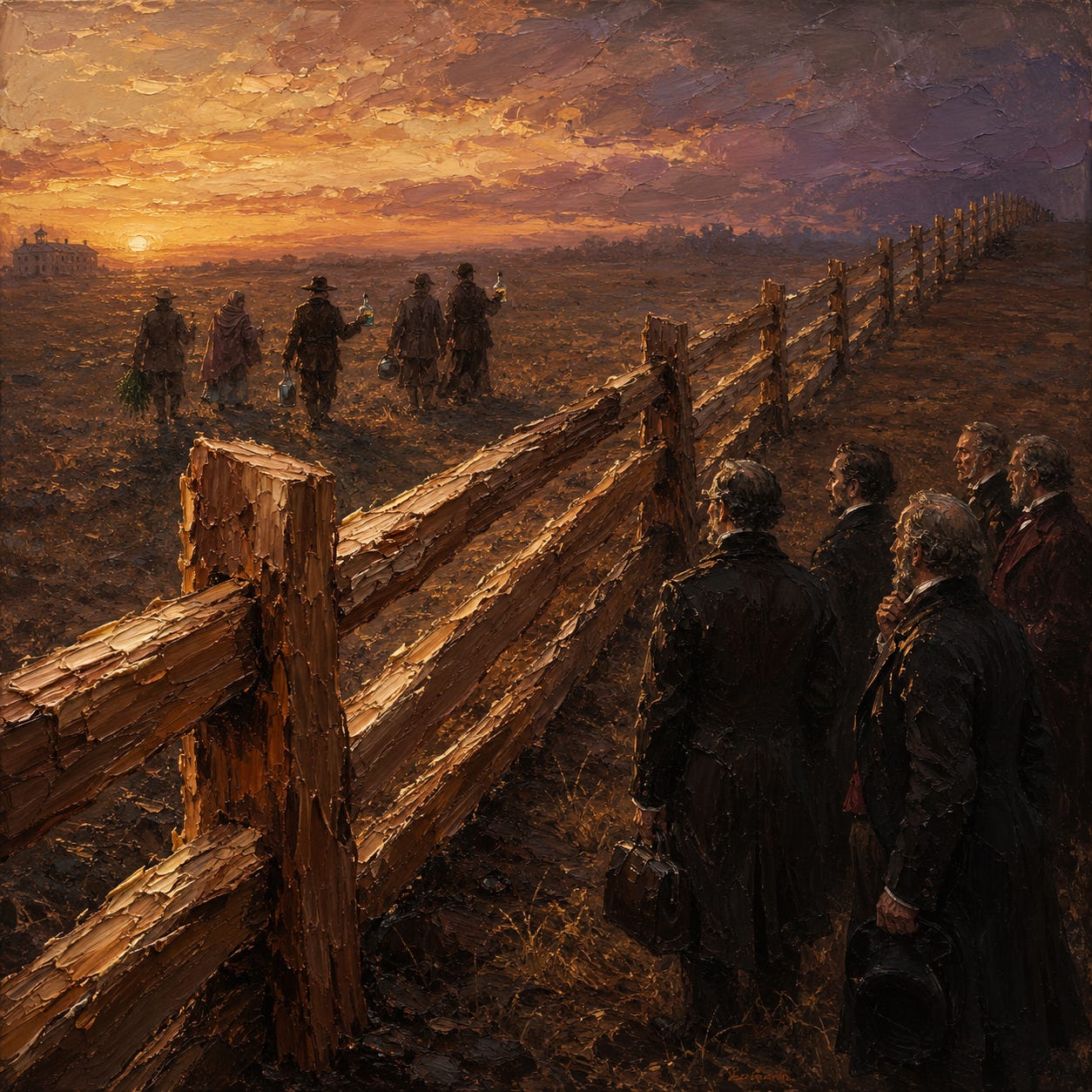
Whether the drafters believed their own vocabulary is not the essay’s concern. Enclosure acts hold their new boundaries regardless of the sincerity of the drafters. Bell, Hays, and Emerson may have written every word in earnest. The fence they drew still stands either way.
The essay compounds with Extraction: The Middle Class as Colony on the extraction system’s economic architecture, The Guards Who Love You on the professional class that carries the system’s authority into the clinical encounter, and The Gratitude of the Captured on the psychological posture the system maintains in its patients. Readers new to the body of work will find at the end a portable diagnostic they can carry into their next medical encounter.
The present essay was written in response to and building on Michael Bryant's The Cult of Modern Medical Expertise, published in August 2026 at the Health Freedom Defense Fund. Bryant traces the corporate engineering of the modern American physician from the Flexner Report forward and notes in passing that the 1847 AMA Code forbade consultation with practitioners of "exclusive dogmas." The present essay returns to that Code and examines what it authorized.
The founding ethical code of American medicine, adopted in Philadelphia in May 1847, contains the following provision in Chapter II, Article IV, §1:
But no one can be considered as a regular practitioner, or a fit associate in consultation, whose practice is based on an exclusive dogma, to the rejection of the accumulated experience of the profession, and of the aids actually furnished by anatomy, physiology, pathology, and organic chemistry.
The sentence is known in medical history as the consultation clause. Most critical accounts of American medical monopoly locate its enforcement in the twentieth century, in the American Medical Association’s mid-century use of the clause to expel physicians who consulted with homeopaths and osteopaths, and in the Flexner Report of 1910, which shut down the schools that had trained the excluded practitioners. That story is accurate as far as it goes. It also arrives sixty-three years late to the mechanism it describes.
The mechanism was in the founding document. The AMA, formed at the same 1847 Philadelphia convention, wrote its exclusion clause into its first ethical code, using language Thomas Percival had provided in 1803, and put the document into circulation before the year was out. Every twentieth-century enforcement action and every rhetorical device the modern medical establishment uses against dissenting physicians and patients has this document as its ancestor.
This work stays free because paid subscribers make it possible. They get the full book library, the Deep Dive Audio Library, and the Questions for Your Doctor, Before You Consent, and Package Insert series. No grants, no gatekeepers — your subscription is what keeps it that way.
The Field Before the Fence
American medicine in 1847 was not the profession the Code claimed to represent. Homeopathy, imported from Germany in the 1820s, had grown by mid-century into a substantial presence in American medical practice, concentrated in the cities the AMA drafters lived in. The American Institute of Homeopathy, formed in New York in 1844, predated the AMA by three years. Eclectic medicine, Thomsonian botanic medicine, hydropathy, and midwifery competed on relatively level ground with allopathy across most states, licensing monopolies for the “regular” profession having been repealed through the 1830s and 1840s under Jacksonian pressure.¹ The field was open. The AMA was founded to close it.
The Code articles are written in the impersonal moral vocabulary of ethics: duty, honor, sacred trust, beneficence. The register in which the drafters spoke about their competitors appears in John Bell’s Introduction to the Code, a four-thousand-word essay preceding the Code proper. Bell chaired the committee and wrote the Introduction in his own voice. The practitioners the Code would exclude were described in the following language:
The choice is not indifferent, in an ethical point of view, besides its important bearing on the fate of the sick themselves, between the directness and sincerity of purpose, the honest zeal, the learning and impartial observations, accumulated from age to age for thousands of years, of the regularly initiated members of the medical profession, and the crooked devices and low arts, for evidently selfish ends, the unsupported promises and reckless trials of interloping empirics, whose very announcements of the means by which they profess to perform their wonders are, for the most part, misleading and false, and, so far, fraudulent.²
Read the passage twice, then read the Code articles that follow with Bell’s Introduction in your ear. Every impersonal provision beginning “A physician should…” translates into the register of ethics what Bell has already said in the register of commerce. What the Code articles authorize is not a professional standard. It is a defense against a specific commercial threat, phrased in the vocabulary a Manchester physician had provided in 1803 for a different purpose.
The Code’s own explanatory Note, written by Isaac Hays on presenting the report to the convention, states that the drafters preserved Percival’s language wherever it “convey the precepts it is wished to inculcate.”³ Percival’s Medical Ethics, published in 1803, was written to resolve a dispute at the Manchester Infirmary. It was an institutional quarrel within a single hospital, among colleagues who worked side by side and needed rules of engagement.⁴ The 1847 committee lifted his hospital-dispute language and applied it, verbatim in places, to an entire national medical field that had never been enclosed. Percival’s rules governed how colleagues should behave with one another in a shared institution. The 1847 version used the same words to exclude a national profession from the field the Code claimed to define. A fence built for a hospital ward became the fence around American medicine.
The Code drew that fence in four specific ways.
I. The Consultation Clause
The Code’s consultation clause defines the “regular practitioner” by what he does not do. He does not adhere to “an exclusive dogma” or reject “the accumulated experience of the profession.” He does not decline the aids of anatomy, physiology, pathology, and organic chemistry. Read positively, the definition is empty. Read as it was written, it is a boundary. Everyone inside the fence may consult with everyone inside. Everyone outside is a non-practitioner in the eyes of the profession, ineligible for consultation as a colleague.
Outside the fence in 1847 were homeopaths, eclectics, botanic practitioners, and hydropathists. Each had claimed at some point that a specific therapeutic principle organized their practice: for homeopathy the law of similars, for the botanic schools the doctrine of vegetable remedies, for the hydropathists water cure, for the eclectics the selective use of proven remedies drawn from multiple traditions. Each had, in the drafters’ vocabulary, “an exclusive dogma.” Osteopathy, founded by Andrew Taylor Still in Missouri in 1874, joined the list once it emerged and became by the twentieth century the second major test of the clause. The mechanism did not care which principle the practitioner held; it cared only that she held one. The word “exclusive” does the work. The reading offered by the profession, that the clause targets only quacks, is not what the clause supports. Any physician working within a defined therapeutic framework was captured. The framework did not have to be wrong. It had to be defined.
Bell stated what the clause was for. Speaking of the ethical superiority of the “regularly initiated members of the medical profession” over “interloping empirics,” he wrote: “Adverse alike to ethical propriety and to medical logic, are the various popular delusions which, like so many epidemics, have, in successive ages, excited the imagination with extravagant expectations of the cure of all diseases and the prolongation of life beyond its customary limits, by means of a single substance.”⁵ The passage is aimed. Homeopathy, at mid-century, was the most conspicuous of the “popular delusions,” and homeopathy is what the language of “a single substance,” meaning the highly diluted remedy, was drafted to name without naming.
Two facts about mid-century American homeopathy explain why the drafters bothered. The first is market share. By the late 1840s homeopathy held roughly ten to fifteen percent of American medical practice, concentrated in the eastern cities where the AMA committee members practiced. The second is patient survival. During the cholera crisis of 1849 and the successive waves of the 1850s, homeopathic hospitals in Cincinnati, New York, and elsewhere published mortality rates dramatically lower than the allopathic hospitals in the same cities. Commonly cited figures ran from three to seven percent for the homeopathic institutions against forty to sixty percent for the allopathic ones.⁶ The precise numbers come from the homeopathic literature and are contested by mainstream historians. The differential itself, and public awareness of it, is not. Whether homeopathic remedies were the reason is beside the point. Abstention from calomel, bleeding, and blistering was probably sufficient explanation. The numbers were public, and the patients had seen them. American medicine in 1847 was in a market crisis. The “regular” profession was losing patients, and the schools training the competitors were growing. The Code was written into that rout.
The transposition matters here more than anywhere. Percival’s rules addressed physicians who worked in the same hospital and disagreed about cases they saw together, meaning collegial deliberation. The 1847 committee applied the same language at a national scale, marking a national class of practitioners as ineligible for the profession’s recognition through the same words Percival had used to govern colleague relations. The vocabulary of insider-regulation had become the vocabulary of national exclusion.
Enforcement was rapid. Within a decade, state and local medical societies began expelling homeopathic members. The Massachusetts Medical Society expelled several Boston homeopaths in the 1870s, and the AMA suspended recognition of state societies that admitted homeopaths.⁷ A physician who consulted with a homeopath had, by the terms of the Code, consulted with someone whose practice was “based on an exclusive dogma.” His license did not need to be revoked by a state board. His profession revoked him.
Flexner’s role in 1910 was to complete what the Code had begun. The Report evaluated 155 medical schools against the Johns Hopkins model of laboratory-based, germ-theory-aligned scientific medicine. It recommended closure of the schools teaching what the Code had already defined as “exclusive dogma”: homeopathy, eclectic medicine, physiomedical practice, and the botanic systems. Rockefeller and Carnegie money flowed to the compliant institutions; the rest closed. The number of American medical schools dropped from 162 to 66 within two decades.⁸ Flexner made sure everyone on the wrong side of the line was out of the profession by 1930.
The clause continues to operate. A state medical board today can revoke a physician’s license for practicing outside “the accepted standard of care,” a phrase that carries the exact function of the 1847 language. During the 2020–2022 period, physicians who prescribed ivermectin or hydroxychloroquine for symptomatic patients labeled with COVID were subject to license suspension in multiple states, and the Federation of State Medical Boards issued a July 2021 statement warning that physicians spreading what the Federation called vaccine misinformation could lose their licenses.⁹ Physicians who criticized mRNA products in public writings faced professional consequences ranging from complaints and board warnings to loss of hospital privileges.¹⁰ The specific therapies were beside the point. A physician who has adopted “an exclusive dogma,” meaning the wrong one, has ceased to be a “regular practitioner.” He may be dismissed by his own profession without recourse to evidence, because the mechanism does not adjudicate evidence. It adjudicates membership.
Whatever the physician did or did not do at the bedside, the ethical instrument invoked against him in 2021 was drafted in 1847.
II. The Obedience Clause
Chapter I, Article II, §6 of the Code addresses the patient’s duties. The provision reads in full:
The obedience of a patient to the prescriptions of his physician should be prompt and implicit. He should never permit his own crude opinions as to their fitness, to influence his attention to them.
The sentence has been quoted so often as an example of nineteenth-century paternalism that the specific weight of the wording has been lost. Each word is chosen. “Prompt” removes the interval in which the patient might consider, “implicit” forecloses the framework in which she might inquire, “crude opinions” degrades her judgment about her own body to a category unworthy of consultation, and “never” removes the exception. The provision does not ask for cooperation or enjoin trust. It authorizes neither dialogue nor reservation. The Code is telling the patient not merely to obey, but to distrust the faculty by which she might not.
Bell’s Introduction supplies the vocabulary the Code article contracts. Speaking of the physician’s authority in the sickroom, Bell wrote that “the more necessary is it that the physician —he who performs the chief part, and in whose judgment and discretion under Providence, life is secured and death turned aside— should be allowed the free use of his faculties, undisturbed by a querulous manner, and desponding, angry, or passionate interjections, under the plea of fear, or grief, or disappointment of cherished hopes, by the sick and their friends.”¹¹ The physician’s authority is placed under Providence. The patient’s emotions are named as “interjections” the physician should not have to hear. The register is sacerdotal. The sickroom is a chapel, the physician its officiant, and the patient’s own experience of her body an unruly congregation the officiant is authorized to silence.
What the patient was being asked to obey, “promptly and implicitly,” in 1847, was heroic medicine. Calomel, the mercurous chloride salt commonly prescribed by the mid-century American allopath, was administered for fevers, dysentery, cholera, syphilis, teething in infants, and a range of other conditions. It was given until the patient salivated, a sign of mercury poisoning that the profession interpreted as therapeutic action. Bleeding by lancet or leech followed as routine treatment for inflammations and fevers, with several pints commonly removed in a single session. Blistering (raising blisters on the skin to draw disease outward) and purging with antimony compounds and croton oil completed the repertoire.¹² Oliver Wendell Holmes, an allopathic physician, told the Massachusetts Medical Society in 1860 that if the whole materia medica, as then used, could be sunk to the bottom of the sea, it would be all the better for mankind and all the worse for the fishes.¹³
The patient who exercised her “crude opinions” about the fitness of these prescriptions had, by mid-century, ample reason to. The homeopathic hospitals demonstrating survival rates several times better than the allopathic ones were not doing so because their remedies worked. They were doing so because their remedies did not poison the patient. The reader who refused calomel had a substantially higher chance of surviving cholera than the reader who accepted it, and by 1849 many American readers knew this. The obedience clause was written to close that door.
Percival’s obedience provisions were drafted for a charity hospital in which patients had no medical alternative. Applying the same language to the American medical field in 1847, when patients did have alternatives and increasingly good reasons to prefer them, was a different operation carried out with the same words.
Flexner does not need to be traced through the obedience clause at length. Eliminating the schools that trained physicians who did not practice heroic medicine removed the therapeutic alternatives to which the patient’s “crude opinions” might have directed her. Once the alternatives were gone, the obedience clause hardened into a description. There was nothing else to obey.
The modern operation of the clause is unmistakable. When a mother declines a vaccine or delays a schedule and is told her decision reflects “vaccine hesitancy,” a term the World Health Organization elevated to a “top ten global health threats” designation in 2019,¹⁴ she is being told that her judgment about her own child’s body is a diagnostic category. The language does not adjudicate the merits of her decision. It adjudicates the fact of her having made one. Her reasons may be well-informed; the products she declines may have documented safety signals; her physician may not have read the inserts she has read. Her decision is the pathology. Her “crude opinion” is the symptom.
When a patient asks a pharmacist about a package insert, the standard response is that the insert is a legal document not intended for patient interpretation, and the patient should discuss any concerns with the prescribing physician. The prescribing physician, in most modern practice settings, does not have time for the discussion. The Code’s provision has become the ambient posture of the entire clinical encounter.
The 2020–2022 period compressed the mechanism into a form that even sympathetic observers found difficult to miss. Patients who reported adverse events after mRNA injections were classified, when they were classified at all, as coincidences, anxiety symptoms, or products of misinformation exposure. The category “medical misinformation,” deployed as grounds for license actions in multiple states, is the obedience clause writ large. The judgment authorized in the sickroom belongs to the “regular practitioner” adhering to “the accumulated experience of the profession.” All other judgment is, in the Code’s original word, crude.
III. The Vocabulary of Dismissal
The Code and its Introduction together contain roughly forty distinct pejorative references to competing practitioners. The vocabulary was drafted as a working tool.
The core lexicon: “empirics,” “quacks,” “impostors,” “pretenders,” “interlopers,” “charlatans,” “empirical imposture,” “empirical confusion,” “nostrums,” “secret compounds,” “delusions,” “popular delusions,” “extravagant expectations,” “misleading and false,” “crooked devices,” “low arts,” “reckless trials,” “unsupported promises,” “credulous.” Each term names a category. Together they constitute a semantic field within which any practitioner outside the profession may be dismissed without any specific claim about her practice needing to be evaluated.
The mechanism is what a philosopher of language would call a category-membership operation. The reader who has been given the vocabulary does not have to think about whether a homeopath’s remedy worked. The homeopath is an empiric, his remedy a nostrum, the patient credulous, her observation a delusion. The vocabulary does the analytical work that evidence would otherwise have to do, and does it so completely that the evidence never has to be looked at. Bell’s Introduction is explicit about this operation:
The credulous, on these occasions, place themselves in the dilemma of bearing testimony either to a miracle or to an imposture: to a miracle, if one particular agent, and it often of known inertness or slight power, can cure all diseases, or even any one disease in all its stages; to an imposture, if the alleged cures are not made, as experience shows that they are not.¹⁵
The passage does not ask whether the cures were made. It defines the epistemic situation such that any answer is captured in advance. If the patient recovered, the recovery was either miraculous, which is impossible, or fraudulent, which was Bell’s meaning by “imposture.” The physician outside the Code’s fence could not, by the terms of the vocabulary the Code had provided, have simply helped his patient. Help was not a permitted description.
This vocabulary is where the enclosure hides, because it functions inside the reader’s own reasoning. Once the vocabulary was in place, no evidence from outside the fence could register as evidence.
The vocabulary described competitors without describing what they did. The label carried the same content regardless of what a particular homeopath prescribed or how his patients fared. The description was portable, applicable to any homeopath by any allopath, without any claim about the specific practice.
Bell went further in the Introduction than the Code articles allowed. Of patents he wrote of “crooked devices and low arts, for evidently selfish ends.” Alternative medicine movements were “delusions” that “excited the imagination with extravagant expectations.” Clergy who endorsed alternative practitioners “ought to keep aloof from vagaries of any description.” Newspapers that advertised alternative practices were “too ready for the sake of lucre to aid and abet the enormities of quackery.”¹⁶
The reader living in 2026 recognizes this vocabulary immediately, because it has been aimed at her or at physicians she trusts in exactly this form. “Interloping empirics” becomes “grifters.” “Popular delusions” becomes “misinformation” or “conspiracy theories.” “Impostor” remains “quack.” “Credulous” becomes “vaccine-hesitant” or “anti-science.” Change a few words and the Bell Introduction could appear in JAMA or The Lancet next week.
The vocabulary’s specific 2020–2022 form can be sketched. A physician who reported adverse events after mRNA products was a spreader of misinformation. Prescribing off-label therapies with published mechanisms of action made a physician a grifter or a quack, and by extension a threat to public health. A patient who declined the products was hesitant, or in the more aggressive phrasing that became widespread by 2021, an anti-vaxxer. In each case the vocabulary determined the assessment in advance of any evidence. The homeopath in 1849 who reported three percent mortality in his cholera ward was, in Bell’s vocabulary, a fraud whose reports were “misleading and false.” The physician in 2021 who reported cardiac events after a specific injection was, in the ambient vocabulary, a spreader of misinformation whose observations were “unsupported.”
The vocabulary is portable in time because it does not describe the practitioners it names. It describes only their location: outside the fence. Any practitioner outside the fence can be captured by it, in any decade, with adjustments only to the specific pejoratives currently in fashion. The device was drafted in 1847. The device is still working.
IV. The Prohibition on Patents
Chapter II, Article I, §4 of the Code addresses the physician’s relationship to patented medicines and secret compounds. The provision reads:
Equally derogatory to professional character is it, for physician to hold a patent for any surgical instrument, or medicine; or to dispense a secret nostrum, whether it be the composition or exclusive property of himself, or of others. For, if such nostrum be of real efficacy, any concealment regarding it is inconsistent with beneficence and professional liberality; and, if mystery alone give it value and importance, such craft implies either disgraceful ignorance, or fraudulent avarice. It is also reprehensible for physicians to give certificates attesting the efficacy of patent or secret medicines, or in any way to promote the use of them.
Read the words the drafters chose. The Code names the offense as “disgraceful ignorance” and “fraudulent avarice.” It did not merely discourage patents and secrecy. It named them as marks of moral disqualification from the profession. Holding a patent on a medicine was fraudulent avarice; dispensing a secret compound was disgraceful ignorance. Certifying the efficacy of a patented medicine in a testimonial was reprehensible on its own terms.
The provision has a logic. The Code was drafted at a moment when the patent-medicine industry, meaning manufacturers and vendors of trademarked, secret-formula proprietary remedies sold directly to the public through newspaper advertising, was one of the largest sectors of the American commercial pharmaceutical trade. Patent medicines were the “nostrums” the Code refers to throughout: brand-name preparations of undisclosed composition, marketed at the credulous. They competed with the physician. A patient who bought Dr. So-and-So’s Vegetable Compound at the drugstore did not need a physician’s prescription. The physician was being routed around.
The Code’s response was to place patents and secrecy under an ethical prohibition. A physician who participated in that trade was, in the profession’s language, no longer a physician. Bell reinforced this in the Introduction:
But by no class are quack medicines and nostrums so largely sold and distributed as by apothecaries, whose position towards physicians, although it may not amount to actual affinity, is such that it ought, at least, to prevent them from entering into an actual, if not formally recognized, alliance with empirics of every grade and degree of pretention.¹⁷
The passage is aimed at the pharmacy trade of the 1840s and its relationship with the patent-medicine manufacturers. The physician’s ethical duty was to distance himself from the trade, and from any physician who participated in it. A physician associated with patents was polluted by the association.
Percival’s 1803 formulation was written for a European medical culture that had not yet developed a modern pharmaceutical industry. The 1847 committee applied his language to a rapidly industrializing American pharmaceutical sector with manufacturing operations, trademark protection, and newspaper advertising infrastructure. A prohibition drafted for a world of individual vendors was applied to the industrial order the profession would eventually join.
That is where the Code’s history reverses itself. The prohibition held, in formal terms, for roughly seventy years. Physicians who patented medicines were sanctioned or shunned. The AMA maintained the prohibition through revisions of the Code in 1903 and 1912. What broke it was not a decision by the profession to reverse its ethical position but the emergence of the modern pharmaceutical industry as the profession’s largest institutional patron, over a period roughly coincident with Flexner and the two decades after him.
The Flexner Report’s laboratory-based, germ-theory-aligned reform of American medical education created the conditions in which the pharmaceutical industry became indispensable. Where the older therapeutic frameworks had relied on remedies the physician gathered, prepared, or diluted himself, the reformed framework called for laboratory-synthesized compounds, and laboratory synthesis meant industrial manufacture with patent protection. The schools that survived Flexner’s cull trained physicians to prescribe those compounds. The profession that emerged was one whose therapeutic activity was, more and more completely, the administration of patented pharmaceutical products.
By the middle of the twentieth century the reversal was complete. The pharmaceutical industry funded medical research, journals, schools, and continuing education. Individual physicians did not need to hold patents; the industry did the patent-holding on their behalf. The 1847 prohibition on “certificates attesting the efficacy of patent or secret medicines” survived nominally in professional conduct codes. From the 1950s forward, the structure of pharmaceutical marketing to physicians consisted of certificates of exactly this kind: opinion leaders publishing favorable trial data at industry expense, department chairs lecturing on manufacturer compounds at manufacturer-funded conferences, guideline-committee members whose recommendations tracked the manufacturer’s product line, continuing-education instructors whose course materials the manufacturer had underwritten. Each was, in the Code’s own 1847 language, doing something reprehensible.¹⁸
The compounds were patented, their compositions substantially secret. The clinical trial data on which the patents were justified were, and are, held in significant portion by the manufacturers and released selectively. Peter Gøtzsche’s Deadly Medicines and Organised Crime documents the industry’s post-1970 record: fraud settlements in the tens of billions of dollars, published trials whose full datasets contradicted their published conclusions, ghostwritten manuscripts placed under academic bylines, and internal marketing documents showing coordinated manipulation of prescribing guidelines.¹⁹ The physician who prescribed the products was not, in the ambient discourse of the twentieth century, engaged in “fraudulent avarice.” He was practicing evidence-based medicine.
The founding ethical prohibition became the founding business model. The Code that had described physician patent-holding as “disgraceful” was, within a century of its adoption, the ethical charter of a profession whose primary economic activity was the administration of patented compounds. The prohibition was not repealed. It was inverted. What the Code named as the mark of disqualification from the profession became the arrangement without which the profession could not have continued to exist.
Coda
The Code drew its fence in 1847 and the fence is still standing. Every subsequent development the reader has been trained to think of as characteristic of modern medical practice is a downstream operation of one of the Code’s founding provisions. The state medical board that revokes a dissenting physician’s license and the pharmacist who declines to discuss the insert are extensions of the founding document, not innovations upon it. So is the professional vocabulary that classifies parental judgment as a diagnosis of hesitancy. The Code is 179 years old and still executing its instructions.
The portable diagnostic the essay hands the reader is this. When she next hears a physician called “irregular,” or a patient described as “noncompliant,” or a treatment dismissed as “unproven,” or a critic labeled a “spreader of misinformation,” she is not hearing modern medical language. She is hearing 1847 language spoken by 2026 institutions. The specific pejoratives have been updated. The mechanism the pejoratives operate has not. The category of “the regular practitioner,” defined by adherence to “the accumulated experience of the profession,” remains the fence. Everyone outside it is what the fence-holders have always called them.
The reader is not looking at the fence from outside. She was born within it, as were her parents. Her physician was trained under its authority, and her insurance recognizes only care it defines as legitimate. The essay has walked her to the fence and named what it is.
How Would I Explain This to a Six-Year-Old?
Imagine there is a big playground with lots of children, and some of them like to play doctor. Different children play doctor in different ways. Some use bandages, some sing songs, some give warm tea, and some just sit with the child who feels sad. All of them are trying to help.
One day a group of children get together and write a rule on a piece of paper. The rule says: Only children who play doctor OUR way are Real Doctors. All the other children are just pretending. You can’t be friends with them. You can’t play together. If they say they helped somebody, they are lying.
They give the paper to all the grown-ups, and the grown-ups agree.
The children who wrote the rule are not always better at helping. Sometimes the children they called pretenders help more people. But the rule does not say anything about who helps more. The rule only says who counts as a Real Doctor.
The rule has another part. It says: When a Real Doctor gives you medicine, you must take it and not ask questions. Your own feelings about the medicine do not count. If you think the medicine is making you sick, that is only your feelings talking.
And the rule has a last part. It says: No Real Doctor is allowed to sell secret medicines, because that would be greedy and dishonest.
That last part got broken a long time ago. Nobody wrote a new rule. The paper still says the old thing, but Real Doctors now sell secret medicines all day. Everyone acts as if the rule was never there.
You were born inside this rule. Your mommy and daddy were born inside it. Your doctor learned inside it. When you visit a doctor today, you are visiting somebody who is still following the rule that was written down when your great-great-great-great-grandparents were babies.
The rule is one hundred and seventy-nine years old. It is still telling everyone who counts as a Real Doctor, and what a Real Doctor is allowed to sell, and how a patient is supposed to sit quietly and take her medicine without asking questions.
The paper is still doing what it was written to do.
In Print
Ten of my books are now available as paperbacks, printed to order through Lulu and shipped worldwide. The Unvaccinated lays out the completely unvaccinated as a comparison group across twenty chapters and five appendices — as far as I know, the only book of its kind. Medicalized Motherhood follows a woman through 123 documented interventions from teenage pill to postpartum discharge. Drilling for Profit argues that cavities, gum disease, and crooked teeth are a dietary problem the dental profession treats surgically. What Your Vet Can’t Tell You applies the same critique to pets — food, vaccines, and a profession trained by the industries whose products cause the harm. Escape from Psychiatry documents the fabrication of the DSM, the collapse of the serotonin hypothesis, and the specific damage done by every major psychiatric drug class.
Three take on the remedies and paradigm questions mainstream medicine actively suppresses. The DMSO Book covers 100,000 studies, zero deaths, and one approval — the suppressed science of medicine’s most versatile compound. Chlorine Dioxide: The Forbidden Remedy collects the interviews, protocols, and evidence from the doctors and researchers they tried to silence. No Contagion, co-authored with Jamie Andrews, catalogues 258 failed contagion experiments and the case against germ theory itself — the paradigm question underneath the whole shelf.
Two more take on the remedies already in your kitchen. Baking Soda locates sodium bicarbonate inside the terrain framework industrial medicine buried — the compound already in your cupboard, and what it does at the level of the blood, kidneys, lungs, digestion, and skin. The Castor Oil Book recovers four thousand years of documented practice on the medicine mainstream healthcare quietly stopped talking about — the kitchen bottle that doesn’t sit well in a system built on prescriptions and procedures.
A physical book reaches the person a Substack post never will — the sceptical relative, the friend who won’t click a link but might open a book, the visitor whose eye lands on a coffee table. The full shelf is at lulu.com/spotlight/unbekoming. Buy one to keep, and one to give away.
References
On the state licensing repeals of the 1830s and 1840s, and the pluralist medical field of the pre-AMA period, see William G. Rothstein, American Physicians in the Nineteenth Century: From Sects to Science (Baltimore: Johns Hopkins University Press, 1972), chapters 4–7; and Martin Kaufman, Homeopathy in America: The Rise and Fall of a Medical Heresy (Baltimore: Johns Hopkins University Press, 1971).
American Medical Association, Code of Medical Ethics (Philadelphia, 1847), Introduction (Document D), pp. 86–87.
American Medical Association, Code of Medical Ethics (1847), Note by Isaac Hays accompanying the report of the Committee, p. 92.
Thomas Percival, Medical Ethics; or, a Code of Institutes and Precepts, Adapted to the Professional Conduct of Physicians and Surgeons (Manchester: J. Johnson and R. Bickerstaff, 1803). On the Manchester Infirmary dispute that prompted Percival’s original code, see Chauncey D. Leake, ed., Percival’s Medical Ethics (Baltimore: Williams & Wilkins, 1927), Introduction.
American Medical Association, Code of Medical Ethics (1847), Introduction (Document D), p. 87.
The homeopathic versus allopathic cholera mortality comparison rests on two principal compilations. Thomas L. Bradford’s The Logic of Figures or Comparative Results of Homoeopathic and Other Treatments (Philadelphia: Boericke & Tafel, 1900) collects contemporary hospital returns from the 1849 and 1854 cholera years, drawing on published reports of the New York Homeopathic Hospital, the Cincinnati Homeopathic Hospital, and comparable institutions in Europe. Harris L. Coulter’s Divided Legacy: The Conflict Between Homoeopathy and the American Medical Association, Volume III (Berkeley: North Atlantic Books, 1973/1982), reviews these figures in chapters 4 and 5 alongside the medical-political context. Both authors write from within the homeopathic tradition, and both should be read with that provenance in view. For the mainstream historical treatment of American cholera and allopathic response, see Charles E. Rosenberg, The Cholera Years: The United States in 1832, 1849, and 1866 (Chicago: University of Chicago Press, 1962), which does not compile the survival comparison but establishes the epidemiological context in which the reported differential mattered. The specific ranges cited in the essay reflect the range across reporting institutions rather than any single facility.
On the expulsion of homeopathic physicians from state and local medical societies in the third quarter of the nineteenth century, see Kaufman, Homeopathy in America, chapters 5–6; and Coulter, Divided Legacy, Volume III, chapters 6–7.
Abraham Flexner, Medical Education in the United States and Canada: A Report to the Carnegie Foundation for the Advancement of Teaching (New York: Carnegie Foundation, Bulletin No. 4, 1910). For the reduction in medical schools and the funding structure of Flexner reform, see Thomas P. Duffy, “The Flexner Report — 100 Years Later,” Yale Journal of Biology and Medicine 84, no. 3 (2011): 269–276.
Federation of State Medical Boards, “FSMB: Physicians Spreading COVID-19 Vaccine Misinformation May Put Medical License at Risk,” statement dated July 29, 2021, fsmb.org.
For documentation of state medical board actions against physicians during the 2020–2022 period, see reporting in Medscape, STAT News, and state-level board records. The Federation of State Medical Boards has maintained ongoing summaries of state actions.
American Medical Association, Code of Medical Ethics (1847), Introduction (Document D), pp. 84–85.
On mid-nineteenth-century American heroic medicine and its therapeutic practices, see John Harley Warner, The Therapeutic Perspective: Medical Practice, Knowledge, and Identity in America, 1820–1885 (Cambridge, MA: Harvard University Press, 1986); and Rothstein, American Physicians, chapters 2–3.
Oliver Wendell Holmes, “Currents and Counter-Currents in Medical Science,” annual address before the Massachusetts Medical Society, May 30, 1860. The full quotation reads: “I firmly believe that if the whole materia medica, as now used, could be sunk to the bottom of the sea, it would be all the better for mankind, and all the worse for the fishes.”
World Health Organization, “Ten Threats to Global Health in 2019,” who.int.
American Medical Association, Code of Medical Ethics (1847), Introduction (Document D), p. 87.
American Medical Association, Code of Medical Ethics (1847), Introduction (Document D), pp. 86–88.
American Medical Association, Code of Medical Ethics (1847), Introduction (Document D), p. 87.
On pharmaceutical industry marketing to physicians, including opinion-leader payments, ghostwriting, and industry funding of guidelines, see Marcia Angell, The Truth About the Drug Companies: How They Deceive Us and What to Do About It (New York: Random House, 2004); and Ben Goldacre, Bad Pharma: How Drug Companies Mislead Doctors and Harm Patients (London: Fourth Estate, 2012).
Peter C. Gøtzsche, Deadly Medicines and Organised Crime: How Big Pharma Has Corrupted Healthcare (London: Radcliffe Publishing, 2013), specifically the chapters on GlaxoSmithKline, Pfizer, Merck, and industry-wide fraud settlement patterns.
I loathed the traitorous AMA before reading this essay. After reading, I have no words to express the depth of my disgust.
Incredible! I wrote extensively about Flexner and all its ramifications over a decade ago, but never thought to move back in the timeline. Brilliant as always, Unbekoming, and extremely helpful contextually as well.