

In 2005, a team at Duke University Medical Center enrolled 1,064 surgical patients in a prospective study of one-year mortality after non-cardiac surgery. They monitored anaesthetic depth continuously using BIS sensors — but blinded the anaesthesia providers to the readings throughout. Clinical decisions were made the usual way. The BIS data were digitised retrospectively and dropped into a multivariate model alongside every other plausible predictor: age, comorbidity, surgical duration, blood pressure, medications, procedure type.
Three variables independently predicted whether a patient was alive twelve months later. The first was comorbidity — expected. The second and third were properties of how the anaesthetic was administered.
Every hour the patient spent in excessively deep anaesthesia increased one-year mortality risk by 24.4%. Every minute of low blood pressure during the procedure increased it by 3.6%. These were not marginal associations. They held across 500 bootstrap resamples of the dataset. And here is the part that should stop you: the median patient in that cohort spent 1.1 hours in excessively deep anaesthesia. Not a complication. The routine output of standard clinical practice.
This finding was published in Anesthesia & Analgesia in 2005. It has not become a standard of care requirement. It has not entered the consent conversation. Most patients facing major surgery today have never heard of it.
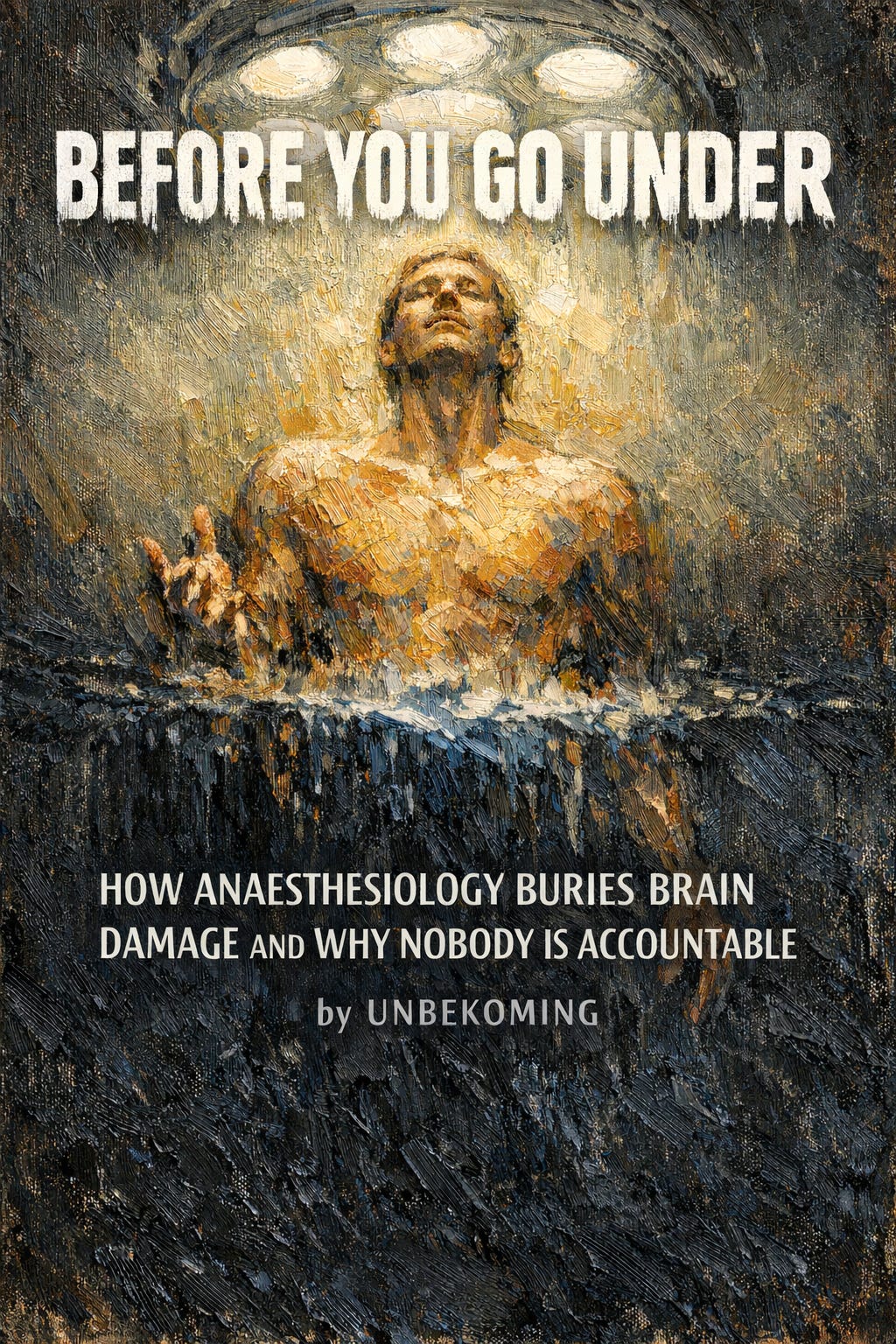
I’ve now written a book about this. It’s called BEFORE YOU GO UNDER How Anaesthesiology Buries Brain Damage and Why Nobody Is Accountable, and it’s available now for paid subscribers.
The book is approximately 27,000 words across an introduction, ten chapters, and five practical appendices. It is entirely new material.
Why a book, not another essay
Recently I wrote one essay on POCD. It covered the ISPOCD1 findings, the consent gap, and the basic outline of why this risk goes undisclosed. The response told me the subject was bigger than an essay could hold.
The book is the full development of what that essay could only introduce. A single essay can make one argument. What this subject requires is cumulative architecture — chapters that build on each other, where evidence established early makes later claims unavoidable. To understand why the choice of anaesthetic agent matters, you need to understand the mechanism. To understand why that mechanism goes undisclosed, you need to understand how the consent process works. To understand why the consent process doesn’t work, you need to understand how billing, malpractice law, and monitoring standards are each structured to be blind to exactly this category of harm. Assembled together, those arguments become something harder to dismiss than any single piece could be.
What the book covers
The first act — Chapters 1 through 4 — establishes what the research actually shows. The ISPOCD1 investigators enrolled over 1,200 elderly surgical patients across eight countries, tested their cognitive function before surgery and at one week and three months after, and found that one in four showed measurable cognitive impairment at one week, and one in ten still did at three months. That paper was published in The Lancet in 1998. Twenty-seven years later, this risk is not disclosed in standard pre-operative consent. The act also covers intraoperative awareness — 26,000 Americans experience it annually, paralysed and unable to signal, with PTSD rates approaching 50% in those who do — and the FDA’s mandatory 2016 label changes for all anaesthetic drugs used in children, which followed seventeen years of animal evidence that the specialty’s consent conversations did not mention.
The second act — Chapters 5 through 8 — examines decisions that currently happen without the patient’s knowledge. Whether regional anaesthesia is offered as an alternative to general. Which specific drug maintains unconsciousness: sevoflurane, the most widely used anaesthetic gas globally, has been shown to trigger tau protein trafficking from neurons to microglia, activate the brain’s inflammatory pathways, and suppress cholinergic neurotransmission — mechanisms with direct relevance to dementia. In a randomised cardiac surgery trial, it produced delirium in 34% of patients compared to 9% for propofol. Patients are not told which agent they will receive, let alone that the choice carries different cognitive risk. The act closes with what happens after surgery when cognitive change goes unattributed: a cascade of misdiagnosis, substitute treatment for conditions the patient doesn’t have, and missed reversibility — because no baseline was recorded, because the clinical infrastructure to connect cause to effect was never built.
The third act — Chapters 9 and 10 — explains why. The billing system rewards time in theatre, not cognitive outcomes. The malpractice system captures harms that are acute, visible, and legally contestable — POCD is none of these. The standard of care is defined as the mean of existing practice, meaning existing practice can never be substandard by definition. These are not separate failures. They are interlocking systems, each internally coherent, each structurally blind to the same category of harm. Chapter 10 is the practical counterweight: the six questions to ask your anaesthesiologist before surgery, what to watch for afterward, and how to navigate a medical system that currently has no pathway for receiving this information.
The appendices
The book includes five appendices designed to be used, not just read.
Appendix A — A pre-operative cognitive baseline record. Complete it before surgery and bring it to every post-operative appointment. It creates the reference point that makes cognitive change attributable.
Appendix B — The six questions distilled into a card format, with a note on what an inadequate answer sounds like.
Appendix C — A twelve-week post-operative cognitive diary with parallel patient and family-observer sections, structured around the domains POCD affects.
Appendix D — A referral letter template for patients presenting to GPs with post-operative cognitive concerns, framed in clinical language. Includes a “notes for the patient” section explaining what to do if the referral produces a neurodegenerative workup without considering the surgical cause.
Appendix E — A guide for family members: how to recognise the quiet subtype of post-operative delirium that ward staff routinely miss, how to track changes at home, and how to make observations count in clinical settings where family accounts are routinely underweighted.
This subject required a book because the individual arguments, however strong, are answerable in isolation. The accountability gap is real. The consent gap is real. The mechanistic evidence is real but incomplete. Any single piece can be countered by a specialist who finds the weak point in that piece’s scope. What cannot be so easily countered is the cumulative picture: the same gap appearing at every level of the system — research, consent, billing, monitoring, malpractice, misdiagnosis — for seventy years, across multiple generations of published evidence, in a field with every incentive to look elsewhere.