

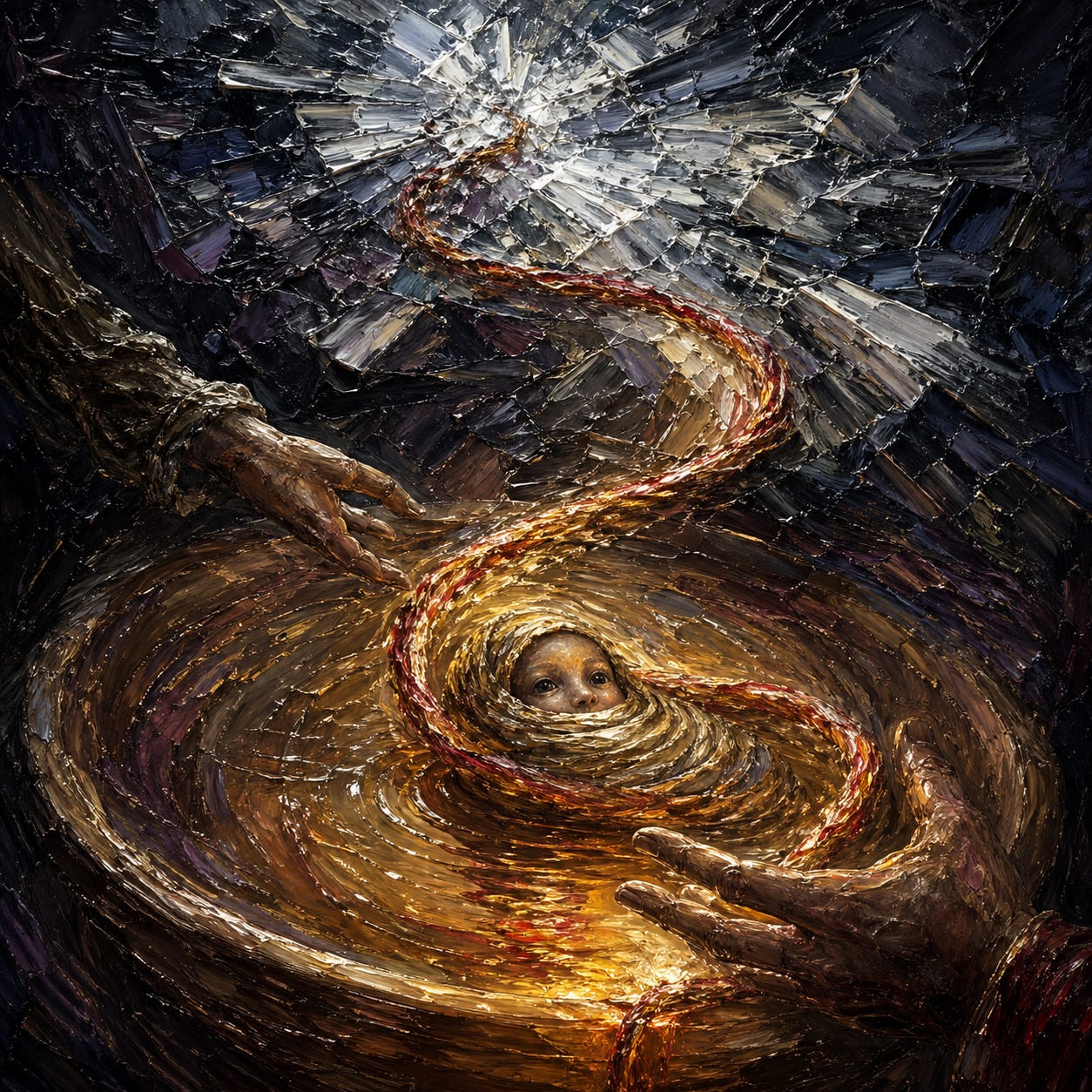
Frédérick Leboyer’s Birth Without Violence, first published in French in 1974 and translated into English the following year, asks a question almost no one had asked before: is birth an enjoyable experience for the baby? Leboyer was a Paris-trained obstetrician who had supervised thousands of deliveries before something began to disturb him. The cry at birth, universally treated as a sign that the lungs work and the machine is functioning, started to sound to him like what it actually is — the cry of a creature in pain. He spent the years from 1966 onwards working out what he came to believe: that the conventional welcome we give newborns inflicts unnecessary suffering, that this suffering leaves marks that persist for life, and that almost everything required to spare the baby costs nothing more than a little patience, silence, and dimmed light.
The book is short, written in a fragmented and almost poetic style, illustrated with photographs that are difficult to look at once their meaning becomes clear. Leboyer’s argument advances by accumulation rather than assertion. He describes the senses of the newborn — sight, hearing, touch — and what each of these senses encounters in a standard delivery room: surgical floodlights blazing into eyes that have only known darkness, shouting voices striking ears that have only known fluid-muffled sound, cold metal scales meeting skin as raw as burned tissue, and the first breath burning the lungs like acid poured on a wound. He then describes what happens when the cord is severed within seconds of emergence, forcing lungs that could have transitioned gradually with the placenta still supplying oxygen to take over under emergency conditions. The pattern this establishes — breathing as a response to suffocation, life as a response to the threat of death — sets the foundation for how that person will breathe, fear, and respond to stress for decades afterwards.
Leboyer’s alternative is methodical and concrete. The lights are dimmed to a single small lamp. The room is kept silent or near-silent. The baby is placed face-down on the mother’s stomach immediately upon emergence. The umbilical cord is left intact and pulsing for four to five minutes while breathing establishes itself without anoxia or panic. The cord is then cut and the baby is lowered into a basin of water at body temperature, where weightlessness is restored and where, frequently, the eyes open for the first time. The look in those eyes — immense, grave, intensely curious — is what convinced Leboyer that the newborn is not a creature acquiring personhood but a person already long in existence, encountering a new world. The baby is then lifted slowly from the water, wrapped warmly, and left to discover the unfamiliar experience of stillness after nine months of perpetual motion. Each stage matches the baby’s own pace.
The book became an immediate bestseller in France and the United States and has shaped natural birth practice ever since, though its full implications remain unrealised in most hospitals. Several of Leboyer’s specific proposals — particularly delayed cord clamping — have entered mainstream obstetrics decades after he proposed them, though for narrowly medical reasons rather than the emotional ones he emphasised. The deeper claims of the book concern what kind of creature the newborn actually is, what it perceives, what it remembers, and what the welcome it receives does to the rest of its life. These claims do not fit comfortably into the technical idiom of modern medicine. They belong to an older tradition that took the intelligence and sensitivity of the very young seriously, and that understood birth as a transition between two phases of an already-existing life rather than as the beginning of life itself. Leboyer’s photographs of newborns playing in warm water within ten minutes of emergence, eyes wide open, faces relaxed into expressions that resemble nothing so much as quiet astonishment, are evidence that something has been wrong with the conventional welcome for a long time, and that the remedy is closer to hand than anyone supposed.
With thanks to Frédérick Leboyer.
Keep Reading
A paid subscription unlocks everything on the site: the full Deep Dive Audio Library of in-depth conversations, the premium content for every book summary I produce across all series, and my growing library of original books. New content is added every month.
This book is part of that library. Subscribing now unlocks the full summary (analogy, one-minute elevator explanation, 12-point summary, and Q&As), the Golden Nugget, and the deep-dive audio conversation for this title, together with the premium content for every other book summary already published.
I do this work independently, outside the institutions these books so often describe. No foundation grants, no academic approval, no editorial gatekeepers deciding what’s acceptable to publish. Your subscription makes that independence possible. If these ideas matter to you, and if the work of surfacing overlooked knowledge matters to you, I’d be grateful for your support.