


Peter Gøtzsche reviewed every randomised mammography screening trial ever conducted for the Cochrane Collaboration. Cochrane’s headline is that, assuming a 15% mortality reduction, one woman in 2000 avoids dying of breast cancer over ten years. Ten are overdiagnosed and treated. Two hundred experience false alarms.
But that headline assumes the reduction. When Gøtzsche looked only at the trials with adequate randomisation — the higher-quality ones — the reduction disappeared. No effect on breast cancer mortality. No effect on all-cause mortality.
This is the Cochrane finding, published in the establishment’s own database of systematic reviews.
No woman being asked to consent to a mammogram this week knows it.
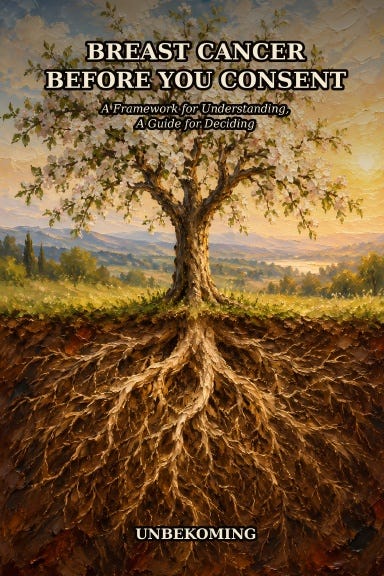
That is why the new Unbekoming paperback exists.
A woman opens a letter. Her mammogram from last week has been flagged. She needs to come back for further imaging.
Another gets a phone call. The biopsy result is back. She has ductal carcinoma in situ. Stage 0. The surgeon can see her Tuesday.
Another sits across from a BRCA counsellor who tells her that carrying the mutation gives her a lifetime risk of 87 percent. There is a procedure that can protect her.
Another has been on a hormonal IUD for three years. Her mood, her cycle, her sense of herself have all changed. Her GP prescribes an antidepressant.
None of them are being told what the published medical literature actually shows.
This new book is what the published medical literature actually shows.
The Argument
H. Gilbert Welch’s autopsy studies show that up to 39 percent of middle-aged women carry breast cancer they will die with, never from. The screening apparatus finds those cancers, calls them disease, and initiates the treatment cascade.
The twenty-five-year Canadian National Breast Screening Study, the most rigorous mammography trial ever conducted, found that one in five diagnosed cancers were overdiagnosis. The screened group and the unscreened group had the same mortality.
The 87 percent BRCA lifetime risk figure a genetic counsellor cites was derived from families selected because they already had clustered breast cancer cases. When the same variant is examined in general-population samples, the risk drops to 17 percent. A woman is being told her risk is roughly five times what the corrected data shows.
A 2004 Australian analysis by Morgan, Ward, and Barton calculated the contribution of chemotherapy to five-year survival across all cancer types. The number is 2.1 to 2.3 percent. Almost every woman who consents to chemotherapy for breast cancer believes she is consenting to something that materially changes her survival probability. The published contribution to five-year survival across all cancers is roughly one in fifty.
None of this is fringe. Every study cited above appeared in the establishment’s own journals. Cochrane. BMJ. New England Journal of Medicine.
The problem is that a woman standing at the consultation desk does not have this evidence in front of her when she is asked to sign.
That is what the book is for.
Buy Breast Cancer: Before You Consent (paperback) →
Structure
Part I is the compact clinical guide. Designed to be read in one hour by a woman with a decision on her calendar: a mammogram Friday, a callback Tuesday, a biopsy result waiting, an IUD consultation the week after next. Four branches. Three questions per branch. The exact wording to use with the clinician on the other side of the desk.
Part II is the evidence in full. Twelve chapters walk through the argument. Gøtzsche on the screening question. Welch on overdiagnosis. The Boobs documentary. What cancer actually is (Warburg, Seyfried). What turbo cancer is. Root canals and breast cancer (Levy, Haley). Iodine and the Japanese paradox (Derry). The BRCA gene and the women who lost their breasts to a hypothesis. Hormonal IUDs and the 2024 Danish cohort of 78,595 women. Tirza Derflinger on better breast health for life. Paul Marik on the perioperative window.
Part III is the preparation tools. The Decision Toolkit. The Personal Action Plan, sequenced across six intervention layers from immediate substrate reduction through terrain rebuild. And “But My Doctor Said,” the eleven objections a woman will hear when she acts on what she has learned, and what the evidence actually shows for each one.
Part IV is the physical reference. The Conversation Card and the Clinical Checklist. Designed to be brought to appointments.
Who It Is For
The woman with a mammogram scheduled who has never been told the screening question is contested.
The woman who has been called back and is being pulled into the diagnostic funnel.
The woman who has been told she has DCIS and is being scheduled for surgery.
The woman who has been offered BRCA testing.
The woman who has been prescribed a hormonal IUD.
The woman whose mother, aunt, sister, friend, or daughter is in one of those situations, and who wants to have a better conversation with her.
The book is not medical advice. It is the published medical literature laid out clearly enough that a woman can make her own informed decision, before she consents to anything.
The Terrain Frame
Every Unbekoming book is written inside the terrain framework, which holds that the internal environment of the body, its toxic burden, nutritional status, electromagnetic exposure, and stress load, determines whether illness manifests. This book is no exception.
The book names one primary cause of the injury the medical system calls breast cancer, substrate accumulation, and three specific contributors: injection load, oral toxicity, and continuous synthetic-progestin exposure. Chapter 5 makes the full case, drawing on Warburg, Béchamp, Cowan, and Seyfried. A woman does not need to accept the framework to use the clinical chapters. She may find herself reaching for it by the time she finishes them.
The Paperback
Available now on the Lulu Bookstore. 359 pages. Source-cited throughout. Published without commercial sponsorship.
AUD 37.99 / USD 24.99 / GBP 19.99 / EUR 23.99 / CAD 34.99.
The digital edition will be released to paid subscribers within 6 months.
This is the seventeenth title in the Unbekoming print catalogue, and the first to unite the compact clinical guide with the full paradigm framework in one volume.
A woman with a mammogram scheduled on Friday has time to read Part I before she goes in. She may still decide to keep the appointment. She may not. What she will not do is walk into that room without knowing what she was never told.
That is the point of the book.
Buy Breast Cancer: Before You Consent (paperback) →
The Shelf
The full Unbekoming print catalogue is at lulu.com/spotlight/unbekoming. Seventeen titles now, across paradigm, remedy, and critique. All direct from the printer.
Thank you
To every reader who has bought a paperback since August, thank you. Genuinely.
This print library exists because you have carried it into existence with your orders. Every new title on the shelf was made possible by the last one selling. Every reader who has bought a book, passed it to someone who needed it, ordered a second copy, or built a small stack of them on a bedside table, thank you.
The completionists who ordered a whole stack in one go, the readers who ordered the single book that met their situation, and everyone in between. The library grows because you keep it growing.
Breast Cancer: Before You Consent is number seventeen. There will be an eighteenth, and a nineteenth, because of you.
Buy Breast Cancer: Before You Consent (paperback) →
This work stays free because paid subscribers make it possible. They get the full book library, the Deep Dive Audio Library, and the Questions for Your Doctor, Before You Consent, and Package Insert series. No grants, no gatekeepers — your subscription is what keeps it that way.
What amazes me is the amount of women who believe that the treatment "cured" them. I often wonder if it is the "belief" that cures them.
https://nataliegwinters.substack.com/p/what-you-eat-what-you-watch-how-you?r=5u4zc&utm_medium=ios