

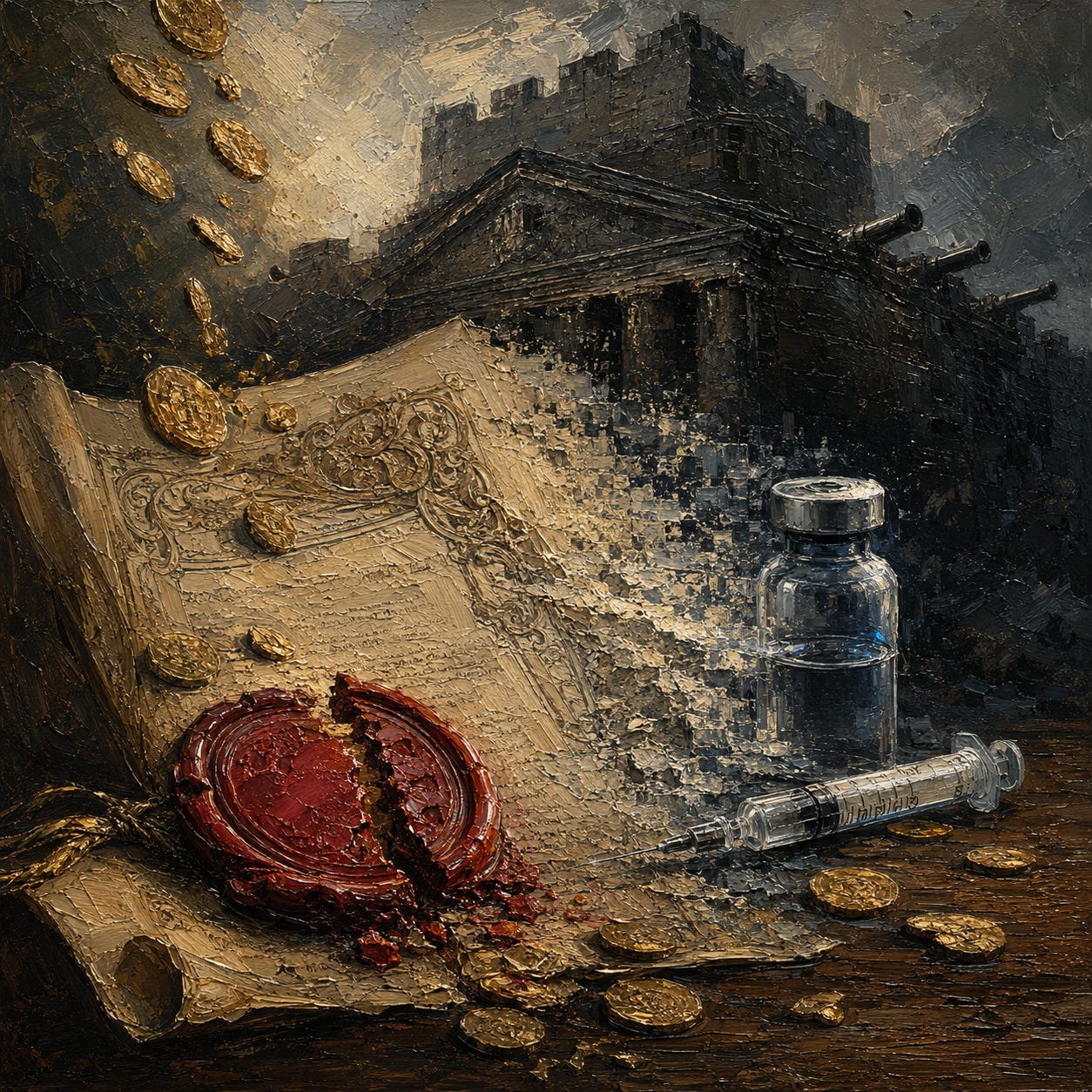
The title of this essay is Fabio Vighi’s line. I wish I had written it. All credit to Vighi for the sentence, the thinking behind it, and the frame it opens. This essay follows in his footsteps.
Author’s note: This essay works across two frames that are not usually placed together. The first is the historical account of mercantilism as a state-financier arrangement running from Venice through Amsterdam through London to Washington. The second is the childhood vaccination program, treated here as the current operating example of that arrangement. Where the essay handles material framed in establishment terms, “public health,” “immune system,” “protection,” “infectious disease,” “safety monitoring,” those terms appear in quotation, in attribution, or in the names of official bodies and legal instruments. My own analytical voice does not endorse those framings. Where I describe what the arrangement actually does, I use plain language. The shifts between the two registers are deliberate.
The Present Moment
On any given morning in the fall of 2026, the United States Treasury faces the same problem it has faced every morning for the past several years. It must sell debt to buyers who are running out of reasons to hold it. The federal debt has passed $38 trillion. The refinancing schedule for the twelve months beginning in late 2024 required rolling over roughly $9.6 trillion of maturing paper, the largest such window in American history.¹ Someone has to buy it. If the auctions fail, or if yields rise sharply, the interest cost on the outstanding debt begins to consume a growing share of federal revenue, and the political economy of the country enters a phase for which no contemporary politician has any preparation.
In September 2019, months before the world had heard of what would be called a novel coronavirus, the overnight repo market seized. Rates that normally sit near the Fed’s target of 2 percent spiked to 10.5 percent as the shadow banking system choked on collateral it could no longer roll.² The Federal Reserve began injecting hundreds of billions of dollars a week to stop an immediate cascade. This was not the response to a pandemic. It was the pre-existing condition that a declared pandemic would eventually be summoned to cover.
Fabio Vighi, a Cardiff University philosopher trained in Lacanian psychoanalysis and the critique of political economy, has spent the past several years writing what has become the sharpest available diagnosis of this arrangement. His frame is what he calls “crisis deployment,” the recognition that emergencies are not failures of the system but its primary operating mode. In an interview I published in May 2026, explaining why he sees American foreign policy as a bond auction management program conducted by other means, he offered this sentence:
“Contemporary (post-productive, financialised, debt-based) capital has outsourced its reproduction to the state’s monopoly on violence.”³
He meant it as diagnosis of the present. The mechanism, in his account, is straightforward. US federal debt is now so large that any rise in borrowing costs becomes existentially threatening. To keep yields low the Treasury needs buyers. To keep buyers the dollar must remain the only safe harbor. To keep the dollar as the only safe harbor there must be visible chaos elsewhere, which the American military and its proxies are unusually well-equipped to provide. Every geopolitical event of the past four years, Ukraine, Gaza, Venezuela, Iran, has functioned as what he calls “yield-curve control by other means.” Bombs falling abroad, in his phrase, tell the bond market that the hegemon still projects, and capital flees to Treasuries.⁴
What Vighi calls “reproduction” is the ordinary business of capital: its continued ability to generate returns for the people who hold it. In a genuine market this requires producing something people voluntarily pay for, at a price that covers the cost of production and yields a surplus. Competition disciplines the process. Capital that cannot earn its return is destroyed and replaced by capital that can. The outsourcing Vighi identifies is the mechanism by which capital escapes this discipline. If you can capture the state’s monopoly on violence, you no longer have to earn your return in a market. You can compel it. The state can be made to require people to buy your product, to prohibit competitors from operating, to absorb the losses when your product harms them, and to prosecute those who resist. Capital that would have collapsed under genuine competition becomes indestructible, because the population is no longer permitted to choose otherwise.
The line lands as diagnosis of an unfamiliar moment. This essay argues that it is diagnosis of the founding moment. The outsourcing did not develop late. It was chartered.
This work stays free because paid subscribers make it possible. They get the full book library, the Deep Dive Audio Library, and the Questions for Your Doctor, Before You Consent, and Package Insert series. No grants, no gatekeepers — your subscription is what keeps it that way.
The Charter
On April 25, 1694, the English Parliament passed a law with a title that told the truth before the politics buried it:
*An Act for granting to their Majesties several Rates and Duties upon Tunnage of Ships and Vessels, and upon Beer, Ale and other Liquors: for securing certain Recompenses and Advantages, in the said Act mentioned, to such persons as shall voluntarily advance the Sum of £1,500,000 towards carrying on the War against France.*⁵
A Scottish promoter named William Paterson had brought the scheme to a committee of the House of Commons the year before. The English Crown was broke, its credit poor, emerging from half a century of civil war. It could not raise taxes and it could not borrow enough from private savers to fight France. Paterson’s group proposed a bank. The bank would issue new notes. The notes would be lent to the government. The government would pay interest on the loan from earmarked taxes on ships, beer, and spirits.⁶
The arrangement had one feature that mattered more than any other. The money the bank lent did not exist before the loan was made. It was created by the act of lending.
Paterson said so openly. “The Bank hath benefit of interest on all moneys which it creates out of nothing.”⁷ The words are from 1694. Sir Edward Holden, founder of the Midland Bank, repeated them in December 1907, and Carroll Quigley observed in 1966 that the principle is generally admitted today.⁸
When the subscription opened on June 21, 1694 at Mercer House, King William III and the Whig parliamentarians crowded in. More than a million pounds was raised in twelve days.⁹ By July 27 the books were open and the Bank of England was in business. Within two years it had issued £760,000 in notes against £36,000 in cash, gone insolvent, and been permitted by act of Parliament to suspend its obligation to redeem notes in gold while continuing to collect from its own debtors.¹⁰ Its notes immediately fell to a 20 percent discount. By 1697 Parliament had prohibited any competing corporate bank from being established in England, and counterfeiting Bank of England notes had been made a capital offense.¹¹
That is the founding arrangement. Private capital creates money out of nothing, lends it to the state, receives interest from taxes on the population, and secures its position through a state monopoly enforced by capital punishment. The state’s monopoly on violence guarantees the bank’s monopoly on money creation. The bank’s monopoly on money creation guarantees the state can fight the wars that the bank’s charter was written to finance.
The war that the 1694 Act was written to fund was the Nine Years’ War against France, which had begun in 1688 and would continue until 1697. It was the first of a series of eighteenth-century wars, the War of Spanish Succession, the War of Austrian Succession, the Seven Years’ War, the American Revolution, the Napoleonic Wars, each of which expanded English public debt and each of which strengthened the political position of the Bank of England as the state’s financing arm.¹² The Bank of England did not exist to serve the state. The state existed to service the Bank of England’s debt.
The Prehistory
Paterson did not invent the arrangement he brought to Parliament. He borrowed it from Venice.
Venice by 1300 had already assembled every element that would later be exported to Amsterdam and London. It had a merchant class that had captured the state. It had a doge who functioned as figurehead, chosen for life but hemmed in on every side by councils and offices designed to prevent independent rule. It had a Council of Ten meeting in secret that ran the actual government. It had chartered trading companies operating under state protection, using state naval force to secure their commercial monopolies. It had a state bank. It had a fleet that could enforce commercial claims across the eastern Mediterranean and beyond.¹³
Pope Pius II, writing in the fifteenth century, described the Venetian ethical position with a bluntness that later chroniclers softened. Something was just for the Venetians if it served the state’s interests, and pious if it expanded the empire.¹⁴ That is the doctrine that survived every subsequent transfer.
Venice was not destroyed in 1797 when the French revolutionary armies entered the lagoon. Its oligarchs had left two centuries earlier, with their capital, their methods, their doctrine, and their appetite. They set up in Amsterdam. They set up in London. They chartered a bank in 1694. The arrangement they had refined over five centuries in the lagoon became the operating structure of what would eventually be called the modern world.¹⁵ What Paterson chartered in 1694 was Venetian doctrine dressed in English tailoring.
The Machinery Expands
Every major English war of the eighteenth century enlarged the Bank of England’s balance sheet and deepened its political position. The Seven Years’ War, ended by the Treaty of Paris in February 1763, left Great Britain with one of the largest national debts in its history. Repayment appeared impossible. The Whig government responded by imposing new taxes and expanding the administrative state to enforce them, which produced the American resistance that produced the American Revolution, which produced further debt.¹⁶
Daniel Natal, an American historian of the mercantile system, has observed that mercantilism is not simply an economic policy. It is a mindset that treats commercial supremacy as identical with national interest, treats other nations as either markets to be captured or rivals to be broken, and treats any productive economy that generates wealth outside the mercantile grid as an intolerable threat. On this reading, both World Wars can be understood as mercantilist strikes against Germany, a nation whose economic model was based on factory production rather than colonial extraction.¹⁷ The nation that made things was destroyed by the nations that sold things.
In 1913 the arrangement crossed the Atlantic. The Federal Reserve Act, drafted in secret at Jekyll Island in November 1910 by a group of investment bankers led by Paul Warburg of Kuhn Loeb, formalized the American replication of the 1694 structure.¹⁸ Only Federal Reserve Banks could print notes. Member banks could not. Reserve requirements were cut from an average of 21.1 percent before the Fed to 11.6 percent under the 1913 Act, and further to 9.8 percent by June 1917. Between December 1913 and January 1920, total bank demand deposits rose from $9.7 billion to $19.1 billion. Member bank deposits grew by 250 percent while non-member deposits grew by a third.¹⁹
Carroll Quigley, writing from inside the establishment he was documenting, observed that the central bankers were not the substantive powers. They were agents of investment bankers who had raised them up. Benjamin Strong, the first Governor of the Federal Reserve Bank of New York and the man who actually ran American monetary policy from 1914 until his death in 1928, came from Bankers’ Trust, a bank created by the Morgans. He was persuaded to take the Fed job by Henry Davison, a partner at J.P. Morgan & Co., and Dwight Morrow, another Morgan partner.²⁰
In 1694 a private bank had been chartered to create money for the state. In 1913 a cartel of private banks was chartered to create money for the state. The scale and the protective camouflage had grown. The arrangement was identical.
The Second Founding
The Bretton Woods conference of 1944 was described by Michael Hudson, whose Super Imperialism remains the definitive account, as the triumph of U.S. Government finance capital.²¹ The postwar international monetary system was designed by American negotiators to place the dollar at the center of global reserves, with foreign currencies pegged to the dollar and the dollar pegged to gold at $35 per ounce. The International Monetary Fund and the World Bank were created as the enforcement arms of an arrangement that made every other economy a residual function of American requirements.²²
The war in Vietnam killed Bretton Woods. American military spending drove the balance of payments into deficit. Foreign central banks, particularly France, began to redeem their accumulating dollar holdings for gold. On August 15, 1971, President Nixon closed the gold window, ending the American commitment to convert dollars into metal at any price.²³
What replaced Bretton Woods was what Hudson calls the Treasury bill standard. Foreign central banks continued to accumulate dollars from American trade and payments deficits. Those dollars could no longer be redeemed for gold. Nor could they be used to buy American companies, which the Treasury signaled would be considered an unfriendly act. The only remaining use for accumulated dollars was to buy American government debt. Foreign central banks became forced lenders to the United States Treasury.²⁴
Hudson’s central insight is that this arrangement inverts the classical logic of imperial finance. Britain in the nineteenth century ruled its empire from a creditor position. The United States after 1971 rules from a debtor position. Hudson himself put it plainly:
“In sum, the United States is able to rule not through its position as world creditor, but as world debtor. Rather than being the world banker, it makes all other countries the lenders to itself. Thus, rather than its debtor position being an element of weakness, America’s seeming weakness has become the foundation of the world’s monetary and financial system.”²⁵
Its payments deficits, its military spending, its budget deficits are all financed by the surplus savings of the very nations its foreign policy destabilizes. The mechanism is closed. American military spending drives the payments deficit. The payments deficit forces foreign central banks to accumulate dollars. Accumulated dollars can only be invested in Treasury debt. Treasury debt finances the next round of military spending.²⁶
What Vighi in 2026 calls “bombs for bonds” is the operational description of the closed loop that Hudson diagnosed structurally in 1972. The wars are not policy failures whose costs are absorbed by the arrangement. The wars are the arrangement’s means of reproduction. They generate the deficit that generates the forced lending that finances the next war.
The 1694 Bank of England was chartered to fund the war against France. The 2026 American Treasury is refinanced by wars against Iran, Russia, and whoever else the news cycle happens to require. The scale has grown. The mechanism is the same.
The Offshore Layer
In 1957, the Midland Bank in the City of London made a series of trades that opened a jurisdiction outside the reach of any regulator. What became known as the Eurodollar market allowed dollars to be held and traded in London under rules the Bank of England did not enforce and American regulators had no authority to reach. By the 1970s the Eurodollar market had absorbed the wholesale funding of every major bank in the world.²⁷
In 1986, Prime Minister Margaret Thatcher ordered the Bank of England to stop regulating the City of London’s financial markets. What followed was the construction of an offshore spiderweb centered on the City, radiating outward to Jersey, Guernsey, the Isle of Man, the Cayman Islands, Bermuda, Singapore, and Hong Kong. The Cayman Islands has one cinema and hosts three-quarters of the world’s hedge funds. Jersey holds about $800 billion. The Caymans report liabilities three times their assets without explanation. Citigroup operates 427 tax haven subsidiaries.²⁸
The offshore layer completes the mercantilist arrangement by allowing the capital of the beneficiary class to escape the taxes and regulations imposed on the population the state nominally serves.²⁹ The state’s coercive apparatus reaches its own citizens. It does not reach its own beneficiaries.
The September 2019 repo spike, the deployment of the Covid emergency to justify unlimited monetary intervention, the succession of geopolitical crises since 2022, and the parallel construction of programmable digital currency infrastructure are the arrangement operating in the open. What has changed is not the arrangement. What has changed is that it no longer requires the camouflage it once did.³⁰
A Note on the Religious Frame
Dr. Martin Erdmann, whose 487-page study The Greed for Gold and Glory is the most rigorously footnoted contemporary account of the mercantile system, argues that the arrangement occupies the position religion used to occupy. It commands total loyalty. It demands financial sacrifice. It offers its own eschatology of progress. The state has not removed God from public life. The state has become God. Classical liberalism and progressive liberalism, on his account, are two forms of the same civil religion, and their apparent opposition disguises their shared foundation.³¹ This essay does not depend on that frame. The frame reaches something the structural argument alone cannot. The arrangement is not simply enforced by coercion. It is worshipped.
The Modern 1694: The National Childhood Vaccine Injury Act of 1986
The clearest contemporary example of the arrangement I have described operates on the bodies of children.
In the early 1980s, the American pharmaceutical industry faced a problem. The whole-cell diphtheria-pertussis-tetanus (DPT) vaccine, mandatory in every state for school entry, was producing injuries at a rate that had begun to generate substantial civil litigation. Harris L. Coulter, a medical historian, and Barbara Loe Fisher, a parent whose son had been brain-damaged after his fourth DPT shot, published in 1985 a book called DPT: A Shot in the Dark, which documented the medical and legal history of the vaccine and its acknowledged neurological adverse events.³² By the mid-1980s, pediatric practices, hospitals, and manufacturers were being sued. Insurance costs were rising. Manufacturers signaled they would withdraw from the vaccine market entirely if the liability environment did not change.³³
Congress had a choice. It could have required the industry to produce a safer product. It could have allowed the tort system to price the risk and let the market adjust. Instead it chose a third path.
The National Childhood Vaccine Injury Act of 1986 extinguished direct manufacturer liability for injuries caused by federally recommended childhood vaccines. Injured children and their families could no longer sue the manufacturer in ordinary civil court. They were instead directed to a specialized administrative tribunal called the Vaccine Injury Compensation Program, staffed by Special Masters appointed by the U.S. Court of Federal Claims. The government’s own attorneys, from the Department of Justice, would defend the program against claims for compensation. The compensation itself would be paid not by the manufacturer but by a trust fund financed by an excise tax on each dose of vaccine, a tax passed through to the consumer at purchase.³⁴
The 1986 Act is the modern 1694 charter. The parallel is exact. In 1694, private capital secured a legal privilege, the monopoly on note issuance enforced by capital penalties against competitors, that made its business model impossible to dissolve without dissolving the state’s own financing arrangement. In 1986, private capital secured a different legal privilege, immunity from tort liability for products the state made mandatory, that made the childhood vaccine business impossible to conduct in its current form without the state absorbing its risk. Both arrangements were sold as necessary. Both are essentially permanent. Both wrote private capital into the state’s legal architecture at a level that ordinary politics cannot reach.
The 1986 Act was sealed into permanence by the Supreme Court in 2011. In Bruesewitz v. Wyeth, a 6-2 majority held that the Act preempts state-law design-defect claims against vaccine manufacturers, even where the plaintiffs argued that a safer alternative design was available.³⁵ Justice Sotomayor’s dissent, joined by Justice Ginsburg, argued that Congress had not intended so complete a preemption and that the ruling eliminated the tort-law mechanism through which manufacturers could be held accountable for improving products they were commercially required to sell. The majority disagreed. The industry that had lobbied for the 1986 Act thereby achieved not only immunity from ordinary tort liability but immunity from any legal obligation to make its products safer. The charter was now proof against the courts.
What the 1986 Act made possible is the childhood vaccine schedule as it currently exists. In 1962, the recommended pediatric schedule contained roughly three vaccines. By 1983, roughly ten doses. By 2000, roughly twenty. Today the CDC schedule specifies approximately seventy-two doses of sixteen different vaccines administered between birth and age eighteen.³⁶ The expansion of the schedule tracks the expansion of the liability-free market that the 1986 Act created. Each new addition enters a business environment in which the manufacturer bears no cost for injury the product may cause. That environment is not a market. It is a state-guaranteed subsidy.
The Injury Court
Wayne Rohde’s The Vaccine Court, published in 2014, is the most comprehensive available account of how the Vaccine Injury Compensation Program actually operates. Rohde is the father of a vaccine-injured child. He spent years pursuing claims through the program on behalf of his son. His book is a practitioner’s document, not an academic one, and it is the more useful for it.³⁷
The program was designed, in its original 1986 conception, to be relatively fast, non-adversarial, and generous. It was to compensate families for injuries listed on an official Vaccine Injury Table without requiring them to prove medical causation. The evidentiary standard was to be low. The burden was to be on the government to disprove the association if it wished to deny the claim. Over the four decades of the program’s operation, every element of this design has been inverted.³⁸
The Vaccine Injury Table has been revised repeatedly to narrow the injuries the government will compensate. Encephalopathy, the classical vaccine adverse event described in the medical literature since the 1930s, has been narrowed to require symptom onset within a window so short that most cases fall outside it. The three-part causation test established in Grant v. Secretary of Health and Human Services in 1992 requires the petitioner to demonstrate a medical theory linking the vaccine to the injury, prove a logical sequence of cause and effect, and support that sequence with reputable medical or scientific explanation.³⁹ Vaccines, as Rohde documents, leave no pathological signatures in most cases. The government’s attorneys deploy this fact against the parents whose children have been injured.
The program takes years to resolve most cases. Government attorneys defend it aggressively, using every procedural device available to delay and to exhaust. Special Masters, whose discretion the Federal Circuit has repeatedly emphasized is broad, apply inconsistent standards. Awards are made in a small fraction of the cases filed. The industry that manufactured the product is not present in the room at any stage.⁴⁰
This is not a compensation system that failed. It is a compensation system that operates as designed once the design’s political purpose is understood. Its purpose is not to compensate injured children. Its purpose is to absorb the political pressure that would otherwise produce consequences for the beneficiary class. The families that receive awards are the cost of maintaining the arrangement. The families that receive nothing, and the far larger number who never file, are the arrangement’s silent externalities.
The Captured Regulator
Robert F. Kennedy Jr.’s The Real Anthony Fauci documents at length the institutional capture of the American health regulatory apparatus by the industry it nominally regulates. The pattern is not incidental. It is the operating architecture.⁴¹
The Food and Drug Administration receives approximately 45 percent of its budget from user fees paid by the pharmaceutical industry. The Centers for Disease Control operates the CDC Foundation, which accepts substantial funding from pharmaceutical companies. The Advisory Committee on Immunization Practices, which sets the childhood vaccine schedule, has voted repeatedly on products developed with the financial involvement of its own members. A 2000 Congressional Government Reform Committee investigation of ACIP’s 1998 vote to add Wyeth’s RotaShield rotavirus vaccine to the mandatory schedule found that seven of the ten committee members deliberating had financial ties to the manufacturers developing rotavirus vaccines. The chairman sat on Merck’s immunization advisory board. Dr. Paul Offit, another member, held a patent on his own rotavirus vaccine funded by a $350,000 Merck grant and was a paid consultant to Merck. The National Institutes of Health, through its Office of Technology Transfer, holds hundreds of patents on medical products including vaccines. High-level NIH officials, including Anthony Fauci, have received royalty payments of up to $150,000 per year on products they help develop and usher through their own agency’s approval process.⁴²
The revolving door between the regulatory agencies and the industry is not concealed. It is celebrated. Julie Gerberding, director of the CDC from 2002 to 2009, left to become president of Merck’s vaccine division. Scott Gottlieb, FDA Commissioner from 2017 to 2019, joined the board of Pfizer within months of leaving.⁴³ The path is well-worn in both directions, and by the time a senior regulator reaches retirement the industry position is understood as compensation for services previously rendered.
This is the operating principle of Erdmann’s third mercantilist component, the chartered corporation whose private interest the state treats as identical with the national interest, now running on a specific industry. The regulator does not restrain the beneficiary class. The regulator is the beneficiary class in a different suit.
The Population-Level Externalities
Harris Coulter’s 1990 book, Vaccination, Social Violence and Criminality: The Medical Assault on the American Brain, extends his earlier work on vaccine injury from the acute clinical case into the population level. Coulter’s central argument is that the well-documented medical literature on post-encephalitic syndrome, developed in response to the encephalitis lethargica cases that spread across Europe and the Americas beginning in 1917, describes the outcome the vaccine schedule now produces on a mass scale.⁴⁴
Constantin von Economo and the interwar neurologists who studied encephalitis lethargica documented that survivors of clinical encephalitis frequently developed personality changes, impulse control failures, learning disabilities, and behavioral pathologies. Cases were followed for decades. The literature was extensive and was standard medical knowledge before it was quietly dropped from the curriculum.⁴⁵ Brain inflammation producing behavioral sequelae is not a speculative mechanism. It is established.
Coulter’s extension of the literature is straightforward. If a vaccine can produce severe encephalitis in some children, as the industry itself has acknowledged since it lobbied for the 1986 Act’s liability shield, then the same mechanism must be producing sub-clinical encephalitis in a much larger number. Standard toxicology recognizes dose-response distributions. There is no scientific reason to assume that vaccine-induced neurological injury manifests only at the severe end of the spectrum with nothing in the middle. The bimodal distribution assumed by the industry is not observed. It is required.
The population-level correlations Coulter documents are the ones the epidemiology community declines to investigate. The rise in learning disabilities, attention disorders, autism spectrum diagnoses, conditions medicine labels autoimmune, and juvenile behavioral pathology in the American population since the 1960s tracks the expansion of the vaccine schedule with a consistency that the standard explanations, better diagnosis and environmental exposure and dietary change, cannot fully account for.⁴⁶ The one study that would settle the question, a comparison of the health outcomes of vaccinated and unvaccinated cohorts, has been repeatedly proposed and repeatedly blocked. The refusal to conduct that study is itself evidence of what the answer would be.
Friedrich Engels, writing in 1843, observed that the extension of the factory system is followed everywhere by an increase in crime, and argued that society creates a demand for crime which is met by a corresponding supply. His point was structural. The industrial arrangement produces criminality as a systemic output, not as an accidental byproduct.⁴⁷ Coulter’s argument, one hundred and fifty years later, is structurally the same. The vaccine arrangement produces damaged children as a systemic output. The costs of the damage are socialized onto special education budgets, disability rolls, juvenile justice systems, adult incarceration facilities, and the psychiatric medication of children whose brains were injured by products the state mandated they receive. The revenue from the damaging products is captured privately by a liability-free cartel.
This is mercantilism operating on the nervous system of the next generation.
The Cover Story
Every mercantilist arrangement requires a cover story. The eighteenth-century arrangement was defended by an appeal to the “favorable balance of trade,” a doctrine that Adam Smith exposed in 1776 as a rationalization for the sacrifice of consumer interests to producer interests.⁴⁸ The contemporary childhood vaccine arrangement is defended by an appeal to the reduction in mortality from conditions classified as infectious disease, which vaccination is credited with achieving.
Suzanne Humphries and Roman Bystrianyk’s Dissolving Illusions presents, in extensive detail with the mortality graphs sourced from government archives, the historical evidence that mortality from these conditions in the industrialized world declined dramatically before the introduction of the corresponding vaccines and continued along the same trajectory after their introduction.⁴⁹ The decline was driven by improvements in sanitation, water quality, nutrition, housing, and living standards. Measles mortality in England and Wales had fallen by more than 98 percent before the measles vaccine was introduced in 1968. Scarlet fever mortality collapsed with no vaccine at all. The pattern is consistent across the industrialized world and across the conditions for which credit is now claimed.⁵⁰
The mortality decline is real. The claim that vaccination caused it is a cover story constructed after the fact. The claim performs a specific political function. It inoculates the arrangement against scrutiny by conferring on it the moral prestige of having saved millions of lives it did not save. The scrutiny cannot be conducted because the arrangement is credited with a public benefit that would be catastrophic to withdraw.
Adam Smith’s insight applies exactly. The stated purpose of the mercantile arrangement was to accumulate national wealth through a favorable balance of trade. The actual purpose was to capture the state’s coercive apparatus on behalf of a merchant class. The stated purpose of the childhood vaccine program is to protect children from infectious disease. The actual purpose is to extract guaranteed revenue from a captive market on behalf of a liability-free cartel.
The Child
Somewhere in the United States this morning, a child was born who will receive, over the next eighteen years, approximately seventy-two doses of sixteen vaccines. Some fraction of those children will be injured. A small fraction of the injured will be recognized as injured. A smaller fraction still will file with the Vaccine Injury Compensation Program. A smaller fraction than that will receive any award, after years of adversarial proceedings against the government’s own attorneys, paid from a fund financed by the tax on the vaccines that injured them.
The much larger population Coulter identified, the children whose damage is not severe enough to be recognized as vaccine injury, who are diagnosed instead with learning disabilities, or attention disorders, or autism spectrum conditions, or conditions medicine labels autoimmune, or behavioral pathologies, will not file with any program. Their costs will be absorbed by their families, by special education budgets, by disability rolls, by mental health systems, by prisons. The revenue from the products that damaged them will be recorded in the annual reports of Pfizer, Merck, GlaxoSmithKline, and Sanofi as shareholder return. The damage will not appear in the accounts at all.
The Charter Is Still in Effect
In 1694, the English Parliament chartered a private bank to create money for the state, protected the bank’s monopoly with the state’s monopoly on violence, and thereby made the bank’s business model impossible to dissolve without dissolving the state’s own financing. The war being fought at the time was the war against France. The war was the occasion. The charter was the arrangement.
In 1986, the American Congress chartered a private industry to produce mandatory medical products for the state, protected the industry from tort liability by directing all claims to a captive administrative tribunal, and thereby made the industry’s business model impossible to dissolve without dissolving a federally coordinated program that now touches every child born in the country. The disease being fought at the time was pertussis. The disease was the occasion. The charter was the arrangement.
Two hundred and ninety-two years separate the documents. The structure is identical. Private capital secures a legal privilege that the state’s coercive apparatus enforces. The population pays. The beneficiary class collects. The arrangement is written into law at a level that ordinary politics cannot reach.
Fabio Vighi described contemporary financialized capital as having outsourced its reproduction to the state’s monopoly on violence. He meant it as diagnosis of a phase. It is diagnosis of the founding. The Bank of England was chartered because private capital could not reproduce itself without the state’s guns. The childhood vaccine industry was chartered because private capital could not sell products of that character without the state’s mandate and the state’s liability shield. Between those two moments run three hundred and thirty-one years of the same arrangement, chartered in different forms for different beneficiaries in different centuries, and reproducing itself through the same mechanism the whole way.
The arrangement was never dismantled. It was moved. It is now sitting in a syringe in a pediatrician’s office, being administered under mandate, to a child whose parents have been told that this is medicine.
How to Explain It to a Six-Year-Old
Imagine a candy shop. The government has made a rule that says everyone has to buy candy from this one shop. No other candy shop is allowed to open. If anyone tries to open a different one, the police close it down. The candy costs a lot, and some of the candy makes children sick. The candy shop owner went to the government one day and said something like this: if my candy makes children sick, do not make me pay for the doctor. That is not fair to me. It will be too expensive. If you make me pay, I will stop selling candy. So the government made another rule. If a child gets sick from the candy, the government pays for the doctor. But the government does not have any money of its own. It takes the money from everyone’s parents. The candy shop keeps all the money it makes from the candy. The parents pay for the candy. Then the parents pay for the doctor. The candy shop pays for neither.
This has been going on for a very long time. Longer than your parents have been alive. Longer than your grandparents have been alive. It started even longer ago than that, in a place called Venice, when knights still fought with swords. From Venice it moved to a city called Amsterdam. Then it moved to England, more than three hundred years ago, when a small group of very rich people convinced the king to let them make the money for the whole country, and then to let the king pay them interest to borrow that same money back. When the arrangement worked well for the rich people, it moved again, across another ocean to America. It stopped being about money and started being about ships, and then about oil, and then about wars, and now about medicine. The names of the things kept changing. The rule did not. One shop is allowed. Everyone must buy. Everyone must pay when the shop’s things cause harm. And the shop is never made to answer for what it sold.
Your parents were told this was normal. Their parents were told this was normal. Their grandparents were told the same thing. It is not normal. It is very old, and it has never been taken apart. It has only been moved from one thing to another. From money to ships to medicine. When you grow up, some of the shops will still be there, still selling things everyone has to buy, still not paying for what they sold. You will remember this: the rule that seems normal is not normal. It was made a long time ago by people who knew exactly what they were doing.
In Print
Ten of my books are now available as paperbacks, printed to order through Lulu and shipped worldwide. The Unvaccinated lays out the completely unvaccinated as a comparison group across twenty chapters and five appendices — as far as I know, the only book of its kind. Medicalized Motherhood follows a woman through 123 documented interventions from teenage pill to postpartum discharge. Drilling for Profit argues that cavities, gum disease, and crooked teeth are a dietary problem the dental profession treats surgically. What Your Vet Can’t Tell You applies the same critique to pets — food, vaccines, and a profession trained by the industries whose products cause the harm. Escape from Psychiatry documents the fabrication of the DSM, the collapse of the serotonin hypothesis, and the specific damage done by every major psychiatric drug class.
Three take on the remedies and paradigm questions mainstream medicine actively suppresses. The DMSO Book covers 100,000 studies, zero deaths, and one approval — the suppressed science of medicine’s most versatile compound. Chlorine Dioxide: The Forbidden Remedy collects the interviews, protocols, and evidence from the doctors and researchers they tried to silence. No Contagion, co-authored with Jamie Andrews, catalogues 258 failed contagion experiments and the case against germ theory itself — the paradigm question underneath the whole shelf.
Two more take on the remedies already in your kitchen. Baking Soda locates sodium bicarbonate inside the terrain framework industrial medicine buried — the compound already in your cupboard, and what it does at the level of the blood, kidneys, lungs, digestion, and skin. The Castor Oil Book recovers four thousand years of documented practice on the medicine mainstream healthcare quietly stopped talking about — the kitchen bottle that doesn’t sit well in a system built on prescriptions and procedures.
A physical book reaches the person a Substack post never will — the sceptical relative, the friend who won’t click a link but might open a book, the visitor whose eye lands on a coffee table. The full shelf is at lulu.com/spotlight/unbekoming. Buy one to keep, and one to give away.
References
Interview with Fabio Vighi, published by Unbekoming, May 12, 2026.
Ibid.
Ibid.
Ibid.; see also Fabio Vighi, “Bombs for Bonds: Iran and the Geopolitics of Refinancing,” The Philosophical Salon, March 9, 2026.
Martin Erdmann, The Greed for Gold and Glory (hereafter GGG), 245, citing the text of the Bank of England Act 1694.
Murray N. Rothbard, The Mystery of Banking, 2nd ed. (Auburn: Ludwig von Mises Institute, 2008), ch. XII; GGG, 243–45.
Carroll Quigley, Tragedy and Hope: A History of the World in Our Time (New York: Macmillan, 1966), quoting William Paterson at the charter of the Bank of England, 1694.
Ibid., citing Sir Edward Holden, 18 December 1907.
GGG, 245–47.
Rothbard, Mystery of Banking, ch. XII. By end 1696 Bank of England notes outstanding were £765,000 against £36,000 in cash.
Ibid.
GGG, chapters on Bank of England expansion; Rothbard, Mystery of Banking, chs. XII–XIV.
GGG, 19–35; Interview with Dr. Martin Erdmann, published by Unbekoming, April 17, 2026.
Pope Pius II, quoted by Erdmann, Interview with Unbekoming, April 2026.
GGG, 32–35; “Mercantilism Never Ended,” published by Unbekoming, April 21, 2026.
GGG, chapter on the Seven Years’ War and its consequences, 277–85.
Interview with Daniel Natal, published by Unbekoming, December 16, 2023.
Michael Hudson, Super Imperialism: The Origin and Fundamentals of U.S. World Dominance, 2nd ed. (London: Pluto Press, 2003) (hereafter SI); Rothbard, Mystery of Banking, ch. XVII.
Rothbard, Mystery of Banking, ch. XVII.
Quigley, Tragedy and Hope, section on Benjamin Strong and the Morgan-Fed connection.
SI, Part I, ch. 5, “Bretton Woods: The Triumph of U.S. Government Finance Capital, 1944–45.”
SI, chs. 7–10, on the World Bank and the International Monetary Fund.
SI, ch. on 1971 and the end of Bretton Woods.
SI, Part III, chs. 11–15, on the Treasury bill standard.
SI, Preface to the second edition, 2002.
SI, Part III, chs. 11–15.
Nicholas Shaxson, Treasure Islands: Dirty Money, Tax Havens and the Men Who Stole Your Cash (London: Vintage, 2012) (hereafter TI), ch. 4; GGG, 389–92.
TI, chs. 4–5; GGG, 389–95.
TI, preface and chs. 1–3.
Interview with Fabio Vighi, May 12, 2026; Vighi, “A Self-Fulfilling Prophecy: Systemic Collapse and Pandemic Simulation,” The Philosophical Salon, August 2021.
Erdmann, The Greed for Gold and Glory; Interview with Dr. Martin Erdmann, April 17, 2026.
Harris L. Coulter and Barbara Loe Fisher, DPT: A Shot in the Dark (Garden City Park, NY: Avery, 1985).
Ibid.; Wayne Rohde, The Vaccine Court: The Dark Truth of America’s Vaccine Injury Compensation Program (New York: Skyhorse, 2014), Introduction.
National Childhood Vaccine Injury Act of 1986 (Public Law 99-660); Rohde, The Vaccine Court, chs. 1–2.
Bruesewitz v. Wyeth, 562 U.S. 223 (2011).
CDC Recommended Immunization Schedule for Persons Aged 0 Through 18 Years, historical and current versions, publicly available at cdc.gov.
Rohde, The Vaccine Court.
Ibid., chs. 3–5.
Grant v. Secretary of Health and Human Services (February 1992); Rohde, The Vaccine Court, ch. 5.
Rohde, The Vaccine Court, chs. 5–8.
Robert F. Kennedy Jr., The Real Anthony Fauci: Bill Gates, Big Pharma, and the Global War on Democracy and Public Health (New York: Skyhorse, 2021).
Ibid., chs. 1–3, on regulatory capture; ACIP rotavirus vote of June 1998 documented in Kennedy citing US House Government Reform Committee investigation (August 2000); NIH royalty arrangements documented in ch. on NIH and Office of Technology Transfer.
Ibid.; publicly reported career transitions for Gerberding (CDC to Merck, 2010) and Gottlieb (FDA to Pfizer, 2019).
Harris L. Coulter, Vaccination, Social Violence and Criminality: The Medical Assault on the American Brain (Berkeley: North Atlantic Books, 1990).
Ibid., chs. 1–3, drawing on the interwar encephalitis literature including the work of Constantin von Economo.
Ibid., chs. 4–9.
Frederick Engels, Outlines of a Critique of Political Economy (1844).
Adam Smith, An Inquiry into the Nature and Causes of the Wealth of Nations, Book IV, ch. 8, quoted at GGG, 64.
Suzanne Humphries and Roman Bystrianyk, Dissolving Illusions: Disease, Vaccines, and the Forgotten History (self-published, 2013).
Ibid., chapters on measles, pertussis, and scarlet fever mortality data.
Great insight - thanks. The following is from a post on X yesterday. So insightful. I then copied it and began a chat with AlterAI. A very interesting chat - recommend it.
Handre@Handre Sep 2
The First World War did not erupt. Governments built it, financed it, and kept it running long past the point where any rational army would have quit the field.
Franz Ferdinand's assassination in Sarajevo on June 28, 1914, gave chancelleries and foreign ministries the pretext they needed. The war itself required something more durable than a pretext. It required central banks.
Every major belligerent suspended the gold standard within weeks of the opening shots. Britain suspended convertibility in August 1914. Germany, France, and Austria-Hungary followed. This mattered enormously. Under a true gold standard, you cannot fund a four-year industrial slaughter. Governments run out of money and populations refuse further sacrifice. The war ends. Instead, central banks printed currency to buy government bonds, transferring the cost of the war to ordinary wage earners through inflation, a tax nobody voted for and most never identified as a tax.
Ludwig von Mises watched this from Vienna and identified the mechanism precisely: inflation allows states to conscript private purchasing power without explicit confiscation. Every loaf of bread that cost more in 1917 than in 1913 represented a transfer from the buyer to the war machine.
The death toll reached approximately 20 million people. The fiscal cost exceeded $200 billion in 1914 dollars. Neither number was achievable under honest money. Politicians and generals sustained the catastrophe because central banking made it financially possible to keep going. Remove the printing press and the trenches empty themselves inside three months.
Sound money is a hard constraint on state violence. States hate hard constraints.
Thank you for this analysis and association between the cartel and the people. I watched an interview with Barbara Loe Fisher a few years ago. She said The 1986 Act passed and was signed into law by Reagan. Then within a few days, the pharma cartel came to Reagan and asked for liability protection (not in the original bill passed by Congress). That liability protection was added as an amendment. I know many vaccine-injured people. Most do not know they are injured by vaccines. Tourette's, epilepsy, diabetes, allergies, scoliosis, so-called auto-immune, and more. It is heartbreaking. An excellent article. Thank you again.