

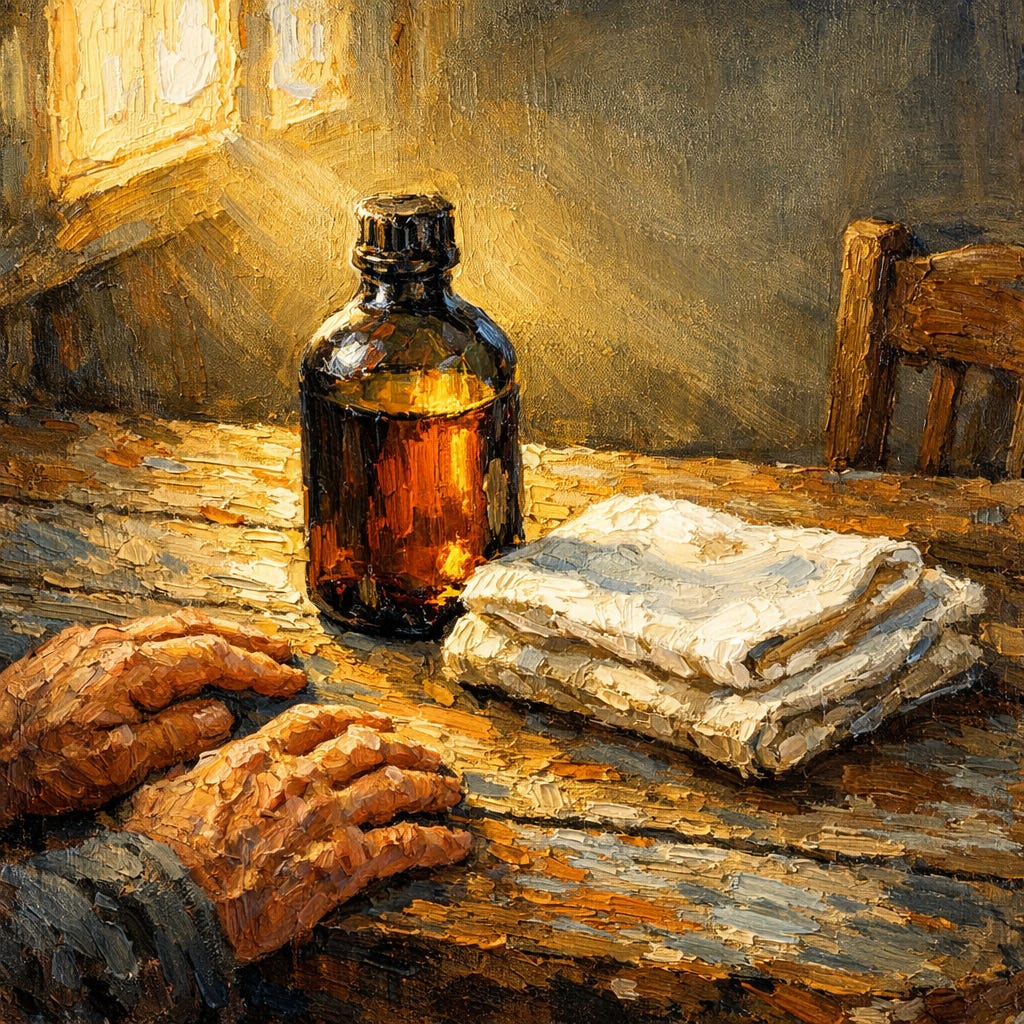
Barbara O’Neill has spent decades teaching natural remedies through lectures, retreats, and videos watched by millions. What follows is drawn from her work—specifically her teachings on castor oil compresses as presented across multiple lectures including “Natural Remedies,” “Home Remedies,” and “Simple Home Remedies.” The knowledge is hers; this essay is an attempt to distill and transmit it.
O’Neill was trained as a nurse. When her first daughter developed an earache at age two, she did not know what to do. Everyone told her not to play with the ears—the child could go deaf. So she went to the doctor, who wrote a prescription for antibiotics. The earache eased within 24 hours. When the antibiotics finished, the earache returned. Six weeks and four courses of antibiotics later, O’Neill found herself asking the doctor whether her daughter would be on antibiotics for the rest of her life.
Two years later, her next child developed an earache at 18 months. This time O’Neill did not go to the doctor. She went next door and knocked on the door of her 85-year-old neighbor.
The old woman knew exactly what to do.
This scene—a trained medical professional standing in the kitchen of an elderly neighbor, learning how to treat a common childhood ailment with an onion—contains the whole story of what happened to practical medicine in the twentieth century. Knowledge that had been passed between generations for centuries, remedies that required nothing more than ingredients from the kitchen and garden, techniques that any parent could learn and apply: all of it pushed aside by a professionalized system that turned every ailment into a visit, a prescription, a dependency.
O’Neill spent the following decades recovering this knowledge and teaching it to others. Among the remedies she teaches, one stands out for its range of application and the elegance of its principle: the castor oil compress.
With thanks to Barbara O’Neill.
Support Independent Research
This work remains free because paid subscribers make it possible. If you find value here, consider joining them.
What paid subscribers get: Access to the Deep Dive Audio Library — 170+ in-depth discussions (30-50 min each) exploring the books behind these essays. New discussions added weekly. That’s 100+ hours of content for less than the price of a single audiobook.
[Upgrade to Paid – $5/month or $50/year]
Get in touch Essay ideas, stories, or expertise to share: unbekoming@outlook.com
The Deepest Penetration
Castor oil penetrates deeper than any other oil. This single property defines everything it can do. Wherever it penetrates, it breaks up what O’Neill calls “unnatural formations”—lumps, bumps, congestion, adhesions, deposits that have accumulated where they don’t belong.
The principle is simple enough that once you understand it, you know where to apply it. Bone spur on the heel? Castor oil compress. Fibroid in the uterus? Castor oil compress. Kidney stones? Castor oil compress over the kidneys. Scar tissue from an old injury? The same. Cyst in the breast, congestion in the chest, stones in the gallbladder, buildup on the eyes that becomes cataracts: the oil penetrates, and the abnormal formation begins to break down.
O’Neill frames this selectivity through a simple image. The castor oil enters the body and asks: where would you like me, what would you like me to do? The unnatural formations—that’s what it addresses. It will break up a bone spur but never break down healthy bone. It will dissolve a cyst but leave normal tissue alone.
This is not the castor oil most people remember. An older generation associates it with punishment—the disgusting liquid forced down children’s throats as a purgative. O’Neill advises against taking it internally. Swallowed, it irritates. Applied externally, held against the skin so it can penetrate slowly and deeply, it becomes something else entirely.
Other practitioners disagree on oral use. Dr. Andrew Kaufman, for instance, recommends castor oil taken orally—up to a quarter cup—as a deep bowel cleanse during acute infections or toxic overload. O’Neill’s approach is exclusively topical. The disagreement is noted here without resolution; readers pursuing oral applications should look beyond O’Neill’s work.
What the Compress Can Address
The list of conditions O’Neill has seen respond to castor oil compresses reads like an inventory of what modern medicine manages rather than resolves.
Bone spurs, bunions, arthritic joints. One woman in her seventies applied compresses to a bunion nightly for two months; the half-inch protrusion disappeared. O’Neill herself manages inherited arthritic tendencies in her thumb with nightly application—when she maintains the practice, the joint never troubles her.
Fibroids, ovarian cysts, endometriosis. The compress goes on the abdomen. O’Neill emphasizes that hormonal imbalance—specifically excess estrogen—drives these growths, so the castor oil works best when combined with approaches that address the underlying hormonal picture. But the oil does its work: penetrating, breaking up the abnormal tissue.
Gallstones and kidney stones. The compress goes over the right rib for the gallbladder, over the lower back for the kidneys. The same principle applies: the oil penetrates, the stones begin to break down.
Irritable bowel and constipation. One woman, married to a doctor, declined whatever her husband offered medically. She had heard about castor oil, applied compresses to her abdomen, and healed her irritable bowel syndrome. O’Neill tells this story without commentary. The doctor’s wife simply chose differently.
Scar tissue and adhesions. This application may be the most overlooked. After any injury or surgery, scar tissue can form internally and cause problems years later. Someone who had an appendix removed a decade ago may develop new symptoms—not from the original condition but from adhesions that built up over time. The castor oil compress, applied consistently, can break up this accumulated tissue.
Even cataracts respond. A drop of castor oil on the finger, wiped over the closed eye, then repeated on the other eye. The oil is sticky, so wiping is easier than dropping it directly in, though O'Neill confirms either approach works: 'Could you put it in your eye? Absolutely. It's just easier to wipe it over your eye though because it's so sticky.' The same principle: abnormal buildup on the lens, gradually dissolved.
Making the Compress
The construction is straightforward, the materials humble.
Start with an incontinence pad—the disposable kind found in any pharmacy. Cut it open and remove the top layer. What remains is a pad with a plastic backing, and this backing matters: it protects clothing and bedding from the sticky oil.
Into the opened pad, insert several layers of cloth. Old sheeting works well. O’Neill uses anywhere from four to ten layers, and emphasizes the relationship: the thicker the compress, the more oil it holds, the more oil penetrates the body. Tape or staple the edges closed.
Pour castor oil onto the middle third of the compress. The oil is thick and will sit on top initially—this is normal. Allow fifteen to thirty minutes for it to soak through. It will spread outward as it absorbs, then spread further when body heat warms it. By starting with oil only in the center, you prevent leakage at the edges.
O’Neill returns to this point repeatedly: castor oil on sheets and clothing is extremely unpleasant. Done correctly, with the plastic backing in place and the oil properly absorbed before application, there is no mess. Done carelessly, you will regret it.
The compress goes directly on the skin over the affected area, plastic side out. It can be held in place with a bandage, worn inside clothing, or simply pressed against the body while resting. Many people sleep with it on. Some wear it through the day. For her own shin injury, O’Neill wore the compress 24 hours a day for a month.
The same compress can be reused for weeks. Fold it over when not in use. Every couple of days, add more oil as the body absorbs what’s there—the compress will feel drier as the oil penetrates inward. After about a month of daily use, make a fresh one.
The Timeline of Healing
O’Neill offers a proportional rule: healing time corresponds to how long the condition has existed.
A bone spur present for three weeks might dissolve in three days. A bone spur present for three months might take three weeks. A bone spur present for three years might require three months.
This principle reframes expectations. Modern medicine has conditioned people to expect fast results—take the pill, feel better tomorrow. The castor oil compress operates on a different timeline, the timeline of the body actually rebuilding tissue and dissolving what doesn’t belong. O’Neill’s consistent message: patience, consistency, daily application. One or two treatments accomplish little. The work is cumulative.
She illustrates this through her own experience. After a serious wrist fracture—ulna fractured, radius completely broken and displaced—she applied castor oil compresses nightly even after the bones healed. The concern was scar tissue. Any significant injury carries the possibility of adhesions forming, causing problems years later. Eight weeks after the break, with the bones confirmed healed by X-ray, she was still applying the compress every night. Prevention is easier than treatment.
The same logic applied to an old shin injury that resurfaced 25 years later. O’Neill had tripped on steps a decade earlier, her shin striking the edge hard. She treated it briefly and forgot about it—no pain, just a small dent in the leg. Then, after weeks of driving a manual transmission car that stressed her left leg, the shin began hurting. A remedial massage revealed accumulated scar tissue at the old injury site. Rather than submit to her son’s painful deep-tissue work to break it up, she chose the gentler approach: castor oil compress, worn continuously, for one month. The pain resolved completely.
The Compress Is Not a Poultice
O’Neill draws a clear distinction. A poultice draws something out of the body. A castor oil compress does not draw anything out—it sends something in. The cloth pad is merely a vehicle, a way to hold oil against the skin so it can penetrate steadily over hours.
This distinction matters for understanding how to use it. A charcoal poultice might be applied once and discarded, having pulled toxins from a bee sting or infection. A castor oil compress works through accumulation, through nightly repetition, through the slow process of oil penetrating tissue and dissolving what shouldn’t be there.
The question sometimes arises: why not simply rub castor oil on the affected area? O’Neill’s answer is practical. The oil is sticky and messy when applied directly to skin. You use a small amount and it doesn’t stay in place. The compress holds substantially more oil against the body for sustained penetration—all night, or all day, or continuously for weeks in acute cases.
What Was Nearly Lost
O’Neill now teaches these remedies to thousands of people through lectures and videos. But the knowledge nearly disappeared entirely.
The 85-year-old neighbor who taught her the onion poultice is gone. That generation—the last generation for whom home remedies were ordinary knowledge, passed from mother to daughter as a matter of course—is largely gone. What they knew existed nowhere in O’Neill’s nursing training. It existed nowhere in the medical system that prescribed four courses of antibiotics for a teething child’s earache.
The displacement happened gradually and then completely. Professionalized medicine offered authority, standardization, insurance coverage, legal legitimacy. What it could not offer was the simple remedies that had kept households functioning for centuries, remedies that cost nearly nothing, required no prescription, carried no side effects, and could be prepared in any kitchen.
A castor oil compress for a fibroid costs a few dollars in materials and can be reused for weeks. It requires no appointment, no imaging, no specialist referral, no surgical scheduling, no recovery time. It requires only consistency and patience—and the knowledge that it works, knowledge that was nearly severed from the culture entirely.
O’Neill’s lectures are a recovery effort. She teaches what the 85-year-old neighbor knew, what generations of women knew, what was known so widely it didn’t need to be written down until suddenly it did, because the chain of transmission had been broken.
The castor oil compress is one piece of this recovered knowledge. There are others: the ginger poultice for joint inflammation, the potato poultice for tissue swelling, the charcoal compress for drawing out toxins, the onion that O’Neill’s neighbor taught her, sliced and cooked and applied warm to a child’s aching ear.
These remedies share common features. They use ingredients available in any kitchen or garden. They require no specialized equipment. They can be prepared by anyone willing to learn. They address common conditions that modern medicine often manages poorly or expensively or with significant side effects. And they were known, widely and practically, until approximately one generation ago.
The knowledge is recoverable. The chain of transmission can be repaired. O’Neill standing in her neighbor’s kitchen, learning what her nursing training never taught her, is the image of that repair beginning. Her teaching is the image of it continuing.
Every household should have the materials for a castor oil compress in the kitchen. The incontinence pad, the old cloths, the bottle of oil, the tape to seal the edges. Ready to be assembled when a bone spur develops, when a cyst is discovered, when an old injury begins to ache, when the body forms something that doesn’t belong and the slow, patient work of dissolving it can begin.
The 85-year-old neighbor is gone. But what she knew doesn’t have to be.
Support Independent Research
This work remains free because paid subscribers make it possible. If you find value here, consider joining them.
What paid subscribers get: Access to the Deep Dive Audio Library — 170+ in-depth discussions (30-50 min each) exploring the books behind these essays. New discussions added weekly. That’s 100+ hours of content for less than the price of a single audiobook.
[Upgrade to Paid – $5/month or $50/year]
Get in touch Essay ideas, stories, or expertise to share: unbekoming@outlook.com
Bitcoin: 3Q6BK8x8zjoPaXykQggzvoJxg5FiEbkb3U
Ethereum: 0x4CB0d39d8466a34609318FC1B003B745893788b3
New Biology Clinic
For those of you looking for practitioners who actually understand terrain medicine and the principles we explore here, I want to share something valuable. Dr. Tom Cowan—whose books and podcasts have shaped much of my own thinking about health—has created the New Biology Clinic, a virtual practice staffed by wellness specialists who operate from the same foundational understanding. This isn’t about symptom suppression or the conventional model. It’s about personalized guidance rooted in how living systems actually work. The clinic offers individual and family memberships that include not just private consults, but group sessions covering movement, nutrition, breathwork, biofield tuning, and more. Everything is virtual, making it accessible wherever you are. If you’ve been searching for practitioners who won’t look at you blankly when you mention structured water or the importance of the extracellular matrix, this is worth exploring. Use discount code “Unbekoming” to get $100 off the member activation fee. You can learn more and sign up at newbiologyclinic.com
Author's Note
Several readers have shared valuable additions in the comments worth highlighting.
Case studies: Darling Crimson describes dissolving a walnut-sized lipoma over several months with twice-daily castor oil application. Pug reports eliminating a 15-year bartholin's cyst in two months using castor oil combined with heat packs and epsom salt baths. Both describe an initial swelling before resolution—worth noting for anyone who experiences this and wonders if it's working.
Edgar Cayce connection: Bonnie Lester mentions learning castor oil compress use from Edgar Cayce's books. Cayce was a major early-twentieth-century proponent of castor oil packs, representing a parallel transmission line beyond the folk tradition O'Neill describes.
Resource sites: Readers recommend DeepRootsAtHome.com, EarthClinic.com, and GreenMedInfo.com as databases for traditional remedies.
Individual variation: Some readers note that castor oil doesn't work identically for everyone. As with any remedy, observe your own response.
Oral use: Some readers shared traditional oral applications (including for inducing labor). These represent different practitioner traditions—O'Neill's approach, which this essay presents, is topical only.
Thank you all for reading and for keeping this knowledge alive in the comments.
Castor oil, turpentine, and DMSO are all good solvents that the body can use to break things down to be eliminated.
https://drsircus.com/general/natural-solvent-medicine-terpenes-dmso-water-turpentine/
Each one dissolves things differently. Castor oil/turpentine are oil/fat soluble while DMSO is water soluble.
On wounds and issues, I like to first apply dmso 50% with a roller applicator and let that soak in.
Then I apply castor oil sometimes with a bit of turpentine using another roller applicator.
It's helped me get rid of an old bone spur!
Amazing stuff and when I tell people about it, they think it's bullshit, especially when they are absorbed into the allopathic IDIOCRACY medical system.