

Everyone knows someone who never flosses and has perfect teeth. Everyone also knows someone who brushes twice a day, uses fluoride, visits the dentist every six months, and still gets cavities. Conventional dentistry has no explanation for either of these people. The model it operates on — bacteria in the mouth feed on sugar, produce acid, and dissolve teeth — cannot account for the most basic observations that any patient could make from the waiting room.
More than four hundred species of bacteria coexist in the mouth at all times, yet decay is not universal. Antibiotics that kill bacteria do not stop cavities. Antibacterial mouthwashes do not prevent them. Populations eating traditional diets — people who never brushed, never flossed, never saw a dentist — had cavity rates approaching zero. And breastfed children develop cavities even though dentistry’s own published research confirms that breast milk inhibits the very bacteria it claims cause decay.
These are not edge cases. They are the norm. The model that cannot explain the norm is the model on which every fluoride treatment, every sealant, every drilling-and-filling protocol, and every instruction to “brush after eating” is built. The premise is not incomplete. It is wrong.
Most people have never heard a dentist explain why they got a cavity in terms more specific than “you need to brush more” or “you’re eating too much sugar.” The sugar part is closer to the truth than dentistry realises — but not for the reason it gives. Conventional dentistry believes sugar feeds bacteria on the tooth surface, and the bacteria produce acid that dissolves enamel. The actual mechanism, demonstrated in controlled experiments over four decades, is that sugar consumed internally disrupts the endocrine system that maintains the tooth from within. That distinction determines whether the solution is a better toothbrush or a better diet. The profession has been prescribing the toothbrush.
The experimental evidence for this is not new. It has existed for decades. It was never incorporated into the profession’s operating system, because the operating system was decided by a vote, not by evidence — and the vote happened before the most important research was even conducted.
Support Independent Research
This work remains free because paid subscribers make it possible. If you find value here, consider joining them.
What paid subscribers get: Access to the Deep Dive Audio Library — 180+ in-depth discussions (30-50 min each) exploring the books behind these essays. New discussions added weekly. That’s 100+ hours of content for less than the price of a single audiobook.
[Upgrade to Paid – $5/month or $50/year]
Get in touch Essay ideas, stories, or expertise to share: unbekoming@outlook.com
Steinman’s Experiments
In 1958, dentist Ralph Steinman at Loma Linda University began questioning the prevailing theory of tooth decay. His personal experience was part of the catalyst — his own debilitating asthma had been cured by removing processed foods and sugar from his diet. But his scientific curiosity was provoked by something more specific: nineteenth-century dental texts that hypothesised the existence of a lymph-like fluid circulation inside the tooth. If teeth contained an active internal fluid, then the acidogenic theory — which treats the tooth as an inert object sitting passively in a hostile environment — was missing something fundamental.
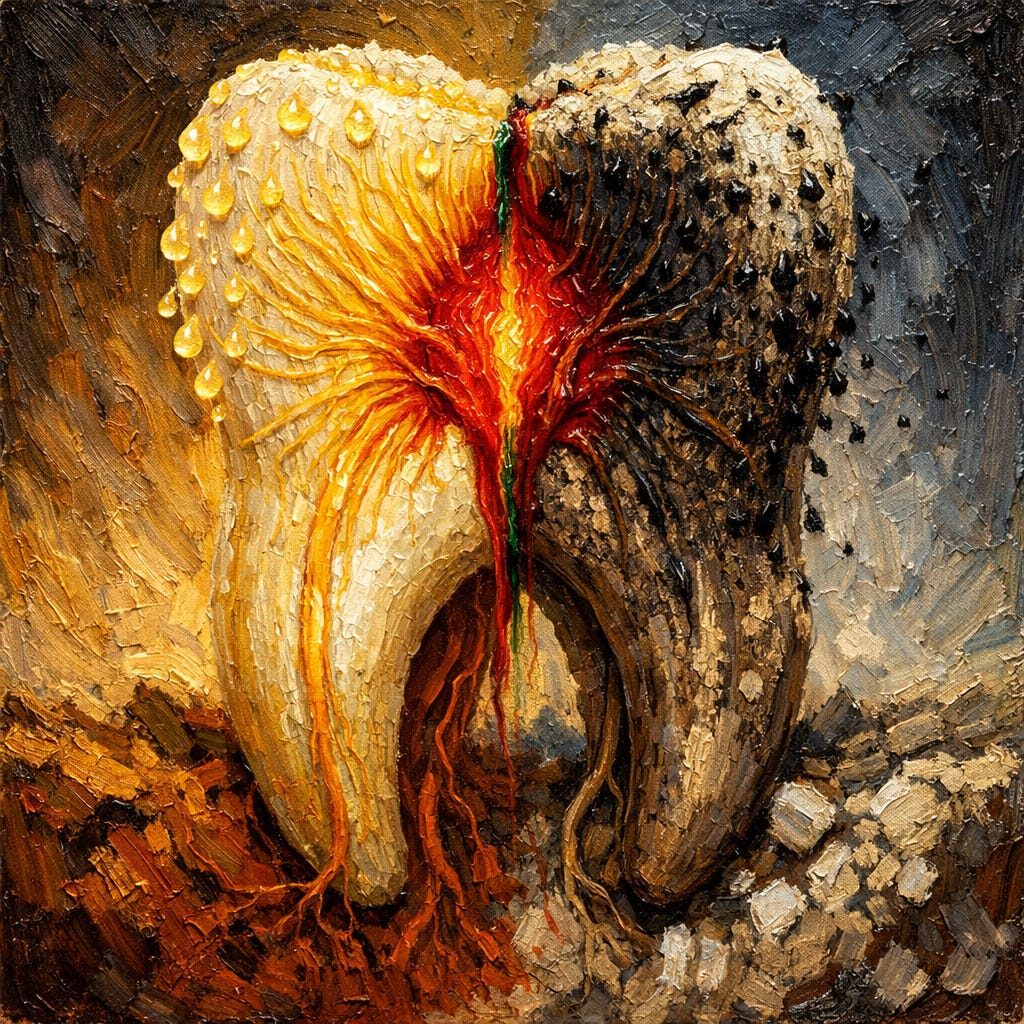
Steinman developed a technique to track this fluid using fluorescent dye markers in rats. Dye injected into a rat’s stomach appeared in the tooth’s inner pulp chamber within six minutes. Within an hour, it was visible in the enamel. Teeth were not inert. They were internally active, circulating a nutrient-rich fluid outward from the pulp through miles of microscopic tubules — like sap in a tree.
This dentinal fluid flushed toxins from the tooth, delivered minerals to the tooth’s structural matrix, and repelled microbial biofilm on the surface. Nadine Artemis, drawing on Steinman’s work, described it as “an invisible toothbrush.” Tiny droplets coalesced on the enamel, forming a protective layer. When the enamel cracked, the fluid volume increased to that area — sap responding to a wound in bark.
Then Steinman disrupted the system.
He fed rats sugar. The fluid flow reversed. Instead of flowing outward — cleaning, mineralising, protecting — it became centripetal, drawing bacteria, acids, and debris inward from the mouth. The teeth decayed from the inside.
He introduced sugar directly into the rats’ stomachs through a tube, bypassing the teeth entirely. The flow still reversed. Cavities still formed. Sugar that never touched a tooth surface caused tooth decay.
He injected glucose under the skin of the rats’ abdomens. Same result. The sugar entered the bloodstream, disrupted the systemic signalling, and the teeth broke down — without a single molecule of sugar contacting the oral environment.
As Dr. George Meinig documented, bacteria placed directly on teeth in controlled conditions did not reliably initiate decay. The conventional model had causation backwards. Sugar was not destroying teeth by feeding bacteria on the tooth surface. It was destroying them by disrupting the endocrine system that maintained the teeth from within.
Teeth Are Organs
Each tooth contains approximately three miles of microscopic tubules called dentinal tubules. They are filled with a fluid estimated to be similar to cerebrospinal fluid and are continuously perfused by odontoblasts — connective tissue cells that act as microscopic pumps, transporting nutrients from the blood supply through the pulp and outward through the dentin to the enamel.
The enamel itself, though the hardest substance in the human body, is not a sealed shell. Under a microscope it looks like a honeycomb — porous enough to permit fluid movement through it. It is constantly building up and breaking down, a dynamic mineral matrix of crystalline calcium phosphate (hydroxyapatite) that depends on continuous delivery of minerals from within. When salivary pH sits at 7, calcium and phosphate flow freely into the enamel, forming dense crystals. When the internal supply is disrupted, the crystals dissolve and the honeycomb develops pores. The tooth becomes vulnerable — not because bacteria attacked from outside, but because the internal support system failed.
Steinman, working with endocrinologist John Leonora over forty years through hundreds of studies, traced the regulatory mechanism for this fluid to a specific endocrine axis: the hypothalamic-parotid gland pathway. The hypothalamus communicates with the parotid gland — the largest salivary gland, situated adjacent to the inner ear and jawbone. When the hypothalamus signals correctly, the parotid gland releases parotid hormone, which triggers and sustains the outward flow of mineral-rich dentinal fluid.
A diet high in sugar and refined carbohydrates breaks this chain. Sugar elevates blood insulin, which suppresses hypothalamic function, which disrupts the hormonal signal to the parotid gland, which shuts down the protective fluid flow. Steinman and Leonora documented that the endocrine axis responds as soon as blood sugar levels change. Chronic elevation — the daily reality of the modern diet — produces chronic suppression of dentinal flow.
Steinman also identified the specific minerals lost in this process: magnesium, copper, iron, and manganese, all active in cellular metabolism and essential for the energy production that powers the cleansing flow through the tubules. The addition of copper, iron, and manganese to a sugar-producing diet almost abolished the decay rate. Phosphorus alone reduced it by eighty-six percent and prevented the atrophy and shrinking of the parotid gland that sugar otherwise caused.
At the tissue level, the process is mechanical. The tooth, deprived of its internal nutrient supply, demineralises. The structural matrix weakens. The dentin loses mineral density. The tissue begins to die. Microorganisms — always present in the mouth, more than four hundred species of them — proliferate in response to the dying tissue. They are participants in decomposition, not its initiators. The relationship is the same one that exists between flies and a wound. The flies did not cause the injury. They arrived because the tissue was already compromised.
Think of it as blaming rain for a leaky roof. When the roof is sealed and maintained, it does not leak whether it rains or not. When the internal structure fails, any moisture finds its way in. Bacteria in the mouth are the rain. The dentinal fluid flow is the roof. Dentistry has spent a century trying to eliminate rain.
Stress, through the production of cortisol, also disrupts the hormonal cascade and hinders dentinal fluid flow. Hormonal shifts — low thyroid activity, pregnancy, puberty, growth spurts in children — affect the hypothalamic-parotid axis and make teeth susceptible during those periods. This is why pregnant women are told they will “lose a tooth for every baby” — not because the baby is stealing calcium in some mechanical sense, but because the hormonal disruption of pregnancy suppresses dentinal fluid flow. The phenomenon is real. The conventional explanation for it is wrong. And fluoride itself systemically suppresses the hypothalamus and reverses parotid activity — meaning the substance prescribed to prevent decay may, through a different pathway, contribute to the conditions that cause it.
Even W.D. Miller, whose 1883 research is cited as the foundation of the bacterial theory of cavities, did not believe bacteria alone caused decay. Miller wrote that the extent to which any tooth suffers from acid depends on “its density and structure,” and that a strong, dense tooth would “resist indefinitely” the same acid that would destroy a weaker one. He also noted that demineralisation always precedes microbial invasion — the tooth loses its mineral density first, and then microorganisms become involved. Modern dentistry adopted Miller’s observations about acid-producing bacteria while discarding his central insight: that the tooth’s own structural integrity was the determining factor.
How the Theory Was Installed
The moment the bacterial model became orthodoxy is historically documented. In the 1940s, at a meeting of the International Association of Dental Research, the question of what causes tooth decay was put to a vote. The acidogenic theory — that acid-producing bacteria on the tooth surface initiate the decay process — was adopted as fact by majority decision.
Competing theories were presented. The most notable was the proteolysis-chelation theory proposed by Dr. Albert Schatz, who argued that enzymes and chelating agents — not bacteria and acid — were responsible for tooth mineral loss, and that diet, trace elements, and hormonal balance were the triggering factors. His theory was sidelined. All systemic theories of decay were sent to the margins.
The vote did not resolve a scientific question. It resolved a professional one. The bacterial model was operationally convenient: it justified intervention at the surface level. It created a treatment protocol — brushing, rinsing, drilling, filling — that could be standardised, taught, and billed. It required no understanding of endocrinology, no dietary assessment, no systemic thinking. A dentist needed to know how to clean a surface and repair a hole. Whatever its scientific limitations, it was a business model of considerable efficiency. As Ramiel Nagel documented, the drilling-and-filling protocol is not just a treatment model — it is a revenue model. The more teeth that are drilled and filled, the more money is generated. There is very little financial incentive in a system structured this way for curing or preventing the disease at its source, because the drilling and filling is the business.
In 1922, twenty years before the vote, dentist Percy Howe had already demonstrated to the American Dental Association that he could not reproduce tooth decay by feeding or inoculating guinea pigs with bacteria associated with dental disease. He could, however, produce decay easily by removing vitamin C from their diet. And there is a further irony in the bacterial model’s claim that sugar feeds the bacteria that cause decay: white sugar, in a twenty-percent solution, actually kills bacteria by drawing water out of them. If dentistry’s theory were correct — that sugar feeds bacteria, and bacteria cause cavities — then a high-sugar diet should reduce bacterial populations and protect teeth. It does the opposite, but not for the reason dentistry claims. The bacterial theory was not proven before the vote. It was not proven after it. It was adopted by consensus and defended by institutional momentum.
Steinman’s research, beginning in 1954 and continuing for four decades through his collaboration with Leonora, provided the mechanistic explanation for what Howe had observed, what Miller had intuited, and what the IADR vote had chosen to ignore. His work was published. It was conducted at a respected university. It was methodologically rigorous. It did not fit the model that had already been installed — the model that generated the procedures, the billing codes, and the professional identity of an entire field.
The Evidence Dentistry Cannot Explain
The evidence the bacterial model fails to account for is not obscure or contested. It is the lived experience of billions of people and the documented record of every population study conducted on traditional diets.
Weston Price, chairman of the Research Section of the American Dental Association, spent nine years in the 1930s travelling the world studying the dental health of indigenous populations. He examined isolated Swiss villagers in the Loetschental Valley, Gaelic communities in the Outer Hebrides, Inuit villages in Alaska, Aboriginal Australians, Maori in New Zealand, Melanesians and Polynesians across the South Pacific, tribes in eastern and central Africa, and indigenous communities in Peru and the Amazon Basin.
The pattern was universal. Among those eating traditional foods across Price’s studies, the average number of teeth affected by cavities was 0.79 percent — fewer than eight out of every thousand teeth examined. Among those eating Western foods in the same populations, often living just a few miles away, the rate exceeded thirty-three percent. Thirteen of the twenty-seven African tribes he studied presented such a high standard of dental excellence that not a single individual in the group had deformed dental arches. Native races of eastern and central Africa showed immunity to caries ranging from zero to less than one percent of teeth affected; where modernised, the incidence rose to 12.1 percent. These people did not brush. They did not floss. They did not use fluoride. Their teeth were often coated with starchy food residue. Many relied on carbohydrate-rich diets: the Gaelics of the Outer Hebrides ate roughly a thousand calories per day of properly prepared oats and had a cavity rate of 0.7 to 1.3 percent. The isolated Swiss of the Loetschental Valley ate about eight hundred calories per day of properly prepared rye bread and had a cavity rate of 0.3 to 5.2 percent. The bacterial model says food residue on teeth, consumed by acid-producing bacteria, causes cavities. These populations had the food, had the bacteria, and had no cavities.
When the same populations adopted Western trade foods — and the items were consistent worldwide, ninety percent of the time consisting of white flour and sugar — rampant tooth decay appeared within a single generation. Price documented Pacific Island communities where trader ships arrived when copra prices were high, paying for dried coconut in white flour and sugar. Tooth decay surged. When copra prices dropped and the ships stopped coming, the people returned to their native diets. Price personally examined individuals whose teeth had open cavities in which the decay had ceased to be active — the disease stopped progressing once the dietary insult was removed.
Price’s nutrient analyses explained why. The isolated Swiss diet contained ten times more fat-soluble vitamins and activators than the modern Swiss diet, four times more calcium, and 3.7 times more phosphorus. The isolated Gaelics consumed ten times more fat-soluble vitamins than their modernised counterparts a few miles away. The Aboriginal Australian coastal diet contained 4.6 times the calcium, 6.2 times the phosphorus, and ten times the fat-soluble vitamins of the modernised diet. Across every population, the pattern held: when the nutrients required to sustain dentinal fluid flow and the internal mineral matrix were present in adequate amounts, the teeth did not decay — regardless of oral hygiene practices, bacterial load, or carbohydrate exposure.
The breast milk problem adds another layer. The American Academy of Pediatric Dentistry’s own published research states that breast milk inhibits acid and bacterial growth in the mouth. Breastfed children should, under the bacterial theory, have lower cavity rates than bottle-fed children. Many do not. Many breastfed children develop tooth decay even with antibacterial milk constantly bathing their teeth. The bacterial theory has no mechanism to explain this. The systemic model does: the child’s overall nutritional status, the mother’s dietary quality, and the resulting hormonal environment determine whether the dentinal fluid flow functions or fails.
The infectious disease framing itself falls apart under examination. If cavities were infectious, antibiotics should cure them — they do not. People who contracted the “infection” should develop antibodies — they do not. Effective antibacterial treatment should prevent recurrence — it does not. The only intervention that reliably halts and reverses early decay is dietary change: the precise intervention the systemic model predicts would work and the bacterial model has no mechanism to explain.
What Follows
If decay is a systemic, endocrine event triggered by diet — and four decades of published research demonstrate the mechanism — then the entire preventive framework of modern dentistry addresses the wrong target. Fluoride, applied topically to tooth surfaces, does nothing to restore the hypothalamic-parotid axis or restart dentinal fluid flow. Worse, Steinman’s research indicated that fluoride systemically suppresses the hypothalamus and reverses parotid activity — the very mechanism that protects teeth from within. Sealants do nothing to address the internal demineralisation that precedes visible decay. Antibacterial mouthwashes are fighting an organism that is responding to tissue death, not causing it. The drill addresses the aftermath of the disease. It does not touch the disease itself.
The cost of getting this wrong is not abstract. Every year, billions of dollars flow through a system built on the premise that bacteria on the tooth surface initiate decay. Every filling, every crown, every fluoride varnish, every sealant is a downstream consequence of that premise. Fillings fail. They crack, they leak, they require replacement — often with larger interventions that weaken the tooth further, progressing from filling to crown to root canal to extraction. The patient who began with a small cavity ends, decades and thousands of dollars later, with an implant screwed into their jawbone. At no point in this cascade did anyone address the reason the tooth decayed in the first place.
The experimental evidence from Steinman’s rat studies, Price’s population studies, Howe’s inoculation experiments, and Miller’s own original caveats all converge on the same conclusion: the profession has been treating the visible damage of a systemic disease while ignoring the systemic disease itself. The person who brushed twice a day, flossed, used fluoride rinse, and still developed cavities was never failing at hygiene. They were never given the right information about what was actually happening inside their teeth.
The Research Exists
Ralph Steinman’s work was conducted at Loma Linda University over forty years, in collaboration with endocrinologist John Leonora, through hundreds of controlled studies. The mechanism he described — hypothalamus to parotid gland to dentinal fluid flow — is documented, tested, and replicable. The dietary triggers he identified — sugar, refined carbohydrates, mineral deficiencies — are consistent with every population study conducted on tooth decay. The mineral interventions he tested — phosphorus reducing decay by eighty-six percent, copper, iron, and manganese nearly abolishing it — produced measurable, dramatic results.
The profession had the evidence. Steinman’s work was in the published literature, including the Journal of Dental Research. Price’s population data was published in the Journal of the American Dental Association. Howe’s inoculation failures were presented to the ADA in 1922. Miller’s own words, written in 1883, explicitly stated that tooth density and structure were the determining factors in decay. The chain of evidence from 1883 to the present supports a single premise: it is diet, not bacteria, that causes cavities.
Tooth decay is a systemic disease driven by diet, regulated by the endocrine system, and expressed through the failure of the tooth’s own internal protective mechanism. Bacteria are present during the process. They are not the cause of it.
Steinman’s research exists. The studies are published. The mechanism is described. The profession chose not to look — and the waiting rooms filled accordingly.
References
Steinman, R.R. and Leonora, J. “Effect of Selected Dietary Additives on the Incidence of Dental Caries in the Rat.” Journal of Dental Research 54 (May 1975): 570–77.
Roggenkamp, C.L. and Leonora, J. Dentinal Fluid Transport: Publications of Drs. Ralph Steinman and John Leonora. Loma Linda, CA: Loma Linda University School of Dentistry, 2004.
Artemis, N. Holistic Dental Care: The Complete Guide to Healthy Teeth and Gums. Berkeley, CA: North Atlantic Books, 2013.
Price, W.A. Nutrition and Physical Degeneration. 7th ed. La Mesa, CA: Price-Pottenger Nutrition Foundation, 2006. Originally published 1939.
Price, W.A. “Field Studies among Some African Tribes on the Relation of Their Nutrition to the Incidence of Dental Caries and Dental Arch Deformities.” Journal of the American Dental Association 23 (May 1936): 888.
Nagel, R. Cure Tooth Decay: Heal and Prevent Cavities with Nutrition. Los Gatos, CA: Golden Child Publishing, 2010.
Meinig, G.E. Root Canal Cover-Up. Ojai, CA: Bion Publishing, 1994.
Breiner, M.A. Whole-Body Dentistry: A Complete Guide to Understanding the Impact of Dentistry on Total Health. Fairfield, CT: Quantum Health Press, 2011.
Nara, R.O. and Mariner, S.A. Money by the Mouthful. Myrtle Beach, SC: OraMedia, 1979.
Fife, B. Oil Pulling Therapy: Detoxifying and Healing the Body Through Oral Cleansing. Colorado Springs, CO: Piccadilly Books, 2008.
Rheaume-Bleue, K. Vitamin K2 and the Calcium Paradox. Toronto: HarperCollins, 2012.
Miller, W.D. The Micro-Organisms of the Human Mouth. Philadelphia: S.S. White Dental Mfg. Co., 1890.
Huggins, H.A. It’s All in Your Head: The Link Between Mercury Amalgams and Illness. New York: Avery Publishing, 1993.
Page, M. and Abrams, L. Your Body Is Your Best Doctor. New Canaan, CT: Keats Publishing, 1972.
American Academy of Pediatric Dentistry. “Breastfeeding and Infant Tooth Decay.” Press Release, April 1999.
Howe, P.R. Proceedings of the American Dental Association, 1922. Presented research on failure to reproduce dental caries through bacterial inoculation in guinea pigs.
Book: Medicalized Motherhood: From First Pill to Permanent Patient
Available as a free download. 123 interventions documented across six phases—from pre-conception capture through postpartum surveillance. Includes practical tools: birth plan template, provider interview questions, quick reference card, and a new chapter on interrupting the cascade. Download it, share it with someone facing their first prenatal appointment, their induction date, their cesarean recommendation. The cascade works because women don’t see it coming. This book makes it visible.
Support Independent Research
This work remains free because paid subscribers make it possible. If you find value here, consider joining them.
What paid subscribers get: Access to the Deep Dive Audio Library — 180+ in-depth discussions (30-50 min each) exploring the books behind these essays. New discussions added weekly. That’s 100+ hours of content for less than the price of a single audiobook.
[Upgrade to Paid – $5/month or $50/year]
Get in touch Essay ideas, stories, or expertise to share: unbekoming@outlook.com
New Biology Clinic
For those of you looking for practitioners who actually understand terrain medicine and the principles we explore here, I want to share something valuable. Dr. Tom Cowan—whose books and podcasts have shaped much of my own thinking about health—has created the New Biology Clinic, a virtual practice staffed by wellness specialists who operate from the same foundational understanding. This isn’t about symptom suppression or the conventional model. It’s about personalized guidance rooted in how living systems actually work. The clinic offers individual and family memberships that include not just private consults, but group sessions covering movement, nutrition, breathwork, biofield tuning, and more. Everything is virtual, making it accessible wherever you are. If you’ve been searching for practitioners who won’t look at you blankly when you mention structured water or the importance of the extracellular matrix, this is worth exploring. Use discount code “Unbekoming” to get $100 off the member activation fee. You can learn more and sign up at newbiologyclinic.com
Yeah, I stopped going to the dentist. Everytime something was wrong with my teeth he wanted to pull a tooth. When his office said I needed to wear a mask, that was it for me. If God wants my teeth, he can have them.
I was recently pondering the reason I hadn’t had a cavity in a decade or more and now I know why. I had stopped drinking soda pop. I did it to reduce my blood pressure. Thinking back, it coincides with the improvement in my dental health. In the last five years I have shied away from almost all sugary treats. Time now to stop that poisoning altogether. And time to start eating foods with better mineral content.