

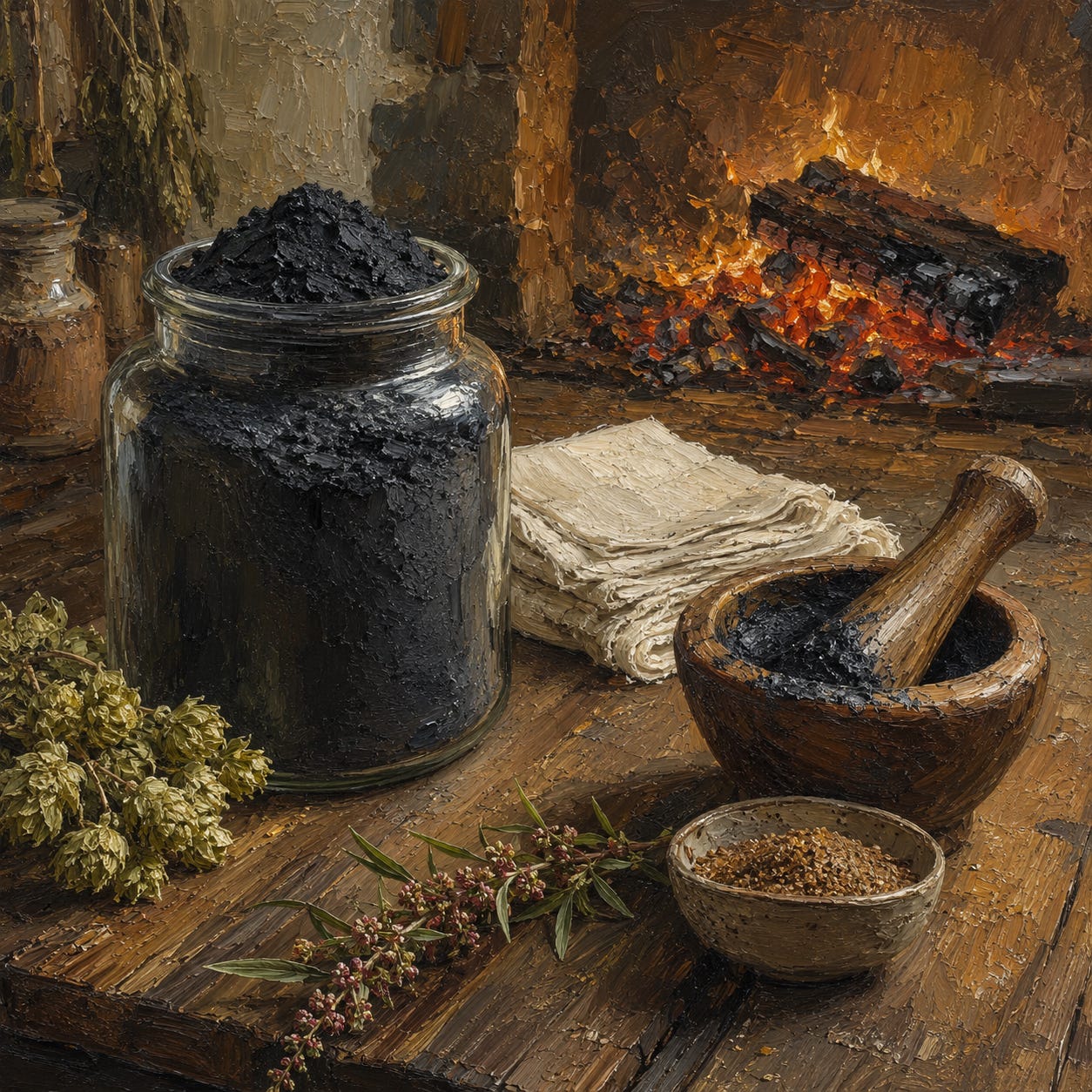
Part of an ongoing series on remedies displaced from ordinary use because no one could own them.
Nothing here is medical advice. The dosages and applications come from Jethro Kloss’s 1939 encyclopedia of natural remedies, confirmed against current clinical references. In an acute poisoning, call poison control first. In the United States, the number is 1-800-222-1222. In Australia, it is 13 11 26. Every developed country has an equivalent. Charcoal is compatible with almost every emergency protocol; use it while help arrives, not instead of it.
In 1813, the French chemist Michel Bertrand swallowed five grams of arsenic trioxide mixed with activated charcoal. He suffered no apparent injury.¹
Seventeen years later, the pharmacist Pierre-Fleurus Touery repeated the experiment publicly. Standing before the assembled French Academy of Medicine in Paris, he swallowed ten times the lethal dose of strychnine mixed with fifteen grams of activated charcoal. He walked away unharmed.¹
The Academy witnessed the second demonstration. The proceedings were recorded and the mechanism was named. Anyone with a wood stove could produce the substance at home.
Two hundred years later, activated charcoal remains on the World Health Organization’s Model List of Essential Medicines, section 4.1, listed as a non-specific antidote for oral poisonings.² Every poison control center in the developed world stocks it. A jar sufficient to treat a household for years costs less than ten dollars.
Not a single mainstream physician recommends keeping it on the shelf at home.
This work stays free because paid subscribers make it possible. They get the full book library, the Deep Dive Audio Library, and the Questions for Your Doctor, Before You Consent, and Package Insert series. No grants, no gatekeepers — your subscription is what keeps it that way.
Audio Deep Dive (for Paid Subscribers)
The lineage
Documented medical use of charcoal reaches back at least to the physicians of Hippocratic Greece, around 400 BCE.¹ The substance sat in the European pharmacopeia through the centuries that followed, used both externally as a poultice and internally for stomach complaints.
The military took charcoal seriously earlier than modern medicine did. During World War I, activated charcoal was the adsorbent element in the gas masks issued to soldiers.¹ Men walked into clouds of chlorine and mustard gas and survived because the charcoal in their filters held the poisons on the pore walls long enough for them to breathe. Applied chemistry, verified under the most extreme experimental conditions imaginable.
By 1939, Jethro Kloss recorded what had happened next in his home country. Writing his encyclopedia of natural remedies, he noted in one sentence: *”Following the war, the use of charcoal in the United States was largely neglected.”*¹ He named two proximate causes. Household confusion of medicinal charcoal with burnt toast. And the pharmaceutical introduction of a mixture called the “universal antidote,” which combined charcoal with magnesium oxide and tannic acid, dulling its action.¹ The deeper cause he could not have named in 1939 would take another eighty years to become fully visible.
Kloss is the contemporaneous witness. A man writing in the middle of the shift saw it happening, named it, and moved on. The rest of the century completed what he was describing.
By 1963, the mainstream still knew what had been lost. Writing in the Journal of Pediatrics, John Holt described charcoal as “probably the most valuable single agent we possess” for ingested poisons, and added: *”A bottle of charcoal on every medicine shelf would go a long way to combat serious poisonings in the home.”*¹
Sixty years later, no medicine shelf has one.
How it works
Charcoal does not soak substances up. It holds them on its surface.
This distinction, technical as it sounds, is the whole story.
When water enters a sponge, the water fills the interior spaces of the material. The sponge absorbs. When arsenic or strychnine or chlorine gas meets charcoal, the molecules stick to the exposed surfaces of the carbon and cannot detach. The charcoal adsorbs. One letter, and the mechanism changes.
The surfaces involved are staggering. A piece of activated charcoal two-fifths of an inch square, once its internal pore structure is measured, presents an area of roughly thirty-three square yards. Larger than most living rooms. A tablespoon of powder holds within its microscopic honeycomb more binding surface than the interior walls of a modest house. A quart of charcoal can bind approximately ninety quarts of ammonia gas. The material holds on its surface between 250 and 350 times its own weight in captured substance.¹
The activation is a specific process. Wood is burned slowly under controlled low-oxygen conditions. Kloss specifies boxwood, coconut shells, willow, or pine as the preferred sources.¹ The volatile components drive off. What remains is a lattice of pure carbon riddled with microscopic pores. A second treatment, usually with steam or acid, opens the pores wider. The finished material is odorless, tasteless, and chemically inert until it meets something it can bind.
What it binds: strychnine, morphine, nicotine, barbiturates, salicylates, kerosene, opium, cocaine, most antidepressant drugs, and the majority of other pharmaceutical compounds.¹ It binds the gases produced by fermentation in the digestive tract, which are responsible for bloating, heartburn, and sour stomach. Applied over a bite or sting, it draws venom outward through the skin.
What it does not bind: lye and caustic alkalis, mineral acids, alcohol, iron, and cyanides.¹ These are the stated limits. Kloss listed them plainly. Any honest account of charcoal names them alongside the substances it does bind, because the material is not magic. It is chemistry.
The mechanism requires no biological model at all. It does not rest on germ theory. It rests on the physical properties of activated carbon. The charcoal binds the toxin, and the body then eliminates the charcoal and toxin together through the ordinary process by which the intestine passes waste.
Three objections
Three arguments will be raised against domestic charcoal use. Each deserves a direct answer.
The first is that charcoal binds nutrients as well as poisons. True. John Holt admitted it in the same article that praised the substance: *”It is now very clear that activated charcoal will adsorb not only poisons but also vitamins, digestive enzymes, amino acids, and other valuable nutrients from the gut. Such losses if continued will seriously affect health, but are of no importance in situations of acute poisoning.”*¹ The answer lives in the last clause. Charcoal is an acute intervention. It is not a daily supplement. Not a cleanse. Not a preventive. Taken across a few hours in response to a specific toxic event, the loss of some nutrients weighs nothing against the neutralization of a poison. Taken daily as an ongoing regimen, it becomes exactly the treadmill the supplement industry runs on, generating depletion while promising vitality. Use it when you need it. Put it back on the shelf when the need has passed.
The second objection is that the body cleanses itself, and intervention is unnecessary. Under ordinary conditions this is correct. The eliminative organs, meaning kidneys, liver, colon, skin, and lungs, handle the metabolic burden of ordinary living without external help. But acute toxic exposure is not ordinary. A wasp sting. Food poisoning. A drug overdose. A mushroom mistake. These are events in which the toxic load exceeds the body’s elimination capacity inside a specific window of time. Charcoal does not replace the body’s own work. It supports it by binding what would otherwise be reabsorbed through the enterohepatic circulation, the loop by which the liver dumps a toxin into the bile, the intestine reabsorbs the toxin into the blood, and the process repeats. Bind the toxin to charcoal in the intestine and the loop breaks. The body carries on with its own work. The intervention is limited, targeted, and stops when the acute phase ends.
The third objection is the most common: if charcoal were truly effective, mainstream medicine would use it. Mainstream medicine does use it. The 2025 WHO Model List of Essential Medicines names activated charcoal under section 4.1 as a first-line non-specific antidote for oral poisonings.² Every poison control center in the United States, the United Kingdom, Australia, and continental Europe stocks it. It appears in the standard emergency-room protocol for suspected overdose. What does not appear anywhere, on any pharmacy shelf display, in any consumer leaflet, in any physician’s after-visit summary, is a recommendation to keep the substance at home. Charcoal is used where the patient cannot refuse the surrounding pharmaceutical protocol. It is not used where the patient could use it alone.
The most cited institutional skepticism about charcoal is a 2005 position paper from the American Academy of Clinical Toxicology and the European Association of Poisons Centres, published in Clinical Toxicology. It concludes that single-dose activated charcoal should not be administered routinely, that greatest benefit comes within one hour of ingestion, and that “there is no evidence that the administration of activated charcoal improves clinical outcome.”⁴ Read carefully, the paper confirms the mechanism in its own data. Fifty grams of activated charcoal reduces drug absorption by roughly 47 percent when given at thirty minutes and 40 percent at one hour.⁴ What is not confirmed is whether that reduction changes survival, and the paper acknowledges that “there are no satisfactorily designed clinical studies” of the question.⁴ The trials that would have proven clinical outcome benefit for a substance that costs pennies were never funded. Which is enough to keep charcoal in the hospital protocol, and enough to keep it off the home shelf.
That distinction sits at the center of the essay’s closing section.
What to keep on hand
The powdered form is the most effective. Capsules are twice as strong as tablets, but the powder mixed into water can be swallowed at once in a dose large enough to matter. Tablets are for chronic gas and indigestion, not for poisoning.¹
Coconut-shell activated charcoal is the modern standard. It comes from a renewable source and has very fine pore structure. Hardwood charcoal also works. Kloss’s original recommendation named boxwood, willow, and pine.¹
The one thing to avoid is charcoal briquettes sold for outdoor grilling. These contain binders, accelerants, and lighter-fluid residues. They are not activated in the medical sense and are not fit for internal use.
A four-ounce jar of activated charcoal powder costs six to ten dollars at current pricing. That quantity is sufficient for years of household use. Larger bulk containers cost a few dollars more. The economics of the substance explain why it generates almost no revenue. There is no repeat customer and no monthly renewal. A single jar sits on the shelf and comes down only when needed.
Storage matters. Charcoal adsorbs ambient volatiles from the air if left uncovered. Kitchen fumes, gasoline vapors, and cleaning products all exhaust its binding capacity before use. Keep it in a sealed glass or metal container. Old charcoal, Kloss notes, can be reactivated by heating.¹
How to use it
For digestive complaints (gas, heartburn, indigestion, food poisoning).
Stir one heaping teaspoon of charcoal powder into a glass of water until it forms a thin slurry. Drink at once. The taste is negligible; the texture is chalky. For persistent symptoms, repeat after two hours. The dose can be doubled without harm.¹
Take charcoal away from food and away from medications. It will bind both.
For acute poisoning (accidental ingestion of a toxic substance).
Five times the estimated weight of the ingested poison, in charcoal. Eight to ten times if food is already in the stomach. One tablespoon of charcoal powder equals approximately ten grams.¹ For an adult, this typically means two to four tablespoons stirred into a large glass of water and drunk immediately.
The sooner charcoal is taken after ingestion, the more effective it will be. Its window is the interval before the toxin has been absorbed out of the intestinal tract and into the bloodstream, usually the first hour or two.
Call poison control simultaneously. Charcoal is compatible with almost every emergency protocol, and the personnel on the phone will not object to its use. In most cases they will confirm it.
External use: the poultice.
Kloss’s recipe calls for equal parts pulverized charcoal and ground flaxseed. Grind the flaxseed fine in a coffee grinder first; the mixture will form a paste faster. Add enough water to form a thick paste and bring it slowly to a boil while stirring. Spread the paste about a quarter-inch thick on a piece of cotton or muslin cloth, keeping it one inch in from the edges. Cover with a second cloth. Apply to the affected area. Cover with a piece of plastic wrap slightly larger than the poultice. Wrap the whole thing with a towel or elastic bandage and pin in place.¹
Leave on for eight to ten hours, during the day or overnight.
When to reach for the poultice.
Insect bites and stings from bee, wasp, spider, and mosquito. The charcoal draws venom outward through the skin.
Poison oak and poison ivy reactions.
Wounds that will not close, chronic ulcers, boils and carbuncles coming to a head.
Inflammation around the eyes and ears.
Abdominal pain from digestive distress that has not resolved with internal charcoal.¹
Combinations Kloss records.
Charcoal with hops applied over the abdomen relieves gallstone pain quickly.
Charcoal moistened with smartweed tea works for bruises and general inflammation.
Charcoal in slippery-elm tea, equal parts, is used for gangrenous sores and stubborn ulcers.
Charcoal mixed with ground fenugreek seed as a paste treats ulcers and swellings. Kloss says the preparation will prevent what he calls “blood poisoning.”
Charcoal and olive oil worked to a paste, taken internally, addresses some forms of persistent indigestion.¹
None of these formulations is patented. Every one is reproducible in a home kitchen with materials that cost dollars. This is the point.
What happened to charcoal
Charcoal was not banned. No court order was issued against its use. What happened was displacement.
Every one of charcoal’s applications was replaced across the twentieth century by a dedicated pharmaceutical product line. The digestive complaints charcoal had handled for two millennia, including heartburn, indigestion, gas, and sour stomach, moved to antacids, then to H2 blockers, then to proton-pump inhibitors, a market now worth tens of billions of dollars annually. Wound care moved to topical antibiotics and a proliferating cascade of specialty dressings. Inflammation moved to steroid creams. Insect bites and stings moved to antihistamines and hydrocortisone. Poisoning management retreated inside the emergency room, where the encounter itself generated the revenue.
Each substitution meant a patented compound, a branded name, a supply chain, a marketing budget, a physician-education program funded by the manufacturer. Charcoal could not compete on those terms. Not because it worked less well. Because it worked too broadly and cost too little. It was the substance no one could own at the level that mattered.
The cholesterol category shows the pattern with fresh clinical evidence attached. In 1986, The Lancet published a Finnish study of patients with elevated cholesterol taking eight grams of activated charcoal three times daily for four weeks. Total cholesterol fell 25 percent, LDL fell 41 percent, and HDL rose 8 percent, with negligible side effects.⁵ Follow-up work through 1989 in the European Journal of Clinical Pharmacology confirmed the dose-response relationship and found charcoal comparable to cholestyramine, the prescription bile acid sequestrant it appeared to substitute for. Charcoal also did not raise triglycerides, which cholestyramine did.⁶ Then the trials stopped. No large-scale study of unpatentable charcoal against the emerging statin class was ever undertaken. Lovastatin was approved in 1987 and the cholesterol-lowering category became one of the most profitable in pharmaceutical history. The Finnish results were not refuted. They were simply not pursued.
Branded applications did proliferate in adjacent markets. Whitening toothpastes. Specialty capsules. Cosmetic face masks. These generate revenue on the label and the packaging rather than on the substance itself. The powdered charcoal in the plain glass jar, meaning the substance that matters for poisoning and digestive complaint and skin injury, remained unownable in the form that would have justified a marketing budget. So the marketing budget went to the packaged variants, and the powdered charcoal disappeared from ordinary awareness.
The exception is instructive. In the emergency room, charcoal survives. The 2025 WHO Model List of Essential Medicines still names it under section 4.1.² Poison control centers stock it. Emergency physicians are trained in its use. Consumer guidance, however, does not exist. There is no aisle at the pharmacy where the powder sits alongside antacids and acetaminophen. There is no leaflet from a pediatrician explaining what to keep on hand for accidental ingestion.
Even inside the emergency setting, the substance is being quietly reduced. The 2022 annual report of the American Association of Poison Control Centers documents that activated charcoal is now administered in fewer than 2.5 percent of exposure cases, a rate that has declined across two decades while more expensive interventions expand.³
The pattern is not concealment. A substance which anyone could hold in their kitchen was quietly repositioned into a clinical setting where the economics of the encounter absorbed the cheapness of the material. At home, charcoal displaces revenue. In the hospital, charcoal generates it, because the hospital charges for the visit, the assessment, the observation, and the bed. What changed was the location. The location determines who profits.
Kloss saw this in 1939. He named it in one sentence and moved on. He had eighty years of remedies still to catalog. The reader of Back to Eden today lives on the other side of the shift he was describing.
How to explain it to a six-year-old
If you burn wood the right way, slowly and with almost no air, it turns into a black powder that looks boring. But under a very strong microscope, that boring powder is full of tiny, tiny holes. So many holes that if you flattened just one spoonful of them out, they would cover a whole living room floor.
Bad things get stuck inside those holes and cannot get out. Poisons that shouldn’t be in your tummy. The sting from a bee. Once they are stuck, they cannot hurt you anymore.
Then the black powder walks out of you the normal way, and it takes the bad things with it.
People have known about this for thousands of years. Doctors still use it in hospitals today. But almost nobody has any in the cupboard at home anymore.
References
Kloss, Jethro. Back to Eden. Back to Eden Publishing, 2009 (originally published 1939). Chapter: “The Value of Charcoal”; Addendum on Activated Charcoal. This is the source for the Bertrand (1813) and Touery (1830) demonstrations, the reference to Hippocratic Greece, the World War I gas mask use, the “largely neglected” observation, the mechanism and adsorptive capacity figures, the substances charcoal does and does not bind, the internal and external dosing, the poultice recipe, the combinations with hops, smartweed, slippery elm, fenugreek, and olive oil, and the two quotations from John Holt in the Journal of Pediatrics.
World Health Organization. Model List of Essential Medicines, 24th List. Geneva: WHO, September 2025. Section 4.1: Antidotes and other substances used in poisonings, non-specific. Activated charcoal listed as “Powder.” Available at who.int/publications.
Gummin, D. D., et al. “2022 Annual Report of the National Poison Data System (NPDS) from America’s Poison Centers: 40th Annual Report.” Clinical Toxicology, 2023. Table 16 documents the declining rate of activated charcoal administration across two decades of poison control practice, now under 2.5% of exposure cases.
Chyka, P. A., Seger, D., Krenzelok, E. P., Vale, J. A. “Position Paper: Single-Dose Activated Charcoal.” American Academy of Clinical Toxicology and European Association of Poisons Centres and Clinical Toxicologists. Clinical Toxicology 43(2): 61–87, 2005. The paper concludes against routine use, confirms mechanism in its adsorption data, and acknowledges that satisfactorily designed clinical outcome studies do not exist.
Kuusisto, P., Vapaatalo, H., Manninen, V., Huttunen, J. K., Neuvonen, P. J. “Effect of activated charcoal on hypercholesterolaemia.” Lancet 1986;2(8503):366–367. Seven patients, four-week course of activated charcoal at 8g three times daily. Total cholesterol reduced 25%, LDL reduced 41%, HDL raised 8%. Side effects negligible.
Neuvonen, P. J., Kuusisto, P., Vapaatalo, H., Manninen, V. “Activated charcoal in the treatment of hypercholesterolaemia: dose-response relationships and comparison with cholestyramine.” European Journal of Clinical Pharmacology 1989;37(3):225–230. Confirms dose-response relationship, finds activated charcoal comparable to cholestyramine in cholesterol reduction, and notes that charcoal does not raise serum triglycerides as cholestyramine does.
In Print
Two of my books are now available as paperbacks. The Unvaccinated: What a Forbidden Comparison Reveals About the True Cost of Vaccination is, as far as I know, the only book of its kind — the completely unvaccinated as a comparison group, laid out across twenty chapters and five appendices. Alongside it is Medicalized Motherhood: From First Pill to Permanent Patient, which follows a woman through 123 documented interventions from teenage pill to postpartum discharge. Both are printed to order through Lulu, shipped worldwide, USD $19.99 each. A physical book reaches the person a Substack post never will — the sceptical relative, the friend who won’t click a link but might open a book, the visitor whose eye lands on a coffee table. Buy one to keep, and one to give away.
Excellent! We have activated charcoal capsules in our health cabinet. A few years ago, I had a growth on my face which grew larger every day for years. It grew to about the size of a quarter. On a visit to the chiropractor, she asked me what it was. I said: "I don't know." Many people in this situation would have gone to the dermatologist for testing, biopsies, etc. I wanted none of that - even though I had this large, quarter-sized, blob on my face. I decided one day to try activated charcoal capsules. I took two every day for about a week. The blob started to disappear slowly. It just peeled off little by little. That was 4 years ago. I reason the growth was a collection of something toxic I was consuming which could find no other way out. When I went back to the chiro for an adjustment, she looked at my face "what happened to that mark you had?" I told her about activated charcoal. She had never heard of it. Thanks again. I did not know I could make a salve. Will bookmark this article.
Charcoal is an old favourite; a very useful natural remedy! I swear, most people get their charcoal intake from burnt toast, ha ha!
We currently have some activated charcoal tablets that we used for the goats when they had some problems. Broke them in half and mixed them in the with the black sunflower seeds and they happily ate them! Of course, we only used them for a short while. The goats were fine. I suppose we could've got the charcoal powder and made a slurry and drenched them, but we figured the tablets were...easier. And they were. Plus it was for digestive issues.
Occasionally I put some activated charcoal from coconut husks in with the chicken feed. It doesn't seem to bother them!
Anyway, I thought you came up with very good explanations of what/when/how to use activated charcoal - and what/when/how NOT to use!