

In 1884, a Japanese naval surgeon named Takaki Kanehiro changed what his sailors ate. Beriberi — fluid retention, shortness of breath, rapid heartbeat, swollen legs, enlarged heart, death by cardiac failure — disappeared from the Navy within three years. The Army’s chief medical officer, trained in German bacteriology, refused. He called Takaki a fake doctor and insisted the disease was caused by an unknown pathogen. During the Russo-Japanese War twenty years later, over 200,000 soldiers developed beriberi. Twenty-seven thousand died of it — more than died in combat.
The disease had been solved. The framework that rejected the solution killed 27,000 men.
The heart failure essay in this book picks up where the beriberi story left off. Loop diuretics — the standard treatment for fluid overload in heart failure — deplete thiamine at rates reaching ninety-eight percent in hospitalised patients on higher doses. The resulting condition is clinically indistinguishable from the heart failure the diuretic was prescribed to manage. Thiamine testing is not part of any major heart failure guideline. When corrected in randomised trials, ejection fraction improves.
Statins deplete the heart’s primary fuel molecule, coenzyme Q10, by sixteen to fifty-four percent. Merck knew. They patented a combination of statin plus CoQ10 before launching their first statin. They never brought it to market. Peter Langsjoen studied 142 heart failure patients on long-term statins — ninety-four percent had the preserved ejection fraction form, the type no drug trial has successfully treated. He stopped the statins. Started CoQ10 at 300 mg daily. One-year mortality: zero.
Heart failure mortality has risen 146 percent over the same five decades in which these drugs were prescribed to ninety-two million Americans.
The rations never changed.
The Book
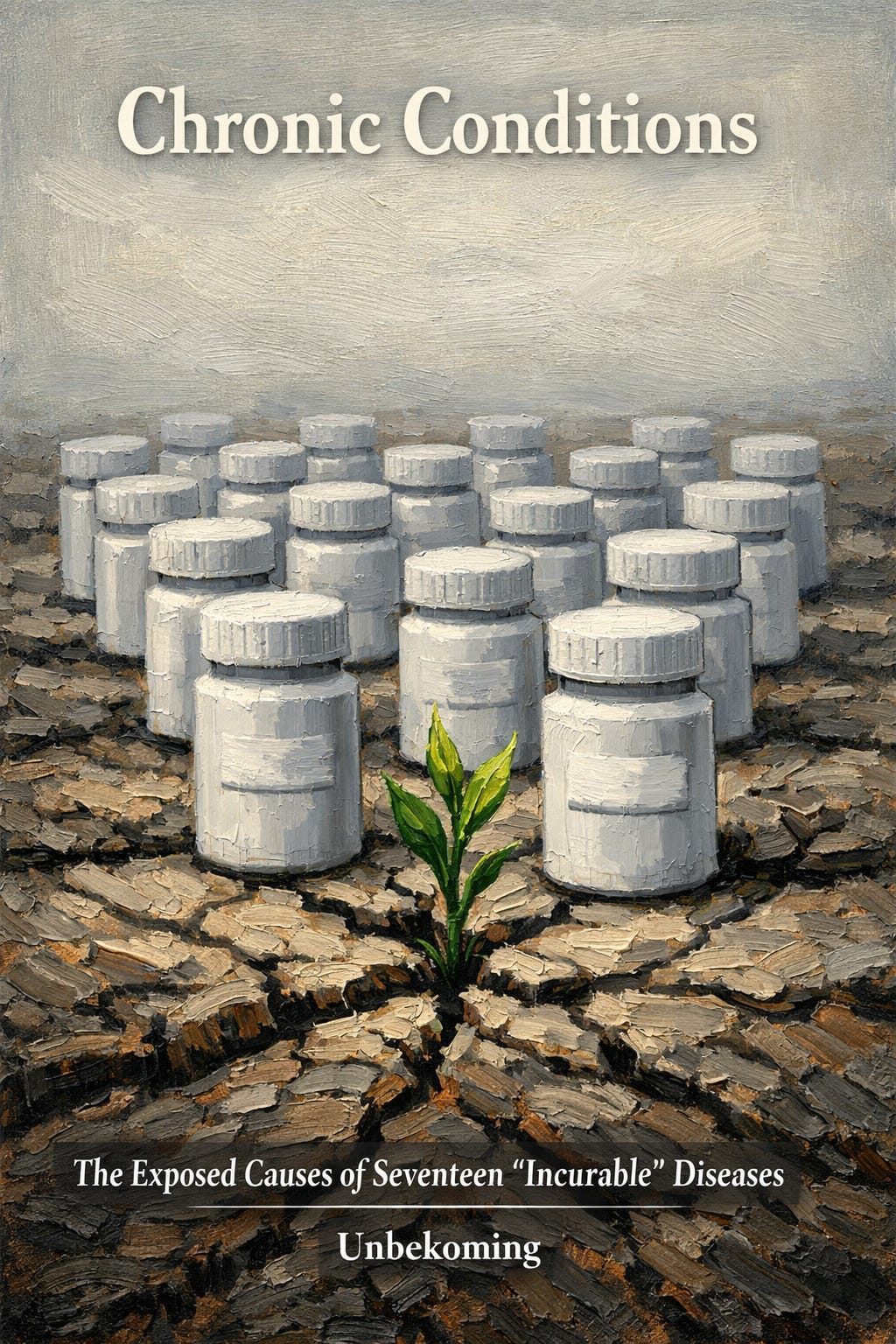
Chronic Conditions: The Exposed Causes of Seventeen “Incurable” Diseases is approximately 92,500 words. Seventeen essays, each examining a condition the medical establishment declares chronic, autoimmune, or incurable — and tracing it to causes the diagnostic system will not investigate. The essays have been lightly edited for this collection. A new introduction and four appendices — approximately 11,400 words of material that does not appear anywhere else — are written specifically for this book.
Why Sequencing Matters
Mercury appears in the autoimmunity essay as the standard laboratory method for inducing autoimmune disease in animals. Two essays later, it reappears in the MS essay — four patients’ cerebrospinal fluid proteins, the markers that define MS on testing, disappeared within thirty-six hours of amalgam removal. Several essays after that, it surfaces again in the Graves’ disease essay — forensic analysis showing thyroid mercury levels five times higher in people with twelve or more fillings, and amalgam removal normalising thyroid antibodies in seventy percent of mercury-sensitive patients.
The first time, it’s a finding. The second time, it’s a coincidence the reader can’t quite dismiss. By the third, something has shifted. The reader is watching the same metal damage different tissues and receive different diagnostic labels depending on which specialist the patient sees.
The pharmaceutical cascade builds the same way. Statins deplete the heart’s fuel in the heart failure essay. Fluoroquinolones degrade collagen through enzyme pathways the FDA has acknowledged with black box warnings — in the hernia essay. Corticosteroids cause the cataracts that ophthalmology then charges thousands to replace — in the cataract essay. Graded exercise therapy produces cell death in skeletal muscle — in the ME/CFS essay. One essay at a time, each finding is troubling. Across five essays, the structure becomes visible: the treatment produces the decline, the decline is attributed to the disease, and the patient becomes a long-term customer.
What’s Inside
The autoimmunity essay traces the “autoimmune” label to Charles Richet’s 1913 Nobel Prize — the demonstration that injecting foreign proteins creates sensitisation, not protection. A December 2002 paper documented over seventy medications producing autoimmune-like conditions that resolve when the medication is removed. Temporary. Reversible. Still labelled incurable.
The Alzheimer’s essay follows Christopher Exley’s finding that one hundred percent of studied brains contained elevated aluminium, Dennis Crouse’s silica water protocol that kept his mother cognitively intact to ninety-seven, and Dale Bredesen’s ReCODE protocol — eighty-four percent improvement where amyloid-targeting drugs achieved 0.4 percent.
The MS essay opens with the Faroe Islands, where no MS existed among native-born residents before British military radar arrived in 1943. It documents vitamin B12 deficiency producing a syndrome indistinguishable from MS — textbook medicine that is not routinely excluded before the MS diagnosis is applied.
The Graves’ essay documents a six-fold increase in risk following major life stress. Nine of eleven patients in a published case series achieved remission through stress relief alone. No drugs. No radioactive iodine. No surgery. Median urinary iodine in the US dropped by more than half between the 1970s and 1990s after potassium iodate was replaced by potassium bromate in bread. Nobody investigated the connection to the thyroid disease that followed.
The gluten intolerance essay traces a near-perfect correlation (R=0.9834) between glyphosate sprayed on wheat and intestinal disease deaths. Frances Leader — diagnosed celiac in Britain, tested negative in Spain, ate wheat without symptoms for years, sick again upon returning to Britain.
The hernia essay documents twenty-five years of published research showing that hernia patients have systemically deficient connective tissue — a finding that has not reached a single mainstream patient information sheet. The kidney stone, gallstone, and appendicitis essays document the body resolving conditions the establishment treats surgically. Gallstones dissolving at sixty to eighty percent on a protocol the surgical profession has never tried, against its own documented dissolution rate of zero.
The cystic fibrosis essay examines a genetic claim built on a foundational paper that explicitly states it has no direct evidence for its central assumption — and over forty percent of patients with the clinical presentation carrying no CFTR mutation at all.
The closing essay documents conditions declared permanent that turned out to be poisoning. Pink disease. Phossy jaw. Pellagra. The same sequence every time: symptoms observed, cause unknown, condition declared incurable, patients managed for life. Then the cause was found. The condition reversed.
The Appendices
For readers who have encountered the individual essays, the appendices are the reason to read the book.
Appendix A — The Terrain Map — lays out the cross-condition pattern in prose organised by insult category, followed by a visual matrix: conditions along one axis, terrain insults along the other. Mercury across four essays. Pharmaceutical iatrogenesis across five. Nutritional deficiency ignored across six. The grid shows what the diagnostic system conceals — the same forces damaging the same body, labelled differently depending on which tissue fails first.
Appendix B — Questions for Any Chronic Diagnosis — provides six sets of universal questions for anyone told they have a chronic, autoimmune, or incurable condition. Questions about the diagnosis itself, the autoimmune claim, toxic burden, nutritional status, stress history, and treatment logic. A condition-specific supplement follows, drawing from each essay’s strongest evidence: the selenium RCT for Graves’, the thiamine deficiency data for heart failure, the collagen research for hernias, the B12 differential for MS.
Appendix C — A Framework for Independent Thinking — is two parts. How to interrogate a chronic diagnosis: separating observation from explanation, checking whether “cause unknown” means uninvestigated, examining whether the treatment causes the progression. How to investigate your own terrain: a structured self-assessment across toxic exposure, nutritional status, electromagnetic environment, and stress — including the nocebo effect of the diagnostic label itself.
Appendix D — Resources — consolidates the key books, researchers, and sources across all seventeen essays into one guide organised by topic, so the reader following a specific thread does not have to search through seventeen separate reference sections.
Why a Book
Seventeen conditions, written about independently over months, kept pointing at the same causes. Mercury in four essays. The pharmaceutical cascade in five. Nutritional deficiencies that would change the diagnosis — untested, across the board. That convergence is invisible when the essays sit weeks apart on a Substack feed. It becomes obvious when they sit next to each other in a book.
Chronic Conditions: The Exposed Causes of Seventeen “Incurable” Diseases is available now for paid subscribers, alongside the full library of my other books.
If you’re already a paid subscriber, the PDF is below. If you’re not, it will appear here once you upgrade.