

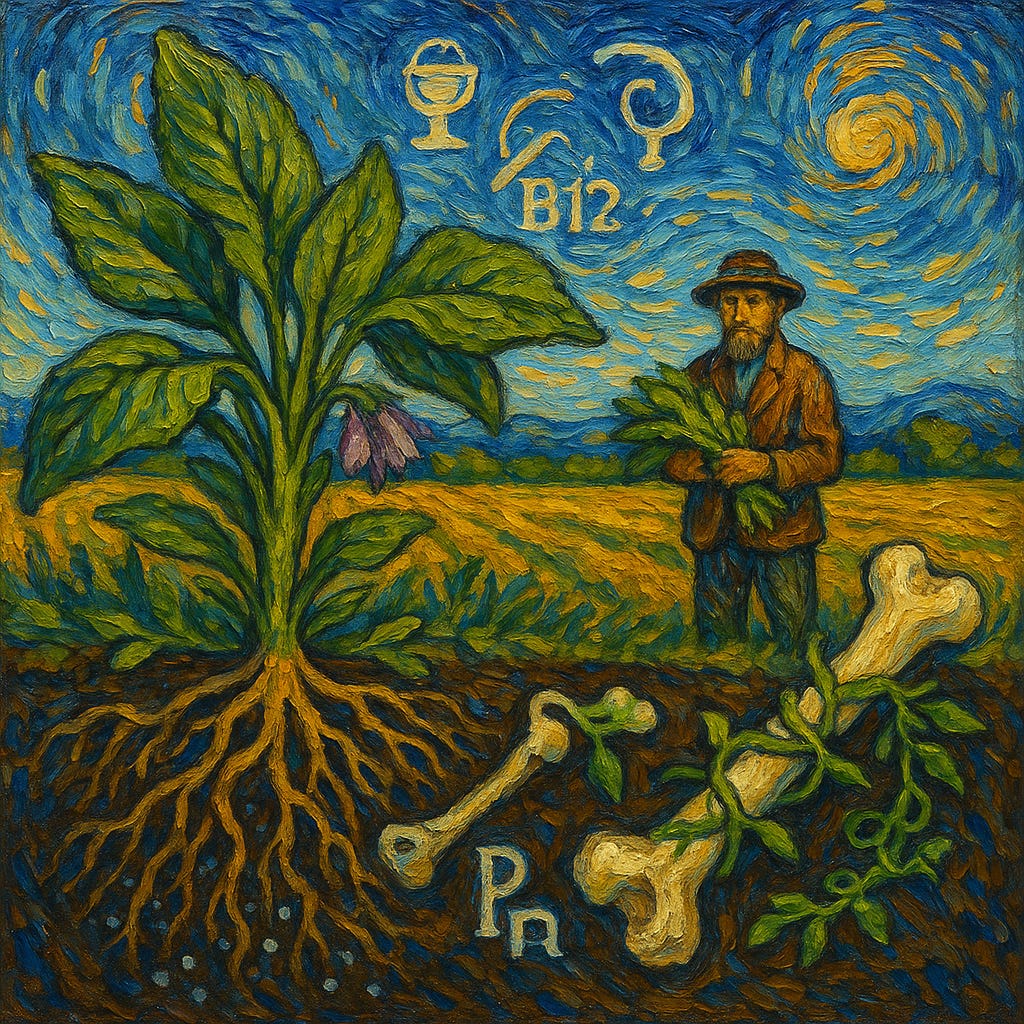
When Dr. Thomas Cowan mentioned comfrey in the context of bone healing—describing how this remarkable plant could help "knit" bones back together through both internal remedies and external compresses—it sparked a curiosity that led to discovering one of agriculture's most profound untold stories. Lawrence D. Hills' comprehensive work on comfrey reveals not just an herb for healing bones, but a plant that represents perhaps the most misunderstood agricultural revolution in modern history. Here is a crop that produces more protein per acre than any other temperate plant, contains the only known plant-based source of vitamin B12, and possesses roots that mine minerals from eight feet underground—yet it remains largely unknown, victims of repeated boom-bust cycles caused by ignorance rather than any failing of the plant itself. The story Hills tells through these thirty questions and answers is one of humanitarian vision meeting biological reality, where a Quaker smallholder's dream of ending world hunger through a single remarkable plant became entangled with commercial exploitation, linguistic manipulation, and the tragedy of knowledge without wisdom.
What makes Hills' work particularly compelling is how it illuminates the disconnect between a plant's true potential and humanity's ability to work with rather than against natural systems. The same characteristics that make comfrey miraculous—its deep mining roots, permanent nature, and vigorous growth—become curses in the hands of those who don't understand its requirements. This mirrors a larger pattern in how we approach both agriculture and healing: seeking quick fixes and magic bullets rather than understanding the deeper intelligence at work. Just as Cowan teaches that bones are "crystallized music" requiring proper nutrition, energetic patterns, and time to heal, comfrey demands respect for its trilogy of needs: "keep it clean, keep it cut, keep it fed." The plant's ability to transform waste into wealth, poison into protein, and mineral-depleted soil into abundance offers lessons that extend far beyond agriculture. In an era of converging crises—protein shortages, soil depletion, and unsustainable industrial farming—comfrey stands as both a practical solution and a philosophical challenge: can we learn to partner with nature's intelligence rather than trying to dominate it? Hills' meticulous documentation suggests the answer lies not in the plant itself, but in our willingness to observe, understand, and work within natural laws rather than against them.
With thanks to Lawrence Hills.
Comfrey: Past, Present and Future: Hills, Lawrence D.
Deep Dive Conversation Library (Bonus for Paid Subscribers Only)
This deep dive is based on the book:
Discussion No.111:
23 insights and reflections from “Comfrey : past, present and future”
Thank you for your support.
Analogy
Imagine a city with a magnificent skyscraper that hardly anyone knows exists. This building has an unusual design—its foundations go down eight stories underground, deeper than any other building in the city. While other buildings draw their water and utilities from the surface networks, this one has drilled down to ancient aquifers and mineral deposits that others can't reach. It brings up pure water and rare minerals from these deep sources, concentrating them on every floor.
The building works like a living factory, producing more food per square foot than any conventional farm, but here's the catch—it only works if you know how to operate it. Give it the right inputs (nitrogen-rich waste that would poison other buildings), maintain it properly (regular harvesting every six weeks), and it produces abundantly for twenty years. Neglect it, and it becomes an indestructible eyesore that crowds out everything else, spreading its foundations under neighboring lots.
The architect who designed it was a humble Quaker who died in poverty, but his blueprints could solve world hunger. Some people made fortunes selling copies of these blueprints without including the instruction manual. Others built the towers but didn't know how to run them, so abandoned skyscrapers dot the landscape, testament to dreams without knowledge. Yet where people understand the building's requirements—deep foundations, waste-to-wealth conversion, regular maintenance—these towers produce protein and medicines that save lives, make farmers profitable, and heal damaged land.
This is comfrey: a biological skyscraper that mines deep earth, transforms waste into wealth, and produces more than any conventional crop—but only for those who understand its nature. Like any powerful technology, it becomes a curse in ignorant hands or a blessing when properly applied. The question isn't whether the building works, but whether we're willing to learn how to operate it.
The One-Minute Elevator Explanation
Comfrey is basically a plant that acts like a mineral mine and protein factory combined. Its roots go down eight feet—deeper than most crops—pulling up nutrients that have washed beyond the reach of vegetables and grains. It grows incredibly fast, producing up to 100 tons per acre of high-protein fodder that you can cut every six weeks from April to November.
Here's why it matters: One acre of comfrey produces as much protein as seven acres of soybeans, but spread throughout the growing season instead of all at once. It contains a unique healing compound called allantoin that cures digestive problems in livestock and promotes wound healing in humans. It's the only known land plant that contains vitamin B12, usually found only in animal products.
The catch? It's permanent—once planted, it's there for twenty years. You can't grow it from seed, only from root cuttings, making it expensive to establish. If you neglect it, it becomes an ineradicable weed. But if you feed it nitrogen, cut it regularly, and keep it clean, it produces more protein per acre than any other temperate crop. It's especially valuable for pigs and poultry because of its low fiber content, and organic gardeners love it as a mineral-rich fertilizer.
The real tragedy is that this crop could help solve world protein shortages, but most people either don't know how to grow it properly or oversell it without understanding. It's like having a Ferrari engine but not knowing you need to change the oil.
[Elevator dings]
Want to learn more? Look into the Henry Doubleday Research Association, explore permaculture applications of deep-rooted plants, or investigate alternative protein sources for sustainable agriculture.
12-Point Summary
1. A History of Misunderstood Potential Comfrey's story spans centuries of boom-and-bust cycles, from its introduction to England by international gardeners in the 1790s to modern American plantation schemes. Each surge of interest brought extravagant claims and high prices, followed by disappointment when farmers didn't understand cultivation requirements. The pattern repeats because comfrey is fundamentally different from conventional crops—it's a permanent, vegetatively propagated perennial that demands specific management. Without proper knowledge, farmers create the very "worthless weeds" that destroy the crop's reputation for generations.
2. The Doubleday Legacy: Vision Over Profit Henry Doubleday transformed comfrey from curiosity to agricultural possibility through thirty years of unpaid research driven by memories of the Irish Potato Famine. This Quaker smallholder achieved 100-ton yields by 1875—figures unmatched for decades—while living in poverty because he gave away knowledge rather than selling it. His guiding principles, "Observe the works of God in humbleness" and "Search always for the Truth that harms no man," created a research tradition that continues through the organization bearing his name, proving that agricultural advancement sometimes requires humanitarian vision rather than commercial drive.
3. Hybrid Vigor: The Genetic Goldmine Russian comfrey's exceptional productivity stems from its origin as a rare natural hybrid between Caucasian and European species, combining the best traits of both parents. This F1 hybrid exhibits "hybrid vigor"—dramatically outperforming either parent species—but cannot produce viable seed, requiring vegetative propagation. The Bocking varieties, carefully selected and numbered clones, standardized this genetic diversity, enabling farmers to choose specific types for different purposes while maintaining genetic consistency for decades through root cutting propagation.
4. Deep Mining for Surface Wealth Comfrey's eight-foot roots function as biological mining equipment, accessing nutrients leached far below normal crop range and concentrating them in easily harvested leaves. Unlike trees that lock minerals in wood for decades, comfrey keeps nutrients in immediately available form, creating an accessible mineral bank containing 5-7% potassium, 2-3% calcium, and significant iron and manganese. This deep-mining ability makes comfrey invaluable for recycling nutrients otherwise lost to the agricultural system, while its unique extraction of cobalt enables vitamin B12 presence in the leaves.
5. Protein Production Revolutionized With 24% crude protein and yields reaching 100 tons per acre, comfrey produces more protein than any temperate crop—3.5 tons per acre versus 0.5 tons from soybeans. The protein quality matches its quantity, containing high levels of lysine, methionine, and especially tryptophan, addressing specific amino acid deficiencies in grain-based diets. Combined with year-round harvest in tropical climates and immediate availability without processing, comfrey offers unique solutions to protein shortages, particularly where transport and storage limit conventional protein sources.
6. Nature's Healing Compound Allantoin, comprising 0.6-0.8% of comfrey roots, represents nature's premier cell-proliferant, actively stimulating healthy cell growth rather than merely killing pathogens. Dr. MacAlister's research documented healing of five-year-old ulcers within weeks and suggested systemic immune enhancement through increased white blood cell production. This compound explains comfrey's two-thousand-year reputation for healing wounds, setting bones, and curing internal ailments, validated by modern research showing its hormone-like action in minute quantities.
7. The Livestock Revolution Comfrey transforms livestock nutrition by addressing multiple challenges simultaneously: providing concentrated protein, preventing disease, and improving condition. Pigs save 25-30% on feed costs while avoiding scour; racehorses maintain peak condition on half normal grain; poultry produce deep orange yolks and mature faster. The crop's low fiber suits non-ruminant digestion perfectly, while allantoin prevents digestive disorders that plague intensive production. Most remarkably, comfrey enables successful rearing of "wrecklings"—runts that would otherwise die or remain unprofitable.
8. Organic Gardening's Ultimate Tool Organic gardeners treasure comfrey as a permanent source of balanced fertility requiring no external inputs. Its pre-composted character (14:1 carbon-nitrogen ratio) allows direct use as "instant compost," doubling potato yields when laid in trenches. Liquid manure from rotted leaves provides potash levels triple those of commercial feeds, while surface mulches slowly release minerals throughout the season. A dozen plants supply 200+ pounds of organic fertilizer annually, enabling complete garden self-sufficiency while building rather than depleting soil fertility.
9. Breaking the B12 Barrier Comfrey's vitamin B12 content—unique among land plants—revolutionizes vegetarian nutrition and livestock feeding. While conventional wisdom restricts B12 to animal products and bacterial synthesis, comfrey apparently absorbs bacterially-produced B12 from deep soil layers where earthworm activity concentrates it. This discovery explains why comfrey-fed pigs thrive without fishmeal, why vegans report cured deficiency symptoms, and how the Teas process achieves B12 levels equaling beef, suggesting profound implications for sustainable protein production.
10. Conservation Challenges and Solutions Comfrey's high moisture and protein combined with low carbohydrates makes traditional conservation difficult—failed silage attempts created foul-smelling products animals refused. Success requires adding molasses for fermentation, mixing with high-carbohydrate crops, or using acid treatments. Emerging technologies offer better solutions: pressure-based pelleting concentrates nutrients without heat; bacterial processes convert fiber to sugars while preserving vitamins; continuous-flow systems could handle thousand-acre productions. These innovations could transform bulky fodder into transportable concentrates.
11. The Management Imperative Comfrey's reputation as both miracle crop and troublesome weed reflects a fundamental truth: success depends entirely on management quality. The trilogy "keep it clean, keep it cut, keep it fed" separates 100-ton yields from weedy failures. Deep soil, abundant nitrogen, and regular cutting every six weeks maintain the crop's racing metabolism. Without this intensive management, the same characteristics that enable record yields—deep roots, vegetative spread, persistence—create ineradicable weeds that haunt farms for generations, teaching the harsh lesson that agricultural power requires agricultural knowledge.
12. Future Food Security Comfrey offers unique advantages for humanity's converging crises: producing seven times more protein per acre than soybeans without requiring nitrogen fertilizer; utilizing waste products that would otherwise pollute; building soil while producing food; enabling local protein self-sufficiency. As energy costs make industrial agriculture unsustainable and climate change disrupts conventional cropping, comfrey's permanent production and adaptability offer security unavailable through annual crops. Whether feeding villages through simple processing or supplying industrial protein through fermentation, comfrey could fulfill Henry Doubleday's vision of a crop to banish hunger—if we can match his wisdom with our technology.
The Golden Nugget
The most profound revelation about comfrey that few people know is its apparent ability to actively absorb vitamin B12 from soil depths through what seems to be a unique biological mechanism. While scientists believed B12 existed only in animal products and bacterial synthesis, Dr. Frank Wokes' experiments proved comfrey roots actively extract this vitamin from solutions, with uptake of 11 milligrams from 40 milligrams in just 48 hours. This isn't mere contamination or surface bacteria—it's an active process possibly involving specialized root adaptations that can identify and absorb bacterial B12 from deep soil layers where earthworm activity concentrates it.
This discovery overturns fundamental assumptions about plant nutrition and the B12 cycle in nature. It suggests that at least one plant evolved the ability to tap into bacterial vitamin production in the deep soil ecosystem, making it available to surface-dwelling organisms. The implications extend far beyond nutrition: if plants can evolve to absorb specific complex vitamins, what other supposedly "animal-only" nutrients might be available through undiscovered botanical pathways? Comfrey may be showing us that the division between plant and animal nutrition is far more permeable than we imagined, and that nature's solutions to nutritional needs are more elegant and interconnected than our compartmentalized science has recognized.
30 Questions and Answers
1. How did Russian comfrey first arrive in England and what role did international gardeners play in its introduction?
Russian comfrey arrived in England through the remarkable international network of eighteenth-century horticulture. Between 1790 and 1801, Joseph Busch, an English nurseryman from Hackney, London, who had taken a position as head gardener at the Palace of St. Petersburg for Empress Catherine the Great, sent several Symphytum species back to England. He shipped them to Conrade Loddige, who had purchased Busch's former nursery business.
This introduction exemplified the casual internationalism of the era, when gardeners moved freely between countries sharing botanical specimens. Busch had planted the sky-blue flowered Symphytum asperrimum from the Caucasus next to the cream-yellow native S. officinale in the palace gardens, creating an attractive border. When Henry Doubleday later wrote to the Palace requesting plants in 1871, the head gardener sent chance seedlings from between these rows—unknowingly dispatching F1 hybrids that would revolutionize fodder production with their exceptional hybrid vigor.
2. Who was Henry Doubleday and why is he considered the most important figure in comfrey's history?
Henry Doubleday (1813-1902) was a Quaker smallholder from Coggeshall, Essex, whose profound impact on agriculture stemmed from his humanitarian vision rather than commercial success. A failed businessman who had attempted to manufacture starch during the Irish Potato Famine and later produced glue for early postage stamps, Doubleday became obsessed with finding crops that could prevent future famines after witnessing the million deaths in Ireland.
His greatest achievement was introducing and developing the first F1 hybrid comfrey, achieving unprecedented yields of 100-120 tons per acre—figures that remained unmatched for decades. Unlike his contemporaries who oversold comfrey for profit, Doubleday spent thirty years meticulously researching the crop, living by his principles of "Observe the works of God in humbleness" and "Search always for the Truth that harms no man." Despite dying in poverty, his legacy inspired the Henry Doubleday Research Association, ensuring his vision of feeding a hungry world would continue long after his death.
3. What caused the boom and bust cycles of comfrey popularity in the 1870s-1890s and again in modern times?
The recurring boom-bust cycles in comfrey cultivation stem from a fatal combination of overselling, ignorance, and the crop's unique characteristics. In the 1870s-1890s, nurserymen promoted comfrey with exaggerated claims, selling expensive plants while providing minimal cultivation guidance. Farmers who bought small quantities planted them in poor locations without proper feeding, resulting in nitrogen-starved plants that bore no resemblance to the promised "towering fountains of leaves."
The pattern repeated in 1970s America when the root-cutting propagation system enabled massive plantings through pyramid-style selling schemes. Farmers planted thousands of acres without understanding how to use the crop, leading to weedy, neglected fields. Both cycles share common elements: high establishment costs, lack of practical knowledge, confusion between different varieties, and the unfortunate fact that neglected comfrey persists as a troublesome weed, damaging the crop's reputation for generations. Each boom created enthusiastic testimonials from successful growers, while each bust left behind frustrated farmers battling an "ineradicable weed."
4. How did the Irish Potato Famine influence Henry Doubleday's vision for comfrey?
The Irish Potato Famine of the 1840s profoundly shaped Henry Doubleday's life mission, transforming him from a failed businessman into a visionary agricultural researcher. Having witnessed the first famine in history where a million white people starved to death, Doubleday became determined to find crops that could prevent such catastrophes. His failed attempt to create a starch factory during the famine, intended to salvage something from blighted potatoes, left him with both personal failure and humanitarian purpose.
This tragedy gave Doubleday a perspective unique among his contemporaries—while others saw comfrey as a commercial opportunity, he envisioned it as salvation for the hungry. His non-commercial mindset, rooted in Quaker principles and famine memories, drove him to spend thirty years perfecting cultivation techniques rather than pursuing profit. Where others abandoned the crop when easy money disappeared, Doubleday persisted because he understood that behind yield figures lay the difference between starvation and survival for future generations.
5. What makes comfrey a hybrid plant and why is this significant for its cultivation?
Comfrey's hybrid nature fundamentally shapes every aspect of its cultivation and explains many of its contradictory characteristics. The cultivated Russian comfrey (Symphytum peregrinum) resulted from rare natural crosses between S. asperrimum from the Caucasus and the native S. officinale, combining the vigor of both parents. This hybridization created plants with exceptional "hybrid vigor"—the phenomenon where crossbred organisms dramatically outperform their parents.
The significance extends beyond mere yield improvements. Because hybrids rarely produce viable seed, comfrey must be propagated vegetatively through root cuttings or division, making it expensive to establish but ensuring genetic consistency. This also means that attempted seed propagation produces wildly variable offspring, explaining why some fields contain spectacular producers while others harbor low-yielding "rogues." Understanding comfrey as a hybrid rather than a true species revolutionized cultivation, enabling growers to select and propagate only the highest-yielding clones, ultimately leading to the development of the standardized Bocking varieties.
6. Why does comfrey rarely set seed and how does this affect its propagation?
Comfrey's flower structure creates an almost insurmountable barrier to pollination, featuring a peculiar "false bottom" made of five awl-shaped growths that obstruct access to nectar. Only large bumblebees possess sufficient strength to push aside these barriers and reach the nectar, making pollination extremely difficult. Even when bees attempt to feed, many simply bite holes in the flower sides to steal nectar without performing pollination. This evolutionary quirk becomes most pronounced in S. asperrimum, further complicated by the genetic incompatibilities common in hybrid plants.
This reproductive challenge profoundly impacts cultivation economics and practices. Without seed production, farmers must establish fields using expensive root cuttings or plant divisions—the costliest "seed" in agriculture after grafted fruit trees. Where grain farmers might spend pounds per acre on seed, comfrey establishment costs hundreds. However, this limitation becomes an advantage in maintaining genetic purity, as every plant grown from root cuttings remains identical to its parent, preserving the exceptional qualities of selected clones for decades without degeneration.
7. What are the Bocking varieties and how do they differ from each other?
The Bocking varieties represent the first systematic attempt to bring order to the chaos of cultivated comfrey. Named after the Essex village where Lawrence Hills established his trial ground, these numbered clones (Bocking 1-21) were selected from various strains and carefully evaluated for distinct characteristics. Each variety displays unique combinations of leaf shape, flower color, stem thickness, growth habit, and most importantly, yield potential.
The variations follow their ancestral patterns—some like Bocking 14 inherit S. asperrimum traits with thin, wingless stems and early growth, while others like Bocking 4 show S. officinale influence with thick, partially winged stems. Flower colors range from yellow (Bocking 10) through purple shades to deep crimson (Bocking 1). Yield differences prove dramatic: Bocking 4 averaged 34 tons per acre over five years, while some varieties barely reached 20 tons. These standardized varieties enable farmers to choose clones suited to specific purposes—Bocking 14 for gardens and medicine, Bocking 4 for maximum fodder yield.
8. What is allantoin and why is it the most important medicinal compound in comfrey?
Allantoin, chemically known as diureide of glyoxylic acid, stands as nature's premier cell-proliferant—a compound that actively promotes the growth of new cells. Present at approximately 0.6-0.8% in comfrey roots and varying amounts in leaves, this crystalline substance has been recognized since ancient times, when Dioscorides noted comfrey's ability to "make grow together." Modern science confirms what herbalists knew empirically: allantoin accelerates the healing of wounds, ulcers, and broken bones by stimulating cell division at injury sites.
The compound's unique mode of action sets it apart from simple antiseptics or nutrients. Rather than killing bacteria directly, allantoin enhances cellular vitality and resistance, creating conditions where healthy cells out-compete pathogens. Dr. MacAlister's research demonstrated its ability to heal previously intractable ulcers, while agricultural experience shows it prevents and cures digestive disorders in livestock. This dual action—promoting healing while preventing disease—makes allantoin invaluable in both medicine and agriculture, justifying comfrey's two-thousand-year reputation as nature's premier healing herb.
9. What are the essential requirements for successfully growing comfrey?
Successful comfrey cultivation demands understanding three fundamental requirements that separate thriving crops from persistent weeds. First, the soil must be deep—at least four feet—allowing the massive roots to penetrate like those of small trees, mining nutrients from far below normal crop range. Shallow soils over rock or hardpan doom comfrey to stunted survival, while deep clays or well-structured soils enable spectacular growth.
Second, nitrogen availability determines whether comfrey races ahead or struggles. Unlike legumes that fix atmospheric nitrogen, comfrey depends entirely on soil reserves or applied nutrients. The crop responds dramatically to raw poultry manure, sewage sludge, or any high-nitrogen source that would burn other plants. Third, management must be intensive—"keep it clean, keep it cut, keep it fed" summarizes the approach. Regular cutting every six weeks maintains young, high-protein growth while preventing flowering that reduces yield. Without this trinity of deep soil, abundant nitrogen, and active management, comfrey becomes the worthless weed its detractors describe.
10. How is comfrey harvested and what yields can farmers realistically expect?
Comfrey harvesting follows a unique pattern unlike any other fodder crop, with four to eight cuts annually from April through November in temperate climates. Each cutting should occur at the "fountain of leaves" stage before flowering stems develop, maintaining optimal protein content while maximizing regrowth speed. Farmers use everything from scythes to silorators, cutting two inches above ground level to preserve growing points. The crop's phenomenal growth rate means fields can be crossed every six weeks, with early cuts yielding less but containing higher protein.
Realistic yields vary dramatically with management quality. Poor plots on neglected land might produce only 20 tons per acre—justifying criticism as a "weed." Well-managed British fields average 40-60 tons, while exceptional management can achieve 80-100 tons. Tropical locations with year-round growth have recorded up to 124 tons, though such figures require intensive feeding and perfect conditions. The key understanding: comfrey yields reflect management more than any other crop. Given proper treatment, 50 tons per acre represents a reasonable target for competent farmers.
11. Why is comfrey considered both a miracle crop and a troublesome weed?
Comfrey's dual reputation perfectly illustrates how agricultural success depends on knowledge and management rather than plant characteristics alone. When grown properly—clean, cut, and fed—comfrey produces more protein per acre than any temperate crop, earning its "miracle" status among informed growers. Its deep roots bring up minerals, its leaves provide exceptional nutrition, and its permanence offers twenty years of production from one planting.
Yet these same characteristics become curses under poor management. The tenacious roots that mine deep nutrients also make eradication nearly impossible—every fragment grows into a new plant. The vigor that produces record yields keeps neglected plants alive as persistent weeds. The crop that won't grow from seed can't be established cheaply like conventional fodder. Most damningly, farmers who plant small trial plots in poor locations without proper feeding create the very "worthless weeds" they later spend years trying to eliminate. Comfrey thus serves as agriculture's clearest example of how ignorance transforms assets into liabilities.
12. What methods exist for conserving comfrey for winter feeding?
Conserving comfrey's summer abundance for winter feeding presents unique challenges due to its high moisture and protein content combined with low carbohydrates. Traditional silage-making often fails catastrophically—without sufficient sugars for proper fermentation, the proteins decompose into foul-smelling compounds that stock refuse to eat. Success requires adding 2-3 gallons of molasses per ton to provide fermentable carbohydrates, or using the A.I.V. acid process that bypasses fermentation entirely.
Alternative conservation methods each have limitations. "Roof-top hay"—spreading cut comfrey on hot corrugated iron roofs—produces black, stemmy material that needs hammermilling but retains nutrition. Artificial drying works but costs prohibit large-scale use. The most practical approach involves mixing comfrey with high-carbohydrate crops like maize or oat-vetch combinations during ensiling, where it enhances overall protein content without fermentation problems. For small-scale operations, the new pressure-based pelleting and cubing technologies show promise, concentrating nutrients while eliminating moisture without expensive heating.
13. How does comfrey's protein content compare to other major fodder crops?
Comfrey's protein profile places it among the elite of fodder crops, averaging 24% crude protein on a dry matter basis—matching lucerne and surpassing most alternatives. However, raw percentages tell only part of the story. While lucerne fixes nitrogen and grows on thin chalky soils unsuitable for comfrey, it contains five times more fiber, reducing digestibility for non-ruminants. Red clover offers similar protein but yields far less bulk. Kale provides winter feeding when comfrey lies dormant but contains only half the protein concentration.
The true comparison emerges in protein yield per acre. At 50 tons fresh weight, comfrey produces over a ton of pure protein—double that of good lucerne and triple that of grass. At 100-ton yields achieved in ideal conditions, protein production reaches 2.5 tons per acre, approaching soybean levels but spread throughout the growing season rather than concentrated in seeds. This combination of high concentration and exceptional yield makes comfrey unmatched for protein production where land costs exceed importance versus ease of cultivation.
14. What minerals does comfrey extract from deep in the soil and concentrate in its leaves?
Comfrey functions as a living mineral mine, sending roots eight feet deep to access nutrients leached beyond reach of conventional crops. Analysis reveals exceptional concentrations: potassium at 5-7% (surpassing most organic sources), calcium at 2-3%, and significant iron and manganese. Unlike trees that lock minerals in wood for decades, comfrey keeps its gathered wealth in readily available form within leaves and stems, creating an instantly accessible mineral bank.
This mineral-concentrating ability provides benefits beyond simple nutrition. The high potassium makes comfrey unpalatable to rabbits and certain poultry when growing, offering natural protection. For organic gardeners, these mineral-rich leaves provide balanced fertilization impossible to achieve with wood ashes or rock dusts. Most remarkably, comfrey appears unique among land plants in extracting traces of cobalt—essential for vitamin B12 synthesis—from soil depths where this rare element accumulates, making it available to surface-dwelling organisms that cannot otherwise access this vital nutrient.
15. Why is comfrey significant as a source of vitamin B12?
Comfrey's ability to contain vitamin B12 represents a botanical anomaly of profound nutritional importance. While conventional wisdom held that only animal products and bacterial synthesis provided this essential vitamin, research revealed comfrey leaves contain 0.4-0.6 micrograms per 100 grams—not through contamination but apparently through root absorption of bacterially-produced B12 from deep soil layers where earthworm activity concentrates it.
This discovery carries revolutionary implications for vegetarian nutrition and livestock feeding. Pigs and poultry, unable to synthesize their own B12, traditionally require expensive fishmeal or synthetic supplements. Four pounds of fresh comfrey daily provides a pig's complete B12 requirement, explaining why comfrey-fed animals thrive without animal protein supplements. For humans, particularly vegans vulnerable to B12 deficiency, comfrey offers the only known plant-based source, though amounts remain small compared to animal products. The mechanism—possible active uptake through specialized root processes—remains scientifically puzzling but practically proven through decades of successful animal feeding.
16. How do the amino acids in comfrey address protein deficiencies in developing countries?
Analysis of comfrey's amino acid profile reveals exceptional relevance to global malnutrition patterns. The plant contains high levels of tryptophan—over one-third more than cashew nuts and triple that of lentils—directly addressing one of three amino acids critically deficient in the corn-bean diets of Latin America. Its methionine content equals that of cheese, while lysine levels match lentils, providing essential amino acids typically scarce in plant-based diets.
Unlike soya requiring specific climates and sophisticated processing, comfrey grows anywhere with adequate depth and moisture, producing its amino acids in immediately usable form. At 50 tons per acre, even with only 12% dry matter, the amino acid yield far exceeds that of conventional protein crops. Most significantly, the ability to harvest continuously in tropical climates means fresh protein availability year-round, avoiding storage problems that plague grain-based solutions. For populations surviving on monotonous cereal diets, small amounts of comfrey could provide the missing amino acids that separate bare survival from healthy development.
17. Why do pig farmers particularly value comfrey and how much can it save on feed costs?
Pig farmers discovered that comfrey addresses multiple swine-rearing challenges simultaneously while dramatically reducing feed costs. The plant's low fiber content (10% versus 30%+ in many forages) suits pigs' simple digestive systems perfectly, while its high protein directly replaces expensive concentrates. Most remarkably, comfrey's allantoin content prevents and cures scour—the persistent diarrhea that weakens piglets and reduces growth rates—acting as both preventive medicine and growth promoter.
Economics prove compelling: feeding trials consistently show 25-30% reduction in commercial feed requirements when comfrey is fed ad libitum. For a farmer raising 100 pigs annually, this translates to saving several tons of purchased meal. Even more profitable is using comfrey to rear "wrecklings"—the runts typically sold cheaply or destroyed. Fed unlimited comfrey, these disadvantaged piglets catch up to normal weights, transforming near-worthless animals into profitable stock. Combined with comfrey's ability to utilize raw pig slurry that would otherwise require expensive treatment, the crop can make the difference between profit and loss in modern pig production.
18. How has comfrey proven valuable for racehorse nutrition and what specific benefits does it provide?
Racehorse trainers, perhaps agriculture's most meticulous nutrition managers, have embraced comfrey for its unique combination of mineral density and physiological effects. Unlike cattle fed for weight gain or milk production, horses require minerals for bone density, speed development, and temperament balance. Comfrey provides calcium and phosphorus in perfect availability for building the cannon bones that must withstand tremendous impact, while its mineral balance maintains coat gloss that indicates peak condition.
Vernon Stephenson's forty-year experience at Hunsley House Stud documented specific benefits: complete elimination of digestive disturbances and colic, prevention of scour in foals, and remarkable calming effects on stallions. The standard ration of 14 pounds daily allowed reduction of grain from 8 to 4 pounds without condition loss, while some horses thrived on comfrey plus wheat cavings alone. Most intriguingly, older stallions like Anatom showed improved temperament when fed up to 40 pounds daily, suggesting allantoin's anti-inflammatory properties may reduce arthritic pain. These benefits justify maintaining comfrey plots at racing establishments where feed cost savings rank below having horses consistently fit to race.
19. What is the Chingola poultry system and how does it integrate comfrey with deep litter management?
The Chingola system, developed by bacteriologist L.G. Fairchild in Zambia, brilliantly solves multiple tropical poultry-keeping challenges through biological integration. Traditional deep litter housing fails in hot climates due to excessive heat from bacterial decomposition. Fairchild's innovation spaces houses 15 feet apart with comfrey planted between, creating a self-sustaining cycle: poultry manure dust fertilizes the comfrey, which provides essential green feed, while building orientation maximizes ventilation and minimizes heat stress.
The system's elegance lies in its completeness. Native African poultry survive dry seasons without green feed but cannot produce competitively. European breeds require green feed year-round but suffer in tropical conditions. Comfrey, growing continuously with deep roots accessing water, provides vitamin A and minerals while its 1.5:1 protein-to-fiber ratio (reversing young lucerne's 1:1.5) perfectly suits poultry digestion. The resulting deep orange egg yolks and healthy birds prove the system's success, while the comfrey-enriched litter becomes premium fertilizer containing up to 6% nitrogen—creating wealth from waste while solving nutritional challenges.
20. How does comfrey cure scour in various animals and what compound is responsible?
Scour—the persistent diarrhea that weakens young animals and retards growth—yields dramatically to comfrey feeding through allantoin's unique action on intestinal tissues. Unlike antibiotics that kill beneficial bacteria along with pathogens, allantoin promotes rapid healing of inflamed intestinal walls while enhancing cellular resistance to infection. This dual action explains why comfrey succeeds where conventional treatments fail: it addresses the underlying tissue damage rather than merely fighting symptoms.
Field evidence spans all livestock species. Piglets with white scour recover within days of receiving chopped comfrey. Calves purchased cheaply at market due to scouring become profitable when fed comfrey with their milk. Foals prone to digestive upsets when transitioning to solid feed show no problems when comfrey forms part of their diet. The mechanism appears consistent: allantoin's cell-proliferant properties accelerate replacement of damaged intestinal lining while its enhancement of cellular vitality prevents re-infection. This natural healing process avoids the resistance problems plaguing antibiotic treatments while building long-term digestive health.
21. What historical medical uses of comfrey have been documented since ancient times?
Comfrey's medical history spans two millennia of consistent application, beginning with Dioscorides in 400 A.D. describing its ability to "make grow together." Medieval herbalists from Turner to Gerard prescribed it for everything from broken bones to internal bleeding, earning names like "Knitbone," "Boneset," and "Bruisewort." The Saxon Leechdom of 1000 A.D. recommended it for those "Bursten Within"—internal injuries that meant certain death before modern surgery.
Documentation reveals remarkable consistency in applications: external use for wounds, fractures, and ulcers; internal use for stomach complaints, lung conditions, and hemorrhages. Seventeenth-century physicians mixed comfrey with honey for respiratory ailments and made poultices for sprains. Country bone-setters applied scraped root paste that hardened like plaster casts, supporting fractures while promoting healing. Even skeptical Victorian medical authorities acknowledged its mucilaginous properties valuable for soothing inflamed tissues. This unbroken chain of medical use across cultures and centuries suggests genuine therapeutic value rather than mere folklore.
22. How does allantoin promote cell proliferation and wound healing?
Allantoin operates through mechanisms that set it apart from conventional wound treatments. Rather than acting as an antiseptic or simple nutrient, it functions as a true cell-proliferant—actively stimulating division and growth of healthy cells. Dr. MacAlister's research demonstrated that wounds dressed with allantoin solution showed rapid epithelial growth from wound margins, with new cell islands appearing across damaged surfaces, spreading until complete coverage occurred.
The compound's action extends beyond simple growth stimulation. It enhances cellular vitality and resistance, enabling healthy cells to out-compete pathogens without direct antimicrobial action. This explains the "cleaning up" of infected wounds—not through killing bacteria but by promoting conditions where healthy tissue predominates. Experiments showed allantoin stimulates white blood cell production, enhancing local immunity. Most remarkably, it appears to work in minute quantities like a hormone, with solutions as dilute as 0.05% producing dramatic healing acceleration. This suggests allantoin may participate in natural healing processes, possibly explaining why internal injuries heal faster than external ones where allantoin-rich fluids bathe damaged tissues.
23. What were Dr. MacAlister's key findings about comfrey's medical applications?
Dr. Charles MacAlister's systematic investigation from 1910-1935 transformed comfrey from folklore to documented medicine. His work began with analyzing Professor Thompson's case of facial sarcoma that disappeared after comfrey poulticing, leading to isolation and identification of allantoin as the active principle. Through careful clinical observation, he documented rapid healing of previously intractable ulcers, including five-year-old leg ulcers that healed in weeks and rodent ulcers that responded after resisting all conventional treatment.
His most significant discoveries concerned allantoin's systemic effects. Experiments proved it stimulates phagocytosis—white blood cell activity—both locally and throughout the body when administered orally. This explained why septic wounds "cleaned up" without antiseptic properties. His treatment of pneumonia cases showed that early allantoin administration shortened disease duration and reduced mortality from 20% to under 5%. Perhaps most intriguingly, he found suggestions that natural allantoin from comfrey might possess superior biological activity to synthetic versions, possibly due to associated compounds or optical isomer differences—a finding with profound implications for natural versus synthetic medicine debates.
24. What safety concerns exist regarding alkaloids in comfrey and what does modern research reveal?
Initial concerns about pyrrolizidine alkaloids in comfrey—compounds known to cause liver damage in some plants—prompted extensive safety investigations. These alkaloids, found throughout the Boraginaceae family, can cause acute liver necrosis or chronic tumors depending on exposure levels. Early analysis detected symphytine and echimidine in comfrey, raising fears about potential toxicity despite centuries of safe use.
However, Dr. Long's comprehensive research revealed crucial distinctions. Comfrey alkaloids proved far less toxic than related compounds, with content varying from 0.009% to 0.030%—levels requiring impossibly large consumption to approach danger. Rat feeding trials using high concentrations of comfrey root flour (highest in alkaloids) showed no liver damage or tumor development. Most significantly, the alkaloids proved unstable, easily oxidized during normal preparation and cooking. Combined with absence of any livestock toxicity despite widespread feeding and the mathematical impossibility of humans consuming harmful quantities through normal use, research concluded comfrey presents no realistic toxic hazard, though concentrated pharmaceutical preparations might warrant caution.
25. How can comfrey be prepared for human consumption and what are its culinary uses?
Comfrey's culinary applications range from simple to sophisticated, with young leaves under six inches providing the best eating. The basic preparation mimics spinach—washed leaves cooked in their own moisture for ten minutes produce a vegetable with subtle asparagus-endive flavors. Unlike true spinach, comfrey leaves don't reduce dramatically, maintaining substance and texture. The slight bitterness, more pronounced in high-potash varieties like Bocking 14, adds complexity appreciated by many.
Creative preparations expand possibilities considerably. Comfrey soup combines sieved cooked leaves with white sauce and seasonings. The dramatic comfrey soufflé showcases its binding properties. Asian-inspired stir-fries benefit from comfrey's substantial texture. Most innovatively, Dr. Kirschner's green drinks—fresh leaves liquidized with water—provide a convenient way to consume allantoin and B12, often mixed with fruits to enhance palatability. Dried leaf tea offers year-round availability, while comfrey flour enriches soups, gravies, and vegetarian proteins. These diverse preparations make comfrey accessible to various dietary preferences while preserving its nutritional benefits.
26. Why do organic gardeners particularly value comfrey and how do they use it?
Organic gardeners embrace comfrey as the ultimate permaculture plant—a permanent, self-sustaining source of fertility requiring no external inputs. Its deep-mining roots access nutrients beyond reach of vegetables, concentrating them in leaves that become perfectly balanced organic fertilizer. Unlike chemical fertilizers where plants absorb only 2-6% of applied nutrients, comfrey's root-selected molecules transfer completely to crops, avoiding waste and pollution.
Applications multiply with gardener creativity. "Instant compost"—wilted leaves in trenches—doubles potato yields while suppressing disease. Liquid manure from rotted leaves feeds tomatoes throughout the season. Surface mulches between fruit bushes provide slow-release potash while suppressing weeds. Compost additions accelerate decomposition while balancing carbon-nitrogen ratios. Most valuably, a dozen plants supply 200+ pounds of high-potash organic fertilizer annually—enough to maintain a productive vegetable garden indefinitely. This self-sufficiency appeals to gardeners seeking independence from industrial inputs while building rather than depleting soil fertility.
27. How does comfrey work as an "instant compost" and liquid fertilizer?
Comfrey's unique chemistry enables it to function as pre-made compost, bypassing the usual decomposition process. With a carbon-nitrogen ratio of 14:1 compared to typical garden waste at 80:1, comfrey already possesses the composition that composting aims to achieve. Its low fiber content means rapid breakdown without the prolonged decomposition woody materials require. When placed in potato trenches, wilted comfrey creates linear compost heaps releasing nutrients precisely as crops demand them.
Liquid fertilizer production exploits comfrey's water-soluble nutrients and rapid decomposition. Submerged leaves quickly blacken and break down, creating a solution containing 3-4 times more potash than commercial tomato feeds with better-balanced nitrogen and phosphorus. Analysis shows 0.034% potash—seemingly dilute but in root-accessible form ensuring complete utilization. The breakdown process concentrates minerals while preserving the root-selected molecular structure that makes nutrients fully available. This combination of immediate availability and sustained release makes comfrey liquid unique among garden fertilizers.
28. What innovations have American growers introduced to comfrey cultivation?
American innovation transformed comfrey from an expensive specialty crop to an agricultural commodity through revolutionary propagation methods. Instead of selling mature plants at high prices, growers developed root cutting systems where potato diggers harvest roots every 2-3 years, cutting them into 1.5-inch sections for mechanical planting. This reduced establishment costs from $500 to $300 per acre while enabling rapid expansion of acreage.
Mechanical cultivation advances proved equally significant. Elmer Jeskey's modified rotavator with center tines removed enables single-pass weed control, fitting over plant rows while cultivating 14-inch strips alongside. This innovation, combined with old tractors permanently attached to equipment, makes daily management as simple as conventional farming. Large-scale experiments with pelleters, cubers, and bacterial processing attempt to solve conservation challenges that limited historical adoption. These practical innovations demonstrate American agriculture's genius for mechanization and scale, though sometimes at the expense of understanding the crop's biological requirements.
29. What industrial processes show promise for converting comfrey into concentrated protein foods?
Robert Teas's bacterial process represents the most promising breakthrough in comfrey utilization. Using cellulose-breaking bacteria, this method converts problematic fiber into simple sugars while concentrating protein and minerals into a Marmite-like substance. The process achieves complete fiber breakdown—solving comfrey's primary limitation for human consumption—while preserving vitamin B12 at levels equaling beef. This black concentrate dissolves readily, stores without refrigeration, and could provide missing amino acids for grain-based diets worldwide.
Alternative approaches multiply as technology advances. Pressure-based pelleting and cubing concentrate nutrients without heat damage. Yeast cultures growing on comfrey substrate might produce single-cell protein while maintaining B12 levels. Enzyme treatments could break down proteins into amino acid supplements. Most ambitiously, continuous-flow industrial processes could handle thousand-acre productions, converting endless trailer-loads into concentrated nutrition. These technologies could transform comfrey from a bulky fodder into transportable protein supplements, finally realizing Henry Doubleday's vision of feeding the hungry wherever they are.
30. What role might comfrey play in addressing global protein shortages and sustainable agriculture?
Comfrey offers unique advantages in addressing the converging crises of protein shortage, energy scarcity, and environmental degradation. Producing 3.5 tons of protein per acre—seven times more than soybeans—while requiring no nitrogen fertilizer (5 tons coal-equivalent per ton) positions comfrey as potentially the most energy-efficient protein source available. Its ability to utilize raw sewage and animal wastes while building rather than depleting soil makes it a cornerstone of sustainable intensification.
The crop's true promise lies in democratizing protein production. Unlike soybeans requiring specific climates and sophisticated processing, comfrey grows anywhere with adequate soil depth, producing protein continuously in forms immediately usable by both humans and animals. Small-scale cultivation could enable protein self-sufficiency for communities now dependent on global commodity chains. As transport costs soar and climate disruption threatens conventional agriculture, comfrey's permanent production and local adaptability offer food security unavailable through annual crops. Whether feeding villages through simple processing or supplying industrial-scale protein through advanced fermentation, comfrey could help humanity navigate the transition to truly sustainable agriculture—fulfilling at last Henry Doubleday's dream of a crop to banish hunger.
I appreciate you being here.
If you've found the content interesting, useful and maybe even helpful, please consider supporting it through a small paid subscription. While 99% of everything here is free, your paid subscription is important as it helps in covering some of the operational costs and supports the continuation of this independent research and journalism work. It also helps keep it free for those that cannot afford to pay.
Please make full use of the Free Libraries.
Unbekoming Interview Library: Great interviews across a spectrum of important topics.
Unbekoming Book Summary Library: Concise summaries of important books.
Stories
I'm always in search of good stories, people with valuable expertise and helpful books. Please don't hesitate to get in touch at unbekoming@outlook.com
Baseline Human Health
Watch and share this profound 21-minute video to understand and appreciate what health looks like without vaccination.
I’ve been growing this for a long time and it’s a great chop and drop fertilizer, I also add it to my compost.
Comfrey in homoeopathic form is Symphytum officinal. It helps to heal fractures with the tissue salt Calc-phos. This combination has been used to treat osteoporosis.
It also heals soft tissues. I healed a torn tendon in my elbow with a few doses. The pain relief was almost instant.