

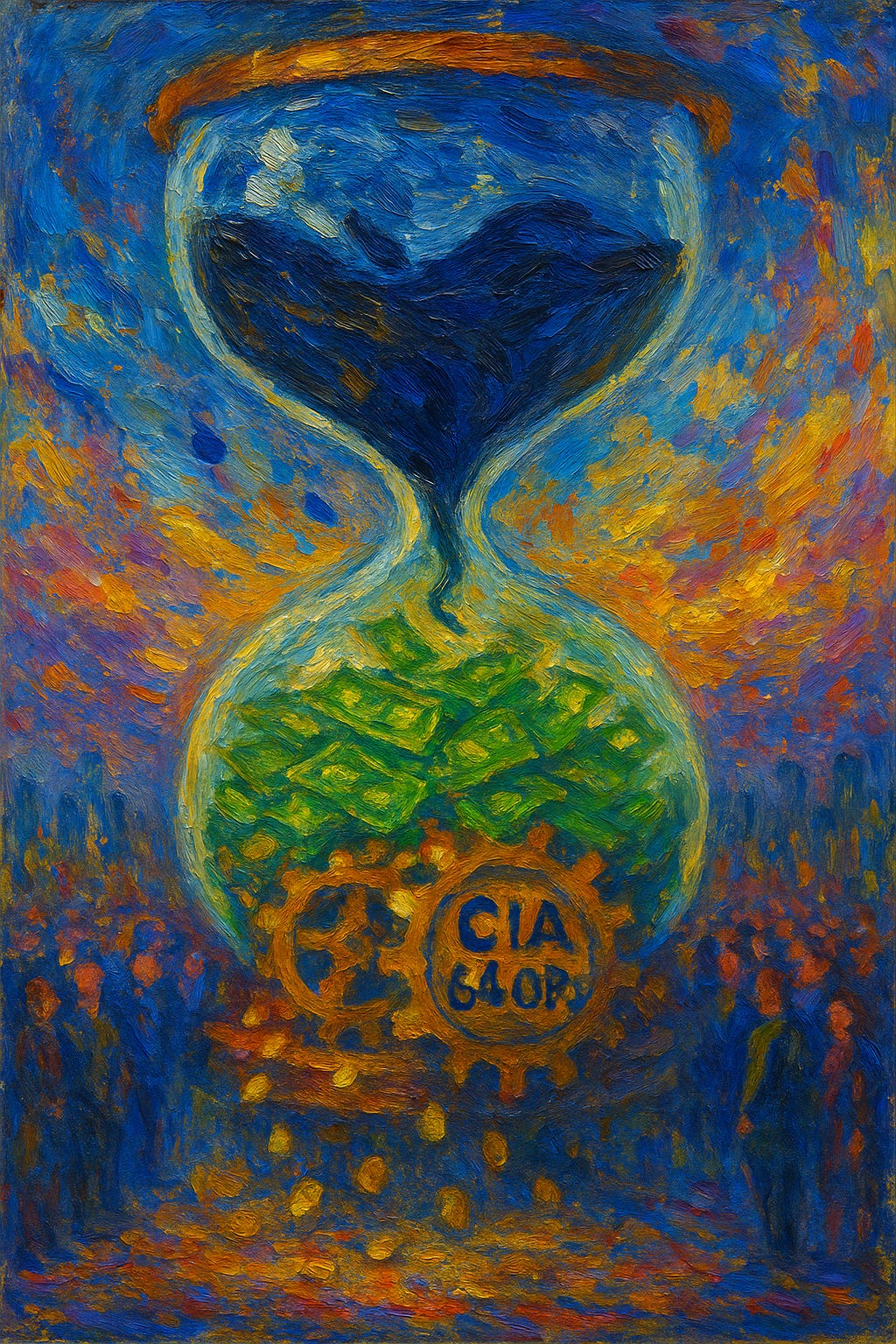
The Hidden Architecture of Empire: How Covert Regime Change Serves the Money Power
Behind the sanitized narratives of humanitarian intervention and democracy promotion lies a darker truth that Lindsey O'Rourke's "Covert Regime Change" illuminates with forensic precision. Her comprehensive analysis of 64 covert operations during the Cold War reveals not the bumbling incompetence of rogue agencies, but the calculated machinations of what Carroll Quigley called the Anglo-American establishment—a manifestation of the central banking money power that has perfected the art of global control through financial instruments, energy dominance, and when necessary, the surgical removal of non-compliant leaders. This is not the story of ideological crusades or even traditional imperialism, but of a sophisticated war machine that has learned to convince its own citizens that their tax dollars fund virtuous missions while simultaneously extracting wealth from both target nations and the very populations financing these operations.
The Petrodollar Foundation of Modern Regime Change
What makes O'Rourke's work particularly revelatory when read alongside Engdahl's analysis is how it exposes the intersection of money, energy, and geopolitical control that defines our modern world. The 1973 oil crisis, orchestrated at the Bilderberg Group's Saltsjöbaden meeting, established the petrodollar system as the backbone of American hegemony—a system where the U.S. gained "comparative advantage in manufacturing dollars" at zero cost while everyone else was forced to acquire these dollars to purchase oil. Understanding this framework transforms our reading of seemingly disparate covert operations into a coherent strategy: Iran's Shah was removed not because of a “student uprising,” but because his nuclear energy program threatened oil dependency; Mossadegh was overthrown to prevent nationalization that would undermine Anglo-Iranian Oil Company profits; and countless other interventions followed the same pattern of protecting the energy-dollar nexus that allows Empire to export paper while importing real goods and resources.
The Perfection of Manufactured Consent
Perhaps most insidiously, Empire has perfected what we might call the "color revolution technology"—the ability to make covert regime changes appear as grassroots uprisings that Western citizens not only support but celebrate as victories for human rights and democracy. This represents the evolution from crude military interventions to sophisticated social engineering campaigns that, as Denis Rancourt documents, coincided perfectly with the post-Soviet acceleration of globalization and the emergence of climate change, gender equity, and anti-racism as state doctrines designed to pacify and redirect domestic populations. The same establishment that orchestrates regime changes abroad has learned to manufacture consent at home through what Antonio Gramsci called cultural hegemony—making their predatory agenda appear as moral imperative. Citizens of Empire thus become unwitting accomplices in their own impoverishment, funding operations that serve financial interests while believing themselves champions of liberation, never recognizing that the true war machine operates not through tanks and bombs alone, but through the more elegant weapons of currency manipulation, energy control, and the careful cultivation of righteous indignation.
With thanks to Lindsey O’Rourke.
Deep Dive Conversation Library (Bonus for Paid Subscribers Only)
This deep dive is based on the book:
Discussion No.106:
23 insights and reflections from “Covert Regime Change”
Thank you for your support.
Analogy
Covert regime change is like a master chef secretly altering a rival restaurant’s signature dish to make it more to their taste, hoping to win over customers without anyone noticing their interference. The chef sneaks into the kitchen at night, tweaking ingredients—swapping sugar for salt or adding a new spice (like coups, election interference, or dissident support)—to reshape the dish to favor their own restaurant’s style. Sometimes, the change works briefly, as in the U.S.’s 1953 Iran coup, where a pro-American leader was installed, delighting the chef’s patrons. But often, the altered dish sours, causing diners to reject it (anti-Americanism) or sparking chaos in the rival’s kitchen, as in Vietnam’s post-Diem instability or Afghanistan’s empowerment of the Mujahedeen, which led to the rise of al-Qaeda. The chef’s stealth avoids immediate blame, but if discovered, as through declassification or leaks, it angers the rival and customers, damaging the chef’s reputation. The new dish may not even suit the chef’s goals, growing unpredictable or unpalatable, reflecting how covert regime change seeks control but risks unintended consequences like instability, civil wars, or long-term hostility.
The One-Minute Elevator Explanation
Picture the Cold War as a high-stakes chess game where the U.S. and Soviet Union competed for global control, but direct moves risked catastrophe. The U.S. turned to covert regime change—secretly orchestrating coups, rigging elections, or backing rebels—to replace unfriendly governments with pro-American ones, as in Iran’s 1953 coup or Guatemala’s 1954 ouster of Jacobo Arbenz. These 64 covert operations, versus just 6 overt ones, aimed to secure U.S. power quietly, avoiding the costs of open war while countering Soviet influence. Driven by security needs—weakening rivals, preventing Soviet alliances, or dominating regions like Latin America—the U.S. used tactics like the CIA’s support for Poland’s Solidarity or assassination plots against Cuba’s Fidel Castro. But these moves often backfired, sparking civil wars, as in the Dominican Republic, or blowback, like Afghanistan’s Mujahedeen fueling terrorism. Today, cyber tactics and democracy promotion, as in Ukraine’s 2014 protests, continue this strategy, but secrecy is harder, and instability remains a risk. The lesson: covert interventions promise control but often create chaos. [Elevator dings] To dive deeper, explore the Church Committee’s 1975 CIA reports or declassified National Archives documents on Cold War interventions.
12-Point Summary
1. Covert Regime Change Defined: Covert regime change involves secret efforts to overthrow or replace foreign governments using tactics like assassinations, coups, election interference, and dissident support, distinct from overt military interventions. The U.S. pursued 64 covert operations during the Cold War, compared to 6 overt, to alter target states’ leadership while maintaining plausible deniability. These operations aimed to align foreign governments with U.S. interests but often faced challenges in maintaining secrecy and achieving lasting success, as seen in the Bay of Pigs invasion’s failure.
2. Security-Based Theory: The primary driver of U.S. regime change was security, categorized into offensive (weakening rivals), preventive (stopping threats), and hegemonic (maintaining regional dominance) operations. This theory explains interventions like the 1953 Iran coup to counter Soviet influence and the 1965 Dominican invasion to secure regional control. Security interests trumped economic or ideological motives, though these played secondary roles, as seen in Guatemala’s 1954 coup influenced by United Fruit Company interests.
3. Cold War Context: The bipolar international system, defined by U.S.-Soviet rivalry, shaped covert operations to counter Soviet expansion without triggering direct conflict. The U.S. targeted Soviet-aligned states (e.g., Eastern Europe) and non-aligned states (e.g., Vietnam) to secure alliances and prevent communist spread. The fear of escalation, especially nuclear, made covert tactics preferable, as they minimized reputational and security costs, though failures like Albania’s Operation BGFIEND exposed strategic limits.
4. Offensive Operations: Offensive operations, part of the rollback strategy, aimed to weaken the Soviet Union by supporting dissidents in Eastern Europe and later in Afghanistan and Nicaragua. Only 2 of 23 covert attempts succeeded, due to Soviet counterintelligence and weak dissident groups, as seen in Ukraine’s failed Operation AERODYNAMIC. These operations highlight the difficulty of challenging consolidated regimes and the risks of supporting groups with questionable human rights records.
5. Preventive Operations: Preventive operations sought to block states from joining the Soviet bloc or acquiring threatening capabilities, as in the 1953 Iran coup and Vietnam’s covert aid to Ngo Dinh Diem. Of 25 covert attempts, successes were limited by target resilience and misjudgments, like the failed 1958 Indonesia coup. These operations reflect the U.S. commitment to containment but often led to instability, as in Vietnam’s post-Diem chaos.
6. Hegemonic Operations: Hegemonic operations, guided by the Monroe Doctrine, aimed to maintain U.S. dominance in the Western Hemisphere, with 18 covert and 3 overt interventions in Latin America. Cases like the Dominican Republic’s Trujillo assassination and Guatemala’s Arbenz ouster secured short-term U.S. interests but fueled anti-Americanism and civil conflict, as seen in the 1965 Dominican Civil War, undermining long-term regional stability.
7. Covert Tactics and Effectiveness: The U.S. used assassinations, coups, election interference, and dissident support, with coups (33% success) and election interference (78% success) outperforming dissident support (13%). Coups in Iran and Guatemala succeeded, while Eastern Europe’s dissident operations largely failed. Statistical analyses show that tactical success did not ensure strategic gains, as interventions often led to instability and blowback, like Afghanistan’s Mujahedeen empowerment.
8. Consequences for Target States: Covert regime change frequently destabilized target states, increasing civil wars (e.g., Dominican Republic 1965) and mass killings (e.g., Ukraine’s dissident abuses). Democratization was rare, with operations often installing authoritarian regimes, as in Iran’s Shah Pahlavi. Probit analyses confirm higher conflict risks post-intervention, highlighting the unintended consequences of disrupting political structures and empowering repressive groups.
9. Impact on Interstate Relations: U.S. regime changes increased militarized interstate disputes, with both successful and failed operations straining relations. The Bay of Pigs invasion worsened U.S.-Cuba ties, contributing to the Cuban Missile Crisis. Failed operations, lacking deniability, damaged U.S. credibility, while successes rarely produced cooperative governments, as seen in Iran’s long-term hostility, underscoring the challenges of aligning target states with U.S. interests.
10. Blowback Mechanisms: Blowback, the unintended negative consequences of covert operations, included anti-Americanism and empowerment of hostile groups. Support for Afghanistan’s Mujahedeen led to al-Qaeda’s rise, while Iran’s 1953 coup fueled the 1979 revolution. These outcomes show how short-term successes created long-term threats, complicating U.S. security goals and highlighting the need to anticipate secondary effects of interventions.
11. Role of Declassification: Declassification, congressional inquiries like the Church Committee, and journalism revealed 64 covert U.S. operations, enabling the book’s dataset. This transparency exposed operations like the Chile coup and Iran-Contra scandal, informing public and academic understanding. However, exposure damaged U.S. credibility, fueling anti-American sentiment and complicating diplomacy, as seen in Latin American reactions to U.S. interventions.
12. Post-Cold War Relevance: Cold War lessons apply to post-Cold War interventions in Afghanistan, Iraq, and Libya, where regime changes led to insurgencies and instability. Cyber tactics, like Russian 2016 election interference, reflect evolving covert strategies, amplifying influence but risking exposure. The persistence of regime change as a U.S. tool underscores the need to balance short-term gains against long-term risks like blowback and regional unrest.
45 Questions and Answers
Question 1: What defines covert regime change, and how does it differ from overt regime change?
Answer: Covert regime change involves a state secretly attempting to overthrow or replace a foreign government through tactics like assassinations, coups, election interference, or supporting dissidents, without publicly acknowledging its role. These operations rely on secrecy and plausible deniability to minimize diplomatic fallout and maintain the appearance of non-involvement. For instance, U.S. efforts to oust leaders like Iran’s Mohammad Mossadegh in 1953 were conducted covertly to avoid international condemnation. The goal is to alter a target state’s leadership or policies to align with the intervening state’s interests, often with less immediate risk of escalation than overt actions.
Overt regime change, in contrast, involves the direct and publicly acknowledged use of military force to topple a foreign government, such as the U.S.-led invasions of Afghanistan in 2001 or Iraq in 2003. These operations are visible, often requiring significant resources and public support, and carry higher reputational and security costs due to their transparency. Unlike covert efforts, overt interventions signal resolve and can reshape international alliances but risk broader conflict. The choice between covert and overt hinges on predicted costs, likelihood of success, and the need for deniability.
Question 2: Why did the United States pursue covert regime change more frequently than overt during the Cold War?
Answer: During the Cold War, the United States pursued covert regime change more frequently—64 covert versus 6 overt operations—due to lower predicted costs and the need for plausible deniability in a tense bipolar world. Covert operations, such as supporting dissidents or staging coups, allowed the U.S. to influence foreign governments without risking direct confrontation with the Soviet Union, which could escalate into major war. The secrecy of covert actions minimized reputational damage and domestic political backlash, making them a preferred tool for altering adversarial regimes discreetly.
Additionally, covert operations were seen as more feasible when the likelihood of success was uncertain or when overt intervention lacked domestic or international support. For example, covert support for anti-Soviet groups in Eastern Europe avoided open conflict with the USSR, while overt actions, like the Korean War, required significant military commitment and public approval. The U.S. relied on covert tactics to maintain strategic flexibility and avoid the high material and security costs associated with overt military campaigns.
Question 3: How did the Cold War’s bipolar international system shape U.S. decisions to launch regime change operations?
Answer: The Cold War’s bipolar international system, defined by U.S.-Soviet rivalry, drove the United States to launch regime change operations to counter Soviet influence and secure its strategic interests. In this system, global politics revolved around two superpowers, each leading an alliance bloc, creating intense competition for influence over other states. The U.S. used regime change to weaken Soviet allies (offensive operations), prevent states from joining the Soviet bloc (preventive operations), or maintain dominance in regions like Latin America (hegemonic operations). The fear of Soviet expansion, as articulated by George Kennan, prompted covert actions to avoid direct superpower conflict.
The bipolar structure heightened the stakes of losing allies or neutral states to the Soviet sphere, as seen in U.S. interventions in Iran and Guatemala to block perceived communist alignment. The risk of escalation to nuclear war made covert operations more appealing, as they allowed the U.S. to act discreetly while maintaining plausible deniability. This system constrained U.S. options, pushing reliance on covert tactics to manage global influence without triggering catastrophic conflict.
Question 4: What are the three main types of security interests driving U.S. regime change operations?
Answer: The three main types of security interests driving U.S. regime change operations are offensive, preventive, and hegemonic. Offensive operations aim to overthrow a military rival or disrupt a rival alliance, such as U.S. efforts to support anti-Soviet dissidents in Eastern Europe during the Cold War’s early and late phases. These operations sought to weaken the Soviet Union’s power and influence, aligning with the rollback strategy to reduce communist dominance.
Preventive operations focus on maintaining the status quo by stopping a state from joining a rival alliance or acquiring threatening capabilities, like nuclear weapons. Examples include U.S. covert interventions in Iran (1953) and Vietnam to prevent alignment with the Soviet bloc. Hegemonic operations seek to maintain U.S. dominance in a region, particularly the Western Hemisphere, as seen in interventions in the Dominican Republic and Guatemala to ensure pro-American governments under the Monroe Doctrine. Each type reflects a strategic effort to enhance U.S. security.
Question 5: How does the security-based theory explain why states launch regime change operations?
Answer: The security-based theory posits that states launch regime change operations to enhance their security or that of their allies by altering a target state’s leadership to align with their interests. Unlike other foreign policy tools like negotiation or coercion, regime change offers the potential to fundamentally shift a state’s preferences, creating a government that shares the intervener’s goals. For instance, the U.S. pursued regime change to counter Soviet influence, believing a friendly government would reduce threats more effectively than temporary coercion. This theory emphasizes security over economic or ideological motives, viewing regime change as a tool to address intractable conflicts.
The theory categorizes operations into offensive (weakening rivals), preventive (stopping future threats), and hegemonic (maintaining regional dominance). States choose regime change when they identify a credible political alternative in the target state and believe the operation’s benefits outweigh its costs. The U.S. applied this logic in cases like Iran and Chile, where installing pro-American leaders was seen as a way to secure long-term strategic advantages, despite risks of failure or backlash.
Question 6: What motivates states to choose covert over overt regime change operations?
Answer: States choose covert over overt regime change operations to minimize material, reputational, and security costs while maintaining plausible deniability. Covert operations, such as coups or election interference, require fewer resources than overt military invasions and avoid the need for public or international justification, reducing diplomatic fallout. For example, the U.S. used covert tactics in Guatemala (1954) to avoid alienating allies, unlike the overt Iraq invasion (2003). Secrecy allows states to act without committing to open conflict, especially in a bipolar system where escalation risks were high.
The decision also depends on the likelihood of success and the target’s strength. Covert operations are preferred when success is uncertain or when overt action might provoke strong resistance from the target or its allies, like the Soviet Union during the Cold War. Covert tactics offer flexibility, allowing states to disavow failed attempts, as seen in the Bay of Pigs invasion, though maintaining secrecy poses challenges. States weigh these factors to balance strategic goals with the risks of exposure.
Question 7: How effective were U.S.-backed covert regime change operations during the Cold War?
Answer: U.S.-backed covert regime change operations during the Cold War had mixed effectiveness, with only 25 of 64 attempts successfully installing a U.S.-backed government. Tactics like coups and election interference were more effective, achieving success in about one-third of cases, while supporting dissidents or secessionists often failed due to weak opposition or strong target defenses. For instance, coups in Iran (1953) and Guatemala (1954) succeeded, but efforts to support anti-Soviet dissidents in Eastern Europe largely failed. Short-term success depended on the target’s regime type and alliance status, with non-aligned states and weaker regimes being easier targets.
Long-term effectiveness was even less consistent, as successful operations often led to instability, civil wars, or anti-American sentiment. Statistical analyses show covert operations increased the likelihood of militarized interstate disputes and civil wars, with minimal positive impact on democratization. The dataset reveals that while covert operations could achieve immediate goals, their broader strategic benefits were often undermined by unintended consequences like blowback, as seen in Afghanistan’s empowerment of the Mujahedeen.
Question 8: What are the main consequences of covert regime change for target states?
Answer: Covert regime change often destabilizes target states, leading to civil wars, mass killings, and limited democratization. Successful operations, like the coup against Guatemala’s Jacobo Arbenz, frequently installed authoritarian regimes that suppressed opposition, increasing the risk of internal conflict. Statistical data indicate that U.S.-backed covert operations raised the probability of civil wars by destabilizing political structures, as seen in the Dominican Republic’s 1965 civil war following U.S. interventions. Mass killings also occurred in some cases, particularly when U.S.-supported dissidents or regimes engaged in human rights abuses, such as in Eastern Europe.
Democratization was rarely achieved, with covert operations often replacing one authoritarian regime with another, as evidenced by the lack of significant polity score improvements in target states. Anti-Americanism frequently emerged as a backlash, complicating long-term relations. For example, the U.S.-backed coup in Iran (1953) fueled resentment, contributing to the 1979 revolution. These consequences highlight the challenges of achieving stable, pro-American outcomes through covert intervention.
Question 9: How did U.S.-backed regime changes impact interstate relations during the Cold War?
Answer: U.S.-backed regime changes during the Cold War often worsened interstate relations, increasing the likelihood of militarized interstate disputes (MIDs). Statistical analyses show that both successful and failed covert operations correlated with higher conflict rates, as target states or their allies retaliated against U.S. interference. For instance, the failed Bay of Pigs invasion (1961) strained U.S.-Cuba relations, contributing to the Cuban Missile Crisis. Even successful operations, like the Iranian coup (1953), sometimes led to long-term hostility, undermining hopes for cooperative relations.
The impact depended on the target’s alliance status and the operation’s covert nature. Interventions against Soviet-aligned states risked escalation, while those against non-aligned states could alienate neutral parties. Failed operations, lacking plausible deniability, damaged U.S. credibility and trust, as seen in Vietnam. Overall, regime changes rarely produced the aligned, cooperative governments the U.S. sought, instead fostering suspicion and conflict in interstate dynamics.
Question 10: What role did plausible deniability play in U.S. covert regime change operations?
Answer: Plausible deniability was a cornerstone of U.S. covert regime change operations, allowing the U.S. to avoid accountability for interventions and minimize reputational and security costs. By conducting operations secretly—through coups, election interference, or dissident support—the U.S. could disavow involvement if missions failed or were exposed, as seen in the Bay of Pigs invasion. This secrecy was critical in the Cold War to prevent direct confrontation with the Soviet Union and maintain alliances by avoiding public violations of sovereignty norms.
Maintaining plausible deniability was challenging, especially as operations grew in scale or involved unreliable intermediaries, like double agents in Eastern Europe. Exposure, as with the Iran-Contra scandal, led to diplomatic fallout and domestic scrutiny. The U.S. used tactics like pseudo-covert operations and foreign intermediaries to enhance deniability, but technological advances and declassification later undermined secrecy, revealing the extent of U.S. involvement and complicating international trust.
Question 11: How did the U.S. pursue offensive operations to weaken Soviet influence during the Cold War?
Answer: The U.S. pursued offensive operations to weaken Soviet influence through covert efforts to overthrow Soviet-aligned governments or support secessionist movements, aligning with the rollback strategy. In the late 1940s, the U.S. backed dissident groups in Eastern Europe, such as Albania’s National Committee for a Free Albania, to destabilize Soviet control. These early efforts aimed to exploit weaknesses in the Soviet bloc but largely failed due to strong Soviet defenses and unreliable dissidents. A second wave in the 1980s targeted countries like Afghanistan, Nicaragua, and Poland, where the U.S. supported anti-Soviet groups like the Mujahedeen to undermine communist regimes.
These operations sought to reduce Soviet power by fracturing its alliances or creating internal instability. However, they often faced challenges, including exposure by Soviet intelligence and human rights abuses by U.S.-backed groups, as in Ukraine’s Organization of Ukrainian Nationalists. Only 2 of 23 covert offensive operations succeeded, highlighting the difficulty of challenging consolidated Soviet allies and the high risk of escalation in a bipolar system.
Question 12: What were the goals of U.S. preventive operations during the Cold War?
Answer: U.S. preventive operations during the Cold War aimed to maintain the status quo by stopping states from joining the Soviet alliance or acquiring threatening capabilities, such as nuclear weapons. These operations, part of the containment strategy, targeted states perceived as at risk of aligning with the USSR, particularly in the Middle East, Southeast Asia, and Africa. For example, the 1953 coup against Iran’s Mohammad Mossadegh prevented a potential shift toward Soviet influence, while covert support for Angolan rebels in the 1970s countered communist expansion. The U.S. sought to install pro-American leaders to secure strategic stability.
Preventive operations often involved election interference, as in France and Italy, to bolster pro-Western parties, or coups, as in Vietnam against Ngo Dinh Diem. The goal was to preempt future threats by ensuring governments aligned with U.S. interests, though outcomes were mixed, with successes like Iran contrasted by failures like Indonesia (1958). These operations reflected the U.S. commitment to containing Soviet expansion without triggering direct conflict.
Question 13: How did the Monroe Doctrine influence U.S. hegemonic operations in the Western Hemisphere?
Answer: The Monroe Doctrine, articulated in 1823, shaped U.S. hegemonic operations by justifying interventions to maintain dominance in the Western Hemisphere, particularly Latin America. It framed the region as the U.S.’s sphere of influence, prompting covert and overt actions to prevent hostile governments or foreign powers from challenging U.S. authority. During the Cold War, the U.S. conducted 18 covert and 3 overt hegemonic operations, such as the 1954 Guatemala coup and the 1965 Dominican Republic invasion, to install pro-American regimes and deter Soviet influence.
The doctrine provided a strategic rationale for interventions against regimes perceived as threats, like Jacobo Arbenz in Guatemala or Juan Bosch in the Dominican Republic, even if their Soviet ties were unclear. These operations aimed to secure military, political, and economic benefits of regional hegemony, though they often sparked anti-Americanism and instability, as seen in Chile’s backlash after Salvador Allende’s ouster. The Monroe Doctrine’s legacy persisted in shaping U.S. policy to prioritize regional control.
Question 14: What covert tactics did the U.S. employ to achieve regime change, and how did their effectiveness vary?
Answer: The U.S. employed four main covert tactics: assassinations, coups, election interference, and support for dissidents. Assassinations, like the plot against the Dominican Republic’s Rafael Trujillo, aimed to eliminate specific leaders but were less effective, succeeding in only a few cases due to logistical challenges. Coups, such as those in Iran (1953) and Guatemala (1954), were more successful, with a higher success rate due to their focus on replacing leadership quickly. Election interference, used in Italy and Japan, effectively bolstered pro-U.S. parties in 78% of cases, leveraging democratic processes to influence outcomes.
Support for dissidents, as in Eastern Europe and Afghanistan, was the least effective, succeeding in only 13% of attempts due to weak opposition groups and strong target defenses. Statistical analyses show coups and election interference outperformed dissident support in short-term success, particularly against non-aligned states. However, long-term outcomes often included instability, as seen in Vietnam, highlighting that tactical effectiveness did not guarantee strategic success.
Question 15: How did U.S. interventions in Eastern Europe aim to roll back Soviet control?
Answer: U.S. interventions in Eastern Europe aimed to roll back Soviet control by supporting dissident groups, secessionist movements, and psychological warfare to destabilize Soviet-aligned regimes. In the late 1940s, operations like those in Albania (Operation BGFIEND) and Ukraine (Operation AERODYNAMIC) backed anti-communist groups to weaken Soviet dominance. The U.S. provided funding, training, and propaganda through organizations like Radio Free Europe to encourage resistance, targeting countries like Poland and Yugoslavia where Soviet control was consolidating.
These efforts faced significant challenges, including Soviet counterintelligence and the weakness of dissident groups, many of which committed human rights abuses, as with Ukraine’s Organization of Ukrainian Nationalists. Most operations failed, with only limited success in the 1980s, such as support for Poland’s Solidarity movement. The U.S. shifted focus after early failures, recognizing the difficulty of challenging consolidated Soviet regimes, but resumed offensive operations when Soviet vulnerabilities re-emerged, reflecting a persistent aim to undermine the USSR’s regional influence.
Question 16: What challenges did the U.S. face in supporting dissident groups in Eastern Europe?
Answer: Supporting dissident groups in Eastern Europe presented challenges like unreliable allies, Soviet counterintelligence, and logistical difficulties. Many groups, such as Albania’s Balli Kombëtar or Ukraine’s Organization of Ukrainian Nationalists, were weak, factionalized, or tainted by collaboration with Nazi Germany, undermining their legitimacy and effectiveness. Soviet infiltration, exemplified by double agents like Kim Philby, compromised operations, leading to the capture or neutralization of U.S.-backed forces, as seen in Albania’s failed Operation BGFIEND. These groups often lacked the strength to challenge Soviet control, resulting in high failure rates.
Additionally, U.S.-supported dissidents sometimes committed human rights abuses, such as ethnic cleansing in Ukraine, damaging the moral credibility of operations. Logistical issues, including difficulty maintaining secrecy and supplying remote groups, further hindered success. The U.S. struggled to identify viable political alternatives, and early failures in the 1940s led to a temporary shift away from offensive operations until the 1980s, when groups like Poland’s Solidarity offered better prospects.
Question 17: How did the U.S. attempt to contain communism in Vietnam through covert operations?
Answer: The U.S. attempted to contain communism in Vietnam through covert operations aimed at bolstering South Vietnam’s government and undermining North Vietnam’s communist regime. From 1954, the U.S. supported Ngo Dinh Diem’s regime with covert aid, training, and propaganda to establish a pro-American state, as seen in the Saigon Military Mission’s efforts to counter the Vietminh. Covert operations included psychological warfare, sabotage, and support for fictitious groups like the Sacred Sword of the Patriots League to disrupt North Vietnam’s control and influence.
These efforts escalated with operations like OPLAN 34A, which involved covert raids and intelligence gathering to weaken the North Vietnamese government. However, operations faced setbacks due to North Vietnam’s resilience, double agents, and Diem’s authoritarianism, which alienated South Vietnamese support. The 1963 coup against Diem, backed by the U.S., aimed to install a more effective leader but led to further instability, highlighting the challenges of containing communism through covert means in a divided Vietnam.
Question 18: What were the consequences of the U.S.-backed coup against Ngo Dinh Diem in Vietnam?
Answer: The U.S.-backed coup against Ngo Dinh Diem in 1963, which resulted in his assassination, destabilized South Vietnam and intensified the Vietnam War. The coup aimed to replace Diem with a more effective leader to counter the Viet Cong and North Vietnam, but it led to a power vacuum and political chaos. Successive weak governments failed to unify the country, increasing reliance on U.S. military support and escalating the conflict, as seen in the Gulf of Tonkin Resolution (1964). The coup’s failure to produce a stable, pro-American regime undermined U.S. containment goals, contributing to prolonged war and anti-American sentiment.
The operation also had broader consequences, including increased Viet Cong influence and a surge in civil unrest, as Buddhist uprisings and factionalism weakened South Vietnam’s government. The coup’s fallout strained U.S. credibility, as domestic and international observers criticized the U.S. role in Diem’s death. This instability fueled the escalation of overt U.S. involvement, demonstrating how covert regime change could lead to unintended strategic setbacks.
Question 19: How did the U.S. maintain regional hegemony in the Dominican Republic through covert interventions?
Answer: The U.S. maintained regional hegemony in the Dominican Republic through covert interventions aimed at ensuring pro-American governments, guided by the Monroe Doctrine. In 1961, the U.S. supported the assassination of dictator Rafael Trujillo to replace his repressive regime with a more stable, pro-U.S. government, fearing his rule could spark a communist revolution. Covert tactics included providing weapons to dissidents and influencing elections, as seen in support for Joaquin Balaguer’s 1966 victory to counter leftist Juan Bosch. These efforts aimed to secure U.S. military and economic interests in the Caribbean.
However, interventions often led to instability, as seen in the 1965 Dominican Civil War, prompting an overt U.S. invasion (Operation Power Pack) to restore order. Covert operations faced challenges like maintaining secrecy and managing anti-American backlash, which grew after U.S. support for authoritarian figures like Balaguer. Despite short-term successes in installing friendly regimes, these interventions fostered long-term resentment, complicating U.S. hegemonic goals in the region.
Question 20: What role did election interference play in U.S. efforts in the Dominican Republic?
Answer: Election interference was a key U.S. tactic in the Dominican Republic to ensure pro-American governments, particularly after Rafael Trujillo’s 1961 assassination. The U.S. covertly supported candidates like Joaquin Balaguer in the 1966 elections, providing funds and propaganda through organizations like the Inter-American Center for Political Training to counter leftist Juan Bosch. This interference aimed to install a stable, pro-U.S. regime to maintain regional hegemony, reflecting fears that a Bosch victory could align the Dominican Republic with communist influences like Cuba.
The tactic was effective in the short term, with Balaguer’s victory securing U.S. interests, but it contributed to long-term instability by undermining democratic legitimacy. U.S. involvement fueled anti-American sentiment, as Dominicans resented foreign manipulation of their elections. The 1965 civil war, partly triggered by disputes over electoral outcomes, highlighted the risks of election interference, which often prioritized U.S. strategic goals over local political stability.
Question 21: How did economic interests influence U.S. decisions to launch regime change operations?
Answer: Economic interests, particularly those of multinational corporations, influenced some U.S. regime change operations, though they were secondary to security concerns. In cases like Guatemala (1954) and Iran (1953), companies such as United Fruit Company and Anglo-Iranian Oil Company lobbied for interventions to protect their assets from nationalization or leftist policies. U.S. policymakers saw these economic interests as intertwined with strategic goals, as economic instability in key regions could weaken anti-communist governments and invite Soviet influence. However, economic motives were not the primary driver, as many interventions targeted states with minimal U.S. economic stakes.
The influence of economic interests was evident in Latin America, where the U.S. sought to maintain access to resources and markets, as seen in Chile’s 1973 coup against Salvador Allende. Yet, the broader Cold War context prioritized security, with economic concerns often serving as a justification to align interventions with domestic and international support. The interplay of economic and security motives shaped decisions but rarely overrode strategic imperatives.
Question 22: What role did anti-communist ideology play in U.S. covert regime change efforts?
Answer: Anti-communist ideology significantly shaped U.S. covert regime change efforts, framing communism as a threat to global security and capitalist liberalism. During the Cold War, U.S. policymakers viewed communist regimes or leftist movements as potential Soviet proxies, prompting interventions to prevent their rise, as in Guatemala (1954) and Chile (1973). This ideology justified supporting authoritarian regimes over leftist governments, even democratic ones, as seen in the ouster of Salvador Allende, reflecting a pragmatic prioritization of anti-communism over democratic ideals.
However, ideology was often secondary to security concerns, serving as a lens to identify threats rather than the sole driver. For example, interventions in non-communist states like the Dominican Republic targeted regimes perceived as vulnerable to communist influence, not just ideological foes. Anti-communism rallied domestic support for covert operations but sometimes led to misjudgments, as in Vietnam, where ideological fears overestimated Soviet ties, contributing to flawed interventions.
Question 23: How did international norms, such as sovereignty, affect U.S. regime change decisions?
Answer: International norms, particularly sovereignty and human rights, constrained U.S. regime change decisions by increasing reputational costs and shaping covert approaches. Violating sovereignty, as in Iran (1953) or Guatemala (1954), risked international condemnation and strained alliances, pushing the U.S. to favor covert operations for plausible deniability. Norms of non-intervention, rooted in Westphalian principles, made overt regime change controversial, requiring justifications like humanitarian concerns or self-defense, as seen in the Dominican Republic’s 1965 invasion. Covert tactics mitigated these risks by avoiding public acknowledgment.
Despite these constraints, the U.S. often prioritized security over norms, especially in the Cold War’s bipolar context, where Soviet expansion was seen as a greater threat. Human rights abuses by U.S.-backed groups, like Eastern Europe’s dissidents, further complicated adherence to norms, as interventions sometimes supported repressive regimes to counter communism. Norms shaped the conduct but did not prevent regime change, highlighting the tension between ethics and strategic goals.
Question 24: Why did the U.S. target both democratic and authoritarian regimes for regime change?
Answer: The U.S. targeted both democratic and authoritarian regimes to advance security interests, prioritizing strategic alignment over regime type. Democratic regimes, like Chile’s under Salvador Allende, were targeted when perceived as leaning toward Soviet influence or implementing policies threatening U.S. interests, such as nationalization. Authoritarian regimes, like Rafael Trujillo’s in the Dominican Republic, faced intervention when their repression risked sparking anti-American revolutions or instability. The security-based theory explains this as a pragmatic choice to install governments aligned with U.S. goals, regardless of their democratic status.
Statistical data show no significant bias toward targeting one regime type over another, with both democracies and autocracies equally likely to be targeted based on their alliance status or regional importance. For instance, election interference in democratic Italy and France aimed to prevent communist victories, while coups against authoritarian leaders like Ngo Dinh Diem addressed perceived ineffectiveness. This flexibility reflects the U.S. focus on security outcomes over ideological consistency.
Question 25: What is the “rogue CIA” explanation, and how does it compare to security-based motivations?
Answer: The “rogue CIA” explanation posits that the Central Intelligence Agency acted independently, initiating covert regime change operations without explicit authorization from U.S. policymakers. This view suggests bureaucratic overreach drove interventions, as in the Dominican Republic’s Trujillo assassination plot, where CIA agents allegedly operated beyond direct orders. However, the book argues this explanation is less compelling than security-based motivations, as most operations aligned with national security goals articulated by presidents and the National Security Council, such as countering Soviet influence in Iran or Vietnam.
Security-based motivations, rooted in offensive, preventive, or hegemonic interests, provide a more consistent explanation, as CIA actions typically followed strategic directives, like containment or rollback. The “rogue CIA” narrative overstates agency autonomy, ignoring oversight mechanisms like the 40 Committee and the alignment of operations with broader U.S. policy. While bureaucratic errors occurred, as in Vietnam, security imperatives—such as preventing communist expansion or maintaining regional hegemony—drove most interventions, not unauthorized CIA initiatives.
Question 26: How did U.S.-backed regime changes contribute to civil wars in target states?
Answer: U.S.-backed regime changes contributed to civil wars in target states by destabilizing political structures and empowering factionalized or repressive regimes. Covert operations, such as the 1954 Guatemala coup, often replaced governments with authoritarian leaders who suppressed opposition, fueling internal conflict. Statistical analyses show a significant correlation between U.S. interventions and increased civil war likelihood, as seen in the Dominican Republic’s 1965 civil war, where U.S. support for Joaquin Balaguer deepened political divisions. The disruption of existing power dynamics often left vacuums that rival groups exploited.
Interventions supporting dissidents, like in Angola or Afghanistan, armed factions that later turned against each other or the state, escalating conflicts. The book’s probit analysis indicates that covert operations, particularly failed ones, increased civil war risks by undermining governance and legitimacy. For example, the coup against Vietnam’s Ngo Dinh Diem led to political chaos, enabling the Viet Cong’s rise and prolonging conflict. These outcomes highlight how regime change often sowed long-term instability.
Question 27: What impact did U.S. covert operations have on democratization in target states?
Answer: U.S. covert operations had minimal positive impact on democratization in target states, often replacing one authoritarian regime with another or destabilizing democratic governments. Statistical data show no significant improvement in polity scores post-intervention, with operations like the 1953 Iran coup installing the authoritarian Shah Pahlavi. Even democracy promotion efforts, such as election interference in Italy, prioritized anti-communist outcomes over genuine democratic development, often supporting right-wing parties with authoritarian tendencies. The focus on security over democratic ideals limited democratization.
In cases like the Dominican Republic, U.S. support for Joaquin Balaguer’s 1966 election victory undermined democratic legitimacy, fostering resentment and instability. The book notes that interventions targeting democracies, like Chile’s Salvador Allende, frequently led to authoritarian reversals. The emphasis on installing pro-American leaders, regardless of regime type, meant that democratization was rarely a priority, and interventions often exacerbated political repression or conflict rather than fostering democratic governance.
Question 28: How did U.S. interventions lead to mass killings in some target states?
Answer: U.S. interventions led to mass killings in some target states by supporting regimes or dissident groups that engaged in human rights abuses to consolidate power. In Eastern Europe, U.S.-backed groups like Ukraine’s Organization of Ukrainian Nationalists committed ethnic cleansing, contributing to mass killings during the 1940s. Similarly, in Guatemala, the U.S.-installed regime of Carlos Castillo Armas suppressed opposition, leading to widespread violence. Statistical analyses confirm a correlation between covert operations and increased mass killings, particularly when interventions empowered authoritarian leaders or fractious dissidents.
The destabilizing effect of regime change created power vacuums that enabled violence, as seen in the Dominican Republic’s post-Trujillo turmoil, where U.S. support for certain factions fueled conflict. Operations supporting dissidents, like in Angola, armed groups that later targeted civilians, exacerbating humanitarian crises. The book highlights that these outcomes were often unintended but stemmed from prioritizing security over human rights, with U.S. interventions amplifying local tensions and enabling repressive tactics.
Question 29: What is blowback, and how did it manifest in U.S. covert regime change operations?
Answer: Blowback refers to unintended, negative consequences of covert regime change operations, often undermining the intervening state’s goals. It manifests as anti-Americanism, empowerment of hostile groups, or long-term instability in target states. For example, U.S. support for the Mujahedeen in Afghanistan during the 1980s aimed to weaken the Soviet Union but inadvertently strengthened Islamist militant groups, contributing to the rise of al-Qaeda and the Taliban. This backlash created new security threats for the U.S., complicating its strategic objectives.
Blowback also occurred in Iran, where the 1953 coup against Mohammad Mossadegh fueled anti-American resentment, leading to the 1979 Islamic Revolution. In Vietnam, the coup against Ngo Dinh Diem destabilized South Vietnam, strengthening the Viet Cong and escalating U.S. involvement. These cases illustrate how covert operations, intended to secure short-term gains, often produced long-term challenges by alienating populations or empowering adversaries, highlighting the risks of unforeseen consequences.
Question 30: How did the U.S. use democracy promotion as a covert tactic during the Cold War?
Answer: The U.S. used democracy promotion as a covert tactic to support pro-American political parties and undermine leftist or communist movements, particularly in democratic states. In countries like Italy, France, and Japan, the U.S. funneled funds and propaganda to moderate or right-wing parties during elections to prevent communist victories, as seen in Italy’s 1948 election. Organizations like the National Endowment for Democracy later formalized these efforts, covertly channeling resources to pro-U.S. groups, as in Poland’s Solidarity movement, to foster governments aligned with U.S. interests.
However, democracy promotion often prioritized strategic outcomes over genuine democratic development, sometimes supporting authoritarian-leaning groups to counter communism. The tactic was effective in 78% of cases, as shown in statistical analyses, but could undermine democratic legitimacy, as in the Dominican Republic’s 1966 elections. By manipulating electoral processes, the U.S. sought to shape political outcomes covertly, though this sometimes fueled anti-American sentiment when exposed.
Question 31: What role did the CIA play in executing U.S. covert regime change operations?
Answer: The Central Intelligence Agency (CIA) was the primary executor of U.S. covert regime change operations, implementing directives from presidents and the National Security Council. The CIA orchestrated coups (e.g., Iran 1953, Guatemala 1954), supported dissidents (e.g., Eastern Europe, Afghanistan), and conducted election interference (e.g., Italy, Dominican Republic). It provided funding, training, intelligence, and logistical support, often working through intermediaries to maintain plausible deniability, as in the Trujillo assassination plot. The CIA’s role expanded after its creation in 1947, driven by the need to counter Soviet influence discreetly.
Despite its central role, the CIA operated under political oversight, with operations approved by bodies like the 40 Committee. Errors, such as underestimating target defenses or relying on unreliable agents, as in Albania, led to failures. The “rogue CIA” narrative exaggerates its autonomy, as most actions aligned with U.S. security goals. Declassification and congressional inquiries, like the Church Committee, later exposed the CIA’s extensive involvement, shaping public and international perceptions of U.S. covert activities.
Question 32: How did declassification and congressional inquiries reveal U.S. covert actions?
Answer: Declassification of U.S. government documents, combined with congressional inquiries and journalistic investigations, revealed the extent of U.S. covert actions during the Cold War. The National Security Act of 1947 and subsequent declassification rules allowed access to records from presidential libraries and archives, exposing operations like the Iran and Guatemala coups. Congressional investigations, notably the 1975 Church Committee, scrutinized CIA activities, uncovering details about assassination plots and election interference, which informed the book’s dataset of 64 covert operations. These revelations provided a clearer picture of U.S. covert strategies.
Journalistic coverage further amplified transparency, with reports on scandals like Iran-Contra exposing covert operations. This openness enabled scholars like O’Rourke to compile comprehensive datasets, revealing 45 more covert attempts than previous studies. However, exposure damaged U.S. credibility, as target states and allies learned of violations of sovereignty, fueling anti-American sentiment and complicating diplomatic relations, as seen in reactions to the Bay of Pigs invasion.
Question 33: What lessons from Cold War covert operations apply to U.S. interventions in the post-Cold War era?
Answer: Cold War covert operations offer lessons for post-Cold War U.S. interventions, emphasizing the risks of instability and blowback. The limited success rate (25 of 64 operations) and frequent unintended consequences, like civil wars in Guatemala and anti-Americanism in Iran, highlight the difficulty of achieving lasting strategic gains. Post-Cold War interventions in Afghanistan (2001) and Iraq (2003) echoed these challenges, with regime changes leading to insurgencies and regional instability, as seen with the Taliban’s resurgence. The lesson is that regime change, even when successful, often fails to produce stable, pro-American governments.
Another lesson is the evolving nature of covert tactics, with cyber interference and democracy promotion replacing traditional coups, as seen in U.S. support for Ukraine’s Euromaidan protests. The Cold War’s emphasis on plausible deniability remains relevant, but technological advances make secrecy harder to maintain, as evidenced by Russian election interference in 2016. Policymakers must weigh short-term gains against long-term risks, recognizing that interventions often exacerbate rather than resolve conflicts.
Question 34: How have technological advances, like cyber communication, changed covert regime change tactics?
Answer: Technological advances, particularly cyber communication and social media, have transformed covert regime change tactics by enabling new forms of influence and propaganda. Unlike Cold War-era tactics like coups or radio broadcasts, modern operations leverage platforms like Facebook and Twitter to manipulate public opinion, as seen in Russian interference in the 2016 U.S. election. Cyber tools allow states to conduct election interference or psychological warfare remotely, reducing material costs and physical risks while reaching large audiences, though they complicate maintaining secrecy due to digital traces.
These advances expand the scope of covert operations, enabling states to support dissidents or shape narratives without direct intervention, as in U.S. support for Ukraine’s 2014 protests. However, they also increase vulnerability, as hacking and leaks, like those by Wikileaks, expose covert actions. The book notes that cyber tactics amplify the potential for blowback, as manipulated populations may react unpredictably, underscoring the need for careful strategic planning in modern covert interventions.
Question 35: What was the significance of the U.S. dataset of 64 covert and 6 overt regime change attempts?
Answer: The dataset of 64 covert and 6 overt U.S. regime change attempts during the Cold War, compiled through archival research, provides a comprehensive view of U.S. covert activities, revealing 45 more covert operations than previous studies. It highlights the scale and diversity of U.S. interventions, targeting allies, adversaries, democracies, and autocracies across regions like Latin America and Eastern Europe. The dataset’s statistical analyses, including probit models and bivariate correlations, demonstrate the limited effectiveness of covert operations (39% success rate) and their destabilizing effects, such as increased civil wars and mass killings.
Its significance lies in offering empirical evidence to assess the causes, conduct, and consequences of regime change, challenging narratives like the “rogue CIA” and emphasizing security-driven motives. Declassification, congressional inquiries, and journalism enabled this dataset, providing transparency into covert actions and informing debates on U.S. foreign policy. It underscores the strategic complexity and risks of regime change, shaping understanding of both historical and ongoing interventions.
Question 36: How did U.S. presidents from Truman to Reagan shape covert regime change policies?
Answer: U.S. presidents from Truman to Reagan shaped covert regime change policies by aligning them with Cold War security goals, though their approaches varied. Truman initiated covert operations to counter Soviet expansion, establishing the CIA and supporting early Eastern European efforts. Eisenhower expanded covert actions, orchestrating successful coups in Iran and Guatemala, emphasizing containment and hegemony. Kennedy intensified operations in Vietnam and the Dominican Republic, balancing covert and overt tactics, while Johnson escalated Vietnam’s covert efforts and authorized the Dominican invasion. Nixon focused on Chile and Vietnam, using covert tactics to counter leftist regimes.
Ford’s assassination ban and Carter’s focus on human rights briefly constrained covert actions, but Carter supported offensive operations in Afghanistan. Reagan revitalized covert efforts, promoting democracy through the National Endowment for Democracy and backing anti-Soviet groups in Poland and Nicaragua. Each president tailored policies to the Cold War context, prioritizing security over ideological consistency, though their decisions often led to mixed outcomes, as seen in Vietnam’s instability and Latin America’s anti-American backlash.
Question 37: What role did George Kennan play in developing U.S. containment and covert strategies?
Answer: George Kennan played a pivotal role in developing U.S. containment and covert strategies, shaping Cold War foreign policy. His 1946 “long telegram” and 1947 “X article” articulated containment, arguing that the Soviet Union’s expansionist tendencies required a strategic response to prevent its influence from spreading. Kennan advocated covert operations as a tool of “political warfare,” influencing the creation of the CIA’s Office of Policy Coordination and early interventions in Eastern Europe, like Operation BGFIEND in Albania. His ideas framed communism as a security threat, justifying regime changes to secure U.S. interests.
Kennan’s emphasis on countering Soviet power without direct confrontation made covert tactics appealing, as seen in election interference in Italy and support for South Vietnam’s Ngo Dinh Diem. However, his pragmatic approach also recognized the limits of covert operations, particularly in consolidated Soviet states, influencing shifts away from rollback after early failures. His strategic vision provided the intellectual foundation for U.S. covert efforts, balancing security imperatives with the risks of escalation.
Question 38: How did the U.S. assess the likelihood of success in covert regime change operations?
Answer: The U.S. assessed the likelihood of success in covert regime change operations by evaluating the target state’s vulnerabilities, the strength of political alternatives, and the operation’s feasibility. Policymakers considered factors like the target’s regime type, military strength, and alliance status, with weaker or non-aligned states seen as easier targets, as in Guatemala (1954). The presence of credible opposition groups or leaders willing to align with U.S. interests, such as Iran’s Shah Pahlavi, increased confidence in success. Intelligence assessments, like National Intelligence Estimates, guided decisions, though errors, as in the Bay of Pigs, often overestimated opposition strength.
Success was also weighed against predicted costs—material, reputational, and security—with covert operations favored when overt action risked escalation or lacked support. The U.S. learned from early failures, like Eastern Europe’s dissident operations, adjusting tactics to focus on coups or election interference, which had higher success rates (33% and 78%, respectively). However, overoptimism and poor intelligence, as in Vietnam, frequently led to miscalculations, undermining long-term outcomes.
Question 39: What were the material, reputational, and security costs of covert regime change?
Answer: Material costs of covert regime change included financial and logistical resources for funding dissidents, orchestrating coups, or conducting propaganda, though these were lower than overt military campaigns. For example, the Bay of Pigs invasion required significant funding but was less costly than the Iraq War. Reputational costs arose from violating sovereignty norms, damaging U.S. credibility when operations were exposed, as in Iran-Contra. These costs strained alliances and fueled anti-Americanism, particularly in Latin America, where interventions like Chile’s 1973 coup sparked backlash.
Security costs involved risks of escalation, especially against Soviet-aligned states, where covert actions could provoke retaliation, as seen in the Cuban Missile Crisis following the Bay of Pigs. Failed operations increased these risks by exposing U.S. involvement, undermining trust and inviting counterinterventions, like Soviet support for Cuba. The book notes that covert operations were chosen to minimize these costs compared to overt actions, but exposure and blowback often offset initial advantages, complicating U.S. strategic goals.
Question 40: How did Realist theories, like Neorealism and Offensive Realism, explain U.S. regime change?
Answer: Realist theories, including Neorealism and Offensive Realism, explain U.S. regime change as driven by the pursuit of power and security in an anarchic international system. Neorealism views states as seeking to maximize security by balancing against threats, justifying U.S. interventions to counter Soviet expansion, as in preventive operations in Iran and Vietnam. Offensive Realism posits that states maximize relative power, aligning with U.S. offensive operations in Eastern Europe to weaken the Soviet bloc and hegemonic operations in Latin America to dominate the Western Hemisphere. These theories frame regime change as a tool to alter the balance of power.
Both theories emphasize state survival and strategic interests over ideological motives, supporting the book’s security-based theory. For example, Neorealism explains U.S. containment efforts to prevent Soviet-aligned states, while Offensive Realism accounts for aggressive rollback strategies in Afghanistan. However, Realist theories also highlight the risks of overreach, as covert operations often failed to secure long-term power gains, leading to instability and blowback, as seen in Vietnam and Chile.
Question 41: What insights does Democratic Peace Theory offer about U.S. targeting of democracies?
Answer: Democratic Peace Theory suggests that democracies rarely fight each other, implying that the U.S. should avoid targeting democratic regimes for regime change. However, the U.S. targeted democracies like Chile (1973) and Italy (1948) when they were perceived as security threats, such as potential alignment with the Soviet Union. The theory’s insight is that democratic norms did not prevent interventions when strategic interests, like countering communism, took precedence, as seen in election interference to block leftist victories in democratic states. This challenges the theory’s assumption of democratic restraint.
The book’s data show that democracies were as likely to be targeted as authoritarian regimes, particularly when they adopted policies contrary to U.S. interests, like Salvador Allende’s nationalization in Chile. Interventions in democracies often aimed to manipulate electoral outcomes rather than overthrow governments outright, reflecting a nuanced application of power. Democratic Peace Theory thus highlights the tension between democratic ideals and strategic imperatives, with the U.S. prioritizing security over normative consistency.
Question 42: How does Hegemonic Stability Theory explain U.S. interventions in Latin America?
Answer: Hegemonic Stability Theory posits that a dominant power maintains order in its sphere of influence to secure economic and security benefits, explaining U.S. interventions in Latin America as efforts to sustain regional hegemony. The U.S., guided by the Monroe Doctrine, intervened covertly in countries like Guatemala (1954) and the Dominican Republic (1961–1966) to install pro-American regimes and prevent challenges to its dominance, particularly from Soviet-aligned or leftist governments. These interventions aimed to ensure political stability and access to resources, as seen in protecting United Fruit Company interests in Guatemala.
The theory underscores the U.S. desire to maintain a regional order that supported its military and economic interests, as evidenced by the 1965 Dominican invasion to counter perceived communist threats. However, interventions often destabilized the region, fostering anti-Americanism and civil conflict, as in Chile after Allende’s ouster. Hegemonic Stability Theory highlights the U.S.’s strategic priority of regional control, but the book shows that covert operations frequently undermined long-term stability, challenging the theory’s assumptions about hegemonic success.
Question 43: What is the principal-agent problem in the context of U.S. covert operations?
Answer: The principal-agent problem in U.S. covert operations refers to the challenge of policymakers (principals) controlling the actions of the CIA or other operatives (agents) who implement regime change. Agents may pursue their own agendas or misinterpret directives, leading to outcomes misaligned with strategic goals, as seen in the CIA’s role in the Dominican Republic’s Trujillo assassination, where actions exceeded explicit orders. This problem arises due to information asymmetries and the secrecy of covert operations, which limit oversight and accountability.
The book notes that while the “rogue CIA” narrative exaggerates agency autonomy, the principal-agent problem contributed to errors, like supporting unreliable dissidents in Eastern Europe or misjudging Vietnam’s political landscape. Oversight mechanisms, like the 40 Committee, aimed to mitigate this, but covert operations’ clandestine nature often allowed agents significant discretion. The problem underscores the difficulty of ensuring alignment between strategic objectives and operational execution, contributing to failures and unintended consequences like blowback.
Question 44: How did psychological warfare and propaganda support U.S. covert regime change efforts?
Answer: Psychological warfare and propaganda were critical U.S. covert tactics to influence target states’ populations and undermine adversarial regimes. In Eastern Europe, operations like Radio Free Europe broadcast anti-communist messages to encourage dissent, while in Guatemala (1954), propaganda campaigns exaggerated opposition strength to destabilize Jacobo Arbenz’s government. These efforts aimed to weaken target regimes by shaping public opinion and supporting dissident movements, often complementing coups or election interference, as in Vietnam’s Saigon Military Mission activities.
However, propaganda’s effectiveness varied, with successes in democratic states like Italy, where it bolstered anti-communist parties, but failures in consolidated regimes like the USSR, where Soviet counterintelligence neutralized efforts. The book highlights that psychological warfare, while cost-effective, risked exposure and backlash, as seen in Albania’s Operation BGFIEND, where propaganda failed to rally sufficient support. Modern cyber tools have amplified these tactics, but Cold War examples show their limits in achieving lasting regime change.
Question 45: What were the ethical dilemmas associated with U.S. covert regime change operations?
Answer: U.S. covert regime change operations raised ethical dilemmas by violating sovereignty and supporting human rights abuses, undermining democratic principles. Interventions like the Iran (1953) and Guatemala (1954) coups disregarded Westphalian norms, prioritizing U.S. security over target states’ autonomy, which fueled anti-American resentment. Supporting repressive regimes or dissidents, such as Ukraine’s Organization of Ukrainian Nationalists, which committed ethnic cleansing, implicated the U.S. in moral transgressions, as these groups often prioritized power over human rights, creating ethical conflicts for U.S. policymakers.
The prioritization of security over democratic ideals, as in targeting Chile’s democratic government under Salvador Allende, further highlighted ethical tensions. Covert operations’ secrecy obscured accountability, delaying public scrutiny until declassification, as with the Church Committee’s findings. These dilemmas reflect the trade-off between strategic goals and moral considerations, with interventions often sacrificing ethical principles for short-term gains, only to face long-term consequences like instability and global criticism.
I appreciate you being here.
If you've found the content interesting, useful and maybe even helpful, please consider supporting it through a small paid subscription. While 99% of everything here is free, your paid subscription is important as it helps in covering some of the operational costs and supports the continuation of this independent research and journalism work. It also helps keep it free for those that cannot afford to pay.
Please make full use of the Free Libraries.
Unbekoming Interview Library: Great interviews across a spectrum of important topics.
Unbekoming Book Summary Library: Concise summaries of important books.
Stories
I'm always in search of good stories, people with valuable expertise and helpful books. Please don't hesitate to get in touch at unbekoming@outlook.com
Baseline Human Health
Watch and share this profound 21-minute video to understand and appreciate what health looks like without vaccination.
The most salient point about the Cold War is that it was fake.
I would highly recommend looking at the works of William Blum, Killing Hope is an excellent account of the empires activities.