

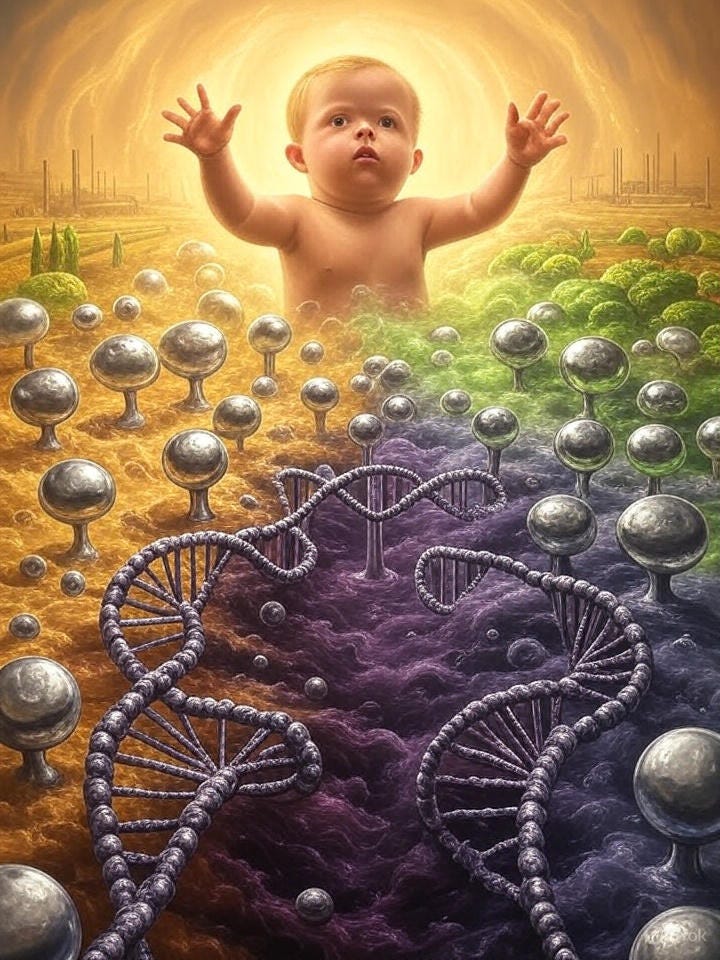
The medical establishment's explanation for Down's syndrome has remained remarkably static for decades: a genetic accident, a chromosomal abnormality, an unfortunate roll of the dice that becomes more likely with maternal age. Yet this tidy narrative begins to unravel when examined closely. The claim that Down's syndrome is purely genetic becomes particularly suspect when we consider that women of all ages give birth to babies with this condition, and that the medical literature itself acknowledges no definitive research linking the syndrome to genetic factors alone. What emerges from the work of researchers like Dawn Lester and David Parker is a fundamentally different understanding - one that points not to faulty genes but to environmental poisoning, where mercury, alongside pesticides, heavy metals, and various forms of radiation, creates the oxidative stress and free radical damage that manifests as chromosomal abnormalities characteristic of Down's syndrome.
The scientific evidence supporting this environmental hypothesis is substantial yet systematically overlooked. Research has demonstrated that mercury produces aberrant chromosome numbers, while ionizing radiation from X-rays given to pregnant women was linked to Down's syndrome as far back as 1964 at Johns Hopkins School of Medicine. That same study found an unexpected correlation with fathers working near radar, suggesting non-ionizing radiation's role. More recent research from 2008 confirmed that radiofrequency electromagnetic fields cause numerical chromosome aberrations after just 72 hours of exposure. Dr. Russell Blaylock's work reveals how pesticides and heavy metals generate massive numbers of free radicals that damage sperm and ova in the same way they damage other cells in the body. These findings point to a clear mechanism: environmental toxins disrupt the critical process of meiosis in germ cells, creating the trisomy 21 that defines Down's syndrome, with the damage varying in intensity based on timing and level of exposure.
This understanding of Down's syndrome as environmental poisoning connects to a broader pattern of mercury-related neurological damage that researchers like Dr. Boyd Haley have spent decades documenting, often at great professional cost. Haley's development of OSR, a compound that safely chelates mercury from the body including the brain, emerged from his recognition that mercury causes rapid demyelination and neurological damage across multiple conditions. His research showing that mercury can replicate all five major biochemical abnormalities found in Alzheimer's disease when added to normal brain tissue suggests the profound impact of this toxin on human neurology. The suppression of this research - Haley lost 25 years of NIH funding after linking mercury to neurological diseases - mirrors the resistance Lester and Parker describe regarding Down's syndrome research. The National Down Syndrome Society's claim that "no definitive scientific research" links environmental factors to the condition becomes less a statement of fact than a reflection of which research gets funded, published, and acknowledged by medical institutions invested in genetic explanations rather than environmental accountability.
The implications of recognizing Down's syndrome as a consequence of environmental toxicity rather than genetic chance are profound. It transforms the condition from an unavoidable tragedy to a preventable injury, shifting focus from acceptance to prevention and treatment. The reason older mothers show higher rates becomes clear - not because of aging eggs, but because of decades of accumulated toxins in their bodies, a burden of mercury from dental amalgams, pesticides from food, radiation from medical procedures, and countless other exposures that compromise cellular division. This reframing demands not just different medical approaches but accountability from industries that have promoted these toxins while knowing their dangers. For families affected by Down's syndrome, this perspective offers both hope and heartbreak - hope that future cases might be prevented through detoxification and environmental cleanup, heartbreak that their children's challenges might have been avoidable. As with so many conditions that modern medicine labels as genetic or idiopathic, Down's syndrome appears to be yet another manifestation of our increasingly toxic world, where the most vulnerable - developing babies - bear the consequences of decades of industrial contamination and medical denialism about environmental causes of disease.
With thanks to Dawn Lester and David Parker.
Down’s Syndrome
Down’s syndrome, also called Down syndrome, is defined by the establishment as, “a condition resulting from a chromosomal abnormality most commonly due to the presence of three copies of chromosome 21 (trisomy 21), which is most likely to occur with advanced maternal age.”
The claim that ‘advanced maternal age’ is a relevant factor for a Down’s syndrome baby is misleading, because women of all ages have given birth to babies with this condition; there is however, a reason for the increased likelihood that an older mother may give birth to a baby with Down’s syndrome, as this discussion will demonstrate.
The nucleus of most cells contains 46 chromosomes arranged in 23 identical pairs. During the normal course of life, millions of the body’s cells die every day and need to be replaced. The replacement process involves a form of cell division called ‘mitosis’ that entails the generation of two identical daughter cells, each of which contains 46 chromosomes arranged in 23 identical pairs.
The exception to this process occurs in cells referred to as ‘germ cells’, also called cells in the germ line. In this context, however, the word ‘germ’ does not refer to a pathogen. Instead, it refers to the primary stage of something. Germ cells are precursors of the reproductive cells of both sperm and ova and are therefore the primary cells from which the human body develops. These germ cells undergo ‘meiosis’, a form of cell division that entails the generation of four daughter cells, each of which contains 23 unpaired chromosomes. After further processes take place, including fertilisation, these cells become the sex cells and are restored to the full complement of 46 chromosomes, but arranged in 22 identical pairs plus an additional pair that comprise the relevant sex chromosomes. Females have two X chromosomes; males have one X chromosome plus one Y chromosome.
Under certain circumstances, cell division of either type may result in the generation of an ‘abnormal’ number and arrangement of chromosomes in the daughter cells; a situation that is known as aneuploidy. An extra chromosome that creates a trio instead of a pair is called trisomy; a missing chromosome from a pair is called monosomy.
According to the NDSS (National Down Syndrome Society) web page entitled Down Syndrome,
“There is no definitive scientific research that indicates that Down syndrome is caused by environmental factors or the parents’ activities before or during pregnancy.”
This is erroneous; there is scientific research that has discovered reasons for chromosomal abnormalities to occur.
Dr David Rasnick PhD and Dr Peter Duesberg have studied aneuploidy and its role in health problems, especially cancer, which is discussed later in this chapter. In his article entitled The aneuploidy theory of cancer and the barriers to its acceptance, Dr Rasnick refers to the existence of aneuploidy in Down’s syndrome and states that,
“Just one extra copy of the smallest chromosome, with its thousand or so normal genes, is sufficient to cause the syndrome.”
The existence of ‘normal’ genes in the presence of abnormal chromosomes indicates that ‘genetic’ factors’ do not contribute to the occurrence of Down’s syndrome.
Although it is not uncommon for babies born with Down’s syndrome to grow to full adulthood, many do not survive, as Dr Rasnick indicates in his article,
“Most Down’s foetuses are spontaneously aborted. Nonetheless, the imbalance is small enough (47 chromosomes) to permit occasional live births.”
The error in chromosome 21 that results in Down’s syndrome occurs in the germ cells, which means that all these cells contain the error. The variation in the ‘viability’ of a foetus indicates that the factors that influence the occurrence of this chromosomal ‘error’ are of a varying intensity.
Cell division errors can affect chromosomes other than chromosome 21. These other chromosomal errors produce ‘defects’ that are also referred to as trisomy, each type of which is identified by the affected chromosome. For example, trisomy 18, which is also called Edwards syndrome, involves an extra copy of chromosome 18.
However, most chromosomal errors other than trisomy 21 generally cause conditions in which there is a much greater level of damage. In the majority of these cases, the foetus is not ‘viable’ and is spontaneously aborted via a ‘miscarriage’, which generally occurs in the very early weeks of pregnancy. Occasionally some babies survive to birth, but it is rare that those born with aneuploidy other than trisomy 21 live beyond their first year.
The CDC web page entitled Facts about Down Syndrome states,
“Researchers know that Down Syndrome is caused by an extra chromosome, but no one knows for sure why Down Syndrome occurs or how many different factors play a role.”
This claim that ‘no one knows’ is disingenuous; many researchers do know why it occurs. They also know about some of the substances that have the ability to cause chromosomal damage. The authors of Uninformed Consent refer to one substance that is a known teratogen with the ability to interfere with chromosomes,
“Mercury has been found to produce aberrant chromosome numbers.”
The timing of the exposure to mercury, or any other toxic substance, that will affect chromosome numbers will be a crucial factor in determining the extent of the effect. If exposure has occurred and is passed to the foetus in the early weeks of the pregnancy, it can lead to ‘aberrant chromosome numbers’ that can result in birth defects or to an ‘unviable’ life that results in a spontaneous abortion or miscarriage.
Another danger posed to the developing baby results from an excess of free radicals, which may be caused by a number of factors, especially of the toxic chemical variety, and by various combinations of these factors. Any substance that generates a high level of free radicals that are not neutralised by an adequate supply of antioxidants in the body can damage cells; as Dr Russell Blaylock explains,
“...the huge number of free radicals produced by exposure to pesticides and heavy metals, extreme exercise, and prolonged poor nutrition will produce the same cellular damage to the sperm and ova as it does to other cells in the body.”
Clearly, damage to the cells of sperm and ova can result in chromosomal damage during meiosis, and lead to aneuploidy and the various birth defects associated with chromosomal errors.
Ionising radiation in the form of X-rays and non-ionising radiation in the form of radar were shown to be associated with Down’s syndrome more than half a century ago; as indicated by Dr Becker in The Body Electric,
“In 1964 a group of researchers studying Down’s syndrome at the Johns Hopkins School of Medicine, after linking the malady to excess X rays given to pregnant women, found an unexpected further correlation with fathers working near radar.”
It has also been known for a few decades that other forms of ionising radiation cause chromosomal damage and certain ‘defects’; as Dr Rosalie Bertell states in No Immediate Danger, which was published in 1985,
“If the radiation damage occurs in germs cells, the sperm or ovum, it can cause defective offspring.”
Other evidence that non-ionising radiation can cause chromosomal damage is indicated by a 2008 article entitled Increased levels of numerical chromosome aberrations after in vitro exposure of human peripheral blood lymphocytes to radiofrequency electromagnetic fields for 72 hours. The title of this article, which is published in the BioInitiative Report 2012, is self-explanatory.
It is clear, therefore, that, contrary to the claim of the NDSS, there are a number of environmental factors that have been proven to cause the chromosomal abnormalities associated with Down’s syndrome; these environmental factors are toxins that include chemicals and electromagnetic radiation, both of which generate free radicals. An increased body burden of toxins for either parent produces increased levels of damaging free radicals that can adversely affect the outcome of cell division. A high body burden of toxins that have accumulated over the course of many years is one of the main reasons that ‘older’ women may be more likely to give birth to babies with Down’s syndrome than younger women.
I appreciate you being here.
If you've found the content interesting, useful and maybe even helpful, please consider supporting it through a small paid subscription. While 99% of everything here is free, your paid subscription is important as it helps in covering some of the operational costs and supports the continuation of this independent research and journalism work. It also helps keep it free for those that cannot afford to pay.
Please make full use of the Free Libraries.
Unbekoming Interview Library: Great interviews across a spectrum of important topics.
Unbekoming Book Summary Library: Concise summaries of important books.
Stories
I'm always in search of good stories, people with valuable expertise and helpful books. Please don't hesitate to get in touch at unbekoming@outlook.com
Baseline Human Health
Watch and share this profound 21-minute video to understand and appreciate what health looks like without vaccination.
It is becoming more and more apparent that many issues related to our health and wellbeing, are linked to toxins and environmental pollution.
For big pharma, the paid up shills called scientists, and their masters, it’s an absolute cash cow. They also get to genocide the population while making the rest of us so unwell we are cornered into buying their poisonous drugs.
I have often wondered about this but told myself that not EVERYTHING is mercury! But if mercury is implicated here, I wonder if some of the medical conditions these kids have would improve with chelation. Also, as far as aluminum is concerned, it is toxic of course, and it is synergistically toxic with mercury, but Andy Cutler claimed that it is only retained in the presence of mercury.
Here is an interesting observation about radiation. I met a person at a Weston A. Price convention who told me that the men who work at radar facilities have to have their fillings replaced because the radiation makes them dissolve.