

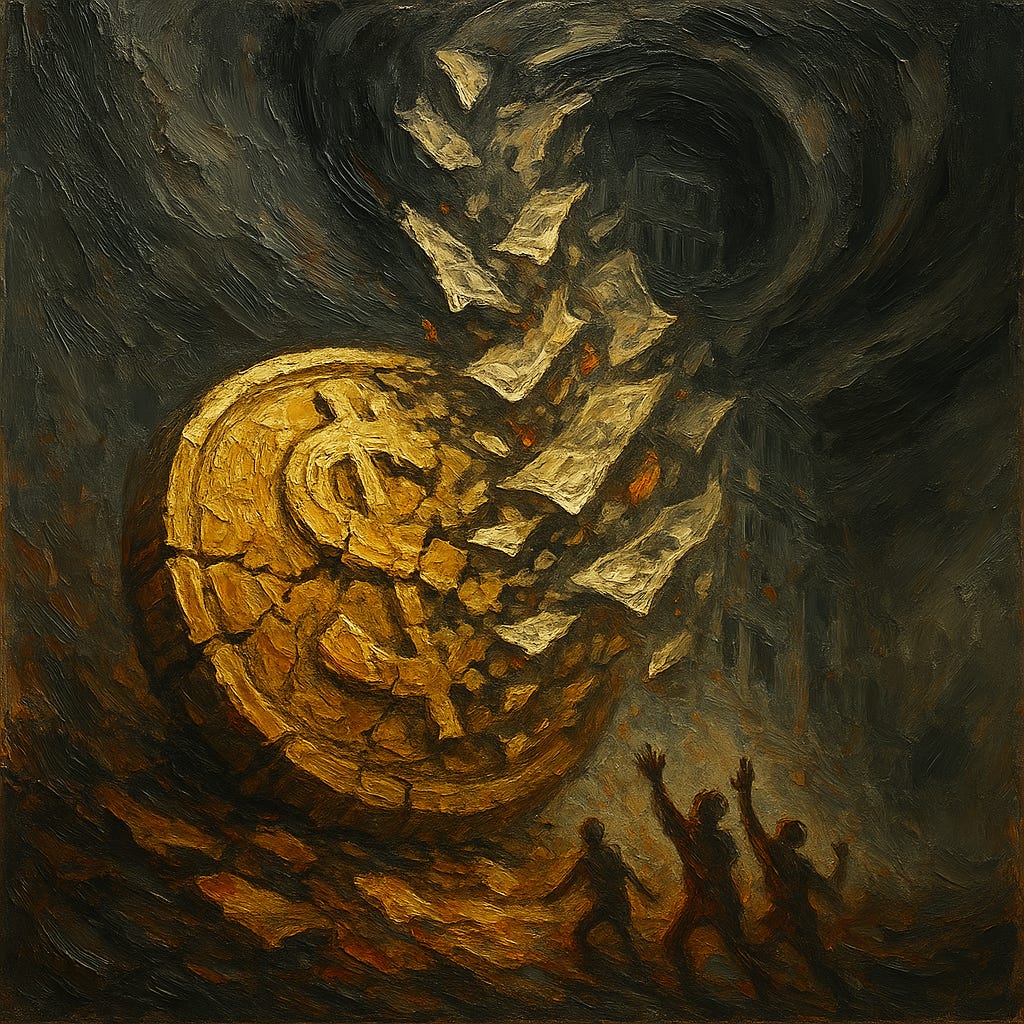
Ron Paul’s “End the Fed” arrived in 2009 at a moment when the American monetary system teetered on the edge of collapse, yet most citizens remained oblivious to the counterfeiting operation running their economy. The Federal Reserve, that peculiar creature born in secrecy on Jekyll Island in 1910, had managed to destroy 96% of the dollar’s value since 1913 while convincing the public that inflation was as natural as rain. Paul, a Texas congressman who spent decades as a lonely voice questioning Fed chairmen in committee hearings, wrote from the intersection of personal conviction and political experience—he’d actually confronted Greenspan about his philosophical betrayal, pressed Bernanke about housing bubbles before they burst, and watched his warnings dismissed as the ravings of a crank. The book read like a criminal indictment written by someone who’d been documenting the crime for thirty years, building his case from childhood memories of penny collecting through his discovery of Austrian economics to his final realization that the Fed wasn’t failing at its stated goals—it was succeeding magnificently at its real purpose: enriching banks while enslaving everyone else through debt and inflation.
The mechanics of this theft were both simple and diabolical. When the Fed created money from nothing—and by 2009 they were creating trillions—they weren’t producing wealth but stealing it from every person holding dollars. The newly conjured money flowed first to primary dealer banks at virtually zero interest, who then lent it out at higher rates or gambled in markets, spending it before prices rose. By the time this money trickled down to workers through wages, prices had already increased, meaning regular people were always behind, always poorer in real terms. Paul traced this process through American history, from the First and Second Banks of the United States through the Fed’s founding by a cabal of bankers literally conspiring at a secret meeting, to Nixon’s 1971 abandonment of the gold standard that removed the last restraint on money printing. The housing bubble that had just burst wasn’t some mysterious market failure—it was the predictable result of Greenspan and Bernanke’s deliberate inflation, their response to each crisis being more of the poison that caused it.
The constitutional case against the Fed should have been enough to end it immediately. The Founders, having lived through the Continental dollar’s collapse, explicitly required gold and silver as legal tender and never granted Congress power to delegate money creation to a private banking cartel. Every Federal Reserve Note was a violation of Article I, Section 10, every act of money creation a form of illegal counterfeiting that would land anyone else in prison. Paul showed how the Supreme Court had twisted the Constitution through cases like McCulloch v. Maryland, inventing “implied powers” that turned the document from a restraint on government into a blank check. Yet Congress loved this arrangement because it let them spend without taxing, fund wars without asking voters, and create welfare programs without admitting their true cost. The Fed enabled what the Constitution was designed to prevent: unlimited government growth through the hidden tax of inflation.
But here’s what made Paul’s critique both powerful and limited: he stayed carefully within the boundaries of acceptable discourse, focusing on the institution of central banking while avoiding the specific families and interests who created and controlled it. The book never ventured into the deeper waters of who exactly sat in those Jekyll Island meetings, which banking dynasties had pushed for central banks for centuries, or how certain names appeared again and again at crucial moments when monetary systems were transformed. This strategic silence probably kept Paul from being completely marginalized—he could maintain his congressional seat, run for president, and get his message into mainstream channels precisely because he criticized the system without naming all its architects. You could read the entire book and never encounter certain surnames that researchers outside the acceptable discourse would consider central to any honest discussion of international banking power. Paul gave us the crime but not all the criminals, the mechanism but not all the mechanics, the what and how but not always the who.
Despite these calculated omissions, “End the Fed” remained invaluable as perhaps the most comprehensive attack on central banking ever written by a sitting congressman. Paul didn’t just theorize—he brought receipts from decades of actual confrontations with Fed chairmen, showing how they deflected, dissembled, and ultimately admitted they were creating money out of thin air with no accountability to anyone. His personal journey from a doctor delivering babies to a congressional gadfly attacking the most powerful institution in America gave the book an authenticity that academic critiques lacked. He showed Americans that their entire economic system was a fraud, that every boom was fake and every bust was engineered, that the Fed wasn’t incompetent but evil—deliberately stealing from the poor to give to banks under the cover of economic jargon. The book’s ultimate value lay not in its completeness but in its existence: here was someone inside the system, with access to the actual criminals, telling as much truth as could be told while still maintaining a platform to tell it. Sometimes the perfect is the enemy of the good, and Paul chose to light a candle rather than curse the darkness—even if that candle carefully avoided illuminating certain corners of the room.
With thanks to Ron Paul.
Deep Dive Conversation Library (Bonus for Paid Subscribers Only)
This deep dive is based on the book:
Discussion No.132:
Insights and reflections from “End The Fed”
Thank you for your support.
Analogy
Imagine you live in a town where one family owns the only water well. This family has the magical power to create as much water as they want from nothing—not by finding new sources or purifying it, but just by declaring it exists. At first, this seems wonderful. Water is plentiful, everyone’s lawns are green, pools are full, and the town prospers. The family that controls the well becomes incredibly wealthy and powerful, as does anyone who befriends them, because they get first access to the new water before everyone else knows it exists.
But here’s the catch: the more water this family creates from nothing, the less valuable all existing water becomes. Soon, it takes two buckets to buy what one bucket bought before. Then five. Then ten. People who saved water in tanks for their retirement find it’s now worthless. Meanwhile, the well-owning family and their friends already traded their early access to the new water for real goods—land, houses, businesses—before prices adjusted. Even worse, when their friends make bad business decisions and waste enormous amounts of water, the well family just creates more to bail them out, diluting everyone else’s water even further. The town government loves this arrangement because they can promise voters unlimited water for fountains, pools, and parks without raising taxes—they just have the well family create more. When citizens finally realize they’re being robbed and demand answers about how much water is being created and who’s getting it, the well family says it’s “too complicated” for regular people to understand and revealing the information would be “counterproductive.” This is exactly what the Federal Reserve does with money—creating it from nothing, enriching those with first access, destroying savings through dilution, enabling government excess, and operating in complete secrecy while pretending it’s all for the common good.
The One-Minute Elevator Explanation
The Federal Reserve is essentially a money-counterfeiting operation that Congress created in 1913, giving a banking cartel the exclusive power to create dollars from nothing. When they print money—nowadays just typing numbers into computers—they’re not creating wealth, they’re stealing it from everyone who has saved dollars, like a thief who sneaks into your house and takes half the value from your wallet while you sleep. This fake money causes booms when everyone feels rich borrowing and spending what doesn’t really exist, followed by devastating busts when reality reasserts itself—think the housing crash of 2008. The Fed enables endless wars and welfare programs by printing whatever the government wants to spend, making every American poorer through the hidden tax of inflation. The solution is simple: end the Fed, restore sound money that government can’t print, and force politicians to be honest about what things actually cost instead of paying for everything with the counterfeit money machine.
[Elevator dings]
Want to understand more? Look into Austrian economics at the Mises Institute, read about what happened when Nixon closed the gold window in 1971, and research how every paper money system in history has ended in disaster.
12-Point Summary
1. The Federal Reserve is a government-sanctioned banking cartel with monopolistic money-creation powers. Created through secret meetings of bankers in 1913 and sold to the public as economic protection, the Fed is actually a partnership between the biggest banks and government that allows both to profit at citizens’ expense. It operates with more secrecy than the CIA while controlling the most important aspect of economic life—the value and quantity of money. This institution was designed by and for the banking elite to socialize their losses onto taxpayers while keeping their profits private.
2. Money printing is the Fed’s core destructive power that corrupts the entire economy. The ability to create unlimited money from nothing allows the Fed to bail out failed banks, fund endless government spending, and manipulate interest rates, all while destroying the purchasing power of every dollar earned or saved by working Americans. This isn’t wealth creation—it’s wealth transfer from the productive middle class to the politically connected elite. Since 1913, the dollar has lost 96% of its value through this process of deliberate debasement.
3. The boom-bust cycle is not a market failure but a direct consequence of Fed manipulation. By artificially lowering interest rates and expanding credit, the Fed sends false signals throughout the economy, causing massive malinvestment in unsustainable projects. The 2008 housing crisis wasn’t caused by capitalism but by the Fed’s deliberate inflation of a housing bubble to paper over the previous dot-com bubble. Every recession is the market trying to correct the Fed’s previous distortions, but instead of allowing healthy correction, the Fed creates even bigger bubbles.
4. Inflation is a hidden tax that disproportionately harms the poor and middle class. When the Fed creates new money, it flows first to banks and government contractors who spend it before prices rise, while workers and retirees get the depreciated dollars after inflation has already occurred. This reverse Robin Hood scheme transfers wealth from those who work and save to those who print and borrow. A minimum wage worker watching grocery prices double while their wages stagnate is being robbed just as surely as if someone picked their pocket.
5. The Fed enables endless warfare and welfare spending by removing fiscal discipline. Without the Fed’s printing press, politicians would have to raise taxes or honestly borrow to fund their programs, making the true cost visible to voters who would reject most spending. Every major war since 1913 has been funded primarily through inflation rather than taxation. The Fed allows politicians to play Santa Claus with counterfeit money, buying votes with programs that would be politically impossible if honestly financed.
6. The Constitution explicitly prohibits paper money and requires gold and silver as legal tender. The Founders, having lived through the disaster of the Continental dollar, deliberately wrote the Constitution to prevent exactly what the Fed does. Only gold and silver were to be legal tender, and Congress was never given authority to delegate its monetary powers to a private banking cartel. The Fed operates in blatant violation of the Constitution, exercising powers never granted and destroying the value of money the Constitution requires to be kept stable.
7. The 1971 abandonment of gold backing unleashed unlimited money creation and debt accumulation. When Nixon severed the last link between dollars and gold, he removed the final restraint on government spending and Fed money printing. Since then, total debt has exploded from 150% to over 350% of GDP, America transformed from the world’s largest creditor to its largest debtor, and the financial system has lurched from crisis to crisis as the Fed tries to paper over problems with ever-larger amounts of printed money.
8. Alan Greenspan and Ben Bernanke personify the Fed’s intellectual and moral bankruptcy. Greenspan transformed from eloquent gold standard advocate who understood inflation as wealth confiscation into history’s greatest money printer who created serial bubbles. Bernanke’s entire philosophy reduces to printing unlimited money to prevent any deflation, believing he can centrally plan the economy through monetary manipulation while refusing to tell Congress where trillions in bailout money went because transparency would be “counterproductive.”
9. Congress maintains willful ignorance about the Fed to avoid responsibility for economic consequences. Most members literally don’t understand how money is created or what the Fed does, with some not even knowing the dollar isn’t backed by gold. This ignorance serves both Congress and the Fed perfectly—politicians get unlimited spending without raising taxes, then blame “speculators” and “greedy corporations” when inflation results. The Fed operates with less oversight than any other government institution, exempt from auditing its most important operations.
10. Free market banking and sound money would provide stability without central planning. Ending the Fed doesn’t mean ending banking—it means banks would compete on safety and soundness rather than political connections, interest rates would reflect real savings rather than Fed manipulation, and money would hold its value rather than constantly depreciate. Historical examples like the Byzantine Empire’s 600-year gold standard and America’s greatest growth period under the classical gold standard prove sound money creates prosperity without the boom-bust cycles the Fed claims to prevent.
11. The current system is mathematically doomed and approaching its crisis endpoint. With unpayable debts, unsustainable promises, and a currency being debased at accelerating rates, the Federal Reserve system faces the same fate as every fiat currency in history—complete collapse. The only question is whether America transitions to sound money through deliberate reform or chaotic crisis. The Fed’s frantic money printing to “save” the economy is actually the poison being administered as medicine, guaranteeing even greater catastrophe.
12. A grassroots movement to end the Fed is building across the political spectrum. From students burning dollar bills at rallies to legislative efforts for Fed transparency, Americans are awakening to the reality that the Fed is the enabler of corruption, war, and economic instability. The intellectual battle is being won as Austrian economists’ predictions prove correct while Keynesian central planners’ promises prove false. The end of the Fed is not a matter of if but when, and whether it comes through peaceful legislation or currency collapse depends on how quickly Americans demand their monetary freedom back.
The Golden Nugget
The most profound yet little-known idea in this book is that the Federal Reserve deliberately creates moral hazard throughout society by breaking the essential link between actions and consequences, transforming America from a nation of savers and producers into a nation of speculators and dependents. By guaranteeing that big banks and connected corporations can never truly fail, while simultaneously punishing savers through inflation and rewarding debtors through currency debasement, the Fed has inverted the natural order that makes civilization possible. This goes far beyond economics—it’s about the destruction of personal responsibility itself. When an entire society learns that prudence is punished, recklessness is rewarded, and political connections matter more than productive work, it doesn’t just lose its prosperity, it loses its soul. The Fed hasn’t just debased our currency; it has debased our culture, creating a system where everyone from Wall Street CEOs to welfare recipients expects someone else to pay for their mistakes, where saving for the future is foolish because the money will be stolen through inflation, and where the entire economy becomes a casino where the house always wins because it owns the printing press.
30 Questions and Answers
Question 1: What is the Federal Reserve and what unique power does it possess that distinguishes it from other institutions?
Answer: The Federal Reserve is America’s central bank, established in 1913, functioning as a government-sanctioned cartel of private banks with monopoly control over the nation’s money supply. Its unique and distinguishing power is the ability to create money out of thin air—literally manufacturing new dollars through computer entries without any backing, constraint, or accountability to market forces. This isn’t merely printing physical currency; it’s the power to expand credit infinitely, manipulate interest rates at will, and monetize government debt by purchasing Treasury bonds with newly created money.
This power to conjure money from nothing sets the Fed apart from every other institution in society. While private banks can leverage deposits through fractional reserves, only the Fed can create the base money that seeds the entire system. No other entity—not Congress, not the Treasury, not private corporations—possesses this extraordinary ability to generate purchasing power without producing anything of value. The Fed exercises this power in complete secrecy, without meaningful oversight, making decisions that affect every dollar in every wallet, every price in every store, and every economic decision made by hundreds of millions of people.
Question 2: How was the Federal Reserve created in 1913, and what was the role of the Jekyll Island meeting?
Answer: The Federal Reserve’s creation was orchestrated through one of the most significant acts of subterfuge in American history. In November 1910, a group of the nation’s most powerful bankers and their allies met secretly at Jekyll Island, Georgia, under the pretense of a duck-hunting expedition. The attendees included Senator Nelson Aldrich (Rockefeller’s man in the Senate), Henry Davison (J.P. Morgan’s senior partner), Paul Warburg (Kuhn, Loeb representative and German central banking advocate), Frank Vanderlip (National City Bank vice president), and A. Piatt Andrew (Assistant Secretary of the Treasury). These men represented roughly one-fourth of the world’s wealth and met in absolute secrecy to draft what would become the Federal Reserve Act.
The conspiracy at Jekyll Island succeeded through a carefully orchestrated propaganda campaign that followed. The bankers funded academic studies, placed articles in newspapers, created fake grassroots organizations, and positioned the Fed as a solution to financial panics—particularly the Panic of 1907. They deliberately structured it as a “decentralized” system of twelve regional banks to hide its true nature as a cartel, making it appear less threatening than a European-style central bank. The public was told the Fed would stabilize the economy, prevent bank failures, and serve the public interest. In reality, the largest banks designed it to socialize their losses, cartelize the banking industry, and create an “elastic” currency they could expand at will—effectively granting themselves a license to counterfeit.
Question 3: What is fractional reserve banking and how does it relate to money creation?
Answer: Fractional reserve banking is the practice where banks lend out most of the money deposited with them while keeping only a small fraction in reserve. When you deposit $1,000 in a bank, the bank might keep just $100 (a 10% reserve) and loan out $900 to someone else. That borrower deposits the $900 in their bank, which then keeps $90 and loans out $810, and the process continues. Through this pyramiding effect, the original $1,000 deposit ultimately creates $10,000 or more in the money supply—money that exists only as accounting entries, not as real wealth.
This system fundamentally merges two incompatible functions: warehousing (keeping your money safe and available) and investment lending (putting money at risk for returns). Banks promise depositors they can withdraw their money anytime while simultaneously lending that same money out for long-term loans. The Federal Reserve enables and encourages this inherent fraud by standing ready to create new reserves whenever banks face trouble, removing the natural discipline that would otherwise constrain reckless lending. Without the Fed’s backstop, fractional reserve banking would be exposed as unsustainable—any significant demand for withdrawals would cause bank failures, forcing honest banking practices. Instead, the Fed’s money printing allows banks to privatize profits during good times and socialize losses during crashes.
Question 4: How does the Federal Reserve create boom-bust cycles in the economy?
Answer: The Federal Reserve creates boom-bust cycles through its manipulation of interest rates and money supply, sending false signals throughout the economy that cause massive misallocation of resources. When the Fed artificially lowers interest rates below market levels and expands credit, it tricks businesses and individuals into thinking there are more real savings available than actually exist. Entrepreneurs launch projects, builders construct homes, and consumers buy goods based on these false price signals, creating an artificial boom where everyone feels wealthy and optimistic.
The bust becomes inevitable because these investments were never backed by real savings—they were built on artificially created credit that distorted economic calculation. Like a drug that initially makes you feel good but eventually poisons your system, cheap money creates unsustainable bubbles in whatever sectors it flows into—technology stocks in the 1990s, housing in the 2000s. When reality reasserts itself and the Fed can no longer maintain the illusion, projects must be abandoned, workers laid off, and debts liquidated. The recession isn’t some mysterious external event—it’s the necessary correction of the Fed’s previous distortions, the hangover after the party. Yet instead of allowing this healthy correction, the Fed typically responds by creating even more money and credit, setting up the next bubble and ensuring the next bust will be even more devastating.
Question 5: What happened when the Bretton Woods system collapsed in 1971, and why was this significant?
Answer: On August 15, 1971, President Nixon severed the last link between the dollar and gold, declaring that foreign governments could no longer exchange their dollars for gold at the fixed rate of $35 per ounce. This “Nixon Shock” ended the Bretton Woods system established after World War II, which had made the dollar the world’s reserve currency backed by gold, and ushered in an unprecedented experiment in global fiat money. For the first time in history, the entire world monetary system was based on paper money backed by nothing but government promises and military might.
This transformation unleashed the Federal Reserve from its last restraint, allowing unlimited money creation without fear of gold redemption. The consequences have been staggering: the dollar has lost over 80% of its purchasing power since 1971, wealth inequality has exploded as those closest to the money printer enriched themselves, and financial bubbles have grown progressively larger and more destructive. The post-1971 system enabled the explosive growth of government debt (now unpayable except through inflation), perpetual warfare financed by money printing, and the transformation of America from the world’s largest creditor to its largest debtor. We’re living through the terminal phase of this forty-year experiment in pure fiat money, as the imbalances created by unlimited credit creation have become too large to sustain.
Question 6: What is the difference between the Austrian and Keynesian views on economic cycles and monetary policy?
Answer: Austrian economists view economic cycles as the inevitable consequence of government and central bank interference in money and credit markets. They understand that artificial credit expansion causes entrepreneurs to make errors en masse, launching unsustainable projects that must eventually be liquidated. Austrians see recessions as necessary corrections, like a body fighting off disease, where malinvestments are cleared out and resources reallocated to productive uses. They recognize that the boom, not the bust, is the problem—the artificial high created by monetary manipulation that distorts price signals and causes resources to be wasted on projects consumers don’t actually want.
Keynesians, by contrast, believe economic cycles result from irrational “animal spirits” and insufficient demand that government must correct through active management. They see recessions as unnecessary suffering that can be avoided if wise technocrats inject enough spending and credit into the system. To Keynesians, the solution to a debt crisis is more debt, the cure for inflation is more inflation (just “targeted” better), and the answer to failed government intervention is always more intervention. While Austrians predicted the housing bubble, the 2008 crisis, and the current economic problems based on their understanding of how Fed policy distorts markets, Keynesians were blindsided because their models ignore the crucial role of monetary manipulation in causing economic chaos. The track record speaks for itself: Austrian economists have consistently predicted major economic crises while Keynesian central planners have consistently created them.
Question 7: How has the dollar lost 95% of its value since 1913, and what does this mean for ordinary people?
Answer: Since the Federal Reserve’s creation in 1913, the dollar has lost approximately 96% of its purchasing power—what cost $1.00 in 1913 now costs over $25.00. This isn’t just an abstract statistic; it represents the systematic theft of wealth from anyone who earned, saved, or held dollars over this period. Your grandparents could buy a quality suit for $20, a new car for $500, and a house for $3,000. Today those same items cost thousands or hundreds of thousands of dollars—not because they became more valuable, but because the Fed deliberately destroyed the dollar’s value through relentless money printing.
This decimation of the dollar means that saving money is punished while debt is rewarded, forcing Americans onto a treadmill where they must constantly chase higher returns just to preserve purchasing power. A worker who saved $10,000 in 1970 and held it in cash would have lost over 85% of its value by today—their lifetime of thrift and responsibility rewarded with poverty. Meanwhile, those who borrowed heavily and owned hard assets saw their debts inflated away while their properties soared in nominal value. The Fed has essentially made every American a forced speculator, unable to simply save money safely, instead pushed into stocks, real estate, and other investments they may not understand just to avoid the guaranteed loss of holding dollars. This is why your parents could support a family on one income while you struggle with two—it’s not that you’re working less hard, it’s that the Fed has stolen the value of your labor through monetary debasement.
Question 8: What constitutional arguments exist against the Federal Reserve’s existence?
Answer: The Constitution is devastatingly clear: Congress has the power “to coin money” and “regulate the value thereof,” while states are prohibited from making anything except gold and silver coin legal tender. Nowhere does the Constitution authorize Congress to delegate its monetary powers to a private banking cartel, nowhere does it permit the creation of paper money, and nowhere does it allow the abandonment of gold and silver as money. The Founders, having lived through the disaster of the Continental dollar, deliberately wrote the Constitution to prevent exactly what the Federal Reserve does every day—the creation of unbacked paper money that robs citizens through inflation.
The Supreme Court case McCulloch v. Maryland in 1819 twisted the Constitution beyond recognition by inventing “implied powers” that somehow authorized a central bank, even though the Convention explicitly rejected granting the federal government the power to emit bills of credit. The Tenth Amendment makes clear that powers not delegated to the federal government are reserved to the states or the people—and the power to create a monetary monopoly was never delegated. The Fed operates in blatant violation of the Constitution, exercising powers never granted, destroying the value of our money in direct contradiction to the mandate to “regulate” (meaning keep regular and stable) its value. Every Federal Reserve Note in your wallet represents an unconstitutional usurpation of power, a silent testimony to how far we’ve strayed from the rule of law into rule by banking cartel.
Question 9: How did the 2008 financial crisis develop from Federal Reserve policies?
Answer: The 2008 crisis was the direct and predictable result of the Federal Reserve’s deliberate policy of inflating a massive housing bubble to paper over the previous dot-com bubble collapse. After the NASDAQ crash in 2000, Greenspan slashed interest rates from 6.5% to an unprecedented 1% and held them there for years, making borrowing essentially free and savings worthless. This tsunami of cheap credit had to go somewhere, and the government explicitly directed it into housing through agencies like Fannie Mae and Freddie Mac, regulations like the Community Reinvestment Act, and the Fed’s implicit promise to bail out any major bank that got into trouble.
Banks responded rationally to these perverted incentives by making millions of loans to people who couldn’t possibly repay them, then packaging these toxic mortgages into complex securities sold worldwide. Everyone from Wall Street to Main Street joined the mania, convinced that house prices could only go up because the Fed would never allow them to fall. When Bernanke finally raised rates to combat inflation, the whole fraudulent structure collapsed—millions lost their homes, retirement accounts were decimated, and the real economy crashed. But instead of allowing the necessary liquidation of bad debt and failed companies, the Fed and government responded with unprecedented bailouts and money printing, protecting the guilty while punishing the innocent with inflation, unemployment, and higher taxes. The crisis wasn’t a failure of capitalism—it was the inevitable consequence of central planning through monetary manipulation.
Question 10: What is moral hazard and how does the Fed create it in the financial system?
Answer: Moral hazard occurs when people take excessive risks because they know someone else will bear the consequences of their failures—like a teenager with dad’s credit card who knows he won’t have to pay the bill. The Federal Reserve institutionalizes moral hazard throughout the entire financial system by guaranteeing that big banks, favored corporations, and government itself will never have to face the full consequences of their reckless behavior. Banks make insanely risky loans knowing the Fed will bail them out, corporations leverage themselves to the hilt knowing they’re “too big to fail,” and politicians promise unlimited benefits knowing the Fed will print whatever money they need.
This destroys the essential market mechanism of profit and loss that ensures resources flow to productive uses. In a free market, bad decisions lead to bankruptcy, teaching vital lessons and transferring resources to better managers. But the Fed short-circuits this process, keeping zombie banks and corporations alive with printed money while prudent competitors are punished for their responsibility. The message is clear: gamble wildly during booms and you’ll get rich; fail spectacularly during busts and you’ll get bailed out. Meanwhile, responsible citizens who saved money, avoided debt, and ran honest businesses are forced through taxation and inflation to subsidize the very people whose recklessness destroyed the economy. The Fed hasn’t eliminated risk—it’s concentrated all risk onto taxpayers and dollar holders while allowing the privileged few to keep all rewards.
Question 11: How does inflation act as a hidden tax, particularly affecting the poor and middle class?
Answer: Inflation is the most vicious and regressive tax possible because it strikes the poor and middle class hardest while enriching the wealthy and politically connected. When the Fed creates new money, it doesn’t distribute it evenly—it flows first to banks, government contractors, and Wall Street, who get to spend it at current prices. By the time this new money filters down to workers and retirees through wages and social security adjustments, prices have already risen, leaving them poorer in real terms. A minimum wage worker or retiree on a fixed income watches helplessly as their grocery bill doubles while their income barely budges—they’re being robbed just as surely as if someone picked their pocket.
The wealthy protect themselves from this theft by owning assets that rise with inflation—stocks, real estate, commodities—while the poor hold their meager savings in cash that loses value every day. Even worse, inflation pushes people into higher tax brackets without any real increase in wealth, a cruel trick called “bracket creep” where you pay more taxes on money worth less. The government loves inflation because it reduces the real value of their debts while providing revenue without the political cost of raising taxes—they get to spend more while pretending to be fiscally responsible. Every time you notice prices creeping higher at the store, remember you’re paying a tax imposed by the Federal Reserve, a tax never voted on by Congress, a tax that transfers wealth from those who work and save to those who print and spend.
Question 12: What was Alan Greenspan’s philosophical transformation regarding gold and central banking?
Answer: Alan Greenspan’s transformation from gold standard advocate to history’s most prolific money printer represents perhaps the most stunning intellectual betrayal in economic history. In 1966, he wrote brilliantly that “in the absence of the gold standard, there is no way to protect savings from confiscation through inflation,” calling gold “the protector of property rights” and condemning deficit spending as “simply a scheme for the confiscation of wealth.” He understood perfectly that government opposition to gold stemmed from its restriction on unlimited money printing, and that the welfare state required fiat money to function.
Yet when offered power as Fed Chairman, Greenspan abandoned every principle he once held, becoming the very destroyer of wealth he had condemned. When confronted with his own words, he incredibly claimed he wouldn’t change a single word of his gold standard advocacy, even while creating the biggest bubbles in history through monetary inflation. He told Congress that central bankers had become smart enough to achieve all the benefits of the gold standard without its limitations—essentially claiming he could counterfeit responsibly. His tenure proved the opposite: the dot-com bubble, the housing bubble, and the roots of our current crisis all grew from Greenspan’s printing press. He went from warning about the dangers of paper money to embodying those dangers, from defending property rights to systematically destroying them through inflation, from principled intellectual to power-seeking pragmatist who sold his soul for a chairman’s seat.
Question 13: What is Ben Bernanke’s approach to preventing deflation and economic downturns?
Answer: Ben Bernanke earned the nickname “Helicopter Ben” from his statement that deflation could always be prevented by dropping money from helicopters if necessary—and he’s proven true to his word by creating more money than any Fed chairman in history. His entire philosophy stems from his academic study of the Great Depression, where he concluded wrongly that the problem was insufficient money printing rather than too much government intervention. At Milton Friedman’s ninetieth birthday, Bernanke literally apologized for the Fed not inflating enough in the 1930s and promised “we won’t do it again”—meaning he would inflate without limit to prevent any deflation.
Bernanke’s approach amounts to economic central planning through monetary manipulation, believing he can fine-tune the economy by controlling interest rates and flooding the system with liquidity whenever problems arise. He views falling prices as catastrophic even though they’re the natural result of increased productivity and the necessary correction of previous inflation. His “solution” to every problem is the same: create more money, lower interest rates, and bail out failing institutions. When pressed about where trillions in bailout money went, he essentially told Congress it was none of their business, calling transparency “counterproductive.” His academic theories have collided with reality, yet he continues doubling down—if trillions don’t work, try tens of trillions. He’s like a doctor who keeps increasing the dose of poison, convinced that enough of it will cure the patient, blind to the fact that the poison is the disease.
Question 14: How does the Federal Reserve enable wars and the growth of government?
Answer: Without the Federal Reserve’s money printing press, the American empire would be impossible and the welfare state would collapse within months. Wars and welfare programs must be paid for, and there are only three ways to do it: taxation, borrowing, or inflation. The public would revolt if taxes were raised high enough to pay for our endless wars and trillion-dollar welfare programs, and borrowing has limits when creditors doubt repayment. But with the Fed ready to create unlimited money, politicians can wage perpetual war and promise unlimited benefits without immediate visible cost, sending the bill to future generations through the hidden tax of inflation.
Every major American war since the Fed’s creation has been financed primarily through money printing—World War I, World War II, Korea, Vietnam, Iraq, Afghanistan—all made possible by the Fed’s counterfeit machine. Without the Fed, Congress would have to honestly debate whether each war was worth the immediate sacrifice in higher taxes, making unnecessary conflicts politically impossible. Similarly, the entire welfare state from Social Security to Medicare to food stamps depends on the Fed’s ability to monetize government debt. Politicians love the Fed because it allows them to play Santa Claus with printed money, buying votes with programs that voters would reject if they saw the real price tag. The Fed is the enabler of empire and the financier of tyranny, turning the government from a limited constitutional republic into an unlimited warfare-welfare state that intervenes everywhere abroad and controls everything at home.
Question 15: What is the relationship between central banking and the welfare-warfare state?
Answer: Central banking and the welfare-warfare state are as inseparable as alcoholism and liver disease—one inevitably causes the other. The welfare state promises endless benefits to voters while the warfare state promises endless enemies to fight, and both require resources far beyond what any government could extract through honest taxation. The Federal Reserve squares this circle by creating the money to pay for both, allowing politicians to simultaneously buy votes with domestic spending and pose as world leaders through military intervention, all without presenting taxpayers with the true bill.
This unholy trinity of central banking, welfare, and warfare creates a self-reinforcing cycle of government growth. Wars create veterans who need benefits, refugees who need assistance, and enemies who require surveillance, expanding the welfare state. Welfare programs create dependency, destroy families, and undermine work ethics, leading to social breakdown that politicians address with more programs and more control. Both create massive constituencies—defense contractors, welfare recipients, government employees—who vote for continued expansion. The Fed enables it all by papering over the mathematical impossibility with printed money, until the day arrives when the currency collapses and the entire fraudulent structure implodes. Every great empire in history has traveled this path: using monetary debasement to finance both bread and circuses at home and military adventures abroad, until economic reality destroys what military might could not defeat.
Question 16: Why does Congress lack proper oversight of the Federal Reserve?
Answer: Congress deliberately designed the Federal Reserve to operate in secrecy, beyond democratic accountability, because politicians want the benefits of money printing without the responsibility for its consequences. The Fed is legally exempt from auditing its most important operations—all foreign transactions, all deals with other central banks, all decisions on monetary policy, and all discussions among board members about these topics are completely hidden from Congress and the people. When Bernanke was asked where trillions in bailout money went, he simply refused to answer, calling transparency “counterproductive,” and Congress just accepted it because they’re either ignorant about money or complicit in the scam.
Most members of Congress literally don’t understand how money is created, what the Fed does, or how monetary policy works—one member privately asked me whether the dollar was still backed by gold, genuinely not knowing it hasn’t been since 1971. This ignorance isn’t accidental; it serves both Congress and the Fed perfectly. Congress gets to spend unlimited money without raising taxes, funding their pet projects and buying votes with printed dollars. When inflation and economic crashes result, they blame “greedy corporations” or “speculators” instead of their printing press. Meanwhile, the Fed operates as a fourth branch of government with more power than the other three combined, completely unelected and unaccountable, setting the value of everyone’s money in secret meetings where no transcript is kept and no representative of the people is allowed. The few of us in Congress who understand this system and demand accountability are dismissed as cranks because the majority prefer comfortable ignorance to uncomfortable truth.
Question 17: What role did government housing policies play in creating the subprime mortgage crisis?
Answer: The housing bubble was a creation of government from start to finish, with the Fed providing the air and Congress directing where it should be blown. Starting with the Community Reinvestment Act forcing banks to make loans in “underserved” communities regardless of creditworthiness, the government essentially mandated that banks abandon traditional lending standards. The Equal Credit Opportunity Act, Fannie Mae, and Freddie Mac all pushed the same agenda: get everyone into a house whether they could afford it or not, using the power of government to override market reality.
Banks went along enthusiastically because they could make the loans, collect the fees, then sell the mortgages to government-sponsored enterprises that had implicit taxpayer backing. When private banks hesitated, politicians threatened them with discrimination lawsuits and regulatory harassment unless they met quotas for subprime lending. The result was millions of people buying houses they couldn’t afford with money they didn’t have at prices that couldn’t last. Politicians congratulated themselves for expanding homeownership, banks made fortunes originating garbage loans, and Wall Street got rich packaging them into toxic securities. When it all predictably collapsed, the same government that created the disaster blamed “predatory lending” and “deregulation,” then used the crisis to grab even more control over the economy. The poor and minorities who were supposedly being helped ended up losing their homes, their savings, and their jobs—victims of government “compassion” that was really just vote-buying disguised as social policy.
Question 18: How do artificially low interest rates distort economic decision-making?
Answer: Interest rates are prices—the price of borrowing money—and like all prices in a free market, they convey crucial information about reality. Natural interest rates tell businesses and individuals the truth about how much people have saved and are willing to defer consumption. When rates are high, it signals that savings are scarce and only the most profitable projects should proceed; when low, it indicates abundant savings available for investment. But when the Fed artificially suppresses rates, it’s lying to everyone in the economy, like putting the wrong labels on medicine bottles or posting false road signs before a cliff.
These false price signals cause entrepreneurs and consumers to make catastrophic errors en masse. Businesses launch projects thinking consumers have saved money to buy their products, but the savings don’t exist—it’s just printed money creating artificial demand. Consumers buy houses and cars they can’t afford, thinking low payments mean they’re wealthy, not realizing they’re spending phantom money that will evaporate. Students take massive loans for worthless degrees because cheap credit makes the debt seem manageable. Retirees are forced into risky investments because safe savings yield nothing. The entire economy becomes a house of cards built on the false foundation of manipulated interest rates. When reality finally reasserts itself, all these decisions based on lies must be unwound—businesses fail, workers lose jobs, homes are foreclosed, and dreams are shattered. The Fed’s interest rate manipulation doesn’t prevent economic suffering; it guarantees it by causing millions to make decisions that seem rational given the false signals but prove disastrous when truth emerges.
Question 19: What happened to gold ownership in America between 1933 and 1975?
Answer: In 1933, Franklin Roosevelt committed one of the greatest thefts in American history when he signed Executive Order 6102, making it illegal for American citizens to own gold. The government forced citizens to turn in their gold at $20.67 per ounce under threat of ten years in prison and a $10,000 fine (equivalent to over $400,000 today), then immediately revalued gold to $35 per ounce—stealing 40% of the value overnight. For forty-two years, Americans were prohibited from owning monetary gold while their government and every other government on earth accumulated it, making the U.S. more totalitarian in this respect than most dictatorships.
This gold confiscation was necessary for the government’s massive expansion during the New Deal and World War II—as long as citizens could exchange paper for gold, there was a limit to money printing. The profits from this theft were used to create the Exchange Stabilization Fund, a secretive Treasury slush fund that still operates today, manipulating markets with zero congressional oversight. Only through grassroots pressure led by people like Jim Blanchard did Congress finally relegalize gold ownership in 1975, and even then the government and IMF immediately dumped massive quantities on the market trying to drive prices down and punish “speculators” who were really just citizens trying to protect their wealth. The message was clear: government considers your attempt to preserve wealth outside their paper system to be a threat to their power. Today they can’t explicitly confiscate gold, but they tax it, track it, and would seize it again in a heartbeat if they thought they could get away with it.
Question 20: How does the Fed’s money printing benefit banks and large corporations at the expense of citizens?
Answer: The Fed’s money creation is the greatest reverse-Robin Hood scheme ever devised, stealing from the poor and middle class to give to the banking elite and politically connected corporations. When the Fed creates new money, it doesn’t mail checks to ordinary citizens—it gives it to primary dealer banks at virtually zero interest, who then lend it out at higher rates or use it to speculate in markets, earning billions risk-free. These banks and their corporate clients get to spend the new money first, before prices rise, purchasing real assets and businesses while the currency still has value.
By the time this money reaches workers through wages, or retirees through social security, prices have already increased, meaning they’re getting paid in depreciated dollars for things that cost more. It’s like being last in line at a buffet where those in front take all the good food and leave you scraps. Even worse, when these banks and corporations make bad bets and face bankruptcy, the Fed bails them out with more printed money, socializing their losses onto everyone who holds dollars. Goldman Sachs gets billions in secretive loans at 0.01% interest while you pay 18% on your credit card and watch your savings earn 0.1% at the bank. Large corporations use cheap Fed money to buy back their own stock, enriching executives while laying off workers. The Fed has created a two-tier economy: socialism for the rich who get unlimited bailouts and free money, brutal capitalism for everyone else who faces foreclosure, bankruptcy, and unemployment when times get tough.
Question 21: What is the “Plunge Protection Team” and how does it manipulate markets?
Answer: The “Plunge Protection Team” is the unofficial name for the President’s Working Group on Financial Markets, created after the 1987 stock market crash to prevent future market “disruptions.” This secretive group includes the Treasury Secretary, Fed Chairman, and heads of the SEC and Commodity Futures Trading Commission, meeting in secret with no public record of their discussions or actions. They possess enormous power to intervene in any market—stocks, bonds, currencies, gold, commodities—using the unlimited money creation of the Fed and the Exchange Stabilization Fund’s billions in off-the-books accounts.
When markets start falling in ways that threaten powerful interests, the PPT springs into action, buying S&P futures to stop stock declines, suppressing gold prices when they signal dollar weakness, or propping up the bonds of favored corporations. They operate on the principle that markets must never be allowed to fully correct, that prices must always be managed to maintain “confidence,” which really means protecting the portfolios of the elite. This destroys the essential market function of price discovery—how can investors make rational decisions when they know the government will secretly intervene to prevent certain outcomes? It creates massive moral hazard as traders take insane risks knowing the PPT will backstop losses. Worse, while they claim to be preventing panics, they’re actually creating the conditions for a much larger collapse by preventing smaller, necessary corrections. Markets need to fall sometimes to clear out excess and malinvestment, but the PPT’s manipulation just builds up pressure until the eventual explosion will be catastrophic and beyond their power to control.
Question 22: Why do politicians prefer inflation to direct taxation or borrowing?
Answer: Politicians love inflation because it’s the perfect stealth tax—invisible, delayed, and blameable on others. When politicians raise taxes, voters know exactly who’s taking their money and vote them out. When they borrow, interest rates rise and crowds out private investment, creating immediate economic pain. But when they inflate through the Fed, they get to spend today while the bill comes due years later in the form of higher prices that they can blame on greedy businesses, speculators, or foreign countries. It’s taxation without representation perfected—they pick your pocket while you sleep and you wake up thinking the baker got greedy.
Inflation allows politicians to promise everyone everything: massive military spending for hawks, endless welfare for doves, tax cuts for conservatives, spending increases for liberals. They never have to make hard choices or tell voters “no” because the Fed will print whatever they need. They get to play Santa Claus with counterfeit money, buying votes with programs that would be rejected if honestly financed. By the time inflation’s effects become obvious, they’ve been reelected multiple times and can express shock at rising prices while demanding new powers to fight the very inflation they created. It’s the ultimate political scam: create a problem through money printing, blame it on the market, then demand more government power to “solve” it. The beauty for politicians is that most people never make the connection between government spending and the declining value of their money, allowing the scam to continue until the currency itself collapses.
Question 23: What were the historical examples of sound money systems that succeeded?
Answer: The Byzantine Empire maintained the gold solidus coin for over six hundred years, creating the longest period of monetary stability in recorded history. From Constantine in the fourth century until the eleventh century, this gold coin held its value, circulating from Britain to India as the world’s most trusted currency. During this period, Constantinople became the richest city on earth, trade flourished across continents, and the empire prospered without the boom-bust cycles that plague modern economies. The byzantines proved that sound money isn’t just theoretical—it works spectacularly in practice, creating centuries of prosperity without a central bank, without monetary policy, without any of the “sophisticated” tools modern economists claim are essential.
Similarly, the classical gold standard of the nineteenth century coincided with the greatest expansion of human prosperity in history. From 1815 to 1914, when most major nations tied their currencies to gold, world trade exploded, living standards soared, and the industrial revolution transformed civilization. There were no exchange rate crises because all currencies were simply different weights of gold. There were no sustained inflations because governments couldn’t print gold. The United States experienced its most rapid economic growth during this period, becoming the world’s leading economy while the dollar gained value—prices actually fell as productivity increased, meaning workers could buy more with their wages every year. These weren’t flukes or coincidences; sound money systems succeed because they align government policy with economic reality, forcing honesty in public finance and preventing the theft of savings through inflation.
Question 24: How would ending the Federal Reserve affect banking and monetary systems?
Answer: Ending the Fed would transform banking from a government-protected cartel into a genuine free market where success depends on sound practices rather than political connections. Banks would compete on safety and service rather than on how much risk they could take knowing taxpayers would cover losses. Without the Fed’s bailout window, banks would keep higher reserves, make prudent loans, and serve customers rather than gambling with deposits. Incompetent and reckless banks would fail, as they should, with their assets sold to responsible competitors, while prudent banks would thrive and grow.
Money itself would improve dramatically as the market chose the best forms of currency rather than being forced to use constantly depreciating Federal Reserve Notes. Whether the market chose gold, silver, competing private currencies, or even kept dollars but without further inflation, the result would be stable money that holds value over time. Interest rates would reflect real savings and actual risk rather than being dictated by central planners, sending honest signals to businesses about when to expand and when to consolidate. The boom-bust cycle would largely disappear because businesses couldn’t be fooled en masse by false price signals from artificial credit expansion. Government would be forced to live within its means, financing spending through direct taxation or honest borrowing at market rates, making the true cost of programs visible to voters. The transition might be rocky as the market cleared out decades of malinvestment, but the result would be a robust, honest, stable financial system serving the productive economy rather than parasitically draining it.
Question 25: What is the case for returning to a gold standard in modern times?
Answer: Gold naturally emerged as money through thousands of years of market selection because it possesses all the qualities ideal money requires: scarcity, durability, divisibility, portability, and impossibility of counterfeiting by governments. A gold standard would immediately end the government’s ability to steal through inflation, forcing fiscal discipline and honest accounting. Wars would become difficult to wage without explicit public support through taxation, welfare programs would require real resources rather than printed money, and the boom-bust cycle would largely end because credit couldn’t be created from nothing.
Modern technology makes gold more practical than ever—electronic gold transfers, gold debit cards, and digital gold currencies already exist and function seamlessly. The objection that there isn’t enough gold is economically illiterate; any quantity of money is sufficient, prices simply adjust to the money supply. As productivity increased, prices would gradually fall, meaning your savings would buy more over time rather than less—rewarding thrift rather than punishing it. International trade would stabilize without currency crises, as all currencies would again be different names for weights of gold. Most importantly, gold would restore honesty to economic life, ending the ability of governments and banks to create wealth illusions through monetary manipulation. The argument against gold isn’t economic—it’s political. Those in power desperately want to maintain their ability to create money from nothing because it’s the source of their control over the economy and our lives.
Question 26: How could competing currencies work as an alternative to Federal Reserve notes?
Answer: Competing currencies would work the same way competition works in every other market—by rewarding quality and punishing failure. Just as we don’t need government to dictate one official car or computer, we don’t need government monopoly money. Private institutions, banks, or even individuals could issue their own currencies backed by gold, silver, baskets of commodities, or even Bitcoin-style cryptographic algorithms. Consumers would choose which currencies to use based on stability, convenience, and trust, with bad currencies quickly losing value and disappearing while good ones gained widespread acceptance.
We already see this working with frequent flyer miles, store rewards programs, and cryptocurrencies—all alternative currencies competing alongside dollars. Without legal tender laws forcing acceptance of Federal Reserve Notes, businesses could price goods in whatever currencies they chose, and technology would make instant conversion seamless. Your phone could hold multiple currency apps, automatically selecting the best one for each transaction. Banks might issue gold-backed electronic currencies, tech companies could create algorithmic stable coins, and local communities might develop regional currencies for local trade. The key is that no currency would have government force behind it—each would succeed or fail based on voluntary acceptance. This competition would impose tremendous discipline, as any currency issuer who inflated or cheated would see their currency abandoned for better alternatives. Historical examples like Scotland’s free banking era and the private currencies of early America show this works beautifully, providing stable money without any central planning or government involvement.
Question 27: What grassroots movements and legislative efforts exist to audit or end the Fed?
Answer: The “End the Fed” movement exploded from college campuses during the 2008 presidential campaign, with students burning dollar bills and chanting at rallies nationwide, representing a young generation that understands they’re inheriting a destroyed currency and unpayable debts. The Campaign for Liberty continues organizing millions of Americans around sound money, while organizations like the Mises Institute provide intellectual ammunition through education about Austrian economics and monetary history. At the state level, numerous legislatures have introduced bills to recognize gold and silver as legal tender, exempt precious metals from taxation, and even establish state depositories for gold reserves independent of the federal system.
My bill H.R. 1207, the Federal Reserve Transparency Act, gained unprecedented support with over 320 cosponsors from both parties, showing that when Americans demand action, even Congress must listen. For the first time in history, the majority of Americans want the Fed audited, and a significant percentage want it abolished entirely. Tea Party protests, Occupy Wall Street, and various populist movements from across the political spectrum have identified the Fed as the enabler of corruption, though they differ on solutions. The internet has revolutionized spreading awareness—what once required years of conferences and publications now reaches millions instantly through videos, podcasts, and social media. Young people especially understand that the Fed is stealing their future, and they’re not accepting the usual excuses about the need for “elastic currency” and “monetary policy.” The intellectual battle is being won, and as the economic crisis deepens, the political pressure to end the Fed will become irresistible.
Question 28: How does the Federal Reserve’s secrecy undermine democratic accountability?
Answer: The Federal Reserve operates with more secrecy than the CIA while wielding more power over Americans’ daily lives than any other government agency. The Fed is legally exempt from auditing its most important operations—all foreign transactions, all monetary policy decisions, all deals with other central banks, and all discussions among board members are completely hidden from Congress and the people. They stopped publishing M3 money supply data when it became too embarrassing, they refuse to reveal which banks receive trillions in bailouts, and they conduct meetings with no transcripts, no recordings, and no accountability.
This secrecy makes democracy impossible because citizens cannot judge policies they cannot see or hold accountable officials whose actions are hidden. The Fed creates or destroys trillions in wealth through secret decisions made by unelected bankers who are more responsive to Wall Street than Main Street. Congress, supposedly exercising oversight, is kept completely in the dark about the Fed’s real operations while being fed carefully prepared testimony full of economic jargon designed to confuse rather than illuminate. When we finally do learn something—like the Fed secretly giving $16 trillion to foreign banks during the crisis—it’s years too late to matter. The Fed has become a shadow government more powerful than our elected government, setting economic policy for 300 million Americans in secret meetings where no representative of the people is allowed. This is not democracy or even republicanism—it’s financial dictatorship dressed up in the language of economic expertise.
Question 29: What economic and social consequences result from a fiat money system over time?
Answer: Fiat money systems inevitably destroy not just economic prosperity but the moral and social fabric of civilization itself. When money can be created from nothing, it rewards political connections over productive work, speculation over saving, and debt over thrift. The entire culture transforms from one that values hard work and delayed gratification to one that demands instant pleasure and expects government rescue from consequences. Families dissolve under the pressure of financial stress caused by inflation, young people cannot afford homes or children, and retirement becomes impossible as savings are destroyed by currency debasement.
The social consequences are even more devastating than the economic ones. Fiat money fuels the growth of government power, enabling the warfare state that sends young people to die in unnecessary wars and the welfare state that creates permanent dependence. It destroys the middle class that serves as democracy’s foundation, creating extreme wealth inequality as those near the money printer get rich while everyone else gets poor. Trust erodes throughout society as people realize the system is rigged, that hard work doesn’t pay while gaming the system does. The inevitable currency collapse brings social chaos—Weimar Germany’s hyperinflation didn’t just destroy the economy, it destroyed the social order and enabled Hitler’s rise. Every fiat currency in history has ended in collapse, taking with it the civilization that depended on it, from Rome’s debasement to France’s assignats to hundreds of other examples. We’re watching this process unfold now in America as the dollar’s purchasing power evaporates, social cohesion dissolves, and the empire built on printed money crumbles from within.
Question 30: What practical steps could transition America away from central banking toward sound money?
Answer: The transition from Federal Reserve tyranny to monetary freedom can begin immediately with simple steps that build momentum toward ultimate abolition. First, legalize competing currencies by repealing legal tender laws and eliminating all taxes on gold and silver, allowing Americans to opt out of the failing dollar system. Demand a complete audit of the Fed, revealing where the trillions went, what deals were made with foreign banks, and how much gold actually remains in Fort Knox. Strip the Fed of its regulatory powers, its ability to bail out banks, and its authority to create money beyond strict congressional limits.
States should establish their own gold depositories and recognize gold and silver as legal tender, creating working alternatives to Federal Reserve Notes. Individuals should accumulate physical gold and silver while they still can, use alternative currencies when possible, and educate others about monetary history and economics. Support politicians who understand sound money regardless of party, and primary those who defend the Fed regardless of their other positions. Create local networks for barter and alternative exchange, preparing for the day when dollars become worthless. Most importantly, education must continue relentlessly—every American must understand that the Fed is a criminal enterprise that steals through inflation, enables war and welfare spending, and destroys prosperity. The Fed’s days are numbered not because politicians will suddenly become honest, but because the system is mathematically doomed. Our choice is whether we prepare for the transition to sound money or simply wait for the chaotic collapse. The end of the Fed is coming—the only question is whether it ends with a whimper through legislation or a bang through currency collapse.
I appreciate you being here.
If you’ve found the content interesting, useful and maybe even helpful, please consider supporting it through a small paid subscription. While 99% of everything here is free, your paid subscription is important as it helps in covering some of the operational costs and supports the continuation of this independent research and journalism work. It also helps keep it free for those that cannot afford to pay.
Please make full use of the Free Libraries.
Unbekoming Interview Library: Great interviews across a spectrum of important topics.
Unbekoming Book Summary Library: Concise summaries of important books.
Stories
I’m always in search of good stories, people with valuable expertise and helpful books. Please don’t hesitate to get in touch at unbekoming@outlook.com
Baseline Human Health
Watch and share this profound 21-minute video to understand and appreciate what health looks like without vaccination.
Thank you for highlighting Ron Paul. We have been long time admirers and supporters of Ron Paul since we first heard about him in the 1980s. He taught us that the existence of the Fed has enabled endless wars, among many other problems. We attended a great economic conference Paul held at Jekyll Island in 2010, and met he and Carol at numerous fundraisers during his runs for President in 1988, 2008 and 2012. He is a giant among men. Tom Massie and Rand Paul have very ably taken up the mantle of ongoing calls to end the fed. The whole monetary system may just collapse with de-dollarization looming, so it may become a moot point.
Money is the root of all evil and evil is the root of all money. (My version)