

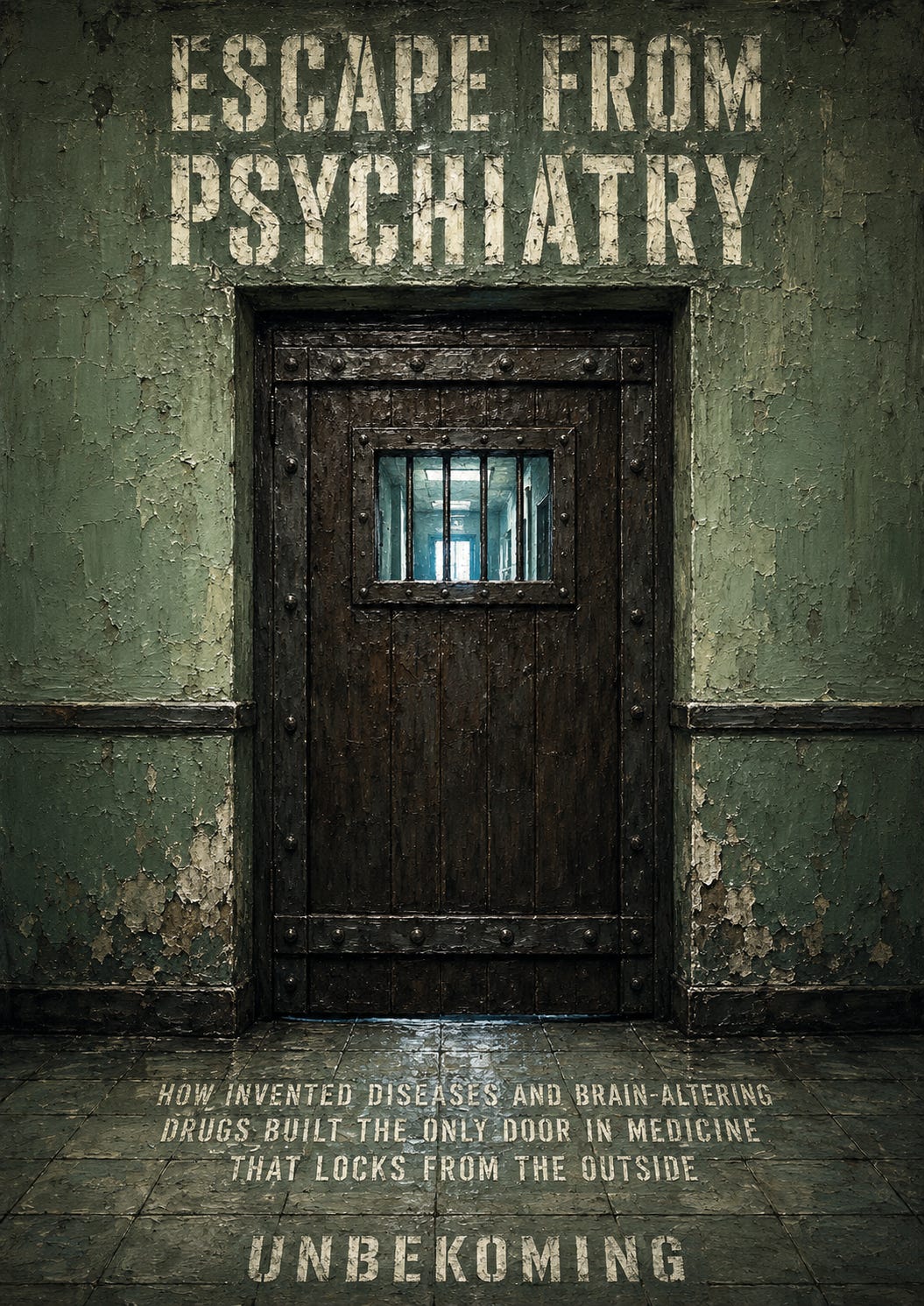
There is one branch of medicine in which the treatment locks the door behind the patient. The drugs psychiatry prescribes for what it calls brain conditions reorganise the brain over months and years. The brain compensates. When the patient tries to leave the drug, the symptoms produced by the compensation are read by both patient and clinician as the original condition returning, the prescription is reinstated, and the cycle continues. This is the architecture of the locked door.
The architecture is now operating at population scale. Sixty million Americans take an antidepressant. One in six adults in the United States is on a psychiatric drug; among women in their fifties and sixties the figure is closer to one in four. Children as young as four are prescribed antipsychotics originally developed for adults diagnosed with schizophrenia. Allen Frances, who chaired the DSM-IV committee, has acknowledged that under current criteria roughly half of Americans will qualify for a psychiatric diagnosis by the age of seventy-five. In 1955, around 355,000 Americans were hospitalised with psychiatric conditions — about one in every 468 people. By 2007, nearly four million Americans were on federal disability for mental illness — about one in every 76. The numbers describe a population being produced, not a fixed burden of illness being treated.
The chemical imbalance theory that justified the prescriptions for three decades was never demonstrated and was finally retired in the medical literature in 2022, after the textbooks, residency curricula, and patient beliefs had been built around it. Conditions that mainstream psychiatry now treats as chronic — depression, bipolar, schizophrenia — produced substantially better long-term outcomes in the pre-pharmacological era and in the parts of the world where the drugs are less consistently available. The chronicity that defines these conditions in the modern clinic is in significant part an artefact of long-term drug exposure, not the natural course of the underlying distress.
The thirteen chapters cover the collapse of the chemical imbalance theory; the construction of the DSM as an instrument of social control; what the major drug classes (antidepressants, antipsychotics, benzodiazepines, mood stabilisers, stimulants) actually do to the body and brain; the manufactured paediatric bipolar epidemic that placed antipsychotics in the mouths of two-year-olds; the dementia myth that converts the side effects of common medications into a degenerative disease; the practical work of coming off; the legal architecture that allows people to be detained and medicated against their will; and a closing chapter drawing on Gabor Maté’s work on what the body keeps when experiences could not be processed at the time they happened.
What sits below the paywall — and what most distinguishes this book from a typical psychiatry critique — is the five-appendix practical companion: the kind of working toolkit the book trade does not usually produce, written for the patient and the family who, having read the chapters, want to know what to do next.
Appendix 1: A Long Q&A Companion — forty questions answered from the evidence in the body of the book and from the work of Breggin, Whitaker, Gøtzsche, Healy, Moncrieff, Szasz, Toft, Greenberg, and Maté. Sections on paradigm and diagnosis (what the chemical imbalance theory was and why it persists, whether any psychiatric diagnosis has ever been validated by a biological test, what the DSM actually is); drug classes (what SSRIs, antipsychotics, benzodiazepines, mood stabilisers, and stimulants actually do, the difference between Ritalin and methamphetamine, whether antidepressants reduce suicide); specific conditions (is depression a disease, is bipolar a real biological condition, is ADHD a brain disorder, what about postpartum depression); withdrawal (the difference between withdrawal and relapse, why hyperbolic tapering matters, what medication spellbinding is); children (the Risperdal scandal, the Biederman manufactured paediatric bipolar epidemic, whether it is safe to give a child an antidepressant); the terrain framework applied to mental distress; and practical action (how to find a practitioner who will help with withdrawal, what to say to a family that thinks you are making a mistake by stopping, what to do if you are facing involuntary commitment).
Appendix 2: A Dictionary of Psychiatric Deception — over thirty terms decoded. Chemical imbalance, antidepressant, antipsychotic, mood stabiliser, anxiolytic, major depressive disorder, treatment-resistant depression, discontinuation syndrome, relapse, recurrence, mental illness, mental health, ADHD, personality disorder, borderline personality disorder, psychosis, mania and hypomania, akathisia, side effect, adverse event, compliance and adherence, maintenance therapy, augmentation, polypharmacy, black box warning, pharmacogenomic testing, genetic predisposition, informed consent, involuntary commitment, stigma, evidence-based, wellness check, and the therapeutic alliance. For each term, the official meaning, what it conceals, and what is actually happening in the clinical encounter when the term is used.
Appendix 3: 12 Questions for Your Psychiatrist (or Prescribing GP) — questions any patient is entitled to ask before agreeing to a course of treatment that may alter their brain for years and may prove difficult to leave. The diagnostic basis of the condition you are said to have. The biological test that confirmed it. The trial data for the duration of use being recommended. The tapering protocol on offer, and whether the prescriber has read Horowitz and Taylor’s 2019 Lancet Psychiatry paper. How withdrawal will be distinguished from relapse if you have a difficult time after reducing the dose. The absolute risk reduction on the marketed outcome. The black box warning monitoring plan. The long-term outcome literature in the Whitaker tradition. Manufacturer payments to the prescriber as disclosed on the Open Payments database. Whether the prescriber can name a single colleague who specialises in helping patients come off psychiatric drugs safely. With guidance on how to use the questions, how to read the responses, and what it means when the clinician will not put the answers in your chart.
Appendix 4: A Practical Withdrawal Companion — the most substantial appendix in the package, drawing on the work of Horowitz and Taylor, Heather Ashton, Peter Breggin, Peter Gøtzsche, the Maudsley Deprescribing Guidelines, and the patient communities that have done the work mainstream psychiatry refused to do. Preparation: stabilising your life, building the support network, addressing the terrain (nutrition, sleep, EMF, toxic burden, sun and ground), choosing your timing. The principles: why slow, receptor occupancy and hyperbolic tapering, the practical rule of reducing by 10% of current dose with eight-week holds. Protocols by drug class — SSRIs and SNRIs, antipsychotics including supersensitivity psychosis, benzodiazepines via the Ashton method, mood stabilisers, stimulants, multiple drugs. The phases of withdrawal: acute, protracted, the windows-and-waves pattern. Managing the symptoms: akathisia, insomnia, anxiety, depression, cognitive symptoms, the crisis nights. Terrain restoration in detail. When to slow, when to pause, when to reinstate. Signs of healing. A full resource list — books, organisations (IIPDW, Inner Compass, Mad in America, Outro Health), online communities, tapering aids — for finding the practitioners and supports the mainstream system will not refer you to.
Appendix 5: For Families — Supporting Someone Through Withdrawal — written for the spouse, parent, adult child, or close friend of someone on psychiatric medication. The medication spellbinding concept and why your view of the drug’s effects has been the more accurate one. What you may have noticed over the years of the prescription but did not have the language to name. The shape of the withdrawal experience. The windows-and-waves model. Your role: what to do, what not to do, the crisis moments, the standing agreement to make before the taper begins, what to do when they want to give up. Your own boundaries and self-care during a process that may take years. The recovery — what comes back, and how to walk alongside the person emerging from the chemistry. A dedicated section for parents of medicated children. The role nobody writes manuals for, and that everyone around a medicated person is being asked, often without knowing it, to perform.
The book follows below this paywall.
— Unbekoming
P.S. You will also find a 50-minute Audio Deep Dive Conversation behind the paywall.