

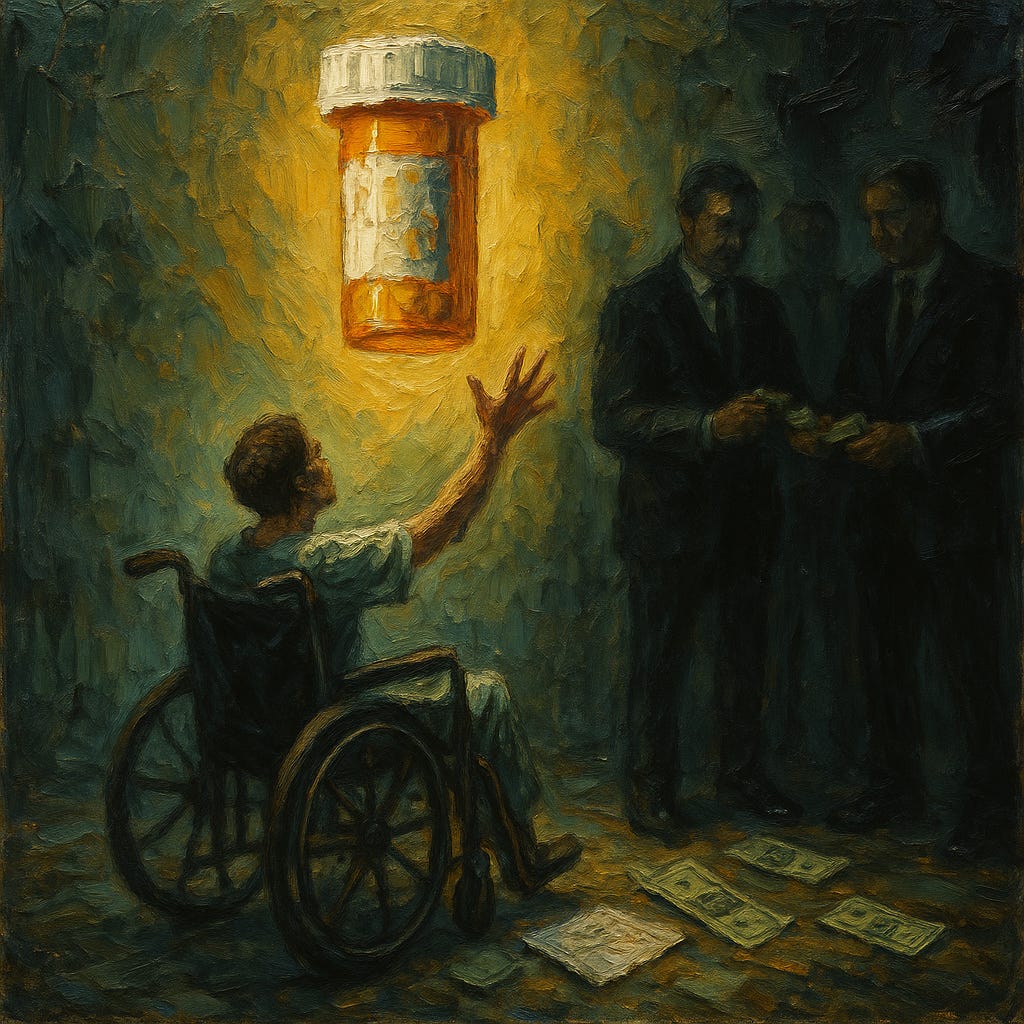
Lisa Pratta attended a patient dinner in Freehold, New Jersey, hours after a colleague asked her to become a whistleblower against their employer, Questcor Pharmaceuticals. She watched multiple sclerosis patients arrive in wheelchairs, accompanied by healthcare aides, desperate for relief from a disease that was destroying their ability to walk, see, and speak. A paid patient advocate named Eileen Schick—herself an MS sufferer—stood before the room describing how Acthar changed her life. A paid neurologist followed with medical authority supporting the same message. By evening’s end, these patients would demand Acthar from their physicians. Lisa’s role was hostess: welcome people, keep quiet, facilitate the manipulation. That night marked the point where she could no longer ignore what she knew—Questcor made more money when Acthar was prescribed incorrectly than when prescribed correctly.
According to the book, the drug itself worked. Acthar could restore sight to the blind, return mobility to the wheelchair-bound, bring back speech to those who had lost it. This genuine therapeutic value made Questcor’s fraud more rather than less damaging. The company took a real medication that helped desperately ill people and corrupted it through systematic off-label promotion, anti-kickback violations, and price increases from affordable levels to $28,000 per vial. Questcor exploited orphan drug status meant to incentivize rare disease treatment, taking taxpayer subsidies while charging astronomical prices. The company trained sales representatives through presentations like “Getting Referrals: ASAP” to maximize prescription volume regardless of medical appropriateness. Patient assistance programs eliminated cost barriers that might have prompted careful consideration of whether expensive treatment was truly necessary. Every element of Questcor’s operation aligned toward extracting maximum revenue from Medicare, Medicaid, and private insurers—ultimately from taxpayers and patients who couldn’t distinguish between medicine they needed and medicine they were being sold.
Lisa faced a calculation familiar to whistleblowers across industries. She had worked thirty-two years in pharmaceutical sales, building a career that supported her as a single mother to special-needs son Marco. Exposing Questcor’s fraud meant risking everything: her job, her income, her ability to support Marco, potentially even custody if she became unemployable. The qui tam lawsuit would proceed under seal for years while she continued attending sales conferences and patient dinners, maintaining her professional persona while federal prosecutors built a case using her evidence. She would watch colleagues celebrate successes achieved through the fraudulent practices she was documenting. The rewards were uncertain—cases fail, settlements disappoint, companies file bankruptcy. The costs were guaranteed. But once her colleague showed her that stopping the fraud might be possible, she couldn’t say no without serious consideration of whether patient protection justified personal sacrifice.
The case that followed exposed systemic vulnerabilities in pharmaceutical regulation, healthcare reimbursement, and corporate accountability. Mallinckrodt acquired Questcor during the sealed investigation and continued the fraud rather than cleaning up operations. When the Department of Justice finally served the lawsuit, Mallinckrodt faced combined pressure from Acthar fraud liability and separate opioid litigation that ultimately drove the company into bankruptcy. The bankruptcy meant even successful prosecution couldn’t produce full recovery—taxpayers defrauded of billions would receive partial payment while executives who orchestrated the scheme largely escaped proportionate consequences. Lisa’s story isn’t just about one company’s fraud but about an industry that systematically prioritizes profit over patient welfare, exploits regulatory programs meant to help vulnerable populations, and operates on the assumption that penalties for getting caught will never exceed profits from the crime. It’s about the personal cost extracted from those brave enough to fight back and the reality that without whistleblowers willing to sacrifice their careers, regulatory oversight alone cannot prevent pharmaceutical companies from turning healing into exploitation.
With thanks to Lisa Pratta.
False Claims: One Insider’s Impossible Battle Against Big Pharma Corruption: Pratta, Lisa
Deep Dive Conversation Library (Bonus for Paid Subscribers Only)
This deep dive is based on the book:
Discussion No.160:
Insights and reflections from “False Claims: One Insider’s Impossible Battle Against Big Pharma Corruption”
Thank you for your support.
ANALOGY
Imagine a fire department that gets paid not for putting out fires, but for the amount of water they use. Each gallon sprayed means more revenue. The department has exclusive rights to serve certain neighborhoods, and taxpayers foot the bill without seeing the invoices. At first, firefighters respond to real emergencies—houses actually burning. But leadership notices something: they make more money when they use maximum water on every call. Soon they’re deploying full crews and equipment for small kitchen fires that a single extinguisher could handle. They start convincing homeowners that small electrical issues require immediate flooding of entire rooms “just to be safe.”
The department hires “fire safety advocates”—people whose houses burned down in the past—to speak at community dinners. These advocates describe how the department’s aggressive water approach saved their lives, encouraging neighbors to call for maximum response at the first hint of smoke. Eventually, the department starts responding to homes where there’s no fire at all. A birthday candle burning becomes justification for deploying trucks. Water bills become astronomical. What used to cost $40 per call now costs $28,000. One firefighter finally notices: the neighborhood isn’t any safer. Resources flow to calls that don’t require them while actual emergencies wait. The whole system has inverted—what started as public safety became revenue extraction. This firefighter faces a choice: report the fraud and lose everything, or stay quiet and participate in a system she knows harms the community it claims to serve. The pharmaceutical industry operates like this corrupted fire department—companies don’t profit primarily by healing the sick more effectively but by maximizing volume and price regardless of medical necessity.
THE ONE-MINUTE ELEVATOR EXPLANATION
Lisa Pratta sold pharmaceuticals for thirty-two years, working her way up from scholarship student escaping an abusive home to successful sales representative supporting her special-needs son. In 2012, while working for Questcor Pharmaceuticals, she became a whistleblower exposing massive fraud against Medicare and Medicaid. Questcor sold Acthar, a legitimate drug for multiple sclerosis flare-ups, but built its business on systematic fraud—raising prices from affordable levels to $28,000 per vial while promoting the drug for off-label uses not approved by the FDA. It paid doctors and patient advocates to generate prescriptions, manipulated reimbursement systems to ensure government programs paid for inappropriate uses, and trained sales staff to maximize prescriptions regardless of medical necessity.
Lisa attended patient dinners where desperate MS patients heard paid advocates describe how Acthar changed their lives. She knew Acthar could genuinely help when prescribed correctly, which made the fraud more insidious—this wasn’t snake oil but rather a real medication corrupted for profit maximization. Filing a qui tam lawsuit under the False Claims Act meant risking everything: her career, her income, possibly custody of her son. She worked for years while the case proceeded under seal, attending sales meetings while federal prosecutors built their case using her evidence. Mallinckrodt acquired Questcor during the investigation and continued the fraudulent practices. When DOJ finally served the lawsuit, the case became public. Mallinckrodt eventually collapsed into bankruptcy under combined pressure from the Acthar fraud case and separate opioid litigation, limiting recovery but exposing practices that cost taxpayers billions. The case reveals how pharmaceutical companies systematically exploit regulations, manipulate systems, and target vulnerable patients—demonstrating that whistleblowers willing to sacrifice careers remain essential for accountability.
12-POINT SUMMARY
1. Lisa Pratta’s Background and Path to Whistleblowing Lisa grew up in Pitman, New Jersey, in an abusive household with a father who was likely an undiagnosed schizophrenic. She escaped through academic achievement, earning a scholarship to Albright College where she studied biology, Spanish, and German. Financial constraints prevented medical school, leading her academic adviser to suggest pharmaceutical sales. She spent thirty-two years in the industry before becoming a whistleblower in 2012. As a single mother to special-needs son Marco, she faced enormous personal risk in exposing fraud that could cost her career, income, and potentially custody.
2. Acthar: A Legitimate Drug Corrupted for Profit Acthar is a corticosteroid medication legitimately indicated for treating multiple sclerosis flare-ups and other neurological conditions. When prescribed correctly, the drug demonstrates genuine therapeutic value—it can help blind patients see, wheelchair-bound patients walk, and restore speech. This legitimate medical utility made Questcor’s fraud particularly insidious. The company didn’t sell worthless snake oil but rather corrupted a real medication through price gouging and inappropriate promotion, transforming genuine treatment into exploitation.
3. Price Escalation from Affordable to $28,000 Per Vial Questcor raised Acthar’s price from affordable levels to $28,000 per vial, a dramatic escalation documented in the December 30, 2012 New York Times article “Questcor Finds Profits, at $28,000 a Vial.” This pricing bore no relationship to development costs or medical value. The increases served purely to maximize revenue extraction from government healthcare programs and private insurers. Taxpayers bore much of this burden through Medicare and Medicaid reimbursement, while the orphan drug designation provided additional subsidies, creating a situation where the public paid twice—once through subsidies enabling the drug’s availability, again through inflated purchase prices.
4. Patient Dinner Programs: Emotional Manipulation Disguised as Education Questcor hosted patient dinners at restaurants where MS patients received free meals while paid speakers promoted Acthar. Patient advocate Eileen Schick, herself an MS sufferer and former nurse, traveled to these events via limousine provided by Questcor. She and paid neurologists delivered presentations designed to create demand among desperate patients. The format proved emotionally manipulative—patients facing devastating disease heard testimonials from others like themselves describing life-changing benefits. By evening’s end, attendees weren’t just informed but convinced they needed Acthar and prepared to demand it from physicians.
5. Off-Label Promotion and Systematic Fraud Questcor systematically promoted Acthar for off-label uses not approved by the FDA. While physicians can legally prescribe medications off-label, pharmaceutical companies are strictly prohibited from marketing drugs for unapproved uses. Questcor violated this prohibition through sales training, presentations like “Getting Referrals: ASAP,” and marketing materials that encouraged prescribing beyond approved indications. The company trained representatives to position Acthar against cheaper alternatives like Solu-Medrol regardless of clinical appropriateness. This off-label promotion formed the core of the False Claims Act violations, causing submission of fraudulent claims to Medicare and Medicaid for prescriptions that shouldn’t have been written or reimbursed.
6. Reimbursement Manipulation and Anti-Kickback Violations Questcor maintained dedicated staff for manipulating the reimbursement system to ensure payment for questionable prescriptions. The company helped secure prior authorizations, appealed denials, and worked around cost controls that payers implemented. Patient Assistance Programs eliminated patient cost-sharing, removing natural barriers to prescribing expensive medications. Questcor violated anti-kickback statutes through speaker fees to physicians, payments to patient advocates, and gifts to high-volume prescribers. These financial arrangements induced prescriptions based on commercial incentives rather than medical judgment.
7. Exploitation of Orphan Drug Status Acthar’s orphan drug designation, intended to incentivize development of rare disease treatments, became a tool for exploitation. The designation provided Questcor with tax benefits, regulatory advantages, and extended market exclusivity—all funded by taxpayers. Rather than using these benefits to ensure patient access at reasonable prices, Questcor charged astronomical amounts while promoting uses beyond the rare conditions justifying orphan status. The company took taxpayer subsidies while simultaneously extracting maximum revenue from government healthcare programs, inverting the orphan drug program’s intended bargain.
8. The Whistleblower Decision and Personal Risks Lisa’s colleague approached her in 2012 asking if she would join a qui tam lawsuit against Questcor. That same evening, she attended a patient dinner in Freehold, New Jersey, that haunted her—watching desperate MS patients be manipulated while knowing she might be able to stop it. She faced career destruction, financial insecurity, potential custody loss, years of maintaining double existence during the sealed investigation period, and possible retaliation. The risks were enormous and certain; the potential reward uncertain. Her decision reflected recognition that once she knew stopping the fraud was possible, she couldn’t say no without serious consideration of whether patient protection justified the personal sacrifice.
9. DOJ Investigation, Evidence Gathering, and Legal Process The case proceeded under seal for years while DOJ senior counsel Augustine Ripa and others investigated. Lisa worked with attorneys Marc Orlow and Ross Begelman to compile evidence including sales presentations, company correspondence, referral documentation, and training materials. She continued working at Questcor throughout the seal period, attending conferences and patient programs while federal prosecutors built their case. When DOJ served Mallinckrodt with the lawsuit, the case became public. Evidence destruction by Questcor complicated prosecution but surviving materials demonstrated systematic fraud.
10. Mallinckrodt Acquisition, Continued Fraud, and Bankruptcy Mallinckrodt acquired Questcor during the sealed investigation, inheriting massive legal liability along with business assets. Rather than implementing compliance reforms, Mallinckrodt continued and refined fraudulent practices through mechanisms like preorder referrals and referrals thresholds. The company’s separate involvement in opioid litigation created compounding legal exposure. The combined pressure from Acthar fraud liability and opioid lawsuits contributed to bankruptcy filing. The bankruptcy fundamentally constrained settlement negotiations, as the company lacked resources to pay full damages to all creditors.
11. Settlement, Resolution, and Limited Recovery Settlement negotiations involved DOJ balancing multiple objectives: maximizing taxpayer recovery, deterring future pharmaceutical fraud, and managing practical limitations imposed by Mallinckrodt’s bankruptcy. The bankruptcy meant even successful prosecution couldn’t produce full recovery of damages. Settlement amounts had to fit within what the bankrupt company could actually pay while satisfying competing creditor claims. For Lisa, settlement brought resolution after years of risk but potentially limited financial recovery relative to the fraud’s magnitude. The case became public record, validating her whistleblowing but permanently marking her as someone who exposed her employer’s fraud.
12. Systemic Implications for Healthcare and Pharmaceutical Regulation The case exposed fundamental vulnerabilities in pharmaceutical regulation, healthcare reimbursement systems, and corporate accountability mechanisms. Orphan drug designation requires reform to prevent exploitation of benefits intended for rare disease treatment. Anti-kickback enforcement needs strengthening to deter systematic violations. Off-label promotion prohibitions require more effective enforcement against institutional practices. Pharmaceutical pricing in the United States lacks controls that prevent exploitation. Patient assistance programs need oversight distinguishing charitable support from marketing tools. The case demonstrated that regulatory oversight alone cannot prevent fraud—whistleblowers willing to sacrifice careers remain essential for accountability.
THE GOLDEN NUGGET
The fraud wasn’t selling worthless medicine—it was corrupting a drug that actually works.
Acthar could restore sight to MS patients, return mobility to the wheelchair-bound, and bring back speech. This genuine therapeutic value made Questcor’s exploitation more rather than less damaging. When pharmaceutical companies sell snake oil, patients eventually recognize the deception. When they take real medications and manipulate who receives them, at what cost, and under what circumstances, the corruption becomes invisible behind legitimate medical benefit.
The $28,000-per-vial price bought a product that sometimes justified its astronomical cost through life-changing results. This truth enabled the lie. Questcor didn’t need to fabricate testimonials from patients—Acthar genuinely helped some people dramatically. The company simply promoted those benefits to everyone regardless of whether they would experience them, priced it beyond all reasonable relationship to value, and systematically manipulated prescribing decisions to maximize volume over appropriateness.
The most profitable fraud operates at the intersection of authentic value and systematic exploitation, where real benefits provide cover for extracting maximum revenue from desperate people who cannot distinguish between medicine they need and medicine they’re being sold.
30 Questions and Answers
Question 1: What was Lisa Pratta’s background and what factors led her to pursue a career in pharmaceutical sales?
Lisa grew up in Pitman, New Jersey, as the oldest of three children in an abusive household. Her father, Archibald Harrison Johnson Murphy, was likely an undiagnosed schizophrenic who wrote prophecies on walls, claimed to be Jesus, and controlled her life—once confronting her returning from a date with a BB gun. From elementary school onward, she recognized good grades were her only escape route. She earned a scholarship to Albright College in Reading, Pennsylvania, where she majored in biology, Spanish, and German, planning to attend medical school.
Financial constraints ended the medical school plan. When graduation approached, she needed immediate income and couldn’t afford additional schooling. Her academic adviser, understanding her financial situation and lack of family support, suggested pharmaceutical sales as a field where she could earn decent money with her science background. The recommendation launched her thirty-two-year career in an industry whose corruption she would eventually expose, shaped by a childhood that had already taught her how to fight when necessary.
Question 2: What is Acthar and what medical conditions was it originally indicated to treat?
Acthar, formally known as H.P. Acthar Gel, is a corticosteroid medication indicated for treating flare-ups in multiple sclerosis patients. The drug works to relieve MS attacks and help patients return to baseline function before the flare-up occurred. Multiple sclerosis attacks the central nervous system, affecting mobility, speech, and vision. The medication could also treat conditions including West syndrome and Romano-Ward syndrome, belonging to a specialized category serving small patient populations that positioned it for orphan drug status.
When prescribed correctly, Acthar demonstrated genuine therapeutic value. Lisa witnessed its capacity to help blind patients see again, enable wheelchair-bound patients to walk, and restore speech to those who had lost it. These legitimate medical benefits made the drug’s misuse particularly troubling—Questcor possessed a medication that could genuinely help desperately ill people yet chose to maximize profits through fraudulent promotion rather than focus on appropriate patient care. The drug’s specialized nature and small target population made it unsuitable for mass-market television advertising, leading Questcor to develop the patient dinner program approach instead.
Question 3: How did Questcor’s patient dinner programs function and what was their actual purpose?
Patient dinner programs invited several dozen MS patients to restaurants for free meals while paid speakers presented information about Acthar. The pharmaceutical industry began using this approach in the 1990s for drugs serving small, specialized patient populations. Lisa served as hostess, welcoming patients—many arriving with healthcare aides due to MS-related mobility challenges—but was forbidden from answering questions. That responsibility fell to paid speakers: typically a patient advocate like Eileen Schick and a neurologist, both compensated and trained by Questcor. Schick, a former nurse who stopped working when MS made her job impossible, traveled from the Poconos via Questcor-provided limousine.
The stated purpose was patient education. The actual purpose was demand creation. By evening’s end, if speakers performed effectively, patients weren’t merely requesting Acthar—they were demanding it from their physicians. These dinners became the most difficult part of Lisa’s job, reminiscent of televised faith healing shows where preachers proclaimed the blind would see. The comparison carried bitter irony because Acthar, when prescribed correctly, actually could help blind patients see and wheelchair-bound patients walk again. Questcor’s crime wasn’t selling snake oil—it was corrupting a genuinely beneficial medication for profit maximization.
Question 4: What was the pricing history of Acthar and how did this relate to Questcor’s business model?
Acthar’s price escalated from affordable levels to $28,000 per vial, documented in the December 30, 2012 New York Times article “Questcor Finds Profits, at $28,000 a Vial” by Andrew Pollack. This pricing bore no relationship to development costs or medical value. The increases served purely to maximize revenue extraction from government healthcare programs and private insurers. The orphan drug designation provided additional financial advantages, allowing Questcor to receive taxpayer subsidies while simultaneously charging exorbitant prices—creating a situation where the public paid twice.
This pricing strategy formed the foundation of Questcor’s business model. The company didn’t profit primarily by expanding appropriate patient treatment but through charging astronomical amounts per vial and promoting uses beyond FDA-approved indications. Quarterly earnings calls reflected how central pricing was to corporate financial performance. Stock value responded to revenue growth driven largely by price increases rather than expanded patient access or improved therapeutic outcomes. Every aspect of the company’s operation aligned toward extracting maximum dollars per vial rather than serving maximum patients appropriately.
Question 5: What does it mean to prescribe a drug “off-label” and why was this central to the legal case against Questcor?
Off-label prescribing occurs when physicians use FDA-approved medications for purposes beyond their specifically approved indications. While physicians can legally prescribe medications off-label based on medical judgment, pharmaceutical companies are strictly prohibited from promoting or marketing drugs for unapproved uses. Questcor systematically encouraged doctors to prescribe Acthar for conditions and in ways not covered by FDA approval through sales training, presentations like “Getting Referrals: ASAP,” and marketing materials that encouraged prescribing beyond approved indications.
This distinction between permissible physician practice and prohibited manufacturer promotion became central to the case against Questcor. Off-label promotion matters because it circumvents the rigorous FDA approval process designed to ensure drugs are safe and effective for specific uses. The fraud becomes particularly egregious when government healthcare programs pay for these inappropriate prescriptions. Medicare and Medicaid reimbursed Questcor for Acthar prescriptions written for off-label uses, meaning taxpayers funded treatments that hadn’t been proven safe or effective for those purposes. This created the foundation for False Claims Act violations.
Question 6: What is the False Claims Act and how does the qui tam relator provision work?
The False Claims Act, originally enacted in 1863, establishes federal law stating that any person who knowingly submits, or causes to submit, fraudulent false claims to the government is liable for three times the government’s damages. The qui tam relator provision allows private citizens—termed relators—to file lawsuits on behalf of the federal government against entities committing fraud. The relator doesn’t need to be a government employee or have official authority. Any person with knowledge of fraud can bring the case, which proceeds under seal initially while the Department of Justice investigates and decides whether to intervene.
Lisa Pratta became a qui tam relator when she filed United States ex rel. Pratta v. Questcor Pharma, Inc. The case name itself reflects this structure—”ex rel.” means “on behalf of,” indicating Lisa brought the action on behalf of the United States government. Relators can receive a percentage of any settlement or judgment recovered, typically ranging from fifteen to thirty percent. For Lisa, this meant potentially losing her career and facing industry blackballing while risking her ability to support her special-needs son Marco. The decision required weighing whether stopping Questcor’s patient harm justified these personal risks.
Question 7: What were the specific fraudulent practices Questcor engaged in regarding Acthar sales?
Questcor’s fraudulent practices operated across multiple dimensions. The core violation involved systematic off-label promotion—actively marketing Acthar for uses beyond FDA-approved indications through sales training and presentations. The company violated anti-kickback statutes through compensation arrangements with physicians and patient advocates, paying them to generate prescriptions. Patient Assistance Programs created legal issues by manipulating the reimbursement system and potentially masking the true cost burden from government payers. Sales conferences included presentations like “Getting Referrals: ASAP” that taught representatives how to maximize prescription volume regardless of medical appropriateness.
Questcor made more money when Acthar was prescribed incorrectly rather than correctly. The referral and preauthorization systems underwent manipulation to ensure payment for questionable prescriptions. Reimbursement management staff worked to secure approval from Medicare and Medicaid for uses that shouldn’t have qualified for coverage. When Mallinckrodt acquired Questcor, fraudulent practices continued and evolved through preorder referrals and referrals thresholds. Evidence destruction and suppression compounded the original fraud—once investigation became apparent, Questcor destroyed or suppressed materials documenting their illegal practices.
Question 8: How did Questcor manipulate the referral and reimbursement system to maximize profits?
The referral system centered on cultivating relationships with high-volume prescribers who would write Acthar prescriptions frequently. Questcor identified doctors who demonstrated willingness to prescribe the medication and intensified focus on those relationships. Representatives tracked referrals—instances where doctors wrote Acthar prescriptions—and targeted efforts toward physicians generating the most referrals regardless of whether those prescriptions reflected appropriate medical judgment. Training through presentations like “Getting Referrals: ASAP” emphasized speed and quantity rather than quality or medical justification.
The reimbursement management process enabled this fraud. When doctors wrote Acthar prescriptions, particularly for off-label uses or questionable indications, insurance companies and government payers might deny coverage. Questcor maintained staff dedicated to overcoming these denials and securing payment. The reimbursement assistance operated at multiple levels—helping patients navigate prior authorization requirements, appealing denials, and providing documentation to support coverage requests. Under Mallinckrodt ownership, the manipulation became more systematic through preorder referrals and referrals thresholds that formalized pressure to maximize prescription volume.
Question 9: What role did “patient advocates” like Eileen Schick play in Questcor’s marketing strategy?
Eileen Schick represented a carefully constructed element of Questcor’s marketing approach. A former nurse whose MS made work impossible, her personal experience with the disease provided credibility when speaking to patient audiences. She was one of only about five MS advocates working nationally. Questcor compensated her for traveling around the country talking to patients, sending a limousine from her Poconos home to events. The company trained her in what to say about Acthar and how to deliver the message. At patient dinners, she served as first speaker, pacing in front of the room in conservative suits and low heels.
This peer-to-peer dynamic created powerful persuasive effects. Patients facing frightening medical realities heard someone who shared their condition speak enthusiastically about treatment. The advocate role allowed Questcor to communicate messages that would have been inappropriate or illegal coming directly from company representatives. Schick could discuss personal experience, describe benefits, and encourage patients to ask doctors about the medication—all while maintaining plausible deniability about promoting off-label uses. Pairing patient advocates with paid neurologists created a one-two punch: Schick provided emotional appeal and peer credibility while neurologists followed with medical authority.
Question 10: What is orphan drug status and how did Questcor exploit this designation?
Orphan drug status provides special regulatory and economic benefits for medications treating rare diseases affecting small patient populations. The designation aims to incentivize pharmaceutical development for conditions that might otherwise lack commercial viability. Companies receive advantages including tax credits, extended market exclusivity, and expedited regulatory review. Acthar received this designation, which provided Questcor with substantial financial benefits funded by taxpayers—creating a situation where taxpayers paid twice: first through subsidies enabling the drug’s availability, then again through inflated prices when Medicare and Medicaid purchased it.
Questcor exploited this designation by charging astronomical prices despite receiving taxpayer support intended to make the medication accessible. The orphan drug program assumes companies need financial assistance to justify developing treatments for small populations. In return, society expects these medications to remain available to patients who need them. Questcor inverted this bargain—taking the benefits while pricing the drug beyond reach and promoting it for uses beyond its orphan designation. The designation became a shield against criticism and a source of unearned legitimacy rather than a framework for serving patients with rare conditions.
Question 11: How did Solu-Medrol compare to Acthar as a treatment option and why did this matter to Questcor’s sales strategy?
Solu-Medrol represented Acthar’s primary competition for treating multiple sclerosis flare-ups. The medication functioned as an alternative corticosteroid that many neurologists considered appropriate first-line treatment. Clinical guidelines often positioned Solu-Medrol ahead of Acthar in the treatment sequence, with Acthar reserved as a second-line option for patients who didn’t respond to Solu-Medrol or experienced prohibitive side effects. The delivery method distinguished the two: Solu-Medrol required infusion administration while Acthar could be administered differently. Most significantly, Solu-Medrol cost dramatically less than Acthar.
Questcor’s sales strategy required displacing Solu-Medrol as the default treatment despite Acthar’s vastly higher cost. Company correspondence discussed approaches for convincing doctors to prescribe Acthar instead of Solu-Medrol even when Solu-Medrol might be medically appropriate. This displacement strategy targeted both first-line use and preventing sequential use where Solu-Medrol would be tried first. Marketing materials downplayed Solu-Medrol’s clinical appropriateness and emphasized any possible advantages Acthar might offer. Positioning Acthar as second-line treatment would have dramatically reduced prescription volume, limiting use to genuine treatment failures—shrinking Questcor’s market and revenue.
Question 12: What were the risks Lisa faced in deciding to become a whistleblower?
Lisa confronted career destruction as the most immediate and certain risk. She had worked her entire professional life in pharmaceutical sales over thirty-two years. Becoming a whistleblower against a pharmaceutical company meant potential blackballing throughout the industry. Even if she won her case and secured financial settlement, she might never work in pharmaceutical sales again. Financial insecurity followed directly—as a single mother to special-needs son Marco, she bore sole responsibility for household income and stability. Losing her job meant losing health insurance, income for daily expenses, and resources for Marco’s care.
Custody concerns added existential stakes. If Lisa lost her income and couldn’t support Marco, she risked losing custody of her son. The timeline created additional psychological burden—whistleblower cases operate under seal initially while DOJ investigates, meaning Lisa would need to continue working at Questcor for potentially years while knowing she had filed a federal lawsuit against the company. She would attend sales meetings, participate in patient dinners, and maintain her professional persona while simultaneously serving as a federal witness documenting their fraud. Retaliation, professional relationship damage, personal safety concerns, emotional toll of fighting a powerful corporation, and the possibility of failure despite strong evidence all weighed on her decision.
Question 13: How did Questcor’s sales training and compensation structure incentivize improper promotion of Acthar?
Questcor’s sales conferences functioned as training grounds for fraudulent promotion techniques. The company held events in locations like Las Vegas, Lake Tahoe, Dana Point, and Whistler Mountain, featuring presentations teaching sales representatives how to maximize Acthar prescriptions. “Getting Referrals: ASAP” exemplified this approach—a presentation explicitly focused on generating prescriptions quickly rather than ensuring medical appropriateness. Training emphasized volume metrics over patient outcomes, teaching representatives to track referral counts, identify high-volume prescribers, and concentrate efforts on doctors willing to write numerous Acthar prescriptions.
Compensation structures reinforced these problematic priorities. Sales representatives earned based on revenue generated rather than patient benefit provided. Since Acthar cost $28,000 per vial, each prescription represented enormous commission potential. Representatives who generated high prescription volumes received higher compensation, recognition, and career advancement opportunities. The company taught representatives to position Acthar against Solu-Medrol despite the dramatic price difference, providing talking points for addressing physician objections about cost. The culture celebrated high performers without apparent regard for how they achieved results, rewarding success without ethical screening.
Question 14: What evidence did Lisa and her attorneys gather to support the False Claims Act lawsuit?
Sales presentations like “Getting Referrals: ASAP” from Questcor sales conferences demonstrated the company’s systematic approach to driving prescription volume, revealing that inappropriate promotion came from corporate strategy rather than isolated representative misconduct. Company correspondence provided emails and internal communications discussing strategies for promoting Acthar, displacing Solu-Medrol, and securing reimbursement for questionable prescriptions. Referral documentation tracked prescriptions generated through promotional activities, showing patterns suggesting off-label use. Training materials documented what the company told representatives to communicate to physicians, including talking points for promoting off-label uses.
Reimbursement records demonstrated financial impact on government healthcare programs through documentation of preauthorization approvals, appeals of denials, and actual payments from Medicare and Medicaid. Marketing materials used at patient programs provided evidence of how Questcor created demand among patients. Financial records tracking Questcor’s stock performance, quarterly earnings, and revenue growth tied fraudulent practices to corporate financial benefit. Supplement disclosures became evidence when they contradicted actual practices. Attorneys Marc Orlow and Ross Begelman worked with Lisa to organize this evidence into a comprehensive case showing systematic fraudulent conduct.
Question 15: How did anti-kickback statute violations factor into Questcor’s illegal practices?
Anti-kickback statutes prohibit offering, paying, soliciting, or receiving anything of value to induce referrals for services or items covered by federal healthcare programs. These laws ensure medical decisions rest on patient needs rather than financial incentives. Questcor violated these statutes through multiple payment arrangements designed to induce Acthar prescriptions. The company paid neurologists to serve as speakers at patient programs, creating financial relationships that incentivized doctors to prescribe Acthar to their own patients. Payment arrangements with patient advocates like Eileen Schick represented another form of kickback—the compensation for advocacy that drove referrals fell within anti-kickback prohibitions.
Anti-kickback violations amplified the False Claims Act case because they showed prescriptions resulted from illegal inducements rather than independent medical judgment. Each prescription induced through kickbacks potentially represented a false claim when submitted for Medicare or Medicaid reimbursement. DOJ senior counsel Augustine Ripa focused substantially on these violations because payment arrangements created clear paper trails through bank records, speaking contracts, and travel reimbursements. Connecting these payments to subsequent prescribing patterns established the inducement element. The violations demonstrated willful misconduct rather than good-faith errors—Questcor operated in a heavily regulated industry with clear guidance about prohibited payment arrangements yet chose to violate them because induced prescriptions generated revenue exceeding compliance costs.
Question 16: What role did the Department of Justice play in investigating and prosecuting the case?
The Department of Justice received Lisa’s qui tam complaint filed under seal and initiated investigation to determine whether allegations had merit and whether the government would intervene. This investigation phase proceeded confidentially while Lisa remained employed at Questcor. DOJ senior counsel Augustine “Augie” Ripa took primary responsibility for preparing the case, spending extensive time reviewing evidence, conducting additional investigation, and building legal strategy. Steven Rich and other DOJ personnel participated, assembling a team with expertise in False Claims Act litigation, pharmaceutical fraud, and healthcare program prosecution.
The investigation proceeded methodically over years. During the seal period, DOJ decided whether to intervene—whether the government would take over prosecution or allow Lisa and her attorneys to proceed independently. When DOJ served Mallinckrodt with the lawsuit, it marked the transition from confidential investigation to public prosecution. Settlement negotiations involved DOJ representing the government’s interests in recovering damages and obtaining accountability while managing practical limitations like Mallinckrodt’s bankruptcy. The government’s involvement transformed Lisa’s individual whistleblower action into a federal prosecution with all the weight and authority that entails.
Question 17: How did Questcor attempt to conceal evidence once the investigation began?
Questcor destroyed or suppressed materials and correspondence that would document illegal practices once the company became aware of investigation. This evidence destruction represented separate criminal exposure beyond the underlying fraud. The systematic nature suggested corporate policy rather than isolated individual actions—sales materials, correspondence about off-label promotion, communications regarding kickback arrangements, and other incriminating records all required elimination. Federal authorities issued “freeze and preserve” orders requiring Questcor to retain all documents relevant to the investigation, but prior destruction had already eliminated potentially incriminating evidence before preservation orders took effect.
The destruction complicated DOJ’s case preparation. Prosecutors had to build their case around surviving evidence while knowing destroyed materials might have provided even stronger proof. Defense attorneys could claim destroyed evidence might have been exculpatory or that gaps in documentation created ambiguity. Evidence destruction can constitute obstruction of justice separate from underlying fraud charges. The destruction also revealed that Questcor knew its activities were illegal—companies don’t destroy evidence of legitimate business practices. The fact that Questcor moved to eliminate documentation once investigation began proved the company recognized those documents would demonstrate fraud.
Question 18: What were the consequences when Mallinckrodt acquired Questcor during the investigation?
Mallinckrodt’s acquisition of Questcor occurred while the federal investigation proceeded under seal. The acquisition meant ownership and management changed, but liability for Questcor’s fraudulent practices transferred to the acquiring company under legal principles of successor liability. Mallinckrodt inherited Questcor’s legal exposure along with its assets and business operations. The stock implications affected shareholders of both companies—Questcor stockholders received consideration based on valuations that didn’t fully account for hidden federal investigation and potential massive liability, while Mallinckrodt shareholders found their company acquiring billions in potential False Claims Act exposure.
Mallinckrodt continued and refined Questcor’s fraudulent practices rather than cleaning up the operation, introducing preorder referrals and referrals thresholds. When DOJ served Mallinckrodt with the lawsuit, the company learned simultaneously about Questcor’s fraud and its own liability. Mallinckrodt’s opioid lawsuits compounded legal difficulties, creating multiple fronts of legal exposure. These combined liabilities eventually overwhelmed the company’s financial capacity and contributed to bankruptcy filing. The bankruptcy fundamentally altered the landscape for resolving the fraud case—DOJ and Lisa found themselves competing with other creditors for recovery from a company that lacked funds to fully satisfy all claims.
Question 19: How did the Patient Assistance Programs create legal issues for Questcor?
Patient Assistance Programs ostensibly helped patients afford expensive medications by covering copayments, deductibles, or other out-of-pocket costs. Questcor presented these programs as charitable efforts to ensure access to Acthar for patients who couldn’t otherwise afford it. The legal problems arose from how these programs functioned within the broader fraudulent scheme. When Questcor reduced or eliminated patient cost-sharing for Acthar, this assistance removed one of the natural barriers to prescribing expensive medications. Physicians and patients might hesitate to use a $28,000-per-vial drug when significant out-of-pocket costs would fall on the patient.
The programs potentially violated anti-kickback statutes by providing remuneration to induce use of Acthar covered by federal healthcare programs. When Medicare paid for Acthar prescriptions and Questcor’s patient assistance programs covered the patient’s share, the company was essentially paying to induce use of a federally-reimbursed medication. Legal programs must be truly independent from manufacturers, must not be tied to use of specific drugs, and must not function primarily to increase manufacturer sales. Questcor’s programs failed these tests because they existed specifically to promote Acthar use and were controlled by the company for commercial benefit.
Question 20: What was the “Getting Referrals: ASAP” sales strategy and why was it problematic?
“Getting Referrals: ASAP” was a presentation delivered at Questcor pharmaceutical sales conferences that explicitly focused on generating prescriptions quickly. The title itself revealed the problematic emphasis—speed and volume rather than medical appropriateness. Representatives learned techniques for maximizing referral numbers without corresponding attention to whether those referrals reflected genuine medical need. The presentation taught strategies for identifying and cultivating high-volume prescribers, with representatives learning to track which doctors wrote Acthar prescriptions frequently and concentrate sales efforts on those physicians.
The presentation occurred at conferences in locations like Las Vegas and other resort destinations, where sales representatives gathered for training and corporate messaging. This wasn’t isolated rogue behavior but rather official corporate strategy being taught systematically to the entire sales force. The strategy’s problematic nature became clear when examined against medical standards—appropriate prescribing involves careful evaluation of patient conditions, consideration of treatment alternatives, and assessment of cost-effectiveness. “Getting Referrals: ASAP” inverted these priorities, emphasizing speed and volume over medical judgment. The presentation materials became evidence in the False Claims Act lawsuit, demonstrating corporate intent to maximize prescriptions regardless of appropriateness.
Question 21: How did Questcor’s practices harm patients beyond the financial costs?
Patients received medications they didn’t need or that weren’t optimal for their conditions. Off-label promotion meant people took Acthar for uses where effectiveness hadn’t been established through clinical trials, experiencing whatever side effects occurred without corresponding therapeutic benefit. MS patients faced particular vulnerability—the disease already caused severe disability, unpredictable flare-ups, and progressive loss of function, creating desperation for anything that might help. Delaying or displacing appropriate treatment represented another form of harm. When patients used Acthar instead of Solu-Medrol or other clinically indicated first-line treatments, they lost time that could have been spent on more appropriate therapy.
The psychological impact of failed treatments created additional harm. MS patients trying Acthar based on promises from patient advocates and physicians might have high hopes for improvement. When the medication failed to deliver expected results because it wasn’t appropriate for their specific situation, they experienced disappointment and lost faith in medical treatment generally. Patients attending dinner programs experienced emotional manipulation—the programs deliberately created hope and expectation through testimonials, creating these expectations for commercial purposes rather than genuine medical indication. Trust in the healthcare system eroded when patients later learned about Questcor’s fraud, discovering that commercial incentives rather than medical judgment drove their physician’s recommendation.
Question 22: What challenges did Lisa face as a woman working in the pharmaceutical sales industry?
A neurologist once told Lisa she was the Joan Rivers of pharmaceutical sales—a characterization that captured both her communication skills and the performance aspects expected of women in the industry. She would sit in doctors’ offices asking “Can we talk?” before chatting about Philadelphia sports teams or celebrity gossip. By the time she pitched Acthar, physicians had already been sold on her personality. This approach was effective but required constant performance of a particular kind of femininity. The industry expected women to use personal charm and relationship-building in ways that differed from expectations for male representatives.
Sexual harassment pervaded the pharmaceutical industry during Lisa’s thirty-two-year career. The book references examples of women’s mistreatment at companies including AstraZeneca and Serono where Lisa had worked previously. Human Resources departments failed to protect women from workplace discrimination and harassment, often siding with the company’s interests rather than addressing legitimate concerns. Women had to be friendly and personable but not too friendly, professional but not cold, assertive but not aggressive—navigating contradictory expectations while men enjoyed broader latitude. The whistleblowing decision carried additional gendered dimensions, as a single mother bearing sole responsibility for her child’s welfare in ways that created different stakes than male colleagues might face.
Question 23: How did the New York Times article “Questcor Finds Profits, at $28,000 a Vial” impact the case?
Andrew Pollack’s article published December 30, 2012, in the New York Times brought national attention to Acthar’s pricing and Questcor’s business practices. The $28,000-per-vial price point became public knowledge, shocking readers unfamiliar with pharmaceutical pricing extremes. The article framed this pricing as emblematic of troubled times in American healthcare, connecting Questcor’s practices to broader systemic problems. The publicity created political and public pressure that complemented the legal case proceeding under seal—while DOJ investigation remained confidential, the Times article put Questcor under public scrutiny for the same practices that formed the basis of the whistleblower lawsuit.
Stock market reactions followed the article’s publication. Short sellers had already begun targeting Questcor stock based on recognition that the business model was unsustainable, and the Times article validated their thesis. The article’s timing relative to the sealed case created an interesting dynamic—Lisa had already filed her qui tam complaint when the article appeared, so the publicity operated independently of the legal case but supported the same narrative. The article reached audiences beyond legal and regulatory circles, creating reputational damage separate from legal liability. Media coverage contributed to broader public consciousness about pharmaceutical industry practices, making Questcor a symbol of industry excess.
Question 24: What was the timeline from Lisa’s decision to become a whistleblower to the lawsuit becoming public?
Lisa became a whistleblower in 2012 while still employed at Questcor. The decision followed her colleague’s request that afternoon to join him in filing a qui tam complaint. That same evening, she attended a patient dinner program in Freehold, New Jersey—the event that haunted her. The juxtaposition of making this momentous decision and then immediately participating in the fraudulent practices she was exposing created intense psychological pressure. The initial period involved working with attorneys Marc Orlow and Ross Begelman to gather evidence and prepare the complaint, requiring documentation of years of fraudulent practices through sales presentations, company correspondence, and referral documentation.
The complaint was filed under seal, beginning the period where the case existed but remained confidential. Lisa continued working at Questcor throughout this period, attending sales conferences and patient programs while knowing federal prosecutors were building a case based on her information. DOJ investigation proceeded for years before the case became public. During this seal period, Mallinckrodt acquired Questcor and the New York Times published its article about Acthar pricing. Mallinckrodt was served with the DOJ lawsuit when the case transitioned from confidential investigation to public litigation. The years between Lisa’s 2012 decision and the case’s public revelation created sustained stress of maintaining employment while knowing eventual revelation could end her career.
Question 25: How did Mallinckrodt’s involvement in the opioid crisis intersect with the Acthar fraud case?
Mallinckrodt faced separate lawsuits related to its role in the opioid epidemic, alleging the company contributed to the crisis through its manufacturing, distribution, or marketing of opioid medications. The dual litigation created compounding legal and financial pressure on Mallinckrodt. The company faced massive potential liability from both the opioid cases and the Acthar fraud case simultaneously, stretching resources and attention. Both cases involved fundamental questions about pharmaceutical industry ethics and accountability—the opioid litigation addressed how companies marketed dangerous medications and contributed to addiction deaths, while the Acthar case involved fraudulent promotion and price gouging.
The financial burden of both litigation tracks contributed to Mallinckrodt’s bankruptcy filing. The company lacked resources to satisfy potential judgments from the opioid cases alone, and adding the Acthar fraud case’s potential liability created an impossible financial situation. Settlement negotiations in the Acthar case had to account for Mallinckrodt’s opioid-related liabilities. The bankruptcy created a situation where victims of Mallinckrodt’s various alleged misconduct competed for recovery from insufficient assets. Media coverage often connected the opioid lawsuits and Acthar fraud case as examples of pharmaceutical industry problems, reinforcing public perception that Mallinckrodt represented broader industry pathologies.
Question 26: What were the settlement negotiations like and what was ultimately resolved?
Settlement negotiations involved DOJ representing the government’s interests in recovering damages from Medicare and Medicaid fraud. The government calculated losses based on inappropriate Acthar prescriptions paid for by federal healthcare programs, multiplied by three as allowed under the False Claims Act, and added civil penalties—resulting in billions in potential liability. Mallinckrodt’s bankruptcy status fundamentally constrained negotiation dynamics. The company lacked resources to pay full damages plus penalties, forcing negotiations to focus on what recovery was actually achievable from a company in financial distress rather than what would fully compensate for the fraud committed.
DOJ balanced multiple objectives: maximizing taxpayer recovery, deterring future pharmaceutical fraud, and holding corporations accountable, while managing bankruptcy limitations. Lisa’s attorneys participated representing her interests as qui tam relator, with her potential recovery depending on the total settlement amount and her percentage share as whistleblower. The settlement needed approval from multiple parties including DOJ, Mallinckrodt, the bankruptcy court, and potentially other creditors. The final settlement terms remained subject to confidentiality provisions common in such cases. For Lisa, settlement meant resolution after years of risk and uncertainty, bringing both financial recovery and public vindication of her whistleblowing.
Question 27: How did multiple sclerosis as a disease make patients particularly vulnerable to Questcor’s tactics?
Multiple sclerosis attacks the central nervous system, progressively destroying patients’ mobility, vision, and speech. The disease operates unpredictably—patients never know when the next flare-up will strike or how severe it will be, creating constant anxiety and making them desperate for any intervention. The disease’s progressive nature means patients face deteriorating function over time, with each attack potentially leaving them worse off than before. This creates urgency around treatment decisions. MS patients often arrive at medical appointments with caregivers or healthcare aides—Lisa observed many attendees at the Freehold dinner arriving in wheelchairs or requiring assistance, visible disability that created emotional atmosphere conducive to persuasion about treatments promising improvement.
The patient population for MS is relatively small—about one million people in the United States compared to nearly seven million with Alzheimer’s—making testimonials from patient advocates like Eileen Schick carry particular weight. The severity of MS symptoms made the $28,000 price point seem potentially justifiable when patients lose the ability to walk, see, or speak. The disease’s variability made it difficult for patients to assess treatment effectiveness—MS naturally fluctuates with periods of stability interspersed with attacks, so when patients took Acthar during stable periods, they might attribute continued stability to the medication even if it provided no actual benefit. The legitimate therapeutic potential of Acthar made the manipulation particularly insidious because patients had no way to know whether presentations reflected honest medical information or fraudulent marketing.
Question 28: What systemic healthcare vulnerabilities did the Questcor case expose?
The orphan drug designation system revealed fundamental flaws in how pharmaceutical regulations balance innovation incentives with patient protection. Questcor demonstrated how companies could exploit well-intentioned benefits by taking taxpayer subsidies while simultaneously charging exploitative prices and promoting drugs beyond their orphan designations. Insurance and government reimbursement systems showed vulnerability to manipulation through prior authorization gaming—Questcor maintained dedicated staff for securing approvals and appealing denials, effectively turning the reimbursement system into a business process optimization problem rather than a medical necessity check. The Medicare and Medicaid programs demonstrated susceptibility to large-scale fraud that could persist for years before detection.
Patient assistance program structures created loopholes allowing pharmaceutical companies to disguise commercial activities as charitable support. The physician prescribing independence that medicine cherishes became a vulnerability when pharmaceutical companies systematically worked to corrupt prescribing decisions through anti-kickback violations. Price regulation gaps in the American pharmaceutical system allowed Questcor to raise Acthar’s price to $28,000 per vial without effective constraint. Whistleblower dependence revealed that regulatory oversight alone couldn’t detect and prevent pharmaceutical fraud—the case required Lisa’s insider knowledge and willingness to risk her career to expose practices that might otherwise have continued indefinitely.
Question 29: What happened to Mallinckrodt after the lawsuit and how did this affect resolution of the case?
Mallinckrodt filed for bankruptcy, collapsing under the combined weight of the Acthar fraud liability, opioid lawsuit exposure, and other financial pressures. The bankruptcy filing transformed the company from a going concern capable of paying substantial settlements to a distressed entity with insufficient assets to satisfy all creditor claims. The bankruptcy proceeding created a structured process for addressing competing claims from multiple creditors—the Acthar fraud case represented one claim among many, including opioid litigation victims, other business creditors, and class action plaintiffs like the United Association of Plumbers & Pipefitters Local 322.
Bankruptcy court jurisdiction meant case resolution proceeded through bankruptcy process rather than normal litigation channels. Settlement amounts necessarily reflected bankruptcy realities rather than full liability. If Questcor had remained viable, settlement might have approached the trebled damages plus penalties contemplated by the False Claims Act, but with Mallinckrodt in bankruptcy, settlement had to fit within what the company could actually pay. The bankruptcy timeline affected when and how Lisa and DOJ could recover, extending over years as courts sorted through complex financial arrangements. The bankruptcy represented a form of corporate accountability failure—while the company faced consequences through financial distress, individual executives who orchestrated or profited from the fraud might not face proportionate punishment.
Question 30: What broader implications does this case have for pharmaceutical industry regulation and whistleblower protections?
The False Claims Act’s qui tam provisions proved essential for exposing fraud that regulatory oversight missed. Without Lisa’s insider knowledge and willingness to become a whistleblower, Questcor’s fraudulent practices might have continued indefinitely, demonstrating that regulatory agencies alone cannot prevent pharmaceutical fraud. Orphan drug designation reform became necessary based on how Questcor exploited the program. Anti-kickback statute enforcement required strengthening, as Questcor’s systematic use of speaker fees, patient advocate payments, and physician gifts demonstrated that existing enforcement inadequately deterred violations. Pharmaceutical pricing regulation emerged as a critical need—Acthar’s $28,000-per-vial price bore no relationship to medical value.
Patient assistance program oversight required improvement to distinguish charitable support from commercial interests. Corporate successor liability principles needed clarification for cases where fraud continues under new ownership. Bankruptcy’s impact on fraud case resolution highlighted need for mechanisms ensuring accountability despite corporate financial distress. Whistleblower protection laws required strengthening to address the personal costs Lisa faced—she risked career, financial security, and custody of her child. Industry culture change emerged as perhaps the most important implication, revealing how pharmaceutical companies systematically prioritize profit over patient welfare. The case ultimately demonstrated that individual courage through whistleblowing, combined with strong legal frameworks like the False Claims Act, can hold even powerful corporations accountable.
I appreciate you being here.
If you’ve found the content interesting, useful and maybe even helpful, please consider supporting it through a small paid subscription. While 99% of everything here is free, your paid subscription is important as it helps in covering some of the operational costs and supports the continuation of this independent research and journalism work. It also helps keep it free for those that cannot afford to pay.
Please make full use of the Free Libraries.
Unbekoming Interview Library: Great interviews across a spectrum of important topics.
Unbekoming Book Summary Library: Concise summaries of important books.
Stories
I’m always in search of good stories, people with valuable expertise and helpful books. Please don’t hesitate to get in touch at unbekoming@outlook.com
Baseline Human Health
Watch and share this profound 21-minute video to understand and appreciate what health looks like without vaccination.
Whistle-blower, Lisa Pratta:
"Long before I became a whistleblower, I’d been conditioned to keep secrets. As a child, I was sexually abused by my father during an era when no one spoke about such things."
Why did you omit this revelation and instead only mention that her father may have been schizophrenic?
Anyway... from this interview I discovered one very important nugget: You can investigate if your doctor is "on the take" or a doctor you've looked at, but are still not a patient of, is on the take.
https://youtu.be/6I6qj4dXbGI
https://openpaymentsdata.cms.gov/
Lastly: The drug that was being used "offlabel", in a dosage that was suboptimal according to package insert, is still being manufactured and prescribed in suboptimal doses, and currently costs not $28,000.00 per vial, as it did when the DoJ investigated, but $45,000.00 US per vial.
It still takes 5 doses for this drug to be of any substantial benefit to MS patients...
It is derived from the pituitary gland of slaughtered pigs so the cost to the drug manufacturer is NEGLIGIBLE.
YOU CANNOT HATE BIG PHARMA ENOUGH!!!
You should listen to Lisa Pratta's
"8 extra things" she didn't cover in the book.
She not only was employed by Big Pharma: she and her son both have been "victims" of the medical industry, regarding "drugs".
Having a hard time with this woman who's "on a book tour" and shopping it around for the best "film rights" deal.
I dunno. Just a vibe.
https://youtu.be/-1LUR0BaYp8