

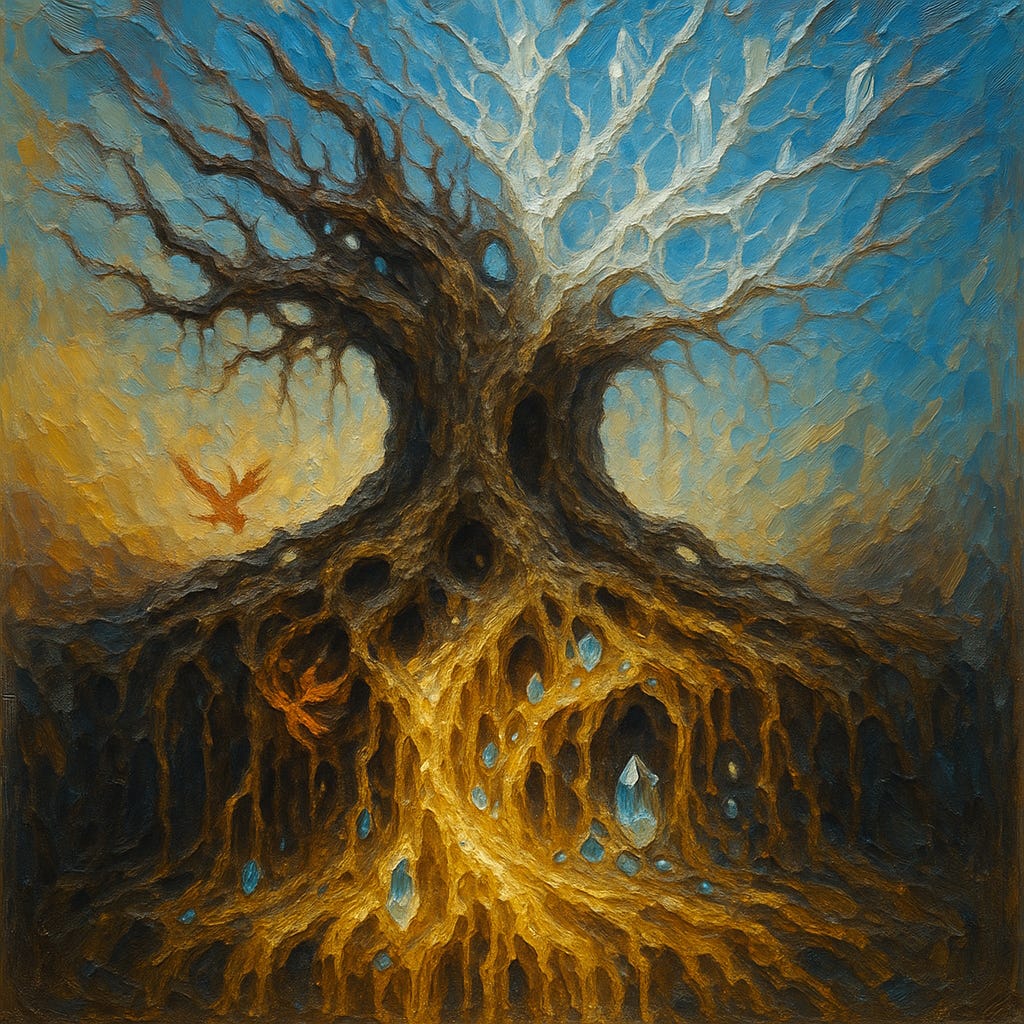
Herbert Shelton spent over forty years supervising more than 30,000 fasts, yet his work remains largely dismissed by mainstream medicine as dangerous quackery. Writing in an era when medical authorities insisted the heart would collapse within six days without food, Shelton documented case after case of hearts actually strengthening during fasts lasting weeks or months. His Natural Hygiene philosophy proposed something so simple it seemed absurd: that most disease stems from a single cause—toxemia, the accumulation of metabolic waste in our tissues—and that the body possesses an inherent wisdom to heal itself if we simply stop interfering. Where medicine saw hundreds of distinct diseases requiring thousands of different treatments, Shelton saw variations of one underlying condition that could be addressed through one fundamental practice: complete physiological rest through fasting.
Yet Shelton wasn't the first to recognize fasting's transformative power. In 1906, Edward Purinton, a semi-invalid taking six medicines simultaneously, undertook what he called the "Conquest Fast"—thirty days on water alone that not only restored his health but revealed what he considered humanity's deepest truth: that we are already perfect, already divine, but layers of undigested food, unexamined thoughts, and unlived emotions create such thick barriers we cannot feel our own perfection. His discovery that fasting revealed not what we must become but what we already are beneath accumulated debris prefigured Shelton's more clinical observations. Purinton wrote over 200 poems in ten months after never having written poetry before, developed what he called "X-ray perception," and ultimately recognized that finding God through fasting was "equivalent to saying I found Myself. For We are One and the Same."
The mechanism both men describe, though separated by decades and differing in language, is remarkably consistent. During a fast, the body doesn't simply starve—it shifts into a different operational mode entirely, one of selective self-consumption called autolysis. The body becomes its own surgeon, enzymatically breaking down and absorbing its tissues in precise order of importance: fat first, then cysts and tumors, then redundant tissues, while vital organs remain protected until the very end. What makes this particularly compelling is Shelton's observation that the body possesses dual nutritional systems—one for feeding and one for fasting—and that the fasting system operates with greater precision than normal digestion. During feeding, we absorb nutrients inefficiently, store toxins inadvertently, and burden our organs continuously. But during fasting, the body becomes a meticulous chemist, redistributing nutrients with pinpoint accuracy to where they're most needed.
Modern practitioners have taken these principles even further. In Siberia, Dr. Sergey Filonov has supervised thousands through dry fasting—eliminating water along with food—demonstrating that what Shelton observed with water fasting intensifies dramatically when the body must produce its own water from fat metabolism. Michelle Slater's journey to his clinic, chronicled in "Starving to Heal in Siberia," shows how a scholar dying from Lyme disease, who had tried everything from antibiotics to Ayurveda, achieved complete recovery through extended dry fasts. Meanwhile, August Dunning's Phoenix Protocol provides the scientific framework these earlier practitioners lacked, explaining how dry fasting activates stem cells, triggers autophagy at levels Yoshinori Ohsumi would later win the Nobel Prize for discovering, and potentially reverses aging at the cellular level through DNA demethylation and telomere lengthening.
What emerges from this century-spanning exploration is that fasting operates on multiple levels simultaneously. Physically, it eliminates the toxic burden creating disease—the metabolic acids causing arthritis clear, the inflammatory markers triggering asthma disappear, blood pressure normalizes as vessels relax. Cellularly, it activates processes we're only beginning to understand—autophagy consuming damaged organelles, stem cells proliferating after Protein Kinase A drops, mitochondria regenerating as deuterium levels fall. Spiritually, as Purinton discovered and countless others confirm, it strips away the false necessities of civilization to reveal something essential about human nature. The range of conditions responding to fasting reads like a medical encyclopedia: multiple sclerosis improving after decades of progression, prostates shrinking from baseball to normal size, psoriasis clearing completely, women with dozens of miscarriages carrying to term.
Perhaps we're looking at the most important healing modality we have precisely because fasting doesn't add anything—it subtracts. In a world obsessed with what supplement to take, what superfood to eat, what treatment to undergo, fasting represents the opposite approach: healing through absence, cure through cessation. It's the one therapy that requires no belief, no special knowledge, no expensive interventions—just the temporary suspension of eating while the body conducts its own healing work. Every animal instinctively fasts when sick or injured; children naturally refuse food during illness until adults override their protective instinct. We've been educated out of this most basic healing response, trained to fear the very mechanism that could restore our health. The convergence of these voices across a century—from Purinton's spiritual awakening to Shelton's clinical documentation to modern cellular biology—suggests that beneath our complex modern diseases lies a simple truth: the body knows how to heal itself if we stop poisoning it and give it rest. The promise isn't immortality but something more radical: that disease is largely optional, that aging might be reversible, and that the power to heal has always resided within us, waiting to be activated through the simple yet profound act of stepping back and allowing it to work.
With thanks to Herbert Shelton.
The rest of this summary — the analogy, one-minute elevator explanation, 12-point summary, Q&As, and Golden Nugget — is for paid subscribers.
Your subscription also unlocks every other book summary in the library, the Deep Dive Audio Library, my original books (new ones added monthly), and three series for the moments when a real decision is in front of you: Questions for Your Doctor, Before You Consent, and Package Inserts.