

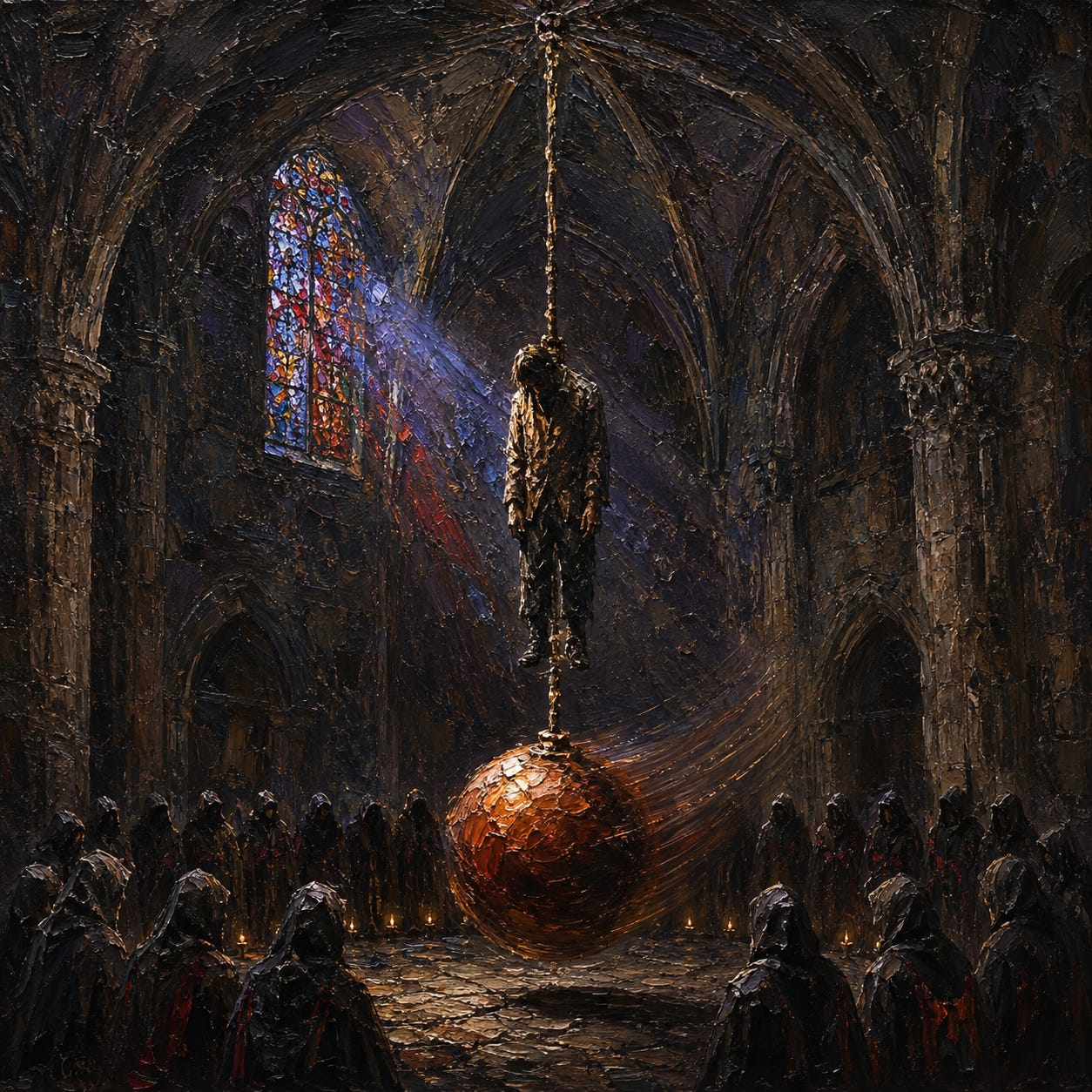
The document that starts the whole catastrophe is a merchant’s delivery order. A fragment of burned parchment found in the town of Provins, listing thirty-six sous for wagons of hay, six new lengths of cloth with seal for rue des Blancs-Manteaux, and six bunches of six Crusaders’ roses at twenty deniers each for six locations in the town on the feast of Saint John, including three bunches for the whores’ street because the prostitutes wanted little hats of roses for the feast day too. That is the entire secret. A retired colonel misreads it as a Templar plan for world domination, three editors at a Milan publishing house take his misreading and build a coherent seven-century conspiracy on top of it, and the readers who receive that conspiracy believe it so completely that they hang one of the editors from the wire of Foucault’s pendulum in a Paris museum on the night of Saint John’s Eve. This is the mechanism Foucault’s Pendulum (1988) puts under a microscope. The mechanism is not that credulous people invent patterns where none exist. The mechanism is that fabricated grand conspiracies serve as cover for the ordinary coordination of power. Invent a seven-century Templar-Rosicrucian-Merovingian synthesis and hand it to the credulous, and three things follow. You satisfy the appetite for hidden meaning, which lets people stop looking at what is actually in front of them. You produce the crank profile the establishment needs to discredit anyone asking real questions. You build a decoy elaborate enough that the actual mechanisms of power operate unremarked while everyone chases the map.
Umberto Eco, born in Alessandria in 1932, was professor of semiotics at the University of Bologna for most of his working life. His scholarly range covered Thomas Aquinas, James Joyce, medieval aesthetics, and the semiotics of popular culture including Superman comics, and his 1980 novel The Name of the Rose had already established him as one of the few academic semioticians whose fiction was read by the general public. He wrote Foucault’s Pendulum from inside the field that studies how signs generate meaning and how readers project meaning onto signs that carry none. The novel is a semiotician’s clinical case study in the form of a thriller. Eco knew exactly what he was doing when he built a three-hundred-page trap for the reader who cannot stop looking for the hidden pattern, and he built the trap with the expertise of a man who had spent his career watching the same trap catch academics, theologians, and advertising executives.
The book appeared in 1988, at the point when the political radicalism of the 1968 generation had largely dissolved into a market for the occult. The novel documents this shift directly in its Milan scenes. The old customers of Pilade’s Bar who once peddled the works of Che are back a decade later selling herbals, Buddhism, and astrology. Transcendental meditation schools and macrobiotic restaurants have opened in the storefronts where the revolutionary bookshops used to be. The Red Brigades and the Moro kidnapping recede, and in their place a whole publishing ecosystem grows up around Rosicrucians, neo-Templars, Rennes-le-Château enthusiasts, Grail hunters, and disciples of Guénon and Papus. Baigent, Leigh, and Lincoln’s Holy Blood, Holy Grail had appeared in 1982 and was selling in the hundreds of thousands. Eco writes into a market saturated with the exact material his editors will parody, and he writes for a readership that in many cases had already bought several volumes of that material without irony.
Three men build the trap they walk into. Casaubon is the narrator, a young Templar scholar. His two colleagues at Garamond Press in Milan are Jacopo Belbo, a melancholy Piedmontese editor with a childhood memory he never quite recovers from, and Diotallevi, an orphan who has convinced himself he must have been Jewish and spends his hours on the Kabbalah. All three meet Colonel Ardenti when he arrives at the office with the Provins parchment and his decoding of it. Ardenti vanishes the same night after a visit from a man calling himself Rakosky. Years later, the same publisher launches a vanity-press line aimed at occultists, and the three editors begin reading Rosicrucian, neo-Templar, Luciferian, and Kabbalist manuscripts by the dozen. As a game, they combine every occult tradition of the last seven centuries into a single coherent conspiracy and call it the Plan. It absorbs the Templars, the Rosicrucians, the Freemasons, the Illuminati of Bavaria, the Grail, the Comte de Saint-Germain, the Protocols of the Elders of Zion, and eventually the spark plugs of a car. Everything fits, because they wrote it to fit. Then their consultant Aglié, an elegant elderly Italian who claims to have known the eighteenth century personally, takes it seriously and passes it to his network. Diotallevi dies of cancer and tells Belbo on his deathbed that his cells have learned to anagrammatize the Torah of his body in the same way the three of them anagrammatized the Torah of history. Belbo is summoned to Paris, refuses to hand over a map he does not have, and is hanged from the wire of the pendulum in the Conservatoire des Arts et Métiers on the night of Saint John’s Eve. Casaubon flees to a country house in the Piedmontese hills and writes the account the reader is holding.
Foucault’s Pendulum came to my attention when James Corbett covered it recently on The Corbett Report, in the monthly Film, Literature and the New World Order series, with Tom Oliver Regenauer as the guest who proposed it. The mainstream reading of the book, that it is a diagnosis of why silly people believe in conspiracies, is the shallow one and probably a deliberate misreading. Eco is not telling you there is no coordination behind the visible order of things. He is telling you that the elaborate synthetic conspiracies the credulous construct are decoys, and that decoys are useful to the people running the actual show. Aglié is real. The Tres is real. Colonel Ardenti really vanishes in the opening chapters, before the three editors invent anything. Inspector De Angelis really has a bomb placed under his wife’s car. Belbo really dies. The novel stands in the small canon of works that diagnose the psychology of belief without offering the reader an exit. Dostoevsky’s Demons is one antecedent, Borges another, and Eco’s book belongs on the same shelf. The full summary unpacks the three rules that govern every conspiracy ever assembled (analogy, coherence as proof, prior belief as authority); Diotallevi’s deathbed argument that the linguistic term metathesis and the oncological term metastasis come from the same Greek root, and that his cancer is his body doing to itself what the three editors did to history; and the revelation that Aglié, the elegant consultant who has cultivated the editors for years, is the same figure who took the original parchment from Colonel Ardenti in the opening pages, meaning the Plan the editors thought they were inventing was already in motion before they began. In the closing pages Casaubon sits at a country house in the Piedmontese hills, watches the vineyards on the Bricco’s slopes, and bites into a peach. Where ammonoids once fed, diamonds. Where diamonds once grew, vineyards. That is the Kingdom, and there is nothing hidden behind it, and Casaubon is at peace with that. He is also certain that They are on their way up the road. The novel does not correct him.
The rest of this summary — the analogy, one-minute elevator explanation, 12-point summary, Q&As, and Golden Nugget — is for paid subscribers.
Your subscription also unlocks every other book summary in the library, the Deep Dive Audio Library, my original books (new ones added monthly), and three series for the moments when a real decision is in front of you: Questions for Your Doctor, Before You Consent, and Package Inserts.