

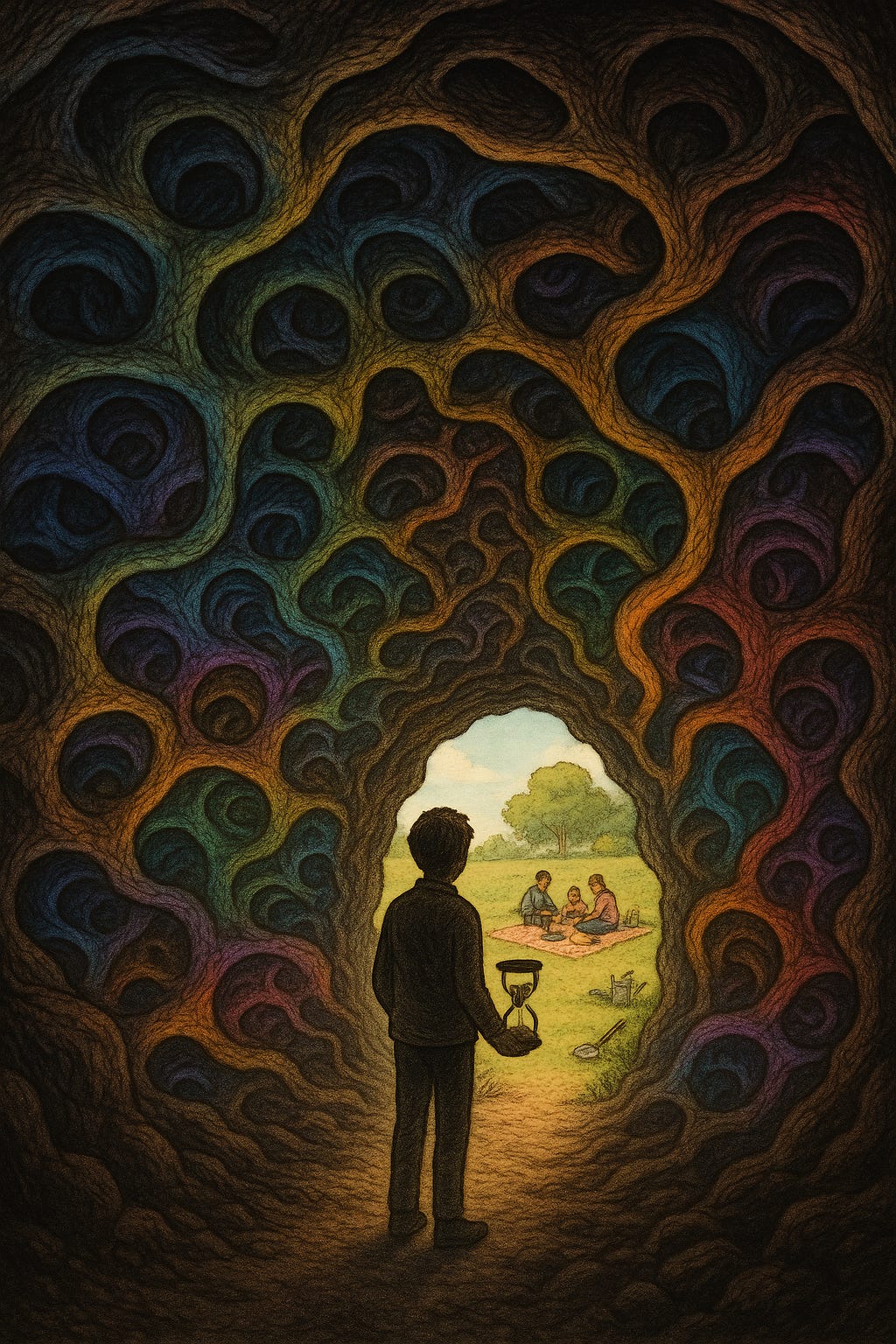
The average human lifespan amounts to roughly 4,000 weeks. That number—stark, finite, unexpectedly small—exposes the absurdity at the heart of modern time management. Every productivity system, inbox-zero method, and life-optimization strategy rests on an impossible premise: that with the right approach, you might somehow fit everything in. You won’t. The math doesn’t work. Human civilization itself is only about 310,000 weeks old, and you’re getting 4,000 of them.
Oliver Burkeman’s Four Thousand Weeks argues that this limitation isn’t a problem to solve but a reality to accept—and that the acceptance itself is where freedom begins. The efficiency trap ensures that every hour saved generates new demands to fill it. Answer emails faster and you receive more emails. Complete tasks efficiently and you’re assigned more tasks. The treadmill speeds up to match your pace. Meanwhile, the harder you try to control time, the more anxious you become, because you’re attempting something ontologically impossible: you don’t have time that you can manage from some external vantage point. You are time—a sequence of present moments with no position outside the flow from which to master it.
The book draws on Heidegger’s philosophy, medieval conceptions of time, and the mechanics of the attention economy to build its case. But its practical implications are immediate: strategic underachievement beats scattered mediocrity. Choosing what to neglect matters more than optimizing what you pursue. The cosmic insignificance of your existence—far from depressing—removes the impossible burden of making your life historically meaningful. What remains is human-scale meaning: the meal prepared well, the friendship maintained, the work done with genuine attention. The catastrophe you’ve been bracing against has already happened. You were always going to die having missed almost everything. The only question is whether you’ll spend your 4,000 weeks fighting that fact or living within it.
Four Thousand Weeks: Time and How to Use It by Oliver Burkeman | Goodreads
Support Independent Research
This work remains free because paid subscribers make it possible. If you find value here, consider joining them.
What paid subscribers get: Access to the Deep Dive Audio Library — 170+ in-depth discussions (30-50 min each) exploring the books behind these essays. New discussions added weekly. That’s 100+ hours of content for less than the price of a single audiobook.
[Upgrade to Paid – $5/month or $50/year]
Get in touch Essay ideas, stories, or expertise to share: unbekoming@outlook.com
Analogy
Imagine you're at an all-you-can-eat buffet that's only open for exactly 80 minutes (representing your 4,000 weeks). The buffet stretches infinitely in all directions with every dish imaginable—not just food, but experiences, relationships, achievements, places to visit, books to read, causes to support. You arrived hungry and eager, plate in hand, certain you'd sample everything that looked appealing.
Twenty minutes in, panic sets in. You've barely made a dent in the first section, and you can see the clock ticking. So you start rushing, piling your plate impossibly high, eating faster, trying to develop a system for maximum consumption efficiency. But the faster you eat, the less you taste. The more you pile on your plate, the more dishes you notice that you'll never get to try. Other diners seem to be eating things you haven't even discovered yet. You download an app that promises to optimize your buffet route. You skip the soup because it takes too long to eat. You avoid chatting with fellow diners because that's time not spent consuming.
Forty minutes in—halfway through your life at this buffet—you're exhausted, overwhelmed, and surprisingly unsatisfied despite having consumed so much. Your stomach hurts from eating too fast. You can't remember what most things tasted like. You realize with horror that at this rate, you'll leave having frantically consumed hundreds of things but truly savored none of them.
Then you notice something. A few diners aren't rushing at all. They've chosen just a small selection of dishes and are eating them slowly, actually tasting them, sharing them with friends, going back for seconds of what they love instead of trying everything once. They're chatting between bites, helping elderly diners with their trays, even sitting still sometimes, not eating at all, just being present in this strange, temporary buffet. They know they'll miss almost everything too—but they seem at peace with it.
The revelation hits: the buffet was never designed for you to try everything. That was never possible. It's designed to overwhelm you with choice so you understand that choosing what to miss is the very thing that makes your choices meaningful. Those 80 minutes aren't a challenge to consume as much as possible—they're an invitation to consciously choose a few things that matter and truly taste them. The tragedy isn't that you can only fit so much on your plate; it's that in trying to fit everything, you taste nothing.
The One-Minute Elevator Explanation
You know that feeling when you're juggling a million things, inbox overflowing, rushing through life convinced that someday you'll finally get on top of everything and then you can relax and enjoy life? Well, here's the thing: you have about 4,000 weeks from birth to death—that's it. When you actually do that math, it hits you that you're never going to get everything done. Never. And that's not failure—that's reality.
We've been tricked into thinking time is something we can master and control, like money we can save up or spend wisely. But we don't have time—we are time. We're just these brief little blips of consciousness flowing through a few decades, and the harder we try to optimize and control every minute, the more anxious and rushed we feel. It's like being in a river and trying to manage the water—you can't, because you are the water.
The real freedom comes when you stop trying to fit everything in and instead make peace with choosing what to neglect. Pay yourself first with time—do what matters most before you tackle the infinite list of other demands. Accept that you'll fail at things, disappoint people, miss out on most opportunities—and that this is what makes your choices meaningful. Stop waiting to feel ready or qualified or in control, because that feeling never comes. Instead of trying to defeat your limitations, work with them. That's where the real juice of life is—not in some future moment when you've finally got everything handled, but right here in this messy, limited, uncontrolled present moment.
[Elevator dings]
Want to dig deeper? Look into Martin Heidegger's concept of "Being-toward-death," research the attention economy and persuasive design, or explore how different cultures throughout history have related to time before clocks took over our lives.
12-Point Summary
1. The Four Thousand Week Reality Check When confronted with the fact that the average human life consists of merely 4,000 weeks, the typical productivity mindset reveals itself as absurd. This shockingly brief duration means that time management, in its conventional sense, is doomed to fail because it's based on the fantasy that with the right system, you might somehow fit everything in. The entire history of human civilization spans only about 310,000 weeks, making your individual existence almost incomprehensibly brief. This isn't meant to depress but to liberate—once you grasp that you'll never have enough time for everything that seems worth doing, you can stop exhausting yourself trying and instead focus on the few things that genuinely matter during your brief moment of consciousness.
2. The Efficiency Trap Paradox The more productive you become, the more demands flood in to fill your newly created capacity, leaving you busier than before. Answer emails quickly and you'll get more emails; complete your work efficiently and you'll be given more work; buy time-saving devices and society's standards will rise to absorb all the time saved. This isn't a flaw in your productivity system—it's the fundamental nature of efficiency in a world of infinite demands. Like Sisyphus with his boulder, except the boulder gets bigger each time you push it up the hill. The solution isn't to become even more efficient but to recognize that the game itself is unwinnable and to stop playing by its rules.
3. From Having Time to Being Time The industrial revolution and the invention of clocks transformed time from something we exist within to something we supposedly possess and must manage efficiently. Medieval peasants lived in "task orientation," working with natural rhythms rather than against abstract schedules, experiencing time as the medium of existence rather than a resource to be maximized. But Heidegger's insight goes deeper: we don't have time, we are time—we're nothing but a sequence of present moments. This means the whole project of trying to master time is like trying to lift yourself by your own bootstraps. You can't get outside of time to control it because you are it, which explains why all our attempts at temporal mastery leave us feeling more anxious and out of control.
4. Existential Overwhelm and Infinite Choice Modern secular life presents us with an inexhaustible supply of experiences, opportunities, and obligations that seem worth pursuing, creating a form of suffering unknown to previous generations who had fewer choices and believed in an afterlife. The internet exponentially amplifies this by making us aware of literally millions of things we could be doing but aren't. The bucket-list retiree and the burnt-out executive are suffering from the same delusion: that it's possible to get enough done to feel satisfied. But in a world of effectively infinite experiences, no amount of productivity can ever be enough. The more wonderful experiences you have, the more you become aware of other wonderful experiences you're missing, creating an endless treadmill of dissatisfaction.
5. The Hidden Nature of Distraction We think distraction means being pulled away from important work by external forces, but it's actually an inside job—we actively collaborate with digital devices and other diversions because facing reality is uncomfortable. Working on something that matters forces you to confront your limitations: that you might fail, can't control outcomes, and are choosing this over infinite other possibilities. The internet offers escape to a realm that feels limitless, where you never have to commit or face your constraints. Shinzen Young's ice-water training in Japan revealed that paying full attention to discomfort, rather than trying to escape it, actually reduces suffering. The "intimate interrupter"—that inner voice urging you toward distraction—isn't pulling you toward something better but away from the uncomfortable truth of your finite existence.
6. The Instrumental Life Problem Treating everything as a means to an end—working to retire, raising kids to produce successful adults, exercising for future health—guarantees you'll never feel satisfied because the present never feels valuable in itself. This is the "causal catastrophe": believing that the value of how we spend time should be judged solely by results, which means life becomes an endless deferral of meaning to a future that never arrives. The Mexican fisherman who already lives the life the businessman is working toward reveals the absurdity. Children don't exist to become adults; they exist to be children. The present isn't a rehearsal for your real life; it is your real life. When you instrumentalize everything, you're gambling away the only existence you'll ever have on a future payoff that never comes.
7. Individual Freedom Versus Communal Time The modern ideal of complete temporal sovereignty—controlling your own schedule, working when you want, being "free"—creates unexpected loneliness and isolation. Time is a "network good" that gains value when others have access to it too. Digital nomads discover that the freedom to work from anywhere means never being free when your friends are; flexible work schedules mean missing the communal rhythms that create social bonds. The Soviet Union's five-day week experiment, where different groups had different weekends, destroyed social life despite giving workers more frequent rest days. Swedish research shows people are happiest when taking vacations at the same time as others. We've pursued individual time freedom so aggressively that we've accidentally desynchronized society, leaving us free but alone.
8. Patience as Power, Not Passivity In a world obsessed with speed and instant results, patience becomes a form of resistance and a competitive advantage. Jennifer Roberts forces her Harvard students to look at a single painting for three hours, past the point of excruciating boredom, until suddenly the artwork begins revealing secrets invisible to hurried viewing. M. Scott Peck discovered he could fix anything once he stopped trying to force quick solutions and instead lay calmly under the car, studying the problem until the solution presented itself. The Helsinki bus station metaphor teaches that originality lies on the far side of patient apprenticeship—you have to stay on the bus through the derivative phase to reach the point where routes diverge. Patience isn't passive waiting but active presence, a muscular staying-with-reality that gives access to depths of experience that hurried living never reaches.
9. The Liberation of Cosmic Insignificance Contemplating your irrelevance on the scale of the universe—a brief flicker of consciousness in infinite space and time—isn't depressing but liberating because it reveals you've been holding yourself to impossible standards. The pressure to "put a dent in the universe" or leave a lasting legacy is based on the egocentric delusion that you're more central to the cosmic story than you actually are. Once you accept your insignificance, the bar for a meaningful life drops to human scale: preparing good meals for your children, writing something that moves a handful of contemporaries, being kind to neighbors. The universe doesn't care what you do with your 4,000 weeks, which means you're free to care about whatever matters to you without worrying whether it's significant enough. Meaning comes not from cosmic importance but from engagement with your specific, limited, insignificant life.
10. Strategic Underachievement and Conscious Neglect Since you'll inevitably fail at things and disappoint people, you might as well choose your failures consciously rather than randomly. Decide in advance to have a mediocre lawn, a cluttered kitchen, or minimal work performance for the next two months while you focus on family, then switch. This isn't giving up but acknowledging reality strategically. Pay yourself first with time—do what matters most before tackling infinite other demands, knowing that many of those demands will never get met. Keep your work in progress limited to three items maximum, forcing yourself to feel the discomfort of everything you're not doing. The person trying to excel at everything ends up mediocre everywhere, while strategic underachievement allows genuine excellence in chosen areas plus the psychological relief of failing at things on purpose rather than by accident.
11. Rest as Resistance, Not Recovery Capitalism transformed rest from life's center into recovery time for more work, making us feel guilty about any leisure that doesn't enhance productivity. The Protestant work ethic made idleness evidence of damnation, creating what Max Weber identified as the spiritual engine of capitalism. Now we're so uncomfortable with non-productive time that we turn hobbies into side hustles, vacations into self-improvement, and exercise into punishment. Danielle Steel working twenty-hour days gets praised as "badass" rather than seen as pathologically unable to stop. True rest requires surrender to purposelessness—engaging in atelic activities that have no goal beyond themselves. Rod Stewart's badly built model trains and Karen Rinaldi's terrible surfing demonstrate the freedom that comes from doing things you'll never monetize or master, where the only point is the doing itself.
12. Embracing the Already Broken The catastrophe you've been tensing against has already happened: the climate is already changing, the pandemic already occurred, your life is already finite, you're already going to die. This isn't depressing but empowering because it means you can stop wasting energy trying to prevent what's already here. When activists stop hoping the dominant culture will stop destroying the world and start working to save specific species, they become more effective. When you accept your relationship is already imperfect, you can stop waiting for it to become perfect and work with what you have. As Pema Chödrön explains, abandoning hope is an affirmation—it kills the frightened part of you desperately avoiding reality and frees the part that can actually respond. You never needed the security you've been seeking; you've been strong enough all along to face reality without illusions. The next necessary thing is all you can do, but it's also all you need to do.
The Golden Nugget
The most profound and least understood idea in the book is that we don't have time—we ARE time. This isn't metaphorical or poetic but literally true: your existence consists of nothing but a sequence of present moments, and you are inseparable from this temporal flow. This means the entire project of "time management"—trying to save time, spend it wisely, or master it—is fundamentally incoherent, like a river trying to manage its own water. You can never step outside of time to control it because there is no "you" separate from the flow of moments that constitutes your existence. This explains why all our attempts to gain mastery over time paradoxically make us feel more anxious and out of control: we're trying to achieve something that's not just difficult but ontologically impossible. The peace comes not from finally getting control but from recognizing that the desire for control is based on a misunderstanding of what you fundamentally are.
30 Questions and Answers
1. Why does the human lifespan of roughly 4,000 weeks matter for how we think about time?
The absurdly brief span of 4,000 weeks forces us to confront an uncomfortable truth: we've been granted the mental capacity to make infinitely ambitious plans, yet practically no time at all to put them into action. This stark number strips away our illusions about having endless time to get our lives in order, to pursue everything that matters, or to postpone the important things until we're ready. When you grasp that modern civilization itself is only about 310,000 weeks old, and that you're getting merely 4,000 of those weeks, the usual time management advice about "fitting everything in" reveals itself as a fantasy.
The brevity isn't meant to induce despair but to inspire a radical shift in perspective. Once you truly understand that your weeks are not only finite but shockingly few, you can stop treating time as something to be conquered or mastered. Instead of exhausting yourself trying to cram more activities into your days or optimizing every hour for maximum productivity, you can focus on the liberation that comes from accepting limits. The real question isn't how to make time for everything—that's impossible—but how to make choices about what to neglect, so you can focus on what genuinely counts during your brief moment of existence.
2. What is the efficiency trap and why does becoming more productive often make us feel more overwhelmed?
The efficiency trap is the cruel paradox where your efforts to get more done and clear your plate simply generate more things to do. When you become excellent at processing emails quickly, you don't achieve an empty inbox and peace of mind—you just receive more emails, because people learn you're responsive and send you more messages. When you efficiently complete your work tasks, you don't get to relax; you get given more work. The housewife with a new washing machine doesn't get more leisure time; society's standards for cleanliness rise to absorb all the time saved. Every efficiency gain gets offset by increased demands, like running faster on a treadmill that speeds up to match your pace.
This trap extends beyond simple task management to encompass our entire experience of life. The more activities you successfully squeeze into your days—visiting exotic destinations, trying new restaurants, taking online courses—the more additional activities you become aware you could be doing. The technology that promises to help us "get on top of everything" actually increases the size of the "everything" we're trying to get on top of. You can't win this game through efficiency alone because the game itself is rigged: in a world of effectively infinite experiences, demands, and possibilities, no amount of productivity can ever be enough to feel like you've done it all.
3. How did the invention of clocks fundamentally change humanity's relationship with time?
Before clocks, medieval people lived in what historians call "task orientation"—you milked cows when they needed milking, harvested when crops were ready, and worked with natural rhythms rather than against an abstract timeline. Time wasn't something separate from life that could be "saved" or "wasted"; it was simply the medium in which existence unfolded. A task might last a "Miserere whyle" (the time to recite Psalm 50) or a "pissing whyle," but there was no anxious sense of time as a resource slipping away. People inhabited what could be called "deep time," where past and present felt continuous and interconnected, where ancestral spirits seemed as present as living relatives.
The mechanical clock changed everything by making time visible, standardized, and abstract—something that exists independently, ticking away whether you use it well or poorly. Once you could measure time precisely, it became natural to treat it as a commodity to be bought, sold, and maximized for profit. Factory owners began paying by the hour and demanding that workers squeeze maximum productivity from each unit of time. Life became a matter of racing against the clock, trying to "master" time rather than simply living within it. The clock transformed time from something we are into something we have—and never have enough of—creating the distinctly modern anxiety of feeling perpetually behind schedule in our own lives.
4. What does it mean that we ARE time rather than HAVE time, and why is this distinction important?
When we talk about "having" time, we imagine it as a resource we possess and control, like money in a bank account that we can save, spend, or waste. But this is an illusion—we never actually have three hours or three days in our possession; we only expect them. At any moment, those hours could be taken away by interruption, illness, or death. The truth is more radical: we don't have time, we are time. Our existence is nothing more than a sequence of present moments, and we are inseparable from this temporal flow. As Borges wrote, "Time is the substance I am made of. Time is a river that sweeps me along, but I am the river."
This distinction matters because trying to master something that you fundamentally are is like trying to lift yourself by your own bootstraps. The attempt to gain control over time—to achieve perfect productivity, to never waste a moment, to feel "on top of things"—is doomed because you can't step outside of time to manage it. You're always already inside the only moment that exists: this one. Accepting that you are time, rather than fighting to have more of it, brings a profound shift. Instead of constantly living for some future moment when you'll finally have things under control, you can surrender to the reality that you're always in the river, always in process, never arriving at some final state of completion.
5. What is "existential overwhelm" and how does it differ from regular busyness?
Existential overwhelm goes deeper than having too many tasks at work or home—it's the modern burden of facing an inexhaustible supply of things that seem worth doing with your finite life. The retiree checking off exotic destinations and the hedonist cramming weekends with experiences are just as overwhelmed as the harried executive, because they're all trying to devour more of life's possibilities than any single lifetime can accommodate. In pre-modern times, people didn't face this challenge: they believed in an afterlife that removed time pressure, saw history as cyclical rather than progressing toward endless new possibilities, and lived in societies where most life choices were predetermined by tradition and social class.
Today, secular modernity has changed everything. Without belief in an afterlife, this life becomes our only shot, intensifying the pressure to "make the most of it." The belief in progress means we're painfully aware of all the future possibilities we'll miss. The internet exponentially multiplies our awareness of experiences we could be having—every Facebook event, travel blog, and online course reminds us of something else we're not doing. Regular busyness might be solved with better scheduling, but existential overwhelm can't be fixed by cramming more in. The more wonderful experiences you successfully have, the more you realize you could have, creating an infinite treadmill where fulfillment always remains just out of reach.
6. Why is distraction not really about external interruptions but about our discomfort with finitude?
When we succumb to distraction, checking social media instead of working on something important, we usually aren't being dragged away against our will—we're eager for the escape. The discomfort we're fleeing isn't physical, like the icy water that trained Shinzen Young in concentration, but existential. Working on something that matters forces us to confront our limitations: that we might fail, that we can't control outcomes, that we're committing our finite time to this instead of infinite other possibilities. The internet offers an escape to a realm that feels limitless, where we can drift through infinite newsfeeds without ever having to commit to anything or face our constraints.
Every meaningful activity demands that we acknowledge our lack of godlike control. Writing a novel means accepting it might be terrible; entering a relationship means risking heartbreak; raising children means facing the terrifying truth that you can't fully protect them. Boredom, often blamed on lack of interest, actually arises from the intense discomfort of being trapped in the present moment with no control over how fast things unfold. Digital devices aren't irresistibly compelling; they're simply where we flee when we can't bear the discomfort of confronting reality. The "intimate interrupter"—that inner voice urging us toward distraction—isn't pulling us toward something better but away from the uncomfortable truth of our finite, limited existence.
7. What's wrong with treating all our time instrumentally as a means to future goals?
Living instrumentally means treating everything you're doing—life itself—as valuable only for where it might lead, never for what it is. You endure the commute to earn the paycheck, suffer through workdays to reach the weekend, raise children to produce successful adults, exercise to achieve future fitness. But this approach guarantees you'll never feel satisfied, because the present moment never feels valuable in itself. Even if you achieve your goals—the promotion, the perfect body, the well-adjusted kids—you'll just find new future targets to chase, remaining perpetually in a state of postponement, always "on your way" to real life but never arriving.
This instrumentalist mindset is particularly tragic when applied to irreplaceable experiences. Parents who view childhood solely as preparation for adulthood miss the miraculous reality of their actual child, here and now, who exists not to become something else but to be what they are. The businessman in the parable who advises the Mexican fisherman to work harder so he can eventually retire and relax fails to see that the fisherman is already living the life that's supposedly the goal. When we treat time as purely instrumental, we're basically making a bet that meaning lies in the future—but since we live only in a succession of present moments culminating in death, we're gambling away the only life we'll ever have on a payoff that never comes.
8. How does the modern attention economy exploit our relationship with time?
The attention economy is essentially a giant machine for getting you to make wrong choices about what to do with your finite life. Social media platforms profit by seizing your attention and selling it to advertisers, using "persuasive design" techniques borrowed from casino slot machines—like the variable rewards of pull-to-refresh—to create compulsive behavior. The platforms deliberately show you content that makes you angriest or most outraged because that's what keeps you scrolling. They're not just wasting your time in isolated moments; they're shaping your entire picture of reality, influencing what you think matters, how dangerous the world is, how venal your political opponents are.
The damage runs deeper than lost hours on Facebook. When the online world constantly adapts to push your psychological buttons while real life doesn't, reality starts to feel insufficiently stimulating—a Scottish beach at dusk seems boring compared to Twitter's endless outrage. The algorithm shapes not just how you spend your online time but your offline time too: you walk around mentally arguing with idiots you encountered online, you vote based on distorted threat perceptions, you avoid family members whose politics differ from yours. As Harry Frankfurt observed, these platforms sabotage our capacity to "want what we want to want"—they don't just steal our time but colonize our consciousness, making us value things we wouldn't choose to value if we were choosing freely.
9. What is the difference between individual time sovereignty and communal synchronized time?
Individual time sovereignty—the freedom to set your own schedule, work when you want, take vacations when you choose—sounds like the ultimate liberation. But this freedom comes with a hidden cost: the more control you have over your time, the harder it becomes to coordinate with others. Digital nomads discover this paradoxically leads to intense loneliness; freelancers find they can't meet friends who work regular hours; even flexible work arrangements mean you're less likely to bond with colleagues. We've essentially imposed on ourselves something like the Soviet five-day week, where everyone's on different schedules and nobody's free at the same time.
Communal synchronized time—the Sabbath, the Swedish fika, summer vacation when everyone's off—represents a different kind of freedom: the freedom to participate in collective life. Research shows Swedes are happiest when the most people are on vacation simultaneously, not just because their friends are available but because there's a collective "cloud of relaxation" over society. Even unemployed people feel happier on weekends, though they don't have jobs to rest from. When we all inhabit the same temporal grooves—working, resting, celebrating together—time feels thicker and more meaningful. The military marching that overwhelmed William McNeill with a sense of "personal enlargement," the choir that makes singers feel like "fireflies flashing in synchrony"—these experiences reveal that surrendering some individual control over time can connect us to something larger than ourselves.
10. Why does patience represent a form of power rather than passive resignation?
In a world geared for speed and instant gratification, patience becomes a radical act of resistance. When Jennifer Roberts forces her students to look at a painting for three hours, she's not teaching them to be passive but to develop what could be called muscular presence—the strength to stay with reality instead of fleeing into distraction. After the first excruciating period of discomfort, something shifts: the painting begins revealing secrets invisible to hurried viewing, like how the boy's ear in Copley's portrait perfectly echoes the squirrel's belly. The patient observer gains access to layers of reality that remain hidden from those who insist on rushing.
Patience is power because it's the capacity to let things take the time they take, which is the only way to do anything meaningful. The writer who can tolerate producing just a few paragraphs daily will complete more books than one who binges and burns out. The mechanic who lies calmly under the car, studying the problem without rushing to fix it, solves it with one finger's pressure. M. Scott Peck discovered he could fix anything once he stopped trying to force quick solutions. In our impatient world, the person who can resist the urge to hurry—who can stay on the bus while others jump off seeking quicker routes—gains the competitive advantage of depth, mastery, and genuine accomplishment.
11. What's the problem with the "when-I-finally" mindset and living provisionally?
The "when-I-finally" mindset treats your current life as a rehearsal for your real life, which will supposedly begin once you get your inbox under control, find the right partner, finish your degree, or achieve financial security. But this provisional living is a trap because the conditions you're waiting for will never fully arrive. Clear your inbox and it fills again; find the perfect partner and discover they're human after all; achieve financial security and realize you need more. You remain perpetually convinced that you're not quite ready to live yet, that you need just a little more preparation, one more achievement, before real life can begin.
Living provisionally means refusing to be "pinned down" to reality, maintaining the fantasy that you could become someone who doesn't face hard choices, feel anxiety, or risk failure. It's the mentality that made Franz Kafka torture Felice Bauer with five years of letters rather than commit to actual relationship, and that keeps people in unfulfilling jobs while dreaming of someday pursuing their passion. The provisional mindset is ultimately a refusal to enter time completely—to be the specific, limited human you are rather than maintaining infinite possibilities. But since life is nothing but a succession of present moments ending in death, waiting to live means never living at all. The only way to "prepare" for life is to begin living it.
12. How does procrastination relate to our inability to accept our limitations?
Procrastination isn't simply laziness or poor time management—it's an emotional strategy for avoiding the painful truth of our limitations. When you postpone starting that creative project, you're not just avoiding work; you're avoiding the possibility that your talents might be limited, that you might fail, or that the finished product won't match your fantasies. As long as you don't begin, you can maintain the illusion that you could do something perfect if you wanted to. The architect from Shiraz who burned his mosque plans rather than build them understood this: the imaginary mosque in his mind was flawless, but any real mosque would expose his lack of omnipotent control over materials, builders, and time.
The good news hidden in this bad news is that once you understand perfection is impossible, procrastination loses its purpose. If you're worried you won't do a good enough job, you can relax—by the flawless standards of your imagination, you definitely won't do a good enough job, so you might as well start. The novel will be imperfect, the relationship will have conflicts, the business might fail. But these limitations aren't obstacles to a meaningful life; they're the conditions that make choice and commitment meaningful in the first place. Procrastination is the fantasy that you might somehow avoid these conditions; beginning is the acceptance that you can't, and that this acceptance is where real life starts.
13. What is "cosmic insignificance therapy" and how can it be liberating?
Cosmic insignificance therapy is the practice of deliberately contemplating your own irrelevance on the scale of the universe—recognizing that you're a minuscule speck existing for an eyeblink in the vast expanse of time and space. Human civilization is only sixty centenarian lifespans old; in cosmic terms, your life is indistinguishable from nothing at all. This might sound terrifying, but it's actually a relief, because it reveals that you've been holding yourself to an impossible standard. The pressure to "put a dent in the universe," leave a legacy, or do something historically significant is based on the delusion that you're more central to the cosmic story than you actually are.
Once you accept your cosmic insignificance, the bar for a meaningful life drops to a manageable height. Preparing a good meal for your children, writing a novel that moves a handful of readers, or being kind to your neighbors might be as significant as anything could be. You're freed from the impossible task of justifying your existence on some cosmic scale and can instead focus on the concrete, finite scale where you actually live. The universe doesn't care what you do with your four thousand weeks—which means you're free to care about whatever actually matters to you, without worrying whether it's significant enough. This isn't nihilism but its opposite: the recognition that meaning comes not from cosmic importance but from engagement with the specific, limited, insignificant life you've been given.
14. Why did medieval peasants experience less time anxiety despite having harder lives?
Medieval peasants lived in "task orientation" rather than clock time, meaning they worked according to natural rhythms—sunrise, sunset, seasons, the needs of animals—rather than against an abstract schedule. They had no concept of time as a separate resource that could be saved or wasted; time was simply the medium of existence, like water to a fish. Without clocks creating an abstract timeline against which to measure their activities, there was no sense of "falling behind" or needing to "catch up." A farmer's work was infinite—there would always be another harvest—so there was no anxious racing toward some imagined point of completion.
Their relationship to time was also fundamentally communal rather than individual. Feast days, market days, and religious observances were collectively observed, creating shared rhythms that nobody questioned or tried to optimize. The absence of capitalism meant no pressure to maximize productivity or turn time into profit. Perhaps most importantly, belief in an afterlife removed the distinctly modern pressure to cram all meaning into one finite existence. This isn't to romanticize medieval life, which was often brutal and short, but to recognize that our time anxiety isn't natural or inevitable—it's a historically specific consequence of how we've learned to think about and organize time.
15. What's the difference between atelic and telic activities, and why does this distinction matter?
Telic activities are done for their outcomes—you study to get a degree, work to earn money, exercise to lose weight. Once you achieve the goal, the activity is complete and loses its purpose. Atelic activities have no such endpoint—you walk in nature for the walking itself, spend time with friends for the companionship, play music for the joy of playing. You can stop doing these things but you can't complete them; their value lies entirely in the doing, not in any result. Most modern life is overwhelmingly telic, focused on achieving future states: the promotion, the retirement fund, the children's college admission.
The problem with a life dominated by telic activities is that you're always mentally living in the future, treating the present as a means to an end. This creates what Schopenhauer called the pendulum between pain and boredom: either you haven't achieved your goal (painful) or you have and now lack purpose (boring). Atelic activities offer an escape from this trap because they return you to the present—there's literally nowhere else to be when the activity has no goal beyond itself. Rod Stewart building model trains badly, hikers following trails that circle back to where they started, friends meeting for conversation with no agenda—these activities affirm that life doesn't need to be justified by outcomes. They're what make life worth living, not because they achieve something but because they are life being lived.
16. How does convenience culture actually make life feel less satisfying?
Convenience culture promises to eliminate friction and difficulty, but it turns out that friction and difficulty are often what make experiences valuable. When you send a birthday card through an app without ever touching it, both sender and recipient know it's a hollow gesture—the effort of buying, writing, and mailing a physical card is what conveys care. The venture capitalist culture of Silicon Valley identifies "pain points" to eliminate, but many of these inconveniences are actually the texture of meaningful life. Your loyalty to the local taxi firm, small talk with the takeout restaurant owner, the slight hassle of paying with cash—these create the social fabric that makes neighborhoods feel like communities.
When everything becomes frictionless, activities lose their weight and significance. Walking becomes not worth doing when you can Uber; cooking becomes pointless when you can order in; voting feels irritating when you can do everything else instantly on your phone. Tim Wu observes that convenience makes us do what's easiest rather than what we prefer—he drinks Starbucks instant coffee despite preferring brewed because the convenience wins. Sylvia Keesmaat deliberately chose an inconvenient life—lighting fires for heat, growing food—not out of romanticism but because convenience had drained meaning from her days. The truth convenience culture obscures is that effort, inconvenience, and even difficulty aren't obstacles to a meaningful life—they're what create meaning in the first place.
17. What can we learn from the Soviet Union's failed five-day workweek experiment?
In 1929, Stalin's regime imposed a five-day week where workers were divided into color-coded groups, each taking different days off, so factories could run continuously. The plan seemed logical: more productivity for the state, more frequent rest days for workers, less crowding of shops and cultural venues. But it destroyed Soviet social life because friends and family members on different schedules could never meet. "What are we to do at home if the wife is in the factory, the children in school, and no one can come to see us?" one worker complained. The experiment revealed that time's value isn't individual but communal—time is only truly valuable when it's shared.
The Soviet experiment was deliberately designed to undermine family and religious bonds that might compete with state loyalty, but we've accidentally imposed something similar on ourselves through the pursuit of individual temporal freedom. Gig economy workers with unpredictable schedules, freelancers working odd hours, and remote workers in different time zones all experience the same isolation the Soviets endured. The lesson isn't that flexibility is bad but that we've overvalued individual time sovereignty at the expense of communal synchronization. The freedom to control your own schedule means little if you're never free at the same time as the people you care about—it's like being the only person with a telephone.
18. Why is the fear of missing out (FOMO) based on a misunderstanding about choice and meaning?
FOMO presumes that you should be able to do everything, that missing out is a failure rather than the inescapable nature of finite existence. But missing out is what makes our choices meaningful—if you could do everything, no individual choice would matter. When you choose to spend an afternoon with your child instead of working, the sacrifice of potential career advancement is what gives weight to your decision. Marriage is meaningful precisely because it forecloses other romantic possibilities. Every yes is also a no to infinity, and that's not a bug but a feature of being human.
The "joy of missing out" comes from recognizing that you'll definitely miss almost everything—and that this is fine, because you couldn't appreciate everything even if you could experience it all. Once you accept that missing out is guaranteed, you can stop treating it as a problem to solve and start treating your choices as affirmations. Instead of agonizing over what you're not doing, you can fully commit to what you are doing, knowing that your willingness to miss out on everything else is what makes this particular choice yours. The infinity of things you'll never do isn't a tragedy—it's the backdrop against which your actual life becomes meaningful.
19. What does it mean to "pay yourself first" when it comes to time, and why is this effective?
Paying yourself first means claiming time for what matters most to you before dealing with everything else, rather than hoping there'll be time left over after you've met all other demands. Just as financial advisors recommend automatically diverting money to savings before you see it, you must block out time for important projects before your calendar fills with other obligations. If creative work matters to you, you do it first thing in the morning, not after you've cleared your inbox. You schedule regular time for relationships, exercise, or activism as non-negotiable appointments, not as things you'll get to if you find time.
This works because there will never be time left over—demands expand to fill all available space, and there's always something that seems urgent. The person who waits until they've handled everything else before turning to what matters most will never turn to it at all. Jessica Abel discovered this after years of trying to "tame" her schedule to make room for illustration: the only solution was to simply start drawing, every day, and accept the consequences. Some other things won't get done, some people will be disappointed, but the alternative is that the most important things definitely won't get done. Paying yourself first is an act of faith that if you commit time to what matters, the rest will work itself out—and even if it doesn't, you'll at least have done something meaningful with your finite days.
20. How does addiction to speed mirror the patterns of substance addiction?
Like an alcoholic who drinks to escape painful emotions, we use speed and busyness to avoid confronting difficult feelings about our finite existence. The cycle is identical: we feel anxiety about not being in control, so we move faster to try to feel in control, but moving faster generates more anxiety, requiring us to move faster still. Stephanie Brown, a therapist in Silicon Valley, recognized her high-achieving clients' relationship with busyness was exactly like her own former relationship with alcohol. Both involve using an external behavior to manage internal distress, and both create a vicious spiral where the supposed solution worsens the problem.
The parallel extends to recovery. Just as an alcoholic must "hit bottom" and admit powerlessness over alcohol, we must crash into the reality that we can't force time to move at our preferred speed. The fantasy that if we just optimize enough, systematize enough, or hustle enough we'll finally get on top of everything is exactly like an alcoholic's fantasy that they can learn to drink moderately. Recovery means accepting what you can't control: that things take the time they take, that you can't hurry reality, that anxiety can't be outrun. When Brown's clients stopped trying to maintain an impossible pace, they experienced the same "second-order change" as recovering alcoholics—not incremental improvement but a complete perspective shift that transformed their relationship with time.
21. Why might strategic underachievement be more valuable than trying to excel at everything?
Strategic underachievement means deliberately choosing in advance what you'll fail at, rather than failing randomly at whatever you couldn't get to. You decide to have a mediocre lawn, a cluttered kitchen, or minimal involvement in your kids' school for the next few months while you focus on work, then switch your attention later. This isn't giving up but acknowledging reality: you'll inevitably underperform somewhere, so you might as well choose where. The relief comes from removing the "sting of shame"—you're not failing at lawn care, you're succeeding at your plan to ignore lawn care.
This approach recognizes that "work-life balance" as typically conceived is impossible—you can't excel simultaneously as a worker, parent, friend, citizen, and individual. Life requires imbalance, choosing what gets attention now versus later. The person trying to maintain high standards across all domains ends up mediocre everywhere, while strategic underachievement allows genuine excellence in chosen areas. It's also psychologically healthier: instead of constantly feeling like you're failing, you're successfully executing a plan that acknowledges your limitations. The question isn't whether you'll disappoint someone or neglect something—you will—but whether you'll do so consciously and strategically or randomly and guiltily.
22. What's the paradox of trying to "live in the moment" and why does it often backfire?
The harder you try to be present, the less present you become, because the effort to be present is itself a form of mental activity that pulls you out of direct experience. It's like trying to fall asleep—the attempt prevents the very thing you're attempting. When you self-consciously try to savor washing dishes, following Thich Nhat Hanh's advice, you end up thinking about whether you're being present enough rather than actually experiencing the dishes. The Carnegie Mellon couples instructed to have more sex for a study ended up enjoying sex less, because turning it into a goal destroyed its spontaneous pleasure.
The paradox exists because trying to be present implies you're separate from the present moment and need to somehow get into it. But you're already in the moment—where else could you be? Your thoughts about whether you're present enough are also occurring in the present. The present isn't something to achieve but something you can't escape. When you stop trying to "live in the moment" and realize you already do, the striving and self-consciousness fall away. Like the tourist at Crater Lake who tries so hard to appreciate it that he can't actually see it, we miss life by trying too hard to capture it. Presence isn't a performance but a recognition of what already is.
23. How does capitalism shape our troubled relationship with rest and leisure?
Capitalism transformed rest from life's center of gravity into mere recovery time for more work. Pre-industrial peoples worked to live, with frequent religious holidays and a leisurely pace even during working hours. The Bishop of Durham complained in 1570 that laborers took long breaks for breakfast, lunch naps, and afternoon snacks. But industrialization demanded coordinated labor and maximum efficiency, turning leisure into whatever was left after work—and only valuable insofar as it made workers more productive. The Protestant work ethic added moral weight: idleness became evidence of damnation, while relentless work suggested salvation.
Today we've internalized capitalism's logic so completely that we feel guilty relaxing unless it serves productivity. We don't just take vacations; we use them to "recharge" for work. We don't just exercise; we "invest" in our health for future performance. Even meditation gets sold as a productivity tool. The idea of rest for its own sake—what Simone de Beauvoir called "individual and living joy"—seems almost immoral. Danielle Steel working twenty-hour days receives praise for being "badass" rather than concern for what appears to be pathological inability to stop. We've become so uncomfortable with non-productive time that we turn hobbies into side hustles and leisure into self-improvement, unable to tolerate activities that don't generate value. Rest hasn't disappeared; it's been colonized by the logic of work.
24. What role does synchronization play in human happiness and community bonding?
Humans have a deep, perhaps evolutionary need to synchronize with others—to move, work, and rest in shared rhythms. When Swedish researchers studied antidepressant use, they found people were happiest not just when they took vacations but when the most people were on vacation simultaneously. Even unemployed people, who have no job to rest from, feel happier on weekends when everyone else is off. William McNeill discovered that marching in formation with other soldiers created a "strange sense of personal enlargement," a feeling of becoming bigger than himself through participation in collective rhythm. Choral singers describe something similar—boundaries dissolve and individual voices merge into something transcendent.
Synchronization creates a different kind of freedom from individual time sovereignty—not freedom from others but freedom through others, the freedom to participate in something larger than yourself. The Swedish fika works because everyone stops for coffee together; its value isn't the caffeine but the temporary dissolution of hierarchy as everyone mingles. Religious traditions understood this: the Sabbath wasn't just about not working but about not working when nobody else was either, creating a shared temporal space outside capitalism's logic. Modern life's shift toward individual schedules—flex time, remote work, gig economy—may increase personal freedom but decreases collective effervescence. We're free to do what we want when we want, but increasingly we're doing it alone.
25. Why is settling actually necessary for a meaningful life rather than a form of giving up?
The refusal to settle is itself a form of settling—you're settling for a life of endless searching rather than deep engagement. By constantly holding out for the perfect partner, job, or city, you're choosing to spend your finite time in a state of uncommitted browsing rather than committed depth. Every moment spent preserving optionality is a moment not spent going deep into any particular option. The person who refuses to settle in a relationship, always keeping one eye on potentially better alternatives, settles for never knowing the profound intimacy that comes only from years of shared history with one specific, imperfect person.
Settling isn't giving up on excellence but recognizing that commitment requires foreclosing possibilities. You can't become a master carpenter while keeping your options open for careers in law, medicine, and music. You can't build deep friendships in a community while constantly considering relocating. What appears to be settling—choosing one person, place, or path—is actually the precondition for the kinds of meaningful experiences that only come from sustained commitment. The Harvard experiment where people who couldn't exchange their chosen artwork ended up happier reveals the psychological truth: burned bridges are liberating. When you remove the possibility of changing course, you stop second-guessing and start investing, and your limited life begins to accumulate the only kind of depth it can ever have—the kind that comes from staying put.
26. What does the Helsinki bus station metaphor teach us about creativity and patience?
At Helsinki's bus station, multiple lines leave from each platform, all taking identical routes through the city for the first several stops. Young artists, photographer Arno Minkkinen explains, are like passengers who get off after three stops when someone tells them their work looks derivative, then return to the station to try a different bus, only to discover after three more stops that this work also seems derivative. They keep returning to the station, never staying on any bus long enough to reach the suburbs where the routes diverge and original work becomes possible. The solution is simple but difficult: "Stay on the bus. Stay on the fucking bus."
This metaphor illuminates a truth about patience that extends beyond art. Originality lies on the far side of unoriginality—you have to pass through the phase of copying others, learning fundamentals, and doing work that feels derivative before you can do work that's genuinely yours. But this requires tolerating the discomfort of that apprentice phase without jumping to something new. In our impatient culture, we're constantly tempted to get off the bus, to seek a shortcut to uniqueness. We want to skip the boring fundamentals, avoid the embarrassing beginner phase, jump straight to mastery. But every field has its own version of those identical early stops—scales for musicians, figure drawing for artists, basic proofs for mathematicians. Patient people stay on the bus through this phase and eventually reach places the impatient never see.
27. How can facing the truth that "everything is already broken" be empowering rather than depressing?
The terrible future you've been unconsciously tensing against has already arrived. The Arctic ice is already melting, the pandemic has already killed millions, thousands of species are already extinct. Your life is already finite, you're already going to die, you've already failed to live up to your infinite potential. This isn't depressing but liberating, because it means you can stop wasting energy trying to prevent what's already happened. As Pema Chödrön says, abandoning hope is an affirmation—it kills the frightened, control-seeking part of you that's been desperately trying to avoid reality, freeing the part that can actually respond to the world as it is.
When you accept that the worst has already happened, you discover that you're still here, still alive, still capable of action. The activists who stop hoping the dominant culture will stop destroying the world and start working to ensure specific species survive are more effective than those paralyzed by hope that somehow everything will work out. The person who accepts their relationship is already imperfect stops waiting for it to become perfect and starts working with what they have. This isn't resignation but its opposite—it's stepping into your actual power rather than fantasizing about imaginary power. You realize you never needed the security you've been seeking, that you've been strong enough all along to face reality without the comfort of illusions.
28. What are the five key questions we should ask ourselves about how we're using our finite time?
First: Where in your life are you pursuing comfort when what's called for is discomfort? Most meaningful experiences require accepting anxiety rather than avoiding it—starting the creative project despite fear of failure, having the difficult conversation despite potential conflict, committing to relationships despite uncertainty. Second: Are you holding yourself to impossible standards? If you're waiting to respond to all demands or achieve perfect work-life balance before feeling okay about yourself, you're demanding something that finite humans can't achieve. Third: Have you accepted who you are rather than who you think you should be? The peace of mind you seek won't come from finally earning your right to exist but from recognizing you don't need to earn it.
Fourth: Where are you still waiting until you know what you're doing? Everyone is winging it all the time; the competence you're waiting to feel before taking action will never arrive, so you might as well act now with the incompetence you have. Fifth: How would you spend your time differently if you didn't need to see results? The cathedral builders who knew they'd die before completion, the activists working on thousand-year problems—they demonstrate that meaningful action doesn't require being around for the outcome. These questions all point toward the same recognition: the life you're waiting to live is the one you're already living, and the sooner you accept its limitations, the sooner you can begin.
29. Why are hobbies we're bad at potentially more fulfilling than activities we excel in?
When Rod Stewart spends decades building model railways badly, or Karen Rinaldi dedicates her life to terrible surfing, they experience something unavailable in domains where they might achieve excellence: freedom from the anxiety of performance. Activities you're bad at can't be instrumentalized for productivity or status—nobody will praise your terrible guitar playing or pay for your amateur paintings. This uselessness is precisely their value. They return you to childhood's absorption, where you did things for their own sake, not to achieve outcomes or justify your existence.
Excellence brings pressure: the professional writer can never just enjoy writing but must worry about quality, reception, sales. Even talented amateurs feel the burden of potential—maybe they could go pro, maybe they're wasting their talent. But when you're genuinely bad at something with no hope of improvement, you're liberated from all that. You can't use the activity to prove your worth, boost your ego, or achieve future goals. All that's left is pure experience: the feeling of fingers on clay, the sound of your voice missing notes, the sensation of repeatedly failing to catch waves. The relief isn't in being bad per se but in engaging with something where being bad doesn't matter, where you're free from the exhausting modern imperative to optimize everything you touch.
30. What does it mean to "do the next necessary thing" and why is this all we can ever really do?
Carl Jung's advice to "do the next and most necessary thing" recognizes that at any moment, despite our elaborate planning systems and productivity methods, we can only ever take one action. The fantasy of control suggests we should be able to see the whole path, optimize our route, ensure we're making the best choice. But in reality, life can only be lived one step at a time, without knowing if this step is optimal, without seeing where it leads, without any guarantee it's the "right" choice. The next necessary thing is often quite obvious once you stop overthinking—it's the crying child who needs comfort, the bill that needs paying, the friend who needs calling.
This approach is radical because it means abandoning the illusion that you can get your life "under control" through perfect planning. Alcoholics Anonymous members know this as "do the next right thing"—not the next five right things, not the optimal thing, just the next thing that seems right from where you stand now. You make that choice with the limited information and finite control you have, then you make the next choice, and the next. The path becomes clear only in retrospect; you can't see it in advance. This isn't a failure of planning but the nature of reality. The next necessary thing is all you can do, but it's also all you need to do—taking that step, then the next, is literally what a life is.
Support Independent Research
This work remains free because paid subscribers make it possible. If you find value here, consider joining them.
What paid subscribers get: Access to the Deep Dive Audio Library — 170+ in-depth discussions (30-50 min each) exploring the books behind these essays. New discussions added weekly. That’s 100+ hours of content for less than the price of a single audiobook.
[Upgrade to Paid – $5/month or $50/year]
Get in touch Essay ideas, stories, or expertise to share: unbekoming@outlook.com
New Biology Clinic
For those of you looking for practitioners who actually understand terrain medicine and the principles we explore here, I want to share something valuable. Dr. Tom Cowan—whose books and podcasts have shaped much of my own thinking about health—has created the New Biology Clinic, a virtual practice staffed by wellness specialists who operate from the same foundational understanding. This isn’t about symptom suppression or the conventional model. It’s about personalized guidance rooted in how living systems actually work. The clinic offers individual and family memberships that include not just private consults, but group sessions covering movement, nutrition, breathwork, biofield tuning, and more. Everything is virtual, making it accessible wherever you are. If you’ve been searching for practitioners who won’t look at you blankly when you mention structured water or the importance of the extracellular matrix, this is worth exploring. Use discount code “Unbekoming” to get $100 off the member activation fee. You can learn more and sign up at newbiologyclinic.com.
I have found much of this more significant in my ’retirement’.
Yet I see it scattered throughout my whole life.
My kids need to read this.
Thank you.