

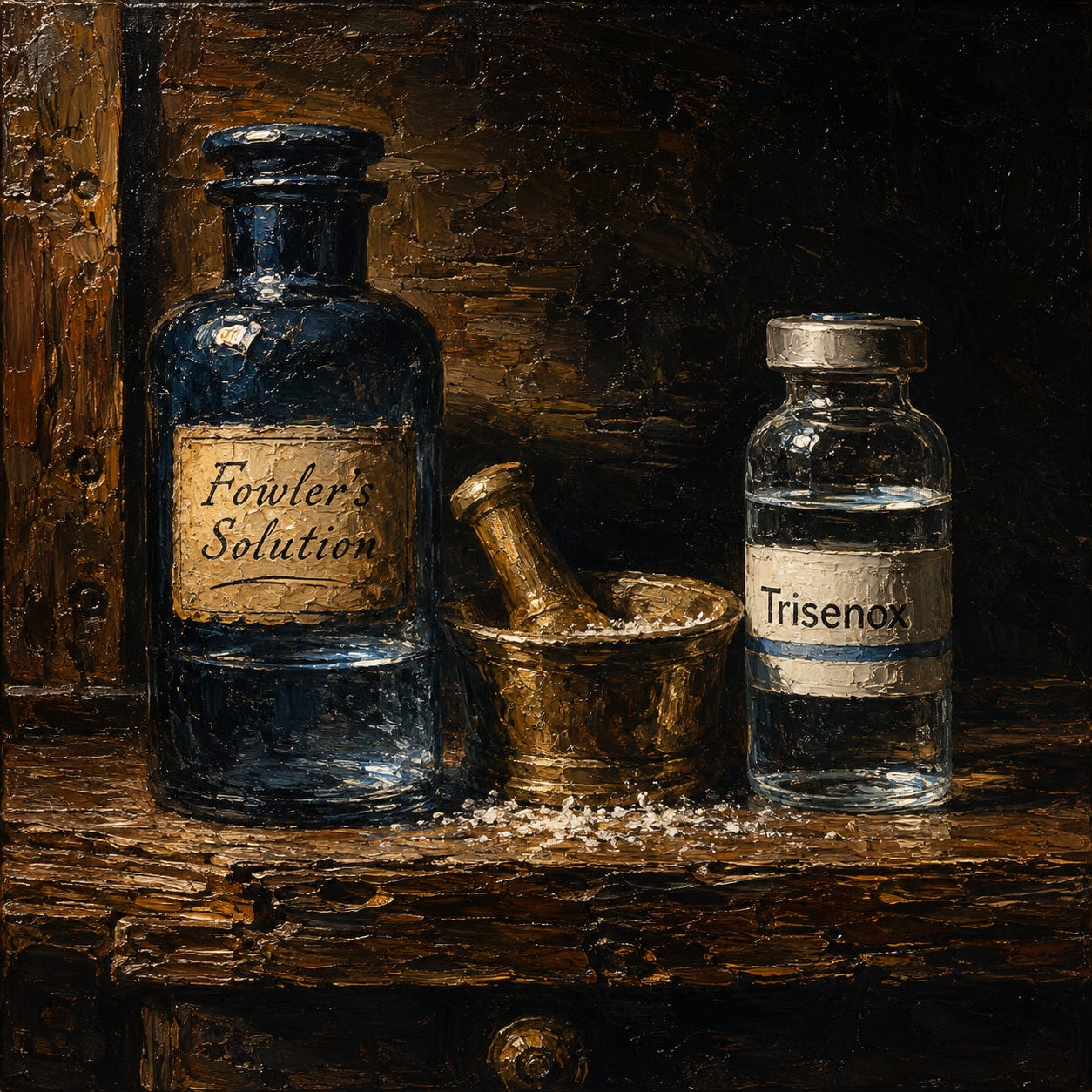
The historical evidence in this essay comes from mainstream medical historians, from Fowler’s own eighteenth-century case reports, and from current FDA drug approvals. Establishment vocabulary (virus, immune system, chickenpox, leukemia, infection) appears here in quotation, in attribution, and in the titles of official documents. In my analytical voice I use the terrain framework: the body is a self-healing organism; disease arises from toxic exposure, nutritional depletion, electromagnetic burden, and stress; symptoms are the body’s intelligent response to insult; and suppression converts acute conditions into chronic ones. Two centuries of arsenic prescription give the reader enough evidence to judge which framework the record supports.
Trisenox, 2026
On September 25, 2000, the FDA approved arsenic trioxide as a prescription medicine, sold under the brand name Trisenox. It is administered intravenously to patients diagnosed with acute promyelocytic leukemia and appears on the World Health Organization’s Model List of Essential Medicines. The compound is As₂O₃, the same white arsenic that has been famous as a household poison since the Renaissance.
The prescription is not new. It was first written in 1783 by Thomas Fowler of the Staffordshire Infirmary. Everything between then and now is history that medicine prefers to describe in the past tense.
The past tense is inaccurate. What Fowler prescribed in 1783 for what he called ague is what a modern oncologist prescribes today for what she calls leukemia. The condition names have changed. The active ingredient has not. What changed in 2000 was the packaging, not the substance. The compound in the vial is the same compound Fowler diluted from a chunk of white arsenic in a Staffordshire apothecary.
Reading the two-hundred-and-forty-three-year record of that compound in medicine reveals something the establishment has never openly acknowledged. The drug is doing what arsenic does to a body. That looks, in the short term, like curing certain diseases, for the same reason arsenic looks like it is curing every disease it is prescribed for. It is not curing anything. It is producing effects the body registers as damage. Some of those effects overlap with the symptoms medicine was calling disease. The overlap gets read as improvement.
The history is worth tracing carefully, because most of what educated readers think they know about the history of medicine is the story of poisoning framed as progress.
This work stays free because paid subscribers make it possible. They get the full book library, the Deep Dive Audio Library, and the Questions for Your Doctor, Before You Consent, and Package Insert series. No grants, no gatekeepers — your subscription is what keeps it that way.
Staffordshire, 1783
Ague was the eighteenth-century word for malaria.¹ Fowler was Physician to the General Infirmary of the County of Stafford, and he encountered ague constantly. The established remedy was cinchona bark, from which quinine would later be extracted. Cinchona worked for some patients and failed for others.
By the early 1780s, a patent medicine called the Ague Drops was in use in the county, marketed by a layman with no medical training. Some patients did well on it. The medical profession regarded such nostrums with disdain, since they were peddled by empirics who worked by trial and error rather than by proper theory. Fowler tried the Ague Drops in the Staffordshire Infirmary and found they were effective.²
In the autumn of 1783, the Infirmary’s apothecary told Fowler he suspected the Ague Drops contained arsenic. Fowler prepared his own solution of white arsenic dissolved in a potassium salt, compared it to the Drops, and found the two performed similarly. He diluted his preparation to roughly the same strength as the patent medicine and began prescribing it to ague patients.
He did not tell the patients they were being given arsenic. Fowler explained in his subsequent 1786 book that he wished to avoid the “disagreeable Association of Ideas” that arsenic carried, since the compound was already famous as the poison of choice for household murder. He named his preparation “the Mineral Solution,” rendered in Latin as Solutio Mineralis. Only after the drug was accepted into the London Pharmacopoeia was it renamed liquor arsenicalis, a more honest term that acknowledged the active ingredient. The name that eventually stuck was Fowler’s Solution.³
His book reported treating 247 patients with ague. He counted 242 of them as cured. Fowler’s case records contain methodological problems he never addressed. Patients who improved after being switched to cinchona following his solution were counted as cures, on the theory that his preparation had prepared the body for the bark. Patients who felt no better and stopped attending the Infirmary were excluded from his statistics on the grounds that their failure to return constituted a failure of character rather than a failure of medicine. He noted that some patients experienced violent vomiting, painful griping, and purging for hours after their doses, and that in another case a patient’s face and eyes swelled so badly she could not see clearly until noon. He acknowledged these effects and continued prescribing.
Fowler estimated that two-thirds of his patients suffered undesirable reactions to his solution.⁴ In the terrain framework, that figure has a clean interpretation. The reactions were the body doing what a body does when it is poisoned. The vomiting was elimination through the stomach. Purging cleared the intestine. Swelling delivered fluid to damaged tissue. Skin changes and eruptions were secondary elimination through the largest organ available for the purpose. Fowler read them as side effects of a medicine. They were the medicine acting on the patient.
The fevers called malaria have a natural course. The attacks typically subside within two to four weeks. Relapse is common, but it may not occur for months. A physician giving an active toxic compound to a patient in the natural remission phase of a cyclical illness has an excellent chance of appearing to cure the condition.
Fowler’s book concluded that his reputation would soon be established on so firm a basis as to render his solution highly useful to future generations. He was correct about the reputation. The usefulness went in the opposite direction from what he predicted.
The Multipotent Drug
In 1809, twenty-six years after Fowler mixed his first batch, the London Pharmacopoeia accepted his solution into the official register of professionally approved remedies.⁵ Even physicians who had been skeptical fell into line. A commentator that year called it almost as certain a medicine as any in the entire materia medica.
The expansion followed a specific logic. Once Fowler’s Solution had been recognized as useful in one ailment, it was tried against others. Once it had been tried against others, it was determined to be effective against them as well. Within decades an American doctor was calling it one of medicine’s “therapeutic mules,” the kind of drug that performed the hardest kind of work under the most adverse conditions with the least amount of exertion. It acquired the nickname “the multipotent drug.”⁶
The list of conditions Fowler’s Solution was prescribed for over the next century runs approximately as follows: malaria, asthma, chorea, epilepsy, psoriasis, eczema, acne, hives, ringworm, diphtheria, worms, anemia, heart palpitations, rheumatism, tuberculosis, typhus, syphilis, uterine disorders, menstrual irregularities, morning sickness, diabetes, rickets, rabies, Hodgkin’s disease, hallucinations, lymphoma, snake bite, and the depression that accompanied suicidal ideation. It was recommended as a prophylactic against scarlet fever, diphtheria, and influenza. Some physicians proposed it as a general tonic to be administered before surgery. One physician began using it as an aphrodisiac after noticing that flies he was poisoning with it displayed unusual sexual excitement before dying.⁷ By the 1880s a prominent physician wrote that if he were forced by law to confine himself to two medicines, arsenic would be one and opium would be the other.⁸
A drug that appears to cure fifty unrelated conditions does not cure any of them. It is doing one thing that gets read as improvement across many different presentations. The one thing arsenic does, in the doses Fowler prescribed, is suppress the body’s efforts to eliminate what has damaged it. Fever falls. Skin eruptions clear. Coughs quiet. Muscular spasms subside. Patients report feeling different, and some report feeling better, and the physician records the improvement as a cure.
Herbert Shelton, writing in the twentieth century, formalized what the pattern was doing.⁹ The body responds to insult with symptoms designed to expel toxic material or repair damaged tissue. When those symptoms are chemically suppressed, the material remains in the body, and the drug that suppressed the symptoms adds its own toxic burden to what was already present. Acute events become chronic ones. The chronic ones eventually get names of their own and are treated as new diseases.
The arc of Fowler’s Solution across the nineteenth century tracks this mechanism with unusual clarity, because the drug was so widely used and so widely written about that the record survives.
How the Disease Got Its Name
Arsenic reliably produces skin eruptions. Fowler himself documented the swollen faces and skin changes in his early patients. The mechanism is straightforward within the terrain framework. Arsenic burdens the liver and kidneys, which are the body’s primary organs of elimination. Once inside a cell, it generates reactive oxygen species that damage proteins and lipids and produce a stream of acidic metabolic waste. Methylation, the biochemical pathway through which the body would normally detoxify arsenic, is disrupted by the same exposure. As the primary emunctories become overwhelmed, the body recruits the skin as a backup route. Toxic material is pushed outward through sweat glands and hair follicles and produces the eruptions the physician sees.¹⁰
On September 14, 1946, the British dermatologist F. Parkes Weber published a paper in The Lancet titled “Arsenical Chicken-Pox.”¹¹ He had observed that patients taking arsenic-containing medications developed skin eruptions that were clinically indistinguishable from chickenpox. He was baffled. He noted that it seemed incredible that a common “infectious disease” could be produced by a drug, but he had seen it happen repeatedly. His resolution was to treat the arsenic-associated eruption as somehow mimicking the “real” viral chickenpox, without pursuing the more direct interpretation: in patients receiving arsenic, what medicine was calling chickenpox and what medicine was calling a drug reaction could not be told apart. Weber did not settle what share of the total chickenpox category was iatrogenic. What he established was that a common named disease and a documented drug reaction were not, on clinical grounds, separable.
Weber’s paper is the kind of document that ought to have prompted an investigation. Instead it entered the medical literature as a curiosity. Within a decade, Thomas Weller and colleagues claimed to have “isolated” a chickenpox virus by adding fluid from patient lesions to cultured cells and observing cellular breakdown. The alleged isolation, examined against ordinary scientific standards, does not meet them. No purified viral particle was obtained. No control experiments were run using the same culture conditions without patient material. The cellular breakdown was attributed to a virus rather than to the starvation and antibiotic poisoning of the cells in culture.¹²
The two events, Weber’s paper and Weller’s cell culture work, sit next to each other in the medical archive. The pattern their conjunction describes is straightforward. Doctors were producing skin eruptions in their patients by prescribing arsenic. The eruptions got named. Once the name existed and was attached to a distinct disease category, the eruptions produced by non-medicinal causes could be swept into the same category, as could the eruptions produced by drugs. When what medicine calls virology became the dominant explanatory framework, a virus was assembled from cell culture debris and declared the cause of the category. The arsenic origin was written out of the story. The disease became something that happened to children in an inevitable-seeming way, associated with a viral particle no one had ever purified from a sick person’s fluid and put into a healthy one.
What medicine calls chickenpox today is a name for a cluster of skin eruptions with multiple possible provocations. Arsenic was one of the provocations Fowler and his successors added to the environment. The reader who wants to check this reasoning is invited to search PubMed for controlled studies purifying what medicine calls the varicella-zoster virus from human vesicle fluid without cell culture. The studies do not exist. What exists are inferences from cell culture reactions and PCR sequences assembled from fragments.
The chickenpox case is instructive because the paper trail is short and the mechanism is legible. The same reasoning applies with less clarity to other conditions arsenic was prescribed for and appeared to affect. In each case, the drug produced or suppressed some visible feature of a symptom cluster the physician had already named. The name persisted. The drug’s role in producing what the name described dropped out of the record.
Milk-and-Roses
The mechanism that explains the medical use also explains what happened outside the doctor’s office.
In the middle of the nineteenth century, arsenic in small doses became popular as a cosmetic. It dilated the capillaries of the face and produced what contemporary sources called a milk-and-roses complexion. Women in Britain and then in America began taking Fowler’s Solution and other arsenic preparations for beauty. Patent medicines were manufactured for the purpose, marketed under names like Dr. Simms’ Arsenic Complexion Wafers and Dr. Campbell’s Arsenic Complexion Wafers, which promised skin of “unrivalled purity of texture, free from any spot or blemish whatever.”¹³ In 1869 a New York physician noted that arsenic accounted for “nearly all the brilliant complexions seen among the females of New York.”
The women were taking Fowler’s Solution voluntarily, without a diagnosis of any disease, and they were experiencing the same effect on their skin that Fowler’s ague patients experienced. Some developed rashes. Others experienced acute poisoning severe enough to kill them. Ambrose Bierce, in the Devil’s Dictionary, defined arsenic as “a kind of cosmetic greatly affected by the ladies, whom it greatly affects in turn.”
The cosmetic parallel removes the confounder of underlying disease. These women were not sick when they started taking arsenic. What arsenic did to their skin was not related to any pre-existing pathology. It was what arsenic does to a body. The same effect, in the same organ, showed up in the medical patients and the cosmetic ones. In the medical patients, the effect was framed as a treatment response. In the cosmetic patients, when it turned lethal, it was framed as vanity’s price. The physiology underneath was identical.
From Cure to Cancer
Fowler’s Solution was administered for psoriasis throughout the nineteenth century and continued to be so administered into the twentieth. It reduced the visible skin plaques. As late as the 1950s, dermatologists had to be scolded in the medical literature for the habit of resorting to Fowler’s Solution whenever, as one commentator put it, “one is at one’s wit’s end in a resistant skin case.”¹⁴
What ended the practice was cancer. In 1947, the Arsenic Committee of the Medical Research Council published Oscar Neubauer’s review of 143 documented cases of arsenical epithelioma — skin cancer caused by medicinal arsenic. The review included a distinct clinical category the profession by then recognized: “Arsenical Epithelioma Arising in a Patch of Psoriasis.” The pattern was familiar enough by 1947 that Neubauer could catalog it as a subtype.¹⁵ Twenty-one years later, Regelson and colleagues published a case in the journal Cancer. Their patient had taken Fowler’s Solution for psoriasis for seventeen years. Seven years after the drug was discontinued, he developed hemangioendothelial sarcoma of the liver. The paper’s conclusion was unambiguous: “Fowler’s solution is a carcinogen.” Their review of the prior literature indicated that liver sarcoma was not an uncommon manifestation of chronic arsenic exposure.¹⁶
The same objection had been raised at the same time against Gay’s Solution, a Mississippi practitioner’s Fowler’s Solution derivative that had briefly displaced steroids as the treatment of choice for difficult asthma cases. Gay’s Solution too was withdrawn once the skin cancer link became clear.¹⁷
The sequence the record captures is the sequence Constantine Hering described in the nineteenth century and Richard Pitcairn documented across fifty years of veterinary practice: suppress a surface eruption, and the underlying disorder relocates to a deeper organ.¹⁸ The skin was the outermost route the body had for handling whatever burden had produced the psoriasis. When arsenic was applied to close the route, the elimination effort did not stop. It moved. The material was retained, the tissue was damaged, and the eventual expression appeared as a malignancy — in the skin exposed to the compound, and eventually in the liver that had been metabolizing it.
The cancer was framed as a side effect of the drug. The psoriasis had been framed as a condition medicine labeled autoimmune, cause unknown. Neither framing describes what the record actually shows. What the record shows is a body burdened enough to push material out through the skin, a drug applied to prevent it from doing so, and a subsequent presentation in the same tissue that finally succeeded in registering as pathology no one could keep suppressing. The three events were one process at three stages.
The Veterinary Proof
The obvious objection to this reading is that patients age, take other medications, encounter new toxic exposures, and generally accumulate diseases in ways that make it hard to attribute a later cancer to an earlier treatment. Confounders proliferate. Any single case is deniable.
Richard Pitcairn spent fifty years as a veterinarian, and he documented the pattern in animals whose lives are short enough and controlled enough to remove most of those confounders. A dog presents with a skin problem. Cortisone is prescribed. The skin clears. Weeks or months later, the same dog develops calcification of the spine, or pancreatitis, or joint breakdown. A cat presents with an inflamed bladder. The bladder symptoms subside under treatment. Later, the cat presents with kidney failure, diabetes, or hyperthyroidism.¹⁹
Pitcairn watched this sequence repeat itself thousands of times across a working lifetime. The dog is not aging into unrelated conditions. The cat is not developing new diseases from lifestyle choices. The animal presented with an acute event, the event was chemically suppressed, and the disorder appeared subsequently in a deeper organ system. Repeat across a career and the pattern is not deniable.
The veterinary evidence matters because the objection about human confounders cannot be raised against it. The animals are indoor, the exposures are limited, the diet is controlled, and the timeline is compressed. The pattern that shows up cleanly in a Cocker Spaniel over eighteen months is the same pattern that plays out over eighteen years in a human being taking a chemical class descended in a straight line from what Fowler mixed in Staffordshire.
Salvarsan and the Rebranding
Fowler’s Solution began to fall out of general medical use around the beginning of the twentieth century, as other pharmaceutical products displaced it. This is described in the histories as the triumph of scientific medicine over the crude remedies of an earlier era. The description is misleading. What replaced Fowler’s Solution in many of its indications was another arsenic compound.
In 1910, Paul Ehrlich announced compound 606, later marketed under the name Salvarsan, an organoarsenic drug he described as the first “magic bullet” for syphilis.²⁰ The compound was made by attaching arsenic to a benzene ring. It was injected. It caused rashes, liver damage, and what contemporary critics called “risks of life and limb.” In what became known as the Salvarsan Wars, physicians accused Ehrlich of profiting from a drug he knew to be dangerous. Some claimed the Frankfurt Hospital had forced prostitutes to undergo the treatments against their will.
Salvarsan was replaced within a few years by Neosalvarsan, a slightly modified derivative marketed as less toxic and more water-soluble. The word less is doing work in that sentence. Neosalvarsan was still an arsenical injected into human bodies, and it still caused the profile of damage arsenic causes.
The disease it was aimed at, syphilis, was itself a condition whose diagnostic criteria and clinical presentation had been shifting for centuries. The earliest historical descriptions of syphilis, from the sixteenth century, describe symptoms that overlap substantially with mercury poisoning, since mercury had been the standard treatment since before the disease had its modern name.²¹ A patient presenting for treatment received mercury. Mercury caused new symptoms. The new symptoms were attributed to disease progression. More mercury was prescribed. When Salvarsan replaced mercury, the same iatrogenic loop continued with a different heavy metal.
The mercury-to-arsenic transition around 1910 was framed as scientific advance. In terms of what was being done to patients, it was one poison replaced by another. The disease continued to exist as a diagnostic label because the treatments continued to produce symptoms that could be called disease progression. The 1940s introduction of penicillin ended the arsenic era for syphilis specifically. It did not end the arsenic era for medicine.
Trisenox, Continued
Fowler’s Solution disappeared from the British Pharmacopoeia after the 1952 edition and from the American Pharmacopoeia five years earlier.²² Establishment histories describe this as the end of arsenic medicine, the point at which modern pharmacology finally moved on from a discredited remedy.
The claim is not true. What actually happened is that arsenic left the pharmacy under one name and returned under another. And in the specific case of leukemia, it never left at all.
The leukemia use is the crucial historical bridge. In 1865, Heinrich Lissauer reported that Fowler’s Solution produced “marked symptomatic relief” in patients with what would later be called chronic myelogenous leukemia. Cutler and Bradford quantified the effect in 1878, publishing in the American Journal of the Medical Sciences the observation that Fowler’s Solution reduced white blood cell counts. Naegeli recommended arsenical compounds for leukemia in 1930. Forkner and Scott re-established Fowler’s Solution as an efficacious treatment for chronic myeloid leukemia in a 1931 paper in JAMA, documenting reductions in leukocytes, arrested anemia, and reduced enlargement of the spleen and lymph nodes. Stephens and Lawrence confirmed the observations in Annals of Internal Medicine in 1936. Queen Mary Hospital in Hong Kong continued producing oral Fowler’s Solution as an anti-leukemic agent until the mid-1950s, when alkylating chemotherapy and radiotherapy displaced it. The compound was in occasional use for CML into the 1960s.²³ Chinese medicine had used arsenical preparations for centuries and continued using them throughout.
Beginning in 1973, Chinese researchers at Harbin Medical University administered intravenous arsenic trioxide to patients with acute promyelocytic leukemia — a different leukemia subtype from the one Fowler’s Solution had historically been used for. Their published results in the mid-1990s brought the compound to Western attention. In 2000, the FDA approved arsenic trioxide under the brand name Trisenox for the treatment of acute promyelocytic leukemia in patients who had relapsed on other therapy.²⁴
The drug is administered intravenously. It is now recommended as a component of first-line therapy for the condition. The mechanism claim is that it induces differentiation and apoptosis in leukemic promyelocytes. Translated from mechanism-speak, the claim is that it kills the cells medicine has decided are the problem. The documented side effects include cardiotoxicity, peripheral neuropathy, liver damage, hyperglycemia, and severe oxidative stress. The FDA label includes a black-box warning for a condition called differentiation syndrome, which can present with fever, breathing difficulty, weight gain, fluid in the lungs, and fluid around the heart, and which can be fatal without prompt recognition and treatment.²⁵
Every one of these effects is what arsenic does to a body. Fowler’s patients showed the same profile in miniature. The two-thirds of his patients who suffered undesirable reactions, the swollen faces, the violent vomiting, the fluid mobilizations, the skin manifestations, are the same body responses that a Trisenox patient in 2026 will experience at higher doses through an IV line.
The framing has changed. The compound has not. Its regulators call it an essential medicine, and its manufacturer sells it as a targeted therapy. What is in the vial is white arsenic.
Between the vial Fowler mixed in 1783 and the vial Teva Pharmaceuticals distributes in 2026, the essential act is unchanged. A trained professional in a white coat administers a compound of arsenic to a patient who is ill. The patient experiences the effects arsenic produces. Some of those effects are read as improvement, some as side effects. Some are severe enough to kill the patient, at which point the death is attributed to the disease rather than to what was given for it.
The Survival Numbers
The Trisenox story medicine tells is a strong one, and any honest treatment of the record has to face it directly.
Before effective chemotherapy, acute promyelocytic leukemia killed most patients within weeks. Median survival was on the order of three and a half weeks. The introduction of anthracyclines in the 1970s brought complete remission rates to between 65 and 80 percent and long-term survival to between 15 and 25 percent. Five-year relative survival was 18 percent in patients diagnosed between 1975 and 1990. The introduction of what the establishment calls all-trans retinoic acid — a metabolite of retinol — in the mid-1980s raised that figure to 52 percent for patients diagnosed between 1991 and 1999. The addition of arsenic trioxide brought complete remission rates to around 90 percent and cure rates to around 80 percent in low-risk patients. Five-year relative survival for patients diagnosed after 2000 reached 64 percent, and more recent studies report figures above 85 percent. The condition is now described in the medical literature as the most curable subtype of acute myeloid leukemia in adults.²⁶
These numbers are real. The pre-treatment mortality was catastrophic. A terrain reading does not begin by denying that patients who would once have died within weeks now live longer. It begins by asking what has been established and what has been assumed.
The treatment is a combination. What medicine calls ATRA plus arsenic trioxide. In low-risk patients, conventional chemotherapy can now be omitted, but ATRA cannot. No published trial has compared ATRA alone against ATRA plus arsenic. The trials that established Trisenox’s reputation compared ATRA plus arsenic against ATRA plus conventional chemotherapy. Both regimens contained the retinoic acid component. What share of the improved survival is attributable to the arsenic in particular, and what share to the retinoic acid, is a question the trial designs did not set up to answer.
The retinoic acid component sits closer to the terrain framework than to the poisoning framework. What is called all-trans retinoic acid is a metabolite of retinol — the compound the vitamin industry sells under the name vitamin A, present in whole-food form in liver, egg yolks, and organ meats. Its mechanism, as the establishment itself describes it, is to promote the maturation of the abnormal cells into normal neutrophils. This is closer to nutritional restoration than to chemical warfare. The arsenic sits atop a treatment whose non-arsenic component may be doing much of what the arsenic is credited with.
The diagnostic category has co-evolved with the treatment. Acute promyelocytic leukemia is now defined molecularly by detection of what mainstream genetics calls the PML::RARA fusion gene, through PCR. Patients receive the diagnosis today who would not have been distinguished from other leukemias in 1970. The population being cured today is not the same population that was dying in the 1970s. Whether the diagnostic shift accounts for some, most, or little of the improved apparent survival is a question the epidemiology does not directly address, because the diagnostic definition changed alongside the treatment.
The compound was here before. Fowler’s Solution was used for leukemia in Western medicine for more than a century, phased out in the 1950s not because it failed to reduce white blood cell counts but because chemotherapy and radiotherapy came along and because the internal cancers documented by Regelson and others made the compound uncomfortable to defend. The mid-century abandonment and the 1990s return demonstrate a specific and uncomfortable fact: arsenic produces measurable effects on blood cells that medicine has, at different times, called toxicity and called cure.
None of these observations negates the survival gain. What they establish is that the story medicine tells — that a poison discovered in the 1990s is what allowed the disease to be cured — leaves out the retinoic acid component and the two-hundred-year record of what arsenic does to a body over time. It also treats a molecularly defined patient population as if it were the same population that was dying before molecular diagnosis existed. The five-year survival window that anchors Trisenox’s reputation does not extend far enough into the future to answer the question Fowler’s psoriasis patients ended up answering, thirty and forty years after their treatments: what does the body do with a poison it did not need?
Reading the Record
The reader who has followed the argument to this point has a choice about how to hold what the record shows.
One option is to treat Fowler’s Solution as a historical curiosity, an example of how medicine used to be primitive before it became scientific. This reading requires ignoring the 1952 boundary, since the compound never actually left medicine. It also requires setting aside the F. Parkes Weber paper on arsenical chickenpox, since the paper implies that a common disease was, at least in the population being treated with arsenic, difficult to distinguish from the medicine used to treat it. Behind both those revisions sits a larger commitment: that the cellular abnormalities called leukemia are caused by something the arsenic prescribed for them addresses, rather than by the terrain in which they arise, which the arsenic makes worse.
The other option is to accept that the record documents something medicine has been reluctant to see. For two centuries and counting, a class of chemical compounds known to be poisons has been administered to sick people, and the effects of the poisoning have been read as evidence that the compounds treat the diseases the patients came in with. The eruptions arsenic produces on the skin get called disease. The compounds get prescribed for the disease. The compounds produce more eruptions. The category expands to include them. When a viral etiology becomes fashionable, a virus is inferred from cell culture debris and the toxic origin is written out. The pattern operates in real time in the current chemotherapy literature.
Every generation of doctors looks back at the previous generation’s medicines and shakes its head at the primitive violence of their treatments. They dismiss bloodletting, mercury, calomel, and the arsenical era as embarrassments the profession has grown out of. They then prescribe the direct descendants of those treatments to their patients, under new names, and repeat the confidence.
Fowler was not a fool. He was a competent, careful physician working within the framework he had. He watched his patients react violently to what he prescribed and continued prescribing, because the framework told him the reactions were the medicine working and the patients who died were victims of the disease he had been unable to defeat in time. The framework absorbed all outcomes.
The framework of 2026 absorbs all outcomes the same way. A Trisenox patient who survives is a success of chemotherapy; a patient who dies, dies of leukemia. Secondary cancers appearing years after treatment are attributed to bad luck or to the underlying disease itself. The compound in the vial, and its capacity to damage tissue in every organ it reaches, remains outside the frame.
The historical record of Fowler’s Solution is a template as much as it is a story about arsenic. The template is that medicine’s confident treatments frequently produce the symptoms medicine calls disease, and medicine’s diagnostic categories frequently absorb the damage its treatments have done. The template applies with equal force to psychiatric medications, which reliably produce the anxiety and depressive presentations they were prescribed for. Statin patients develop the muscle-wasting syndromes catalogued in their own drug labels. The gut conditions that follow courses of antibiotics and antifungals are documented, common, and treated as new diagnoses rather than as consequences. Biologics injected for what medicine calls autoimmune conditions produce the cancers listed on the black-box warnings of the products themselves.
Once the template is visible, most of what an educated reader thinks she knows about disease history begins to look different. What she was told was the discovery of successive causes and successive cures was, in a substantial fraction of the record, the discovery of successive ways to poison patients and successive ways to name the results. The names came from the treatments. The treatments produced the names. The two centuries of Fowler’s Solution and its descendants make the sequence legible.
The compound is still on the shelf. It has a new label.
How To Explain It To A 6 Year Old
A long time ago, a doctor named Thomas Fowler mixed up a medicine and started giving it to sick people. The medicine was made of arsenic, which is a poison, but Fowler did not tell his patients that, because he did not want to worry them.
The medicine made some patients feel a little better for a while. It also made most of them throw up, and made their faces swell up, and made rashes come out on their skin.
Fowler thought the medicine was working. He thought the throwing up and the swelling and the rashes were just what medicine sometimes does to you before you get better. But that is not what was happening. What was happening was that the patients’ bodies were trying to push the poison out. Throwing up pushes poison out through the mouth. Rashes push poison out through the skin. The bodies were doing exactly what bodies do when they are poisoned.
Other doctors started using Fowler’s medicine too. They gave it for lots of different sicknesses. Every time the medicine made a rash come out on a patient’s skin, other doctors gave that rash a name and called it a disease. And then they gave the patients more of Fowler’s medicine to treat the disease. And that made more rashes.
Years later, some scientists said they had found a tiny germ that they said was making the rashes. But they had not really found the germ. They had just decided that a germ must be the cause. And once everybody believed in the germ, nobody talked about the arsenic anymore.
The arsenic is still around. The doctors still use it. They just call it by a different name and put it in a different bottle. The doctors think they are treating a different disease now. But the medicine is the same. And what it does to bodies is still the same.
The rule is simple. When a medicine makes you feel worse, that is your body telling you something. Bodies are not fools. Bodies know what to do when they are poisoned. The job of a good doctor is to figure out what is poisoning the patient and take that thing away, and then let the body do what it knows how to do.
Fowler was not a bad man. He just believed the wrong story about what medicine was doing. The story was so strong that he did not see the truth even when it was throwing up all over his infirmary floor.
A Note on Medical Advice
This essay is a work of historical investigation and analysis. Nothing here is medical advice, and nothing here should be read as a recommendation to accept, refuse, discontinue, or modify any treatment. Readers facing decisions about their own care, or the care of family members, should make those decisions in consultation with clinicians they trust. My purpose is to make the historical record accessible so that readers can bring what they learn to those conversations with the fullest possible view of the ground.
In Print
Ten of my books are now available as paperbacks, printed to order through Lulu and shipped worldwide. The Unvaccinated lays out the completely unvaccinated as a comparison group across twenty chapters and five appendices — as far as I know, the only book of its kind. Medicalized Motherhood follows a woman through 123 documented interventions from teenage pill to postpartum discharge. Drilling for Profit argues that cavities, gum disease, and crooked teeth are a dietary problem the dental profession treats surgically. What Your Vet Can’t Tell You applies the same critique to pets — food, vaccines, and a profession trained by the industries whose products cause the harm. Escape from Psychiatry documents the fabrication of the DSM, the collapse of the serotonin hypothesis, and the specific damage done by every major psychiatric drug class.
Three take on the remedies and paradigm questions mainstream medicine actively suppresses. The DMSO Book covers 100,000 studies, zero deaths, and one approval — the suppressed science of medicine’s most versatile compound. Chlorine Dioxide: The Forbidden Remedy collects the interviews, protocols, and evidence from the doctors and researchers they tried to silence. No Contagion, co-authored with Jamie Andrews, catalogues 258 failed contagion experiments and the case against germ theory itself — the paradigm question underneath the whole shelf.
Two more take on the remedies already in your kitchen. Baking Soda locates sodium bicarbonate inside the terrain framework industrial medicine buried — the compound already in your cupboard, and what it does at the level of the blood, kidneys, lungs, digestion, and skin. The Castor Oil Book recovers four thousand years of documented practice on the medicine mainstream healthcare quietly stopped talking about — the kitchen bottle that doesn’t sit well in a system built on prescriptions and procedures.
A physical book reaches the person a Substack post never will — the sceptical relative, the friend who won’t click a link but might open a book, the visitor whose eye lands on a coffee table. The full shelf is at lulu.com/spotlight/unbekoming. Buy one to keep, and one to give away.
References
James C. Whorton, The Arsenic Century: How Victorian Britain Was Poisoned at Home, Work, and Play (Oxford University Press, 2010), chapter on Physician-Assisted Poisoning, on ague as the eighteenth-century word for malaria and Fowler’s context at the Staffordshire General Infirmary.
Whorton, The Arsenic Century, on the Ague Drops patent medicine and Fowler’s adoption of it in Infirmary practice.
Thomas Fowler, Medical Reports of the Effects of Arsenic in the Cure of Agues, Remitting Fevers, and Periodic Headaches (London, 1786), on the composition, naming, and initial deployment of the Mineral Solution / Solutio Mineralis / liquor arsenicalis. Cited extensively in Whorton.
Whorton, The Arsenic Century, on Fowler’s estimate that two-thirds of his patients suffered undesirable effects, drawn from his own case reports.
Whorton, The Arsenic Century, on the 1809 acceptance of liquor arsenicalis into the London Pharmacopoeia.
Whorton, The Arsenic Century, on the “therapeutic mule” characterization and the “multipotent drug” nickname, citing nineteenth-century medical commentary.
Whorton, The Arsenic Century, catalog of conditions Fowler’s Solution was prescribed for, drawn from nineteenth-century medical journals and textbooks.
Whorton, The Arsenic Century, on the 1880s physician who ranked arsenic and opium as the two essential drugs of the materia medica.
Herbert M. Shelton, “Enervation and Toxemia,” Hygienic Review, Vol. XXV, August 1964, on the acute-to-chronic mechanism of suppression. Discussed at length in Dawn Lester and David Parker, What Really Makes You Ill? Why Everything You Thought You Knew About Disease Is Wrong (2019).
Unbekoming, “Chickenpox, Arsenic, and the Great Viral Lie,” on arsenic’s mechanism of generating reactive oxygen species, impairing methylation, burdening the liver and kidneys, and pushing waste through the skin. Underlying biochemistry documented in the arsenic toxicology literature.
F. Parkes Weber, “Arsenical Chicken-Pox,” The Lancet, September 14, 1946, Volume 248, page 402. DOI: 10.1016/S0140-6736(46)90925-7.
Thomas H. Weller, cell culture work on what was identified as varicella-zoster virus, mid-1950s. Methodological critique in Mark Bailey, A Farewell to Virology (2022) and Daniel Roytas, Can You Catch a Cold? Untold History and Human Experiments (2023).
Whorton, The Arsenic Century, on the cosmetic use of arsenic for the “milk-and-roses” complexion, including Dr. Simms’ and Dr. Campbell’s Arsenic Complexion Wafers and the 1869 New York physician’s observation.
Whorton, The Arsenic Century, on the persistence of Fowler’s Solution for psoriasis into the 1950s, including the medical scolding of dermatologists for continuing to use it in resistant skin cases.
Oscar Neubauer, “Arsenical Cancer: A Review,” British Journal of Cancer, Vol. 1, No. 2 (June 1947), pp. 192–251. Published for the Arsenic Committee of the Medical Research Council. DOI: 10.1038/bjc.1947.22. Includes the specific clinical section “Arsenical Epithelioma Arising in a Patch of Psoriasis.”
W. Regelson, U. Kim, J. Ospina, and J. F. Holland, “Hemangioendothelial sarcoma of liver from chronic arsenic intoxication by Fowler’s solution,” Cancer, Vol. 21, No. 3 (March 1968), pp. 514–522. DOI: 10.1002/1097-0142(196803)21:3<514::AID-CNCR2820210323>3.0.CO;2-Z.
Whorton, The Arsenic Century, on Gay’s Solution as a 1950s revival of Fowler’s Solution for asthma, and on the skin cancer objection that ended both applications.
Constantine Hering’s directional pattern of cure, discussed in Don Hamilton, Homeopathic Care for Cats and Dogs (North Atlantic Books, 2010); documented across a working lifetime in Richard Pitcairn, Dr. Pitcairn’s Complete Guide to Natural Health for Dogs and Cats (Rodale, multiple editions).
Pitcairn, Complete Guide, on the recurrent pattern of surface suppression followed by deeper-organ presentation in dogs and cats.
Unbekoming, “What Is Syphilis?” on Paul Ehrlich’s compound 606 (Salvarsan), the Salvarsan Wars, and the mercury-to-arsenic-to-penicillin transition. Historical detail confirmed in the WHO’s own syphilis treatment guidelines and in standard histories of chemotherapy.
Unbekoming, “What Is Syphilis?” on the historical overlap between mercury poisoning symptoms and syphilis symptoms, and the unfalsifiable treatment loop that resulted.
Whorton, The Arsenic Century, on Fowler’s Solution being withdrawn from the British Pharmacopoeia after the 1952 edition and from the American Pharmacopoeia five years earlier.
Historical primary sources on Fowler’s Solution for chronic myeloid leukemia: Heinrich Lissauer (1865); A. Cutler and E. H. Bradford, “A case of leukaemia,” American Journal of the Medical Sciences (January 1878), pp. 81–84; O. Naegeli (1930); C. A. Forkner and T. F. M. Scott, “Arsenic as a therapeutic agent in chronic myelogenous leukemia: preliminary report,” Journal of the American Medical Association (1931), Vol. 97, iii; D. J. Stephens and J. S. Lawrence, “The therapeutic effect of solution of potassium arsenite in chronic myelogenous leukemia,” Annals of Internal Medicine (1936), Vol. 9, pp. 1488–1502. Continued use at Queen Mary Hospital, Hong Kong through the mid-1950s documented in E. Tse, C. C. Chua, and Y. L. Kwong, “Resurrection of Oral Arsenic Trioxide for Treating Acute Promyelocytic Leukaemia,” Frontiers in Oncology, Vol. 10 (August 2020), Article 1294. DOI: 10.3389/fonc.2020.01294.
FDA approval history for Trisenox (arsenic trioxide), approved September 25, 2000, for relapsed or refractory acute promyelocytic leukemia, subsequently incorporated into first-line therapy protocols. WHO Model List of Essential Medicines, current editions. On the 1973 Harbin initiation of intravenous arsenic trioxide, see Tse et al. (2020), op. cit.
Trisenox (arsenic trioxide) prescribing information, current FDA label, including boxed warning for differentiation syndrome and documented cardiotoxicity, hepatotoxicity, and neurotoxicity.
Historical APL survival data: Zhen Chen et al., “Acute promyelocytic leukemia: A population-based study on incidence and survival in the United States, 1975–2008,” Cancer, Vol. 118, No. 23 (December 2012), pp. 5811–5818. DOI: 10.1002/cncr.27623 (five-year relative survival figures of 0.18 for 1975–1990, 0.52 for 1991–1999, 0.64 for 2000–2008). Cure rate figures around 80–90 percent in low-risk patients: Charles A. Coombs, Todd L. Rosenblat, and Martin S. Tallman, “Acute promyelocytic leukemia: where did we start, where are we now, and the future,” Blood Cancer Journal, Vol. 5 (April 2015), e304. Early historical median survival of approximately three and a half weeks documented in the same reference. Real-world 3-year overall survival of 87.9 percent in Chinese population-based data: Yong Zhang et al., “Early Death and Survival of Patients With Acute Promyelocytic Leukemia in ATRA Plus Arsenic Era,” Frontiers in Oncology (2021).
Additional Sources
James C. Whorton, The Arsenic Century: How Victorian Britain Was Poisoned at Home, Work, and Play (Oxford University Press, 2010). The definitive social and medical history of arsenic in the nineteenth century, including the arc of Fowler’s Solution across the century.
Dawn Lester and David Parker, What Really Makes You Ill? Why Everything You Thought You Knew About Disease Is Wrong (2019). Chapters on arsenic as a “medicinal” agent, on the toxic-terrain interpretation of nineteenth-century disease categories, and on the industrial history of pharmaceutical arsenic.
Thomas Cowan, The Contagion Myth: Why Viruses (including “Coronavirus”) Are Not the Cause of Disease (Skyhorse, 2020). On the terrain interpretation of what medicine calls infectious disease, including the ecological reading of malaria.
Mark Bailey, A Farewell to Virology (2022). Methodological critique of the cell culture procedures underlying viral “isolation” claims, including for varicella-zoster.
Daniel Roytas, Can You Catch a Cold? Untold History and Human Experiments (2023). Documentation of the failed contagion experiments across two centuries.
Richard H. Pitcairn, Dr. Pitcairn’s Complete Guide to Natural Health for Dogs and Cats (Rodale, multiple editions). Fifty years of veterinary observation of the suppression-to-deeper-disease sequence, with the confounders removed by the controlled conditions of animal care.
Herbert M. Shelton, Natural Hygiene: Man’s Pristine Way of Life and collected articles from Hygienic Review. The foundational articulation of the acute-to-chronic mechanism through which pharmaceutical suppression of symptoms drives the progression of disease.
Torsten Engelbrecht, Claus Köhnlein, Samantha Bailey, and others, Virus Mania: Corona, COVID-19, Measles, Swine Flu, Cervical Cancer, Avian Flu, SARS, BSE, Hepatitis C, AIDS, Polio, Spanish Flu (3rd edition, 2021). On the arsenical origins of polio in the early twentieth century (Vulpian, Popow, and the lead-arsenate pesticide sequence in Massachusetts) and the pattern of attributing toxic-etiology conditions to viruses.
Mark Gober, Sam Bailey, Mark Bailey, Stefan Lanka, and others, An End to Upside Down Medicine: Contagion, Viruses, and Vaccines (Waterside, 2023). On the mercury-and-arsenic history of smallpox treatment and on the parallel construction of the chickenpox category.
E. Tse, C. C. Chua, and Y. L. Kwong, “Resurrection of Oral Arsenic Trioxide for Treating Acute Promyelocytic Leukaemia: A Historical Account From Bedside to Bench to Bedside,” Frontiers in Oncology, Vol. 10 (August 2020). The mainstream historical review that documents the CML-to-APL arsenic continuity, including the Hong Kong Queen Mary Hospital records.
Charles A. Coombs, Todd L. Rosenblat, and Martin S. Tallman, “Acute promyelocytic leukemia: where did we start, where are we now, and the future,” Blood Cancer Journal, Vol. 5 (April 2015), e304. The establishment survival narrative in its own words.
"For two centuries and counting, a class of chemical compounds known to be poisons has been administered to sick people..." Gee, it sounds a LOT like vaccines, eh?
Great! Now have an additional chemo drug to treat cancer! Added to the oncologist cook book of approved drugs for administering to the cancer patient. Any potentially life saving drug that is not in the cook book is forbidden to be used. Goes for Ivermectin and all the other drugs that are successfully reversing cancer outside the Big Pharma controlled cancer treatment programs. Dr. Malik is is reporting on the successes as well as others.