

From Huxley to Tolle, from YouTube mystics to Davos keynote speakers, the idea that all religions teach the same thing has become one of the most popular spiritual positions of our time. The pitch is familiar: someone has studied 190 sacred texts from every corner of human civilisation and discovered that they all whisper the same five truths. You are not separate. Fear is illusion. Your mind shapes reality. Ego is the enemy. Everything is connected.
The message is warm. It feels true. It sells millions of books and generates billions of views. It populates TED stages and wellness retreats, corporate mindfulness programmes and Silicon Valley micro-dosing circles. It has become the default spirituality of the professional class — non-denominational, non-threatening, compatible with any lifestyle and every brand. The publishing industry calls it “mind-body-spirit.” The algorithms call it engagement. The Perennial Philosophy, as Aldous Huxley named it in 1945, has become the spiritual common sense of globalised modernity.
It also happens to describe a world perfectly suited to the interests of global capital.
This is not a coincidence.
Explaining It to a Six-Year-Old
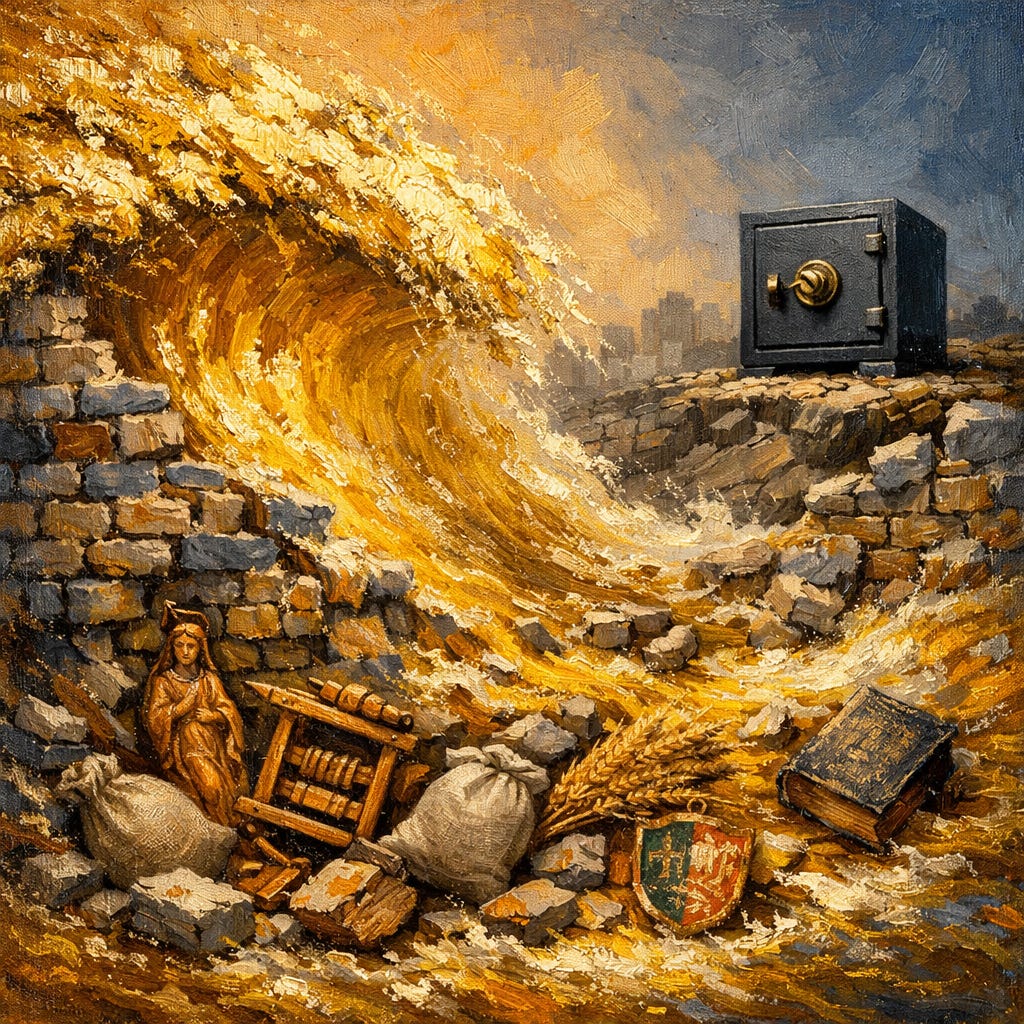
Imagine a rich bully in the playground. He wants two things. First, he wants to go anywhere he likes, take any toy he wants, and play in every sandpit — no fences, no rules, no one telling him “that’s not yours.” That’s freedom. Second, he wants a big locked box where he keeps all the toys he’s already taken, and he wants the teacher to guard it for him. That’s protection.
Now imagine he finds a way to get the other kids to believe that sharing everything is spiritually beautiful, that wanting your own toys is selfish, that fences between sandpits are signs of ignorance, and that the truly enlightened child has no attachments.
The other kids take down their fences. They stop guarding their toys. They feel evolved.
The bully keeps his locked box. He keeps the teacher on his side. He takes what he wants from the open sandpits and calls it progress.
That is the essay.
Support Independent Investigative Journalism and Research
This work remains free because paid subscribers make it possible. If you find value here, consider joining them.
What paid subscribers get: Access to all books I’ve written plus 1-2 new ones per month. e.g.
The DMSO Book
The Kitchen Remedies Guide
Chlorine Dioxide
The PSA Trap
Breast Cancer
Drilling for Profit
What Your Vet Can’t Tell You
Plus: Access to the Deep Dive Audio Library — 180+ in-depth discussions (30-50 min each) exploring the books behind these essays. New discussions regularly added. That’s 100+ hours of content for less than the price of a single audiobook.
[Upgrade to Paid – $5/month or $50/year]
What Capital Actually Wants
Capital wants two things. Only two. Freedom and protection.
Freedom means the removal of friction. Every barrier between capital and its next destination is an obstacle to be dissolved: borders, tariffs, local customs, labour protections, cultural attachments, particular identities, traditional loyalties. Anything that slows the movement of money, goods, or labour is friction, and capital wants it gone.
Protection means the security of what has already been accumulated. Property rights, patent law, contract enforcement, police, military, bailouts, limited liability, central banks as lenders of last resort. The structures that guard existing wealth are non-negotiable.
These two demands appear to contradict each other. Freedom means tearing down walls. Protection means building them. But the contradiction dissolves once you see who the walls are for. Capital wants your walls torn down and its own walls reinforced. The doors open outward for expansion and close inward for security.
Karl Polanyi identified this pattern in 1944. His Great Transformation documented what he called the “double movement” — the simultaneous expansion of markets and the counter-movement to protect society from their effects. For a century, Polanyi wrote, the market expanded continuously while being met by a countermovement checking the expansion in definite directions.¹ The market pushed to commodify everything — labour, land, money — and society pushed back to protect the things that markets destroy.
What made the market system revolutionary, and revolutionary in a destructive sense, was what Polanyi called the “commodity fiction” — the treatment of labour, land, and money as if they were commodities produced for sale, when none of them are. Labour is human life. Land is nature. Money is a social convention. To organise an entire society around the fiction that these are products to be bought and sold is to subordinate human existence to the logic of the market.
And Polanyi’s crucial insight about the politics of all this: the free market was never natural. Laissez-faire was planned. The restrictions that followed were spontaneous. The state created the conditions for market freedom, then society instinctively pushed back to protect itself. The liberal response was to blame the pushback — to treat every act of social self-protection as a conspiracy against progress. Polanyi showed that this liberal narrative was false. The protectionist counter-movement arose without any traceable links between the interests directly affected. People in different countries, facing different circumstances, independently arrived at the same conclusion: the self-regulating market was destroying their world.
The double movement is the freedom/protection dynamic stated in the language of political economy.
Marx saw it too, from a different angle. In 1848, he described the bourgeoisie’s universal solvent: all fixed, fast-frozen relations, with their train of ancient and venerable prejudices and opinions, are swept away. All that is solid melts into air, all that is holy is profaned.² Every fixed relation is friction. Every ancient prejudice is an obstacle. Every local custom is a barrier to the expanding market. Capital gives a cosmopolitan character to production and consumption in every country. National industries are destroyed. Local wants are replaced by wants requiring for their satisfaction the products of distant lands. National one-sidedness becomes impossible. A world market replaces everything particular.
Marx noticed something else: the cheap prices of capital’s commodities are the heavy artillery with which it batters down all Chinese walls. It compels all nations to adopt the bourgeois mode of production. In one word, it creates a world after its own image.
The universalising tendency is not incidental to capitalism. It is capitalism.
The Ladder They Kicked Away
The freedom/protection dynamic becomes visible the moment you look at how wealthy nations actually developed versus what they tell everyone else to do.
Ha-Joon Chang’s Kicking Away the Ladder assembled the evidence. Britain, the supposed champion of free trade, industrialised behind some of the most aggressive protectionist policies in history. The United States, which now preaches open markets to the developing world, was the mother country and bastion of modern protectionism throughout the nineteenth century — the very period in which it rose to industrial dominance.³ Germany, France, Sweden, Japan — virtually every successful industrialiser used infant industry protection, export subsidies, and strategic state intervention to build their economies.
Then, having climbed the ladder, they kicked it away.
Friedrich List spotted this in the 1840s. It is a very common clever device, he wrote, that when anyone has attained the summit of greatness, he kicks away the ladder by which he has climbed up, in order to deprive others of the means of climbing up after him.⁴
Chang’s summary is direct. Are the developed countries recommending policies they find beneficial for themselves rather than for the countries receiving the advice? The answer, unfortunately, is yes.
Protection for me, freedom for you. The pattern has been running for centuries.
Immanuel Wallerstein formalised this in his world-systems analysis. The global economy is divided into core and periphery, linked by what he called “unequal exchange.” Core nations dominate through quasi-monopolised production processes. Peripheral nations supply competitive, low-margin products. The exchange looks voluntary and market-driven. But the structure ensures that surplus value flows steadily from periphery to core. And the concentration of capital in core zones created the fiscal base and political motivation to ensure that peripheral states became or remained relatively weaker.⁵
The periphery is told to open its markets — that’s freedom, imposed downward. The core maintains its monopolies, its intellectual property regimes, its financial institutions — that’s protection, reserved for those at the top. The arrangement is presented in the universal language of “development,” “progress,” and “the international rules-based order.” And as Wallerstein noted, the process is hidden: actual prices always seemed to be negotiated in a world market on the basis of impersonal economic forces. The enormous apparatus of latent force has not had to be invoked in each separate transaction to ensure that the exchange was unequal.
Left Delivers Freedom, Right Delivers Protection
If capital needs both freedom and protection, and the political system is divided into left and right, the question is: who delivers what?
The left delivers freedom. Not economic freedom — that’s the right’s brand — but cultural freedom, which serves the same dissolving function. The dissolution of borders, traditional identity, religious authority, gender norms, family structure, local community. Everything that creates friction for the flow of labour, consumption, and compliance gets dissolved under the banner of liberation and progress.
The right delivers protection. Property rights, military spending, law enforcement, contract enforcement, national security, patent law, corporate legal structures. Everything that secures accumulated wealth and ensures that the rules protect those who already have power.
Capital funds both sides because each side delivers half of what it needs. The culture war that appears to divide them is, from capital’s perspective, a division of labour.
This explains one of the great puzzles of modern politics: why the same corporations fund both progressive cultural causes and conservative economic candidates. Why the same foundations promote both border dissolution and intellectual property enforcement. Why the same institutions champion individual liberation while strengthening institutional control. It is not hypocrisy. It is a perfectly rational strategy for securing both freedom and protection simultaneously.
Sheldon Wolin described the result as “inverted totalitarianism” — a system in which corporate power captures the state not through revolution but through symbiosis. Unlike classical totalitarianism, which mobilised populations, inverted totalitarianism fragments them. It thrives on disaggregation, on a citizenry who are self-reliant, competitive, and equally fearful.⁶ The partnership between corporation and state became ever closer during the Cold War, and corporate economic power became the basis of power on which the state relied, as its own ambitions became more expansive, more global, and more bellicose. The result was an unprecedented combination of powers distinguished by their totalising tendencies — powers whose very nature it is to challenge boundaries continually.
Those totalising tendencies again. The same dissolving force Marx identified in 1848, now operating through the managed political apparatus of a nominal democracy.
Patrick Deneen came at it from the other side. Liberalism, he argued, didn’t fail by betraying its principles. It failed by fulfilling them. Both the left and right versions of liberalism share the same universalist project — they just disagree about the vehicle. Mainstream conservatives advance liberal universalism through the nation, primarily through globalised economic policy and interventionist militarism. Liberals believe the nation-state must be superseded by global governance.⁷ Both are universalist. Both are borderless in their logic.
Deneen identified the deeper pattern: liberalism regards all boundaries as suspect. Not just national borders, but any existing differentiation, distinction, boundary, and delineation — all come under suspicion as arbitrarily limiting individual freedom of choice. Geography, history, nature, family, sex, community — every form gets interrogated for its arbitrariness, and few survive the interrogation.
Capital’s freedom demand, dressed in the language of human rights.
Universalism as Imperial Technology
The spiritual version of this project is the deepest and most effective layer.
Every major seafaring mercantile empire develops a universalist ideology. This is so predictable it approaches a law. The Phoenicians spread syncretic religious ideas across the Mediterranean. Rome adopted a universal religion and universal citizenship as it needed to govern diverse peoples across vast distances. The British Empire developed liberal universalism — free trade, universal rights, the “civilising mission.” The American empire followed with democratic universalism and global institutions.
The reason is structural, not conspiratorial. A mercantile empire needs friction removed. Particular identities, local customs, distinct legal systems, tribal loyalties — all of these are obstacles to trade, extraction, and governance. Universalism is the intellectual and spiritual solvent that dissolves these obstacles, reframing the removal of local sovereignty as enlightenment rather than conquest.
Edward Said showed how culture — including narratives of universal progress — provided the operating system for empire. The knowledge enterprise of Orientalism encompassed the imagination itself, the whole of India and the Levant, the Biblical texts and the Biblical lands, the spice trade, colonial armies — and many Eastern sects, philosophies, and wisdoms domesticated for local European use.⁸ The domestication is the key word. Eastern spiritual traditions were not studied on their own terms. They were absorbed, reformulated, and deployed in service of the imperial project.
Uday Mehta’s Liberalism and Empire demonstrated how this worked in the British case. Liberal universalism — with its claims about human nature, natural rights, and rational progress — was not merely compatible with empire. It was the ideology of empire. If all people share the same rational nature, and if liberal institutions represent the highest expression of that nature, then spreading those institutions — by force if necessary — is not domination. It is elevation.
When liberals encountered peoples whose cultures didn’t conform to liberal categories, they didn’t question the categories. They diagnosed the peoples as deficient. What got ignored were the very things through which the strangers’ singularity, individuality, and social identity rendered their lives meaningful to themselves.⁹
Meanwhile, the liberal theorists themselves had no trouble recognising that political identity was tied to territory. Citizens think of themselves as coming from or belonging to a specific, territorially demarcated place. Yet liberal theory not only ignored the links between political identity and territory but conceptualised the former in terms that denied any significance to the latter.
The theory dissolved what the theorists themselves lived by. Universalism for the theory. Particularity for the theorist.
The Spiritual Version
The perennial philosophy — the claim that all religions share a common mystical core — follows exactly the same logic.
Jeremy Carrette and Richard King’s Selling Spirituality traced how this works. Spiritual traditions that were once embedded in specific communities, specific cosmologies, and specific ethical obligations have been stripped of their particular content and repackaged as consumer products for the global market. Spirituality, once deeply entwined in cosmologies that related the individual to society and the cosmos as a whole, is now dissected and decontextualised for corporate capitalism.¹⁰
The privatisation happens in two stages. First, religion is psychologised — turned into an interior, individual experience. This was the work of humanistic and transpersonal psychology in the mid-twentieth century. In the very act of freeing the mind from the dogma of religion, consumers entered the thought-control of individualism. The individual is abstracted from their community, their tradition, their obligations. Their spirituality becomes a private matter — a consumer choice. As Erich Fromm put it: because we have freed ourselves of the older overt forms of authority, we do not see that we have become the prey of a new kind of authority.
Second, that privatised spirituality is corporatised. Following the deregulation of markets in the 1980s and the rise of neoliberal ideology, cultural forms themselves became commodities. For the first time in human history, economics began to dictate the terms of expression for the rest of the social world. Spirituality becomes a product — marketed, branded, and sold. Mindfulness programmes for corporate productivity. Yoga retreats for burned-out executives. Meditation apps for anxious consumers. The territorial takeover of religion by psychology is the platform for the takeover of spirituality by capitalism.
Carrette and King named the result: capitalist spirituality is the psychological sedative for a culture that is in the process of rejecting the values of community and social justice. It offers personalised packages of meaning and social accommodation rather than recipes for social change. What is being sold to us as radical, trendy and transformative spirituality in fact produces little in the way of a significant change in one’s lifestyle or fundamental behaviour patterns.
The perennial philosophy — “we are all one” — is the spiritual expression of this commodification. Take 190 sacred texts. Strip away the covenant theology of Judaism, the specific demands of a personal God in Christianity, the submission to divine law in Islam, the radical locality of indigenous traditions, the social obligations of Confucianism. Keep only the mystical fragments that point toward ego dissolution, boundary dissolution, identity dissolution. Stitch them together and call it universal truth.
What’s left is a spirituality that asks nothing of power and dissolves everything that might resist it.
The Cherry-Picking Problem
The traditions being invoked to support universal oneness contain, within themselves, powerful defences against exactly this dissolution.
Judaism is built on chosenness and particularity — a covenant between a specific God and a specific people, with specific obligations tied to specific practices and a specific land. Christianity insists on a personal God who makes demands, communities of faith with structures of authority, and subsidiarity — the principle that authority should rest at the lowest effective level. Islam means submission to a specific God with specific laws governing every dimension of life. Indigenous traditions are radically local — rooted in this land, these ancestors, this tribe. Confucianism centres on filial obligation, social hierarchy, and the specific duties owed to family and community — the antithesis of abstract oneness.
Even Hinduism, the tradition most frequently cited for universalism, contains varnashrama dharma — duties specific to one’s place in life and society. And the Hindu universalism that Westerners encounter is itself a colonial product. The idea that all religions are one was developed by nineteenth-century Hindu reformers like Vivekananda, who were themselves influenced by British liberal universalism and Theosophy. They re-exported a universalised Hinduism back to the West, where it became the foundation for Huxley’s Perennial Philosophy and eventually the entire New Age movement. The feedback loop between empire and the spirituality that serves it runs deeper than most people realise.
Buddhism, supposedly the most compatible with the “we are all one” narrative, explicitly denies a cosmic self. The concept of anatta — no-self — is not the same as “you are the ocean temporarily being a wave.” It is a more radical claim that directly contradicts the perennial philosophy’s foundational assertion. The Buddha did not teach that you are secretly divine. He taught that there is no “you” to be divine. The universalists consistently erase this distinction.
The parts of these traditions that say “stay rooted, know your place, honour your ancestors, defend your people, submit to obligations you did not choose” get edited out. This is not a neutral editorial decision. It is a political act that removes from circulation precisely the ideas that would create friction for capital.
They Talk Universalism and Live Particularism
The people who promote borderless universalism at the highest levels — the Davos attendees, the TED speakers, the corporate mindfulness advocates — maintain very strong particular identities, very clear boundaries, and very robust protections for their own interests.
Christopher Lasch saw this coming in 1995. In The Revolt of the Elites, he described how the professional-managerial class had detached from the communities they were supposed to serve. Their fortunes are tied to enterprises that operate across national boundaries. Their loyalties are international rather than regional, national, or local. They have more in common with their counterparts in Brussels or Hong Kong than with the masses of Americans not yet plugged into the network of global communications. They have removed themselves from the common life.¹¹
Lasch contrasted this new class with older elites who, whatever their faults, were rooted in specific places. Wealth was understood to carry civic obligations. Libraries, museums, hospitals, and universities stood as evidence that the old elites were implicated in the lives of their neighbours and in those of generations to come. The new elites have no such obligations. Advancement requires a willingness to follow the siren call of opportunity wherever it leads. Those who stay at home forfeit the chance of upward mobility.
The communities the new class builds are not communities in any traditional sense. They are networks — self-selected, interest-based, deliberately insulated from the friction of actual neighbours, actual places, actual obligations not chosen. Lasch observed that the networker is described as cosmopolitan, liberated from local gossip and prejudice. But the truth is the opposite: the neighbourhood is more truly cosmopolitan than the superficial cosmopolitanism of the like-minded. A neighbourhood forces encounter with difference, with people you didn’t choose, with obligations that precede your preferences. A network merely confirms what you already believe.
Lasch quoted Wendell Berry: we have seen the emergence into power in this country of an economic elite who have invested their lives and loyalties in no locality and in no nation, whose ambitions are global, and who are so insulated by wealth and power that they feel no need to care about what happens to any place.
The universalism is for export. The particularism is for personal use.
The people telling you to dissolve your ego are fiercely defending their own. The people telling you that borders are illusions live behind gates. The people promoting a spirituality of surrender maintain an economics of control.
What Gets Destroyed
Wendell Berry described what is lost when the universal replaces the particular. As local community decays along with local economy, a vast amnesia settles over the countryside.¹² Local knowledge and local memory disappear. The history of how a place can be lived in and cared for — knowledge accumulated over generations — vanishes.
This is not a minor loss. Berry understood that the only true and effective operator’s manual for the earth is not a book that any human will ever write. It is hundreds of thousands of local cultures. Each one contains the accumulated wisdom of how to live in a specific place without destroying it. When universalism dissolves these cultures, it doesn’t replace them with something better. It replaces them with nothing — with the abstract knowledge of distant experts who have never set foot on the land they are managing.
When a community loses its memory, its members no longer know one another. How can they know one another if they have forgotten or have never learned one another’s stories? Without shared stories there is no trust. Without trust there is no mutual aid. Without mutual aid there is no community. What remains is a population of isolated individuals, configured for management by distant authority.
Berry saw the economic dimension clearly: most of the money made on the products of this place has gone to fill the pockets of people in distant cities who did not produce the products. The countryside becomes a colony of the city. Local economies are reduced to raw material extraction, their value captured elsewhere. The people who remain are trained not to improve local conditions but to leave — moving up to what Berry called a place of higher consideration.
Polanyi had identified this same destruction a half-century earlier. He wrote of how the market system transformed the traditional character of settled populations into a new type of people — migratory, nomadic, lacking in self-respect and discipline. The market did not just reorganise production. It destroyed the social fabric within which production had meaning — those relationships to nature and man in which economic existence was formerly embedded. The problem was not merely exploitation. It was dislocation. The dissolution of the relationships that made life intelligible.
The Pattern Completed
Capital wants freedom and protection. The left delivers cultural freedom — the dissolution of identity, tradition, borders, and belonging. The right delivers economic protection — the security of property, wealth, and institutional power. Spiritual universalism operates at the deepest level of this project, dissolving not just political or economic boundaries but the very sense of self that would defend them.
The message “you are not separate, ego is the enemy, identity is illusion” sounds like liberation. It produces a population without the attachments, loyalties, or particular identities that might resist the reorganisation of their world by people who maintain all of these things for themselves.
Polanyi called it the double movement. Marx called it the universalising tendency of capital. Wallerstein called it the core-periphery relationship. Mehta called it liberalism’s imperial logic. Carrette and King called it the silent takeover of religion. Lasch called it the revolt of the elites. Berry called it the unsettling of America.
They were all describing the same thing: a system that demands openness from everyone except those who run it.
The spiritual framing is what makes resistance so difficult. If you defend your borders, your traditions, your particular community, you are “operating from ego.” You are “trapped in separation.” You are spiritually unevolved. The people telling you this may be entirely sincere. The function their message serves is independent of their intentions.
The ancient traditions being cherry-picked to support this project contain, ironically, the antidote. Not the fragments about cosmic oneness — those are real, and they may even be true. But the other parts. The covenant. The obligation. The law. The land. The community that you didn’t choose and can’t dissolve. The duties that precede your desires. The ancestors whose work you inherit and whose trust you carry.
Capital has no use for any of that. Which is exactly why it matters.
References
Karl Polanyi, The Great Transformation (1944)
Karl Marx, The Communist Manifesto (1848)
Ha-Joon Chang, Kicking Away the Ladder (2002)
Friedrich List, The National System of Political Economy (1841), quoted in Chang
Immanuel Wallerstein, Historical Capitalism (1983) and World-Systems Analysis: An Introduction (2004)
Sheldon Wolin, Democracy Incorporated (2008)
Patrick Deneen, Why Liberalism Failed (2018)
Edward Said, Culture and Imperialism (1993) and Orientalism (1978)
Uday Singh Mehta, Liberalism and Empire (1999)
Jeremy Carrette and Richard King, Selling Spirituality (2005)
Christopher Lasch, The Revolt of the Elites and the Betrayal of Democracy (1995)
Wendell Berry, What Are People For? (1990)
This is a tour-de-force of an essay. Having grown up in the 'New Age' era, dipped into Eastern religions and esoterica (I actually have a book entitled 'No Boundaries'), this account resonates deeply with me and has brought to the surface all those puzzling contradictions I had in my head about such things as 'freedom', 'heritage', 'religion' and 'politics'. It explains an awful lot. Thanks!
This is brilliant!!! 🙌