

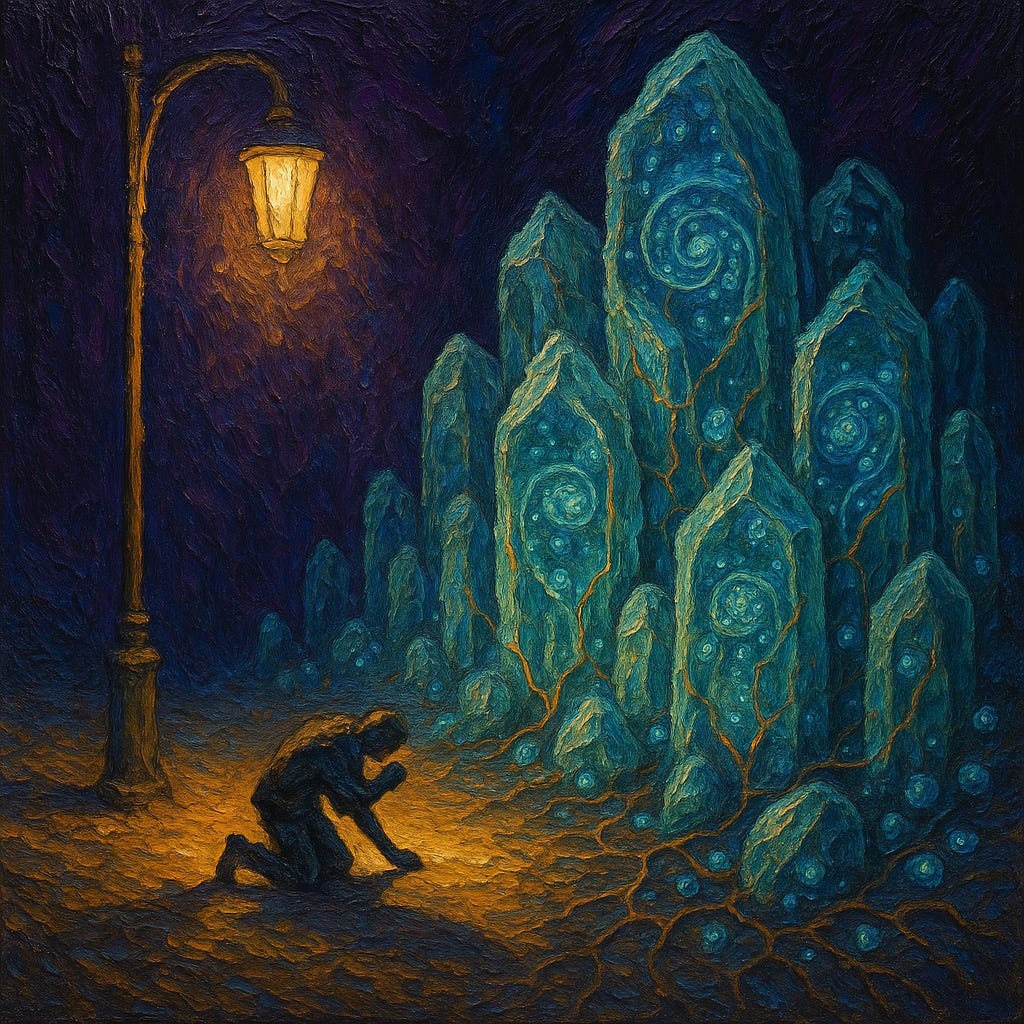
For over a century, medical science has been like the drunk man in the old parable who loses his keys in the dark park but searches for them under the streetlight because "that's where the light is." Not where the keys actually are. Just where it's convenient to look.
This is agnotology in its purest form—the deliberate construction of ignorance through the strategic placement of attention. We search endlessly in illuminated dead ends while the real mechanisms of life remain shrouded in enforced darkness. The oligarchy that controls research funding, medical education, and scientific publishing has positioned the streetlight squarely on germ theory. It's profitable, this notion that specific external microbes cause specific diseases. Meanwhile, the deeper truths about life's fundamental nature stay safely in the shadows where they won't disturb pharmaceutical revenue streams.
When Australian researcher Philippa Uwins cracked open ancient rocks from deep beneath the ocean floor, she found exactly what Antoine Béchamp had described 150 years earlier—living particles ten times smaller than any known bacteria. But this time, with modern electron microscopy and DNA staining techniques that couldn't be dismissed or ignored. These nanobes weren't a new discovery—they were proof that we've been systematically prevented from seeing what Béchamp had already shown us. There's far more to the cell, far more to life itself, than we have been allowed to know. And that's precisely why you've likely never heard of nanobes OR microzymas, despite their revolutionary implications for understanding what life actually is.
Think about this: Uwins' team discovered organisms that shouldn't exist according to everything we've been taught. These nanobes measure between 20 nanometers and 1 micrometer—so tiny that scientific theory insisted they were too small to contain DNA and cellular machinery. They have only 1/1000th the volume of the calculated minimum cell size. Impossible, the textbooks said. Yet when researchers tested them with three different DNA-specific stains, the nanobes lit up. Unmistakable fluorescence. Genetic material, right there in the "impossible."
But here's where it gets fascinating. These organisms had been trapped in 200-million-year-old rocks. At temperatures that would boil water. Under pressures 2,000 times normal atmospheric pressure. And when brought to the surface? They began growing at room temperature within weeks, spreading across laboratory equipment, forming colonies along human fingerprints—microscopic cities following the trails of oils and proteins we leave behind. If organisms can exist at sizes previously thought impossible, survive in solid rock for millions of years, and spontaneously revive when conditions change... well, everything we think we know about life needs reexamination.
This discovery becomes even more profound when you realize it's the latest vindication of Antoine Béchamp's suppressed work from the 1800s. In "The Blood and its Third Element," Béchamp meticulously documented microzymas—subcellular living particles smaller than any cell, capable of transforming into bacteria when their environment changed. He found them surviving in limestone millions of years old, still maintaining their fermentative abilities. These weren't foreign invaders. They were the fundamental units of life itself, present in every tissue, imperishable and eternal.
While Béchamp was documenting how disease arose from within—when these microzymas responded to disturbed terrain—Louis Pasteur was busy plagiarizing his discoveries. Distorting them. Turning nuanced observations into the simplistic "germ theory" that portrayed bacteria as external enemies requiring warfare. (Much more profitable that way, you understand.) The editor's preface to Béchamp's work puts it plainly: Uwins' nanobes are "without doubt what Béchamp described as microzymas."
The pattern repeats through history. Royal Rife's laboratory destroyed after he filmed these transformations at 60,000x magnification. Gaston Naessens prosecuted for developing treatments based on observing what he called "somatids." Same pattern, same suppression. Keep everyone searching under the streetlight of germ theory while the true nature of life remains deliberately obscured.
Contemporary practitioners—the ones brave enough to look where the light hasn't been directed—they're finding something remarkable. Healing becomes possible where conventional medicine sees only management. Dr. Marizelle Arce shows that bacteria are "gardeners of our internal environment," appearing and changing form based on tissue conditions. When antibiotics force them to adapt through pleomorphism, they don't die. They transform into fungi. Ever wonder why yeast infections inevitably follow antibiotic treatment? There's your answer.
Dr. Thomas Cowan goes further. Tumors aren't diseases attacking the body—they're the body's intelligent solution to containing toxins it cannot eliminate through normal channels. Like a pristine lake creating concentrated pockets of debris to prevent total contamination. These physicians understand what Béchamp proved and Uwins rediscovered: microorganisms don't cause disease, they respond to environmental conditions. Symptoms are intelligent communications from a body trying to heal. Suppressing these responses with pharmaceutical weapons? That just drives disease deeper.
Once you know where to look, the evidence is everywhere. Antibiotic resistance isn't bacteria becoming stronger—it's microzymas adapting to new toxic conditions. Autoimmune diseases aren't the body attacking itself but crying out for nourishment. Those chronic diseases medicine calls incurable? They're simply trapped inflammation and disturbed terrain that no one has been taught to address. Can't have that knowledge spreading around. It would end pharmaceutical dependence.
The implications stretch far beyond medicine and into the very foundations of biology itself. If Béchamp was right about microzymas in geological deposits millions of years old, if Uwins' nanobes can survive in solid rock for 200 million years before spontaneously reviving, then the boundary between living and non-living matter isn't what we thought. But there's an even deeper deception at play here. As multiple researchers are now demonstrating, what we call DNA science may itself be elaborate technical theater. Jamie Andrews shows through control experiments that DNA extraction—whether from strawberries with dish soap or human cells with expensive kits—measures electrical charges moving through gel, not genetic sequences. PCR tests detect ionic components, not genes. When forensic DNA accuracy drops from 99.8% claimed to just 6% in blinded studies, we're seeing fraud, not science. Tam reveals that DNA extraction still uses the same harsh acids and solvents from 1869 that likely destroy what they claim to isolate, while Jonathan Latham documents how the most comprehensive genetic studies ever conducted show genes contribute at most 5-10% to common diseases—the rest is environmental. The entire genetic paradigm is "at least 70% fraud, possibly as high as 90%"—a fraud pie that serves oligarchy by deflecting blame from industrial toxins to unchangeable genes. Life isn't encoded in some readable genetic blueprint that doesn't actually exist. It's an eternal continuum of imperishable particles—call them microzymas, nanobes, or simply the fundamental units of life—that organize into temporary forms we call bodies, then return to their fundamental state when those forms dissolve. Without DNA theory as portrayed, genetics collapses; without genetics, virology collapses; without virology, the entire justification for mass poisoning through vaccination crumbles.
Now you see why the oligarchy must maintain the fiction of germ theory at all costs. If people understood that health emerges from supporting their internal terrain rather than fighting imaginary enemies... if they knew bacteria are evolutionary forms of their own anatomical elements rather than invaders... if they grasped that what we call contagion is actually similar environmental conditions triggering similar responses in multiple people... The entire edifice would collapse. Pharmaceutical medicine, vaccine programs, pandemic preparedness treaties—all of it. The drunkard's search under the streetlight isn't accidental. It's engineered.
But here's the thing: the discovery of nanobes represents a crack in the wall. Through it, we can glimpse the suppressed reality of what we truly are. Microscopic life persists in forms ten times smaller than "possible." It survives in solid rock through geological ages. It transforms in response to environmental conditions rather than existing as fixed species. Once you see this, the elaborate deception that has kept humanity medicalized and dependent starts to crumble.
The oligarchy can only direct the light for those who don't know there's darkness to explore. Recognize the drunkard's search for what it is, and you can step away from the streetlight. Feel your way toward actual truth.
Your body isn't a sterile fortress defending against microbial invaders. It's a flowing ecosystem of ancient, intelligent life responding to the conditions you create—through nutrition, emotion, environment, belief. Every symptom is communication. Every bacteria, an adapted response. Every disease, a call to examine your terrain rather than attack your body with pharmaceutical weapons.
The path forward? It's not through more sophisticated drugs or vaccines. It's through understanding what Béchamp discovered, what Uwins validated, what modern terrain physicians are proving daily. Life is far more mysterious, resilient, and intelligent than we've been allowed to know. Reclaim this knowledge, and you transform from a helpless patient searching under the streetlight of germ theory into something else entirely—a conscious participant in the ancient microzymian symphony that maintains life itself.
With thanks to Philippa Uwins.
Mic-UK: Nanobes - About Philippa Uwins and the discovery team

Novel Nano-Organisms from Australian Sandstones
PHILIPPA J.R. UWINS,¹· RICHARD I. WEBB,¹ and ANTHONY P. TAYLOR¹·²*
¹Centre for Microscopy and Microanalysis, The University of Queensland, St. Lucia, Queensland, Australia 4072
²Department of Microbiology, The University of Queensland, St. Lucia, Queensland, Australia 4072
ABSTRACT
We report the detection of living colonies of nano-organisms (nanobes) on Triassic and Jurassic sandstones and other substrates. Nanobes have cellular structures that are strikingly similar in morphology to Actinomycetes and fungi (spores, filaments, and fruiting bodies) with the exception that they are up to 10 times smaller in diameter (20 nm to 1.0 μm). Nanobes are noncrystalline structures that are composed of C, O, and N. Ultra thin sections of nanobes show the existence of an outer layer or membrane that may represent a cell wall. This outer layer surrounds an electron dense region interpreted to be the cytoplasm and a less electron dense central region that may represent a nuclear area. Nanobes show a positive reaction to three DNA stains, [4',6-diamidino-2 phenylindole (DAPI), Acridine Orange, and Feulgen], which strongly suggests that nanobes contain DNA. Nanobes are communicable and grow in aerobic conditions at atmospheric pressure and ambient temperatures. While morphologically distinct, nanobes are in the same size range as the controversial fossil nannobacteria described by others in various rock types and in the Martian meteorite ALH84001.
Analogy
Imagine walking through an ancient library where all the books were thought to be decorative boxes, sealed and lifeless for millions of years. One day, a curious librarian cracks open one of these ancient tomes and discovers that the dust motes floating in the beam of sunlight aren't dust at all—they're an entire civilization of beings so small that thousands could dance on the period at the end of this sentence. These beings had been sleeping in their stone books for eons, but given fresh air and warmth, they wake up and begin building their microscopic cities right before our eyes, spreading from book to book, growing wherever someone's fingerprint left oils on a page. The discovery forces us to reconsider every old book we've ever dismissed as empty, every rock we've thought lifeless, and every planet we've considered barren. Just as finding a thriving ecosystem in what we thought was dust changes how we see that library, finding nanobes living in ancient rocks changes how we understand the very boundaries of life itself.
The One-Minute Elevator Explanation
Scientists in Australia cracked open rocks from miles beneath the ocean floor and discovered something that shouldn't exist—living organisms ten times smaller than any known bacteria. These "nanobes" are so tiny that scientific theory said they were too small to contain the DNA and machinery necessary for life, yet when researchers tested them, they lit up with DNA stains like microscopic Christmas lights. Even more bizarre, these organisms had been trapped in 200-million-year-old rocks at temperatures that would boil water, but when brought to the surface, they started growing at room temperature, spreading to laboratory equipment and even forming colonies along human fingerprints. It's like finding a thriving metropolis inside what everyone thought was a grain of sand. This discovery is forcing scientists to completely reconsider how small life can be, where it might exist, and whether those controversial structures in the Mars meteorite might actually be fossils after all. If life can squeeze itself into packages this tiny and survive in solid rock for millions of years, then we need to look for life in places we never imagined possible—from the deepest rocks on Earth to the subsurface of Mars and beyond. [Elevator dings] Follow up on Folk's nannobacteria research, the ALH84001 Mars meteorite debate, and extremophile bacteria discoveries.
12-Point Summary
1. Discovery in Ancient Rocks Australian researchers examining petroleum exploration samples from 3,400 to 5,100 meters below the ocean floor discovered colonies of previously unknown organisms in Triassic and Jurassic sandstones. These rocks, dated between 150-250 million years old, had been subjected to temperatures of 117-170°C and crushing pressures of 2,000 atmospheres. When the team fractured fresh surfaces of these ancient rocks, they observed unusual growths that became visible to the naked eye within 2-3 weeks, appearing as white, gray, or brown fuzzy patches that spontaneously spread to nearby laboratory surfaces.
2. Impossibly Small Size Nanobes measure between 20 nanometers and 1 micrometer in diameter, making them up to ten times smaller than the smallest known bacteria. The thinnest nano-filaments at 20 nanometers are theoretically too small to contain the minimum DNA, ribosomes, and enzymes required for independent life—they have only 1/1000th the volume of the calculated minimum cell size. This size range aligns with the controversial fossilized structures found in Martian meteorite ALH84001, which had been dismissed as too small to represent ancient life forms.
3. Complex Morphology Despite Tiny Size Under electron microscopy, nanobes revealed sophisticated structural organization including filamentous networks, coccoid bodies interpreted as spores, club-shaped reproductive structures, and apparent fruiting bodies. The organisms showed remarkable morphological similarity to Actinomycetes bacteria and fungi, displaying branching patterns, septa-like constrictions, and both radial and axial growth symmetries typical of living organisms. Researchers identified two distinct size classes: nano-filaments (20-200 nm) and micro-filaments (200-1000 nm), suggesting different life stages or functional forms within colonies.
4. Confirmed DNA Presence Three separate DNA-specific staining techniques—DAPI, Acridine Orange, and Feulgen—all produced positive results, providing powerful evidence that nanobes contain genetic material. The DAPI stain, which specifically binds to adenine-thymine base pairs in DNA, caused nanobes to fluoresce blue under UV light, though the process took up to three days due to their unusually resistant cell walls. When researchers treated samples with acetone to partially break down these hydrophobic barriers, the DNA stains penetrated rapidly, producing intense fluorescence within minutes.
5. Biological Elemental Composition Energy dispersive X-ray spectroscopy revealed that nanobes consist primarily of carbon, oxygen, and nitrogen—the fundamental elements of life—in proportions consistent with biological materials. Crucially absent were significant amounts of silicon, metals, or sulfur that would indicate mineral structures. The elemental signature was so distinctly biological that researchers could systematically eliminate every known inorganic compound, including silicates, carbonates, metallic oxides, and even exotic carbon structures like fullerenes or nanotubes.
6. Living Cellular Architecture Ultra-thin sections examined under transmission electron microscopy revealed nanobes possess internal organization resembling conventional cells. Researchers identified a distinct outer membrane or cell wall surrounding an electron-dense region interpreted as cytoplasm, with less dense areas possibly representing nuclear regions. Some colonies showed extracellular polymer networks surrounding the organisms, and filaments displayed continuous internal structure at branching points, confirming these were integrated biological entities rather than mineral aggregates.
7. Active Growth and Spread Nanobes demonstrated the ability to grow and spread under normal laboratory conditions (22°C, atmospheric pressure), despite originating from extreme deep-rock environments. Colonies spontaneously appeared on various substrates including polystyrene Petri dishes, glass surfaces, and copper microscope mounts that had been near the original rock samples. Growth appeared to occur through spore dispersal or direct contact, with colonies achieving visible size within 2-3 weeks and continuing to expand over months.
8. Evidence of Heterotrophic Metabolism The most striking evidence for active metabolism came from nanobes preferentially colonizing human fingerprints on laboratory dishes, creating perfect replicas of fingerprint patterns in their growth. This suggested they were heterotrophic organisms that consumed organic materials for energy, explaining their ability to survive in hydrocarbon-bearing rocks while thriving on skin oils and proteins. The dramatic difference in growth rates between clean surfaces and those with organic contamination indicated nanobes actively responded to nutrient availability.
9. Systematic Elimination of Non-Biological Explanations Researchers methodically ruled out every proposed non-biological explanation through multiple lines of evidence. Electron diffraction proved nanobes were amorphous, not crystalline minerals. Their elemental composition excluded all major mineral groups. Their growth behavior—spreading between surfaces, preferential colonization of organic materials, and consistent morphology—couldn't be explained by mineral precipitation or polymer formation. The positive DNA staining provided definitive evidence that no non-living material could replicate.
10. Revolutionary Implications for Size Limits of Life The existence of living nanobes challenges the fundamental assumption that life requires a minimum cell size of 150-200 nanometers diameter. If confirmed, they would represent either a new domain of life operating under different organizational principles, or evidence that life can compress its essential machinery far more efficiently than previously thought possible. This forces a reconsideration of theoretical models for minimal cell size and opens entirely new size ranges for seeking life in extreme environments.
11. Connection to Astrobiology and Planetary Exploration Nanobes provide a living analog for the controversial nanostructures found in Martian meteorite ALH84001, removing the size-based argument against their biological origin. Their ability to survive in microscopic rock pores at extreme conditions for millions of years suggests life could persist in previously unconsidered environments on Mars, Europa, Enceladus, and other planetary bodies. Their tiny size means current life-detection methods might miss entire biosystems hiding in microscopic spaces ten times smaller than typically examined.
12. Paradigm Shift in Understanding Life's Limits The discovery of nanobes represents a potential paradigm shift in biology, similar to the initial discovery of bacteria or extremophiles. If these organisms can survive millions of years in solid rock at extreme temperatures and pressures, then virtually any environment with historical liquid water becomes a potential habitat for life. Their existence would validate expanding the search for life to smaller scales and more extreme environments than ever previously considered, fundamentally changing how we explore for life on Earth and other worlds.
The Golden Nugget
The most profound revelation that few people would recognize is that nanobes were found growing in petroleum-bearing rocks that had been sealed from the surface world for over 200 million years, yet they spontaneously came to life and began reproducing within weeks when exposed to surface conditions. This suggests the existence of a deep, hot biosphere extending miles beneath Earth's surface—a hidden ecosystem that has been evolving in complete isolation since before the dinosaurs, possibly representing an entirely separate genesis of life or a refuge where ancient life forms survived every mass extinction that devastated surface life. If confirmed, it means that the vast majority of Earth's biosphere might exist not in the thin film of oceans, soil, and air that we know, but in the seemingly solid rock beneath our feet, with implications that most planets in the universe could harbor similar deep life even if their surfaces appear completely sterile.
20 Questions and Answers
1. What are these mysterious nanobes that scientists discovered living inside ancient rocks?
Nanobes are incredibly tiny organisms discovered in sandstone samples from petroleum exploration wells deep beneath the ocean floor off western Australia. These structures appear to be alive, growing in colonies that look like tangled webs of ultra-thin filaments, round bodies, and swollen reproductive structures. They were found in Triassic and Jurassic sandstones that are hundreds of millions of years old, living in rock formations that had been sealed deep underground.
The discovery happened almost by accident when researchers were examining rock samples and noticed unusual growths appearing on freshly broken surfaces. Within weeks of breaking open these ancient rocks, colonies of these mysterious organisms became visible to the naked eye as white, brown, or gray fuzzy patches. The organisms spontaneously grew not just on the rocks but spread to laboratory equipment, growing at room temperature in normal air despite coming from rocks that had been trapped at extreme depths and temperatures for millions of years.
2. Just how incredibly small are nanobes compared to the bacteria we normally hear about?
Nanobes are mind-bogglingly small, measuring between 20 nanometers and 1,000 nanometers (1 micrometer) in diameter, making them up to ten times smaller than typical bacteria. To put this in perspective, the smallest nanobe filaments are only 20 nanometers wide—that's about 1/5000th the width of a human hair. Most bacteria range from 150 to 50,000 nanometers, so nanobes exist in a size range that scientists previously thought was too small to contain all the machinery necessary for life.
Individual nanobe filaments can be as thin as 20-128 nanometers, while the larger micro-filaments reach up to 1,000 nanometers across. The smallest structures are so tiny that they push against what scientists call the "minimum size limit" for life—the theoretical boundary of how small something can be and still contain DNA, proteins, and all the other molecules needed to grow, reproduce, and maintain itself as a living organism.
3. What do nanobes actually look like under powerful microscopes?
Under scanning electron microscopes, nanobes reveal themselves as an alien landscape of biological forms. They create intricate colonies composed of long, thin filaments that branch and weave together like microscopic root systems or fungal networks. Some filaments terminate in rounded ends, while others connect to swollen, club-shaped structures that researchers interpret as fruiting bodies—possibly reproductive structures. The colonies can form beautiful radial patterns spreading outward from central points, creating formations that look like tiny starbursts or dandelion seeds.
The organisms display remarkable structural diversity within their colonies. Researchers observed coccoid (round) bodies that might be spores, measuring 45 to 100 nanometers across, scattered throughout the fibrous networks. The filaments themselves maintain consistent diameters along their length but show curious constrictions or pinch-points that might represent internal divisions similar to the septa found in fungi. Some colonies even showed unusual swollen structures with multiple filaments protruding from them, resembling nothing so much as microscopic octopi or cellular flowers blooming in the rock matrix.
4. How deep underground were these organisms found, and what extreme conditions did they come from?
The nanobes were discovered in rock samples retrieved from staggering depths of 3,400 to 5,100 meters below the sea bed—that's roughly two to three miles beneath the ocean floor. At these depths, the rocks existed at temperatures between 117°C and 170°C (243°F to 338°F), hot enough to boil water at surface pressure, with crushing pressures around 2,000 times normal atmospheric pressure. These sandstones were extensively cemented with quartz overgrowths and had extremely low permeability, meaning fluids could barely move through them.
What makes their discovery even more remarkable is that these organisms, adapted to such extreme conditions, began growing happily at room temperature (22°C/72°F) and normal atmospheric pressure once brought to the surface. The sandstones themselves dated from the Triassic and Jurassic periods, meaning they had been buried for roughly 150 to 250 million years. The researchers were examining these ancient rocks as part of petroleum exploration offshore western Australia when they made their unexpected discovery of what appeared to be thriving microscopic life.
5. How did scientists prove these tiny structures were actually alive and not just mineral deposits?
The research team employed an arsenal of sophisticated techniques to demonstrate that nanobes were biological rather than mineral structures. Using electron diffraction analysis, they showed that nanobes had amorphous (non-crystalline) structures, immediately ruling out crystalline minerals. Energy dispersive X-ray spectroscopy revealed that nanobes were composed primarily of carbon, oxygen, and nitrogen—the fundamental elements of life—with notably absent were the high levels of silicon, metals, or sulfur that would indicate mineral deposits.
The most compelling evidence came from multiple DNA staining techniques. When treated with DAPI, a fluorescent probe that specifically binds to DNA, the nanobes glowed with characteristic blue fluorescence under UV light. They also reacted positively to Acridine Orange, showing green fluorescence indicating DNA presence, and to Feulgen stain, which specifically detects the sugar components of DNA molecules. The fact that three different DNA-specific stains all produced positive results provided powerful evidence that these structures contained genetic material, something no mineral or non-living polymer could possess.
6. What was the breakthrough moment when researchers confirmed nanobes contain DNA?
The pivotal moment came when researchers applied DAPI stain to nanobe colonies and watched them slowly develop an unmistakable blue fluorescence over three days. This wasn't just any fluorescence—DAPI specifically binds to DNA's adenine-thymine base pairs, creating a molecular lock-and-key reaction that only occurs with genetic material. The team initially struggled because nanobes have unusually hydrophobic (water-repelling) walls that resisted the stain, requiring extended exposure times compared to normal bacteria.
To confirm their observations weren't artifacts or contamination, the researchers photographed the exact same colonies under UV light to capture the DNA fluorescence, then immediately examined them in an environmental scanning electron microscope. This dual approach proved that the glowing structures were definitely the nanobe colonies and not some other microorganism. When they treated samples with acetone to partially break down the tough cell walls, the DNA stains penetrated rapidly, producing intense fluorescence within minutes rather than days, removing any doubt that these tiny structures harbored genetic material.
7. What are nanobes made of at the chemical level?
Spectroscopic analysis revealed that nanobes consist primarily of carbon, oxygen, and nitrogen—the holy trinity of biological molecules. These three elements alone make up over 78% of a typical living cell's composition, and their presence in nanobes in the right proportions strongly suggested organic rather than inorganic origin. The carbon formed the backbone of organic molecules, oxygen was present in amounts consistent with biological materials rather than oxides or carbonates, and crucially, nitrogen appeared in significant quantities—an element that wouldn't be present in mineral structures but is essential for proteins and DNA.
The near-absence of other elements told an equally important story. Silicon appeared only in trace amounts, ruling out silicate minerals. No significant metals were detected, eliminating metallic oxides. Sulfur was absent, excluding sulfide minerals. The elemental signature was so distinctly biological that researchers systematically eliminated every known inorganic compound that could mimic these structures. Even carbon nanotubes and fullerenes, which are pure carbon structures, were ruled out because they would appear crystalline under electron diffraction and form under extreme temperatures above 1200°C, not at room temperature.
8. What internal structures do nanobes have that resemble those in normal cells?
When researchers managed to create ultra-thin sections of nanobes—a challenging feat given their tough, hydrophobic walls—they discovered remarkable internal organization. The sections revealed a distinct outer layer interpreted as a cell membrane or wall, surrounding a dense region that appeared to be cytoplasm. Within this cytoplasm, they observed less dense areas that might represent nuclear regions where genetic material is stored. These three distinct zones—membrane, cytoplasm, and nuclear area—mirror the basic organization found in many single-celled organisms.
The transmission electron microscopy also revealed fascinating details about nanobe colony structure. Some filaments were surrounded by networks of extracellular polymers—sticky substances that cells often produce to attach to surfaces or communicate with neighbors. At branching points where filaments divided, the internal structure remained continuous, showing these weren't simply mineral deposits but integrated biological structures. The presence of apparent septa (cross-walls) within filaments suggested internal compartmentalization similar to fungal hyphae, though at a much smaller scale than ever previously observed.
9. Why did finding DNA in something so small shock the scientific community?
The discovery of DNA in nanobes challenged a fundamental assumption in biology: that there's a minimum size limit for life. Scientists had calculated that a cell needs to be at least 150-200 nanometers in diameter to contain the minimum required DNA, ribosomes for protein synthesis, and enzymes for metabolism. Yet here were organisms with filaments as thin as 20 nanometers—theoretically too small to house even a minimal genome—showing clear evidence of genetic material. This forced researchers to reconsider whether life might be able to compress its molecular machinery far more efficiently than previously thought possible.
The implications extended beyond Earth biology to astrobiology and the search for extraterrestrial life. If organisms could exist at such tiny scales, it opened up entirely new possibilities for where life might hide—in microscopic pores of rocks, in extreme environments previously thought uninhabitable, or even in meteorites from other planets. The controversy connected directly to debates about structures found in Martian meteorite ALH84001, where similar-sized formations had been dismissed as too small to be fossilized life. If nanobes were real living organisms, those Martian structures suddenly deserved a second look.
10. How do nanobes spread from rocks to laboratory equipment and grow new colonies?
Researchers observed a remarkable pattern of colonization that suggested nanobes spread through airborne spores or direct contact. After placing sandstone samples in storage containers, nanobe colonies spontaneously appeared on the polystyrene Petri dishes, glass surfaces, and even copper microscope mounting stubs nearby. These colonies started as invisible contamination but grew over days to months into visible fuzzy patches that could be seen without magnification. The growth pattern suggested that spores from the freshly fractured rock surfaces had spread to adjacent surfaces, where they germinated and established new colonies.
The most intriguing evidence for active spread came from an unexpected observation: nanobe colonies that formed perfect replicas of human fingerprints on Petri dish surfaces. Where someone had touched the dish, leaving behind skin oils and organic compounds, nanobes grew preferentially along the fingerprint ridges, creating ghostly impressions visible as white or gray growth patterns. This suggested not only that nanobes could spread from person to person or surface to surface, but that they actively sought out organic materials as growth substrates, establishing colonies wherever nutrients were available.
11. What bizarre observation about fingerprints revealed how nanobes might feed themselves?
The discovery that nanobes preferentially grew along fingerprint patterns on laboratory dishes provided the first major clue about their metabolism. Where researchers had inadvertently touched polystyrene Petri dishes, leaving invisible fingerprints, nanobe colonies later appeared in perfect ridge-and-whorl patterns matching the prints. The organisms clearly preferred growing where human skin oils, proteins, and other organic compounds had been deposited, suggesting they were heterotrophic—meaning they consumed organic material for energy rather than producing their own food through photosynthesis or chemical reactions.
This heterotrophic behavior made sense given their original habitat deep in ancient rocks where no sunlight penetrated. The organisms appeared capable of utilizing whatever organic compounds were available, from trace hydrocarbons in petroleum-bearing rocks to skin oils on laboratory equipment. The fingerprint colonies grew more densely and rapidly than colonies on clean surfaces, demonstrating that nanobes actively responded to nutrient availability. This metabolic flexibility might explain how they survived in nutrient-poor deep rock environments yet thrived when exposed to richer food sources at the surface.
12. Why do many scientists argue that nanobes are too small to be alive?
The central objection to nanobes being living organisms revolves around the theoretical minimum space required for life's essential machinery. Scientists have calculated that a free-living organism needs enough room for at least 250-450 genes worth of DNA, thousands of ribosomes to make proteins, hundreds of different enzymes for metabolism, and a membrane to contain it all. Even with maximum theoretical packing efficiency, this would require a sphere at least 150-200 nanometers in diameter. Nanobes with 20-nanometer filaments would have only 1/1000th the volume of this theoretical minimum cell.
Critics argue that such tiny structures could potentially be unusual mineral formations, fossilization artifacts, or even components broken off from larger organisms rather than independent life forms. The debate echoes earlier controversies when bacteria were first discovered—many scientists refused to believe such small entities could be alive until improved microscopes and cultivation techniques proved otherwise. Some researchers suggest nanobes might represent a different strategy for life, perhaps sharing genetic material among a colony network or existing as obligate symbionts that rely on other organisms for essential functions they cannot perform themselves.
13. How do nanobes connect to the controversial structures found in the Mars meteorite?
The nanobe discovery reignited debates about meteorite ALH84001, a Martian rock that made headlines in 1996 when NASA scientists announced it contained possible fossilized microorganisms. The supposed Martian "nanofossils" were similar in size to nanobes—20 to 100 nanometers—and critics had dismissed them as too small to represent ancient life. But if Earth harbored living nanobes at these dimensions, the size argument against Martian nanofossils suddenly lost its power. The morphological similarities were striking: both showed elongated filaments, rounded bodies, and colonial growth patterns at nearly identical size scales.
The connection goes deeper than just size comparisons. Both nanobes and the Martian structures were found in rock formations, both were discovered using similar electron microscopy techniques, and both challenged conventional thinking about life's limits. While the Martian structures remained mineralized and couldn't be tested for DNA or growth, Earth nanobes provided a living example that organisms of such dimensions could theoretically exist. This didn't prove the Martian structures were once alive, but it removed one of the strongest arguments against that possibility, forcing scientists to reconsider what they might be looking for when searching for extraterrestrial life.
14. What clever detective work ruled out that nanobes could be crystals or other non-living materials?
The research team systematically eliminated every non-biological explanation through a combination of chemical and structural analyses. First, electron diffraction patterns showed nanobes were amorphous, not crystalline, immediately ruling out mineral crystals. The elemental composition excluded all major mineral groups: too little silicon for silicates, no metals for oxides, no sulfur for sulfides, and wrong proportions for carbonates. Even exotic possibilities like fullerenes or carbon nanotubes were eliminated because these would show crystalline structure and only form at extreme temperatures above 1200°C, not at room temperature where nanobes grew.
The growth behavior provided additional evidence against non-biological origins. Minerals don't preferentially grow on fingerprints, spread from surface to surface, or maintain consistent filament diameters with rounded ends. The positive DNA staining was the clincher—no known mineral or synthetic polymer contains DNA or would react with multiple DNA-specific stains. The researchers even considered whether nanobes might be contaminating beam-sensitive minerals that appeared amorphous under electron bombardment, but nanobes proved remarkably stable under the electron beam, maintaining their structure through extended observation periods that would have destroyed such minerals.
15. Why were nanobes so difficult to prepare for study compared to normal bacteria?
Nanobes proved to be remarkably uncooperative research subjects due to their extraordinarily tough, hydrophobic walls that repelled water and most laboratory chemicals. Standard bacterial preparation techniques failed spectacularly—nanobes wouldn't absorb fixatives like glutaraldehyde properly, reacted adversely to dehydrating agents like ethanol and acetone, and often fell out of resin during sectioning for electron microscopy. Their walls were so resistant that DNA stains requiring minutes to penetrate normal bacteria took up to three days to penetrate nanobes, and even then only worked after researchers discovered that acetone treatment could partially break down the defensive barriers.
This unusual chemistry suggested nanobes possessed unique adaptations for surviving in extreme environments. Their hydrophobic nature might protect them from water-based threats in their deep-rock habitat while their chemical resistance could shield them from the harsh petroleum compounds and mineral acids present in their geological homes. The preparation challenges ironically provided evidence for their biological nature—mineral structures wouldn't selectively resist biological stains and fixatives in such specific ways. Researchers eventually developed special protocols, treating nanobes more like archaeological specimens than typical bacteria, carefully coaxing them to reveal their internal structures without destroying them in the process.
16. What familiar organisms do nanobes resemble, despite being dramatically smaller?
Under high magnification, nanobes display morphologies strikingly similar to Actinomycetes and fungi, just miniaturized to an almost impossible degree. Like Actinomycetes bacteria, they form branching filamentous colonies with spore-like rounded bodies scattered throughout. Their filaments show the same type of radial growth patterns, spreading outward from central points in star-like formations. The resemblance to fungi is equally remarkable—nanobes produce structures that look exactly like tiny fungal hyphae, complete with apparent septa (cross-walls) creating compartments along the filaments, and swollen reproductive structures reminiscent of fungal fruiting bodies.
The similarities extend beyond simple shape-matching to include growth behaviors and colony organization. Like both fungi and Actinomycetes, nanobes form dense mycelial networks, produce apparent spores for reproduction, and show both sexual and asexual reproductive structures within the same colony. Some researchers observed constrictions along filaments that looked identical to the chain-like spore formations seen in Streptomyces bacteria, just scaled down by a factor of ten. These parallels suggested that despite their size difference, nanobes might employ similar biological strategies for growth, reproduction, and survival as their larger cousins.
17. How quickly can nanobes grow from invisible specks to colonies you can see with your eyes?
Starting from invisible spores or fragments on freshly fractured rock surfaces, nanobe colonies achieved naked-eye visibility within an astonishingly rapid 2-3 weeks under laboratory conditions. The colonies first appeared as tiny white, gray, or brown fuzzy spots about 0.1-0.2 millimeters across—just barely visible as specks to someone with good eyesight. Over subsequent weeks to months, these initial colonies expanded into larger patches that were unmistakably visible, forming distinctive patterns on rock surfaces, Petri dishes, and even metal microscope mounts.
The growth rate appeared to depend heavily on nutrient availability and surface characteristics. On bare rock or clean glass, colonies grew slowly and remained relatively small. But on surfaces with organic contamination—particularly those fingerprints—growth accelerated dramatically, with dense colonies developing along fingerprint ridges within days. This suggested that while nanobes could survive on minimal nutrients, they were opportunistic and capable of explosive growth when conditions improved, perhaps explaining how they persisted in nutrient-poor deep rocks yet thrived when exposed to richer surface environments.
18. What's the difference between the thin nanobe filaments and the thicker ones researchers observed?
Researchers distinguished two distinct size classes of filaments within nanobe colonies: nano-filaments measuring 20-200 nanometers in diameter, and micro-filaments ranging from 200-1000 nanometers across. The nano-filaments appeared to be the primary growth form, creating dense networks of incredibly thin threads that were often unbranched and terminated in rounded ends. These ultra-thin structures pushed the absolute limits of what could theoretically contain genetic material and cellular machinery, representing the most controversial aspect of nanobe biology.
The larger micro-filaments showed more complex architecture, frequently branching and sometimes containing visible internal structures like septa or constrictions. These thicker filaments might represent mature growth forms, reproductive structures, or perhaps colonies of nano-filaments bundled together. Intriguingly, researchers observed transitions between the two sizes, with nano-filaments appearing to emerge from or develop into micro-filaments, suggesting a life cycle that involved both forms. The micro-filaments' size placed them within the range of small bacteria, making them less controversial but equally important for understanding how nanobes organized their colonies.
19. How did researchers systematically eliminate every non-biological explanation for these structures?
The elimination process resembled a scientific detective story, with researchers testing and rejecting hypotheses one by one. For the mineral hypothesis, they used electron diffraction to prove nanobes were amorphous, not crystalline, then used spectroscopy to show the elemental composition matched no known mineral. The absence of sufficient silicon, metals, or sulfur ruled out silicates, oxides, and sulfides. Carbon-based minerals like carbonates were eliminated because the oxygen levels were too low and no suitable cations were present. Even exotic carbon structures like fullerenes were rejected because they require extreme formation temperatures and show crystalline structure.
The possibility of non-living organic polymers was addressed through growth observations and DNA testing. No known polymer spontaneously grows at room temperature, spreads between surfaces, or preferentially colonizes fingerprints. The crucial evidence came from three different DNA stains producing positive results—something impossible for any non-biological polymer. The researchers even considered whether nanobes might be artifacts created by their preparation techniques, but finding them growing on multiple substrates and in different laboratories eliminated this possibility. By the study's end, every non-biological explanation had been tested and found wanting, leaving only the controversial conclusion that nanobes were indeed living organisms.
20. What could the existence of nanobes mean for finding life in extreme places, including other planets?
If nanobes are confirmed as living organisms, they fundamentally expand the possible habitats for life throughout the universe. Their ability to survive in microscopic rock pores at extreme temperatures and pressures, yet remain viable for millions of years, suggests life might persist in environments previously considered sterile. This includes deep subsurface environments on Earth, Mars, and potentially the ice-covered moons of Jupiter and Saturn. The tiny size of nanobes means they could inhabit microscopic niches invisible to conventional life detection methods, hiding in spaces ten times smaller than scientists typically examine.
For astrobiology, nanobes provide a template for what alien life might look like—not the large, complex organisms of science fiction, but ultra-tiny entities at the very edge of life's minimum size. Their existence would validate searching for biosignatures at much smaller scales and in more extreme environments than current Mars missions consider. If life can compress itself into 20-nanometer packages and survive for geological time periods in solid rock, then virtually any planetary body with liquid water at some point in its history becomes a potential harbor for life. The implications extend to panspermia theories too—if nanobes can survive millions of years in rock, they might also survive interplanetary or even interstellar journeys, spreading life between worlds.
I appreciate you being here.
If you've found the content interesting, useful and maybe even helpful, please consider supporting it through a small paid subscription. While 99% of everything here is free, your paid subscription is important as it helps in covering some of the operational costs and supports the continuation of this independent research and journalism work. It also helps keep it free for those that cannot afford to pay.
Please make full use of the Free Libraries.
Unbekoming Interview Library: Great interviews across a spectrum of important topics.
Unbekoming Book Summary Library: Concise summaries of important books.
Stories
I'm always in search of good stories, people with valuable expertise and helpful books. Please don't hesitate to get in touch at unbekoming@outlook.com
Baseline Human Health
Watch and share this profound 21-minute video to understand and appreciate what health looks like without vaccination.
I have spent the last 10 years reading and studying about this forgotten and buried side of Bechamp's discoveries and this exposition is genuinely heart warming and long overdue; the world is still denied access to a great deal of Bechamp's writings because much has yet to be translated from the original French; and also because of the suppression of material by French academies and libraries which, in restoring Bechamp's name and reputation, would have to reveal the Pasteurian fraud the world still lives under; and we now know, from Pasteur's own lab notes and diaries, that the scientific truths of Bechamp and others were deliberately suppressed to hijack and control all of medical science to this day.
Beats everything the modern stone age medical mafia claims about medicine. Their toxic drugs and vaccines are useless and often exacerbate the problems. Modern medicine is an 180 degree turn away from health. Then again, if the truth become widespread and health were to abound, we wouldn't need these medical clowns very much. That is what scares them so they create the fear of death with every little microbe turned into a monster killer.