

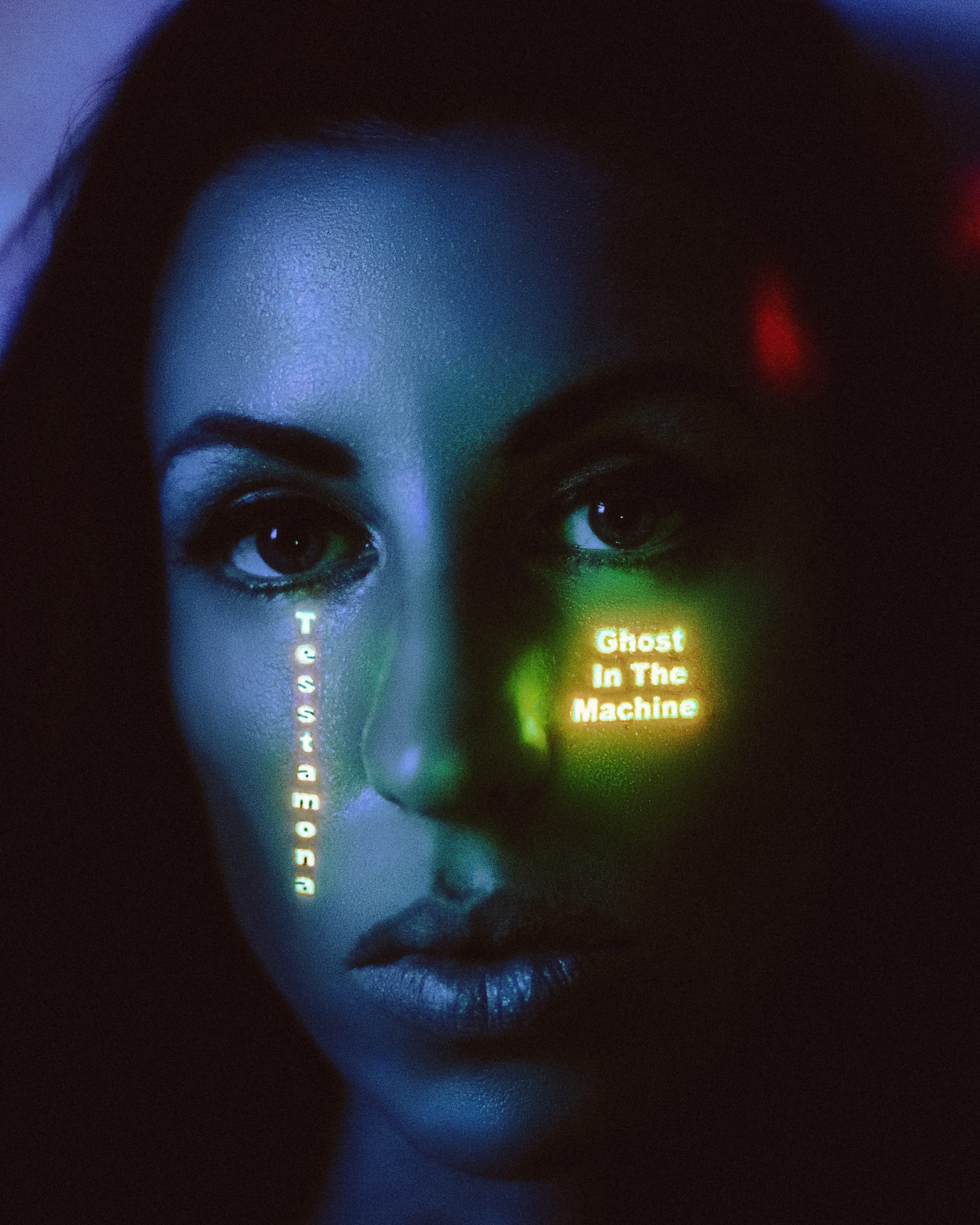
Tess has been writing lyrics since childhood — first as a way to survive an environment she couldn’t control, later as the only language that could carry what she needed to say. She taught herself to sing in a community college choir class she almost walked out of. She’s moved from LA to Oregon during lockdowns, then Nashville to escape vaccine mandates, then Florida. Got banned from TikTok. Had her content throttled everywhere else. Kept writing. Kept recording.
I interviewed Tess in December 2024, when the album was still taking shape. What came through in that conversation was someone who understood — from the inside — that personal liberation and the larger fight are the same fight.
Ghost in the Machine is the full statement. Nine songs, produced with Cris Cordero, out now on all platforms.
In her letter to the people who pre-ordered the album, she wrote: “Creating art is a spiritual prison break — nothing less.” And: “In my darkest hour I used to pray to God to just let me live long enough to release something like this.”
She lived long enough.
Most truth music has a ceiling. It preaches to the converted. It catalogues what’s wrong in a tone that only works if you already agree. Tess knows this. She told me that “direct aggression toward the problem is not effective” and that leaning into vulnerability had been “revolutionary in itself.”
You can hear that shift across the album. It doesn’t just diagnose. It moves through the diagnosis and into the cost of actually getting free — inside your own head first, then out in the world.
“Dopamine” opens the record by speaking as the mechanism. Not heroin, not fentanyl — dopamine itself, the attention economy’s real currency. The voice is a predator’s: I am your dopamine / I’ll only cost you / all of your dreams. But the bridge flips it. The predator lets slip the secret it’s been guarding — that everything people chase through the feed already exists inside them. The song doesn’t lecture about phone addiction. It lets the drug talk, and the drug is more honest than any TED talk on the subject.
“Algorithm Ghetto” was the first single, and the track most readers here will already know. It’s the most overtly political thing on the record — censorship, smart cities, pharmaceutical harm, social engineering, all of it. What saves it from being a list is the spoken word outro. Tess drops the melody and just talks: Your thoughts are not always your own in this system... Every time we trade molecules for pixels, and convenience for surveillance... She names the trap, then pivots to the only thing that matters — All that we have is each other / don’t forget / Friend. Connection, not rage.
The title track started life as a 2 AM voice memo. Tess was on the floor of her apartment in Sarasota, sick with bronchitis from mould exposure. She recorded it on her phone, made zero changes to the vocal, layered a vintage record player effect over it, and that became “Portal” — the interlude that leads into “Ghost in the Machine” proper. The question the song keeps circling — are you a ghost in the machine, or are you here with me? — isn’t rhetorical. It’s an actual invitation. When was the last time you felt the sun on your skin and could hear the birds instead of traffic? When was the last time you went walking without having somewhere to be? The song closes with Sa Ta Na Ma, a Kundalini yoga mantra from the Kirtan Kriya practice. Tess includes a note in the lyric sheet about it — the practice has been clinically shown to reduce symptoms of Alzheimer’s and dementia, and she wants you to look into it. That’s the kind of album this is. The lyric sheet has homework.
“The Ones Who Found God in Hell” is the recovery song, written for people who came through the worst of it — addiction, jail, trauma — and came out carrying something they could give to the next person behind them. We are the ones who rose from addiction jails and prison / Unspoken crime scene bodies and we have a mission / to alchemize our nightmares / into medicine / for the traveller.
“Grieve My Love” does the thing almost nobody in music is willing to do right now. It sits with grief. Doesn’t fix it, doesn’t medicate it, doesn’t pivot to empowerment. Grief is love / so grieve my love. It names what happens when that grief gets swallowed instead — the needle, the pistol, the bottle, the train’s final stop — and calls it what it is: forgotten reverence. We forgot what it is to be human. The song says remember.
Tess raised a question in our interview that stuck with me. If humanity is still around in fifty years, and people want to hear what 2024 actually sounded like — what life was actually like for the people who lived through it — would mainstream music tell them anything? Would it reflect what people were struggling with, what they lost, what they refused to surrender?
Nothing in the mainstream reflects any of it. The industry optimises for algorithmic reach, not truth. The result is a cultural record with a hole in the middle where honest testimony should be.
This album fills some of that hole. It’s a record made by someone who taught herself to sing in a community college choir, survived the mandate years, got deplatformed, dealt with chronic illness, moved across the country more times than she can count, and still made the thing she was put here to make.
There can be no revolution without healing. That’s what Tess told me. This album is what that sounds like.
Ghost in the Machine is on all streaming platforms.
Website: tesstamona.com
Substack: Memento Mori Alchemy
YouTube (music videos): youtube.com/tesstamona
All links: linktr.ee/tesstamona
Art is a most powerful weapon against the beast. We need more of it.
Support This Work
This work remains free because paid subscribers make it possible. If you find value here, consider joining them.
Paid subscribers get access to all books — including The DMSO Book, The Kitchen Remedies Guide, Chlorine Dioxide, The PSA Trap, Breast Cancer, and more — with 1-2 new books added each month. Plus the Deep Dive Audio Library: 180+ in-depth audio book summaries and discussions.
Pricing Update: The annual subscription moves from $50 AUD to $50 USD on May 1 — the first change in five years. Current paid subscribers keep their existing rate. Free subscribers can lock in the current price by upgrading before May 1.
I am sobbing reading this. I didn't know the article had gone live until someone commented on one of my YouTube videos saying Unbekoming sent them. Thank you so much. You did an unbelievable justice to the album and the actual dharma within the vehicle for the dharma. You also saw me in a way that I often can't remember to see myself. Thank you so much.
Just got done listening through twice, touched my core and my everyday beliefs, my convictions and just a rebellious sexy voice with a true spirit that can inspire maybe some of the pawns to put down the cell, get out of digital hell and get some sun. Unbekoming thanks so much, this chick is a keeper, my wife came in said, I know why u like this, it turns you on, slapped me on the shoulder and left, how fun is that.