

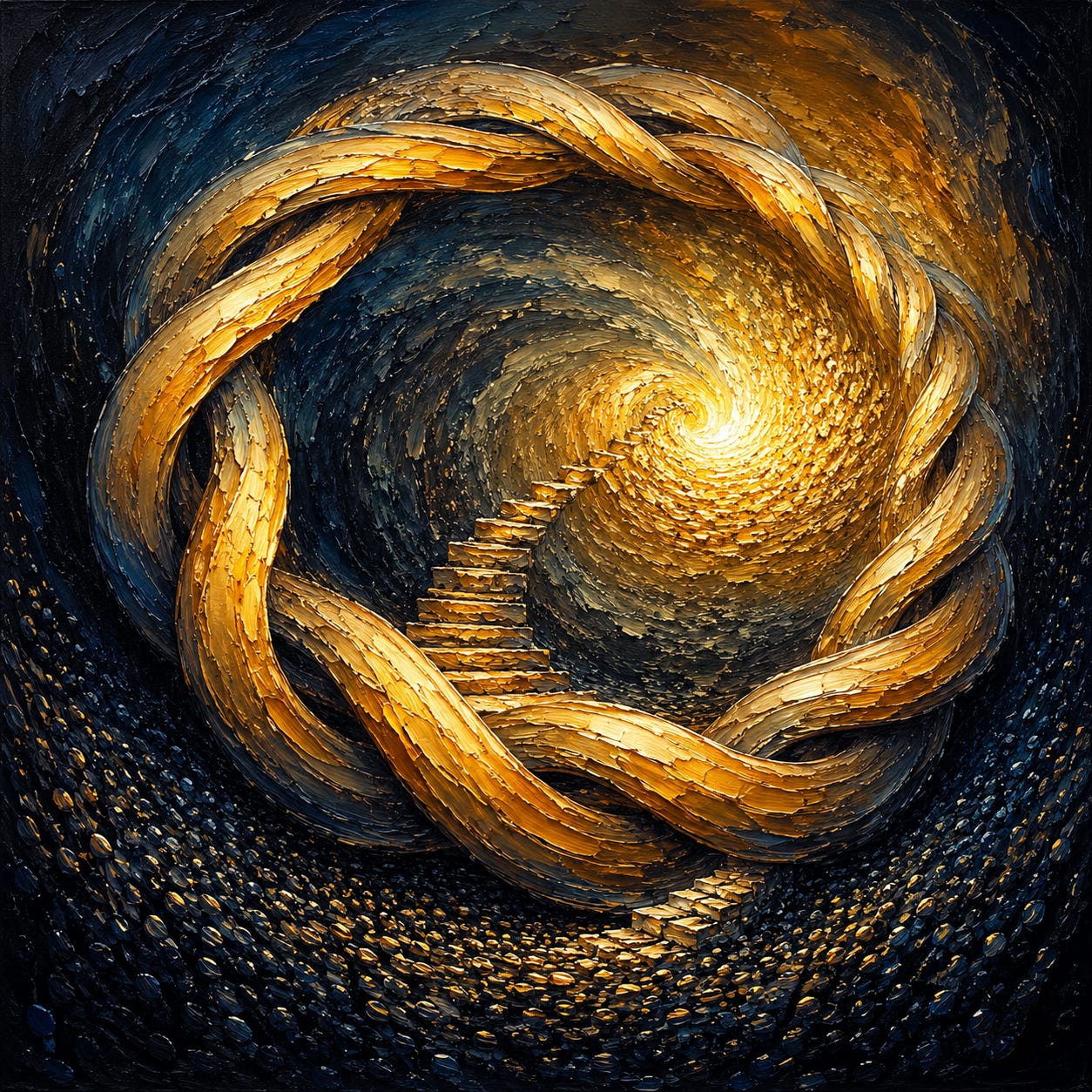
A self is the part of you that says I: the part that means things, makes choices, and knows that it exists. Gödel, Escher, Bach promises that this self can be built out of parts that do none of those things, and it makes the promise so beautifully that readers have spent forty years mistaking it for a revelation.
Your neurons are as mindless as falling dominoes. Your atoms obey blind physics. And yet, the argument goes, when a system becomes rich enough to bend back and refer to itself, to form what Hofstadter calls a strange loop, mind and meaning surface at the higher level, with no soul required and no living spark added in. Gödel found that loop hiding inside arithmetic, where he built a statement that is true but can never be proven. Escher drew it: two hands sketching the hands that sketch them. Bach composed it: a melody that rises forever and lands exactly where it began. Three men, three crafts, one buried shape, and beneath all of it a single claim. The gap between dead matter and a conscious self is nothing more than a pattern that has learned to point at itself.
Douglas Hofstadter wrote it as a young cognitive scientist, and his real lifelong subject is analogy, the question of how a mind sees that two unlike things share a hidden skeleton. It was never the thinking machines for which his book is now waved as scripture. The irony runs deep. Hofstadter is a sharp critic of the AI industry that worships him, and he regards today’s large language models as clever mimics that miss everything he finds interesting about a mind. He is no materialist cheerleader, either. His best chapters set reduction against holism and refuse to declare a winner. An ant colony named Aunt Hillary carries on witty conversations while not one of her ants understands a thing, and her mind turns out to be entirely real and nowhere to be found in any single ant. He is far too subtle to be the reductionist his admirers take him for, which is exactly what makes the worldview he sells so effective.
It arrived in 1979, took the Pulitzer a year later, and was immediately adopted as the sacred text of a particular tribe. From the early AI labs through Silicon Valley’s founder reading lists, it became a credential, the long and dazzling book that certifies you as one of the very clever. Part of the devotion is earned. It takes the daily stuff of the programmer, recursion and self-reference and formal systems, and lifts it into a meditation on consciousness, mathematics, and music. But the deeper reason it is loved by the people building thinking machines is that it underwrites them. If a mind is only a pattern that has learned to point at itself, then a mind can be built, and a book that makes that feel inevitable hands the whole enterprise its philosophical permission slip, at the precise moment vast fortunes have been staked on its being true. The devotion, though, is mostly performed from a distance. This is the most displayed and least finished book on the shelf, its spine uncreased, invoked far more often than it is read. The slogan its admirers walk away with, that mind is computation and life is code, is its surface, not its substance.
The achievement the Pulitzer rewarded was subtler than reductionism. The book makes mechanism beautiful. It wins over the artist, the musician, and the spiritually curious, the readers who would most resist being told they are machinery, by showing them Escher and Bach already at home inside the machine. Its load-bearing analogy is DNA as the source code of life, the genome treated as software that writes both the organism and the hand that copies it. Hofstadter dresses the claim in real nuance, insisting the code means nothing without the cell that reads it, but the headline the culture absorbed survived intact: life is a program. That is the metaphysics on which industrial medicine and reductionist science are built, the frame in which a condition is pronounced innate and closed to any other cause. A revered, beautifully written book that makes that frame feel profound is the most effective advertisement the worldview has ever had, and no one had to pay for it. It threatens no industry and implicates no funder. Books that do the opposite are not crowned.
This summary takes the book at full strength, in its own voice, because a worldview should be met at its most persuasive before it is weighed. Inside you will find a phonograph engineered to destroy itself, which is Gödel’s theorem rendered in plastic; an ant colony that thinks while its ants do not; a strand of chemistry presented as a loop that writes the hand that copies it; and a careful dismantling of the hope that a truth you can see but never prove makes the human mind something more than a machine. Read it, and you will hold what the totem actually contains, and see plainly the worldview being sold by the people who carry the book but have never opened it.
The rest of this summary — the analogy, one-minute elevator explanation, 12-point summary, Q&As, and Golden Nugget — is for paid subscribers.
Your subscription also unlocks every other book summary in the library, the Deep Dive Audio Library, my original books (new ones added monthly), and three series for the moments when a real decision is in front of you: Questions for Your Doctor, Before You Consent, and Package Inserts.