

Michael Gray Griffith’s Goodbye Road stands as the most comprehensive ground-level documentation of Australia’s COVID-era transformation, captured by someone who lost everything for the right to bear witness. The collection spans from September 2021 to March 2025, tracing Griffith’s evolution from censored playwright to the founder of Café Locked Out and, ultimately, to what his editor John Stapleton calls “Australia’s leading contemporary historian.” These essays, drawn from his Epic Deplorables Road Trip across Australia’s forgotten corners, record not just protest movements or policy failures but the precise moment when thousands of Australians discovered their neighbors would have pointed them out to authorities if asked. The book’s power lies not in political analysis but in its accumulation of intimate betrayals: the paramedic with forty years’ experience who saw zero myocarditis cases before the vaccine rollout and now sees them everywhere; the fertility clinic worker who watched miscarriages and stillbirths spike but couldn’t speak; the brother who died days after his second shot, his doctor admitting the cause only in secret.
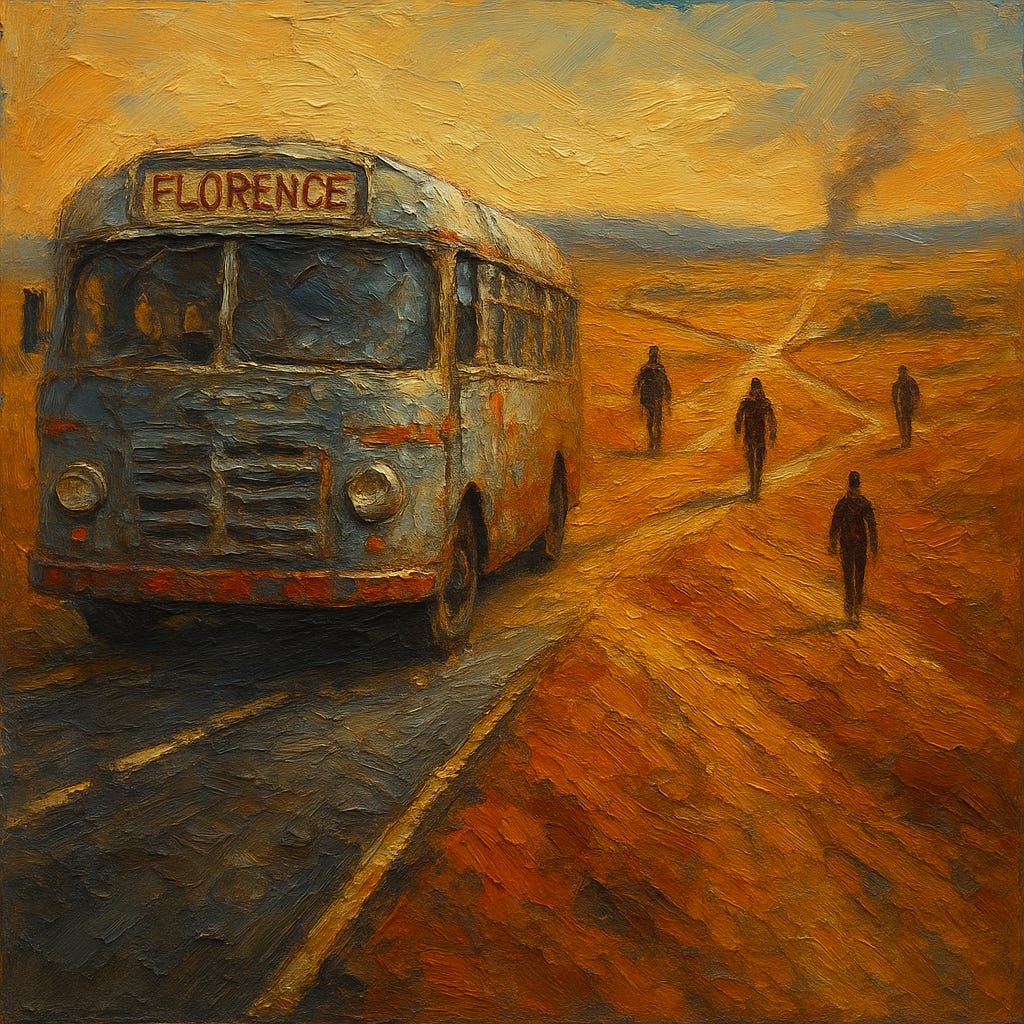
Griffith writes with the urgency of someone processing trauma in real time, parking his bus Florence on beaches and typing out the stories that haunt him before they consume him. His method—he compares it to a paramedic dropping patients at a hospital—creates prose that carries the rawness of testimony rather than the polish of retrospection. In “The Day They Shot Matt Lawson,” he captures the surreal violence of Melbourne’s protests through granular detail: the moment rubber bullets struck a young carpenter, the blood pooling on Flinders Street, the crowd’s shift from disbelief to rage. The essay “Nullarbor Leper” follows his banishment from Western Australia when border guards discovered his unvaccinated status, transforming a simple border crossing into an exploration of how quickly citizenship becomes conditional. Throughout, Griffith maintains what he calls “an orphan’s eye”—the perspective of those cast out finding each other on what he’s dubbed Goodbye Road, the path taken by those who refused compliance and lost their former lives.
The collection’s greatest achievement lies in its preservation of voices that would otherwise vanish into silence. Griffith interviews hundreds of Australians whose stories the mainstream media won’t touch: nurses who faked vaccination records for their families, doctors who secretly admit vaccine injuries while publicly maintaining silence, workers who lost careers spanning decades for refusing a medical procedure. His essay “Australia: The Great Silence” crystallizes this suppression through a single conversation with a paramedic whose brother died after vaccination. The man refuses to go on record, fearing for his family’s employment, yet spends an hour pouring out details that contradict every official narrative—the explosion in myocarditis cases, the young trainees dying suddenly, the fertility clinic overwhelmed with stillbirths. Griffith becomes the repository for these dangerous truths, carrying them in his interviews until he can release them into the world, understanding that without his documentation, these testimonies would die with their witnesses.
The censorship Griffith endured—a ten-year Facebook ban, removal from YouTube, confirmation from Australia’s eSafety Commission that he was being suppressed by a “third party”—paradoxically validates the importance of his work. As he notes, fantasists without influence don’t merit banning; only those who threaten official narratives draw such systematic silencing. This persecution forced him onto alternative platforms and into direct contact with communities across Australia, transforming him from a playwright observing society into a participant-chronicler embedded within a movement. His essays trace this evolution through moments of surprising tenderness: the couple in “Rise, My Brothers, Rise” who offer their farm as sanctuary for protesters, the mechanics who keep Florence running through donations, the thousands who recognize him at markets and beaches, approaching not as fans but as fellow travelers on Goodbye Road. Each encounter reinforces the book’s central insight—that Australia’s freedom movement emerged not from political organizing but from the spontaneous recognition of kinship among the ostracized.
Griffith’s background as a playwright—his work on soldier suicide was used by the Australian Army for prevention training—infuses these essays with theatrical sensibility without sacrificing documentary rigor. He structures revelations for maximum impact, as when “The Pilot” builds slowly from aviation regulations to the moment an experienced captain admits he’s watching colleagues die mysteriously post-vaccination. The essay “Elephants” uses the metaphor of the unspeakable presence in every room to explore how Australians learned to navigate around obvious truths, developing elaborate social choreographies to avoid mentioning vaccine injuries, sudden deaths, or the friends they’d lost to mandates. His finest pieces achieve the compression of stage drama, containing entire social ruptures within single conversations: the mother in “HER Body, OUR Choice” explaining how her daughter’s university threatened expulsion for refusing vaccination; the café owner in “PayPal Bans Café Locked Out” discovering his business account frozen for hosting unvaccinated customers.
Goodbye Road succeeds as both immediate witness testimony and lasting historical document because Griffith understands he’s recording a civilization’s nervous breakdown in real time. The book’s title itself—taken from the path traveled by those expelled from mainstream society—captures how millions of Australians experienced not just job losses or social exclusion but a fundamental severance from their previous lives. In my June 2024 interview with Griffith, he revealed the personal cost of this documentation: shot with rubber bullets at the Shrine of Remembrance, under constant surveillance, living in a bus because conventional employment became impossible. Yet the collection radiates not bitterness but astonishment at the communities that emerged from shared exile. The 8:32 Gatherings he describes—modern corroborees of the displaced—represent something unprecedented in Australian history: a parallel society built by those who discovered, as Griffith writes, that “when we hugged, we hugged like people who’d found someone lost in the wilds.” This is the book’s ultimate achievement—it records not just what Australia lost during its descent into medical authoritarianism, but what the exiled found in each other when they had nothing left to lose.
With thanks to Michael Gray Griffiths.
Goodbye Road - Kindle edition by Griffith, Michael G.

I appreciate you being here.
If you’ve found the content interesting, useful and maybe even helpful, please consider supporting it through a small paid subscription. While 99% of everything here is free, your paid subscription is important as it helps in covering some of the operational costs and supports the continuation of this independent research and journalism work. It also helps keep it free for those that cannot afford to pay.
Please make full use of the Free Libraries.
Unbekoming Interview Library: Great interviews across a spectrum of important topics.
Unbekoming Book Summary Library: Concise summaries of important books.
Stories
I’m always in search of good stories, people with valuable expertise and helpful books. Please don’t hesitate to get in touch at unbekoming@outlook.com
Baseline Human Health
Watch and share this profound 21-minute video to understand and appreciate what health looks like without vaccination.
There are books that one reads and one is not the same having read them. I suspect this will be that sort. I look forward to reading it nevertheless.
Michael occupies already the status of iconic Australian legend - a living standard bearer for ethical integrity, true authenticity and genuine compassion. May his light and courage continue to illuminate covidian injustices, and guide us beyond.
A quality of being to be thankful for, to emulate, as humanity navigates its 'ethics' evolution.
Buy his book !