

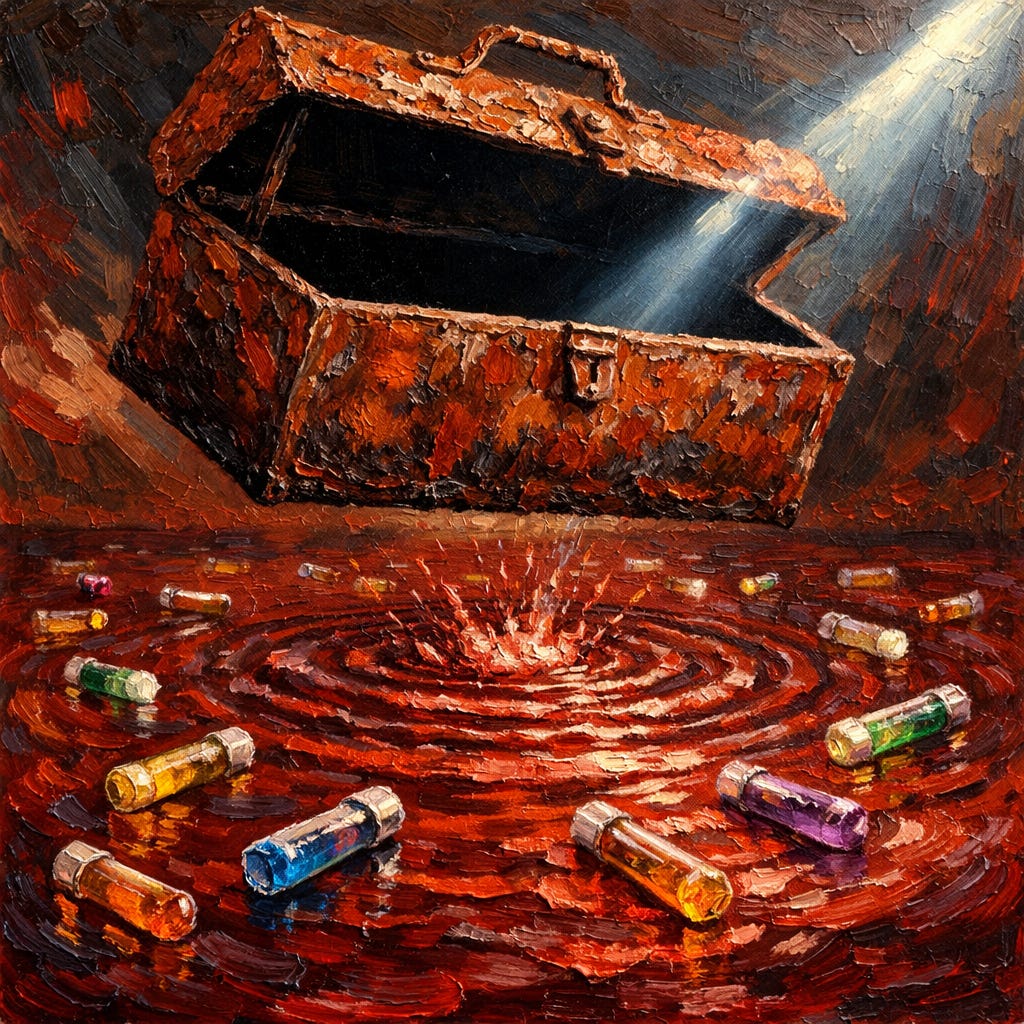
Imagine you hit someone over the head with a toolbox. They develop a sore head, a bump, a headache. You claim the injury was caused by the thumbtacks inside the toolbox.
Not the hammer, not the wrench, not the screwdriver, not the weight of the toolbox itself. The thumbtacks.
Anyone hearing this would say the same thing: that’s absurd. You hit them with the entire toolbox. You have no basis to blame one component, let alone the smallest one. If you wanted to make that claim, you’d need to open the toolbox, find the thumbtacks, remove them from everything else, and hit the person with only the thumbtacks to see if that alone caused the injury.
Now change the analogy slightly. You still hit someone with the toolbox and blamed the thumbtacks — but you also discover that every toolbox ever examined on earth has never been shown to contain a thumbtack. No one has ever opened one and found a thumbtack inside. You’ve blamed a component that has never been demonstrated to exist within the very object you used.¹
That is the state of virology’s claim about blood transfusions and HIV.
Support Independent Investigative Journalism and Research
This work remains free because paid subscribers make it possible. If you find value here, consider joining them.
What paid subscribers get: 1-2 free books per month. e.g. The PSA Trap, Breast Cancer.
Plus: Access to the Deep Dive Audio Library — 180+ in-depth discussions (30-50 min each) exploring the books behind these essays. New discussions added weekly. That’s 100+ hours of content for less than the price of a single audiobook.
[Upgrade to Paid – $5/month or $50/year]
Get in touch Essay ideas, stories, or expertise to share: unbekoming@outlook.com
What You Actually See
A medical practitioner recently posed a question to Dr. Tom Cowan during a Wednesday webinar: how do people contract HIV and Hepatitis C from blood transfusions, if viruses don’t exist?¹
The question contains an assumption so deeply embedded that most people don’t notice it. It assumes that “contracting HIV from a blood transfusion” is an observation — something someone witnessed. It isn’t. It’s an interpretation layered on top of an observation.
Strip away the interpretation and describe only what is observed:
A person who is unwell — perhaps chronically ill, perhaps bleeding from an injury, perhaps fighting cancer — receives blood from another person. That donor may be overtly sick, or may appear healthy but carry markers that suggest otherwise. After the transfusion, some recipients get worse. Some develop new symptoms. Some seem unaffected.¹
That’s the observation. The full observation. Everything beyond this is construction — a story built on top of what was seen.
The construction adds: a virus was present in the donor’s blood. It transferred to the recipient. The virus caused the subsequent illness. Antibody tests confirm the virus was there.
Each layer of that construction collapses under examination.
The Virus That Was Never Found
No HIV particle has ever been purified directly from the blood or any biological fluid of any human being — sick or well.¹ ²
This is not a fringe claim. Christine Massey, a former biostatistician, filed Freedom of Information requests with 225 institutions across 25 countries, asking for records describing the purification of HIV (and other alleged viruses) directly from human samples. Every institution responded the same way: no such records exist.² The CDC’s response was explicit: they do not purify or isolate HIV in the manner described — meaning direct purification from a patient sample.²
When Cowan states that “nobody has ever seen an HIV or a Hep C virus in any blood of any fluid, sick or not,” he is not making a speculative claim.¹ He is describing the documented state of the evidence as confirmed by the institutions responsible for establishing it.
This includes the man credited with discovering HIV. In a 1997 interview with French journalist Djamel Tahi, conducted at the Pasteur Institute and recorded on video, Luc Montagnier admitted that even after “a Roman effort,” electron micrographs of the cell cultures in which HIV was supposedly detected showed no particles with “morphology typical of retroviruses.”¹³ The discoverer of HIV, looking at his own evidence, could not see the virus. All electron micrographs of supposed HIV from the 1980s onward come not from patient blood but from laboratory cell cultures — cells manipulated in a Petri dish for days before imaging.¹³
The standard response is that viruses are too small to find directly and must be detected indirectly — through antibody tests, through PCR-amplified genetic fragments, through cell culture effects. Each of these methods introduces the same fundamental problem: they never establish the independent existence of the thing they claim to detect.
PCR does not find viruses. It amplifies short genetic sequences — fragments that are then assumed to originate from a virus that was never independently verified to exist. Viral load testing, as Cowan notes, “is clearly not testing for a virus. That’s testing for a piece of something which you allege to be from a virus which has never been isolated.”¹
The Antibody Problem
The strongest card in the conventional hand appears to be antibody testing. A person tests “HIV positive,” and this is treated as confirmation of infection. The reasoning is circular: antibodies to HIV are detected, therefore HIV is present.
The circularity becomes visible when you ask a single question: how were these antibodies validated as specific to HIV, if HIV itself has never been purified and characterised as an independent particle?¹
If you have never isolated the virus, you cannot know which proteins belong to it. If you don’t know which proteins belong to it, you cannot design a test that specifically detects antibodies to those proteins. What you have, at best, is a test that detects antibodies to something — and then a story about what that something is.
The non-specificity of HIV antibody testing is not a theoretical objection. Christine Johnson, a science journalist affiliated with the dissident group HEAL Los Angeles, compiled a list — sourced from peer-reviewed literature — of conditions known to produce positive HIV antibody results. Her initial compilation documented over 60 such conditions; subsequent research expanded this to more than 110.³ Cowan cites “66 other conditions” that produce HIV-positive results.¹ The list includes:
Influenza and influenza vaccination.⁴ Pregnancy, particularly in multiparous women.⁵ Autoimmune conditions — lupus, rheumatoid arthritis, scleroderma.⁴ ⁵ Hepatitis, including alcoholic hepatitis.⁴ Tuberculosis, malaria, syphilis.⁴ Multiple blood transfusions.³ Epstein-Barr virus infection.⁶ Kidney and liver disease.⁴ Recent vaccinations of various kinds.⁴ ⁵ And, as documented in 2025 research, SARS-CoV-2 antibodies — with a strong positive correlation between COVID antibody levels and HIV false-positive rates.⁷
Even mainstream literature acknowledges this problem. A 2016 paper in AIDS Research and Therapy detailed the “spectrum of false positivity” for fourth-generation HIV tests, documenting cases where patients with Epstein-Barr infection, liver disease, and metastatic cancer produced reactive HIV screening results that were ultimately confirmed as false positives.⁸ A 2024 case report in ASM Case Reports described a pregnant woman whose HIV-1/2 antigen/antibody screening was reactive and whose confirmatory HIV-1/2 antibody differentiation assay was positive for HIV-1 — yet HIV RNA was undetectable and Western blot analysis showed only “nonspecific background reactivity.”⁹ She did not have HIV. The full diagnostic algorithm had to be exhausted to reach that conclusion.
When a test produces positive results across dozens of unrelated conditions — from pregnancy to flu vaccination to autoimmune disease to cancer — it is not detecting a specific virus. It is detecting a non-specific immune response. As the Perth Group’s Eleni Papadopulos-Eleopulos observed in her interview with Johnson, “AIDS patients are inundated with antibodies to so many different things that a few of these could easily react with two or three of the ten proteins present in the ‘HIV’ test.”¹⁰
Stefan Lanka has advanced the hypothesis that these antibodies may function as repair proteins — substances the body produces in greater quantities when tissue damage is extensive.¹ The more damage, the more repair proteins, which is why sicker people tend to produce more of the substances detected by these tests. The correlation between a positive test and subsequent illness is real. The attribution of that correlation to a specific virus is the construction.
The test manufacturers themselves acknowledge the problem. The Abbott ELISA test kit insert states: “There is no recognized standard for establishing the presence or absence of antibodies to HIV-1 and HIV-2 in human blood.”¹⁴ Thomas Zuck of the FDA warned in 1986 that the antibody tests were not designed specifically to detect HIV. But stopping their use, he admitted at a WHO meeting, was “simply not practical” — public pressure for an HIV test was too strong.¹⁴
HIV antibody testing also reversed a foundational principle of immunology. In every other context, the presence of antibodies indicates that a person has successfully fought off an infectious agent and is now protected. Vaccination theory depends on this interpretation — stimulate antibodies and you’ve achieved immunity. HIV testing inverted this: the same antibody response that everywhere else signals protection was reinterpreted as evidence of an active, fatal infection.¹⁵ Both interpretations cannot be simultaneously correct, yet both are maintained within the same medical system.¹⁶
Return to the Toolbox
Cowan’s toolbox analogy crystallises the logical failure at the centre of the transfusion claim:¹
Blood is the toolbox. It is an extraordinarily complex substance — containing cells, proteins, minerals, metabolic byproducts, whatever the donor ate or ingested, whatever drugs they took, possibly components we haven’t identified and don’t understand. You take this entire complex mixture and inject it into another person.
If the recipient gets sicker, you have observed that injecting one person’s blood into another person can make them worse. You have not observed anything about which component of the blood caused the problem. Blaming the virus — the thumbtack — requires first demonstrating that the thumbtack exists inside the toolbox. That demonstration has never occurred.
Then Cowan extends the analogy to match the actual state of the evidence: imagine you blamed the thumbtacks, but you also checked every toolbox on earth and never found one containing a thumbtack. You’re attributing causation to a component whose existence has never been confirmed within the very substance you’re pointing to.¹
The analogy works because it strips the medical terminology away and reveals the logical structure. Nobody, confronted with the toolbox version, would accept the thumbtack explanation. The moment you translate it back into the language of virology, the same people who rejected the thumbtack argument will accept the HIV argument — not because the logic changed, but because the language became specialised enough to bypass their critical faculties.
The Same Pattern: Hepatitis C
Everything described above for HIV applies with equal force to Hepatitis C — and in some respects the case is even more damning.
Michael Houghton, credited as co-discoverer of HCV, stood before the 8th International HCV Congress in Paris in 2001 and asked: “Where is the hepatitis C virus? Has anybody seen it?”¹⁷ This from the man who supposedly found it. Nobody in the room produced an answer.
The reason nobody could answer is that HCV, like HIV, has never been found in intact form. In 1987, Houghton’s team at the biotechnology company Chiron used PCR to fish out tiny gene fragments from chimpanzee liver tissue — fragments that didn’t appear to belong to the host’s genome — and declared them evidence of a new virus.¹⁷ These snippets existed in such small quantities that they should not have been considered a cause of liver disease. But Chiron built an antibody test from them. The Procleix blood screening test alone generated over $60 million per quarter.¹⁷
The gene sequences classified as belonging to HCV have also been found in people who tested negative on HCV antibody tests.¹⁸ The sequences can only be detected in about half of so-called hepatitis patients.¹⁷ Koch’s first postulate — that the pathogen must be found in every case of the disease — fails at the threshold.
The foundational transmission experiment was conducted in 1978, before HCV had even been named.¹⁷ Researchers took blood from patients assumed to have non-A, non-B hepatitis and injected it into five chimpanzees. None of the animals developed hepatitis. Around the fourteenth week, liver enzyme values rose slightly for a few days — a finding equally interpretable as an immune response to foreign blood. As Claus Köhnlein pointed out in the British Medical Journal, the control should have been five chimpanzees injected with blood from a healthy donor.¹⁷ ¹⁹ Instead, one animal was simply kept in a separate room and observed, without being injected with anything. This is the toolbox experiment — they hit the chimps with the whole toolbox (blood) and couldn’t even produce the injury they expected. And they had no control to distinguish the toolbox from the thumbtack.
A 1999 study in the American Journal of Epidemiology tested whether needle exchange programmes prevent HCV transmission among drug users. The result: addicts who used clean needle programmes tested HCV-positive more often than those without access to clean needles.²⁰ If HCV were transmitted via contaminated blood in needles, clean needles should dramatically reduce transmission. The opposite result points toward the tests detecting something other than a transmitted virus.
The toxicological explanation requires no virus at all. Almost 80% of people who test HCV-positive are drug users.¹⁷ A large American study published in the Annals of Internal Medicine using blood serums drawn and frozen between 1948 and 1954 found practically no difference in subsequent liver disease between HCV-positive and HCV-negative patients.²¹ Those who do develop real liver damage have invariably consumed alcohol and drugs — substances that are directly hepatotoxic. Industrial chemicals known to damage the liver include trichloroethylene, xylene, toluene, and chloroform. Common medications documented as hepatotoxic include paracetamol, aspirin, ibuprofen, and statins.²² The list includes certain antivirals used to treat hepatitis B — drugs prescribed for a liver disease that are themselves liver-damaging.²²
It is not uncommon for HCV-positive individuals to later test negative without any treatment²¹ — a finding that baffles the virus model but makes immediate sense if the tests are detecting non-specific markers of liver stress that resolve when the toxic insult is removed.
In October 2020, Harvey Alter, Charles Rice, and Michael Houghton received the Nobel Prize in Medicine for “seminal discoveries that led to the identification” of HCV.¹⁷ The same Houghton who asked a congress whether anyone had seen the virus. The same pattern as Montagnier’s 2008 Nobel for HIV — institutional validation of a hypothesis that lacks purification evidence.
Blood Makes People Sick — No Virus Required
Medicine has known for over a century that injecting foreign blood into a person can make them ill. The phenomenon was first described in detail by Clemens von Pirquet and Béla Schick in 1905 as serum sickness — a systemic inflammatory reaction to foreign proteins.¹¹ The condition produces fever, joint pain, rash, and lymph node swelling, typically appearing within days to two weeks after exposure.
Transfusion reactions remain a documented category of medical harm. They include acute hemolytic reactions from blood type incompatibility, febrile non-hemolytic reactions from donor cytokines, anaphylactic responses, transfusion-related acute lung injury (TRALI), and circulatory overload.¹² TRALI alone accounted for 18% of acute transfusion fatalities reported to the FDA between 2018 and 2022.¹² Transfusion-associated circulatory overload was the leading cause, at 34%.¹²
None of these reactions require a viral explanation. They occur because blood is immunologically specific to the individual. As Cowan puts it: “Your blood is your own. It’s very specific and individual to you, and it should be only in the direst of emergencies that you accept somebody else’s blood being injected into your body.”¹
When the blood donor is someone with significant health problems — a drug user, an alcoholic, someone with liver disease, someone on multiple pharmaceuticals — the blood carries whatever substances are circulating in that person’s body. Cowan describes the typical profile of people who test positive for these antibodies: “they were basically drug addicts and people who were extraordinarily promiscuous sexually, and they took lots of antibiotics, and they were wasting and some of them were alcoholics... and IV drug abusers and many other things, and had liver problems.”¹ Their blood is not the blood of a healthy person. It is a cocktail of metabolic stress, pharmaceutical residues, and the byproducts of organs under siege.
Inject that blood into someone who is already compromised — already ill enough to require a transfusion — and some of them get worse. Some don’t. The outcome likely depends on the specific condition of both donor and recipient, the nature of what’s in the blood, and factors we don’t fully understand.
The most direct test of the viral transfusion hypothesis is straightforward: did death rates from blood transfusions increase during the supposed HIV epidemic, and did they decrease after HIV screening was introduced? Peter Duesberg — a molecular biologist at Berkeley who accepted HIV’s existence but challenged its causal role — examined this question and found no evidence that transfusion death rates ever rose due to HIV transmission, nor that they declined once the virus was screened from the blood supply.²⁴ If HIV in transfused blood were causing AIDS, both trends should be unmistakable. Neither appeared.
Duesberg’s work introduces an additional layer. Even researchers who accepted HIV as an isolated retrovirus found it functionally absent in patients. On average, only 1 in 500 to 3,000 T-cells in AIDS patients showed evidence of HIV infection. Free virus was essentially undetectable in blood. “Isolation” required culturing millions of white blood cells for weeks, chemically stimulating them, and repeating the process up to fifteen times to coax out a single infectious unit.²⁴ If the virus cannot be found in meaningful quantities even by those who believe in it, the claim that it is destroying the immune system through transfused blood becomes untenable on its own terms — before you even reach the question of whether it exists at all.
The hemophiliac data sharpens this point further. Hemophiliacs who received blood products saw their life expectancy continuously rise from the 1960s through the mid-1980s. Then it reversed. The Darby study, published in Nature in 1995, documented hemophiliac death rates climbing from approximately 1986-87 onward.²³ Orthodox medicine cited this as proof that HIV in the blood supply was killing them. The timeline tells a different story. Since roughly half of the 2,037 severe hemophiliacs in the study were already HIV-positive by 1985, HIV-caused mortality should have been detectable before 1985 if HIV were the cause. It wasn’t. The mortality spike began only after the introduction of HIV testing in 1985 and AZT treatment from 1987.²³ Positive-tested hemophiliacs — regardless of health status — were automatically treated with AZT and other toxic medications. As biologist Paul Philpott observed: “Only one theory can explain why the explosion of hemophiliac mortality should occur only on the heels of HIV testing: the increased mortality was caused by the pharmaceutical drugs.”²³
This points to a pattern that operates beyond transfusions: the diagnostic loop. A person tests positive on a non-specific antibody test. They receive a diagnosis. The diagnosis triggers treatment with toxic medications. The medications produce symptoms — immune suppression, organ damage, wasting. The symptoms are attributed to “disease progression,” confirming the original diagnosis. The test created the disease it claimed to detect.
No viral agent is required to explain any of this.
Beyond Blood: The Broader Specificity Problem
The epistemological problem Cowan identifies — confusing observation with construction — extends well beyond HIV and Hepatitis C. It runs through the entire architecture of modern diagnostic testing.
Blood tests operate on a principle that sounds straightforward: add specific chemical reagents to a blood sample, observe a colour change, and conclude that a particular substance is present at a particular concentration. Cowan, drawing on the work of Dr. Jordan Grant, identifies the gap in this reasoning: the reagents have never been proven to be specific to the molecules they claim to detect.¹
The process works like this: researchers create an artificial substance, find reagents that produce a colour change in its presence, and then apply those same reagents to a blood sample. If a colour change occurs, they conclude the original substance was in the blood. The problem is that the colour change may result from the reagents interacting with any number of other substances in a complex biological fluid. Specificity — the demonstration that the reaction occurs only in the presence of the target molecule — is assumed rather than established.¹
Take cholesterol. You mix a waxy substance with certain reagents and get a colour change. You then mix those same reagents with someone’s blood, get a similar colour change, and declare you’ve measured their cholesterol level. But as Cowan points out, “you’ve never actually purified, isolated, identified cholesterol in the blood, partly because that set of reagents is not actually been proven to be specific for anything, let alone cholesterol, let alone in the blood.”¹ What you’ve demonstrated is that certain chemicals, when mixed with blood, produce a reaction. The specificity of that reaction — the claim that it measures one particular molecule at one particular concentration — is the story, not the observation.
The same logic applies to thyroid testing. A person’s blood produces less colour change than 99 others using a particular set of reagents. The construction: this person has hypothyroidism, a deficiency of thyroid hormone. The observation: this person’s blood reacts differently to certain chemicals. You can give them a substance that changes their symptoms — and that may be useful, practically — but you haven’t proven the test was measuring what you claimed it measured, nor that the substance you gave them worked for the reasons you think.¹
DNA testing follows the same pattern. Reagents are mixed with tissue — a cheek swab, saliva, blood — and a chemical reaction occurs. The reaction is then interpreted as revealing a specific genetic sequence belonging to a specific individual. Cowan is careful here: he doesn’t say the test provides no information. It may. Patterns may emerge from these reactions that carry practical value — potentially even information about family relationships. But the underlying reality remains: “All you know is you’re taking chemicals and mixing it with complex biological samples coming out with a color change, which is not specific, and then making up a story about what that color change means.”¹
The deeper issue Cowan identifies is that we have very little understanding of what a living being is actually made of, in what form substances exist inside living tissue, or how chemicals organise into a living organism. Laboratory tests extract, mix, react, and measure. Each step alters the sample. What you end up measuring may not be what existed in the tissue before you started measuring it. This is not a new concern — it is the observer effect applied to biochemistry — but it is systematically ignored in clinical practice, where test results are treated as direct readouts of biological reality.¹
The distinction between observation and construction matters because the story determines the treatment. If you decide the test proves a specific molecular deficiency, you prescribe a specific molecular replacement. If you recognise the test shows a non-specific difference, you remain open to a wider range of explanations and interventions — dietary changes, detoxification, energy work, emotional processing — that address the person’s condition rather than chasing a number on a lab report.
The Discipline of Seeing
What Cowan is teaching — across this webinar and across his broader body of work — is not primarily a medical argument. It is an epistemological discipline: the practice of separating what you observe from what you construct.¹
“It’s not what you don’t know that gets you,” he says, paraphrasing the aphorism attributed variously to Mark Twain and others. “It’s what you know for sure that just ain’t so.”¹
The discipline is simple to state and difficult to practice. When confronted with a medical scenario — a person gets a blood transfusion and becomes sicker — the trained mind immediately reaches for the explanation it was taught. HIV entered the blood. The virus transferred. The infection progressed. Each step feels like observation, but none of it was observed. What was observed was: blood went in, person got sicker.
The gap between observation and construction is where institutional medicine lives. Not in the observations themselves — which are often accurate — but in the stories attached to them. A person has a cough and fever; the observation is a person has a cough and fever. “They have a viral respiratory infection” is a construction. “The virus is replicating in their lung tissue” is a construction built on a construction.
Medical practitioners are more vulnerable to this conflation than laypeople, not less. Training deepens the conflation by presenting constructions as observations thousands of times across years of education. Cowan acknowledges this directly: when a medical practitioner submitted the transfusion question, he noted that medical training “puts him or her at a handicap. And I would say that’s true. We are more indoctrinated than even the more normal people.”¹
The toolbox analogy is powerful precisely because it operates outside the medical vocabulary that triggers this trained conflation. When you hear “toolbox” and “thumbtack,” your critical thinking remains intact. You can immediately see the logical absurdity. The moment you hear “blood” and “virus,” years of conditioning activate and the same logical absurdity becomes invisible.
This is why Cowan returns to analogies so frequently. They aren’t simplifications. They are escape routes from the specialised language that disables critical thought. “I want everybody to not only to be able to understand this, but I want them to be able to explain it to anybody that they meet.”¹
Closing that gap — relentlessly asking “what did I actually see?” — doesn’t make medicine simpler. It makes it more honest. And honesty, Cowan argues, is the precondition for healing: “The more you rely on that, and the more you do that, the better you get at it, and the more able you are to actually live your life and base your life and have confidence in your life based on your own experience, which is the road to health.”¹
There is something liberating in this practice, and something frightening. Liberating, because it returns authority to your own senses and reasoning. Frightening, because it means accepting how much of what you thought you knew is a story someone else told you — and how many of those stories were never tested against what you could actually see.
The toolbox didn’t contain a thumbtack. The blood was never shown to contain a virus. What we observed was a complex fluid making some sick people sicker. That’s the full finding. Everything else is a story — and the story has never been proven.
References
Cowan, T. Wednesday Webinar, February 18, 2026. Discussion of HIV, Hepatitis C, blood transfusions, blood testing, and the epistemological discipline of separating observation from construction.
Massey, C. Freedom of Information requests to 225+ health and science institutions across 25+ countries regarding purification/isolation records for SARS-CoV-2, HIV, HPV, and other alleged viruses. Compiled at fluoridefreepeel.ca. CDC FOIA response via Roger Andoh, Office of the Chief Operating Officer.
Johnson, C. “Whose Antibodies Are They Anyway?” Continuum, Sept/Oct 1996. Republished in Townsend Letter for Doctors and Patients, December 1998: 26-27. Initial compilation of 60+ conditions; subsequent research by Johnson and others expanded to 110+, as documented by Timothy Jay Garland’s presentation to MENSA referencing Johnson’s work via the Immunity Resource Foundation.
“What Diseases Can Cause a False-Positive HIV Test?” Prime Infusions, March 2025. Reviewing cross-reactivity from autoimmune disorders, infections (tuberculosis, malaria, syphilis, Lyme disease), vaccinations, and renal/hepatic dysfunction.
“Navigating False Positive HIV Test Results: A Case Report.” ASM Case Reports, 2024. Documenting false-positive HIV-1/2 Ag/Ab screening and differentiation assay results in a pregnant woman, with discussion of biological causes including alloantibodies in pregnancy and autoimmune cross-reactivity.
“Acute EBV Infection and HIV Antibody Cross-Reactivity in a First Time Donor.” Hematology & Transfusion International Journal, December 2015. Documenting a blood donor with acute Epstein-Barr infection producing a highly positive HIV antibody test, confirmed false positive by Western Blot and nucleic acid testing.
Wang, W. et al. “Cross-reactivity mediated by SARS-CoV-2 antibodies: Mechanism and impact of elevated HIV ELISA false-positive rates in the late-phase COVID-19 pandemic.” ScienceDirect, August 2025. Documenting strong positive correlation (P<0.01) between SARS-CoV-2 antibody levels and HIV ELISA false-positive rates.
Liu, P., Jackson, P., Shaw, N. “Spectrum of False Positivity for the Fourth Generation Human Immunodeficiency Virus Diagnostic Tests.” AIDS Research and Therapy, 2016; 13:1. Documenting false-positive results associated with Epstein-Barr viremia, liver disease, and malignancy.
“Navigating False Positive HIV Test Results.” ASM Case Reports, 2024. 10.1128/asmcr.00097-24. Documenting a case where both HIV-1/2 Ag/Ab screening and HIV-1/2 antibody differentiation assay were positive, yet HIV RNA was undetectable and Western blot showed only gp160 cross-reactivity.
Papadopulos-Eleopulos, E. Interview with Christine Johnson. Published at immunity.org.uk and subsequently reproduced in various formats. Discussion of antibody non-specificity, the Perth Group’s analysis of HIV isolation claims, and the cross-reactivity of mycobacterial and yeast antibodies with HIV test proteins.
von Pirquet, C. and Schick, B. Die Serumkrankheit (Serum Sickness), 1905. First detailed description of immune complex hypersensitivity reactions to foreign serum proteins.
Medscape. “Transfusion Reactions: Background, Pathophysiology, Etiology.” Emedicine.medscape.com. Documenting TRALI (18% of acute transfusion fatalities, FY2018-2022), TACO (34% of acute transfusion fatalities), and the full spectrum of hemolytic, febrile, allergic, and anaphylactic transfusion reactions.
Tahi, D. Interview with Luc Montagnier. Continuum, 1997. Conducted at the Pasteur Institute, recorded on video. Montagnier’s admission regarding the absence of retroviral morphology in electron micrographs of HIV cell cultures.
Engelbrecht, T.; Köhnlein, C.; Bailey, S. et al. Virus Mania, 3rd ed., 2021. Chapter 3 (HIV/AIDS). Documenting the Abbott ELISA test kit insert statement; Thomas Zuck’s 1986 FDA admission at WHO meeting. Also citing: Hodgkinson, N. “HIV diagnosis: a ludicrous case of circular reasoning,” The Business online, 16 May 2004.
Duesberg, P.; Koehnlein, C.; Rasnick, D. “The Chemical Bases of the Various AIDS Epidemics.” Journal of Biosciences, June 2003, p. 390. Discussion of the inversion of traditional immunological interpretation in HIV antibody testing.
Lester, D.; Parker, D. What Really Makes You Ill?, 2019. Chapter 4. Analysis of the mutually exclusive interpretations of antibody presence in conventional immunology vs. HIV testing. Also citing: Bauer, H. “HIV Tests Are Not HIV Tests.”
Engelbrecht, T.; Köhnlein, C.; Bailey, S. et al. Virus Mania, 3rd ed., 2021. Chapter 4 (Hepatitis C). Documenting: Houghton’s question at 8th International HCV Congress, Paris, 2001; the 1987 Chiron gene fragment methodology; the 1978 chimpanzee experiment (Alter et al., The Lancet, March 1978); Koch’s postulates failure for HCV; the drug user profile of HCV-positive patients. Also citing: Crowe, D. “The ABCs of Hepatitis,” Alive Magazine, May 2004.
Chen, Z. “Hepatitis C virus (HCV) specific sequences are demonstrable in the DNA fraction of peripheral blood mononuclear cells from healthy, anti-HCV antibody-negative individuals.” European Journal of Clinical Chemistry and Clinical Biochemistry, December 1997, pp. 899-905.
Köhnlein, C. “Hepatitis C—the epidemic that never was?” BMJ (online), 7 March 2002. Also cited in: Gober, M. An End to Upside Down Medicine, 2023.
Hagan, H. “Syringe exchange and risk of infection with hepatitis B and C viruses.” American Journal of Epidemiology, 1 February 1999, pp. 203-213.
Thomas, D. “The natural history of hepatitis C virus infection.” JAMA, 26 July 2000, p. 450. Also: Annals of Internal Medicine, 2000 — study using blood serums drawn and frozen between 1948 and 1954.
Lester, D.; Parker, D. What Really Makes You Ill?, 2019. Chapter on hepatitis and hepatotoxic substances. Citing June 2012 article “Toxic hepatitis in occupational exposure to solvents.” Documentation of hepatotoxicity of paracetamol, aspirin, ibuprofen, statins, and certain antivirals including tenofovir.
Darby, S. “Mortality before and after HIV infection in the complete UK population of haemophiliacs.” Nature, 7 September 1995, pp. 79-82. Also: Duesberg, P.; Koehnlein, C.; Rasnick, D. Journal of Biosciences, June 2003. Philpott’s analysis cited in: Engelbrecht, T. et al. Virus Mania, 3rd ed., 2021, Chapter 3.
Duesberg, P. Inventing the AIDS Virus, 1996. Documenting: the absence of increased transfusion death rates during the HIV era and absence of decreased death rates after HIV screening; the scarcity of HIV in AIDS patients (1 in 500-3,000 T-cells infected; free virus undetectable); the requirement for weeks of cell culture and chemical stimulation to “isolate” HIV from patient samples. Duesberg accepted HIV’s existence as an isolated retrovirus but challenged its causal role in AIDS.
New Biology Clinic
For those of you looking for practitioners who actually understand terrain medicine and the principles we explore here, I want to share something valuable. Dr. Tom Cowan—whose books and podcasts have shaped much of my own thinking about health—has created the New Biology Clinic, a virtual practice staffed by wellness specialists who operate from the same foundational understanding. This isn’t about symptom suppression or the conventional model. It’s about personalized guidance rooted in how living systems actually work. The clinic offers individual and family memberships that include not just private consults, but group sessions covering movement, nutrition, breathwork, biofield tuning, and more. Everything is virtual, making it accessible wherever you are. If you’ve been searching for practitioners who won’t look at you blankly when you mention structured water or the importance of the extracellular matrix, this is worth exploring. Use discount code “Unbekoming” to get $100 off the member activation fee. You can learn more and sign up at newbiologyclinic.com
🤣🎭 PEER REVIEW PANEL 🎭🤣
(A completely fictional satire. Any resemblance to the pseudoscience of viroLIEgy is purely intentional…)
🧑⚖️ CHAIRPERSON:
Alright everyone, welcome to today’s peer review. We’re here to assess whether this paper has proved the existence of a virus. Gloves off, brains on… theoretically 🧠✨
🧑🔬 viroLIEgist:
Thank you. As you can see from Figure 3, we isolated the virus.
🧑⚖️ CHAIRPERSON:
Excellent. How did you isolate it?
🧑🔬 viroLIEgist:
We mixed lung fluid, antibiotics, antifungals, starvation media, and monkey kidney cells together 🧫🐒💥
🧑⚖️ REVIEWER A:
So… you didn’t isolate anything.
🧑🔬 viroLIEgist:
No no, you misunderstand. Isolation now means “putting things together.”
🧑⚖️ REVIEWER B:
Ah yes, like isolating a giraffe by throwing it into a zoo 🦒🏟️
🧑⚖️ CHAIRPERSON:
Please continue.
🧑🔬 viroLIEgist:
After poisoning the monkey kidney cells until they died 💀 we declared the cytopathic effect as proof of a virus.
🧑⚖️ REVIEWER A:
Did you run controls where you poisoned the cells without patient material?
🧑🔬 viroLIEgist:
That would be unethical.
🧧♂️ ETHICS OBSERVER:
Unethical… to do science?
🧑🔬 viroLIEgist:
Exactly.
🧑⚖️ CHAIRPERSON:
And how did you confirm the virus caused the cell death?
🧑🔬 viroLIEgist:
Because the cells died.
🧑⚖️ REVIEWER B:
From antibiotics, starvation, toxic media, and mechanical stress?
🧑🔬 viroLIEgist:
Yes. That’s how viruses work 🦠😌
🧑⚖️ REVIEWER A:
Did healthy samples undergo the same process?
🧑🔬 viroLIEgist:
No, that would undermine the narrative.
🧑⚖️ CHAIRPERSON:
Very honest. Continue.
🧑🔬 viroLIEgist:
Here are our TEM images 📸
As you can see, the virus is clearly present.
🧑⚖️ REVIEWER B:
I see grey blobs.
🧑🔬 viroLIEgist:
Look again — we added arrows 🔺🔻➡️
🧑⚖️ REVIEWER A:
Those arrows are pointing at the cellular debris of the monkey kidney cells you poisoned.
🧑🔬 viroLIEgist:
Correct. That’s what the virus looks like.
🧑⚖️ REVIEWER B:
Those same structures are revealed in healthy cells when exposed to the toxic exposures of your protocol.
🧑🔬 viroLIEgist:
Only because the virus is hiding.
🧑⚖️ CHAIRPERSON:
What about Koch’s postulates?
🧑🔬 ALL viroLIEgists (IN UNISON):
OBSOLETE 😡🔥
🧑⚖️ REVIEWER B:
Because they fail?
🧑🔬 viroLIEgist:
Because they ask for evidence.
🧑⚖️ REVIEWER A:
Did you ever demonstrate the virus alone causing disease in a healthy host?
🧑🔬 viroLIEgist:
No — but we injected the toxic monkey kidney cell culture directly into the organs of lab animals to prove poisons can be transmitted via syringe 💉🐀
🧑⚖️ REVIEWER B:
So you poisoned animals, observed predictable injury, and called it viral transmission?
🧑🔬 viroLIEgist:
That circular reasoning is the cornerstone of viroLIEgy.
🧑⚖️ CHAIRPERSON:
And?
🧑🔬 viroLIEgist:
It’s peer reviewed.
🧧♂️ BIOSECURITY LIAISON:
Before we vote, can this paper justify emergency powers, injections, and surveillance? 🏛️💉📡
🧑🔬 viroLIEgist:
Absolutely.
🧑⚖️ CHAIRPERSON:
Then I see no problems here.
🧑⚖️ REVIEWER A:
But there’s no isolation, no controls, no causation, and no proof.
🧑⚖️ CHAIRPERSON:
Correct.
Motion to approve?
🧑🔬 ALL:
APPROVED ✅👏👏👏
🧑⚖️ CHAIRPERSON:
Excellent work, everyone. Another virus proven — not by evidence, but by consensus, arrows, and exhaustive avoidance of the scientific method 😌🔺🦠
Once again a fascinating essay. I zeroed in on the brief cholesterol measurement piece. What is really being measured. I’ve consistently had “ High cholesterol” for decades. Yet no symptoms, and various tests EKG, etc, showed my heart is working well, but MDs keep trying to twist this into a story that I need to take statins to reduce a magical number.