

A man in his twenties lies in a caravan at the edge of a paddock in the Australian rainforest. His foot is swollen like a red balloon. A red line travels up his leg toward his groin. He smokes marijuana to dull the pain.
Three days earlier, he was sickling grass barefoot. The blade went into the back of his ankle. The wound sealed on the outside but never healed underneath—the precise condition in which tetanus flourishes. There is a horse in the paddock. He is waiting for nature to heal him.
Barbara O’Neill gets the call. She sees immediately that the marijuana is the problem within the problem. Pain is information. Pain tells you to do something. By dulling it, he has silenced the messenger while the message grows more urgent.
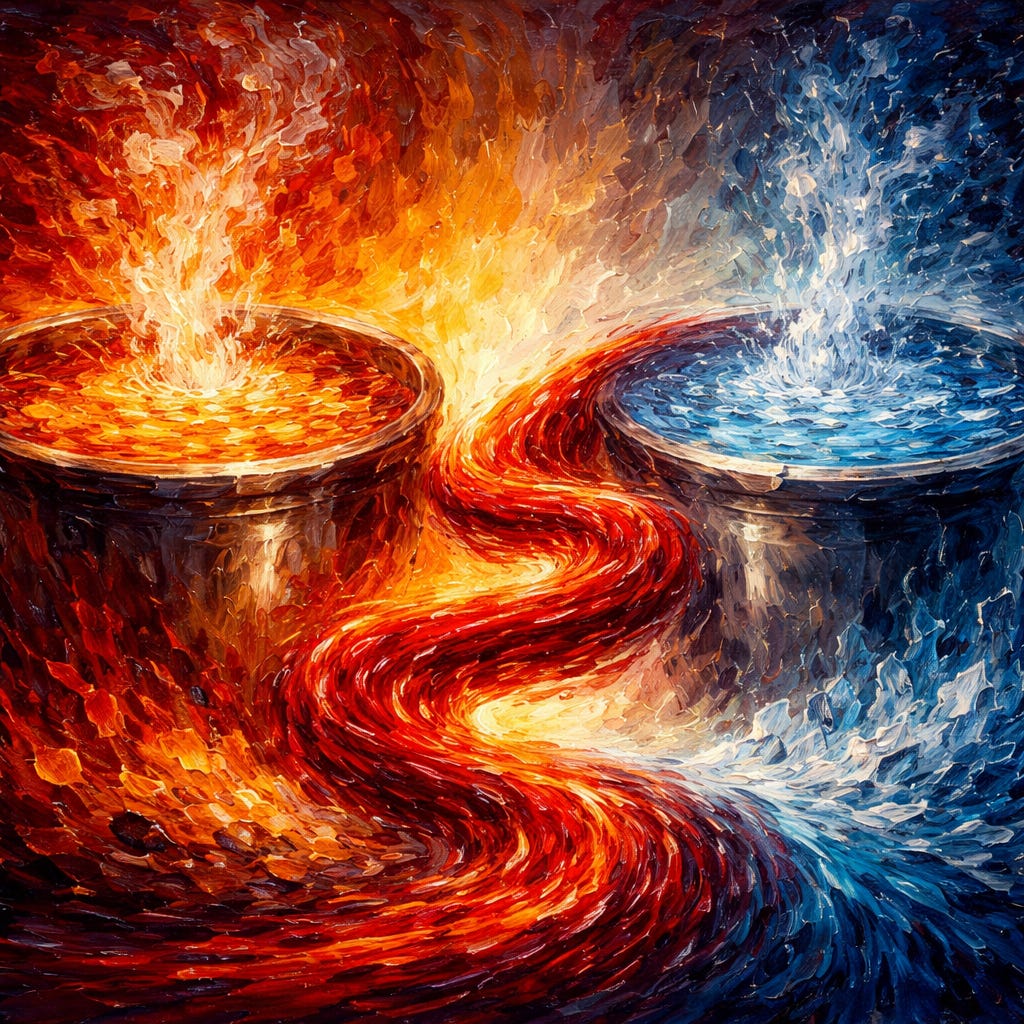
She does not reach for antibiotics. She reaches for two buckets.
Support Independent Research
This work remains free because paid subscribers make it possible. If you find value here, consider joining them.
What paid subscribers get: Access to the Deep Dive Audio Library — 180+ in-depth discussions (30-50 min each) exploring the books behind these essays. New discussions added weekly. That’s 100+ hours of content for less than the price of a single audiobook.
[Upgrade to Paid – $5/month or $50/year]
Get in touch Essay ideas, stories, or expertise to share: unbekoming@outlook.com
One bucket holds water as hot as he can bear. The other holds ice water. His foot goes into the hot for three minutes. Then into the cold for thirty seconds. Three cycles.
By the end, his pain has reduced by fifty percent.
Heat dilates blood vessels. Cold constricts them. Alternate between the two and you create a pumping action—hot opens the vessels wide, flooding the area with fresh blood; cold clamps down, pushing the old blood out. In an injury, blood pools and stagnates. Two problems compound: fresh blood stops arriving, and old blood sits there accumulating waste. The contrast solves both. Fresh blood carries oxygen, nutrients, white blood cells. It carries debris away. Three minutes allows full dilation. Thirty seconds constricts without triggering shutdown. Three cycles drives the exchange deep.
“The life of the flesh is in the blood,” O’Neill quotes from Leviticus. Everything she teaches flows from this. If blood moves, healing happens. If blood stagnates, problems compound. The body does not need to be taught how to heal. It needs circulation restored.
After the first round, O’Neill applies a grated potato poultice to the man’s foot—a drawer that pulls waste through the skin. She tells him to come back in two hours.
When he returns, he can limp. Before, he could not walk. The wound is oozing. The sealed surface has opened; what was trapped inside is coming out. The red line has retreated four inches.
If the pain were unchanged, if the red line were still advancing, she would send him to the hospital. She says this explicitly: “If in doubt, we’d take him straight to hospital. If he didn’t want to go and we could see he was dying, we’d take him of course.”
The body is responding. So she continues.
Another round of hot and cold. Another potato poultice. He returns at six o’clock. The line has retreated further. More contrast therapy. Another poultice overnight. By morning, the red line is gone. The foot looks like a dried prune—wrinkled from hours under moist poultices—but the swelling has resolved.
No antibiotics. No hospital. No tetanus shot. Two buckets of water, a potato, and the body’s own machinery doing what it does when someone restores the conditions for it to work.
A twenty-five-year-old man sits in front of O’Neill. Newly married, wife pregnant with their first child. He has an anal fissure. He can barely walk. He can barely sit.
The doctors have already inserted a rubber loop between the fissure and the anus—the first in a planned series of operations. One intervention leads to complications requiring another intervention. Scar tissue builds. Function degrades. The sequence runs toward removing sections of the colon, toward a colostomy bag, toward a hole in the abdomen with a pouch attached. He is twenty-five years old.
She prescribes sitz baths.
Two tubs large enough to sit in. One hot, one cold with ice cubes. He sits in the hot for three minutes—water up to his waist, the affected area submerged. Then into the cold for thirty seconds. Three cycles. Every night.
The same pumping action that saved the rainforest hippie’s leg now works on the internal tissues of the pelvic floor. Fresh blood floods the damaged fissure. Waste flushes out. The tissue gets what it needs to heal: oxygen, nutrients, movement.
“How long will that take?” she asks him. “Ten minutes. You just got to have the tubs. You just got to make an appointment with yourself.”
Combined with dietary changes—eliminating wheat, dairy, and refined sugar; adding slippery elm to soothe the intestinal lining—the sitz baths offer a way off the surgical conveyor belt. “I said if I was you I’d put all that on hold and try this,” O’Neill tells him. “The body’s designed to heal itself, and it will heal itself if you give it the right conditions.”
He agrees. His wife is pregnant. He has reasons to try.
The timing matters.
Three minutes in hot water allows full vasodilation—the vessels open as wide as they will go. After three minutes, the effect plateaus and blood slows. Thirty seconds in cold triggers vasoconstriction without causing the body to mount a defensive response. You want the squeeze, not the shutdown. Three cycles is the threshold where cumulative effect produces measurable change—the fifty percent pain reduction O’Neill observes repeatedly.
While the foot or body is in the cold, add more hot water to the hot bucket. The hot water cools during the treatment; the preparation happens during the cold phase so it’s ready for the next cycle.
Watch the face. O’Neill emphasizes this when working with others. The first immersion can be intense. Keep your hand on their foot. Watch their expression. If it’s too hot, add cold water. As hot as they can comfortably bear—not scalding, not tepid. Discomfort is acceptable. Tissue damage is not.
Hot and cold contrast restores circulation. Poultices continue the work between sessions. O’Neill sequences them: contrast therapy first, then a poultice overnight.
For the sickle wound, the potato poultice draws debris through the skin while the man rests. Potato is for tissue inflammation—cooling, gentle, safe on sensitive areas. For joint inflammation—arthritis, gout, a sore lower back—ginger is the poultice of choice. Ginger pulls inflammation from the joint to the skin, generating heat in the process.
In her son William’s case—a splinter embedded deep in his foot that resisted weeks of nightly potato poultices—O’Neill escalated. Hot and cold in the mornings. Poultice during the day. Hot and cold in the evening. Fresh poultice overnight. After two and a half days of this intensified protocol, the wood surfaced through softened skin and emerged.
If results aren’t coming, do it harder. Do it more often. The body responds to persistent effort. If it doesn’t respond—if the red line keeps advancing, if the pain keeps intensifying, if the swelling won’t reduce—then you’ve reached the limits of what these methods address, and you go to the hospital.
People with peripheral neuropathy or chronically cold feet cannot do hot and cold contrast on their extremities. No sensation means no ability to gauge temperature. Numb feet in hot water means burns they don’t feel happening.
O’Neill recommends cayenne pepper compresses instead: olive oil spread on paper towel, half a teaspoon of cayenne sprinkled on top, the foot placed directly onto the compress and wrapped overnight with cling wrap and a sock. Cayenne stimulates blood flow without requiring temperature sensation. Someone with good circulation wakes with feet almost too hot. Someone with poor circulation may need several nights before feeling the first tingles of returning sensation.
Any part of the body that stays cold is a part where blood isn’t flowing. Where blood doesn’t flow, tissues starve, nerves die, gangrene follows. The cayenne compress works on the same principle as the contrast therapy: move the blood.
Every home has what’s needed. Two buckets for extremities. Two tubs for sitz baths. Hot water, ice, ten minutes.
For extremity treatment—feet, hands, elbows—fill one bucket with water as hot as tolerable, one with ice water. Submerge the affected area in hot for three minutes, cold for thirty seconds. Repeat three times. Add hot water during the cold phase to maintain temperature.
For sitz baths—hemorrhoids, fissures, prostate conditions, pelvic floor issues—two tubs or basins large enough to sit in. Same protocol: three minutes hot, thirty seconds cold, three cycles. Water up to the waist, affected area fully submerged.
Daily for chronic conditions. Multiple sessions per day for acute ones. Follow with a poultice—potato for tissue inflammation, ginger for joints. Restored circulation plus targeted drawing action compounds overnight.
What happened to the man with the sickle wound would, in a hospital, be called recovery from lymphangitis—a medical emergency indicating infection spreading toward the lymph nodes. Standard treatment: IV antibiotics, possible surgical debridement, hospital admission.
O’Neill restored the conditions under which the body clears its own debris. Fresh blood in, old blood out. The white blood cells were always there. The immune system was functional. What was missing was movement. The wound had sealed over stagnant tissue. The marijuana had dulled the pain that would have driven him to act. Everything was stuck.
Two buckets got it moving.
When facing a health crisis, ask whether the proposed intervention works with the body’s healing mechanisms or bypasses them. Surgery cuts. Antibiotics kill without discrimination. Painkillers silence the messenger.
Two buckets. Hot water. Ice water. Three minutes. Thirty seconds. Three times.
The body knows what to do.
Barbara O’Neill spent decades running Misty Mountain Health Retreat in Australia, teaching principles she learned raising six children in rainforest isolation, far from doctors, studying traditional remedies and the body’s capacity to heal itself. Her lectures have reached hundreds of thousands through YouTube. Her book, Self Heal By Design, documents the framework. Hot and cold contrast therapy flows from her central premise: perfect health requires perfect circulation, and circulation can be restored with nothing more than water and attention.
References
O’Neill, Barbara. Self Heal By Design: The Role of Micro-Organisms for Health. Fourth edition, Bellbrook, NSW, 2017.
O’Neill, Barbara. “Natural Remedies.” Lecture, Misty Mountain Health Retreat. YouTube, February 3, 2018.
O’Neill, Barbara. “Home Remedies.” Lecture, Misty Mountain Health Retreat.
O’Neill, Barbara. “Simple Home Remedies.” Lecture, Misty Mountain Health Retreat.
O’Neill, Barbara. “Caring For The Gut.” Lecture, Misty Mountain Health Retreat.
O’Neill, Barbara. “The Use of Water.” Lecture, Misty Mountain Health Retreat.
Book: Medicalized Motherhood: From First Pill to Permanent Patient
Available as a free download. 123 interventions documented across six phases—from pre-conception capture through postpartum surveillance. Includes practical tools: birth plan template, provider interview questions, quick reference card, and a new chapter on interrupting the cascade. Download it, share it with someone facing their first prenatal appointment, their induction date, their cesarean recommendation. The cascade works because women don’t see it coming. This book makes it visible.
Support Independent Research
This work remains free because paid subscribers make it possible. If you find value here, consider joining them.
What paid subscribers get: Access to the Deep Dive Audio Library — 180+ in-depth discussions (30-50 min each) exploring the books behind these essays. New discussions added weekly. That’s 100+ hours of content for less than the price of a single audiobook.
[Upgrade to Paid – $5/month or $50/year]
Get in touch Essay ideas, stories, or expertise to share: unbekoming@outlook.com
New Biology Clinic
For those of you looking for practitioners who actually understand terrain medicine and the principles we explore here, I want to share something valuable. Dr. Tom Cowan—whose books and podcasts have shaped much of my own thinking about health—has created the New Biology Clinic, a virtual practice staffed by wellness specialists who operate from the same foundational understanding. This isn’t about symptom suppression or the conventional model. It’s about personalized guidance rooted in how living systems actually work. The clinic offers individual and family memberships that include not just private consults, but group sessions covering movement, nutrition, breathwork, biofield tuning, and more. Everything is virtual, making it accessible wherever you are. If you’ve been searching for practitioners who won’t look at you blankly when you mention structured water or the importance of the extracellular matrix, this is worth exploring. Use discount code “Unbekoming” to get $100 off the member activation fee. You can learn more and sign up at newbiologyclinic.com
This tracks with my personal experience of sunburn. Years ago I intuited a treatment that has never failed me: ASAP get into the shower under water as hot as I can take, for as long as I can take. The contrast is simply room temperature.
Great post, TYVM.
What a fantastic approach! A great elaboration, too.
I use hot and cold somewhat, but mostly hot.
I use far infrared lamps extensively, both at home and in treating patients with pain. They provide stronger therapeutic effects than a hot bath can achieve, though alternating hot and cold ais a great idea. This is really the folk medicine of many countries.
Far infrared penetrates up to 5 cm into tissues. It also boosts nitric oxide production, which acts not only as a vasodilator and muscle relaxant but also provides anti-inflammatory and analgesic effects. Mitochondrial function improves as well, promoting overall body relaxation. Microcirculation improves greatly.
When my son crashed into a skip (a huge metal structure) while speeding downhill on his bike, he suffered severe thigh injuries. The accident cut his thigh muscles, damaged bone and tendons (though nothing broke), and created an enormous hematoma that turned his leg purple with no function. He couldn't walk. Agony of pain.
Doctors prescribed painkillers, and a physiotherapist predicted 12-15 monthsfor recovery. Instead, after one month bedridden (walking impossible), 1.5 months on crutches, and two weeks of walking, he was skiing with his school and even doing ski jumps with no pain and function restored.
His rapid recovery came from daily far infrared therapy (3–4 hours) plus herbs to clear damaged tissue debris and rebuild muscle, tendons, and bone. That was impressive to see actually.
When my children were young and had frequent sports injuries, wounds typically healed in 2–3 days,unless school staff applied too many ice packs, which is standard here. Ice numbs pain but causes vasoconstriction, slowing healing dramatically.
Why do I write all this? Far infrared lamp, the ones used in Chinese medicine (TDP lamps, medicinal), are easy to buy. they are bulky and not the cheapest (150-250 pounds), but they are easy to use (switch on or off) and last for a family for a lifetime. Of course, alternating hot and cold baths can be used anywhere, and are great.