

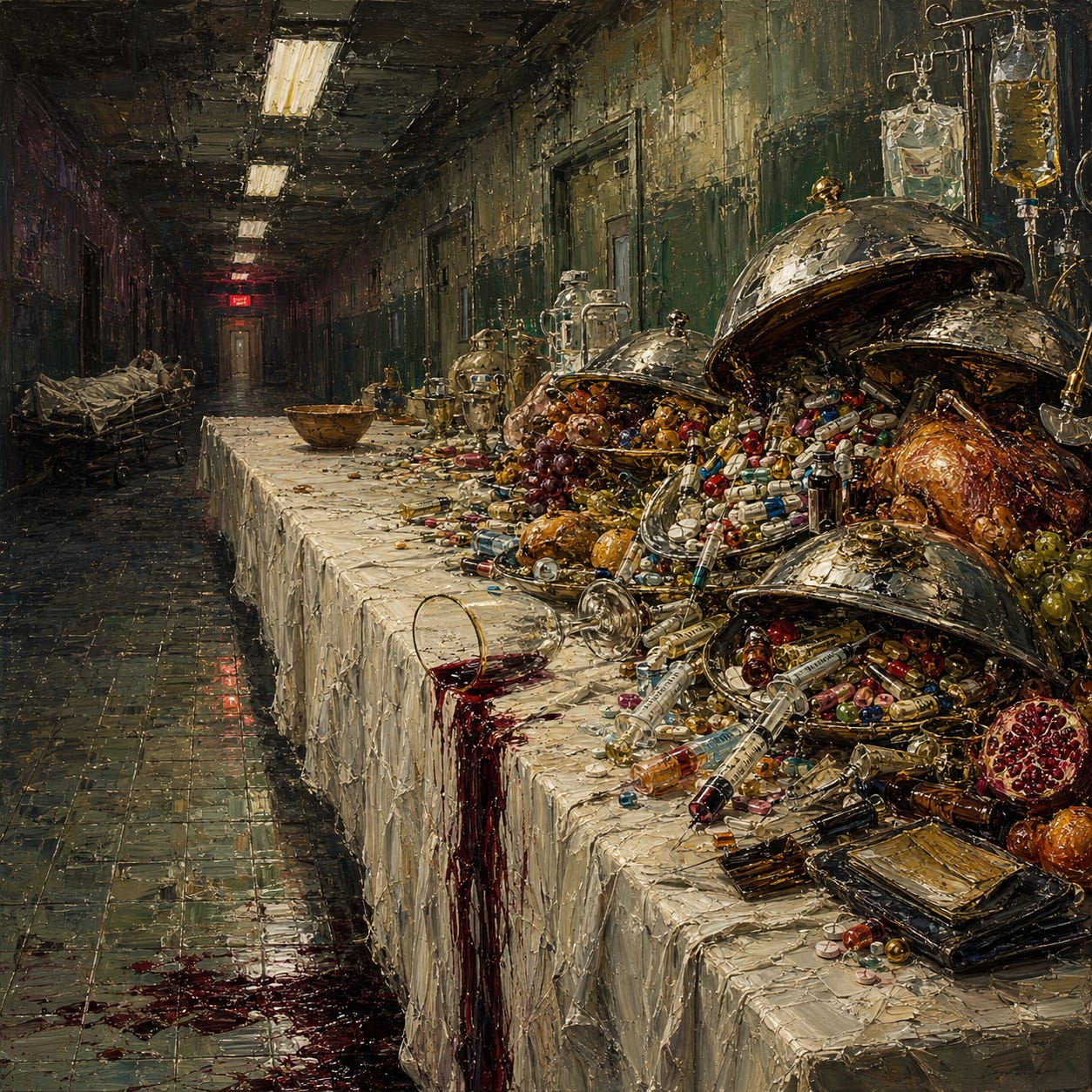
Between 1996 and 2009, about $37 billion in the United States went to two drugs — Procrit and Aranesp — that were prescribed to hundreds of thousands of cancer patients on the strength of pooled data from six studies of 131 patients total. The drugs were marketed as providing “strength for living,” a claim their FDA labels never supported. When a German radiation therapist named Michael Henke ran a proper trial in 1997, he discovered the drugs accelerated tumor growth. When the 939-patient BEST trial confirmed the finding in 2003, the trial’s own principal investigator published a piece in Lancet Oncology urging colleagues to disregard the data — an act unprecedented in medical literature. Academic centers stopped prescribing. Private practices did not. Sales continued. This is the operating pattern of American oncology, and the pattern is what Otis Webb Brawley documents in How We Do Harm (2011), through nine patient stories, a dozen drug and technology case studies, and the institutional history that produced them.
Brawley is a medical oncologist trained at Case Western Reserve, the National Cancer Institute, and the National Naval Medical Center. He was founding director of the Grady Memorial Hospital cancer center in Atlanta, chief medical officer of the American Cancer Society from 2007, and a faculty member at Emory. His additional training is in epidemiology and biostatistics — the disciplines that let him distinguish survival from mortality in prostate-cancer screening arguments where most of his colleagues cannot. He co-authored the specialty’s first-ever board-certification exam alongside John Ultmann, his mentor at the University of Chicago. His research at the American Cancer Society produced the finding that Americans without insurance or on Medicaid are 1.6 times more likely to die within five years of a cancer diagnosis than those with private insurance. He is writing from inside the profession he describes.
The book appeared in 2011, three years after the FDA’s revised restrictions on the ESAs Lilla Romeo received 221½ doses of, two years after the 2009 U.S. Preventive Services Task Force mammography statement that triggered nationwide outrage, and a decade after the collapse of bone marrow transplantation for breast cancer — a procedure that had killed women on the strength of Werner Bezwoda’s fabricated South African data, defended by lawsuits that forced ten state legislatures to require insurers to pay for it. The public debate about American health care that year was dominated by “death panels” — the effective scare tactic that reform would ration care for the elderly. What went unremarked was that rationing was already happening every day, that insurance companies denied care while paying for harm because insurers are not legally permitted to know the stage of any cancer they are being billed for, and that the country spent $2.53 trillion on health care in 2009, two and a half times what it spent on food, while ranking fiftieth in life expectancy. The book contradicts the mainstream framing of that debate on both sides.
Brawley is not a terrain-paradigm author. He operates within the establishment framework and accepts its explanatory categories. What he documents is what happens inside that framework when profit incentives, captured regulators, self-interested guideline-writers, and a culture of aggressive intervention are given free rein — and his testimony carries the weight of a lifetime spent training the fellows, chairing the committees, and running the cancer centers whose failures he describes. The full summary unpacks the Ralph DeAngelo cascade — from a shopping-mall PSA test to a rectal-to-bladder fistula to death from sepsis three years later, recorded on his death certificate as a urinary tract infection; the AstraZeneca isomer trick that converted the expiring Prilosec patent into the Nexium blockbuster at twelve times the price of the identical generic; the suspicion, offered without polemic in a chapter on faith-based medicine, that the celebrated 30 percent decline in prostate cancer mortality since 1990 may be an artifact of hormonal therapy killing men from cardiovascular disease before their prostate cancer can. Ralph’s death certificate does not mention the radiation-induced fistula. His death was not counted as a prostate cancer death, though his death was caused by the cure.
The rest of this summary — the analogy, one-minute elevator explanation, 12-point summary, Q&As, and Golden Nugget — is for paid subscribers.
Your subscription also unlocks every other book summary in the library, the Deep Dive Audio Library, my original books (new ones added monthly), and three series for the moments when a real decision is in front of you: Questions for Your Doctor, Before You Consent, and Package Inserts.