

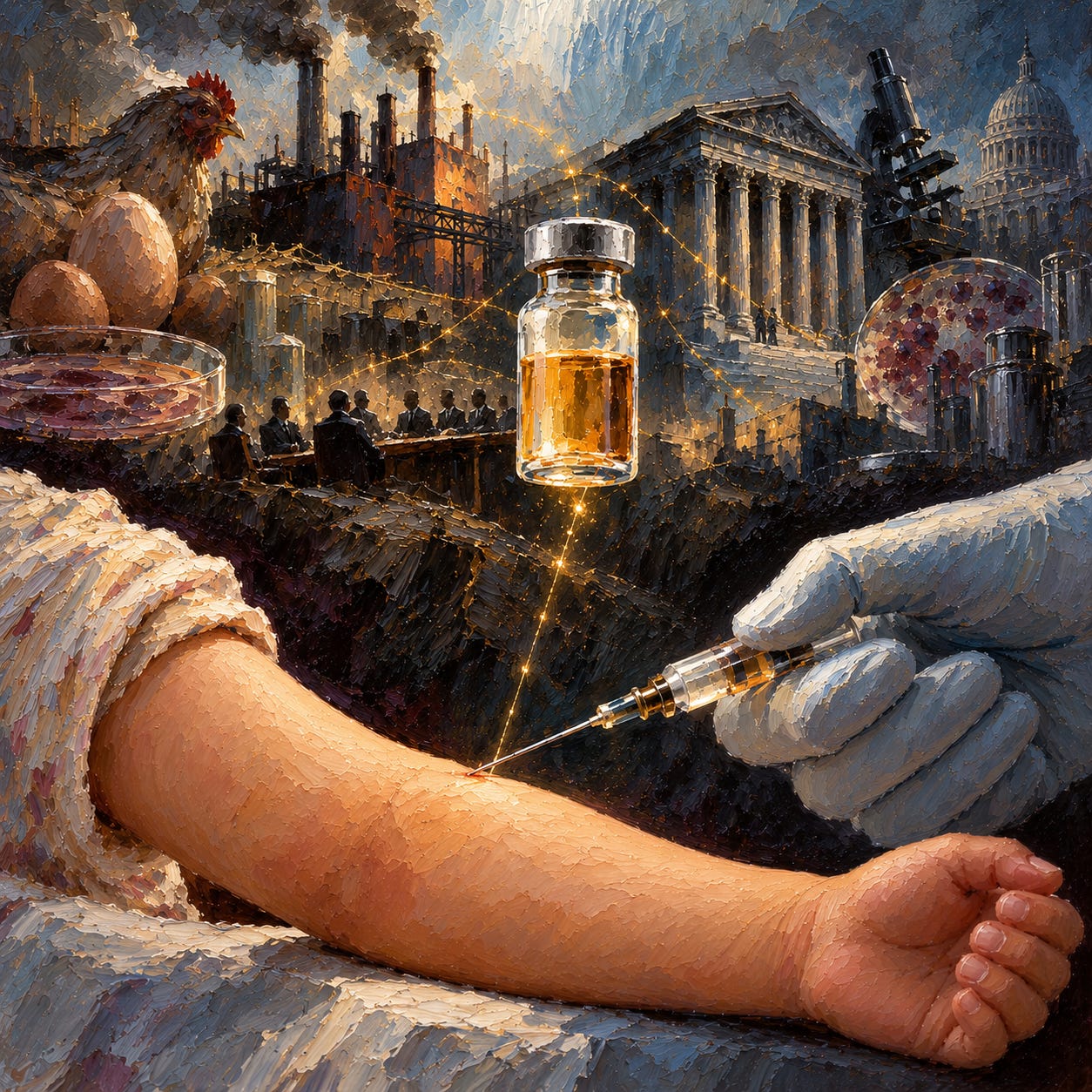
Preface
Leonard Read published “I, Pencil” in 1958. It has never been out of print.¹ It runs about 2,600 words and does something almost no essay does: it puts the argument in the mouth of the object under discussion. The pencil narrates its own genealogy. Read supplies no commentary. He does not need to. By the time the pencil has finished naming its cedar, its graphite, its brass, its factice, its lacquer, its labor, its factories, its ships, its lighthouses, and its coffee, the reader has arrived at Milton Friedman’s later summary without having been led there: no one in a central office ordered any of this, and yet all of it happened.²
What follows is that essay’s structural mirror, applied to a different object.
The object is the MMR vaccine. It speaks in its own voice, which is to say it speaks in the vocabulary its manufacturer uses. It refers to measles and mumps and rubella. It refers to protection and immunity. It calls itself a vaccine. These are the terms in which its supply chain, its regulatory approval, and its schedule position are all described in the documents from which the vial was produced. Whether those terms describe biological reality is not the vial’s question and it is not this essay’s question. The essay’s question is only what the vial’s genealogy contains, and where that genealogy ends.
Read’s subtitle was “My Family Tree as Told to Leonard E. Read.” This essay carries only “My Family Tree.” The device is his. The object is mine.
The vial speaks.
This work stays free because paid subscribers make it possible. They get the full book library, the Deep Dive Audio Library, and the Questions for Your Doctor, Before You Consent, and Package Insert series. No grants, no gatekeepers — your subscription is what keeps it that way.
Audio Deep Dive (for Paid Subscribers)
What I am
I am a vial of MMR-II. I contain three occupants: measles, mumps, and rubella. I am kept at a temperature between 2 and 8 degrees Celsius. I am familiar to every mother in America, and to almost every child, though the child does not remember me by name. I sit in a small refrigerator in every pediatrician’s office in the country. My contents are drawn into a small syringe about fifteen minutes before I am needed. The syringe is then delivered subcutaneously into the upper arm or the outer thigh of a child, usually at 12 to 15 months of age, and again between 4 and 6 years.³
I am small. My glass shell is about three inches tall. My label carries a lot number, an expiration date, and the name Merck. I look, to any casual observer, unremarkable.
And yet, like my distant ancestor the pencil, I am a mystery. Not a single person on the face of this earth knows how to make me. I am produced at the rate of tens of millions of doses per year. I have been administered, in some formulation of my three components, more than a billion times worldwide. I generate revenue in the neighborhood of two billion U.S. dollars per year for the company whose name is on my label.⁴ And yet, if you asked the president of that company to make me from scratch, without his factory, his suppliers, his equipment, his laboratories, his patents, his regulators, and his shipping, he could not. Nor could anyone else.
Pick me up. What do you see? A small glass vial with a rubber stopper, a cap, a label, a milliliter of liquid.
That is not much. Let me tell you where each part of me comes from.
The measles and the mumps
The measles component of me traces to a boy named David Edmonston. In 1954, in Boston, Dr. Thomas Peebles took a swab from David’s throat. David had measles. Peebles and John Enders cultured what they took from David in cell culture, and John Enders won the Nobel Prize partly for the work that made this culture possible. The Edmonston strain, further attenuated by passage through chick embryo cells, is the ancestor of the measles material I contain today. David Edmonston lived, grew up, and went to Harvard. Merck rarely mentions him after the swab.⁵
The mumps component of me has a name too. It is called the Jeryl Lynn strain, after a five-year-old girl. In March 1963, her father Maurice Hilleman was working at Merck. Jeryl Lynn woke him in the middle of the night with mumps. He drove to the laboratory, retrieved a cotton swab, drove back, swabbed her throat, and drove the swab to the freezer. Jeryl Lynn’s mumps became the seed for every dose of mumps material Merck has manufactured for the past sixty years. Her half-sister Kirsten was later immunized against Jeryl Lynn’s mumps. Hilleman is described in Merck’s official history as the inventor of more vaccines than any other individual in the twentieth century. He is generally credited with developing the majority of the products on the current American pediatric schedule.⁵
My mumps component has been the subject of False Claims Act litigation since 2010. Two of Merck’s own virologists, Stephen Krahling and Joan Wlochowski, allege that the company manipulated the efficacy testing for my mumps component in order to sustain the 95 percent figure it had marketed to the CDC and to preserve its exclusive federal license. The federal district court in the Eastern District of Pennsylvania denied Merck’s motion to dismiss in 2014, finding that the whistleblowers had pleaded facts sufficient to sustain the claim. On summary judgment, the court later dismissed the case on materiality grounds, finding that even if the alleged fraud had occurred, it would not have changed the CDC’s decision to purchase me. The Third Circuit Court of Appeals affirmed the dismissal on August 6, 2024. The court did not rule on whether the fraud occurred, only on whether it would have mattered to the CDC.⁶
Both the measles and the mumps components of me are grown in cell cultures derived from the fertilized eggs of specific pathogen-free chickens. The chickens live in enclosed flocks maintained by companies such as Charles River Laboratories in North Franklin, Connecticut. The flocks are monitored continuously for the presence of avian pathogens. The eggs are collected on precise schedules, inoculated with seed material, incubated, and harvested. The harvest is filtered, concentrated, and combined with stabilizers.
Think of all the persons and the numberless skills that went into this. The breeding of the chicken flock. The feed supply. The temperature and humidity control of the coops. The transportation of the eggs to the manufacturing facility. The construction of the sterile cabinets in which the inoculation is performed. The training of the technicians who perform it. The stainless steel of the tanks. The mining of the ore from which the stainless steel is drawn. The furnaces. The rolling mills. The shipping. Not one of these people wakes up in the morning wanting to make me. Each is doing his part, and payment is exchanged, and the eggs arrive on time.
The rubella
The rubella component of me is different. It is not grown in chicken eggs.
In 1962, a woman in Stockholm, Sweden, was pregnant. She had several children already and could not face having another. Abortion was legal in Sweden. The pregnancy was terminated in the second trimester. The lungs of the female fetus were dissected and delivered to Leonard Hayflick, a cell biologist working at the Wistar Institute in Philadelphia. From those lungs, Hayflick derived a cell line, which he called WI-38, standing for Wistar Institute, 38th sample. WI-38 was the first human diploid cell line used in the manufacture of a vaccine. WI-38 is the cell line in which the rubella component of me is grown today.⁷
Four years later, in September 1966, a 27-year-old British woman was carrying a 14-week-old male fetus. She had been referred for termination for what was recorded, in the standard psychiatric language of the era, as reasons of mental health. The pregnancy was terminated. The lungs of the fetus were dissected and delivered to the Medical Research Council in London, where a cell line was derived and named MRC-5. MRC-5 is the cell line in which the chickenpox component of my sibling product ProQuad is grown.⁸
The rubella strain itself has a name and a designation. It is called Wistar RA 27/3. It was developed by Stanley Plotkin at the Wistar Institute in 1965. The “27” refers to the twenty-seventh aborted fetus from which Plotkin’s laboratory obtained tissue in the course of the work. The “3” refers to the third explant from that tissue. Plotkin’s own published account is not ambiguous about the number involved. He counts them.⁹
Consider what is required to arrive at that. The cell biologist who derives the cell line. The pathologist who dissects the fetal lungs. The obstetrician who performs the termination. The mother who consents, or who is not asked in a form she recognizes as consent. The freezing of the cell line. The regulatory bodies that certify it. The manufacturers who scale it up. The insurance actuaries who calculate the price of a vial that includes it.
Plotkin himself has been open about the practice. His published position, articulated many times over the decades, is that fetal cell lines are a legitimate biomedical resource that should not be foreclosed on ethical grounds. He is not embarrassed by this. He regards it as a scientific fact and a policy defense, not a scandal.
In sworn testimony before attorney Aaron Siri in January 2018, Plotkin confirmed that vaccine development has used, and continues to use, tissue from voluntarily aborted human fetuses. He confirmed that the human subjects who tested his RA 27/3 strain included what his own paper described as “seronegative mentally retarded children.” He confirmed authorship of a letter to the editor of Ethics on Human Experimentation in which he had written: “The question is whether we are to have experiments performed on fully functioning adults and on children who are potentially contributors to society or to perform initial studies in children and adults who are human in form but not in social potential?” Asked whether he had ever used the infants of women in prison to test experimental vaccines, he answered yes. Asked whether he had ever used populations under colonial administration, he answered yes.¹⁰
The Catholic Church, which one might expect to oppose the practice, issued a position in 2005 permitting the use of vaccines derived from historical fetal cell lines where no alternative exists, on the ground that current beneficiaries are morally remote from the original abortions. That position has not been universally accepted within the Church.¹¹
I contain, in each dose, residual DNA from the WI-38 cell line. The FDA sets a limit on how much residual DNA I may contain: less than 10 nanograms per dose. I contain more than that limit in the laboratory work of Theresa Deisher, whose findings have been challenged but not, to date, replicated in a contradicting study.¹² I contain no live fetal tissue. What I contain is the descendants, propagated in laboratory cell culture across sixty years, of the cells that once grew in the lungs of the three-month-old girl in Sweden.
Their names are not recorded in the scientific literature. They are, in every material sense, my ancestors.
The rest of me
The three biological components of me are only part of what I am. I also contain sorbitol, a sugar alcohol industrially produced from glucose derived from cornstarch, which is grown on farms in the American Midwest, harvested by machinery manufactured in Iowa, transported by rail, and processed in refineries in Illinois and Nebraska. I contain sucrose, cane sugar largely from Louisiana and Florida, or beet sugar from North Dakota. I contain sodium chloride and monosodium phosphate, salt from evaporation ponds, phosphate from the mines of Morocco and the American southeast. I contain hydrolyzed gelatin, derived from the collagen of the skin and bones of pigs and cattle slaughtered in facilities in the American Midwest and Brazil, boiled in acid to release the collagen, then hydrolyzed with enzymes.
I contain recombinant human albumin, produced by an industrially altered strain of the yeast Saccharomyces cerevisiae, grown in vats to secrete human serum albumin, then purified from the broth. The technique was developed at the University of California and licensed to industrial producers. The yeast strain itself has a lineage stretching back to the brewing traditions of nineteenth-century Denmark.
I contain neomycin, an antibiotic derived from the bacterium Streptomyces fradiae, isolated in 1949 by Selman Waksman at Rutgers University from soil samples, and now produced by industrial fermentation in facilities in China and India.¹³ I contain traces of fetal bovine serum, drawn from the blood of unborn calves during the slaughter of pregnant cattle, primarily in New Zealand and Australia.
My glass shell is manufactured from silica sand, boric acid, aluminum oxide, and sodium carbonate, melted at approximately 1,600 degrees Celsius, formed by machinery originally designed by the Owens-Illinois company, then annealed, then packaged. My rubber stopper is manufactured from a proprietary elastomer, coated with a fluoropolymer film that prevents interaction with my contents. My aluminum cap is stamped from aluminum sheet, itself smelted from bauxite mined in Guinea and Australia. My label is printed on synthetic paper using UV-cured inks.
I am made of the world.
What I do not know I contain
Everything I have told you so far comes from my package insert, which Merck discloses and the FDA reviews.
There is another list.
In 2017, two materials scientists at the Italian National Council of Research, Antonietta Gatti and Stefano Montanari, published the first systematic microscope survey of injectable vaccines. They obtained forty-four vaccines from pharmacies in Italy and France. They took twenty microliters of each, about one twenty-fifth of a full dose, placed the drop on a cellulose filter, dried it, and examined it under a Field Emission Gun Environmental Scanning Electron Microscope. The microscope resolves features at the nanometer scale. Its attached X-ray spectrometer identifies the elemental composition of any particle the microscope can see. The instruments are standard equipment in materials science, semiconductor manufacturing, and forensic analysis. They cost in the range of half a million U.S. dollars. Major pharmaceutical manufacturers, Merck included, own instruments of this class.¹⁴
Forty-three of the forty-four vaccines Gatti and Montanari examined contained foreign metallic particles that appear on no package insert. The catalog across the full set included lead, tungsten, stainless steel, bismuth, gold, silver, platinum, cerium, zirconium, hafnium, antimony, strontium, barium, copper, tin, and zinc, in various alloy combinations. Many of the combinations, the authors noted, “have no technical use, cannot be found in any material handbook and look like the result of the random formation occurring, for example, when waste is burnt.”
My European sibling, M-M-R vaxPro, was among the vaccines examined. Manufactured by Merck to substantially the same specification as I am, it registered particles containing platinum, silver, bismuth, iron, and chromium. None of those elements appears on the package insert I was produced from. None has a declared role in my formulation. Their combination corresponds to no recognized industrial alloy.
The forty-fourth vaccine was for cats. Feligen CRP, manufactured by Virbac, contained particles of only calcium and silicon-aluminum, materials consistent with saline residue and environmental dust. Under the same instruments at the same resolution, the veterinary production line produced a clean vial. The human production lines did not.
I cannot narrate the supply chain of what Gatti and Montanari photographed inside my sibling. My manufacturer does not disclose it. My regulator does not require inspection at the resolution that would detect it. The instruments have existed for decades. The technique was routine in adjacent fields. The first systematic survey produced the catalog above.
My genealogy, as I have told it to you, has a gap. The gap is not small. What fills it includes lead, tungsten, and rare earth metal debris that appears on no package insert issued by any manufacturer of injectable products for human use.
What fills the gap is delivered into the same arm.
The factory
I am produced primarily at Merck’s West Point, Pennsylvania facility, which employs approximately 8,500 people across roughly 400 buildings on a campus of 425 acres. The facility has been continuously in operation since 1904. The buildings that produce me include Class 100 clean rooms, high-containment biological suites, and freezers capable of maintaining temperatures far below what my finished contents require.
Merck spent, in the most recent year for which figures are available, approximately 13.5 billion U.S. dollars on research and development across all its product lines. The individual cost of developing me across the twentieth century is difficult to reconstruct, because my three components were developed at different times, in different institutions, with different funding sources. Some of the funding was public. Some was philanthropic. Some was Merck’s own. The cell lines from which my rubella component is grown were, in significant part, developed with grants from the U.S. National Institutes of Health.
I am, in raw manufacturing terms, one of the most complex biological products on earth. I am also, by revenue, a mid-sized product in Merck’s portfolio. The company earned approximately 60 billion U.S. dollars in total revenue last year. I contributed, in my most recent reporting year, in the neighborhood of two billion dollars of that total.
The paperwork
I would not exist in my current form without several categories of paperwork.
The first is patents. My three components, my adjuncts, my formulation, my delivery mechanism, and my manufacturing process are covered by hundreds of patents, some expired, some still in force. My commercial life depends on the ongoing enforcement of these patents by the United States Patent and Trademark Office and by the courts.
The second is regulatory approval. I received my first FDA licenses as three separate vaccines: measles in 1963, mumps in 1967, rubella in 1969. I received my license as a combined single product in 1971. I was reformulated with the Wistar RA 27/3 rubella strain in 1978 and licensed as MMR-II in 1979.¹⁵ My pre-licensing clinical trials, which the package insert does not describe, were obtained by outside researchers via FOIA. They consisted of eight small unblinded trials totaling approximately 850 children in the mid-1970s. No control group in any of them received a placebo.¹⁶ The FDA reviews new lots of me on an ongoing basis and requires that samples of each lot be submitted for release.
The third is recommendation. The Advisory Committee on Immunization Practices, or ACIP, is a group of individuals appointed by the Secretary of Health and Human Services. In 1971, the ACIP recommended me. In 1989, following a resurgence of measles cases, the ACIP added a second dose. My schedule position, at 12 to 15 months and 4 to 6 years, is set by the ACIP. Committee members are required to disclose their financial relationships with pharmaceutical manufacturers. Multiple committee members over the past three decades have held such relationships. Paul Offit served on the ACIP from 1998 to 2003 while holding a patent on a rotavirus vaccine that Merck later licensed and marketed as RotaTeq; his share of the licensing revenue has been reported at several million dollars.¹⁷ Julie Gerberding, whose agency accepted ACIP recommendations while she served as CDC director from 2002 to 2009, left the CDC in 2010 to become president of Merck’s vaccine division, a role she held for a decade.¹⁸
The fourth is mandate. Every American state requires that children receive me before entering school. The specific exemptions vary from state to state. Some states permit religious exemption. A smaller number permit philosophical exemption. Six states permit only medical exemption.¹⁹ The state mandate chain is what converts the ACIP recommendation into practical universality.
The fifth is indemnification. In 1986, the U.S. Congress passed the National Childhood Vaccine Injury Act.²⁰ The Act removed the ability of a parent to sue a vaccine manufacturer in tort for design defect. Injured parties are directed instead to the Vaccine Injury Compensation Program, an administrative process funded by a per-dose tax on me and on my sister products. The tax is 75 cents per antigen per dose.²¹ The Program has paid out more than five billion U.S. dollars in awards since its inception in 1988. A minority of petitions succeed, and cases that do succeed typically take several years to resolve.²² In 2011, in the case of Bruesewitz v. Wyeth, the U.S. Supreme Court affirmed the pre-emption.²³ I have been, for the past four decades, unsuable in the ordinary sense in which the pencil, if it stabs a child in the hand, is suable.
The size of the American pediatric schedule has grown over the decades in which my regulatory arrangements have taken their current form. In 1986, when the Act that indemnified me was passed, the recommended schedule contained three products (DTP, oral polio, and MMR) delivered in about ten doses through the age of six. Today, the recommended schedule contains more than a dozen products delivered in more than seventy doses through the age of eighteen. My own two doses are a modest fraction of the total. The growth of the schedule tracks, though not perfectly, the removal of tort liability. Prior to 1986, manufacturers priced injury risk into their products. After 1986, the incentive to price injury risk into the schedule was substantially reduced.
Include, among my ancestors, the patent attorneys. The regulatory affairs officers. The FDA reviewers. The ACIP members. The state legislators. The state public health officers. The Health Resources and Services Administration attorneys. The U.S. Senators and Representatives who wrote the 1986 Act. The six-justice majority that confirmed it in Bruesewitz.
The delivery
Once produced, once labeled, once released by the FDA, I am shipped in temperature-controlled trucks from West Point to distribution centers around the country. From there, I am shipped to pediatricians’ offices, hospital pharmacies, county health departments, and pharmacies operated by chains such as CVS and Walgreens. I am kept throughout this journey between 2 and 8 degrees Celsius. If I am kept warmer or colder than that range for more than a very brief period, I lose potency, and I am discarded.
The pediatrician’s office where I most often end up has a small refrigerator, usually beige, plugged into an outlet monitored by a temperature logger. On the day I am used, a medical assistant retrieves me, checks my lot number, reconstitutes me with a diluent supplied in a companion vial, draws me into a syringe, and places the syringe in a small tray. A nurse or the physician then enters the examination room with the tray.
The child on the table is, typically, twelve to fifteen months old. She has just been examined for weight and height. She has been observed for developmental milestones. She has been listened to with a stethoscope and looked at with an otoscope. Her mother is present. The mother, in most cases, has signed a form called the Vaccine Information Statement, distributed by the Centers for Disease Control.
The Vaccine Information Statement is a document of approximately two to four pages, printed on both sides. It lists my composition, my benefits as understood by the CDC, my common side effects, and my rare serious adverse events. It concludes with information about the Vaccine Injury Compensation Program. The Statement does not disclose my supply chain in any detail. It does not name the cell lines from which my rubella component is grown. It does not itemize my adjuncts. It does not describe the 1986 legal framework in any way a non-lawyer would find useful.
My post-marketing adverse reactions are not on the Statement. They are on my own package insert, which the mother does not sign. Merck’s current M-M-R II prescribing information, revised November 2024, lists among the neurological adverse reactions identified in clinical trials or reported during post-approval use: encephalitis, encephalopathy, measles inclusion body encephalitis, subacute sclerosing panencephalitis, Guillain-Barré Syndrome, acute disseminated encephalomyelitis, transverse myelitis, febrile convulsions, afebrile convulsions or seizures, ataxia, polyneuritis, polyneuropathy, ocular palsies, paresthesia, and syncope. In 1999, a Toronto research team sequenced regions of the measles virus recovered from the brain of a 21-month-old boy who died of measles inclusion body encephalitis eight and a half months after receiving me. The sequenced regions were identical to the Moraten and Schwarz vaccine strains, both derivatives of the Enders-Edmonston lineage that produces my measles component. The child had no history of wild measles infection.²⁴
The mother, in most cases, has not read the form closely. She trusts the pediatrician.
The nurse or physician holds the child’s thigh or arm still. The needle enters the tissue. The plunger depresses. The syringe is withdrawn. A small bandage is applied. The child, in most cases, cries briefly, then is comforted.
That is where I go. That is what I am for.
Where my story ends
The pencil, my ancestor and my model, ended its own story with a peaceful observation. The millions of hands converging on its creation, the pencil said, testified to something miraculous: an invisible hand that arranges free coordination among strangers who never meet, in service of a child in the first grade who wanted to write.
I have tried, in these pages, to imitate the pencil’s account of itself. I have named my components, my adjuncts, my factories, my patents, my regulators, my mandates, and my delivery. I have counted, insofar as I am able, the millions of hands. I have not editorialized. I have simply narrated my genealogy, as the pencil narrated its own.
There is a point in the narration where the imitation breaks.
The pencil, in its story, is chosen. The child walks into the store. She reaches for one. She could have chosen another, or none. She pays for it with money she has earned or that her mother has given her. If the pencil disappoints her, if the lead breaks or the wood splinters or the eraser fails, she can throw it away, and no committee will require her to buy another. The pencil, in Read’s telling, is delivered into a free hand by a free choice, and the whole essay’s celebration rests on that fact. The invisible hand works, Read wrote, because it responds to what free people freely want.
I am not delivered into a free hand.
I am delivered into the arm of a child who did not choose me. She was brought. She did not reach for me. She was held. She has no capacity, at 12 or 15 months, to consent to what is done to her. Her mother’s consent, obtained by a form the mother did not draft and often did not read, is understood to substitute for hers.
The child’s mother, in almost every American state, cannot easily refuse me. If she refuses, her child cannot enter school. In six states, if she refuses on any ground other than a physician-certified medical contraindication, she loses that option too.
If I harm the child, no court in the country will hear the case. Her mother’s lawyer, if he is competent, will decline the file. He will direct her to the Vaccine Injury Compensation Program, administered by the Department of Health and Human Services. The Program will pay, if it pays at all, from a tax collected on every dose of me that has already been administered, capped at damages I have accounted for in my price. The company on my label will not appear.
These conditions do not appear anywhere in the pencil’s story.
The pencil’s genealogy ends in a small hand that chose it, holding it, writing with it. The pencil serves the child. That is what makes Read’s essay end where and how it does.
My genealogy ends in a small arm that did not choose me, could not easily refuse me, and cannot recover in the ordinary courts if I harm it. It is not obvious to me, looking back across my own genealogy, whom I serve.
If I look up at my patents, I see the company that holds them. If I look up at my ACIP schedule position, I see the committee members who voted for it, some of whom have held financial relationships with the company. If I look up at my state mandate chain, I see the legislators who wrote the requirement and the public health officers who enforce it. If I look up at my 1986 indemnity, I see the members of Congress who passed it and the six-justice Supreme Court majority that confirmed it in Bruesewitz v. Wyeth.
They form, together, an arrangement that is not the small hand at the end of the pencil’s story.
Read wrote that his pencil’s story testified to what free people can do when left alone to cooperate. He was writing at a moment when he believed such freedom was being lost.
I offer myself, in his cadence and his form, as testimony to something else. Read’s pencil was the miracle of the market operating in the presence of a person who could walk away from any single instance of it. I am what the same coordination produces, at the same level of complexity, when the person at the end of the arrangement has been arranged so that she cannot walk away.
That is my family tree.
In Print
The Unbekoming library is available in paperback, printed to order through Lulu and shipped worldwide. The shelf begins with the paradigm question underneath everything else — No Virus, the isolation problem, the collapse of virology’s foundational claims, and a disease-by-disease reappraisal — and moves through the suppressed compounds mainstream medicine set aside: The DMSO Book, Chlorine Dioxide: The Forbidden Remedy, The Iodine Book, and The Hydrogen Peroxide Book. Two more recover what’s still on the kitchen shelf: Baking Soda and The Castor Oil Book. Two more recover the minerals modern soil, water, and processing quietly stripped from the diet: The Magnesium Handbook and The Boron Book. Sitting alongside these is No Contagion, co-authored with Jamie Andrews — the case against germ theory itself, catalogued through 258 failed contagion experiments.
The critique books cover what medicine, dentistry, psychiatry, and veterinary practice have become. The Unvaccinated treats the completely unvaccinated as a comparison group across twenty chapters and five appendices. Medicalized Motherhood follows a woman through 123 documented interventions from teenage pill to postpartum discharge. Drilling for Profit treats cavities, gum disease, and crooked teeth as the dietary problem they are. What Your Vet Can’t Tell You applies the same critique to pets. Escape from Psychiatry documents the fabrication of the DSM and the specific damage of every major psychiatric drug class. The Vitamin K Injection covers what happens in the first hours of a newborn’s life.
The full shelf is at lulu.com/spotlight/unbekoming. A physical book reaches the person a Substack post never will — the skeptical relative, the friend who won’t click a link but might open a book, the visitor whose eye lands on a coffee table. Buy one to keep, and one to give away.
References
Read, Leonard E. “I, Pencil: My Family Tree as Told to Leonard E. Read.” The Freeman, December 1958. Foundation for Economic Education.
Friedman, Milton and Rose. Free to Choose: A Personal Statement. Harcourt Brace Jovanovich, 1980. Chapter 1, “The Power of the Market.”
Merck Sharp & Dohme LLC. M-M-R II (Measles, Mumps and Rubella Virus Vaccine Live) Prescribing Information, revised November 2024. Available via FDA DailyMed (setid 0a9e384f-e717-436b-b9a0-15e53cef0862) and the WHO prequal package insert archive.
Merck & Co., Inc. 2023 Annual Report and Form 10-K Filing.
Offit, Paul A. Vaccinated: One Man’s Quest to Defeat the World’s Deadliest Diseases. HarperCollins, 2007.
United States ex rel. Krahling v. Merck & Co., Inc., Civil Action No. 10-4374 (E.D. Pa.), filed August 27, 2010; consolidated with Chatom Primary Care, P.C. v. Merck, Civil Action No. 12-3555; motion to dismiss denied September 5, 2014 (Judge Jones II); summary judgment for Merck subsequently granted; Third Circuit Court of Appeals affirmed August 6, 2024. Whistleblower complaints and unsealed filings available via federal court records.
Wadman, Meredith. The Vaccine Race: Science, Politics, and the Human Costs of Defeating Disease. Viking, 2017.
Jacobs, J. P., Jones, C. M., and Baille, J. P. “Characteristics of a Human Diploid Cell Designated MRC-5.” Nature 227 (1970): 168-170.
Plotkin, Stanley A. and Farquhar, John D. “Rubella Vaccination.” American Journal of Diseases of Children, 1969. See also Plotkin’s subsequent published accounts of the RA 27/3 attenuation history.
Deposition of Stanley A. Plotkin, taken by attorney Aaron Siri, January 11, 2018. Public record. Transcript excerpts reproduced in Handley, J. B., How to End the Autism Epidemic, Chelsea Green, 2018, chapter 4.
Pontifical Academy for Life. “Moral Reflections on Vaccines Prepared from Cells Derived from Aborted Human Fetuses.” Vatican City, June 2005.
Deisher, Theresa A., Doan, N. V., Omaiye, A., Koyama, K., Bwabye, S. “Epidemiologic and Molecular Relationship Between Vaccine Manufacture and Autism Spectrum Disorder Prevalence.” Issues in Law & Medicine 30, no. 1 (2015): 47-70. Related: Deisher, T. A., et al. “Impact of Environmental Factors on the Prevalence of Autistic Disorder After 1979.” Journal of Public Health and Epidemiology 6, no. 9 (2014): 271-286.
Waksman, S. A. and Lechevalier, H. A. “Neomycin, a New Antibiotic Active Against Streptomycin-Resistant Bacteria, Including Tuberculosis Organisms.” Science 109 (1949): 305-307.
Gatti, Antonietta M. and Montanari, Stefano. “New Quality-Control Investigations on Vaccines: Micro- and Nanocontamination.” International Journal of Vaccines and Vaccination 4, no. 1 (2017): 7-14.
Centers for Disease Control and Prevention. Epidemiology and Prevention of Vaccine-Preventable Diseases (The Pink Book), 14th edition. Chapters on measles, mumps, and rubella. Licensure timeline: measles 1963, mumps 1967, rubella 1969, combined MMR 1971, MMR-II 1979.
Kennedy, Robert F. Jr., et al. Turtles All the Way Down: Vaccine Science and Myth. Children’s Health Defense, 2022, chapter 1 (on clinical trial adequacy). Documentation of MMR-II’s FOIA’d pre-licensing trial design.
Offit, Paul A. Patent and licensing revenue disclosures regarding RotaTeq. Multiple public sources, including reporting in the Philadelphia Inquirer by Bob Fernandez, “Rotavirus Vaccine’s Rocky Road” (2008-2010). Offit’s ACIP membership 1998-2003 is documented in CDC ACIP meeting archives.
Merck & Co. press release, “Merck Names Julie Gerberding, M.D., M.P.H., President of Merck Vaccines,” December 21, 2009; effective start date January 25, 2010.
National Conference of State Legislatures. “States with Religious and Philosophical Exemptions from School Immunization Requirements.” As of 2024, six states permit only medical exemption: California, Connecticut, Maine, Mississippi, New York, and West Virginia.
National Childhood Vaccine Injury Act of 1986, Pub. L. 99-660, codified at 42 U.S.C. §§ 300aa-1 to 300aa-34.
Vaccine excise tax: 26 U.S.C. § 4131, imposing a 75-cent excise tax per dose per antigen on taxable vaccines.
Health Resources and Services Administration. Vaccine Injury Compensation Program Statistics Reports, cumulative through 2024.
Bruesewitz v. Wyeth LLC, 562 U.S. 223 (2011). Decision by Justice Scalia joined by Roberts, Kennedy, Thomas, Breyer, and Alito; dissent by Sotomayor joined by Ginsburg; Kagan recused.
Bitnun, A., Shannon, P., Durward, A., Rota, P. A., Bellini, W. J., Graham, C., Wang, E., Ford-Jones, E. L., Cox, P., Becker, L., Fearon, M., Petric, M., and Tellier, R. “Measles Inclusion-Body Encephalitis Caused by the Vaccine Strain of Measles Virus.” Clinical Infectious Diseases 29, no. 4 (1999): 855-861. DOI: 10.1086/520449.
Are we not warned against ultra-processed food? How is this different other than being a far more egregious method of entry?