

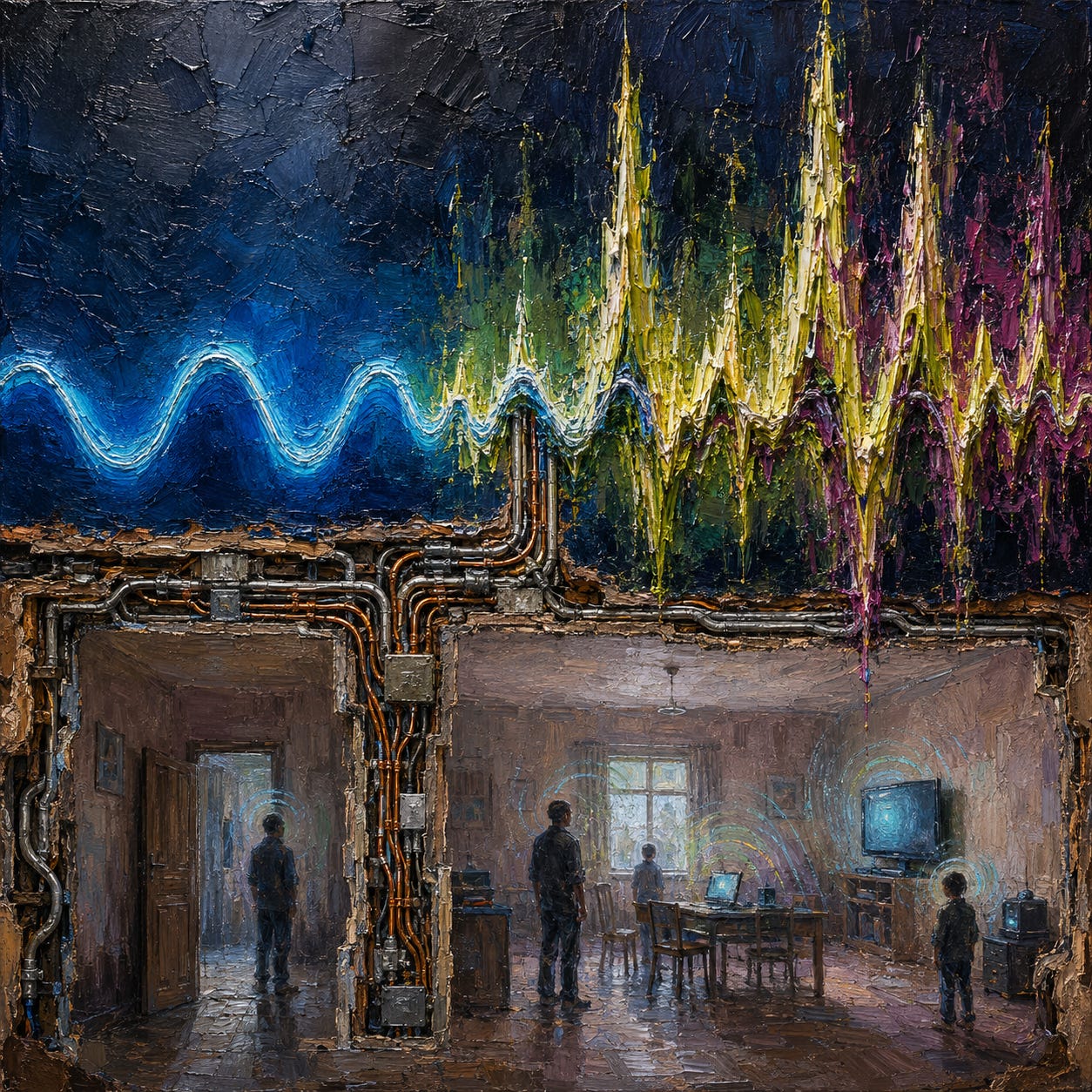
Sixteen teachers in a single California school. Eighteen cancers between them. The cohort was 137, hired between 1988 and 2005. When the classrooms were tested, levels of high-frequency voltage transients — what Magda Havas and her colleagues call “dirty electricity” — were far above what should exist on a clean 60-hertz sine wave. The study was published in 2008, has never been repeated, and is one of many pieces of evidence Dr. Havas has spent the last three decades assembling.
She came to electromagnetic pollution from acid rain. Her fieldwork in the Canadian Arctic and at Hubbard Brook, and her role as Science Advisor to the Canadian Coalition on Acid Rain, helped pass the 1985 Eastern Canadian Acid Rain Program that cut sulphur dioxide emissions by 30%. When the lakes began recovering faster than expected, she went looking for the next problem. She found dirty electricity in the wiring, radiofrequency radiation from wireless technology, and ground current from unbalanced distribution systems — and has since published over 200 papers on how these exposures affect blood sugar in diabetics, heart rhythm in adults exposed to 2.4 GHz cordless phones, cognitive function in firefighters working under cell towers, and behaviour in schoolchildren. The environmental variable she has spent thirty years documenting is real. What it does inside any given body depends on what that body is already carrying.
The regulatory sequence she describes is familiar. Asbestos, lead, mercury, DDT, PCBs, CFCs, glyphosate, tobacco — each time the same pattern. Industry-funded advisory bodies counsel governments. Governments counsel doctors. Doctors counsel patients. Legislation trails the damage by decades. What follows is the specific evidence: the studies, the mechanisms, the schools where installing filters produced measurable improvements in teacher health within six weeks, and the practical steps any reader can take today. Her strongest recommendations cost nothing.
With thanks to Dr. Magda Havas.
1. Your career has covered everything from acid rain in the Canadian Arctic to electromagnetic pollution in classrooms. Can you walk us through that journey and what connected one chapter to the next?
Both acid rain and electromagnetic radiation (EMR) are types of environmental pollution, which is what I study as an environmental toxicologist. Acid rain was controversial in its hay day as is EMR today. I’m drawn to controversial issues because it implies that the science isn’t yet definite or at least not widely accepted. It provides a challenge and I enjoy scientific challenges.
2. For someone who’s never heard the term, how would you describe “dirty electricity” in plain language, and where is it most likely lurking in a typical home?
The analogy I use it that dirty electricity is like dirty water that is contaminated by chemicals, bacteria or particulate. Clean electricity is a smooth sine wave, whereas dirty electricity is contaminated with something called high frequency voltage transients (HFVT) or Intermediate Frequency (IF) Radiation. It is generated by electronic devices like computers, smart meters, energy efficient lighting, dimmer switches, treadmills, solar power, wind turbines and arching on powerlines. It is virtually ubiquitous but there is relatively little research on the biological effects of dirty electricity. DE is a form of electromagnetic interferences (EMI) that is well known among electricians and electrical engineers. Surge suppressors were used to protect your computer from these “surges” and now we have capacitive filters that short out these higher frequencies and purify the electricity. Audiophiles use power conditions to improve the quality of music on their stereos and to protect their equipment.
3. You made a significant pivot in the 1990s from established environmental toxicology into a much more contested area. Was there a specific moment, patient story, or piece of data that convinced you this was worth staking your reputation on?
I made a pivot because we had clean air legislation that reduce sulphur dioxide emissions in both Canada and the United States in the 1990s. For a few years I studied the recovery of lakes in Ontario, which occurred much more quickly than expected, and I realized that one of the reasons I was doing this research was to improve air quality. We were successful and I lost interest in continuing with air quality research. I was looking for another challenge, and I stumbled across electromagnetic fields. At the time, several studies suggested that children who lived near powerlines had a greater risk of developing cancer. I began to read the research and found it was at an early stage with lots of scientific disagreement. It took me three years before I came to the conclusion that the risk to children was real and that was after I devoured the literature not only on childhood cancer but on cancers and occupational exposure, the role of natural EMFs, the healing potential of EMFs. I then started research on DE, ground current and microwave radiation generated by wireless technology. I began to work with people who were intolerant of EMFs trying to understand the mechanisms involved. I didn’t view this a “staking my reputation”. I was simply curious–a very useful trait of young children, scientists and those with an inquiring mind.
4. Some of your most surprising findings involve diabetes — people reportedly needing less insulin once their electrical environment was filtered. How did you first stumble onto that link, and how do you explain what might be happening biologically?
I was working with a power quality expert, Dave Stetzer in Wisconsin, who was prediabetic. He told me his blood sugar increased when he was working on powerlines. From a scientific perspective this was an ideal opportunity since we can objectively measure blood sugar but can’t control it voluntarily. I began to work with both type 1 and type 2 diabetics and published our findings. When someone is stressed, their body releases sugar for action (fight or flight). For non-diabetics the insulin kicks in and reduces the excess sugar if it is not needed. Diabetics have difficulty with their insulin so the sugar remains elevated for longer periods and can be measured. (Link: https://pubmed.ncbi.nlm.nih.gov/18568931/ )
5. Your school studies, from the La Quinta cancer cluster to schools in Minnesota and Ontario, keep returning to vulnerable populations. What patterns kept showing up across very different schools that made you think you weren’t seeing coincidences?
The La Quinta cancer cluster was research done by Milham and Morgan showing that teachers in classrooms with high levels of dirty electricity had a greater incidence of various types of cancers. It was the first study of its kind and hasn’t yet been repeated. (Link: https://pubmed.ncbi.nlm.nih.gov/18512243/ )
I had just published research on electric and magnetic field levels in the downtown core of 60 cities/town in Ontario that was reported in the Toronto Star. A woman in Toronto read the article and began to tell me about her daughter who was attending a private school in Toronto and who became ill by noon and had to go home. This woman mentioned that there were “filters” that reduced dirty electricity and she purchased these filters for her home and had remarkable results from a health perspective for all family members include her two dogs who were much better behaved.
She contacted the principal of the school and asked if she could plug filters in the school to protect her daughter. She contacted me to see if I would be willing to do a study at the school because she believed that others would also benefit from these filters. I was sceptical but agreed to conduct a study because she was a mom who was ready to go the extra mile for her daughter and because from a scientific perspective, either the filters worked or they didn’t and we could document this. Either response was useful from a scientific perspective. When it was time to analyse the data collected daily during a 6-week period I couldn’t believe the results. Back then (2003) we believed that approximately 3% of the population was sensitive to electromagnetic pollution. We would need to test at least 100 teachers with 3 or more reacting positively to accurately test the teachers. However, in our test only 19 teachers responded enough days for us to assess the results. Instead, what we found is that approximately 30% to 40% of the teachers had a net positive response when the filters were plugged in. In other words, their health, energy and mood improved substantially. Student behaviour also improved especially in the elementary grades.
(Link: https://www.electricalpollution.com/documents/WWcolour.pdf )
I then learned about a school in Wisconsin that had sick building syndrome. They eventually tested for power quality and found high levels of DE in the school because of the computers and fluorescent lighting. When the School Board installed these filters, teacher and student health both improved. (Link: https://stetzerelectric.com/how-melrose-mindoro-school-district-restored-health-and-learning-by-eliminating-dirty-electricity/ )
We then repeated the study in 3 Minnesota schools with more teachers, better monitoring of the DE and more filters and had the same results we got for the Toronto school. Teacher health improved for about 35% of the teachers and student behaviour improved especially in elementary and middle school, less in high school. So, we had evidence from schools in three different locations all with similar results. This was a game changer and that led me to do more research with diabetics and people who had MS. (link: https://www.sciencedirect.com/science/article/abs/pii/S0048969708004634 )
6. You ran a double-blind, peer-reviewed study showing cordless phones could trigger heart arrhythmia. For a curious but skeptical reader, can you explain how a double-blind setup actually works in this kind of research and why that design matters so much?
I began to work with people who told me they were sensitive to wireless technology. Several mentioned that it affected their heart with either irregular or very rapid pulse. Once again, this is something we can objectively measure. Our first study was in Colorado with 25 volunteers only some of whom believed they were sensitive. We used the base station of a cordless phone that generates 2.4 GHz frequencies (same as WiFi). Forty percent of the subjects experienced some changes in their HRV attributable to digitally pulsed (100 Hz) MW radiation. For some the response was extreme (tachycardia), for others moderate to mild (changes in sympathetic nervous system and/or parasympathetic nervous system). and for some there was no observable reaction either because of high adaptive capacity or because of systemic neurovegetative exhaustion. In other word, their nervous system was so dysfunctional they were unable to respond to a physiological stress. Here is a link to a follow-up study with HRV. (Link: https://esmed.org/MRA/mra/article/view/2605 )
Double-Blind Aspect; There is something called a placebo effect and a nocebo effect. Both involve the thoughts of a person influencing how they feel/respond to a “treatment”. If we told those who perceive themselves as being “sensitive” that we were now going to expose them to microwave radiation, this could–by itself–cause a physiological reaction.
Example: Consider someone sitting in a dark room and they perceive something coiled near their foot. They think it is a snake and their heartbeat increases immediately. When they turn on the lights, they realize it is a coiled rope, and their heartbeat and blood pressure begins to return to normal.
By keeping the subject blinded (i.e., they don’t know when they are being exposed) they are unable to respond psychologically. This would be considered a single-blind study.
However, when researchers are interpreting the results of individuals, if they don’t know when that person is exposed, they can remain objective. For most studies, ideally both the subject and researcher should be blinded, and this is called a double-blind study. Dr. Marrongelle who is a HRV expert and who has conducted hundreds of thousands of tests with his patients was blinded to their exposure.
7. Mainstream bodies like the WHO and ICNIRP have generally taken a more cautious position on health effects from non-ionizing radiation at everyday exposure levels. How do you engage with that disagreement, and what do you wish more of your scientific colleagues understood about your work?
I would not use the term “cautious”. I would use to term “favourable to the industry”. The “experts” at ICNIRP are known to be pro-industry. Many of them either work or are funded by industry. The WHO has drifted from its fundamental role of protecting the public. They receive funding from Bill Gates (pro-industry) and quite recently the U.S. has decided to defund the WHO for failing to do their job.
Also, when it comes to any environmental pollutant, pro-industry agencies try to deflect from the real problem to prevent legal action and to maintain their market advantage. This happens repeatedly. Asbestos, lead, mercury, DDT, PCBs, CFC, glyphosate, food additives, smoking are all examples of this and, as a result, appropriate and protective legislation is delayed for decades. Sadly, there is nothing new about this.
Scientists with different areas of expertise and medical doctors who have not been taught about the harmful effects of environmental toxins turn to our government agencies for advice and the advice they are given is pro-industry and anti-health.
8. Electromagnetic hypersensitivity is one of the most debated parts of this field — some studies suggest symptoms don’t reliably track with actual exposure when people are blinded to it. How do you respond to readers who’ve encountered that critique?
Many of the “provocation” studies that have been conducted have failed to consider the following:
Was the person being tested exposed to EMFs on their way to the clinic/lab where the testing was done?
Were all forms of EMFs (RFR, dirty electricity, low frequency electric and magnetic fields) minimized in the test environment? This is seldom the case. Even having fluorescent lights turned on can trigger responses in sensitive individuals even when their exposure to cell phone radiation is being test.
How quickly do people respond? Some respond immediately while others have a delayed response. In our HRV study, we measured ONLY immediate responders and hence some of those we labelled “non-responders” may also be sensitive, but the testing didn’t allow for that.
How quickly do people recover from exposure. Once again, it could be immediate and, in some cases, it could take hours, day and even weeks to recover. That is why the first bullet is important and why provocation tests are often not sufficiently sensitive to identify EHS.
Do those with EHS know when they are exposed to EM pollution? Some do but most don’t. Knowing whether you are exposed isn’t a criterion for detecting EHS, yet many of the provocation studies use this as “lack of evidence”.
9. You helped draft Resolution 15 for the International Association of Firefighters, opposing cell towers on fire stations. What was happening with firefighters specifically that made this issue feel urgent and unmistakable to them?
Increasingly the telecom industry has been placing cell towers on the top of firehalls. This exposes those in the firehall to an environmental toxin. Dr. Gunnar Heuser, MD did SPECT brain scans on fire fighters and found abnormalities. The firefighters complained of confusion, short-term memory loss, inability to focus, migraine headaches, slowed reaction time insomnia, “brain fog”, infertility, depression, tremors and vertigo. Image a firefighter working and trying to save lives in a burning building with even one of those symptoms other than infertility. These symptoms place the firefighter, his/her colleagues, and the job they are trying to do a risk. We presented a short lecture to Canadian firefighters at the Boston meeting and after our lecture, the firefighters lined up to share with the presenters privately their symptoms that they were unwilling to share with their union because they feared for their jobs. Here is more information. (Link: https://mdsafetech.org/2019/09/28/firefighters-fighting-fires-and-now-cell-towers/ )
10. For a reader who finishes this interview wanting to do something today, what are the simplest, no-cost changes anyone can make in their home to lower their exposure before they spend a dollar on equipment?
The bottom line is the electrosmog is a pollutant and we need to minimize our exposure as much as possible. The www.electrosensitivesociety.com provides many tips that are free and some that require a small investment. I list some of them here: Link: https://www.electrosensitivity.co/practical-advice-1.html
1. You yourself
Do not use a cellphone (mobile phone) or Bluetooth.
Use a land-line telephone instead.Do not use an iPad or tablet with wireless switched on.
Make sure the wireless is switched off; use only cable connections.Do not use virtual home assistants, such as Amazon Echo, Alexa or Google Home, especially if there are children, pregnant women or elderly people in the home.
Instead use cabled devices without wireless.
2. Your home and office
Do not use a cordless (DECT) phone.
Use a wired phone with a landline instead.Do not have a wireless smart meter fitted.
Keep an analogue one without wireless.Do not have WiFi
Use cables or DLAN plugs instead (but keep away from the wiring).Remove as many electrical devices from your sleeping area and near your bed as possible.
Avoid having clock radios and chargers near your bed.
Do not use an electric blanket while in bed.
Keep your sleeping area free of electromagnetic exposure.Do not use virtual home assistants, such as Amazon Echo, Alexa or Google Home, especially if there are children, pregnant women or elderly people in the home.
Instead use cabled devices without wireless.
3. Your environment and housing area
Avoid living near a cellphone tower or phone mast, including apartments below roof antennas.
Avoid living near neighbours with WiFi and wireless smart meters or ask them to replace wireless devices with wired ones.
Avoid living near an airport with radar in your direction.
Avoid living near overhead power cables, mains supplies or substations.
4. Your daily activities
Avoid where possible all schools, medical centres, shops, buses, trains and aircraft with WiFi.
Wear protective clothing if necessary.
11. If someone does decide to measure and filter, how would you advise them to prioritize? Is it the bedroom where they sleep, the room a child uses, the home office, somewhere else entirely?
You identified the most important areas in your home. Electromagnetic hygiene in the areas where you spend the most amount of time.
12. After more than 370 presentations in over 30 countries, what’s the most stubborn misconception about this topic that you find yourself correcting again and again?
It is not so much a “topic” but rather an “attitude”. Scepticism is healthy. A closed mind is not. When I encounter the later, I disengage in the conversation as it is a waste of time.
13. Your acid rain advocacy helped push through legislation that cut sulfur dioxide emissions by 30%. Do you see a realistic policy pathway for electromagnetic pollution, and what would a sensible first step look like in a country like Canada or the US?
Yes, and I’m very hopeful that Bobby Kennedy, who is currently the Secretary at Human and Health Services (HHS) will alter policy regarding wireless technology in particular. President Trump, with the help of Kennedy, recently brought in policy to reduce the current number of vaccines injections in children. This was an election promise. Kennedy has advocated for a very long time about electromagnetic pollution as well. He has two more years to fulfill that promise and I am very hopeful he will succeed.
14. You officially retired from teaching at Trent in 2018, but by all accounts you’re as busy as ever. What questions or projects are taking up most of your attention right now, and is there anything you’re working on that readers should keep an eye out for?
I love what I do … learning and teaching … so yes, I’m as busy as ever in retirement. An area of research we did not discuss is my work with beneficial electromagnetic applications as it is NOT all bad news. Some types of EMFs are beneficial including light therapy and PEMF therapy (pulsed electromagnetic fields).
We just completed several studies that I’m excited about.
One is with bees. Here is the link to the publication: https://www.tandfonline.com/doi/full/10.1080/15368378.2026.2644215 We placed a purewave magnetic disc in bee hives and it improved their resilience and their over winter survival. The bee hives with the disc were calmer and required fewer queen bee replacements.
Sheena Symington (Director of the Electromagnetic Society) and I just completed some research on Auricular Chromotherapy (ACT) that help people dealing with trauma and anxiety resolve their issues. In this research light is shone on the ear at acupuncture points that relate to memory and emotions. The method takes just a few minutes with remarkable success rate. Here is a link to the article we just published: https://townsendletter.com/auricular-chromotherapy-act-for-anxiety-and-trauma/
In the past few years, we have published articles on PEMF therapy for
reducing symptoms of arthritis (Centurion, link: https://juniperpublishers.com/ntab/NTAB.MS.ID.555571.php)
improving health of the autonomic nervous system, (Seqex link: https://esmed.org/MRA/mra/article/view/3208)
reducing pleural effusion after open heart surgery (ONDAMED link: https://www.researchgate.net/publication/322903832_Case_Study_Pulsed_Electromagnetic_Field_PEMF_Therapy_Relieves_Pleural_Effusion_Following_Open_Heart_Surgery
15. For readers who want to follow your research, read the studies you’ve referenced today, or get in touch directly, what’s the best way for them to stay connected with your work?
They can visit my websites:
www.magdahavas.com for the harmful effects of electrosmog
www.theroselab.com for the beneficial effects of PEMF and Light therapy
www.youtube.com/magdahavas for educational videos
I can be reached at drmagdahavas@gmail.com
In Print
Seven of my books are now available as paperbacks, printed to order through Lulu and shipped worldwide. The Unvaccinated lays out the completely unvaccinated as a comparison group across twenty chapters and five appendices — as far as I know, the only book of its kind. Medicalized Motherhood follows a woman through 123 documented interventions from teenage pill to postpartum discharge. Drilling for Profit argues that cavities, gum disease, and crooked teeth are a dietary problem the dental profession treats surgically. What Your Vet Can’t Tell You applies the same critique to pets — food, vaccines, and a profession trained by the industries whose products cause the harm. Escape from Psychiatry documents the fabrication of the DSM, the collapse of the serotonin hypothesis, and the specific damage done by every major psychiatric drug class.
Two more take up what the first five leave out — the remedies the first five explain why you need. The DMSO Book covers 100,000 studies, zero deaths, and one approval — the suppressed science of medicine’s most versatile compound. Chlorine Dioxide: The Forbidden Remedy collects the interviews, protocols, and evidence from the doctors and researchers they tried to silence.
A physical book reaches the person a Substack post never will — the sceptical relative, the friend who won’t click a link but might open a book, the visitor whose eye lands on a coffee table. Buy one to keep, and one to give away.
Electromagnetic radiation is *the most widespread environmental pollutant in mankind's history* yet no one wants to notice the elephant in the elevator. I've been attempting to educate people regarding this *bio-hazard* for over 35 years. No one seems concerned...
I followed Magda Havas for a number of years, and her analyses were always thorough and well structured. If anything, I found her quite conservative regarding the actual issues. From her suggestions for lowering EMF exposures: "Do not use a cellphone (mobile phone) or Bluetooth. Use a land-line telephone instead."
Erm... "Land line" telephone?
ATT owns nearly ALL telecommunications and copper land line infrastructure in the former United States. Recent regulations passed by a *complicit* Congress, now allow ATT (and subsidiaries) to dismantle copper based systems and replace those with satellite based 5G and assorted wi-fi broadcast. If you think reports of diabetes, heart arrhythmia, autoimmune disorder, and behavioral disturbance have plateaued, you're living in a fantasy land... Thank you for publishing this expose'.
That was a period when buildings were placed on known industrial sites with toxic spills. State governments began using the term "vapor intrusion". I was a teacher in one such school.