

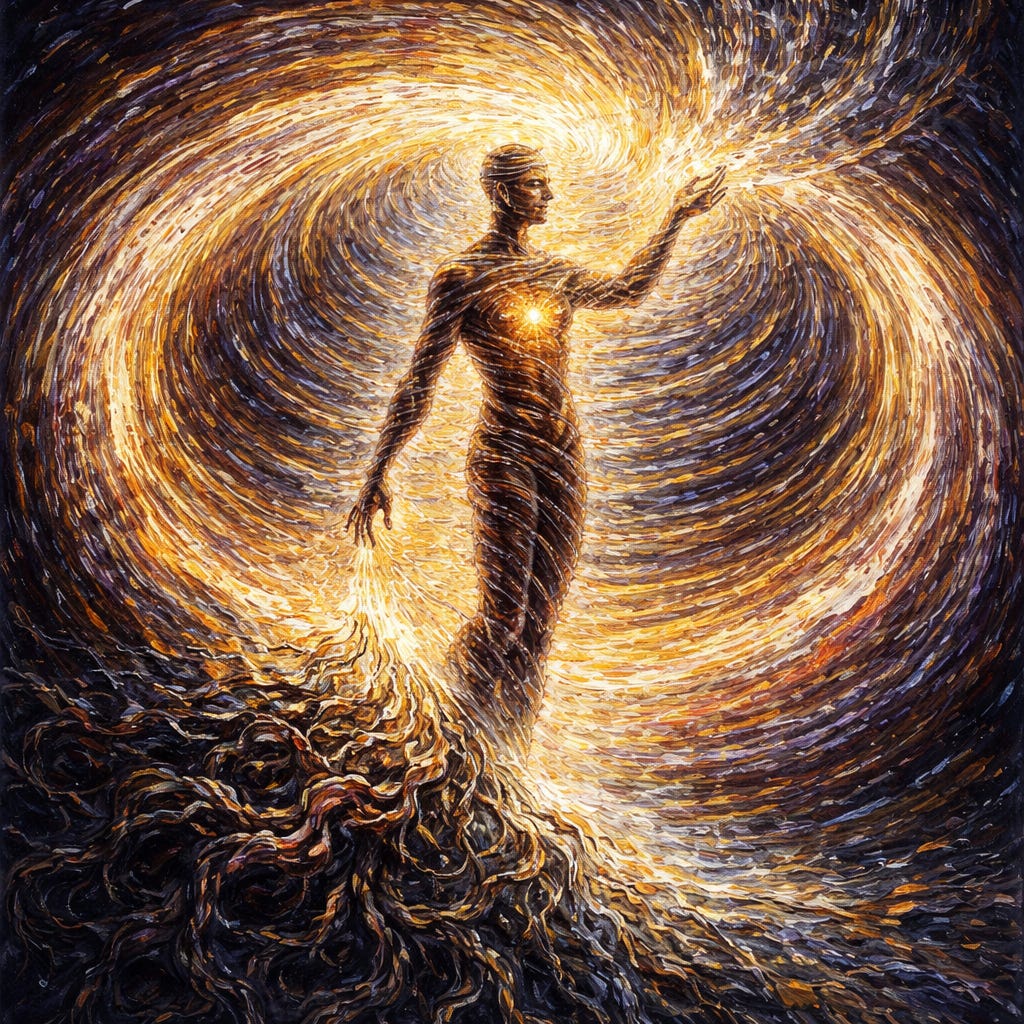
Some people do everything right. The juicing, the supplements, the yoga, the meditation, the organic food, the breathwork. They spend thousands of dollars and thousands of hours optimising their biochemistry — and still feel terrible. Eileen McKusick was one of those people. She spent decades searching for answers, and the one that finally worked came from a direction she didn’t expect.
McKusick is the author of Tuning the Human Biofield — nearly 190,000 copies sold — and Electric Body, Electric Health. She has spent close to thirty years working with tuning forks and the human energy field, logged over 10,000 clinical hours, written a master’s thesis on audible sound and the biofield, and trained thousands of practitioners worldwide who independently replicate her findings. She is currently pursuing a PhD in Integral Health. None of this came from certainty. She was openly sceptical of her own work for fifteen years, questioning whether what she observed was real — until the evidence, and the replication by her students, made it impossible to keep doubting.

What she arrived at, through her own healing and her work with thousands of clients, is that chemistry is downstream of physics. We are electromagnetic beings running on charge, rhythm, and flow. When suppressed emotions create patterns of tension in the body’s electrical system, that disruption eventually shows up as disease, fatigue, pain. This isn’t a new idea — electrical approaches to health were widely explored in the early twentieth century before being quietly sidelined in favour of the chemical-mechanical model we inherited. McKusick has spent her career recovering what was lost and putting it to practical use.
Her books made me want to sit down and ask her about all of it. What follows is a practitioner thinking out loud — about sound, electricity, trauma, belief, and what it actually takes to heal.
With thanks to Eileen McKusick.
Eileen McKusick | Electric Health & Sound Therapy Pioneer
Support Independent Research
This work remains free because paid subscribers make it possible. If you find value here, consider joining them.
What paid subscribers get: Access to the Deep Dive Audio Library — 180+ in-depth discussions (30-50 min each) exploring the books behind these essays. New discussions added weekly. That’s 100+ hours of content for less than the price of a single audiobook.
[Upgrade to Paid – $5/month or $50/year]
Get in touch Essay ideas, stories, or expertise to share: unbekoming@outlook.com
1. Eileen, your path to this work wasn’t linear—you started as someone who struggled with bulimia, chronic pain, and depression, and you spent years learning to sing despite being told you were tone deaf. What was it about that journey that eventually led you to working with sound and the human energy field?
What led me to sound and the human energy field is the fact that it’s really the only thing I’ve encountered that’s been truly useful and helpful. I spent decades and thousands and thousands of dollars going down many paths and not experiencing the degree of liberation I was seeking.
It wasn’t until I started working with sound—really, I worked with clients until 2010, and working with clients didn’t even solve my own problems. But in 2010, I started training my first group of students in Biofield Tuning and started receiving sessions myself. That was also when I discovered plasma, the fourth state of matter, and it started to dawn on me that the body had an electrical system, and that’s what the sound was interacting with.
I would say the combination of that awareness and my growing understanding of electric health, plus being able to receive Biofield Tuning, was super helpful in getting me free of all the lobster pots I was stuck in. I was stuck in a bunch.
Then in 2020, I started working with Isaac and Torrell Corrin, and this work that we call Sing the Body Electric came through us. It wasn’t anything we set out to do. It felt like something we were remembering—from maybe past lives in Egypt. When we first met, we had this sort of instant kinship.
That vocal toning—there’s 42 tones and 5 zones in the sonic anatomy—and it’s been through that work that I’ve really liberated my voice. I really think this is a vital and missing piece in health and freedom. An embodiment of your soul, an expression of your soul, is through your own voice. Our culture, our world, has really locked people down in their voices, in so many aspects of their voices. Celebrity culture being one of them. The dehumanization, the demoralization, the snuffing out of people’s spirits—that can really be restored through the voice finding its way to its true expression.
The most healing thing I’ve ever experienced was the recording of our last album, coming out in about a month, that we call Rock Mantras. Our first album came out the year before, and it was really just a support album for our students. It has all the tones, all the different aspects, and some of what we call tonics, which are songs of tones. I find that it’s not that hard to tone—most people can sit around and go “ohhhhm”—but to go from toning to singing a song is a really big jump. These are songs of tones, a half-step that’s very accessible for people.
Even in the process of recording the album, I had this really interesting experience. I always felt like my midline was shifted off to the left side, and no amount of tuning, bodywork, anything—I was always just kind of sitting on the left side of myself. Over the three days that we recorded the tracks, I felt my midline move to center. For the first time in my life, I’d really landed plumb square and round within myself. I felt I had really come to the work I was here to do—which wasn’t tuning forks or the biofield, but really feeling free to express my soul through my voice.
I’m excited for this album to come out, because I think it’s truly healing, and it’s very different from a lot of healing or New Age music. It’s rock and roll—we’ve got drums, bass, guitar. It rocks.
2. You describe yourself as a “practical skeptic” who spent years asking “what the heck am I actually working with?” When you used tuning forks on clients, can you walk us through how you moved from observing that something was happening to understanding why it was happening?
That’s a great question. In the beginning, all the way back in 1996, when I picked up my first forks and started playing with them, I had no idea what was going on. But what I observed right off the bat was that even though I didn’t know what I was doing—I was just experimenting, playing—people reported immediately that they had less pain, that they were sleeping better, that they felt better.
I’d been doing massage, and they were clients in my massage practice. They’d come back and say, “Do that sound thing again, that was cool.” In pretty short order I stopped doing massage and was just playing with the forks. But I was also—it was the idea of vibrational medicine that brought me to the forks in the first place, so I also had 100-watt light bulbs in red, orange, yellow, blue, green, purple. I had a gooseneck lamp, so I’d screw in the bulb and put it on the energy center. I had a surround sound stereo with a subwoofer under the table, so I’d play music and use colour and sound. Over time, I just whittled it down to the forks, because I’m a minimalist.
I did it part-time until 2006, which is when I accidentally discovered that there was stuff going on—restriction, atonality, and distortion—in the atmosphere around the body. I started exploring what I now know as the biofield, but certainly didn’t then.
I developed this method—start from six feet away and comb in towards the body. And I was like, “This is so freaking weird. What am I even doing?” I was skeptical about this work for fifteen years. “What’s even happening? Am I making this up? Am I imagining this? Does this really work?” But people kept giving me feedback and telling their friends. My practice kept growing.
I would say it wasn’t until I had gone to college as an adult and written a master’s thesis called “Exploring the Effects of Audible Sound on the Human Body and Its Biofield”—a deep academic dive—and had about 10,000 hours under my belt, and trained students who were getting the same outcomes, that I finally felt confident in what I was doing. It was just so strange, and I was the only one on the planet doing it. It took a lot of exposure and insight and understanding and replication to finally believe in it.
2.1 Was there a period before this Rockefeller medicine era where sound and vibrational therapy was a recognised practice, or have you brought something entirely new into the space?
There’s nothing new under the sun. I’ve definitely reclaimed something. Sound and music has been used in healing in every culture throughout human history. Think about the didgeridoo, at least 40,000 years old. Temple bells, chanting, mantra, gongs, drums, rattles. Even the classic Native American medicine man, going around the body with drum and song and rattle—that is breaking up the stagnant, stuck energy in the field. I’m not really doing anything much different. I’m just a white girl with a tuning fork, but it’s the same thing at the end of the day.
There was quite a lot of understanding of the electrical nature of the body in the late 1800s and early 1900s. You could buy devices for your electric health from the Sears and Roebuck catalogue. It was explored, it was understood, it was being used. Tesla and Tesla coils. And it was very deliberately—especially in the 1940s, and especially after World War II—hidden. Subverted. Very intentionally, we brought forth a pill for every problem.
I even think of someone like Mesmer—the story around Anton Mesmer. He was using his hands and metal rods and crystal goblets, making sound with them, then using his hands around people as he worked with their magnetic fluid around the body. So it’s been this vitalism versus mechanism debate for a while, even before Rockefeller. But it’s definitely been intentionally subverted because it’s more effective than chemical, mechanical medicine, quite honestly.
3. One of your central claims is that we are fundamentally electromagnetic beings, not just biochemical ones. For someone trained to think about health in terms of nutrients, hormones, and neurotransmitters, what’s the first shift in understanding you’d want them to make?
Chemistry is downstream of physics.
Everything is mind. Everything is patterns of energy within mind. Rhythms, patterns, flows, wiring. Our electrical signal gets impacted by inputs—traumatic inputs, false beliefs, obfuscation.
It’s all patterns of the way energy moves through us, and the way that energy moves through us is rhythmic. Everything is rhythm—heart rhythm, brain rhythm, digestive rhythm. You’ve got a little orchestra going on in there, and that is the precursor to the chemistry and physiology that arises from it. Even the work of Candace Pert demonstrated that when we feel a particular emotion—which is a very specific waveform moving through our body—it generates specific molecules. Her book, The Molecules of Emotion.
So the wave is the precursor to the molecule.
4. You use the metaphor of the body as a rechargeable battery, with voltage that can be depleted or replenished. What does it actually feel like to have low voltage versus high voltage, and how can someone begin to notice this in themselves?
A really good example is something like seasonal affective disorder. I’m in Vermont, very high up in the northern hemisphere, almost to Canada. We don’t get a lot of sunshine in the winter. If you’ve got any kind of solar-powered anything, it needs to be topped off with sunlight in order to have a strong charge. It’s like the power goes out and you go looking for the flashlight you haven’t used in a while—you turn it on, and it’s dim. Not fully charged. Dim. Low.
When we’re fully charged, it means that we are breathing fully. We breathe charge. In the chemical perspective, it’s like, “Oh, it’s oxygen.” But oxygen has free electrons. When we breathe in the air, which is a weak plasma—or you go to the beach to recharge, because it’s an ionised environment—you are bringing in more electric charge. Your blood goes from dark red to bright red because you’re breathing light. It’s the charge, the electric charge, that goes and feeds all your cells.
Same with food. If we eat food that’s fresh, alive, full of sunlight, then the electrical fermentation of your digestion extracts charge from that, just like it extracts charge from the air. Everything about breathing and eating is about feeding our battery. If we breathe shallow, eat sugar, and don’t go outside, we’re going to have low voltage. But if we’re outside a lot, grounded and barefoot, eating fresh food, breathing fully, and joyful—then we’re going to be much more fully charged.
4.1 What are you observing in terms of how mainstream academia is dealing with this subject? Is there a trend upwards in acceptance, or is it still highly suffocated?
I would say both. It is trending upwards, but it’s still very suffocated. They say that the biofield remains a battleground. I don’t understand that. To me, it’s really obvious. We have electric current running through us—nobody can argue with that. Your heartbeat is electric. They’re showing that even conception is an electric event, orgasm is an electric event. Brain waves are electric. Anything that has electric current running through it has a magnetic field around it. We all learned that in grade school. What is the battle? There is no battle. It’s just willful obfuscation. It’s ridiculous, quite frankly.
That’s part of why I’ve gone back to get my PhD. I just started this semester. I returned—I did PhD studies from 2013 to 2015 at the California Institute for Human Science, which is one of the only—maybe the only—accredited college in the United States that has consciousness studies. I’m getting a PhD in Integral Health. And it’s to wade back into this nonsense battle about the biofield. Just be a soldier for that.
5. Your mapping of the biofield suggests that our memories and experiences are stored in specific locations in the energy field around the body, almost like rings in a tree. How did you discover this structure, and what convinced you it was real rather than something you were projecting onto your observations?
When I first started exploring the field and would hit an area of resistance where the sound of the fork would go really distorted, I had this experience with what I call my mail slot—M-A-I-L slot—in the back of my head, right around the atlas. I would feel the mail slot open, and a little note would drop in. The note would say something like, “Sadness, age 10.” So I would say to the person I was working with, “Did something really sad happen to you when you were ten?” And they’d go on to tell me the story of sadness when they were ten.
That’s how I mapped the field. It came in my mail slot. I don’t know where it came from. I was so puzzled—“How do I know this? Am I remembering this from some past life?” I’m too practical to be like, “Oh, it’s my guides.” I’m a scientist. I’d much rather say, “Oh, it’s a mystery,” than assign it to something I’m making up.
It happened by degrees. I describe it as a blind fumble in the dark where I was teaching myself sonic Braille, with momentary flashes of illumination where I’d suddenly see a pattern or suddenly understand something. It took about four years for the whole map to show itself—the ancestral rivers, the mother and father spots, the timelined aspect, the file-drawer aspect. All the sad-sounding emotions are here, all the angry-sounding stories and emotions are there.
By 2010, I had a group of friends and clients bully me into teaching them. I didn’t feel ready—I was working on a master’s in education, I wanted to have a degree before I taught anything—but they were like, “No, you have to teach us now.” When I introduced the Biofield Anatomy map to them, I said, “This is one person’s subjective experience. As a scientist, I cannot give this to you and tell you it’s a legit thing. This is just a model, but it’s a model that works. It works for me. It’s very consistent.”
When they started using the map and having the same experience I did—they didn’t need the mail slot, they could just plot it on the map. You mark out six feet to the edge of the field—that’s birth. Three feet, that’s age thirty. Off the left shoulder, this is something sad when you were thirty. And the person would confirm it. This is one of the things people really remark about in Biofield Tuning—how blown away they are by the ability of their practitioner to nail memories and dates.
The field is holographic, and everything is everywhere in the field. On a certain level, it isn’t this structured. But on a certain level that we can access, it is—and it’s accurate again and again and again. I just worked with somebody right before this interview, and I got just inside the outer boundary of the field into birth, and it felt so fast. I said to her, “Did you have a really fast birth?” And she said, “Yeah, I came really fast. My mum had a three-day labour with my older brother, and I think I just wanted to spare her that.” That’s an intuition. That’s feeling a current—a fast current in the spot of birth.
Every single emotion has a specific frequency signature. What started as mail slot drops became a science and a language I came to understand. I didn’t need the mail slot anymore, because I’d know—“Oh, that sound is a move. That’s a breakup. That’s a car accident.” It’s a very specific language that’s the same from person to person. It’s the same in animals and plants, too. They speak the same vibrational language as humans. I can tell if a plant is afraid. I hear it. It’s a very pure, very precise language.
5.1 How does your work map over Rupert Sheldrake’s work with morphic resonance?
Simply in that everything is a field. It’s all fields, all fields of information, and there’s resonance within those fields. It overlaps with a lot of what Lynne McTaggart talks about in The Field, and many people who speak to the field nature—that we’re all one.
Another part of making us ignorant is that we’ve been conditioned to see everything as separate. When I was eighteen and first got into science and spirituality, health and human potential, I figured out very early on—after I did acid and had a visceral experience of unity consciousness—I was like, “Whoa, I had no idea everything was all one.” Then I realised: this is the problem. This is the one problem that, if we solved it, would solve most of the other problems. We’re all walking around believing everything is separate, but it’s all one thing. It’s all coming from the same field. We’re all made of the same substrate.
In the world of divide and conquer, fostering the illusion of separation gives power to those who keep us ignorant.
6. You’ve said that the majority of disease begins as an emotional event, and that addressing stuck emotions accomplished what years of supplements and clean eating couldn’t. What do you mean when you say emotions are electromagnetic waves, and what happens when we suppress them rather than let them move through?
An emotion is a wave. It gets generated, it rises up, it crests, and then it falls away. Most of us grew up in abstinence-only households when it came to emotion. We simply weren’t allowed to express it. So we all learned that when something started to come up, we had to hold it back down again. In order to hold something down, you have to engage tension.
I’ve really come to the conclusion—and I know there’s a lot of debate in the health field about what actually causes disease, whether it’s parasites or this or that—I believe it’s tension. Patterns of subconscious tension holding in sounds, holding in feelings, holding back authenticity. You end up with all of these different patterns of constriction that inhibit functioning. Inflammation in some areas, deficiency in others.
I worked with a woman a few days ago who has a pancreatic cyst. She’s going to the doctor and they’re like, “Oh, we’re going to cut out half your pancreas and all of your spleen.” So you’d think the problem was in the pancreas. No. The problem was actually in the ligament between the kidney and the spleen. There was this whole constriction on the left side related to her mother, her mother’s mother—all of this energy from the mother and grandmother lineage that she had compressed around. Because of that constriction, blood flow, lymph flow, energy flow weren’t getting to the pancreas. The pancreas is the most downstream organ—it’s like, “I’m really struggling here.” So it’s tension. Emotional tension.
Then it gets suppressed, and she got really scared because her cyst was growing, so she got more scared—kidney going into overdrive—and it started getting bigger. Almost every disorder, even toxic exposure—we’re all exposed to heavy metals. Why do some people accumulate them and others don’t? In my experience, there’s a certain personality type that really accumulates heavy metals, and that is people who hold in anger. Think about getting angry, and then the tension you have to engage to hold it in. It creates tension across every membrane in the body. Is your body going to move heavy metals through that tension? I don’t think so. It starts to pile up.
You can’t even necessarily blame the toxins, because a squishy, robust body is going to squish them out.
6.1 Have you worked with cancer patients, and have you seen a change in the direction of cancer with this type of work?
I have, in a limited capacity. When people choose to go through conventional treatment, it puts a real hurting on their body. Once disease has gone deeply into the body and the process of death has started to set in, it’s silly to think that my tuning forks are going to save you. I’m not going to bring anybody back from the brink. I can’t do that.
I would say Biofield Tuning works great for mild to moderate things, and it’s fabulous for prevention. I’m 57, knock on wood, I don’t have any health issues. No pain. High, clear energy. I can eat anything I want. I’ve had a lot of tuning, a lot of bodywork, done a lot with voice. I don’t take any kind of supplements—zero. If I ever have anything that’s a little bit funky, I take whole plant dandelion extract, because dandelions are like, “Yay, we’re alive!” And if I want to feel alive, I want that vibe in my system.
One of my best friends was diagnosed with cancer in 2013. Once we got her x-rays and knew where it was, I came in to work on her. When I hit the edge of the field of the tumour, the moment I hit it, she went, “Ow!” I came back and hit it again—“Ow!” I was like, “I’m not doing this. This is a no-go.” Not only that, but her mum and her aunt had both died of breast cancer, or lung cancer and bone cancer, when they were her age. She was kind of committed to the idea that she had that fate.
In the United States, it’s illegal to treat cancer with anything other than drugs and surgery. And because what I’m doing is such a disruptive technology—I’ve had so many people say, “I got more out of three visits with you than I did in years of talk therapy,” or, “My physio had been working on my right hip but didn’t address my left shoulder at all, and then you came and worked both of them and now it’s sorted out.” Or, “You got me off thyroid medication,” or off antidepressants, or off anti-anxiety meds. This is very disruptive to a lot of industries. So I don’t want to go messing with the medical mafia and be like, “Yeah, I treat cancer too!” Just not going there.
I will work with people who have cancer, and we’ll get into the underlying emotional issues. But full-blown tumours, advanced cancer—no.
7. There’s a moment in your second book where you describe going from chronic pain, debt, and struggle to resolving all of those issues after you began receiving tuning sessions from your own students. What shifted, and how much of that shift was the tuning itself versus the new understanding you’d developed about your own electrical nature?
All of those things are tension-based. Even poverty consciousness—it’s this feeling of, “Oh, how is it that my car always knows when I have a little extra money in the bank and needs repairs in the exact amount?” And you’re about to write that cheque and you go “ehhh”—what does that do? That restricts flow.
All of it—pain, struggle, everything—tension. False beliefs create patterns of tension. They create obscurations in our own perception. That’s noise in the signal. Anywhere you’ve got noise in the signal, there’s corresponding tension, and vice versa.
So it was just unwinding all of the tensions—false beliefs, stories, traumas, ancestral miasms, cultural lies—all layers of tension. Unwind, unwind, unwind, become more free. They don’t want us to be free. This is the greatest act of rebellion—to get yourself free.
8. You write about people who do everything “right”—the juicing, the supplements, the yoga, the meditation—but still feel terrible because they haven’t addressed the emotional dimension. What does it look like to actually work with emotions rather than around them?
It’s uncomfortable. You do have to feel it to heal it. I call myself Shortcut Shirley—if there is an easy way to do something, I’m going to find it. Even my mum, when I was little, said, “If there’s an easy way to do something, that child will find it.” It’s just the way my mind has always worked. And I have not found a way around: you’ve got to feel it to heal it.
It sucks. It’s uncomfortable. I’ve been through a lot of detox, because as you unwind patterns of tension, suddenly the garbage trucks can get into areas where they couldn’t get before. Mucus, rashes, waves of emotion, tears, more mucus. It sucked. But the spaciousness that you get to on the other side makes it totally worth it.
A lot of people don’t heal because they’re not willing to feel the discomfort. I was a master stuffer. I became a sugar addict probably when I was two. There’s a picture of me at about two and a half, lying on the floor of the pantry—I look like a stuffed doll, with this big box of open Lucky Charms next to me. I had clearly eaten myself into a carb coma. I figured out very early on that sugar and carbs would kill the pain I felt.
When I first started doing yoga at twenty-three, you get into poses like plough and you’ve got your belly hanging in your face, and all of those emotions are buried. The anger, the sadness—you’ve stuffed them into every hidey-hole in your body. When you start holding your body or moving your body in a different way, those molecules start popping and coming up. This is why a lot of people start working out and then stop—those emotions start off-gassing. You get confronted with all the discomfort you’ve stuffed away. Maybe without even realising it, you drift away from wanting to exercise, because of the discomfort that arises.
In the chemical and mechanical model, people think they’re doing the right thing by eating clean. All the celery juice in the world is not going to soften your heart. It’s not. Everybody’s barking up the wrong tree.
Especially the biohackers with all their devices and supplements—Dave Asprey and his 180 supplements a day. Give me a break. It’s not necessary. The more we feel and heal the emotions we’ve stuffed, the more we can let God in. Because God’s the only vitamin you need, really. The source of your own electric body. The one light. The more you can bring that into your being and resonate with it, that’s all you need.
8.1 You mentioned compassion. Can you talk about the connection between compassion and this work?
It’s very easy for us to succumb to our first thought or response, which is almost always judgement of some kind. A lot of people get stuck in judgement. But if you take the next step past judgement, it leads you to compassion. It’s not a long way. It’s just one more step.
A big part of it is knowing that I am that. That’s where this unity consciousness, this real awareness, comes in—“Oh, I am that. That is me.” It’s easy to judge, and it’s easy to judge ourselves. Everybody walks around with this inner critic, inner judge, inner victim—power dynamic, attack and defence. Just have compassion for yourself, and kindness, and care.
Believe that you’re worthy of it, because at the kernel of every dysfunction I’ve ever worked with is a story that they’re not worthy in some way. That’s been really programmed into us.
When we’re all growing up, we’re told—you say you hate something and your parents go, “Don’t use that word, hate is a very bad word.” Well, hate is a natural human emotion. So you have all these people suppressing their hate because they’re trying to be good. And then they parade Donald Trump and say, “You can hate him.” And then people end up dumping all the hate they haven’t let themselves feel—towards themselves, towards others, towards life—into “I hate Donald Trump!” You don’t hate Donald. You don’t even fucking know him. All you know is this image that the media tells you to hate. It has nothing to do with Donald Trump and everything to do with the panorama of your own inner emotions that you haven’t let yourself feel or express. So much of it turns into self-loathing—we hate our bodies, we hate ourselves—while trying not to hate because it’s bad.
Rancour is another one. I have a video on my YouTube channel called “The Hidden Emotion That’s Keeping You Stuck.” Whether you feel rancour towards yourself or towards someone else, it puckers all the linings of all your membranes and inhibits flow. The solution to all of that is compassion. It’s not an easy state to get to. Took me a long time and a lot of work to express compassion naturally instead of trying to force it.
9. Your work has obvious implications for how we think about trauma. If traumatic experiences create pathological oscillations that persist in the biofield, what does resolution look like? Is it about releasing stored energy, changing the pattern, or something else?
It’s both. The tuning forks, as I understand them, work with resonance and entrainment. When I find a pathological oscillation in the field, I hear it, I feel it, you might feel it in your body. Think about something in your car that’s loose—every time you drive, that vibration is disrupting the functionality of everything and will cause everything to break down over time. So every pathological oscillation is like some part of your car that’s loose. If you go in and tighten everything up, everything gets smoother.
The tuning fork will initially resonate with the distortion—the memory, the input. But a strong, coherent signal overtakes and entrains a weak, incoherent signal. First, the body is like, “Wow, I sound really bad over there.” It’s just like you don’t know you have a poppy seed in your teeth until you look in the mirror—and as soon as you see it, you want to get it out. Same thing. The body didn’t realise it was so funky in that spot. You’re providing a reflection for the body to order itself against. The body is designed to put itself in order, and it will use whatever it can in its environment to order itself.
Within that oscillation, there’s also trapped energy that isn’t flowing. Everything’s supposed to flow, and now it’s all snarled up. When we can get it to harmonise, the energy that’s trapped can be guided back into the midline of the torus and restored to flow.
People who’ve had a lot of trauma have a lot of freeze, distortion, and noise in their signal. It makes it really hard to function. But you can go in methodically—it’s like hair that’s a big tangled mess. You’ve got to comb it out, and if it’s really bad, it might take a few sessions. It’s this field grooming that detangles the knots, settles down the noise, and helps everything go back into more coherence.
But it can take time. If you’ve had a lifetime of trauma, I’m not going to fix you in three sessions. The older you are, and the more complex and intense your trauma, the longer it’s going to take. If I’m working with someone young who’s only had a little bit—bada-boom, bada-bing. But if I’m working with somebody who’s seventy-five and they’ve had trauma after trauma after trauma, it’s going to take a while. It’s a big mess.
9.1 Surely it’s tied in with thinking patterns also. You can address the field, but there’s muscle memory in the thinking patterns that would negatively impact the field again.
Absolutely. I’ll give you an example. I had this pattern—whenever I’d get really out of balance, I’d go see my acupuncturist. She’d always say, “Your energy pools up here.” That was my chronic thing. Then one day I realised what it was. It was longing. I had this mental and emotional pattern of longing. When I was in unfulfilled longing, my energy would circulate in a loop and not go to all the places it needed to. I struggled around that until I ended up having a session with Bradley Nelson, the Body Code / Emotion Code guy. He determined it was an ancestral pattern that went back twenty-two generations on my mother’s side.
He cleared it. The dude takes a magnet and wipes it across his head. And I felt this whole energy—this whole imprint in my bloodline that I was following suit with blindly—just roll out down my arm and out. Then that pattern of subconsciously indulging in longing, setting up those circumstances, all went away. Not from tuning.
There’s always room. I’m a big fan of a multimodal approach. A lot of us are carrying around things we don’t even realise have been passed along in our genetic blueprint for generations.
10. Between your first book, Tuning the Human Biofield, and your second, Electric Body, Electric Health, your emphasis seemed to shift from the sound therapy method itself toward a broader framework of understanding ourselves as electrical beings. What changed in your thinking during those years?
When I didn’t have an agent for my first book but did for my second—because I wanted a Big Five publisher, that feather in my cap—he kept saying that the editors he approached were like, “Oh, she’s known for her work with sound. We wish we had published Tuning the Human Biofield.” That book has been at number one in both energy healing and chakras on Amazon for months. It’s sold about 180,000 to 190,000 copies. Done really well.
But they kept saying, “This is something different.” And I was like—Tuning the Human Biofield was about electricity too. The biofield is your electromagnetic body. I talk a lot about plasma, about ether, about the biofield in that book.
But as time went on, I really started to grasp and work with this idea of electric health. I started taking care of my own electric health—walking barefoot regularly, looking at food from an electric health perspective, digestion from an electric health perspective. There were certain things I came across, like Jerry Tennant’s book Healing Is Voltage. That was a big aha for me—it made a bunch of things click into place. Then Gerald Pollack’s The Fourth Phase of Water. I just started coming across more resources that talked about electricity, and I realised: this is where it’s at. I bought the domain ElectricHealth.com.


In my own experience—even going through menopause, the word “hormones” never entered my mind. Not once. I realised it was a grounding issue. They’ve done studies where they’ve taken people’s blood out of them, treated the blood in another location, and the body resonates with that blood being treated outside the body. When a woman bleeds every month, whether she puts it in a keeper cup and puts it in her garden or flushes a tampon down the toilet, her blood is going to the ground. Then all of a sudden, you’ve got no blood going to ground anymore. A lot of hot flashes, weight gain, and issues that women have in menopause is buildup of charge.
I wore moccasins everywhere—back in 2016, 2017, you couldn’t buy cute grounding shoes. My husband called me Pocahontas. I wore those damn things everywhere. But I completely sorted it. I started to get symptoms, immediately figured it out, addressed it from an electrical perspective, and resolved it.
11. For someone who will never pick up a tuning fork or book a Biofield Tuning session, what’s the most important thing they can take from your work and apply to their own health and life?
Stress. Even the CDC says 85% of disease is caused by stress. It’s really about managing your stress, because stress is electrical—it puts you into dysregulation. When we’re dysregulated and stressed and tensed, our body suffers.
You have to take care of yourself. You have to figure out how to regulate yourself, how to foster coherent states within yourself—gratitude, compassion, love, kindness, humility, grace, wisdom. You’ve got to mind your thoughts and feelings, and guide yourself routinely back to your centre, back to compassion, back to kindness, back to coherence, back to regulation.
These little old ladies who live to be over a hundred—they smoke butts and drink booze and eat chocolate and laugh. They’re not swallowing fistfuls of pills. They’re managing their stress really well. The people in the Blue Zones—they’ve got community, they’ve got each other, they laugh, they play games together, they do music together.
You’ve got to have more fun. More hugs. More beach time, woods time. Take care of your inner child. Sing. Laugh. Laughter is such good medicine. And the world is dampening all of these things that lift our spirits and help us feel good. We’re getting bombarded from every angle with things that dysregulate us.
You have to mind your diet of inputs. The more you can eat wild food, sing and dance, play music—there are so many ways to be a natural human. Extract yourself from your unnatural, stress-filled, angst-filled, demoralised existence, and stake a claim for your own humanity, your own enjoyment and pleasure in life.
12. You tell a story about using your mind to create “plasma fur” around your body to protect yourself from chemical scents that used to debilitate you—and it worked. What does that suggest about the relationship between our thoughts, our stories about ourselves, and our actual physical experience?
So much of what governs our experience is our beliefs. People will cling more tightly to their beliefs than anything, without even realising they’re clinging to them. I find beliefs in the field—like, “Why can’t I get this thing to move? What the heck is it? Oh, it’s a belief.” Look at the flat earth, round earth debate and how righteous people get about it. I don’t know whether it’s flat or round. I don’t frickin’ know. But so many people think they know, and beliefs are so governing of experience.
Beliefs are lenses that we not only experience life through but perceive it through—our own bodies, our own minds. I just realised one day that I was telling myself a story of weakness and victimhood, and I was having that experience.
At that point, I’d started to get an inkling about the power of belief and mind. I remember being at Home Depot—my husband is a builder kind of guy, and we have a lot of date nights at Home Depot. I was like, “Not this aisle again!” I decided I’m not going to be a victim. I’m just going to pretend it doesn’t bother me. I visualised my alpaca fur hat—when I wear it in the snow, it just wicks the snow away. So I put that on my whole being. I protected myself with that. I strode down the aisle, and it didn’t bother me at all. I changed my mind about it, changed my imagination about it, and had a completely different experience.
I don’t think we realise how powerful our mind, our beliefs, our stories, our intention is. People will say, “Oh, I’m broken,” and I’m like, “Well, that’s a story. Do you understand how powerful your word and your belief is? You want to keep affirming that story?”
13. You’ve trained thousands of practitioners in Biofield Tuning at this point. What do you notice about the people who are drawn to this work, and what have you learned from watching them learn?
They’re sensitives. I always say, “How many of you were told that you were too sensitive as a child?” Everyone’s like, “Me.” They’re sensitives. They’re maybe slightly rebels, because they’re willing to keep going in the direction that their soul is guiding them, even though it might be against the tide of popular culture. They care. You don’t become a healer unless you care. You’ve got to really care, be curious about your fellow human, want to help your fellow human.
It feels great to help people. You get somebody out of pain, you help settle somebody’s anxiety, you help somebody see the beauty that they really are—it feels really good. Even though it can be uncomfortable to resonate with someone in their pain, the good feeling on the other side makes it worthwhile.
A lot of them, though—and this is something I’ve been bringing up more and more—we’re the freaks. We’re the ones people call weird and too alternative. I’ve been telling them: actually, you’re right, and they’re wrong. You have every right to grow a spine, stand up, and tell them to fuck off. Or inform them. Because the mainstream has been taught to be such bulldogs, and these people end up shrinking instead of standing in their own sovereignty and truth. There’s a kind of meekness that I’m helping people get through.
I’m a Jedi at this point with this. I can take any sceptic and convert them within a minute—show them how they’re operating within constructed ignorance. I do it in a very resonance-and-entrainment, loving, compassionate way. But I’m very confident in my understanding that they’re living in the illusion of willful ignorance that the education system and the mainstream have put them in. And I actually know better.
13.1 Are you finding existing practitioners with other modalities coming to you to add Biofield Tuning to their work?
Definitely. We’ve got all kinds of people—chiropractors, naturopaths, psychotherapists, nurses, some doctors, physical therapists, massage therapists, acupuncturists. I have a number of acupuncturists who gave up their acupuncture licences to do Biofield Tuning instead, because they found it more effective. Nurses who have given up nursing licences. Psychotherapists who have given up psychotherapist licences. I’ve got a really great guy on my team who was a physician’s assistant and left that to do this work full time.
14. The conventional scientific framework doesn’t have much room for the phenomena you’re describing. How do you think about that gap—is it that the science hasn’t caught up yet, that the wrong questions are being asked, or something else?
It’s conformity to a paradigm and dogma. It’s not genuine scientific inquiry. Anybody with a genuinely scientific mind would say, “Oh yeah, anything that has electric current does have a magnetic field. Let’s explore magnetic fields.” Even when I was at a consciousness conference a number of years ago in Arizona—they were all talking about the brain, the brain and consciousness—I got up and asked the panel, “You’re all talking about electricity in the brain. Is anybody talking about magnetic fields around the brain?” Crickets.
Electricity is more masculine, and magnetism is more feminine. Mental health is more masculine. Emotional health—nobody talks about emotional health. That’s the elephant in the room. That’s more feminine. Even the magnetic field of the Earth is decreasing as over-electrification increases. There’s a larger issue here—the denial, the subjugation of the feminine, the emotional, the magnetic.
It’s programming. It’s dogma. It’s changeable. I think we’re going to see it change.
15. What are you most focused on right now in your work, and for readers who want to follow what you’re doing or explore further, where should they start?
I’m focused on going back to get my PhD. I’m curious where it will lead me. I’m going in for biofield science and doing research, but what I’m already bumping up against, even in the first few assignments, is the lack of whole systems thinking in academia. I’m very much a whole systems thinker. The way everything is siloed and disconnected—it’s the illusion of separation. I’m being confronted by how it’s infused itself completely into academia, the dogma and conformity around all of it. I’m not sure exactly where this will go. I’m completely curious and open to go where it wants to bring me.
I’m also super excited about the Rock Mantras album coming out. We’ve got some gigs lined up, a little tour.
I have a third book coming out called The Stabilizing Statements, probably mid-year. I realised recently that I’m a mapmaker. I did the Biofield Anatomy map, then we have four maps of the sonic anatomy, and I have the Stabilizing Statements map. Most recently, I recreated David Hawkins’ Power vs. Force scale of emotions—where he puts enlightenment up at 1,000 and shame down at 200. Everybody’s trying to “high vibe,” and I’m always correcting people: “Higher frequencies are faster frequencies—what are you even talking about? It is not a more desirable state to go higher. God is closer to zero. We need low vibes to sleep and rest. We need the bass. We need the drums. This whole high-vibe language is so off-base.”
I realised that a lot of that language comes from his map. So I recreated it as a circle, with the highly agitated emotions on the outside, and moving in towards the centre—compassion, kindness, wisdom, gratitude—all closer in. Enlightenment is in the centre of your being. It’s such a more useful model than this high-vibe thing. I know he meant well, and he was being a dude in a hierarchical world. But as a mapmaker and explorer of consciousness, it made sense to recreate it in a way that reflects the territory more accurately.
I’m thinking about maybe writing a book about all my maps and what I’ve learned from them.
For people who want to learn Biofield Tuning, go to BiofieldTuning.com. My website, EileenMcKusick.com, is a portal to everything—Sing the Body Electric, my tuning forks, my classes, my books. That’s a good hub to spoke out from.
Book: Medicalized Motherhood: From First Pill to Permanent Patient
Available as a free download. 123 interventions documented across six phases—from pre-conception capture through postpartum surveillance. Includes practical tools: birth plan template, provider interview questions, quick reference card, and a new chapter on interrupting the cascade. Download it, share it with someone facing their first prenatal appointment, their induction date, their cesarean recommendation. The cascade works because women don’t see it coming. This book makes it visible.
Support Independent Research
This work remains free because paid subscribers make it possible. If you find value here, consider joining them.
What paid subscribers get: Access to the Deep Dive Audio Library — 180+ in-depth discussions (30-50 min each) exploring the books behind these essays. New discussions added weekly. That’s 100+ hours of content for less than the price of a single audiobook.
[Upgrade to Paid – $5/month or $50/year]
Get in touch Essay ideas, stories, or expertise to share: unbekoming@outlook.com
New Biology Clinic
For those of you looking for practitioners who actually understand terrain medicine and the principles we explore here, I want to share something valuable. Dr. Tom Cowan—whose books and podcasts have shaped much of my own thinking about health—has created the New Biology Clinic, a virtual practice staffed by wellness specialists who operate from the same foundational understanding. This isn’t about symptom suppression or the conventional model. It’s about personalized guidance rooted in how living systems actually work. The clinic offers individual and family memberships that include not just private consults, but group sessions covering movement, nutrition, breathwork, biofield tuning, and more. Everything is virtual, making it accessible wherever you are. If you’ve been searching for practitioners who won’t look at you blankly when you mention structured water or the importance of the extracellular matrix, this is worth exploring. Use discount code “Unbekoming” to get $100 off the member activation fee. You can learn more and sign up at newbiologyclinic.com
Incredible interview! I can’t wait to try this. Everything Eileen is doing seems to dovetail nicely with Karl Pribram’s Holonomic brain theory - check it out.
Surprised accupuncturists are giving up their practices. To me, having experienced acupuncture and learning about the electrical properties of fascia, this type of therapy appears to be a natural addition to their practice. In my opinion (I am not trained in Chinese medicine), the reason why acupuncture works is due to electric fields. Some skilled acupuncturists free trapped emotions using acupuncture.