

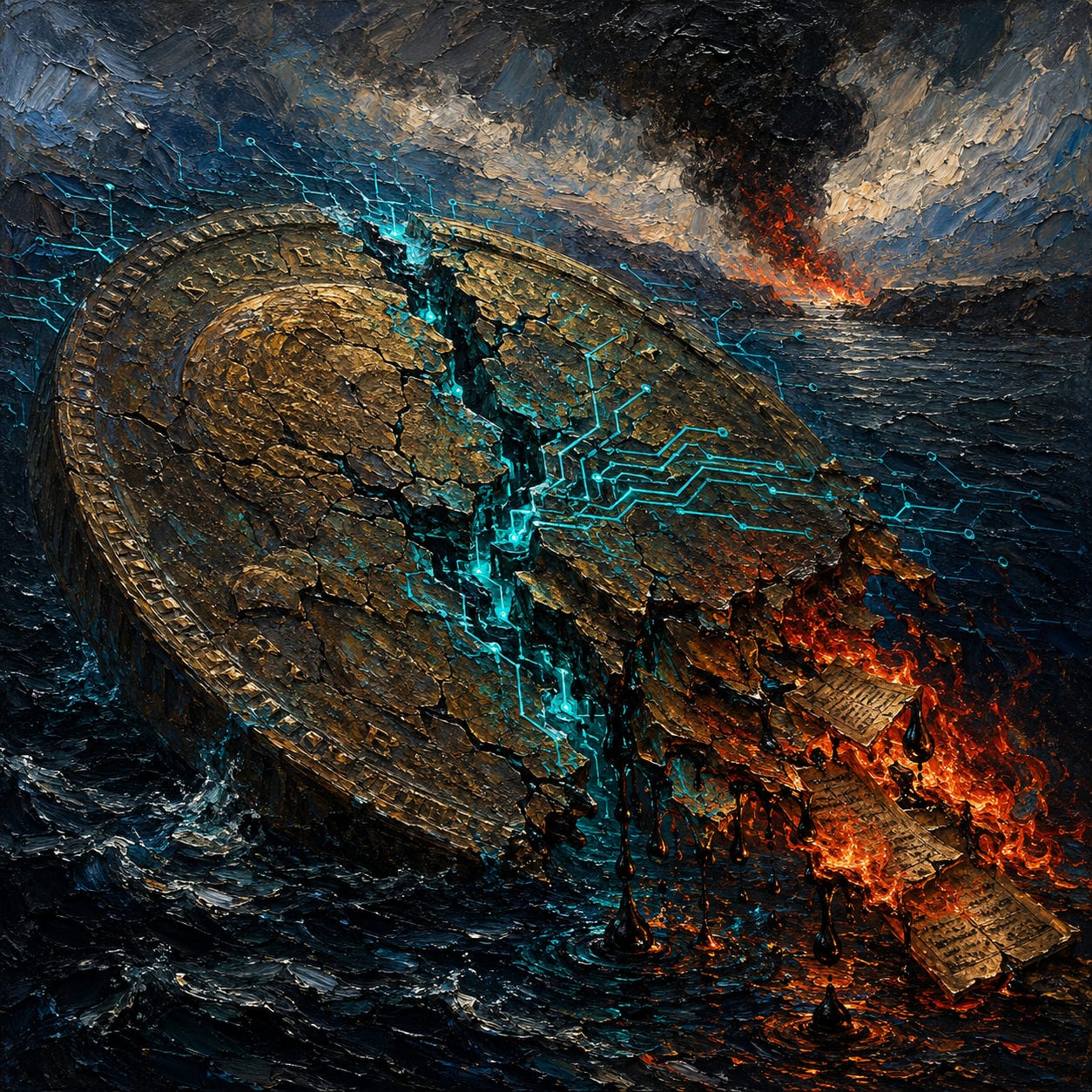
I first came across Fabio Vighi in late 2022, through a link at the bottom of an essay by a reader called Allen. Allen had written for me about the September 2019 repo spike — the moment when overnight lending rates exploded from 2% to 10.5% and the Fed had to start injecting hundreds of billions weekly into Wall Street — arguing it was the real event Covid was deployed to cover. Among his further-reading links was a piece called “A Self-Fulfilling Prophecy: Systemic Collapse and Pandemic Simulation,” published on The Philosophical Salon in August 2021. I followed the link. It was by Fabio Vighi, a Cardiff University philosopher trained in Lacanian psychoanalysis and the critique of political economy, and it had been laying out the case — the 2019 financial collapse, the lockdowns as cover for unprecedented monetary intervention, the pandemic narrative as the alibi for a bailout already underway — over a year before I’d read anything like it elsewhere.

The framework Vighi developed across that essay and the ones that followed is what he calls crisis management — or, in its sharper form, crisis deployment: the recognition that emergencies are not failures of hyper-financialised capitalism but its primary operating mode. The September 2019 repo crisis was the Rosetta Stone. Once you see that the bailout was already underway before the virus arrived, the sequence reverses. The crisis doesn’t cause the intervention; the intervention is already primed and the crisis provides the cover. What makes Vighi distinctive is the depth he brings to the diagnosis. He traces the structural logic through Wertkritik — value critique, the post-Marxist tradition that reads capitalism as a system that can no longer reproduce itself through productive labour and so survives through financial bubbles, perpetual emergency, and the accelerated impoverishment of the masses. The 2019 repo spike isn’t an aberration. It’s what a debt-saturated, post-productive economy looks like when its life-support runs low and another emergency has to be manufactured to justify the next round of liquidity.
The years since have not been kind to the official story, and they have been very kind to Vighi’s framework. Every major event since 2022 has fit the same template. The Ukraine war, the Gaza catastrophe, the Venezuela intervention, and now the Iran escalation function as bond-auction management — what Vighi calls “yield-curve control by other means” — with crisis abroad driving capital into Treasuries and suppressing yields at home. The programmable digital infrastructure — stablecoins on Fed master accounts, money that can be made to expire — has been quietly assembled as the delivery mechanism for the next round of monetary intervention. The Epstein files arrived as managed spectacle, drip-fed to keep outrage diffuse and bipartisan while the Treasury rolled over $9.6 trillion in twelve months. And the language itself has degraded: heads of state now speak openly in the idiom of murder, which Vighi reads as the symbolic order disintegrating because the system that produced it can no longer mediate its own violence. One analytical key, opening lock after lock.
If you’ve been watching the news with a sense that the official explanations don’t add up — that the wars, the inflation, the digital infrastructure, the scandals, and the political brutality must somehow be connected even though no one in the mainstream will say how — this interview is for you. Vighi reads the present moment as a single mechanism rather than a sequence of unrelated emergencies, and the value of his framework is that it gives you something to use, not just something to understand. The interview closes with the three signals he tells readers to watch: the acceleration of the event-news-event cycle until no crisis can resolve before the next one arrives, the proposed solution that is always the cause of the previous crisis repackaged as the cure, and the question of what disappears from the news while you are distracted. These are the practical tools. The interview itself is what they were built from.
With thanks to Fabio Vighi.
Fabio Vighi, Author at The Philosophical Salon
Support This Work
This work remains free because paid subscribers make it possible. If you find value here, consider joining them.
Paid subscribers get access to all books — including The DMSO Book, The Kitchen Remedies Guide, Chlorine Dioxide, The PSA Trap, Breast Cancer, and more — with 1-2 new books added each month. Plus the Deep Dive Audio Library: 180+ in-depth audio book summaries and discussions.
Paid subscribers also get the Questions for Your Doctor series, short printable guides built around the questions doctors are not trained to answer, one decision at a time. The companion Before You Consent series goes deeper, walking through a single diagnosis or prescription from the moment it lands to the days after, with every figure sourced. And the Package Insert series reads the labels the doctor never opens and the pharmacist never mentions, what the manufacturer admits, in their own words, about what they sell.
I do this work independently, outside the institutions these books so often describe. No foundation grants, no academic approval, no editorial gatekeepers deciding what’s acceptable to publish. Your subscription makes that independence possible.
1. Before we get into the substance of your recent essays, tell readers a bit about your background — how did a scholar trained in psychoanalytic theory and cultural criticism end up writing some of the sharpest commentary around on central banking, bond auctions, and the mechanics of debt refinancing?
The short answer is that I never really left psychoanalytic theory, philosophy, cultural criticism, and especially the critique of political economy. In a way, what I found more recently is a more urgent object for theory. Lacan, for instance, taught me to follow the symptom. For the past two decades it has become clear to me that the symptom has stopped hiding in cultural, philosophical, or even political texts, and instead has started screaming from the financial pages. I began asking myself: what if central banking is the discourse of the capitalist unconscious? What if bond yields are the real master signifiers organising narratives and events on the world stage? It seemed to me that in financial capitalism the logic of crisis management follows the same structure as the Lacanian “real”: it always returns to its place as a weird form of compulsive enjoyment, and always demands new symbolisations (emergency narratives to be sold to the public). If that is the case then moving between theory, cultural criticism and repo markets feels less like an impossible interdisciplinary leap and more like staying in the same analytical frame. So I didn’t abandon theory. I just stopped pretending that finance was somewhere else.
But to be clear, the critique of political economy has long been central to my work – specifically the post-Marxist tradition of Wertkritik, or value critique. This tradition gives us the tools to historicise what happened over the last 50 years or so. The shift from the real economy to fictitious capital – finance as the dominant force – did not fall from the sky, and it’s not just about the Gordon Gekkos amongst us. It began in the 1970s with the third industrial revolution (microelectronics). The rapid acceleration in technological automation meant that more productive jobs were eliminated than could be reabsorbed. That was the watershed moment that led to neoliberal financialization. A systemic crossing of the Rubicon. Capital could no longer expand through the production of real (i.e., labour-based) value, so it turned towards financial speculation, where money itself is put to work instead of commodity-producing workers. Today, with the fourth AI revolution, we are well beyond the point of no return – meaning that capitalism can no longer reproduce itself through labour-based production at all. It now survives purely through financial bubbles, state bailouts, the perpetual deferral of collapse, and of course the accelerated impoverishment of the masses, which demands more authoritarian control measures. Systemically, financial capital works as compensation for the absolute fall in the rate of profit in the real economy. It’s quite simple, and yet I find it astonishing that this key phenomenon of modernity keeps either being ignored or getting relegated to the footnotes of our media-soaked environment.
This is also my criticism of contemporary philosophers. They tend to be too precious when it comes to “the economy.” They don’t really want to get their hands dirty. They tend to think that the financial system is another word for “economicism” – something too “vulgar” to be associated with the lofty world of ideas. And that’s a big mistake, which perhaps is rooted in their delusional acquiescence within a collapsing system.
2. A phrase that recurs across your work is “crisis deployment” — the idea that emergencies are not failures of the system but its primary operating mode. Can you walk readers through what you mean, and why you think the September 2019 repo market intervention, months before Covid arrived, is the Rosetta Stone for understanding everything that followed?
I normally use the more neutral expression “crisis management”, but I find “crisis deployment” bolder - it means recognising that what we call an emergency is never just a systemic failure; it’s the system’s default operating mode. The real crisis is the terminal condition of hyper-financialised capital, and the emergencies are its life support. The September 2019 repo spike is the Rosetta Stone because it showed us the truth of “crisis capitalism” before the pandemic performance began. So what happened? Overnight, repo rates exploded from 2% to 10.5%, meaning the shadow banking system was choking on its own toxicity. Was this spike orchestrated? Even if it was, which is very likely, it still reflected the elementary truth of today’s debt-soaked, terminally ill system. In response to that, the Fed had to inject hundreds of billions weekly just to stop immediate collapse. Then, months later, Covid arrived. And suddenly, the Fed could do openly, and massively, what it had started doing covertly: unlimited quantitative easing, trillions created, backstopping everything. Crucially, under the cover of a virus narrative. The lockdowns not only justified the printing spree, but also froze the real economy, preventing that tsunami of liquidity from risking to turn into immediate hyperinflation. So what I’ve argued is that the deployment of the pandemic as a crisis – the timing, the intensity, the coordination – ended up serving one master: saving and rebooting a financial system that was already flatlining before a single case was actually reported.
And now, look at the current situation. The renewed escalation with Iran, coupled with the potential return of viral threats (today, the hantavirus), suggests that exceptional monetary injections are about to return. The pattern is repeating: geopolitical crisis plus bio-emergency narrative creates the perfect cover for another round of liquidity deployment. The names change, but the structure remains identical. Crisis deployment is a method.
3. In “Bombs for Bonds” you describe American foreign policy as “yield-curve control by other means.” That’s a striking phrase. What does it mean to say that wars are now fought to keep US borrowing costs low, and how does the Iran escalation fit that pattern?
The phrase “yield-curve control by other means” is deliberately Clausewitzian. Contemporary (post-productive, financialised, debt-based) capital has outsourced its reproduction to the state’s monopoly on violence. Here’s the mechanism: US federal debt is now so enormous ($38 trillion and climbing) that any rise in borrowing costs becomes an existential threat. To keep yields low, you need buyers. To get buyers, you need the dollar to remain the only safe harbour. To keep the dollar as the only safe harbour, you need chaos everywhere else – or at least the credible threat of it. The Iran escalation fits this perverse paradigm perfectly, because eventually – even if external buyers will diminish – it will call the Fed cavalry into action. And whether it will work or not, the debt vigilantes don’t seem to have a plan B, which is testament to the proverbial lack of imagination of the so-called elites, and technocratic reason more generally. So here’s the logic again: every time the Treasury faces a difficult auction (struggling to sell its IOUs), a geopolitical “event” conveniently raises risk perception elsewhere. The predicted result is that capital flees to the dollar and yields compress. A crisis is manufactured externally to solve the crisis internally. The mullahs in Tehran serve the same function as the terrorist bogeyman after 9/11: they are the negative imaginary that keeps the capitalist “real” – the debt spiral – at bay. Until even this desperate and criminal strategy stops working.
4. You’ve argued that the Israeli strikes on Iran in March were timed to coincide with the largest Treasury debt rollover in US history — roughly $9.6 trillion over twelve months. For a reader who has never looked at a bond auction calendar, how should they understand that connection between bombs falling abroad and refinancing pressure at home?
I often use the parallel with Immanuel Kant’s notion of the “mathematical sublime”, a figure so large that it defies the imagination. In this respect, $9.6 trillion (9.6 followed by twelve zeros) in refinancing over twelve months is less a number than the signifier of a nervous breakdown. Someone has to buy that debt, and buyers need convincing that the US Treasury market is still the only game in town. The Israeli strikes in March should be read as a signal: the US can still project power, disrupt its rivals’ energy calculus, and attempt to control the global risk narrative – whatever it takes. The connection is not about secret phone calls between Tel Aviv and the Treasury desk. It’s much more structural. When your entire economic model depends on perpetual demand for your sovereign paper, you cannot afford even the appearance of military decline. This is why, for the US-led West, war is the oldest credibility device. Bombs falling tells bond markets: hey guys, we are still the hegemon! Your capital is safe here!
5. In “The Programmable Crisis” you describe how stablecoins, crypto exchanges getting Federal Reserve master accounts, and programmable digital dollars are being quietly assembled into what you call the next delivery mechanism for monetary intervention. What should an ordinary person understand about this new “digital pipeline” — and why does it matter that money itself might soon have an expiry date?
The average person should understand two things, and then a third that explains both. First, the move toward stablecoins and Fed master accounts is not decentralisation. It’s the Fed learning to inject liquidity directly into every wallet, bypassing the clogged arteries of commercial banking. The “digital pipeline” is a delivery mechanism for future bailouts and especially for future technologies of control. Second, money with an expiry date – programmable digital currency – completes the shift from sovereignty over territory to sovereignty over time. If your money expires, your compliance is not optional. The state doesn’t need to coerce you; it just waits for your funds to become worthless unless you spend them in approved ways. This is not dystopian fiction, as it is already being piloted.
But here is what they won’t tell you. What is being stripped away is the last sensory trace linking money to social labour. Money-capital is shedding its “labour substance”, thereby revealing its true vocation: compulsive self-expansion without content. Essentially, the stablecoin is the zero made programmable: a token backed by Treasuries (promises backed by promises), created by authorisation, and erased by command. Cash, at least, is still bearer-based: if you hold it, you use it. Digital money is conditional. Control shifts from possession to permission. Look at the Iranian wallets: $344 million in USDT (stablecoin) frozen on the Tron network, visible on the chain but immobile in reality. They are no longer money. They are a monument to meaninglessness: marked by the zero and left to decay. A stablecoin backed by Treasuries is a zero backed by a zero. Stripped of any link to social labour, money now requires surveillance and coercion to sustain the illusion of social substance. In this sense, capitalism is no longer even pretending to be about freedom. It is revealing itself as what it always aimed to be: a system of total administration, now writing its own bankruptcy into code. The only real transition would be out of money-capital as such – producing and distributing goods not for accumulation, but through alternative forms of social coordination. Without that transition, most complaints about the slide into a dystopian world, however justified, will ultimately be hysterical in nature – sound and fury leading nowhere. So the real question is: can we begin to think about how to access the means of life in a manner no longer mediated by the tyranny of the zero?
6. You’ve written that Europe is rearming instead of decarbonising, and that the Green Deal has been quietly demoted because defence spending offers something green industry cannot — guaranteed demand. What does this shift tell us about what the European project is actually for, underneath the rhetoric?
The Green Deal has not really been abandoned - it has been repurposed. The new shade of green is military. Ursula von der Leyen talked about the Green Deal as Europe’s moon landing, and now she talks about defence as existential necessity. Why? Because defence spending offers something the green industry cannot: guaranteed demand. Green transition depends on consumer choice, market signals, and price competition, while defence procurement is the state writing a blank cheque. What does this tell us about the European project? That underneath the rhetoric of values, climate justice, and social solidarity, the real engine is the same as everywhere else: the desperate search for profitable financial outlets for surplus capital. Rearmament is now seen as the stimulus package that cannot fail. It’s weird Keynesianism for an age that is abolishing the productive economy. Europe is rearming not to defend democracy, nor merely to keep the dream of productivism alive. Europe is rearming because the boost to the military sector legitimises more stimulus, and therefore more debt-creation. In either case, the stimulus doesn’t trickle down, but gets sucked up at the top. In today’s post-productive age capitals just move upward with increasing recklessness and shamelessness. The rest, including any “trickle down” narrative, is stale rhetoric.
7. In “Inside the Bubble of Successful Paranoia” you draw on the French psychoanalyst Jacques Lacan to diagnose our current moment. For readers who’ve never encountered Lacanian thought, can you explain in plain terms what “successful paranoia” means, and why you think it describes the way we relate to technology and capital today?
To understand this, we have to go back to Freud and Lacan. Freud’s case of President Schreber is the classic example: a man who believed he was being transformed into a woman to be impregnated by God, that rays were penetrating his body, that the end of the world was coming. He was clinically delusional, and yet he wrote a lucid, systematic memoir, held down a judicial position for years, and never fully decompensated. His paranoia “worked”. It gave him a framework that contained the uncontainable. Lacan showed that paranoia is not simply breakdown - it can be a successful defence against breakdown. James Joyce, for Lacan, was perhaps the key example: his writing, his “sinthome”, was a psychotic structure that held. Instead of collapsing under the unsymbolisable real, Joyce tied it into a knot that, however obsessively and weirdly, functioned.
Now look at us. We live inside a belief system called techno-capitalism, which is objectively insane. Infinite growth, value detached from labour, circulating as pure zero. Artificial intelligence promising salvation while dismantling the social state. Markets pricing catastrophe as opportunity. And yet we remain attached. We don’t break. We scroll, we invest, we update our software, and we call this “the future”. The most obvious expression of this collective successful paranoia is the techno-accelerationist manifesto. “Let the system accelerate until it collapses or transcends” – a deliberate courting of the end dressed up as strategy. The accelerationists embrace capitalist madness as the only viable path. This is paranoia that has made peace with its object. The belief is delusional - no serious politics can be built on “faster, harder, crash!” - and yet it functions. It circulates and gets funded. It recruits bright young people who sense something is wrong but cannot imagine stepping outside the frame. Successful paranoia is the name for this condition: we know the system is destroying us, we know the logic is cracked, and yet we believe – not despite the cracks, but through them. The delusion works. That is what makes it so hard to escape.
8. You make a distinction between denial (”I’d rather not know”) and delusion (”it all makes sense”) — and you argue we’ve shifted from one to the other. What does that shift look like in everyday life, and why do you think even much of the Left has retreated into what you call a “socially sanctioned delusional system”?
Denial says: “I’d rather not know”, it’s active repression. Delusion says: “I know, and it all makes sense!” The meaning has been pre-digested, the outrage has been channelled into predictable positions, the structure has been accepted as the only horizon of possibility. Delusion is a form of belief in, and attachment to, the system, no matter how crazy such delusional fantasy is. I argue that, collectively, we have shifted from denial to delusion because denial was exhausting. You cannot sustain “I’d rather not know” when the news cycle forces the knowing upon you. So instead, we have built elaborate interpretive discourses that allow us to feel informed and ethically positioned, while remaining functionally paralysed. The Left, especially, has retreated into delusional narratives because critique has become a comfort zone. Naming problems now substitutes for seeing what the problem is. The critique of political economy has been replaced by the critique of pronouns and similar morally invested positions, which work as perfectly delusional structures.
9. Your essay on the Epstein files argues that the scandal isn’t a rupture in the system but part of how the system sustains itself. That’s counterintuitive — most people experience the files as a genuine exposure of elite corruption. Why do you think the drip-feed of revelations actually stabilises power rather than threatening it?
It seems to me this Epstein business is part of the delusional architecture I was referring to. That’s why the drip-feed of revelations should be seen as a conservative “technology of containment.” Perhaps if the entire truth were released at once, two things would happen: first, public outrage might actually crystallise into something politically difficult to manage; second, the story would end. The serialised release ensures that outrage remains diffuse: always there but never concentrated enough to demand any structural change. Moreover, the files produce scandal for everyone. Left and right elites are implicated. The spectacle becomes bipartisan, and therefore politically useless. We are invited to be outraged at individuals – Epstein, Maxwell, specific names on flight logs – while the system that produced them, that organised the circuits of power and capital in which such predation becomes possible, remains untouched. And this is really the key point. Essentially, exposure stabilises the system because it redirects anger from structure to personality; it personalises guilt. We get catharsis without transformation: a kind of self-satisfying homeostasis that ends up strengthening the power structure.
10. You write that capitalism and sexual abuse are driven by “the same predatory logic.” That’s a confronting claim. Can you unpack what you mean — and why you think Epstein’s network should be read as a metonymy for the system rather than as an aberration within it?
This is meant to be confronting. Capitalism reduces everything to assets, to extractable value, things to be used and discarded. The sexual predator does the same: the other is not a subject but an object, a commodity. Therefore Epstein’s network is not an aberration, but rather the logic of capital applied to the body. My point is that the skills that make a successful billionaire – the capacity to instrumentalise others, to calculate risk, to treat relationships as transactions – are disturbingly adjacent to those that enable systematic abuse. Capitalism is not only perverse but essentially psychotic. When we say Epstein was a monster, most of the time we want to reassure ourselves that he is outside the system. Calling him a monster is our successful paranoia: it allows us to name the evil while preserving the structure that produced it. But in truth his network passed through the same boardrooms, the same foundations, the same universities, the same political circles as legitimate capital. Epstein’s island is less the exception than the underbelly of the boardroom, stripped of its civilised mask. Therefore he can be seen as a metonymy: the part that reveals the whole. You might have seen Pier Paolo Pasolini’s film Salò, or the 120 Days of Sodom (1975); well, it could be remade today with only the Epstein class at its core.
11. In your most recent essay, “The Iron Fist Drops the Glove,” you argue that the first sign of a collapsing system is the collapse of its language. You point to heads of state now speaking openly like murderers — something you say neither Hitler nor Stalin did in public. What does this degradation of political speech tell us about where we actually are in the cycle of decline?
Giorgio Agamben has shown that the first sign of a dying civilisation is the degradation of its language, i.e. of its symbolic order. But what we are witnessing now is even stranger and more advanced. Hitler never said in public, “I am murdering the Jews.” The violence of mass murders required the alibi of necessity, of security, of historical inevitability. It required some form of symbolisation. Now, heads of state like Trump speak openly like psychotic assassins because they are the product of a system that needs such political short-circuits. A system based on the programmed release of chaos needs chaotic leaders. The other point to note is that we’ve grown so desensitised to this type of post-politics that there is no longer any serious pushback. So when an Israeli minister casually discusses starving Gaza as a “justified” tactic, he is not hiding. In fact, we could argue that he is testing: how much direct truth can the system absorb? I’m not referring to the truth of facts, but to the truth of the real: the raw, un-symbolisable kernel of reality that the symbolic order is supposed to make sense of and keep at bay. The fact that there is no effective blowback, including from more “moderate” politicians, tells us that the symbolic order has lost its binding power. We are beyond hypocrisy. We have entered an era exposed to collective psychosis. And when language no longer functions as a constraint on power, this means that collapse is not just coming our way – it is already here.
12. Drawing on Giorgio Agamben, you suggest that the word “West” literally means “that which never ceases falling,” and that our civilisation governs itself through its own perpetual collapse. For a reader trying to make sense of headlines that feel increasingly unreal, how does this etymological insight change the way we should read the news?
I find Agamben’s etymological point devastating. “West”, from the Latin occidens, is that which is always falling, always setting. Our civilisation names itself as decline. It has never governed itself through prosperity and stability. Most of the time it has governed through crisis, through emergency, through the perpetual mobilisation against an external or internal enemy. And now we are at the tail end of that structural crisis deployment strategy. Reading the news through this lens is revealing. When you see “inflation fears,” “migrant crisis,” “threat to democracy,” you should stop asking “how do we solve this?” and start asking “whose power does this emergency consolidate?” The news is not informing us on events; it is reporting the system’s immune response - the convulsive fevers that convince the organism it is still fighting, still alive. The unreality of the headlines is the necessary condition for crisis deployment to continue. As Jean Baudrillard put it a while ago, we’ve entered hyperreality. We mistake the news for reality because we have lost the capacity to see beyond the fictions that rule us. The ambiguity of the real has vanished.
13. Agamben offers the image of Naples on New Year’s Eve — throwing everything out of the window and then picking up the shards in the street, because shards bring good luck. What do you think those shards might look like in practice, and how would a person recognise one when they see it?
For me, that image is perfect. Naples on New Year’s Eve: throwing everything out of the window (furniture, appliances, memories) and then gathering the shards in the street, because shards bring good luck. What are the shards? They are the fragments of the old world that survive the collapse; not so much as nostalgia, but as potential. A food cooperative; a mutual aid network; a squat that becomes a school; a community garden on abandoned land; a library (or university library) that refuses to digitise and “burn books” (rings any bells?). These are not solutions, insofar as they are not a programme. They are shards: broken pieces of a sociality that capital cannot fully colonise. And you recognise them by one simple test: they don’t answer to the logic of accumulation. They are truly “not for profit”: not for metrics, not for growth. They are useless, in the best possible sense. We need to learn to make use of the useless by building an alternative social narrative around it.
14. For a curious reader who wants to develop what you’d call a clearer eye — someone who senses something is wrong but still half-trusts the mainstream framing — what signals would you tell them to watch? What does it look like, in practice, to notice crisis deployment in real time rather than in hindsight?
I would look for three signals. First, watch for the sudden acceleration of the event-news-event cycle. When reported crises follow each other so quickly that none can be resolved before the next iteration arrives, you are seeing systemic deployment. Second, notice when the proposed solution to a crisis is the same policy that caused the previous crisis. More debt to solve a debt crisis. More surveillance to solve a surveillance crisis. More war to solve a war crisis. This is the signature of crisis deployment: the disease is repackaged as the cure. Third, pay attention to what disappears from the news while you are distracted. While you were outraged about Epstein, what was the Fed doing? While you were doomscrolling Gaza, what clause got added to the financial services bill? The crisis that demands your attention is rarely the crisis that matters. The real crisis is the one they don’t need to sell you, because it is already baked into the structure.
15. Finally, what are you working on now, and where can readers follow your writing and stay in touch with your work?
In all honesty, I believe there is little else for me to do right now than to deepen my understanding of the complexity of this critical situation we are in. That means continuing to work in two forms: the book, for sustained depth, and the shorter article, for speed and reach. Readers can find my writing at The Philosophical Salon, where I publish regularly, and on my Substack page. The work is ongoing because the crisis is not ending anytime soon. But neither, I hope, is the will to think it.
Depressing... Truly! I choose to have faith in my God, who is bigger than all of this corruption. That's where my hope is ✝️🙏🏼
I often see an intricate analysis of how the govt cons us , but what's the point?
The bigger question is - what can we as individuals do?