

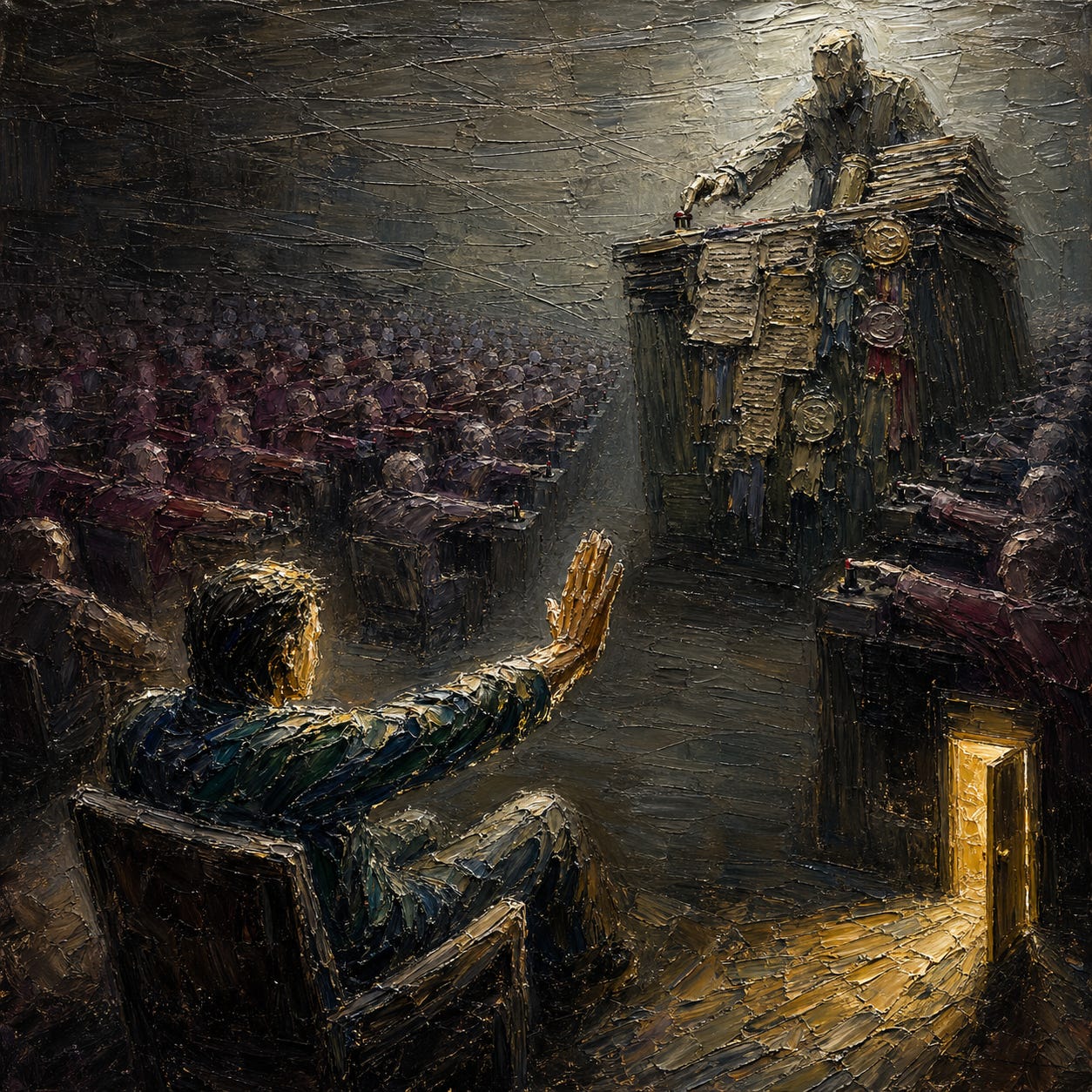
Suzannah Alexander went back to graduate school for clinical mental health counseling expecting to learn psychology. What she found was a program that taught students to evaluate themselves and their clients through immutable characteristics like race, that treated her Buddhist practice as “invalidating” to other identities, and that flagged her as a problem despite stellar grades. She walked away from the program in tears. Then she started writing.
The publication that came out of that decision, Diogenes in Exile, is now a sustained investigation into how the helping professions get captured. Alexander has documented the accreditation requirement buried inside the National Board for Certified Counselors’ Code of Ethics that quietly restricts which graduates can work across state lines. She has dissected the “Whitelash” paper — a study in which two social work instructors recorded themselves pressuring white students into shame and guilt, treated student objections as evidence the method was working, made it through ethics review and peer review into a top journal, and was pulled only after public scrutiny. She has built out the Total Mind Diagnostic Model, an alternative to DSM-style labeling that maps a person across biology, emotion regulation, mental events, behaviors, and environment. And she has gone back to the 35% who refused to obey in Milgram’s experiments to ask what cultivates moral agency in environments designed to erode it.
The interview that follows draws across that body of work. Alexander discusses how she came to recognise the pressure inside her own training as indoctrination, what a code of ethics is doing when it functions as a credentialing gatekeeper rather than a behavioural one, why autoethnography is naive introspection in academic dress, how often people are being misdiagnosed right now under the current system, and what she would actually ask a therapist before sitting down across from them. She also addresses the personal cost of doing this work, and the one structural change she would make first if anyone with authority over the system were listening.
With thanks to Suzannah Alexander.
Diogenes In Exile | Suzannah Alexander | Substack
Support This Work
This work remains free because paid subscribers make it possible. If you find value here, consider joining them.
Paid subscribers get access to all books — including The DMSO Book, The Kitchen Remedies Guide, Chlorine Dioxide, The PSA Trap, Breast Cancer, and more — with 1-2 new books added each month. Plus the Deep Dive Audio Library: 180+ in-depth audio book summaries and discussions.
Pricing Update: The annual subscription moves from $50 AUD to $50 USD on May 7 (now extended from May 1) — the first change in five years. Current paid subscribers keep their existing rate. Free subscribers can lock in the current price by upgrading before May 7.
1. Suzannah, to start, can you please walk readers through how you ended up at Diogenes in Exile? What took you back to graduate school for clinical mental health counseling, and what did you encounter there that made you decide to leave the program rather than finish it?
My current journey began with the breakdown of my marriage and the resulting divorce. I had been a stay at home parent, and now I suddenly found myself looking for a place in the workforce where I could still be a stable presence for my kids. At the same time, I needed to be financially stable. I also wanted to be helpful in my community. I didn’t have great ambitions, I was more thinking, talk therapy was something that I could do, even if my body started to give out. And as an ambivert, I could schedule my time where I worked on artwork until I got exasperated with being isolated and artwork, then I could work with people until I reached my limit of being social, then go back to working on artwork. That seemed like it would be a pretty good life.
Returning to college was a hard transition, especially in catching up with changes in technology. Grad school in particular wasn’t at all what I expected. I had been excited to learn more about psychology. What I discovered there was that we were taught how to evaluate ourselves and clients based on a race and other immutable characteristics.
We learned to use a technique called broaching where you bring up the issue of race regardless of the concern that brought a client into therapy in the first place.
If the trainee was white, and most of us were, we were told that it was on us to “do the work” to prevent our whiteness from harming clients of color. Doing the work meant assuming all black or brown people have grievances due to the history of slavery and therefore they should be given opportunities and financial support ahead of everyone else regardless of ability or genuine need.
Of course that also communicated that black or brown people were incompetent and could never succeed on their own. Everyone who was white was assumed to be part of the white supremacy. I thought what we were being taught would be malpractice in the field.
This created a ton of pressure in the classroom, especially as it became clear that there was no tolerance for error, much less nuance. At anytime we could be accused of a micro-aggression that could derail our career, as happened to me. I still got great grades in the program, but I was identified as a problem. When I brought up the central practice of Buddhism, the doctrine of the non-self, as a way to stabilize yourself with a difficult client, that hit a nerve, particularly with a transgender student, who called that thinking practice out as a privilege.
The practice teaches you to stop focusing on your identity. What I didn’t know was that as a white, hetero, gender-normative person I was supposed to think about my hetero, gender-normative whiteness all the time. Constantly making sure none of that was harming anyone.
I was told that the doctrine of the non-self was invalidating to other identities by three different professors. That made no sense to me, and I was well aware that focusing on your personal identity like that was contrary to good mental health. The cognitive dissonance those conflicting ideas inspired made it hard to think.
I assumed I had explained the meditation very poorly. Needless to say, my efforts to improve the clarity of my description didn’t go well.
By the end of the semester I walked away from the program, a confused wreck, barely able to stop crying enough to drive myself home.
2. You’ve written that your Buddhist practice was treated as “invalidating” by faculty. For readers who’ve never sat inside a counseling classroom, what did that look like day to day, and when did you first realise the problem was structural rather than a clash with one professor?
At first it was just mostly confusing. I didn’t have a background in critical theories, but I knew Buddhist practices are the backbone of two major treatment theories. It didn’t occur to me that Buddhism could be a problem. That my description of the practice was labeled invalidating was discouraging and disorienting. I thought for sure the professors must understand the overlap between Buddhism and some of the major techniques, but I also didn’t want to be that student that tells professors their own field.
At one point a professor was telling us about how we needed to spend the rest of our lives trying to become more culturally aware, that this was a life long quest, that we must never stop, but we also would never complete. I could feel my anxiety sky-rocketing, and I sensed the same coming from the class. This seemed terrible for our mental health, and a bad baseline for how we’d relate to clients, so I spoke up pointing out that wasn’t an achievable goal. I thought the professor had gotten carried away. It didn’t occur to me that she intended for us to carry that much anxiety.
Like several other incidents that felt somewhat off, I figured this was just a misunderstanding and we’d get it worked out. I mean, it was a program full of people learning to be therapists, being taught by people who were licensed therapists. Surely if any group could work through a communication issue it would be this group. Right?
At about six weeks in I started to realize that things weren’t getting worked out. People weren’t genuinely friendly, and even though I couldn’t put my finger on why the whole environment started to feel threatening.
As the pressure intensified I noticed that I wanted to call this indoctrination. Toward the end, when I finally realized that the professors weren’t looking out for my best interests, and as a group agreed that I was deserving of being held back so the degree would take at least an additional year of time and tuition, despite stellar grades, I knew I was dealing with groupthink. And I knew that the only way this could have come to dominate an entire department was if that line of thinking was supported by the extended institutions around it.
3. The “Whitelash” paper you covered was written by two instructors who recorded their own teaching sessions, described pressuring white students until they felt shame and guilt, and treated the students’ objections as evidence the method was working. That paper made it through an ethics review, peer review, and into a top social work journal before being pulled. What does the fact that it got that far tell us about the gatekeeping inside the profession?
What it tells me is that there is no safeguarding of students. That study originally wasn’t required to go through an internal ethics review because (IRB) it was the two professors recording their thoughts after teaching their regular class.
That means, and one of the professors states this in the Whitelash paper, this kind of treatment of the students is par for the course every year. Typically studies involving human subjects must go through an internal ethics review. That didn’t happen because the format obscured how students were being used.
When reporting drew public attention to that oversight, that’s when the Whitelash study was pulled. There are conflicting stories about the reasoning behind it being pulled. The publisher cited an internal review, but the authors said they withdrew it from consideration for no real reason.
What that says to me about gatekeeping in the profession, is that it seems to be dependent on public scrutiny. The profession has given itself permission to humiliate, shame, and otherwise harm people if that kind of behavior can be rationalized as serving some version of the greater good.
And students should know that even though there are supposed to be IRBs for studies, there isn’t any such process for classes themselves. Professors can do whatever they want as long as they have a good enough cover story, and the backing of the university culture.
4. You’ve drawn a sharp distinction between qualitative research done well and autoethnography being used as a substitute for evidence. For a reader who isn’t an academic, what’s the practical difference — and why should someone outside the university care which one their future therapist was trained on?
A qualitative study involves an experiment where something is being tested in a measurable way. Oftentimes you could substitute anyone in to follow the procedure run the experiment, and then tally up the results which are evidence that either supports or refutes the idea or hypothesis you were testing. That data tells you the conclusion.
You can repeat the experiment, and if it was done well, you’d get the same results.
With autoethnography what you have is a specific person writing down their “observations” which could be their thoughts, feelings, or intuitions. Then those are presented as evidence supporting a specific conclusion.
But that’s not evidence of anything more than one person’s story. You can’t repeat the experiment, and one person’s observations aren’t data. That’s at best a data point, but mostly it’s an anecdote. This kind of “research” was known as naive introspection to past generations, and it was discredited a century ago.
Double blind experiments are the gold standard for scientific study because that process solves the problem of confirmation bias corrupting the data. Autoethnography, like naive introspection before it, is submersion into bias. If anything it is a study in how we will see what we want to see.
And a therapist trained from conclusions determined by autoethnography would be given conclusions that have no basis in facts. They would be sharing a delusion, not helping clients find ways to manage the hard realities of life. Such a therapist may have difficulty even distinguishing reality from fantasy because they’re not being taught to prioritize or even distinguish real evidence.
5. The NBCC’s Code of Ethics contains a clause requiring counselors to have graduated from programs accredited by CHEA-recognised bodies. On the surface it sounds like a basic quality standard. What is that clause actually doing, and how does a code of ethics end up functioning as a credentialing gatekeeper rather than a behavioural one?
That clause is actually limiting the people who can get the NBCC credential to those who have already passed through other approved gatekeepers under the guise of which graduate program you chose being framed as an “ethical” professional responsibility.
It specifically eliminates anyone who went to a program only recognized under the U.S. Department of Education (DoE) approval process. This is a legally sophisticated, covert way to maintain ideological purity, or simply control who is allowed to enter this level of the profession.
And their code of ethics is functioning this way because the NBCC wants it to function this way. The NBCC has a long history as part of a professional consortium which included an accreditor, a student honor society, the licensing board collective, and other professional organizations.
Those groups, after excluding dissenting voices, defined counseling as the multicultural, social justice advocacy we see today. I think it’s fair to assume that was intentional. And the DoE, being bound to the Constitution and federal law, can’t legally impose an ideology, which the counseling establishment, through detailed rules like this, does.
6. Across counseling, social work, and psychology, you keep finding the same pattern: an ideological commitment baked into accreditation, then enforced through licensing, then defended as “ethics.” If you had to explain to a curious outsider how a whole profession gets captured this way, where would you tell them to look first?
I would say look at the history. With counseling I have deconstructed how the field went from guidance counselors in the public school system, to a new field of talk therapy over the course of decades. In the process, practitioners, educators, student groups and leaders gathered into a consortium that decided on an advocacy mission as the hallmark of the profession, and a commitment to spreading the idea of multiculturalism even to clients.
This didn’t happen overnight; it is a long pattern of development and there was cross pollination and rivalry between social work and clinical psychology. There are documents showing how even early on dissenters were excluded, and professional groups fought to monopolize control. The first piece I wrote detailed this history, and gave me the handle I needed to understand everything I’ve learned since.
When you know the history, it’s easier to pick out the loopholes that allowed for full ideological takeover because you can follow along exactly how it happened.
7. You returned to Stanley Milgram’s obedience experiments and focused on the 35% who refused. Researchers found that the resisters didn’t have stronger moral convictions than the compliant subjects — they had a stronger sense that their actions were their own. What do you think that finding means for students sitting in a classroom being told that compliance is professionalism?
I think any student who is in an environment that communicates compliance is professionalism should be aware that this statement is a hallmark of indoctrination. And it is up to the individual to decide if the values you are expected to perform are in alignment with your inner sense of right and wrong, or if the structure the indoctrination creates is helpful or harmful.
It’s worth pointing out that a certain amount of indoctrination is normal and not all of it is bad. There are also some people who benefit from having an external structure that helps guide their impulses.
That said, every individual is responsible for their own behavior, and examining the underlying assumptions of what they are being told and asked to do. The more individuals internalize that message, the more they build within themselves habits that resist being easily influenced to abandon personal integrity.
At today’s university, it is not a given that professors have your best interests at heart. Legally they are explicitly not fiduciaries. So if you are hearing things in the classroom you know are racist or wrong, or if others and you yourself are expected to accept humiliation or any other sort of public poor treatment, you have to decide how you’ll respond to that situation.
8. One of the things that comes through in your writing is that the people who quietly went along with their training don’t necessarily believe what they were taught — they just learned to stop arguing. What happens to a profession when a meaningful percentage of its practitioners have spent years rehearsing self-betrayal?
Research on cognitive dissonance shows us that anytime we betray our values we slowly lose sight of them. This is how good, well meaning people can become identical to what they say they hate. Eventually a person’s identity will become bound to the fiction, because to admit that you abandoned your values means you’re not the good person you’ve been telling yourself you are.
Some people will fight to the bitter end to maintain their identity as a “good person.” Even when it is demonstrable they have hurt people.
When you consider people’s ability to make a living and feed their families are bound up in maintaining that kind of fiction, admitting mistakes, much less accepting that your whole career may have had the opposite impact of what you intended, people have very strong motivations to deny there is a problem.
Today we look back at things like slavery, eugenics, or lobotomies, wondering why it took so long, or took a war to change course. For otherwise good people, the shame of admitting fault or complicity can keep them fighting.
And it’s worth pointing out, there still are good practitioners out there, who aren’t being pressured as much, or are adept at managing the contradictions while keeping the needs of clients ahead of their own. These folks will get caught in the crossfire, and that’s also unfair and painful.
That said, the end game for a corrupt field is that it will lose public trust sooner or later, until it either fixes itself, or it is replaced.
9. Your satirical “Code of Ethics for the Thoroughly Confused Professional” and the leaked DSM-6 entries are clearly jokes, but they land because they’re recognisable. What can satire say about these institutions that straight reporting can’t?
I think my satire, like most humor, allows me to speak about the uncomfortable truth of how these institutions are actually functioning in a way that disarms some of the danger of saying it.
The satirical pieces I’ve written also are intended to make complicated problems more enjoyable and easier to understand.
That helps in confronting many of these extremely important, but not at all sexy problems. Who wants to seriously talk about defining a code of ethics when there is a war, or a new celebrity fumble to think about?
This is a human and understandable short-coming. The intent isn’t to place blame. What’s great about satire is that through making something so absurd that it is funny, you also highlight why it’s valuable in the first place. Aren’t we all ready to laugh ourselves silly while we fix the details in a bunch of documents now?!
10.You've proposed something called the Total Mind Diagnostic Model as an alternative to the DSM's label-based approach. Walk readers through what would actually be different — and take the Maria example you've used, the woman who'd be diagnosed with depression under the DSM but whose real picture includes an autoimmune flare, ongoing domestic violence, and trauma symptoms. How often do you think that kind of mismatch between the label and the actual situation is happening right now in real clinical practice?
If you look at recent studies of misdiagnosis or treatment resistance, you see staggering rates of misdiagnosis from 50% to 77% among people with depressive or bipolar disorder respectively. Psychiatry reports treatment resistance being from 20% to 60%.
This happens largely due to framing diagnosis as a concrete thing, like having the measles, but the underlying definitions of what triggers a diagnosis being vague and open to interpretation. Having the measles is something you can verify with a test, but the same isn’t true for most mental illnesses.
In mental health, most “illnesses” are defined by a list of emotional states, thought patterns, and unexplained behaviors that are causing impairments. The current model lumps these things together and treats them as a discrete thing.
The way I see it, general health, emotional range, thought patterns, behaviors, and environmental situations are the discrete things. And if we break these things down in a granular way we’ll come closer to finding the source of why a person is experiencing whatever distress has caused them to seek help.
With the Total Mind Diagnostic model, the biggest difference would be that you wouldn’t go directly to the therapist’s office. You’d get a check-up for a baseline of general health, and to monitor physiological wellbeing. Then therapy would involve understanding your emotional patterns, thought patterns, behavior patterns, and environmental/relationship circumstances.
For example, a practitioner would create a profile of a client that showed good health, moderate emotional volatility, no inner monologue, low metacognition, no physical fitness habits, unemployed, and a contentious relationship with her overbearing mother who she lives with.
When we frame someone’s current challenges as being the product of these layered systems, not only do we side step the toxic problems associated with labeling someone with a diagnosis, but we also generate a much more specific picture of what pathways will help first.
It would even help parse the elements that right now result in someone getting a diagnosis of a personality disorder. Whether that would make these issues easier to treat remains to be seen, but if we can identify patterns of heightened or flattened emotions, with certain thought and behavior patterns, it would make our understanding of the person’s make up more precise.
11. A practical question for readers who are looking for a therapist or sending a family member to one: what should they actually ask, and what should they watch for, to figure out whether the person across from them is going to treat them as an individual or as a member of a category?
If I were looking for a therapist today, I would ask about their training program, and if they were trained to provide affirming care.
Affirming care is something that you want to avoid. Good psychotherapy should challenge you and make you think about your role in maintaining dysfunctional behaviors and relationships. Affirming care does just the opposite which can prevent clients from improving their lives and accepting hard realities they may be avoiding.
There are also groups like Critical Therapy Antidote and the Open Therapy Institute are both networks of professionals aligned to diverse viewpoints and politically neutral mental health treatment. One of my early posts covered all of the different ways to find help and manage mental health first aid.
12. You’ve talked about the cost of speaking out — colleagues distancing themselves, the difficulty of getting heard in mainstream outlets, the personal toll of walking away from a career path you’d invested in. What keeps you doing this work, and what would you say to a student or practitioner who’s seeing the same things but is afraid to say so?
I’ve thought about this question a lot. While I could point to my kids, or my desire to be a positive force in my community or my family history steeped in the Revolutionary War, all of those things are true in their way. Yet on a more fundamental level, experiencing this firsthand, seeing how an ideology has contorted universities to deliver cruelty while calling it kindness, I cannot turn away.
My nature is more socially anxious, and I don’t like confrontation or conflict, I want to feel like I belong, but I also can’t abide what’s happening. For now, even though it’s lonely, scary, and exhausting at times, I’ll persevere. I’ve surrendered to this process. I’m hoping it ends with a piece of land I can garden until I’m 90, but I’ll let the chips fall where they may. That’s the only thing that helps me sleep at night.
13. If you had the ear of someone with real authority over higher education or licensing — a state legislator, a university trustee, the head of an accrediting body — what’s the one change you’d ask them to make first, and why that one?
As far as fixing higher education is concerned, we need to reform accreditation, ideally by tracking outcomes. And seriously consider either making more people in higher education legally fiduciaries for students, or empowering individuals with a private right to action, to sue accreditors.
As a start, I think there is a great case for enforcing anti-trust laws around accreditation, licensing boards, and other professional entities that are behaving like cartels.
The important thing that most people should be on the lookout for is instances where we have created pockets of unaccountable power, like accreditation.
The problem isn’t so much the accreditors themselves, it’s that they have significant power and no real brakes. Students can’t sue accreditors and neither can universities without potentially sacrificing their ability to stay open.
No group should have that kind of power without a clear channel for their judgement to be appealed, or for a body behaving in bad faith to be avoided entirely.
If we are going to work our way out of this mess, we start here, with accreditation, and then we look at other unaccountable pockets of power, like licensing boards and professional compacts, to deregulate, restructure and reform.
And if I really had the right person’s ear, I’d ask that accreditation and other requirements be removed so all professionals can work with the military. Right now our service members only get the most ideologically taught practitioners.
14. To close, what are you working on right now, and where can readers find you and follow what you’re doing next?
What I’m working on right now is documenting how universities are getting around DEI restrictions. That is continuing both overtly and covertly, and continues shaping what students are taught to believe and how they’re trained to behave. My full report on the counseling compact will be out of editing soon. It documents how all the codes of ethics, accreditation standards, and licensing come together to control the profession from grad school to clinical practice.
I can be found on my Substack, Diogenes in Exile and on X @diogenesinexile.
What’s next is deregulating and writing policies for reform that get the system out of the way of people trying to work and innovate, while making sure we’re not creating new unaccountable authorities. And maybe some day I’ll get to build a proper garden.
You’re not going through this alone: "flagged her as a problem despite stellar grades. She walked away from the program in tears. Then she started writing."
The publication that resulted from that decision, Diogenes in Exile, is now a sustained investigation into how the helping professions are captured.
https://www.youtube.com/watch?v=4XhrgFvvOcg&list=PLBG6e1YmbrdypMO4QOQZ3n6NP4vGmdN10&index=2
https://hxlibraries.substack.com/p/when-collegiality-becomes-censorship
https://unbekoming.substack.com/p/heresy
This kind of decline is historically rare and uniquely dangerous. When a society loses the clarity and the will to defend its own continuity, the decay is slow, steady, and difficult to reverse. Recovery, if it comes, will not resemble the rapid reconstruction of post-war Germany. It will require something deeper: a long process of cultural and moral reawakening, a rediscovery of purpose, and a renewed capacity to see the world as it is rather than as institutions prefer to describe it.
Regarding the censure of a Buddhist approach, this has me wondering what that looks like at Naropa. I have heard from those who went there that it is full and well woke, being in Boulder. I would guess that this would mean that Buddhist practices are legitimate only in the delineated ways.
The Affirmative model mentioned of course had me thinking of the transgender psychology bind that had triggered mandatory "affirmation" as soon as anyone triggers into the transgender domain. I am not currently clear where we're at with that after the recent Supreme Court case, I think, which prohibited limiting the speech of as therapist.
Yes, professional boards are number one controls of institutions. The government partners with them in such a way as to control everyone in a way that would seem unconstitutional. More and more professional are coming under this control system. So ridiculous to the point that the person who cuts your hair may be under this control. Where I am there was a case in which a horse masseuse was persecuted by the state, and after an exhausting legal fight, did eventually win a judgement allowing her to massage horses without the government in the middle.
I am keenly interested in the dynamic of those who do not go along. That can look so many ways. I would very much like to understand the many ways in which a person may come to stand apart, differentiate, facilitate other possibilities, and contribute to both an individual and a grander social experience and historical process.