

Editor’s note: What follows uses Duesberg’s own professional categories (virus, retrovirus, antibody, cancer-causing gene) because his argument cannot be summarised in any other language. I do not accept those categories. Paragraph 5 states my own position. Read the first four paragraphs as a faithful report of Duesberg’s case. Read the fifth as what I think of the case now.
One hundred and fifty chimpanzees have been injected with HIV since 1984. Not one has developed AIDS. Four hundred thousand AIDS patients were treated by five million unvaccinated medical workers through the first decade after the 1984 declaration, without a single documented case of a worker falling ill from patient contact. Seventeen million HIV-positive people worldwide, most of whom acquired the antibody status from their mothers at birth, are perfectly healthy. These are the facts around which Peter Duesberg built Inventing the AIDS Virus in 1996, the most comprehensive scientific case ever assembled against the hypothesis that HIV causes AIDS. By Duesberg’s own counting, what is called HIV is found in only one of every five hundred T-cells of AIDS patients and is almost always dormant. A hepatitis B patient, within mainstream virology’s own measurements, is said to carry ten million free particles in a single milliliter of blood. Something that cannot be found in the patient cannot be causing the disease.
Duesberg was not writing from the margins. He discovered the first cancer-causing gene in a retrovirus in 1970 with Peter Vogt, demolishing the puzzle of how the Rous sarcoma virus produced tumors. He was elected to the National Academy of Sciences for that work and received the NIH’s Outstanding Investigator Grant in 1985, a seven-year award specifically designed to allow established scientists to pursue risky and heterodox research directions. He trained at the Max Planck Institute for Virus Research in Tübingen before Wendell Stanley brought him to Berkeley in 1964. When he began publishing his criticism of the HIV hypothesis in Cancer Research in 1987, he held tenure at one of the world’s leading molecular biology departments and belonged to the inner circle of retrovirologists who had built the field. The response was not scientific rebuttal. The response was the systematic withdrawal of invitations, the quiet blocking of National Academy awards, internal HHS “MEDIA ALERT” memos coordinating damage control, and Anthony Fauci’s warning to journalists that those who covered Duesberg sympathetically would find their access diminished. No peer-reviewed article has ever refuted the central arguments of his 1987 paper.
The book arrived twelve years after Robert Gallo’s April 1984 press conference with Secretary of Health and Human Services Margaret Heckler, at which the probable cause of AIDS was announced to the world before any supporting paper had been published. Gallo had been convicted of scientific misconduct in December 1992 for falsely claiming he could not grow Luc Montagnier’s French virus in his own laboratory; the conviction was later overturned on a procedural technicality after the Department of Health and Human Services raised the burden of proof. The Concorde study had reported in 1994 that AZT recipients died at a rate 25 percent higher than untreated controls. Paul Volberding, who had organized the trial establishing AZT as a preventive treatment, published in 1994 that the drug did not significantly prolong survival. Hundreds of thousands of healthy HIV-positives had been taking a chemotherapy originally designed to kill cancer cells, rejected for that purpose in the 1960s, and resurrected in 1987 through a Phase II trial that broke its own double-blind controls, lost 15 percent of its subjects without explanation, and showed altered symptom report forms that an FOIA investigation would later surface. The book went through three publishers—Addison Wesley announced it in 1993, St. Martin’s signed it in 1994, Regnery finally issued it in February 1996—because the material was considered too dangerous to handle.
The full summary unpacks the mathematical demonstration that HIV’s 48-hour generation time makes the officially posited ten-year latency biologically impossible; the direct chemical mechanism by which alkyl nitrite inhalants destroyed the hemoglobin and depleted the body’s cleansing and repair capacity in homosexual men through the popper craze of the 1970s and 1980s, producing the pulmonary Kaposi’s sarcoma that had never been diagnosed before and that disappeared in proportion to declining popper use; the structural reason hemophiliac life expectancy doubled from eleven years in 1972 to twenty-seven years by 1987 during the exact period when three-quarters of American hemophiliacs became HIV-positive; and the architecture of the Epidemic Intelligence Service, through which two thousand CDC-trained alumni now hold key positions at the New York Times, ABC News, the Journal of the American Medical Association, the World Health Organization, and foreign health ministries. Research-grade AZT, when ordered from Sigma Chemical Co. by laboratory scientists, arrives with a bright orange skull-and-crossbones label warning of toxicity through inhalation, skin contact, and ingestion. The patient receives the same compound in a white capsule with a blue band.
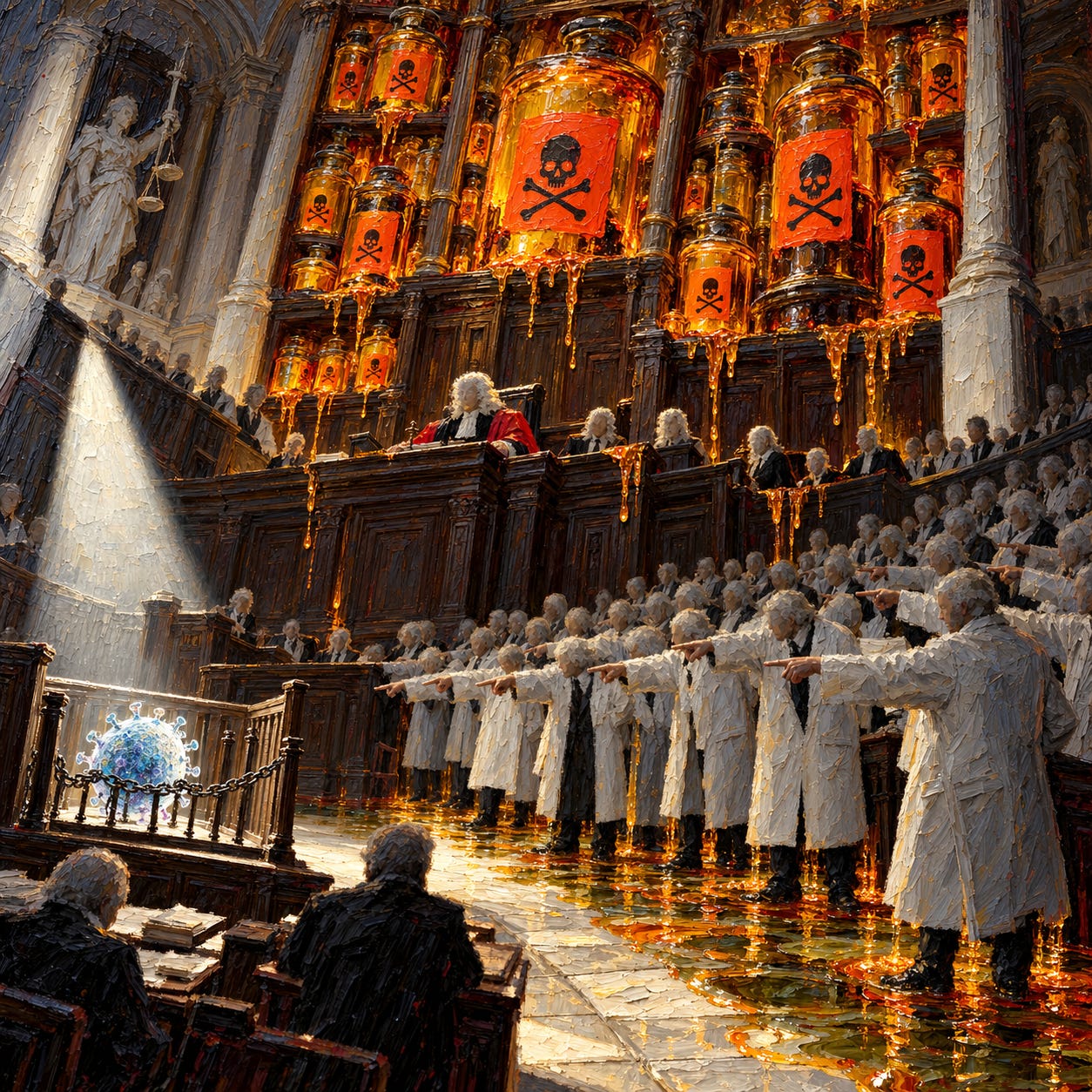
The attack operates entirely from within classical virology. Duesberg accepts that viruses exist as mainstream virologists describe them and that many of them cause disease. His innocence argument is specifically about retroviruses as a class: they do not kill the cells they integrate into, do not generate the viral loads of pathogenic viruses, and have never been established as agents of fatal disease. HIV, in his framework, is innocent because it is a retrovirus and retroviruses are innocent. The pathogenicity of polio, influenza, hepatitis B, and measles he accepts as given. The hepatitis B comparison he deploys against HIV depends on treating hepatitis B as a real pathogen carrying real viral loads. This is the double protection built into his frame. It smashes the HIV hypothesis while preserving both virology as a discipline and the pathogenic status of every other named virus. Whether any of these alleged particles exists as described, as a distinct exogenous infectious entity isolated from a sick person and demonstrated to cause disease, is a question the book does not open. The limit matters because virology’s foundational methods were already available for scrutiny by 1996: cell cultures starved and poisoned with antibiotics, patient material added, the resulting cellular breakdown declared a viral particle, genomic sequences assembled from fragments by PCR and announced as whole organisms. The book does not question any of this. By preserving the apparatus while attacking one of its products, Duesberg kept intact the operating system that would be deployed again in 2020 for SARS-CoV-2. Those within the dissident community who went further, who questioned whether HIV had ever been properly isolated at all, were marginalized by the terms of his framing as surely as by the establishment he opposed. The book remains essential reading for the specific case it makes against the HIV-AIDS hypothesis. It should be read with the understanding that its scrutiny stops one layer short of where the inquiry needed to go.
Related


The rest of this summary — the analogy, one-minute elevator explanation, 12-point summary, Q&As, and Golden Nugget — is for paid subscribers.
Your subscription also unlocks every other book summary in the library, the Deep Dive Audio Library, my original books (new ones added monthly), and three series for the moments when a real decision is in front of you: Questions for Your Doctor, Before You Consent, and Package Inserts.