

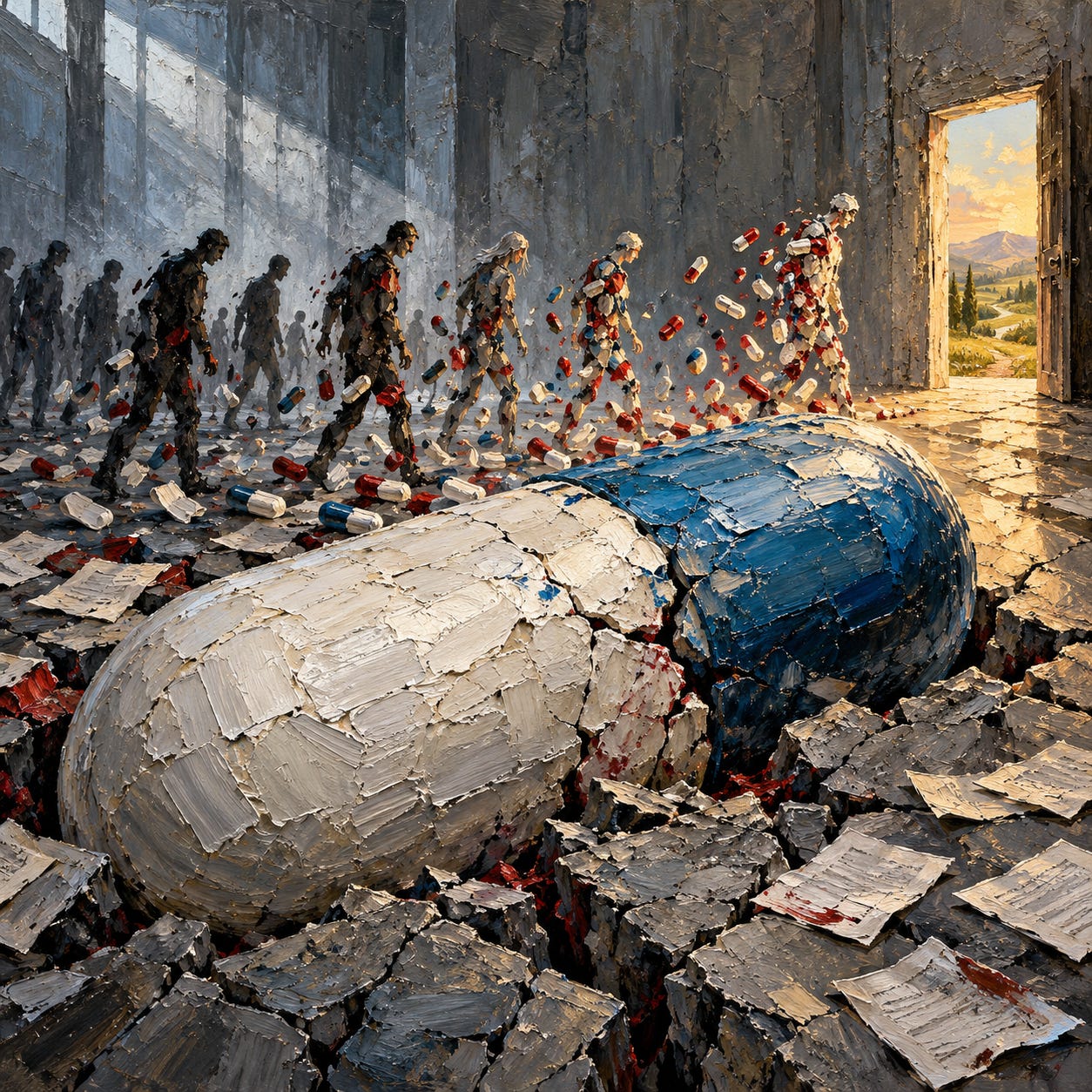
The STAR*D study, a $35 million trial funded by the US National Institute of Mental Health, enrolled 4,041 patients and announced that about 70% became symptom-free on depression pills. The actual stay-well rate at one year was 3%. Ed Pigott and colleagues reconstructed the data from the published papers. Investigator Maurizio Fava, asked by a journalist, acknowledged that 3% was accurate and that the investigators had known this all along. The 70% figure remains cited in psychiatric textbooks and was repeated by the New York Times in a 2024 article praising the drugs. Peter Gøtzsche’s Is Psychiatry a Crime Against Humanity?, published by the Institute for Scientific Freedom in 2024, builds its central charge from accumulated evidence of this kind: fraud concealed in prestigious journals, deaths misclassified as natural causes, suicide risks hidden through creative recoding, and a profession whose leaders defend practices they privately acknowledge do not work.
Gøtzsche is a specialist in internal medicine who co-founded the Cochrane Collaboration in 1993 and established the Nordic Cochrane Centre. He has published more than 100 papers in the BMJ, Lancet, JAMA, Annals of Internal Medicine, and New England Journal of Medicine. His scientific works have been cited more than 150,000 times, with an H-index of 91. He studied psychiatry closely for 17 years before writing this book, working as expert witness in court cases concerning forced treatment and psychiatric drug harms across ten countries. In 2018, Cochrane CEO Mark Wilson arranged his expulsion from the Collaboration he had helped found, and from the Nordic Centre he directed, after years of criticism of psychiatric drug reviews and pharmaceutical industry influence. Four board members walked out in protest. The expulsion was condemned in Science, Nature, Lancet, and the BMJ. He writes from inside the institutions that produced the evidence base he is now dismantling.
By 2024, the biological model of mental illness had been failing publicly for a decade. Thomas Insel, director of the NIMH from 2002 to 2015, had already acknowledged that two decades of new drug development had produced no evidence of reduced morbidity or mortality from any mental illness. The Human Genome Project had failed to find the genes psychiatric researchers predicted. The chemical imbalance theory had been dismantled by Joanna Moncrieff’s 2022 umbrella review of the serotonin evidence. The United Nations Special Rapporteur Dainius Pūras had called on all nations to make forced psychiatric treatment illegal; not one had complied in ten years. Insel’s own 2022 book Healing defended the collapsed paradigm by diverting attention toward social supports while omitting the long-term outcome studies his own institute had funded. Gøtzsche’s book arrived into this situation as the sustained, documented accounting that mainstream psychiatric literature refused to produce.
The book sits alongside Robert Whitaker’s Anatomy of an Epidemic, Peter Breggin’s work on medication spellbinding, and the Critical Psychiatry Network’s output as part of a body of evidence that establishment medicine has quarantined rather than engaged. The full summary unpacks the 2-point drug-placebo difference on the Hamilton depression scale against the 5-6 point minimum needed to perceive change, the hyperbolic binding curves that make linear tapering guaranteed to produce withdrawal symptoms misread as relapse, Joseph Biederman’s $4.2 million in undisclosed drug company payments and his invention of juvenile bipolar disorder which drove a 35-fold increase in child diagnoses, and the mortality rate of one dementia patient killed per 100 treated with antipsychotics for ten weeks. Silas Dam was 24 when he killed himself in 2023 after winning his case against belt restraint at the European Court of Human Rights. His suicide note read: “Psychiatry killed me, belt restraint killed me, forced medication killed me. Share my story.”
The rest of this summary — the analogy, one-minute elevator explanation, 12-point summary, Q&As, and Golden Nugget — is for paid subscribers.
Your subscription also unlocks every other book summary in the library, the Deep Dive Audio Library, my original books (new ones added monthly), and three series for the moments when a real decision is in front of you: Questions for Your Doctor, Before You Consent, and Package Inserts.