

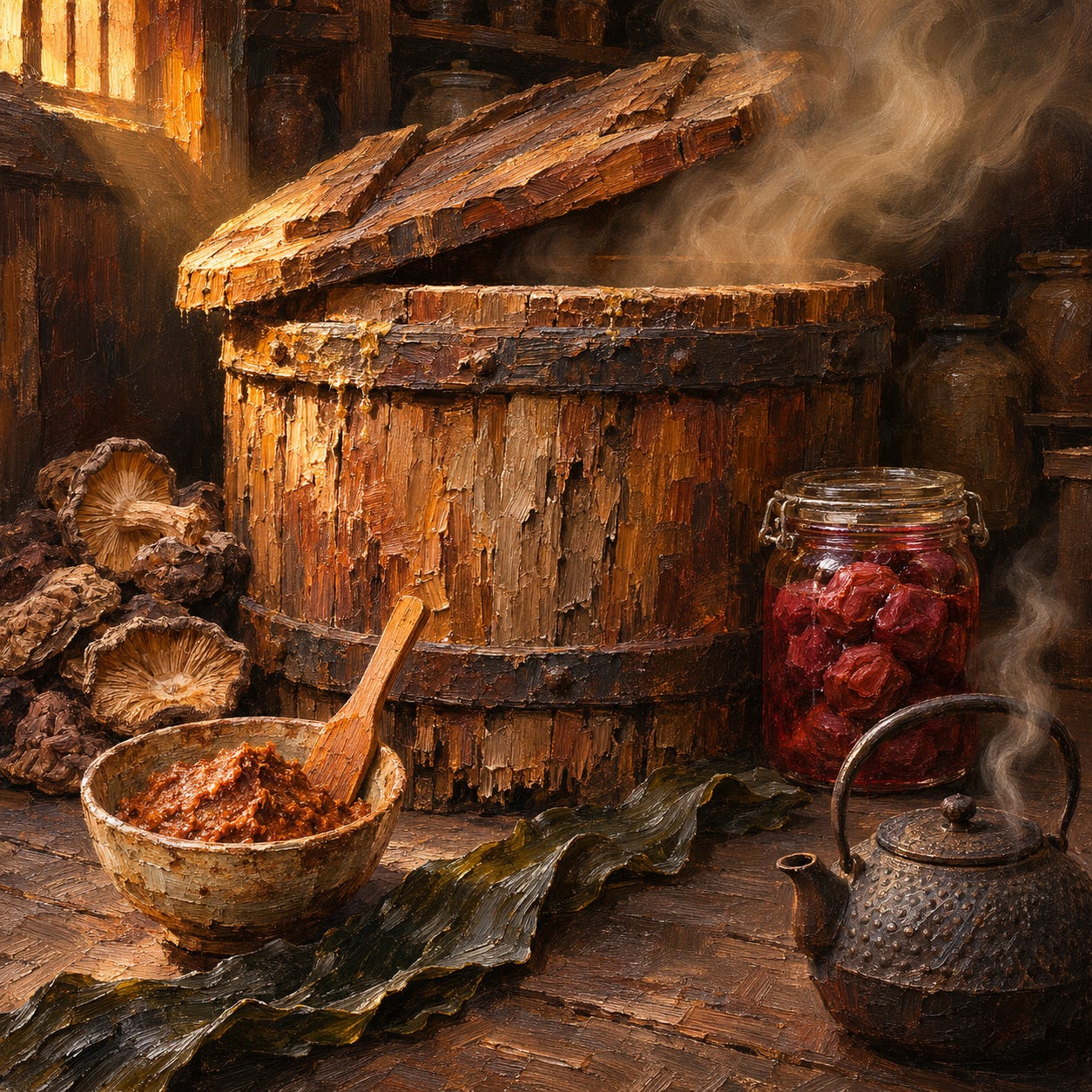
In 1945, Dr. Shinichiro Akizuki ran St. Francis Hospital in Nagasaki, a few miles from the atomic bomb’s ground zero. He and his staff spent years treating the wounded and the dying, exposed daily to the fallout, yet none of them developed the usual symptoms of radiation sickness. Akizuki credited the one thing his staff shared: a daily bowl of miso soup. For decades the claim sat as folklore in macrobiotic circles. Then in 1989, Dr. Akihiro Ito at Hiroshima University’s Atomic Radioactivity Medical Laboratory tested it in rats. Animals denied miso developed liver cancer at 100 to 200 percent the rate of miso-fed animals, with far more organ inflammation from the radiation. Four follow-up studies at Hiroshima University refined the finding further: the longer the miso had been aged, the greater the protective effect. A country doctor’s observation from a destroyed hospital turned out to be experimentally correct half a century later. That story opens Japanese Foods That Heal (2007) by John and Jan Belleme, and it sets the tone for a book that treats the Japanese pantry as a documented medicine chest.
The Bellemes write from inside the tradition rather than from outside it. In 1979 they spent eight months living with miso master Takamichi Onozaki and his family in Yaita, a small city in Tochigi Prefecture, working six and a half days a week in the family’s unheated house through a Japanese winter and learning the age-old methods of making traditionally crafted miso. That apprenticeship became the foundation for the American Miso Company in Rutherfordton, North Carolina, one of the first operations to produce traditional long-aged miso in the United States. By the time this book appeared, they had written more than 120 articles and four previous books on traditional foods, and had spent a working lifetime inside the small network of importers, farmers, and family shops that kept these foods alive. The dedication reads: For Takamichi Onozaki, whose open heart and gentle spirit made two foreigners feel at home. The whole project is an act of gratitude for what one Japanese family taught two Americans about food.
By the mid-2000s the ancient Japanese saying Ishoku Dogen (Food Is Medicine) was no longer heresy in the West. The FDA had authorized the soy-protein heart-health claim in 1999, population studies from Japan were showing dramatic cancer-rate gaps with Western countries, and the macrobiotic pipeline built by George Ohsawa, Michio and Aveline Kushi, and the founders of Erewhon had put miso, tofu, and seaweed on natural-foods store shelves across North America. The book was written against a specific adversary: the industrial substitutes that look like traditional foods but are made in a day with hexane solvents, laboratory enzymes, chemical bleaches, and synthetic blends. By 2007, the authentic whole-bean shoyu aged twenty-four months in cedar casks accounted for less than one percent of Japan’s soy sauce production. The industrial product carrying the same name had colonized most of the supermarket shelf. The Bellemes were documenting a 2,000-year food culture at the moment it was being quietly replaced, and the book served both as a shopping guide and as an archive of what was at risk of being lost.
The book sits within the terrain canon as a practical pantry, eighteen specific foods, each one examined for the medicinal action documented in the modern literature and for the slow traditional process that produces it. The full summary unpacks the 2003 Journal of the National Cancer Institute study of 20,000 Japanese women showing three bowls of miso soup a day cut breast cancer rates by 40 percent; the research on alginic acid in kombu, wakame, hijiki, and arame binding heavy metals and radioactive strontium in the intestines so they cannot be absorbed; Dr. Hiroki Namba’s work on maitake D-fraction, which produced tumor regression or significant symptom improvement in 11 of 15 breast cancer patients and 12 of 18 lung cancer patients, and which the National Cancer Institute reported as matching AZT’s effect without AZT’s toxic side effects; and the chemistry of EGCG in green tea, which a University of Kansas study found 100 times more effective than vitamin C at blocking the cell mutations that cause cancer. Japanese women have breast cancer rates 80 percent lower than American women and half the hip fracture rate. In Japan, hot flashes are so rare there is no Japanese word for the condition.
Reader’s Guide PDF Download & Audio Deep Dive (Paid Subscribers Only)
The rest of this summary — the analogy, one-minute elevator explanation, 12-point summary, Q&As, and Golden Nugget — is for paid subscribers.
Your subscription also unlocks every other book summary in the library, the Deep Dive Audio Library, my original books (new ones added monthly), and three series for the moments when a real decision is in front of you: Questions for Your Doctor, Before You Consent, and Package Inserts.