

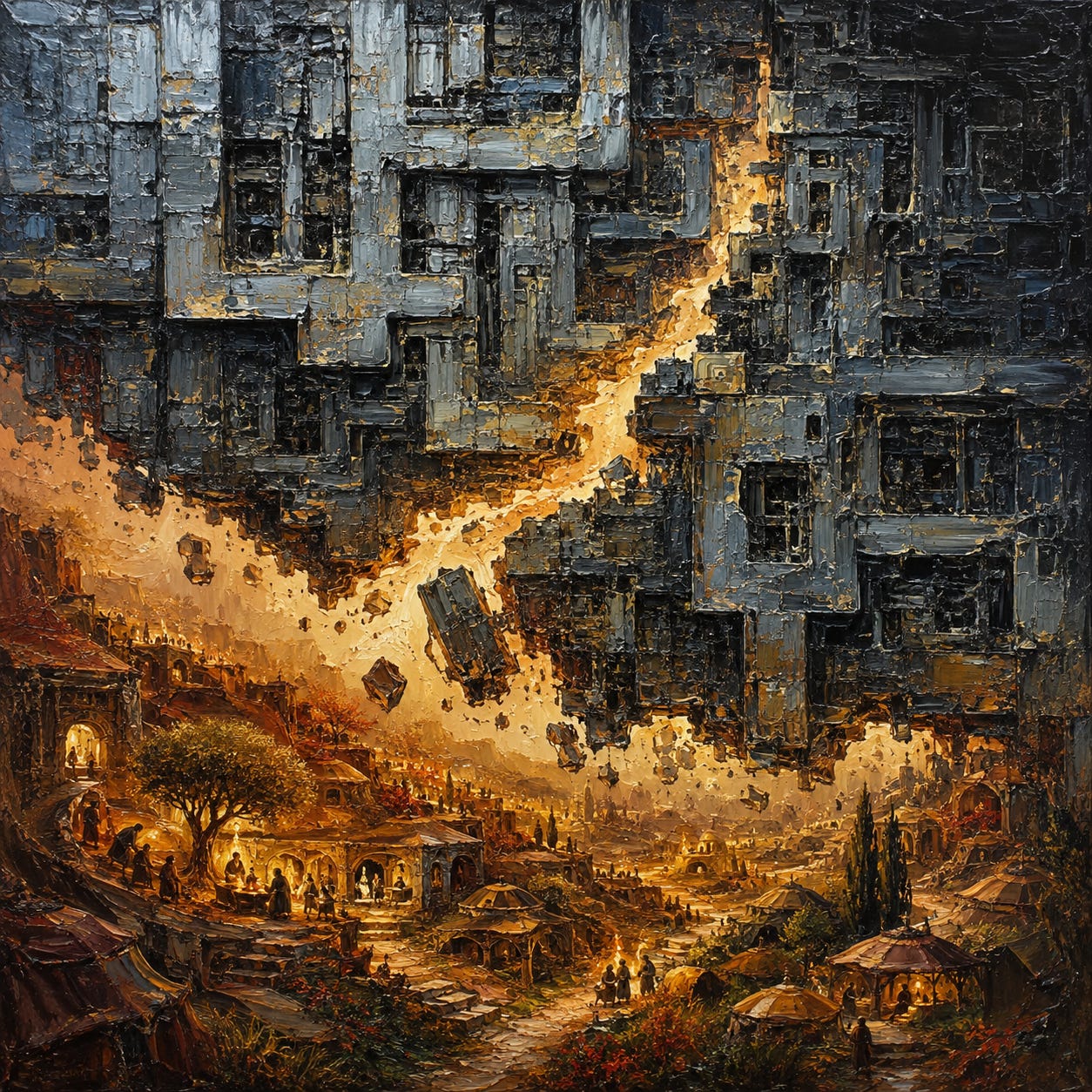
The Closure series has documented how institutions close around their own logic. Neutralization, Dilution, Suspension, Reversal, Rogueness, Enantiodromia — each a named mechanism through which corrective feedback stops producing correction. Structural Rigidity, the previous essay, showed how institutional blindness feeds this closure from the inside. But institutions do not close in isolation. They close inside societies. When enough of them close for long enough, the societies around them begin to change.
Mutation traces what that change looks like. Luc Lelièvre shifts the scale of analysis from the institution to the civilisation, and asks what happens when the closure documented across the earlier essays extends beyond bureaucratic walls. The essay maps a five-stage sequence — Closure, Saturation, Threshold, Mutation, New Landscape — that describes not collapse but reconfiguration. Systems built to stabilise now destabilise. Systems built to empower now diminish. Hospitals generate illness. Media generate obedience. Schools generate confusion. Lelièvre calls this Anti-Progress: the moment when institutions cross a threshold and begin producing their opposite.
The essay’s sharpest reframing is the Illusion of Novelty. The West is not living through unprecedented times. Corruption, moral panic, geopolitical fear, and institutional failure have all appeared before. What has changed is the density of the environment in which they now occur. Familiar dangers feel amplified because saturation has stripped away the buffers that once absorbed them. Apocalyptic Compression fuses every distinct threat into a single storyline of existential danger. Populations do not revolt against this. They withdraw. Once they withdraw, they do not come back. Mutation is Lelièvre’s map of the world that emerges on the other side of that withdrawal — smaller, more human, more territorial, and impossible to plan.
This work stays free because paid subscribers make it possible. They get the full book library, the Deep Dive Audio Library, and the Questions for Your Doctor, Before You Consent, and Package Insert series. No grants, no gatekeepers — your subscription is what keeps it that way.
Audio Deep Dive (for Paid Subscribers)
MUTATION
An Essay by Luc Lelièvre
INTRODUCTION — The Great Inversion
Modernity once believed it could outrun its own shadow. It imagined that knowledge, management, and technology could be stacked endlessly, each layer adding stability, clarity, and control. It imagined that human societies could be governed as engineers govern machines: through rules, models, metrics, and digital oversight. It imagined Progress as a straight line and the future as an ever-improving version of the present.
Mutation begins with the recognition that this imagination has inverted. The systems built to stabilize life now destabilize it. The institutions designed to produce competence now produce incompetence. The digital infrastructures meant to empower human agency now diminish it. Progress has crossed a threshold, and its mechanisms now reverse course. More control yields less stability. More management yields less competence. More oversight yields less autonomy. The future no longer extends forward; it folds back on itself.
This reversal is not a drama of villains and heroes. It is not a conspiracy, a political failure, or a moral decline. It is anthropological. It stems from the mismatch between human cognition and the complexity of the systems we have built. Modernity’s dream of Closure — the belief that society can be governed by administrative logic and digital monitoring — has reached its structural limits. Institutions have grown too large to perceive themselves. Bureaucracies have become too dense to adapt. Narratives have become too saturated to coordinate meaning. The very tools meant to improve life now produce the opposite.
If Closure describes the progressive loss of corrective capacity within institutions, Mutation examines what happens when those closed institutional processes operate at the societal level. The mechanisms identified across the Closure series remain active, but Mutation shifts the scale of analysis from institutional closure to the broader anthropological and civilizational environment in which institutions operate. It asks what happens when prolonged closure, saturation, and failed correction begin to alter the narratives, identities, expectations, and adaptive strategies through which human societies respond to change. Mutation therefore does not replace Closure or add another mechanism to it. It describes the broader transformation that emerges when the mechanisms of Closure extend beyond institutional boundaries and begin to reshape the social environment itself.
Mutation uses the term Anti-Progress to describe this inversion. It is the moment when systems begin to produce outcomes that contradict their purpose. Hospitals generate illness. Media generate obedience. Schools generate confusion. Digital systems generate noise. Political systems generate withdrawal. Cultural systems generate fragmentation. Ideological systems generate blindness. Anti-Progress is not collapse; it is correction — the way a forest burns not because it is dying but because it has grown beyond its capacity to sustain itself.
This correction aligns with patterns anthropologists, sociologists, and cognitive theorists have described for decades. Human cognition cannot process infinite complexity. Institutions cannot adapt when variation is suppressed. Legitimacy collapses when participation becomes ceremonial. Trust erodes when narratives fragment. Technology reshapes agency faster than societies can absorb the change. When these pressures converge, systems reorganize rather than collapse. They mutate.
The next social configuration will not be designed. It will emerge. It will arise from blind variation, selective retention, and the withdrawal of cooperation from saturated institutions. It will not resemble the technocratic dream of Progress or the nostalgic fantasies of decline. It will be something else — smaller, more human, more convivial, and more adaptive. It will be the world that appears when the world we built exceeds the limits of our cognition.
Mutation is the story of this reversal. It is not a warning, a lament, or a prophecy. It is a description of the moment we inhabit: a civilization that has reached the limits of its own logic and is quietly reorganizing itself from within. It is the map of a world that is ending and the outline of the world that is beginning to take its place.
Closure — the attempt to govern society through rules, models, and administrative logic — has reached its structural limits. The result is not evolution but Anti-Progress: a systemic correction that reshapes institutions from the inside.
Mutation shows why this reversal is inevitable, why it is anthropological, and why the next social configuration will be emergent rather than planned.
I. The End of Closure — The Inversion of Progress
Modernity believed it could govern complexity through technique. It imagined that human societies could be stabilized by administrative logic, optimized by technocratic expertise, and made predictable through digital oversight. Closure was the culmination of this belief: the idea that rules, models, and procedures could replace judgment, experience, and intuition. It marked the final stage of technocratic modernity, the moment when institutions ceased to rely on human agency and instead trusted their own abstractions. Closure promised stability. It delivered fragility.
The paradox is structural. Administrative control expands by narrowing the space for human discretion. It replaces adaptive behavior with compliance, variation with standardization, and local knowledge with centralized procedures. As James C. Scott showed, high-modernist systems collapse not for lack of intelligence, but because they suppress the very forms of intelligence they need to survive. When institutions privilege legibility over reality, they see only what their models allow. Everything else becomes noise. Closure is the triumph of the map over the territory.
This triumph carries a cost. The rational actor model — the foundation of modern policy, economics, and governance — collapses under real-world conditions. Humans do not behave as the models predict. They do not respond to incentives as administrative logic expects. They do not process information as digital systems assume. They do not inhabit the world that technocratic institutions imagine. As Pascal Boyer explains, human cognition evolved for small, local, low-complexity environments. When institutions exceed these cognitive limits, populations withdraw cooperation, not out of rebellion but out of saturation. The rational actor model fails because it was never anthropologically plausible.
As Closure intensifies, institutions lose the ability to distinguish meaningful action from ceremonial conformity. Meyer and Rowan showed that modern organizations increasingly adopt structures not because they work, but because they signal legitimacy. Scott demonstrated that states perform rationality even when their actions undermine their own goals. Graeber revealed that bureaucracies expand for reasons unrelated to efficiency. DiMaggio and Powell explained that institutions converge toward identical forms not because these forms are effective, but because they reduce uncertainty. Closure produces a world in which institutions perform rituals of competence while losing substance.
This is the moment when Progress reverses. Mutation calls this inversion Anti-Progress: the structural phenomenon in which systems produce outcomes that contradict their purpose. The more a healthcare system expands, the more illness it produces. The more a media system centralizes, the more noise it generates. The more a digital system monitors, the more agency it erodes. The more an administrative system regulates, the more fragility it creates. Anti-Progress is not a moral failure. It is a structural inevitability. When systems suppress variation, ignore feedback, and replace human judgment with procedural logic, they begin to produce their own opposite.
Modernity assumed that more technique would always yield greater improvement. Mutation shows that beyond a certain threshold, greater technique leads to a structural reversal. Closure becomes Saturation. Saturation becomes Threshold. Threshold becomes Inversion. The system does not collapse; it mutates. It reorganizes itself through blind variation and selective retention, the evolutionary mechanism described by Campbell and Holland. It abandons the dream of technocratic Progress and begins generating new forms of order that no institution had planned.
The end of Closure is not the end of modernity. It is the end of a particular metaphysics — the belief that human societies can be engineered from above. Mutation argues that this belief has reached its structural limit. The systems built to govern complexity have become too complex to manage. The tools designed to stabilize society now destabilize it. The logic meant to produce Progress now produces Anti-Progress. Modernity has entered its reversal phase, not because it failed, but because it succeeded beyond the limits of human cognition.
The next stage will not be designed. It will emerge precisely because Closure has ended.
II. Saturation — When Systems Can No Longer Absorb Complexity
II‑A. Saturation
Saturation is the moment when technocratic systems exceed the cognitive, institutional, and anthropological limits of the societies they govern. It is not a dramatic crisis but a slow thickening of complexity — a density of rules, data, procedures, and narratives that no longer fits within the human mind. Modernity assumed that cognition could scale indefinitely, that institutions could absorb an infinite amount of information, and that digital systems could compensate for human limits. Saturation is the point at which these assumptions collapse.
At the societal scale, cognitive overload becomes a structural condition. Abraham Moles showed that when informational density exceeds human processing capacity, perception fragments, meaning dissolves, and narratives lose coherence. Pascal Boyer demonstrated that human cognition evolved in environments far simpler than those of modernity. Saturation is not merely too much information; it is too much structure, oversight, and attentional demand, too many competing narratives, and too many layers of abstraction. It is the moment when societies can no longer metabolize the complexity they have created.
Institutions share the same fate. As Niklas Luhmann explained, complex systems lose feedback sensitivity as they grow. They become blind to their own dysfunction, unable to distinguish signal from noise or to perceive the consequences of their actions. Administrative logic supplants judgment; procedure supplants adaptation; compliance supplants competence. The disappearance of feedback is not accidental — it is the inevitable result of systems that have become too dense to hear themselves. Saturation is institutional deafness.
This deafness produces a collapse of legitimacy. Jürgen Habermas showed that legitimacy erodes when administrative logic supplants meaningful participation. Tom Tyler demonstrated that compliance depends on perceived fairness, not coercion. When institutions saturate, they lose both fairness and intelligibility. Populations do not rebel; they withdraw. Legitimacy does not explode; it evaporates. Saturation is the quiet moment when institutions discover they still have authority on paper, not in practice.
Innovation, once celebrated as the engine of Progress, becomes a source of threat. Artificial intelligence, biometric surveillance, and massive data infrastructures were meant to increase efficiency and clarity. Under Saturation, they increase opacity and anxiety. They add layers of complexity to systems already unable to absorb any more. They amplify noise, accelerate administrative overreach, and deepen the mismatch between human cognition and institutional demands. Innovation becomes destabilizing because it expands the very structures that have already exceeded their limits.
II‑B. Apocalyptic Compression
As saturation deepens, societies compress complexity into simplified narratives. This phenomenon — apocalyptic compression — occurs when cognitive environments become too dense to interpret. Under overwhelming informational pressure, populations merge heterogeneous threats into a single storyline. War, famine, surveillance, pandemics, demographic shifts, technological acceleration, institutional decay, and geopolitical tension cease to be distinct phenomena; they become components of a unified apocalypse.
Apocalyptic compression is not irrational but an anthropological response to environments that exceed cognitive capacity. It seeks to restore coherence by reducing the incomprehensible to a single narrative of existential danger. In saturated societies, the apocalypse becomes the minimal unit of meaning.
Doom narratives proliferate in this environment. Harvey Whitehouse showed that high-intensity narratives arise when cognitive environments become overwhelming. Moles demonstrated that informational overload produces apocalyptic storytelling. Saturation generates both utopian fantasies and dystopian fears — two sides of the same phenomenon. Utopia promises escape from complexity; dystopia warns of punishment for failing to manage it. Both are artifacts of Saturation, attempts to impose meaning on environments that have become too dense to understand. Apocalyptic compression intensifies these narratives by giving them structural coherence they otherwise lack. It transforms diffuse anxieties into totalizing explanations, making the apocalypse feel not only possible but inevitable.
II‑C. The Illusion of Novelty
Western societies often believe they are living through unprecedented turmoil. Every crisis feels new, every danger feels amplified, and every scandal feels larger than those of the past. But this sense of novelty is itself an illusion — a cognitive artifact of Saturation. The phenomena that dominate contemporary life are not new. Witch hunts existed in the 1950s. Moral panics about youth have occurred in every decade. Corruption among elites has been a constant feature of democratic systems. Geopolitical fear shaped the entire Cold War. Social fragmentation, institutional distrust, and political hysteria have all appeared before. What has changed is not the nature of the events but the structure of the environment in which they occur.
The West is not facing new problems. It is grappling with old ones under new structural limits. The manipulation of public perception is not new; the cognitive environment in which it operates is. In the mid-twentieth century, propaganda functioned within a low-density media ecosystem. Information moved slowly. Narratives were filtered. Institutions still possessed coherence. Populations still trusted the system. Complexity was metabolizable. Today, the same mechanisms operate within a hyper-dense, real-time, infinite-feed environment that exceeds human cognitive capacity. The manipulation is familiar. The saturation is not.
This is why dangers feel larger, corruption more visible, threats more immediate, and institutions more fragile. It is not because the dangers have changed, but because the system’s ability to absorb them has collapsed. Saturation magnifies everything. It amplifies signals, accelerates feedback loops, and dissolves the buffers that once protected societies from their own anxieties. The same events now produce different effects because they occur within a system that can no longer process them.
The illusion of novelty arises when populations interpret structural saturation as a historical rupture. They believe the world is becoming more dangerous because they can no longer process the density of information about familiar dangers. They believe elites are more corrupt because institutional coherence has dissolved, making corruption more visible and less buffered. They believe society is collapsing because the cognitive scaffolding that once stabilized meaning has eroded. The novelty is not in the events themselves but in the system’s inability to absorb them.
This distinction defines the present moment. The West is not collapsing under new pressures. It is mutating under old pressures that have become unmanageable. The same corruption, the same geopolitical tension, the same moral panics, and the same institutional failures now occur within a saturated environment that magnifies their impact and dissolves the structures that once contained them. The illusion of novelty is the emotional expression of a structural shift: the transition from metabolizable complexity to ungovernable density.
Saturation is not collapse. It is the moment before collapse becomes possible — when systems lose the ability to adapt, populations lose the ability to engage, and narratives lose the ability to coordinate meaning. It is the anthropological limit of technocracy, the point at which modernity discovers that complexity cannot be governed indefinitely. Saturation is the thick silence before the Threshold.
III. Threshold — The Human Withdrawal
Threshold is the moment when apocalyptic compression ceases to be a narrative phenomenon and becomes an anthropological one. After Saturation has overwhelmed cognition and apocalyptic narratives have fused complexity into a single storyline of existential threat, populations begin to withdraw. They do not revolt. They do not protest. They do not attempt to reform the system. They stop cooperating with structures that no longer make sense. Threshold is the quiet pivot from narrative collapse to behavioral retreat.
Apocalyptic compression prepares for this withdrawal by exhausting the cognitive space in which cooperation is possible. When every signal becomes a warning, every institutional action is interpreted as coercion, every technological development is framed as surveillance, and every geopolitical tension is imagined as catastrophe, the system loses its ability to command trust. Cooperation requires a minimum of intelligibility. Apocalyptic compression destroys that intelligibility. It replaces the possibility of shared meaning with the certainty of shared danger. Threshold begins when populations conclude that the system is not merely opaque but hostile.
This withdrawal is not ideological. It is anthropological. Human cognition cannot sustain engagement with environments that exceed its limits. Pascal Boyer showed that humans evolved to cooperate in small, local, low-complexity settings where feedback was immediate, consequences were visible, and social structures were comprehensible. Saturated institutions violate all three conditions. Feedback disappears. Consequences become opaque. Structures become incomprehensible. Apocalyptic compression accelerates this process by transforming institutional opacity into an existential threat. The threshold is the moment when humans revert to cognitive environments they can understand.
Silent refusal is the first expression of this retreat. Compliance erodes not because populations oppose the system, but because they no longer believe it can deliver meaning, fairness, or competence. They follow rules selectively, avoid bureaucratic demands, circumvent digital oversight, and disengage from institutions. They do not fight the system; they starve it. Apocalyptic compression has already convinced them that the system is beyond repair. The threshold is the behavioral confirmation of that conviction.
This pattern is universal across Western democracies because it is rooted in cognition rather than ideology. Whether in Europe, the United States, India, or Mexico, the same dynamics recur: institutional density produces saturation; saturation produces apocalyptic compression; apocalyptic compression produces withdrawal. Populations retreat from structures that no longer offer intelligible guidance. They rely on informal networks, local knowledge, and territorial logic. They rebuild meaning at scales they can manage. The threshold is not a political crisis. It is a cognitive adaptation.
Trust collapses as a pre-political phenomenon. It does not collapse because of polarization or media narratives. It collapses because institutions behave in ways humans cannot interpret. When saturated systems act unpredictably, contradict themselves, or produce outcomes that run counter to their stated purpose, populations perceive them as threats. Apocalyptic compression amplifies this perception by framing institutional dysfunction as intentional harm. The threshold is the moment when trust becomes impossible because meaning has dissolved.
Case studies reveal a common pattern. In Mexico, populations circumvent formal institutions through informal networks. In India, bureaucratic saturation produces parallel systems of local adaptation. In Europe, administrative density generates quiet noncompliance. In the United States, institutional fragmentation produces withdrawal from civic participation. These are not political failures. They are cognitive responses to environments that have exceeded human limits. Once populations discover alternative modes of coordination, they do not return to saturated systems. The threshold is irreversible.
Threshold marks the end of technocratic authority. Institutions still exist, but they no longer govern. Populations still obey some rules, yet they no longer believe in the system that produces them. Apocalyptic compression has already dissolved the narrative foundations of legitimacy. Threshold dissolves the behavioral foundations. Modernity discovers that its greatest challenge is not rebellion but indifference. Threshold is the quiet revolution — the human withdrawal that precedes Mutation.
IV. Mutation — Structural Reconfiguration Without Collapse
Mutation begins where Threshold ends. Once populations have withdrawn from saturated institutions, once apocalyptic compression has dissolved the narrative foundations of legitimacy. Once cooperation has evaporated and indifference has replaced obedience, the system enters a new phase. Mutation is not the collapse of technocratic modernity but its inversion — the moment when systems begin generating their opposite, not through conflict or destruction but through the internal logic of saturation and withdrawal. It is the structural reconfiguration that follows the exhaustion of the metaphysics of Progress.
Threshold prepares Mutation by stripping institutions of the behavioral support they need to function. When populations disengage, institutions continue to operate, but only in a ceremonial sense. They retain their formal structures, procedures, metrics, and rituals of competence, yet lose the human substrate that once made these structures meaningful. Mutation begins when institutions discover they still exist but no longer govern. It is the moment when the system continues to move, but without direction, feedback, legitimacy, or the cooperation that once sustained it.
This inversion is not a political event. It is anthropological. When technocratic systems exceed the cognitive limits of the populations they govern, they begin to produce outcomes that contradict their purpose. Administrative logic expands until it suffocates the very forms of intelligence it depends on. Digital oversight multiplies until it erodes the autonomy it was meant to enhance. Innovation accelerates until it destabilizes the structures it was meant to strengthen. When systems exceed cognitive and institutional limits, they generate their own opposite: competence becomes incompetence, stability becomes fragility, clarity becomes noise, oversight becomes blindness. Anti-Progress is not a malfunction; it is the structural consequence of systems that have outgrown their anthropological foundations.
Threshold amplifies this inversion by eliminating the corrective mechanisms that once kept institutions aligned with reality. When populations withdraw, feedback vanishes entirely. Institutions no longer receive signals from the environments they govern. They act unthinkingly, repeating procedures that no longer reflect the world around them. Mutation is the moment when these blind actions begin to reshape the system from within. It is not collapse; it is self-transformation. It is the system reorganizing itself in the absence of cooperation, legitimacy, and narrative coherence.
As technocratic systems invert, counter‑structures emerge. Localism reappears not as ideology but as adaptation. Fragmentation becomes a mode of survival. Identities proliferate not because populations seek conflict but because saturated environments force individuals to retreat into smaller cognitive territories. These counter‑structures are not political movements; they are anthropological responses to complexity. When institutions saturate, and populations withdraw, humans revert to scales they can understand — local, familiar, territorial, narrative. Mutation is the moment when these counter‑structures begin to replace the exhausted forms of technocratic modernity.
Apocalyptic compression continues to shape this transition. The narratives of existential threat that emerged during Saturation do not disappear; they mutate. They become organizing principles for new forms of social coordination. They provide meaning where institutions can no longer do so. They offer coherence in environments where coherence has collapsed. Mutation is not only structural; it is narrative. It is the reorganization of meaning at scales compatible with human cognition. It is the emergence of new stories, identities, forms of belonging, and modes of coordination that arise from the ruins of technocratic saturation.
Mutation is therefore not collapse. It is reconfiguration. It is the moment when exhausted systems invert, counter-structures proliferate, narratives intensify, and populations retreat into cognitive territories they can grasp. It is the quiet transformation that occurs when modernity reaches the limits of its own logic and begins to reorganize from within. Mutation is the structural correction of technocratic modernity — the reversal that emerges when the metaphysics of Progress has exhausted its capacity to govern complexity.
V. The New Landscape — After Closure Breaks
The New Landscape emerges only after Mutation has completed its work. Once technocratic systems have inverted, once counter-structures have proliferated, once apocalyptic compression has dissolved the narrative foundations of legitimacy. Once Threshold has removed the behavioral substrate sustaining institutional authority, modernity enters a new terrain. This terrain is not designed, planned, or engineered. It is emergent. It arises from the spontaneous reorganization of saturated systems and the quiet withdrawal of populations who no longer inhabit the cognitive space required for technocratic governance.
Mutation prepares this landscape by hollowing out the structures of modernity from within. Institutions persist, but their coherence dissolves. Procedures continue to operate, yet their purpose evaporates. Metrics continue to measure, but their meaning collapses. The system endures, yet only as a shell — a ceremonial remnant of a metaphysics that no longer corresponds to reality. The New Landscape begins when these hollow structures cease to govern and become background noise, while new forms of order emerge in the foreground.
The first sign of this emergence is the return of local agency. After Threshold, populations no longer rely on saturated institutions for meaning, coordination, or security. They retreat into smaller cognitive territories — neighborhoods, municipalities, informal networks, and territorial identities. These structures do not replace the state; they bypass it. They do not oppose technocracy; they outgrow it. Local agency is not nostalgia. It is adaptation. It is the scale at which humans can coordinate meaning when larger systems have become unintelligible. The New Landscape is built from these small, human-scaled units of coherence.
Global agendas decline for the same reason. Projects like 2030 or 2050 assumed that populations could sustain engagement with abstractions extending decades into the future. Saturation proved they could not. Apocalyptic compression recast these agendas as symbols of threat rather than of progress. Threshold dissolved the behavioral commitment required to sustain them. Mutation dismantled the institutional capacity needed to implement them. In the New Landscape, global planning becomes ceremonial — a ritual performed by institutions that no longer possess the cognitive or administrative coherence to act. The decline of global agendas is not political; it is anthropological.
As Mutation deepens, elites and institutions fragment. The expert communities that once provided coherence lose consensus. The administrative systems that once provided stability lose alignment. The political structures that once provided direction have lost their intelligibility. Fragmentation is not conflict; it is entropy. It is the natural consequence of systems that have exceeded their capacity to coordinate meaning. In the New Landscape, elites no longer inhabit a shared narrative. They no longer perceive the same problems or act in concert. Their fragmentation mirrors the fragmentation of the societies they once governed.
Centralization becomes untenable. Modernity assumed that complexity could be governed from above. Saturation showed that once systems exceeded cognitive limits, complexity could not be governed. The threshold removed the cooperation required for centralization to function. Mutation inverted the logic of centralization, turning oversight into blindness and management into fragility. In the New Landscape, centralization persists only as a symbolic structure — a vestige of a worldview that no longer corresponds to the world it attempts to govern. The end of centralization is not a political event; it is a cognitive threshold.
What emerges in its place is post-technocratic pluralism. Multiple forms of order coexist: local, territorial, digital, informal, narrative, and communal. None dominate. None govern the whole. Pluralism is not chaos. It is the natural state of systems that have abandoned the dream of technocratic unity. It is the world that appears when saturated institutions lose coherence and populations reorganize into smaller, more adaptive structures. Pluralism is not a failure of modernity; it is its mutation. It is the landscape that emerges when the metaphysics of Progress dissolves, and the logic of Mutation takes its place.
The New Landscape is not a return to the past. It is not collapse. It is not revolution. It is the structural reconfiguration that follows the exhaustion of technocratic modernity — the moment when the world we built exceeds the limits of our cognition and reorganizes into forms of order that cannot be planned. Mutation is the map of this landscape. It describes the world that emerges when modernity reaches the limits of its own logic and quietly transforms itself from within.
VI. The Anthropological Limits of Global Planning
The New Landscape reveals a world in which technocratic modernity has lost coherence. Institutions persist as ceremonial structures, global agendas dissolve into symbolic gestures, elites fragment, and populations reorganize into smaller, more intelligible forms of coordination. In this environment, the idea of global planning — the belief that human societies can be aligned with planetary goals through administrative logic, long-term timelines, and centralized oversight — reaches its anthropological limit. The exhaustion of technocratic modernity renders global planning not only impractical but structurally impossible.
Mutation undermines this limit by dismantling the cognitive and institutional foundations of global coordination. Once populations withdraw from saturated institutions, once apocalyptic compression recasts global agendas as narratives of threat. Once centralization becomes a symbolic remnant rather than a functional mechanism, the conditions for global planning evaporate. Global coordination requires trust, coherence, shared narratives, and stable institutions. The New Landscape provides none of these. It offers pluralism, fragmentation, local agency, and cognitive retreat. Global planning cannot operate in such an environment because it depends on forms of cooperation that no longer exist.
Humans resist centralization not because they reject its ideology but because they cannot inhabit its cognitive space. Pascal Boyer showed that human cognition evolved for small, local, low-complexity environments. Global planning assumes the opposite: that populations can sustain engagement with abstractions spanning continents and decades. In the New Landscape, this assumption collapses. Saturation has already overwhelmed cognition. Apocalyptic compression has already fused complexity into an existential threat. Threshold has already removed behavioral cooperation. Mutation has already reorganized meaning at the human scale. Global planning fails because it demands cognitive capacities humans do not possess.
Institutions saturate before coordination becomes possible. Niklas Luhmann demonstrated that complex systems lose feedback sensitivity as they grow. In the New Landscape, institutions no longer perceive themselves, let alone the global environments they attempt to govern. They act unthinkingly, repeating procedures that no longer reflect reality. Global planning assumes that institutions can coordinate across borders, cultures, and time horizons. Mutation shows that they cannot even coordinate internally. Before global agendas can be implemented, the institutions responsible for them reach their cognitive and administrative limits. Coordination collapses under its own weight.
Societies fragment under pressure. Abraham Moles showed that informational density produces narrative fragmentation. Harvey Whitehouse demonstrated that high-intensity narratives proliferate during periods of uncertainty. In the New Landscape, apocalyptic compression has already dissolved shared meaning. Populations inhabit different cognitive worlds, narratives, and identities. Global planning requires narrative coherence — a shared story about the future. Mutation has replaced coherence with pluralism. Global planning becomes impossible because it attempts to govern populations that no longer share a common frame of reference.
Local identity intensifies. In saturated environments, territorial logic reemerges as the primary scale of meaning. Communities retreat into cognitive environments they can understand. Global planning assumes that local identities can be subordinated to planetary goals. The New Landscape shows the opposite: local identity becomes a refuge for populations overwhelmed by complexity. Global planning collapses because it attempts to govern populations that have cognitively withdrawn from the global frame.
Elites themselves are saturated and divided. Modernity assumed elites could sustain the cognitive load required for global coordination. Saturation proved they could not. The threshold removed the behavioral coherence that once sustained elite consensus. Mutation fragmented their narratives. In the New Landscape, elites no longer perceive the same problems or act in concert. Their fragmentation mirrors the fragmentation of the societies they once governed. Global planning collapses because the very actors responsible for it are cognitively overwhelmed.
Dates such as 2030 or 2050 become symbolic rather than operational. They serve as ritual markers, not as realistic timelines. They create the illusion of direction in environments where direction has collapsed. In the New Landscape, these dates persist only as ceremonial gestures — remnants of a metaphysics that no longer corresponds to reality. Global planning collapses because its timelines are not cognitive commitments but symbolic artifacts.
Mutation dismantles the conditions for global planning. It dissolves narrative coherence, erodes institutional capacity, fragments elite consensus, intensifies local identity, and accelerates cognitive withdrawal. The anthropological limits of global planning are not obstacles to be overcome; they are structural boundaries. Agenda 2030–2050 cannot succeed because modernity has entered a phase in which global coordination is no longer cognitively or institutionally feasible. The world is mutating into forms of order that cannot be planned.
VII. What This Means for the Individual
The Anthropological Limits of Global Planning reveal a world in which the individual can no longer rely on the structures that once organized meaning, direction, and stability. Global agendas dissolve into symbolic gestures, institutions lose coherence, elites fragment, and societies reorganize themselves through smaller, more intelligible forms of coordination. In this environment, the individual faces a new existential condition: living inside a system that is mutating faster than it can be understood. The question is no longer how societies will reorganize, but how individuals can inhabit a world where coherence is no longer provided from above.
The exhaustion of global planning marks the end of the metaphysics of Progress as a personal orientation. For generations, individuals were taught to anchor their lives in long-term trajectories, institutional promises, and collective futures. They were told that expertise could guide them, that institutions could protect them, and that planning could stabilize their world. In the New Landscape, these assurances evaporate. The individual must navigate environments where institutions act blindly, narratives fragment, coordination collapses, and meaning must be rebuilt at the human scale. The collapse of global planning is not only structural; it is existential.
To live within a mutating structure requires a shift in orientation. Ideology becomes irrelevant because the system no longer behaves in ways ideology can interpret. The individual must learn to see Saturation, Apocalyptic Compression, Threshold, and Mutation as structural processes rather than political crises. The world is not collapsing; it is reorganizing. The individual must learn to inhabit this reorganization without relying on the metaphysics of Progress that once provided direction. Understanding the system matters more than believing in it. Perception becomes more important than conviction.
Personal autonomy returns, not as a political demand but as a cognitive necessity. As institutions lose coherence, individuals regain agency by default. They must rely on local knowledge, personal judgment, and territorial logic to rebuild meaning at scales they can grasp. Autonomy is not rebellion; it is adaptation. It is the natural response to systems that no longer offer intelligible guidance. In the New Landscape, autonomy is not a choice but a condition — the only viable mode of navigation in environments where institutional direction has dissolved.
Technocratic dependency ends. Modernity taught individuals to rely on experts, institutions, and digital systems for guidance. Saturation dissolved that dependency. Apocalyptic compression transformed institutional signals into sources of anxiety. The Threshold removed the behavioral cooperation that once sustained institutional authority. Mutation inverted the logic of expertise, turning competence into ritual and oversight into blindness. In the New Landscape, the individual must learn to operate without the scaffolding of technocracy. This is not liberation; it is necessity. It is the cognitive environment that emerges when Closure breaks.
Agency returns in unexpected ways. Individuals regain control not by influencing large systems but by withdrawing from them. They regain autonomy by reducing engagement with saturated structures, relying on smaller networks, cultivating local competence, and developing personal judgment. Agency becomes a matter of scale: individuals act effectively only within environments that remain cognitively legible. Mutation teaches individuals to choose their scale wisely. The New Landscape rewards those who operate at human scale and punishes those who attempt to inhabit the collapsed metaphysics of Progress.
To navigate a post-Closure world, individuals must abandon the belief that coherence will be imposed from above. They must learn to inhabit a world where meaning is rebuilt from below, through local structures, personal judgment, and adaptive behavior. They must recognize that global planning is dissolving, not failing; that autonomy is returning, not being granted; and that institutions are mutating, not collapsing. They must learn to perceive the world not as a system in crisis but as one reorganizing itself into forms of order that cannot be planned.
The individual is not powerless in this landscape. They are required to operate differently. They must become cartographers of their cognitive territory, navigators of their scale, and interpreters of their environment. Mutation is not only the structural reversal of technocratic modernity. It is the existential condition of individuals living within systems that have exceeded their cognitive limits. It is the moment when personal autonomy becomes the primary means of navigating a world that is mutating into forms of order that cannot be planned.
CONCLUSION — Mutation Is Not a Choice
Mutation is not a political project. It is not a revolution. It is not a collapse. It is the structural correction of technocratic modernity — the moment when systems that once promised stability, clarity, and progress begin to produce their opposite. After Saturation overwhelms cognition, after apocalyptic compression fuses complexity into an existential threat, after Threshold removes the behavioral substrate of cooperation, after Mutation inverts institutional logic, after the New Landscape dissolves centralization, and after the anthropological limits of global planning become impossible to ignore, modernity enters a phase in which reorganization replaces governance. Mutation is the name of this phase.
The systems built to stabilize life now destabilize it. The institutions designed to produce competence now produce incompetence. The digital infrastructures meant to empower human agency now diminish it. The narratives meant to coordinate meaning now fragment under their own density. The metaphysics of Progress — the belief that human societies can be engineered from above — has exhausted its capacity to govern complexity. Mutation is not the failure of this metaphysics; it is its correction. It is the moment when modernity discovers that its tools have outgrown the cognitive and institutional foundations that once sustained them.
This correction is not a drama of villains and heroes. It is anthropological. It stems from the mismatch between human cognition and the complexity of the systems we have built. It emerges when institutions exceed their feedback capacity, when narratives lose coherence, when oversight becomes less useful, and when planning exceeds its cognitive horizon. Mutation is the structural reversal that occurs when technocratic systems reach the limits of their own logic and begin to reorganize from within.
The next world will not be designed. It will emerge. It will arise from blind variation, selective retention, and the withdrawal of cooperation from saturated institutions. It will not resemble the technocratic dream of global coordination or the nostalgic fantasies of decline. It will be something else — smaller, more human, more territorial, more plural, more adaptive. It will be the world that appears when the world we built exceeds the limits of our cognition.
For the individual, Mutation is not merely structural; it is existential. It marks the end of technocratic dependency and the return of personal autonomy. It requires a shift in orientation — from ideology to understanding, from belief to perception, and from institutional reliance to cognitive self-navigation. It demands that individuals rebuild meaning at scales they can inhabit, choose their cognitive territory wisely, and operate within environments that remain legible. Mutation is not a choice because the forces driving it are not ideological but anthropological. These forces arise from the limits of cognition, the saturation of institutions, the fragmentation of narratives, and the exhaustion of centralization.
This essay has traced the path of that reversal: the end of Closure, the rise of Saturation, the onset of Threshold, the inversion of Mutation, the emergence of the New Landscape, the collapse of global planning, and the return of individual agency. It has shown that Mutation is not collapse but reconfiguration, not destruction but transformation, and not chaos but adaptation. It has shown that the world is not ending; it is reorganizing.
Mutation is not a choice. It is the structural correction of modernity. It is the world that emerges when the world we built exceeds the limits of our cognition. It is the quiet reversal of a civilization that believed it could engineer its future — and is now discovering that the future will emerge on its own.
Annotated MLA Bibliography — Academic Sources Supporting the Structural Model of Mutation
Ainslie, George. Picoeconomics: The Strategic Interaction of Successive Motivational States Within the Person. Cambridge University Press, 1992.
Annotation: Develops the theory of intertemporal preference and hyperbolic discounting, explaining why humans systematically prioritize immediate concerns over distant rewards. Supports Mutation’s argument that long-term global planning faces anthropological limits because human cognition struggles to sustain commitment to abstract future horizons.
Boyer, Pascal. Minds Make Societies: How Cognition Explains the World Humans Create. Yale University Press, 2018.
Annotation: Explains how human cognition produces social structures, narratives, and collective behavior. Supports Mutation’s argument that saturated societies generate simplified threat narratives and apocalyptic storytelling when cognitive load exceeds capacity.
Campbell, Donald T. “Blind Variation and Selective Retention.” The American Psychologist, vol. 21, no. 5, 1966, pp. 309–328.
Annotation: Provides an evolutionary model of adaptation. Explains why over-controlled systems fail, thereby reinforcing Mutation’s claim that technocratic Closure suppresses variation until structural reversal becomes possible.
Chomsky, Noam, and Edward S. Herman. Manufacturing Consent: The Political Economy of the Mass Media. Pantheon Books, 1988.
Annotation: Demonstrates how media systems converge on simplified narratives that reinforce institutional stability. Essential to Mutation’s analysis of recurring threat narratives and the production of collective meaning amid saturation.
DiMaggio, Paul J., and Walter W. Powell. “The Iron Cage Revisited: Institutional Isomorphism and Collective Rationality in Organizational Fields.” American Sociological Review, vol. 48, no. 2, 1983, pp. 147–160.
Annotation: Explains how institutions converge toward rigid, increasingly similar structures under pressure. Supports Mutation’s argument that technocratic systems lose adaptability and move toward Saturation.
Douglas, Mary. How Institutions Think. Syracuse University Press, 1986.
Annotation: Shows how institutions develop cognitive blind spots, classifications, and shared assumptions that shape perception. Foundational to Mutation’s Closure phase, during which systems become unable to recognize their own dysfunction.
Graeber, David. The Utopia of Rules: On Technology, Stupidity, and the Secret Joys of Bureaucracy. Melville House, 2015.
Annotation: Analyzes how bureaucratic systems expand beyond practical necessity and become self-referential. Provides an anthropological foundation for Mutation’s Closure → Saturation dynamic, in which administrative logic supplants human judgment.
Graeber, David. Bullshit Jobs: A Theory. Simon & Schuster, 2018.
Annotation: Explains how modern institutions generate meaningless work that erodes agency, purpose, and legitimacy. Supports Mutation’s Threshold phase: loss of meaning → withdrawal of cooperation → declining institutional legitimacy.
Habermas, Jürgen. Legitimation Crisis. Beacon Press, 1975.
Annotation: Analyzes how modern systems lose legitimacy when administrative rationality supplants meaningful participation. Essential for Mutation’s Threshold phase, in which institutional authority survives formally but weakens socially.
Hirschman, Albert O. Exit, Voice, and Loyalty: Responses to Decline in Firms, Organizations, and States. Harvard University Press, 1970.
Annotation: Explains how individuals respond to declining institutions through exit, voice, or loyalty, rather than simple obedience or rebellion. Provides a strong theoretical foundation for Mutiny’s concept of Threshold, in which populations gradually withdraw cooperation from saturated institutions rather than engaging in open revolt. Reinforces the argument that institutional decline is often expressed through diffuse disengagement, reduced participation, and the emergence of alternative forms of social coordination.
Holland, John H. Hidden Order: How Adaptation Builds Complexity. Addison-Wesley, 1995.
Annotation: Explains how adaptive systems reorganize through decentralized processes, variation, and emergence. Provides theoretical grounding for Mutation as structural reconfiguration rather than as collapse.
Illich, Ivan. Energy and Equity. Harper & Row, 1974.
Annotation: Shows how high-energy, high-control systems can produce dependency, inequality, and declining autonomy. Supports Mutation’s argument that technocratic Progress can devolve into Anti-Progress.
Illich, Ivan. Medical Nemesis: The Expropriation of Health. Pantheon Books, 1976.
Annotation: Demonstrates how institutional expansion can generate unintended harms alongside intended benefits. Central to Mutation’s argument is that systems can begin producing outcomes opposite their original purpose.
Illich, Ivan. Tools for Conviviality. Harper & Row, 1973.
Annotation: Defines convivial tools as systems that preserve human autonomy and agency. Provides the philosophical foundation for Mutation’s argument for post-technocratic, human-scale coordination.
Kahneman, Daniel. Thinking, Fast and Slow. Farrar, Straus and Giroux, 2011.
Annotation: Synthesizes decades of research on cognitive biases, bounded rationality, and the limits of human decision-making. Supports Mutation’s argument that technocratic models grounded in rational calculation underestimate the cognitive constraints of real human beings.
Laibson, David. “Golden Eggs and Hyperbolic Discounting.” Quarterly Journal of Economics, vol. 112, no. 2, 1997, pp. 443–477.
Annotation: Provides an economic model of hyperbolic discounting, demonstrating why individuals often struggle to align their current behavior with distant objectives. Supports Mutation’s claim that long-term planning frameworks face structural cognitive limitations.
Luhmann, Niklas. Social Systems. Stanford University Press, 1995.
Annotation: Explains how complex systems lose sensitivity to feedback as they grow. Essential to Mutation’s concepts of Saturation, institutional blindness, and declining adaptive capacity.
Meyer, John W., and Brian Rowan. “Institutionalized Organizations: Formal Structure as Myth and Ceremony.” American Journal of Sociology, vol. 83, no. 2, 1977, pp. 340–363.
Annotation: Shows how organizations adopt symbolic structures to maintain legitimacy rather than to improve effectiveness. Supports Mutation’s argument that modern systems increasingly perform competence rather than produce it.
Moles, Abraham A. Information Theory and Aesthetic Perception. University of Illinois Press, 1966.
Annotation: Analyzes information overload, redundancy, and noise in human perception. Essential to Mutation’s concept of Saturation: when societies exceed cognitive capacity, they experience fragmentation and loss of shared meaning.
Moles, Abraham A. Sociodynamique de la culture. Mouton, 1967.
Annotation: Explores cultural dynamics amid high information density. Supports Mutation’s analysis of narrative fragmentation, identity intensification, and crisis storytelling.
Morozov, Evgeny. To Save Everything, Click Here: The Folly of Technological Solutionism. PublicAffairs, 2013.
Annotation: Critiques the assumption that digital technologies can solve complex social problems and reinforces Mutation’s argument that technocratic overreach can lead to unintended consequences.
Orlov, Dmitry. Reinventing Collapse: The Soviet Example and American Prospects. New Society Publishers, 2008.
Annotation: Compares institutional failure in the Soviet case with potential Western vulnerabilities and illustrates patterns of saturation, rigidity, and loss of legitimacy.
Orlov, Dmitry. The Five Stages of Collapse: Survivors’ Toolkit. New Society Publishers, 2013.
Annotation: Describes systemic decline through interconnected institutional failures and parallels Mutation’s phases of Saturation, Threshold, and Structural Transformation.
Putnam, Robert D. Bowling Alone: The Collapse and Revival of American Community. Simon & Schuster, 2000.
Annotation: Documents declining social trust and civic engagement, supporting Mutation’s Threshold phase and the erosion of cooperation across large institutional systems.
Saad, Gad. The Parasitic Mind: How Infectious Ideas Are Killing Common Sense. Regnery Publishing, 2020.
Annotation: Examines ideological conformity and resistance to corrective feedback, both relevant to Mutation’s analysis of institutional closure and narrative rigidity.
Scott, James C. Seeing Like a State: How Certain Schemes to Improve the Human Condition Have Failed. Yale University Press, 1998.
Annotation: Shows how high-modernist planning fails when it ignores local knowledge and human complexity. One of the central sources for Mutation’s argument that technocratic Progress can devolve into Anti-Progress.
Scott, W. Richard. Institutions and Organizations: Ideas, Interests, and Identities. Sage Publications, 2014.
Annotation: Provides a foundational analysis of institutional structures, legitimacy, and conformity. Essential for Mutation’s Closure and Saturation phases.
Tainter, Joseph A. The Collapse of Complex Societies. Cambridge University Press, 1988.
Annotation: Demonstrates that increasing complexity eventually yields diminishing returns. Directly supports Mutation’s argument that institutional expansion can lead to structural correction.
Thaler, Richard H. Misbehaving: The Making of Behavioral Economics. W. W. Norton, 2015.
Annotation: Documents the development of behavioral economics and challenges traditional models of rational decision-making. Supports Mutation’s critique of technocratic systems based on unrealistic assumptions about human rationality.
Tyler, Tom R. Why People Obey the Law. Princeton University Press, 1990.
Annotation: Legitimacy and perceived fairness sustain compliance more effectively than coercion alone. This is essential for Mutation’s Threshold phase, when institutional cooperation declines before formal breakdown occurs.
Tversky, Amos, and Daniel Kahneman. “Judgment under Uncertainty: Heuristics and Biases.” Science, vol. 185, no. 4157, 1974, pp. 1124–1131.
Annotation: Establishes the role of cognitive heuristics and systematic biases in human judgment. Supports Mutation’s argument that institutional models grounded in perfect rationality underestimate human cognitive limits.
Whitehouse, Harvey. Modes of Religiosity: A Cognitive Theory of Religious Transmission. AltaMira Press, 2004.
Annotation: Explains how high-intensity narratives emerge during periods of uncertainty and social stress. Supports Mutation’s analysis of apocalyptic storytelling and collective meaning-making.
Winner, Langdon. The Whale and the Reactor: A Search for Limits in an Age of High Technology. University of Chicago Press, 1986.
Annotation: Explores how technological systems reshape political structures and human agency. Reinforces Mutation’s argument that technological expansion can reduce autonomy when social systems lose control of their tools.
In Print
Five of my books are now available as paperbacks, printed to order through Lulu and shipped worldwide. The Unvaccinated lays out the completely unvaccinated as a comparison group across twenty chapters and five appendices — as far as I know, the only book of its kind. Medicalized Motherhood follows a woman through 123 documented interventions from teenage pill to postpartum discharge. Drilling for Profit argues that cavities, gum disease, and crooked teeth are a dietary problem the dental profession treats surgically. What Your Vet Can’t Tell You applies the same critique to pets — food, vaccines, and a profession trained by the industries whose products cause the harm. Escape from Psychiatry documents the fabrication of the DSM, the collapse of the serotonin hypothesis, and the specific damage done by every major psychiatric drug class.
A physical book reaches the person a Substack post never will — the sceptical relative, the friend who won’t click a link but might open a book, the visitor whose eye lands on a coffee table. Buy one to keep, and one to give away.
A lot to process in this essay. I agree with the premise and the need to withdraw from the broken systems surrounding us, but I wonder about the ability of the average person to adapt. As an example, many individuals in my environment continue to vote as a civic duty, despite the misery it delivers. They bought into the COVID nonsense, mock any changes to our dismal medical system, and vote by party alignment, unmoved by empty candidate promises. I sincerely hope for a return to personal autonomy and localized networks, but fear that it will be a very slow process.
I had to backup and re-read several sections. Feels like that proved the book itself. Cognition does get overloaded. The complexity of the judicial system proved that years ago. Try to litigate a case now Pro Se. The legal professionals use the Justice buildings for socializing and work on cases in between. When citizens go near them, they have the forced forehead look that makes those ¹¹ wrinkles between your eyebrows. This, and children, are the biggest causes of them.
The IRS is in that same complex state. When a citizen can't sit down to fill a form of basic data and the questions become increasing too complicated to comprehend, it's the end. They give up because it's way to much. They hire people like me, who's dealt with the agency and has adapted to speak their language I am the bridge between them. The person is saturated. The system has some stability but the cracks of stress are visible. I suspect it won't be long.
The Elites have this information. Their "experts" know this. They see it coming. Is this why their panicking and we're seeing it in plain view? What drove then to such extremes?