


The label for Humira, once the best-selling drug in the world, lists its risks in plain print. One of them, in the label’s own words, is new “autoimmune” disease.
A drug prescribed for a condition labelled autoimmune carries a warning that it can cause a condition labelled autoimmune. That contradiction sits in every box, on a folded paper almost nobody reads.
My new book starts there.
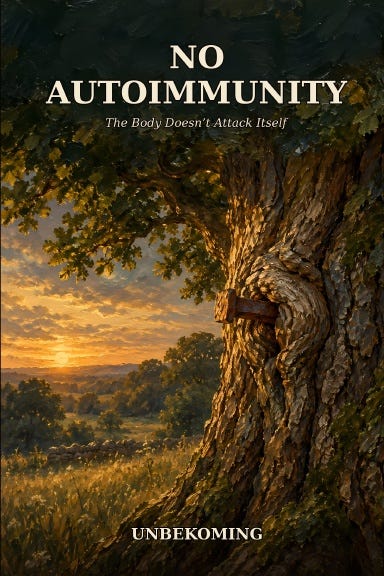
No Autoimmunity: The Body Doesn’t Attack Itself
For seventy years, “your body is attacking itself, and we don’t know why” has ended the conversation for people diagnosed with multiple sclerosis, lupus, rheumatoid arthritis, Hashimoto’s, Type 1 diabetes, Crohn’s and psoriasis. More than eighty conditions now carry the autoimmune label. The diagnosis comes with a prescription for life. It almost never comes with a question about cause.
This book asks the question and answers it from the framework’s own records: its drug labels, its journals, its regulatory filings, and its own experiments.
What’s inside
Humira: The Cover Story. A drug that once earned more than twenty billion dollars a year, whose own label warns of lymphoma and new conditions labelled autoimmune. Stop taking it and the symptoms usually return, so the prescription never ends.
The Autoimmune Label. In 1956 researchers produced thyroid disease in rabbits by injecting thyroid tissue with a powerful adjuvant. A category defined by “unknown cause” has since grown to more than eighty conditions.
The Three Deceptions. The “immune system” as an army, antibodies as soldiers, autoimmunity as the army turning on itself. Each idea props up the others.
Richet’s Erased Nobel. The 1913 Nobel Prize for showing that injected foreign proteins sensitise the body. Medicine kept the prize and filed the warning under “allergy.”
The Nervous System. The 1976 swine flu campaign and the paralysis cases that followed. Hal Huggins removed mercury fillings from MS patients, documented their improvement, and lost his licence.
The Endocrine System. Fluoride and bromide crowding out iodine, and a lifelong thyroid pill that ensures nobody learns whether the gland could recover.
Connective Tissue. Evelyn Hess’s catalog of more than seventy medications that produce lupus and related disease, which usually clears once the drug is stopped. The book’s central proof, from the framework’s own literature.
The GI Tract. Celiac disease went from one child in five thousand in 1950 to about one person in a hundred today. The chapter covers what changed in the food.
Skin and Blood. Psoriasis appears where skin is injured, and the drugs sold for psoriasis are documented to cause it.
The Documented Reversals. Drugs withdrawn, mercury removed, implants taken out, diets changed. Once the injury is gone, the body mends.
What Made the Reversal Possible. Remove the harm, restore what the body needs, give it time, and protect what still works.
How to Think About the Diagnosis You Were Given. Written directly to the reader holding a diagnosis, with the exposure history to build and the questions to ask.
Where to Go from Here. A reading list and the kinds of practitioners worth finding.
Every chapter closes with How to Explain It to a 6 Year Old, a plain-language section you can read aloud to a child or hand to a relative who will never read a medical paper. The book also includes a glossary, a bibliography of more than 100 sources and a full index.
Who this book is for
If you or someone you love has been handed one of these diagnoses, read this before accepting that the answer is a lifetime prescription. If you’re a practitioner, or someone who simply wants to check the record, the full documentary trail is here, referenced source by source.
288 pages, paperback.
The shelf
No Autoimmunity joins the rest of the Unbekoming catalogue at lulu.com/spotlight/unbekoming.
Thank you
Every book on that shelf exists because readers here keep asking better questions and sharing what they find. Thank you for reading, and for putting these books in the hands of the people who need them.
Unbekoming
In Print
The Unbekoming library is available in paperback, printed to order through Lulu and shipped worldwide. The shelf begins with the paradigm question underneath everything else — No Virus, the isolation problem, the collapse of virology’s foundational claims, and a disease-by-disease reappraisal — and moves through the suppressed compounds mainstream medicine set aside: The DMSO Book, Chlorine Dioxide: The Forbidden Remedy, The Iodine Book, and The Hydrogen Peroxide Book. Two more recover what’s still on the kitchen shelf: Baking Soda and The Castor Oil Book. Two more recover the minerals modern soil, water, and processing quietly stripped from the diet: The Magnesium Handbook and The Boron Book. Sitting alongside these is No Contagion, co-authored with Jamie Andrews — the case against germ theory itself, catalogued through 258 failed contagion experiments.
The critique books cover what medicine, dentistry, psychiatry, and veterinary practice have become. The Unvaccinated treats the completely unvaccinated as a comparison group across twenty chapters and five appendices. Medicalized Motherhood follows a woman through 123 documented interventions from teenage pill to postpartum discharge. Drilling for Profit treats cavities, gum disease, and crooked teeth as the dietary problem they are. What Your Vet Can’t Tell You applies the same critique to pets. Escape from Psychiatry documents the fabrication of the DSM and the specific damage of every major psychiatric drug class. The Vitamin K Injection covers what happens in the first hours of a newborn’s life.
The full shelf is at lulu.com/spotlight/unbekoming. A physical book reaches the person a Substack post never will — the skeptical relative, the friend who won’t click a link but might open a book, the visitor whose eye lands on a coffee table. Buy one to keep, and one to give away.
The fact that none of these illnesses existed 200 years ago should say enough. 'Modern' life, 'Western' food (and to some extent, western clothing), allopathic meds, bring it on. Recently I saw people load a container with donated fabrics for African missions - all of them polyester, acrylic, and fabrics that people should not wear in the tropics. There is a reason for what African people wear!
My wife was diagnosed with scleroderma. My guess is it was caused by something covered here.