

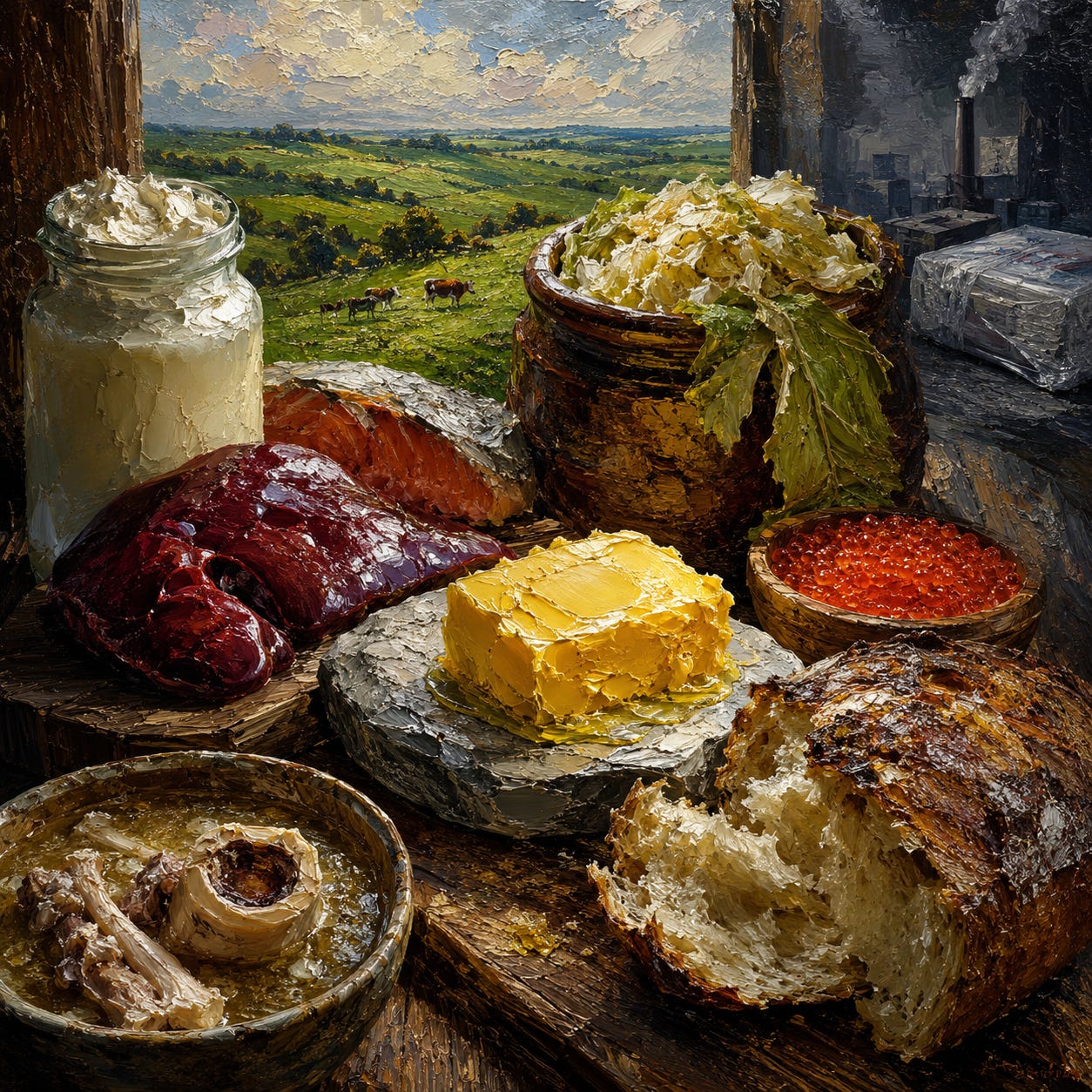
Within a single generation of contact with white flour, refined sugar, vegetable oils and canned goods, the children of fourteen isolated populations Weston Price had photographed in robust health — Swiss Alpine villagers, Gaelic islanders, Inuit, Masai, Polynesians, Aboriginal Australians — developed crowded teeth, narrow faces, dental decay and the chronic conditions filling Western hospitals. The photographic record, parents and children side by side from the same families, was assembled in the 1930s and published as Nutrition and Physical Degeneration in 1939. Sally Fallon’s Nourishing Traditions, first published in 1995 and expanded across subsequent editions, is the book that took Price’s evidence out of the archives, married it to the practical recipes and preparation methods of the cultures he had documented, and put it back into working kitchens. The central claim it establishes is concrete and falsifiable: the dental crowding, the developmental conditions, the fertility difficulties and the chronic disease patterns of modern populations are the visible signature of a multigenerational depletion of specific food factors — concentrated in butter from cows on rapidly growing spring pasture, in cod liver oil, in organ meats from pastured animals, in fish eggs, in raw aged cheese and in the lacto-fermented foods of traditional cuisines — that began when these foods were displaced by margarine, refined seed oils, skim milk and muscle meat.
Fallon wrote as the principal popular interpreter of Price’s field work, in collaboration with the lipid biochemist Mary Enig — whose technical analysis of fats and oils had made her one of the few credentialed scientists pushing back publicly against the lipid hypothesis through the 1970s and 1980s. Fallon’s institutional base was the Price-Pottenger Nutrition Foundation, which preserved Price’s archives, and later the Weston A. Price Foundation, which she co-founded in 1999 to extend the work. The cookbook format was strategic. The dietary establishment had captured the credentialed channels — medical schools, dietetic associations, the federal guidelines — and the Price evidence had been pushed to the margins for sixty years by the time Fallon picked it up. A cookbook circulated through kitchens reaches readers the journals cannot, and Nourishing Traditions has done so steadily for three decades.
The book appeared in 1995, near the high-water mark of low-fat orthodoxy. The 1977 dietary guidelines had enshrined the lipid hypothesis as federal policy. The food pyramid published by the USDA in 1992 placed grains at its base — six to eleven servings daily — and treated fats as foods to use sparingly. Margarine sales had peaked, refined seed oils dominated 70 percent of fat calories, and the American Heart Association certified industrial seed oil products as heart-healthy. Cardiology, dietetics and pharmacy had built professional infrastructures on the assumption that saturated fat and cholesterol caused heart disease — the assumption Ancel Keys had produced in the late 1950s by selecting seven countries from a dataset of twenty-two and omitting the populations whose data contradicted the curve. The Framingham Heart Study had run for decades without producing the expected correlation; its director eventually acknowledged that those who ate the most saturated fat weighed the least and were the most physically active. None of this displaced the orthodoxy. Fallon’s book entered that environment carrying evidence the establishment had had for sixty years and chosen not to engage with.
Nourishing Traditions sits within the terrain canon as the practical kitchen-level expression of the framework Béchamp grounded in the milieu intérieur and Shelton extended through the acute-to-chronic mechanism: disease arises from nutritional deficiency and toxic exposure, and removing the insults while supplying what the body actually requires — through whole foods in their living matrices — allows it to do what it is designed to do, which is heal. The full summary unpacks Pottenger’s ten-year cat studies showing degeneration accelerating across three generations of cooked-food eaters with no fourth generation; the strategic positioning of soy infant formula, whose phytoestrogen load on a body-weight basis is equivalent to an adult consuming several hormonal birth-control pills daily; and the pre-conception nutrition tradition documented across every continent Price studied, in which couples were placed on special diets for six months or longer before attempting to conceive, and in which children were spaced three or more years apart so the mother’s reserves could replenish between pregnancies. Where the practice held, each child was born with the vigour of the first. Where it lapsed, the second and third children showed visible deterioration, photographed and dated, in families whose parents were eating the same food they had always eaten and whose children were not.
The full summary continues below for paid subscribers
To finish reading this book, become a paid subscriber.
Your subscription unlocks the rest of this summary — the analogy, one-minute elevator explanation, 12-point summary, Q&As, and Golden Nugget — along with the premium content for every other book summary in the library. It also unlocks the full Deep Dive Audio Library of in-depth conversations and my growing library of original books. New content is added every month.
I do this work independently, outside the institutions these books so often describe. No foundation grants, no academic approval, no editorial gatekeepers deciding what’s acceptable to publish. Your subscription makes that independence possible.