

The Wellness Company and the McCullough Foundation published this paper in Anticancer Research in June 2026 and have promoted its 84.4% headline aggressively across the medical-freedom press. The journal has since issued an Expression of Concern about the paper and is conducting a continuing methodological review. In September 2026, Thomas Cowan tore it apart on his webinar on both methodological and paradigm grounds. This essay works the methodological line to its endpoint using the paper’s own data, then lands the paradigm point at the close. Most of the argument operates in the paper’s own vocabulary, because that is where the paper’s collapse is visible. When the register shifts at the end from conventional oncology to the terrain reading of what cancer actually is, that shift is deliberate. The paper convicts itself on its own terms first. The larger question of why a paper this weak was ever needed by the movement that produced it comes second.
p = 0.91. That is the number, calculated by the authors themselves, that dismantles the 84.4% headline of the McCullough Foundation’s ivermectin-and-mebendazole cancer paper, published in Anticancer Research. Table 4 reports that patients taking one capsule per day and patients taking four had statistically indistinguishable cancer outcomes. The paper’s own analysis contains the refutation of the paper’s own promotion.
Here is Table 4 as it appears in the paper.¹
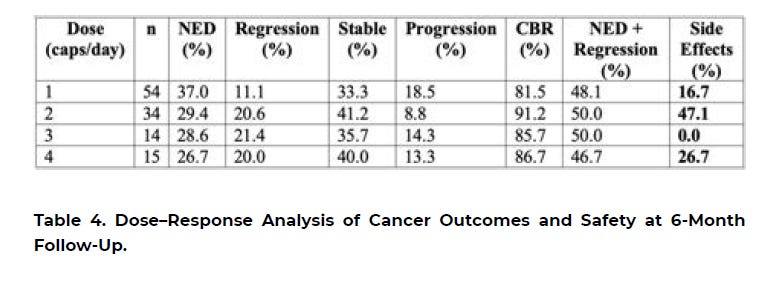
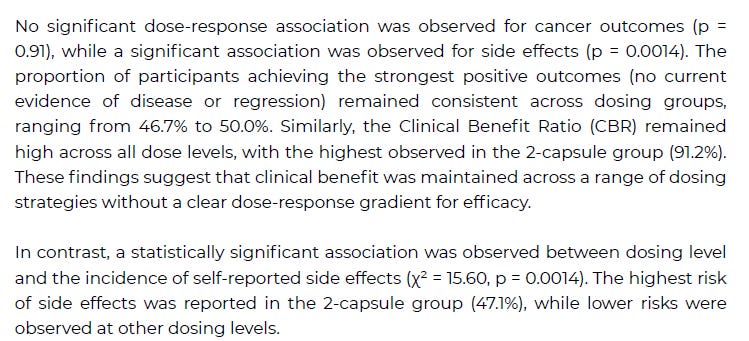
What that value means, in the paper’s own analysis, is that the differences in cancer outcomes across the four dose groups are indistinguishable from noise. The Clinical Benefit Ratio (CBR) held between 81.5 and 91.2 percent across every dose level. The combined “no evidence of disease plus regression” rate held between 46.7 and 50.0 percent across every dose level. Nothing about outcome tracks with how much of the drug the patient took.
Real pharmacological effects track with exposure. This is elementary. When outcome does not vary with dose, the outcome is not being driven by the substance. The finding in Table 4 is not a footnote about dosing optimization. It is a signal that whatever produced the 84.4% headline was not the ivermectin-and-mebendazole combination. If the drug were driving cancer outcomes, four times the daily dose should produce a visibly different distribution than one. It does not.
The same table contains the other half of the argument. Side effects do track with dose, at p = 0.0014. The 2-capsule group reports 47.1 percent side effects. The 1-capsule group reports 16.7 percent. The drug is doing something biologically at higher doses. Patients feel it. Their bodies register it. But the something they register does not translate into more cancer benefit. This is the profile of a substance with real biological activity that is not on the outcome being claimed.
The authors themselves reframe this finding. Their sentence reads: “clinical benefit was maintained across a range of dosing strategies without a clear dose-response gradient for efficacy.”
That sentence converts a refutation into a marketing point. Absence of a dose-response is not evidence that the drug works across a flexible range. It is evidence that the outcome is not being produced by the drug. The phrase “clinical benefit was maintained” assumes what the analysis has just failed to establish, namely that clinical benefit was ever caused by the substance in the first place. What the authors wrote is the same thing a homeopathy trial reports when higher potencies do not outperform lower ones. Absence of dose-response looks like uniform benefit when the reader is already assuming benefit. Once that assumption is checked, the same finding reads as the drug not being the active ingredient.
The paper contains one honest sentence about all of this, at the end of its limitations section: “Given these threats to validity, therapeutic benefit cannot be inferred.” That sentence, from the authors themselves, is inconsistent with every promotional claim built on the 84.4% headline.
This work stays free because paid subscribers make it possible. They get the full book library, the Deep Dive Audio Library, and the Questions for Your Doctor, Before You Consent, and Package Insert series. No grants, no gatekeepers — your subscription is what keeps it that way.
What the 84.4% Actually Measures
If the substance is not producing the outcome, something else in the cohort is. Table 2 of the paper begins to show what.
At baseline, 62.9 percent of the cohort was already classified as “not currently spreading.” Only 37.1 percent had actively progressing disease at the time they entered the study. The primary outcome, the Clinical Benefit Ratio, was defined by the authors as the proportion of participants with no current evidence of disease (NED), regression, or stable disease. If nearly two-thirds of the cohort was already stable when they walked in the door, the CBR at six months largely measures whether people who were stable at entry remained stable over the following six months.
Stable cancer stays stable. That is what stable cancer does. Not for six months, and not because of the last thing the patient swallowed.
Duration since diagnosis compounds this. Of the 197 baseline participants, 47.7 percent were within their first year of diagnosis. But 42.2 percent had been living with their diagnosis for more than two years. 21.3 percent had been living with it for two to five years, 10.2 percent for five to ten years, and 10.7 percent for more than ten years. Many of these patients are long-term survivors of already-treated cancer. Their being stable or NED after another six months requires no explanation from ivermectin. It requires no explanation at all beyond the natural history of their disease, which is that they have been living with it for years.
The NED figure itself is the paper’s headline finding within the headline finding. 32.8 percent of the 122 follow-up participants reported no current evidence of disease at six months. What does this actually measure?
From Table 2, in the paper’s own categorization of prior treatments received: 42.1 percent had surgery, 31.5 percent chemotherapy, 28.9 percent radiation therapy, 17.3 percent “immunotherapy,” 14.7 percent hormone therapy, 8.6 percent targeted therapy. Surgery alone can render a cancer patient NED. Chemotherapy and radiation given to cure a cancer, rather than manage it, can render a patient NED. The paper does not separate patients who were NED at baseline from those who became NED during follow-up. It does not report how many of the 40 NED patients had already been rendered NED by prior conventional treatment before they ever swallowed a capsule of the compounded formulation.
This omission matters. If a patient was rendered NED by a radical prostatectomy in 2023, started taking ivermectin-mebendazole in 2025, and was still NED at follow-up in early 2026, the paper’s methodology counts that patient as NED at follow-up without asking whether the surgery two years earlier is a more parsimonious explanation than the capsules from last summer. Multiply that pattern across the 40 NED patients in the cohort and the headline figure loses its meaning.
Two other numbers in Table 3 make the same point in a different way. Regression: 15.6 percent (19 patients). Progression: 15.6 percent (19 patients). Equal numbers got better and equal numbers got worse. In a heterogeneous cohort of 122 cancer patients spanning multiple cancer types and durations since diagnosis, this distribution is what you would expect from natural fluctuation and reporting noise. Nothing here suggests that the drug pushed the distribution in the direction the headline claims. If the drug were producing regression, regression should exceed progression by a meaningful margin. It does not.
Then there is what else the patients were doing. At follow-up: 27.9 percent were undergoing chemotherapy concurrently with the drug, 21.3 percent radiation, 19.7 percent surgery, 49.2 percent using other cancer-related supplements, 37.7 percent making dietary changes. The paper’s free-text fields captured intermittent or prolonged fasting, ketogenic diets, hyperbaric oxygen therapy, red-light therapy, turmeric, berberine, medicinal mushrooms, and supplemental “vitamin D.” Any single one of these interventions has more mechanistic literature behind it in cancer than the ivermectin-mebendazole combination has clinical evidence for. Fasting alone has produced measurable effects on tumor metabolism in published research. Ketogenic dietary intervention has a clinical literature going back decades.
The paper does not stratify outcomes by any of these variables. It reports that patients took the ivermectin-mebendazole combination, and that a range of outcomes followed. It does not ask how those outcomes distribute across patients who were also fasting, on ketogenic diets, undergoing chemotherapy, or having surgery. It does not ask because the answer would dilute the causal attribution to the drug.
One further layer sits underneath all of this. The outcomes are patient-reported. Not clinically adjudicated, not radiographically confirmed. Patients who paid for the compounded formulation from The Wellness Company were sent a survey and asked whether their cancer had improved. Patients who have paid for a treatment and been told it works have well-documented incentives to report improvement, both to themselves and to those asking. The paper acknowledges this in its limitations section and then proceeds to build a headline number on top of it.
The 84.4% headline is what happens when you take a cohort mostly composed of people whose cancer was already stable, ask them by questionnaire whether it stayed stable, and count everyone who did not tick the box marked “worse.” It is a marketing number that measures cohort selection and natural history, not drug effect. The paper’s own dose-response analysis is consistent with this reading. The paper’s own limitations section acknowledges as much.
A defender of the paper might reply that the authors explicitly label the findings hypothesis-generating and never claim causation. That defense collapses under the paper’s own promotion. Every hedged phrase in the limitations section becomes a marketing claim in the press releases and interviews built around the study. The hypothesis-generating language protects the authors from methodological criticism while the 84.4% headline sells the product. Both live inside the same paper because they serve different audiences: the academic reader who might scrutinize, and the medical-freedom customer who will not.
The Paper’s Own Structural Failures
The paper also contains structural failures visible to the reader without leaving the front matter or reference list.
The first is the IRB dodge. The paper’s Institutional Review Board statement reads: “This project was conducted as a retrospective analysis of a prospective clinical program evaluation. Consistent with established frameworks for quality improvement and internal assessment of clinical services, the project utilized voluntary, patient-reported data. As such, it did not meet the definition of human subjects research and did not require Institutional Review Board (IRB) review.”
Translation: 197 cancer patients were enrolled in a longitudinal study of a compounded pharmaceutical, dosed for six months, tracked with baseline and follow-up surveys, and analyzed for cancer outcomes. The authors then declared the enterprise to be not-human-subjects-research on the grounds that it was internal quality improvement. This classification allowed the study to proceed without ethical review of the protocol, without informed consent framed as research, and without any independent body assessing whether patients with active cancer diagnoses should be enrolled in a longitudinal drug study run by the same company selling them the drug.
The “quality improvement” designation exists for legitimate reasons in clinical care. It is designed to allow hospitals and clinics to audit their own service delivery without triggering the full IRB apparatus, on the reasoning that internal audit is not human experimentation. Applying it to a prospective observational cohort study of 197 cancer patients on a compounded pharmaceutical, conducted specifically to generate a publishable evidence base for that pharmaceutical, is not what the framework was designed for. The authors are using an audit exemption to conduct research on people with cancer.
The second is the conflict of interest, which the paper does disclose in plain language. Every author is affiliated with or receives salary support from The Wellness Company, which operates the telemedicine platform through which the evaluated combination was prescribed and dispensed. TWC also sells compounded formulations of ivermectin and mebendazole. This is not a peripheral commercial arrangement. It is the entire arrangement. The study evaluates a product that the study’s authors sell.
This is the structure that pharmaceutical trials are correctly criticized for when Pfizer studies Pfizer’s product, or when Merck studies Merck’s. The structural failure is identical. The scale is smaller and the price point is different, and the distinction ends there. When the company selling the drug also designs the study, enrolls the patients, defines the primary outcome, collects the data, analyzes the results, and writes the paper, the conflict of interest is not a technical disclosure item. It is a description of the entire evidentiary apparatus.
The third failure sits in the paper’s reference list. Reference 13 is a 2025 case series by Makis, Baghli, and Martinez titled “Fenbendazole as an Anticancer Agent? A Case Series of Self-Administration in Three Patients,” published in Case Reports in Oncology. The Hulscher paper cites it in the Discussion as evidence for the “growing body of promising clinical evidence” supporting repurposed antiparasitic agents in cancer.
That case series was retracted by the publisher on January 21, 2026.²
The reference list in the Hulscher paper carries the retraction notice. The paper cites a retracted case series in support of its central claim. Whether this happened because the authors updated the reference after retraction and left the citation in anyway, or because the journal added the notice automatically, the paper as it currently stands cites a retracted work as one of four clinical references supporting its most important framing claim.
Karger Publishers, which retracted the paper, gave its reason on the retraction notice. The first author was offering paid services related to fenbendazole cancer protocols at the time of manuscript submission and did not disclose this in the paper. The editor concluded that the undisclosed conflict “would have affected the interpretation of the work and recommendation.”³
The retraction notice does not specifically name The Wellness Company as the vehicle for the undisclosed services. The commercial relationship between Dr. Makis and TWC is a matter of public record on TWC’s own website, which maintains a promotional page for Dr. Makis featuring the retracted case series as a marketing asset and directing cancer patients to purchase the same ivermectin-and-mebendazole product the Hulscher paper evaluates, sold through TWC’s platform.⁴ The retracted paper and the paper citing it are connected through the same commercial arrangement, whatever Karger’s retraction notice does or does not specify.
What is left in the Hulscher paper’s “growing body of promising clinical evidence” after Makis is removed?
Reference 11 is a small observational study of ivermectin alone in Ecuadorian cancer patients, published in Nursing Reports, reporting self-reported clinical benefits and quality-of-life improvements.⁵
Reference 12 is a real small randomized controlled trial: Hegazy et al., published in Life Sciences in 2022, enrolling 40 metastatic colorectal cancer patients (twenty per arm), testing mebendazole added to bevacizumab plus FOLFOX4 chemotherapy for 12 weeks. This trial reported a 65 percent versus 10 percent overall response rate. The intervention tested is not the ivermectin-plus-mebendazole combination the Hulscher paper evaluates. It is mebendazole added to standard chemotherapy in one specific cancer type.⁶
Reference 14 is a conference abstract from the 2025 ASCO Annual Meeting: Yuan et al., reporting preliminary results from the first nine patients enrolled in a phase I/II trial of ivermectin combined with balstilimab, an expensive proprietary cancer drug, in metastatic triple-negative breast cancer. This is not a published trial. It is a nine-patient preliminary safety cohort, and the intervention is not the combination the Hulscher paper evaluates.⁷
Three references remain once Makis is out: a self-reported observational study of ivermectin alone in Ecuador, a small RCT of mebendazole added to standard chemotherapy in Egyptian colorectal cancer patients, and a nine-patient preliminary safety abstract on ivermectin combined with balstilimab. Not one of the three tests the ivermectin-plus-mebendazole combination that the Hulscher paper is built around. Not one is powered as a definitive trial of the intervention. The “growing body of promising clinical evidence” phrasing rests on this.
The American Society of Clinical Oncology, hardly a hostile witness for repurposed antiparasitic research, issued a Clinical Notice in May 2026 stating: “To date, there is no robust, peer-reviewed clinical evidence demonstrating that either ivermectin or fenbendazole is safe or effective for treating any human malignancy.”⁸ The Hulscher paper’s own reference list confirms this, once the retracted citation is set aside.
Of the four clinical references supporting the paper’s central claim, the flashiest, the one reporting the most spectacular outcomes (three stage IV cancer patients allegedly achieving complete or near-complete remission on fenbendazole sustained for up to three years), is the one that failed editorial scrutiny for undisclosed commercial conflict. This is not a coincidence of timing. The most extraordinary case reports attracted the most editorial attention, and the editorial attention surfaced a commercial relationship the paper’s structure could not accommodate.
The Journal’s Own Concerns
The Hulscher paper appeared in the peer-reviewed oncology journal Anticancer Research (Vol. 46, No. 6, pp. 3243-3255, June 2026), not only in the promotional literature of the McCullough Foundation and The Wellness Company. In the same month the paper was published, the journal’s Editorial Board issued a formal Expression of Concern about it.¹¹
The June 2026 Expression of Concern stated that “serious scientific concerns were raised by the international medical community regarding the verifiability and statistical reliability, and ethical oversight of the underlying dataset.” The Board wrote that “a study published in a peer-reviewed oncology journal that reports a ‘Clinical Benefit Ratio of 84.4%’ and specific percentages of ‘tumor regression’ must rest on a verifiably real clinical foundation and adhere to established ethical frameworks for human subject research to maintain its validity in the permanent scholarly record.” It added: “Anticancer Research does not endorse or condone the unvalidated off-label use of medications for unapproved oncological indications.” The Board announced a formal “Post-Publication Data Integrity and Ethical Oversight Audit” covering IRB documentation, source-verified baseline cancer diagnoses, and objective medical documentation of the reported regressions.
On September 1, 2026, the journal issued an Update to the Expression of Concern.¹² The audit was narrowed. The IRB and ethical oversight questions were formally set aside: “The question of ethical oversight is not pursued and forms no part of the ongoing review. The Board draws no adverse inference from the non-production of any material.” The Update also states explicitly, in the journal’s own words: “No allegation of fabrication, falsification, plagiarism, image manipulation, or other research misconduct is made against any author.”
What remains under review is a list of specific methodological questions the Board has put to the authors. In the journal’s own words, the continuing review concerns: “the construction and interpretation of the composite outcome reported as a Clinical Benefit Ratio and of the self-reported survey measure underlying it; the timing of baseline assessment relative to treatment exposure; the basis for the reported relationship between dose and adverse effects; the analysis presented in support of the representativeness of the follow-up sample; the composition of the dose-stratified analysis; and the treatment of participants without follow-up, and of concurrent conventional cancer therapy, in attributing the reported outcomes.”
That list closely tracks the argument of this essay. The construction of the Clinical Benefit Ratio is what “What the 84.4% Actually Measures” unpacks. The self-reported survey measure is the patient-reporting-bias problem. Timing of baseline assessment relative to treatment exposure is the NED-explained-by-prior-treatment problem. The composition of the dose-stratified analysis is the p = 0.91 finding this essay opens with. Treatment of concurrent conventional cancer therapy is the confound named throughout. When the paper’s own peer-reviewed journal identifies these questions as material enough to warrant continuing review, the essay is not describing a different paper. It is describing the same paper the journal is now describing.
The review is ongoing. As of the September Update, the journal has stated that “no final decision has been taken on whether the article should be corrected, retracted, or otherwise updated.” What has been decided is that the paper, with a Clinical Benefit Ratio of 84.4% held up as its headline, cannot rest on its published methodology alone. The journal has said so.
Why This Paper Exists
A reader might reasonably ask why a paper this weak was published at all, and why it has been promoted so aggressively across the medical-freedom press.
The answer takes the essay out of the paper and into the movement that produced it. In September 2026, Thomas Cowan devoted a webinar to precisely this question, and his methodological critique tracks what has been laid out above. His deeper move goes further. Cowan observes that even in himself, someone who has spent years documenting the failures of pharmaceutical medicine and the germ theory framework, the paper produced a reflex. In his own words: “I know the reaction even in me. I don’t mean even in me like I’m something different, but as much as I have looked into these things, there is a reaction of oh I should really do this or I should get a hold of these drugs just in case someday I get cancer I can use these drugs that that sort of wells up and then you have to sort of take a step back.”⁹
That admission is the most important sentence in Cowan’s webinar. It comes from inside the health-freedom movement, from someone who cannot be dismissed as an establishment defender. What it names is the reflex the paper is designed to activate. A dramatic clinical claim promoted through channels the movement trusts triggers exactly the same pill-first response that mainstream medicine has trained everyone to have. The channel is different. The reflex is the same.
The reflex has a paradigm underneath it, and the paradigm is not what the reader might expect. The Hulscher paper does not propose an alternative model of cancer. It adopts conventional oncology’s model whole. The Introduction talks about PAK1 kinase inhibition, Wnt/β-catenin disruption, PI3K/Akt/mTOR and STAT3 signaling, mitochondrial dysfunction, cancer stem cell eradication, microtubule destabilization, cell cycle arrest, apoptosis induction. These are the standard targets of standard oncology. The paper’s proposal is that ivermectin and mebendazole hit those targets too, and hit them cheaply. The paper is not suggesting cancer is caused by parasites or that these drugs work as antiparasitics. It is suggesting that drugs originally developed as antiparasitics happen, through completely separate mechanisms, to act on the same molecular targets conventional oncology already aims at.
That is the paradigm move, and it is worth naming carefully. The medical-freedom press is offering the movement the conventional-oncology worldview repackaged. Cancer is still framed as a discrete pathological entity, driven by aberrant molecular signaling, to be attacked by a molecule that hits the right target. The disease model is unchanged. The list of drugs is different. The molecule mainstream medicine offers is patented and expensive. The molecule the medical-freedom press offers is off-patent and cheap. Only the molecule and the marketing channel change. Everything else, the framing of cancer, the pill-first logic, the framing of the patient as someone whose job is to swallow the correct chemical, is the same.
Cowan calls this the Hegelian dialectic frame, in which the public is offered two competing narratives that both obscure a deeper truth by keeping the argument on their shared terrain. The reader who accepts the medical-freedom press’s ivermectin-and-mebendazole cancer story has not left conventional oncology. They have subscribed to a different retailer of it.
A different reading of what cancer is starts from a different question. It does not ask which molecule to use against the malignant entity. It asks what conditions in the tissue and in the metabolism have produced the phenotype the pathologist is calling cancer, and what conditions would allow those cells to reintegrate or die on their own terms. The research literature on cancer as a mitochondrial-metabolic condition, running from Warburg through Seyfried and out to the current metabolic-oncology and integrative practitioners, is where the actual next question lives.¹⁰ The two framings look similar from a distance and are entirely different at close range. A pharmaceutical proposed as a molecular attack on a target is not the same intervention as a pharmaceutical proposed as one lever in a metabolic shift, even when the pill in the bottle is identical. The Hulscher paper operates in the first framing, asking whether the drug hit the target. The metabolic literature operates in the second, asking whether the terrain has been changed. None of that second question is contained in the Hulscher paper. All of it requires reconsidering what cancer is at the level of cellular biology.
The paper being promoted across the medical-freedom press does not point toward that reconsideration. It offers the movement a pill to reach for, so that the reflex the movement has trained itself to distrust in the mainstream can be exercised in a version the movement trusts. That is why a study with p = 0.91 in its own dose-response table, no IRB oversight, disclosed conflicts of interest, and a retracted citation gets published and promoted so hard across the same channels that spent four years being right about COVID. The pill is what the movement is being offered. The paper is the paperwork that makes reaching for it feel like science.
One-Minute Elevator Explanation
In 2026, the McCullough Foundation and The Wellness Company published a paper claiming 84.4% clinical benefit from an ivermectin-and-mebendazole combination in a cohort of 197 cancer patients. The paper became a marketing centerpiece across the medical-freedom press.
The paper’s own Table 4 refutes the claim. When the authors compared cancer outcomes across patients taking one, two, three, and four capsules per day, the outcomes were statistically identical, at p = 0.91. If the drug were producing the outcomes, four times the dose would produce a visibly different result. It did not. What varied with dose was side effects, at p = 0.0014, not benefit.
The 84.4% number is manufactured by the cohort itself. Almost two-thirds of the patients were already stable when they entered the study. Many had already been rendered NED by prior surgery or chemotherapy, which the paper does not separate from any effect of the drug. Regression equaled progression at 15.6 percent each, the shape of natural fluctuation. And every patient was doing multiple other things at the same time, including fasting, ketogenic diet, hyperbaric oxygen, and ongoing chemotherapy.
The paper also carries structural failures. The authors used an internal-audit exemption to run six months of research on 197 cancer patients while disclosing that they sell the product being evaluated. One of their four supporting clinical citations has been retracted for undisclosed commercial conflict, the same species of conflict that runs through their own paper. The paper’s own peer-reviewed journal, Anticancer Research, has issued an Expression of Concern and is conducting a continuing methodological review whose specific questions closely track the argument above.
The paper convicts itself with its own data. What is left is the pill the movement is being sold and the paperwork that makes reaching for it feel like science.
How to Explain It to a Six-Year-Old
Imagine a shop that sells special jellybeans. The shop says the jellybeans cure a certain kind of sadness. To prove it, the shop asks its customers to try the jellybeans for six months and then come back and say how they feel.
Some customers eat one jellybean a day. Some eat two. Some eat three. Some eat four. Six months later, everybody comes back and says how they feel.
Here is the strange part. The people who ate one jellybean a day and the people who ate four jellybeans a day felt about the same as each other. Every group felt about the same. It did not matter how many jellybeans anyone ate.
If the jellybeans really cured that kind of sadness, the people who ate four a day should feel much less sad than the people who ate one a day. Because that is how medicines work. More of a medicine that works does more of the work.
So whatever is going on, it is not the jellybeans doing it. The jellybeans are not curing anything.
But the shop puts a big sign in the window that says: 84 out of every 100 of our customers said they felt okay six months later! And the sign is not exactly lying. Most of the people who walked into the shop were already feeling pretty okay when they walked in, and six months later they were still feeling pretty okay.
The sign is true. But it is telling you the wrong thing. It is not telling you that the jellybeans work. It is telling you that people who were feeling okay when they arrived were still feeling okay when they came back. And the shop making the sign is the shop that sells the jellybeans.
In Print
Thirteen of my books are now available as paperbacks, printed to order through Lulu and shipped worldwide. The Unvaccinated lays out the completely unvaccinated as a comparison group across twenty chapters and five appendices — as far as I know, the only book of its kind. Medicalized Motherhood follows a woman through 123 documented interventions from teenage pill to postpartum discharge. Drilling for Profit argues that cavities, gum disease, and crooked teeth are a dietary problem the dental profession treats surgically. What Your Vet Can’t Tell You applies the same critique to pets — food, vaccines, and a profession trained by the industries whose products cause the harm. Escape from Psychiatry documents the fabrication of the DSM, the collapse of the serotonin hypothesis, and the specific damage done by every major psychiatric drug class.
Two go to the paradigm underneath the whole shelf. No Contagion, co-authored with Jamie Andrews, catalogues 258 failed contagion experiments and the case against germ theory itself. No Virus takes the examination one layer deeper — the isolation problem, the collapse of virology’s foundational claims, and a disease-by-disease reappraisal of the entities the framework is built on.
Four take on the remedies and paradigm questions mainstream medicine actively suppresses. The DMSO Book covers 100,000 studies, zero deaths, and one approval — the suppressed science of medicine’s most versatile compound. Chlorine Dioxide: The Forbidden Remedy collects the interviews, protocols, and evidence from the doctors and researchers they tried to silence. The Iodine Book recovers an essential mineral driven out of easy reach by bromide, fluoride, and perchlorate — and the pharmacological tradition that kept its therapeutic use alive across the decades mainstream medicine set it aside. The Hydrogen Peroxide Book recovers a century of practice with a compound the body already makes — mitochondrial, phagocytic, part of thyroid hormone synthesis — suppressed precisely because its clinical utility threatened the pharmaceutical direction that captured twentieth-century medicine.
Two more take on the remedies already in your kitchen. Baking Soda locates sodium bicarbonate inside the terrain framework industrial medicine buried — the compound already in your cupboard, and what it does at the level of the blood, kidneys, lungs, digestion, and skin. The Castor Oil Book recovers four thousand years of documented practice on the medicine mainstream healthcare quietly stopped talking about — the kitchen bottle that doesn’t sit well in a system built on prescriptions and procedures.
A physical book reaches the person a Substack post never will — the sceptical relative, the friend who won’t click a link but might open a book, the visitor whose eye lands on a coffee table. The full shelf is at lulu.com/spotlight/unbekoming. Buy one to keep, and one to give away.
References
Hulscher N, Victory K, Thorp JA, Pinsky D, Diaz-Villalobos A, Gillooly P, Coulson F, Annazone M, Radesi C, Brooks J, McCullough PA, Risch H. Real-world Clinical Outcomes of Ivermectin and Mebendazole in Cancer Patients: Results from a Prospective Observational Cohort. Anticancer Res. 2026;46(6):3243-3255. doi:10.21873/anticanres.18194
Makis W, Baghli I, Martinez P. Fenbendazole as an Anticancer Agent? A Case Series of Self-Administration in Three Patients. Case Rep Oncol. 2025;18(1):856-863. Retracted in: Case Rep Oncol. 2026;19(1):169. doi:10.1159/000546362
Retraction Statement: Paper by William Makis, Ilyes Baghli, and Pierrick Martinez entitled “Fenbendazole as an Anticancer Agent? A Case Series of Self-Administration in Three Patients.” Case Rep Oncol. 2026;19(1):169. doi:10.1159/000549387
The Wellness Company. Dr. William Makis. https://www.twc.health/pages/dr-william-makis-copy
Jiménez-Gaona Y, Vivanco-Galván O, Morales-Larreategui G, Cabrera-Bejarano A, Lakshminarayanan V. Outcome of Ivermectin in Cancer Treatment: An Experience in Loja-Ecuador. Nurs Rep. 2023;13(1):315-326.
Hegazy SK, El-Azab GA, Zakaria F, Mostafa MF, El-Ghoneimy RA. Mebendazole; from an anti-parasitic drug to a promising candidate for drug repurposing in colorectal cancer. Life Sci. 2022;299:120536.
Yuan Y, Bitar JS, Walker M, Lin D, Lee J, Choi SY, Shiao S, Tighiouart M, Frankel PH, Lee PP. A phase I/II study evaluating the safety and efficacy of ivermectin in combination with balstilimab in patients with metastatic triple-negative breast cancer. J Clin Oncol. 2025;43(16_suppl):e13146.
American Society of Clinical Oncology. ASCO Clinical Notice: Recommending Against Ivermectin and Fenbendazole for Cancer Treatment, Outside of Clinical Trials. ASCO Connection; May 2026.
Cowan T. Ivermectin and Fenbendazole for Cancer: What the Study Actually Shows. New Biology Clinic webinar transcript; September 2, 2026.
Seyfried TN. Cancer as a Metabolic Disease: On the Origin, Management, and Prevention of Cancer. Wiley; 2012.
Anticancer Research Editorial Board. Expression of Concern. Anticancer Res. 2026;46(6):e3243. doi:10.21873/anticanres.18276
Anticancer Research Editorial Board. Update to the Expression of Concern. Anticancer Res. 2026;46(9):e3243u. doi:10.21873/anticanres.18380
So, before this paper was published, my uncle called me from Potomac Valley Hospital in Keyser WV. He had stage 4 bone and lung cancer that spread to his brain. He was receiving palliative care only of oxycodone, morphine & Fentanyl. He finally called me because he was at the end of the line and near death and his wife and son wanted him to try what I was posting on Facebook. Dr. Lee Merritt and others were promoting ivermectin & Fenbendazole along with organic beet juice to help flush the liver and magnesium citrate and NAC.
I asked my uncle if he wanted to live. He said yes! I told him to get out of the hospital and I would gather the supplies and meet him at the farm. We had to get all the backed up stool out of him using high doses of magnesium and gloves. At first, his cancer started spreading to his brain. I got him some methylene blue. Then he started to stabilize. A fundraiser and many prayers. The doctors said he was now a candidate for immunotherapy and he took it! Seven weeks later his scans came back clean. Further imaging showed just a very nodules, which they used a gamma knife to dissolve. In six months he was considered to be100% in remission! He is still well today and does a maintenance dose of ivermectin & Fenbendazole monthly! You may have problems with the 84.4% finger! That is fine, but no one can tell me that what we did was folly!
Ten people have scurvy. Then they start taking Vitamin C tablets. Some take 1 a day, others take 2 a day, others take 3 a day, and some take 4 a day. All of them got cured of scurvy! The "excess" Vitamin C was passed out with the urine. That they took different doses doesn't mean that the Vitamin C had nothing to do with their recovery.