

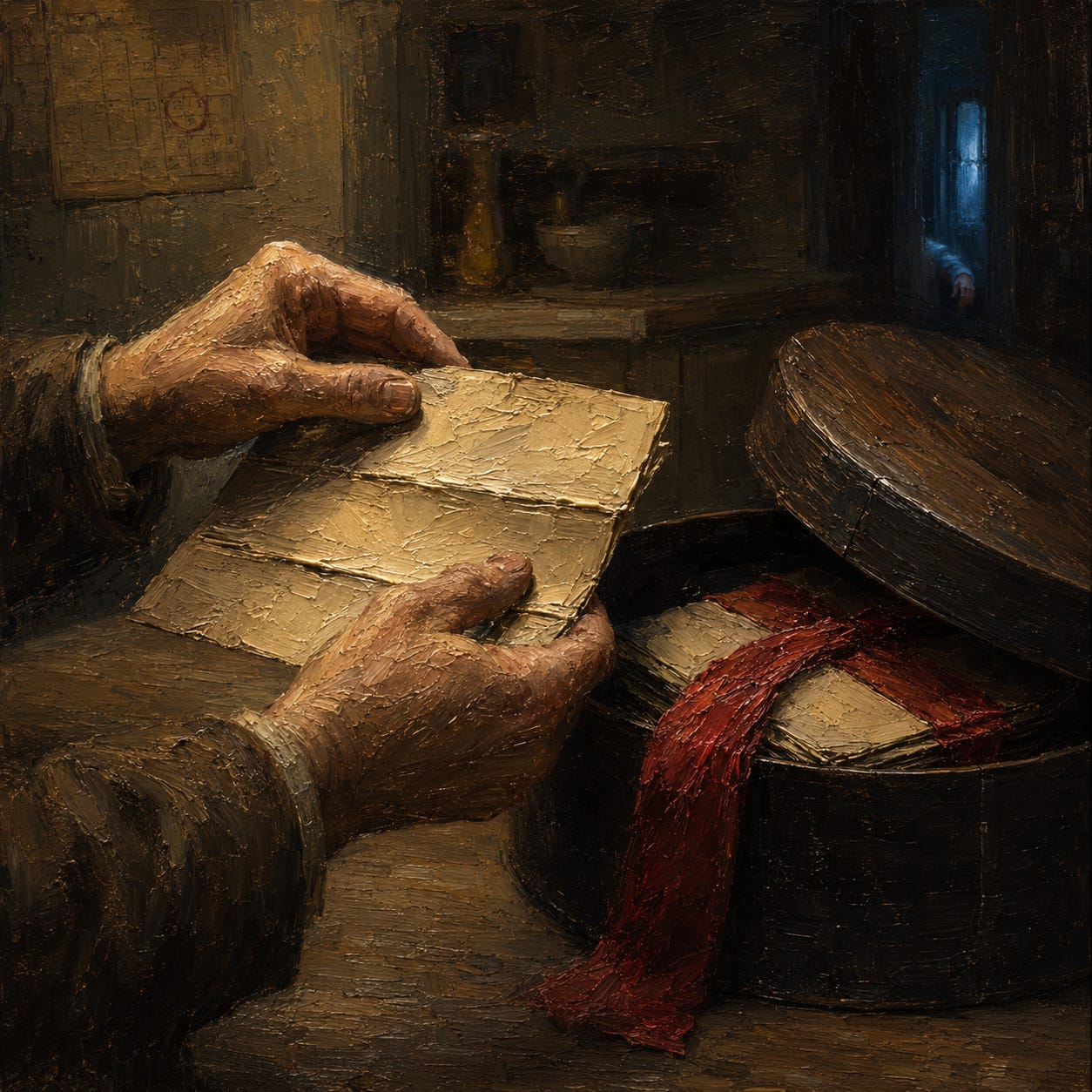
The hatbox is on the kitchen table because there was no room for it in the car with the folding chairs. She brought it home on Wednesday evening after the funeral and it has been sitting on the table since. Sam has been sick since Thursday morning with a low fever and a cough, and she has not sorted anything.
She is six months along with the second.
He goes down at seven. She reheats the pasta. She sits at the table with the pasta and a glass of water and looks at the hatbox.
Her grandmother kept everything. That was the family joke. The house on Long Island had bins of Christmas cards from 1972, drawers of buttons from coats no one remembered, a filing cabinet in the basement labelled TAXES 1988–1994. The hatbox was in the upstairs bedroom closet, on the top shelf, behind a stack of photograph albums. Her mother had said, take what you want.
She takes off the lid. The hatbox is full of letters. Envelopes tied in ribbon, some in bundles, some loose. A birthday card from her grandfather to her grandmother from 1961. A postcard from someone named Ida in Rochester. A recipe for a lemon cake in her great-grandmother’s hand.
Under the postcards there is a packet of older letters, tied with a ribbon that has faded from red to the color of dried blood. The envelopes are brittle. The paper is thick and yellow. She works the ribbon loose.
The letter on top is dated November 12, 1915. It is addressed to a Mr. Charles M. Higgins, at an office in Brooklyn. She has never heard the name.
She reads it once. Then she reads it again.
Her great-great-grandfather’s handwriting is small and controlled, sloping slightly to the right. He writes in complete sentences. He writes as a man who is trying not to write in the way he wants to write. He describes his son. The boy’s name was Thomas. He was seven years old, and he had been vaccinated in September as a condition of entering the third grade at the school on Sterling Place.
The arm swelled within two days. The arm blackened. The boy ran a fever that could not be brought down. The doctor came twice. On the third visit the doctor did not stay. The boy died on the sixth day.
His name was Thomas and he was seven years of age, the letter says, and I set this down because I will not have him forgotten in the interest of anyone’s peace of mind.
She sits at the table with the letter in her hand. The pasta is cold. Sam is asleep down the hall. Her husband is in Denver until Monday night.
The letter says that Mr. Higgins is understood to be gathering these accounts. The letter says that Thomas is buried in Green-Wood. The letter says that the writer’s wife has not spoken more than three words in the eight weeks since the funeral. The letter is signed James Whitfield.
She folds it and puts it back in the envelope and sets it on the table. She looks at it. She looks at the calendar on the fridge. Tuesday is circled.
She takes the hatbox off the table and puts it on the counter. She leaves the letter where it is.
Sam wakes at seven-thirty crying. She goes in. His forehead is warm but not hot. The thermometer says 99.8. She gives him half a teaspoon of the pink medicine and carries him to the couch.
He does not want to be put down. She sits with him against her chest and the television on low and watches him watch the television. His hair is damp at the temples. He is heavier than he was a month ago. She can feel his heart against her ribs.
The letter is on the kitchen table. She can see the corner of it from the couch.
His name was Thomas and he was seven years of age.
She thinks about her great-great-grandfather. She does not know what he looked like. She does not know what he did for a living. She does not know whether he ever wrote to Mr. Higgins again, or whether Mr. Higgins wrote back, or what became of the collection of accounts. She knows that Thomas was seven and that the arm blackened and that the boy is in Green-Wood.
Sam shifts against her chest and says mama and does not open his eyes.
She thinks about Tuesday. The three shots. She cannot remember their names. The pediatrician’s office at nine in the morning, the elevator, the waiting room with the fish tank, the little scale for weighing him, the sticker afterward. She has done this three times. She has never thought about it while she was doing it.
She thinks about the last time. He had been fine at the appointment. He had cried for a minute and eaten a rice cake in the car on the way home. The arm had swelled that night. She had called the office in the morning and the nurse had said within normal range, warm compresses, ibuprofen if he was uncomfortable. She had watched the arm every morning for a week. On the seventh morning it was smaller. On the eighth morning it was gone. She had stopped watching.
The arm is under Sam’s pajama sleeve now, pressed against her ribs. She can feel it there.
She does not look.
She takes his temperature again at ten. 99.4. She takes it again at noon. 99.6. She takes it again at two. 99.9. She feeds him applesauce and small pieces of toast. She reads him a book about a bear.
At four she puts him down for a nap and goes back to the kitchen and picks up the letter again.
I did not want it done. I signed the paper because he could not attend school without it, and the master had said the school would enforce it, and I had believed there was no danger in it whatever, for so I had been told.
She puts the letter down.
He wakes at 2:14. She hears him through the monitor and goes in.
The room is dark. The nightlight is a small blue thing shaped like a whale. He is standing in his crib. He has been crying but he has stopped by the time she reaches him. He puts his arms up.
She lifts him out. She sits with him in the rocking chair in the corner of the room. He puts his face against her shoulder and is quiet. The chair is tight against the belly. She adjusts.
She can feel his arm through the pajama sleeve. His left arm. The one they used last time. The one they will use on Tuesday. She can feel the small bones of it, the warmth of it, the way it moves as he breathes.
She thinks about pulling the sleeve up.
She thinks about it for a long time. The rocking chair moves under them. He is heavy against her shoulder. His breath is small and even. The blue light is on the wall. She thinks about pulling the sleeve up and looking at the arm. The arm that healed. The arm she stopped watching.
She does not pull the sleeve up.
She rocks him back to sleep and puts him in the crib and stands beside the crib for a long time and then she goes back to bed.
She does not sleep.
He naps from one to three. She sits at the kitchen table and reads the letter for the fourth time.
The doctor came twice, and on the third visit he did not stay. He said, in the parlor, that some children were more sensitive than others, and that this was a thing that occasionally happened, and that we ought to take comfort in the fact that it was rare. My wife was in the kitchen. She did not hear him say it. I have not repeated it to her.
I write to you, Mr. Higgins, because it is known in the neighborhood that you are gathering these accounts. I write also because I have been informed that a certificate has been produced by the attending physician which does not mention the operation performed at the school in September, and gives as the cause of my son’s death a condition of the blood of undetermined origin. I have seen this document. I have inquired as to what may be done to have it corrected. I have been told there is nothing that can be done.
His name was Thomas and he was seven years of age, and I set this down because I will not have him forgotten in the interest of anyone’s peace of mind.
She looks at the letter for a long time.
She thinks about the schoolroom on Sterling Place. She thinks about the boy walking home. She thinks about his arm. In her mind he looks like Sam at seven. In her mind he is Sam at seven. In her mind he cannot be anyone else.
She puts the letter down. She takes the thermometer and goes to check on Sam. He is asleep. His cheeks are pink. His temperature is 99.2. His arm is under the sleeve of his pajamas. She stands beside the crib and looks at him.
She does not pull the sleeve up.
She goes back to the kitchen. She does not put the letter away.
Her husband will be home at 11:20. His flight is on time. She has spoken to him twice today. She has not mentioned the letter.
Sam is asleep. His fever is gone. He ate a whole banana at dinner. His arm is under his pajama sleeve down the hall. The arm from four months ago. The arm the pediatrician will use on Tuesday.
She sits at the kitchen table with the letter in front of her.
She has thought, across the weekend, about her pediatrician, whom she likes. About what she would say to her husband when he comes home, and has not said. About what she was told at the last appointment, and the appointment before that. About what within normal range means.
She has not thought about Tuesday directly. Tuesday is the thing she has been thinking around.
She looks at the letter.
The letter is a hundred and eleven years old. It has been folded along three creases since November of 1915. The creases are soft with time. Her great-great-grandfather folded it in this way when he finished it. He wrote it, and he read it, and he folded it, and he put it in the envelope, and he addressed the envelope to Mr. Higgins in Brooklyn, and he sent it. Mr. Higgins received it and read it and put it in a file. At some point the letter came back into the family. She does not know when. She does not know how. It has been in the hatbox for as long as the hatbox has existed. Her grandmother had it. Her great-grandmother, perhaps, had it before that. No one has spoken of it.
She picks the letter up.
She folds it along the three creases. Her hands find the folds his hands made. The paper folds where the paper has always folded. It fits itself back into its own shape as if it has been waiting to.
She puts it in the envelope.
She puts the envelope in the packet, under the ribbon.
She puts the packet in the hatbox.
She puts the lid on the hatbox.
She sits at the table with the closed hatbox in front of her.
The calendar is across the room on the fridge. She does not look at it.
She sits there for a long time.
This work stays free because paid subscribers make it possible. They get the full book library, the Deep Dive Audio Library, and the Questions for Your Doctor, Before You Consent, and Package Insert series. No grants, no gatekeepers — your subscription is what keeps it that way.
Take a moment to remember who we might be as a culture without all the poison injections.
So poignant…thank you, Unbekoming.
Very recently, I posted a comment on Age of Autism, which the editor then ran as its own article. Link below, as well as a cut and paste of it. I feel it is very important, and relevant to today’s essay by Unbekoming.
https://ageofautism.com/well-shout-ourselves-blue/
Transcript, beginning with intro paragraph by editor:
Last week, I wrote a post about my daughter’s 30th birthday (https://ageofautism.com/happy-birthday/). Our Laura Hayes’ comment needs shouting from the rooftops. Until we’re blue.
Wishing Gianna a joy-filled birthday weekend! Kim, may you and the girls have a wonderful time celebrating together 🙂
After reading Kim’s account of what the Hepatitis b vaccine did to Gianna, I yet again thought about that vaccine, the harm it has caused, the idiocy and immorality of administering it to a newborn, infant, or young child, and the literal turning off of one’s brain that must occur for those who administer it.
Our son Ryan stopped crying after that vaccine at a mere 2 months of age. Stopped crying, as an infant, his only way of communicating. What must that vaccine have done to his brain and nervous system? Kim’s daughter went in the opposite direction, with a high-pitched, keening, mother knows it’s not right type of cry. What must that vaccine have done to Gianna’s brain and nervous system? Michael Belkin’s infant daughter, Lyla Rose, died in her crib about 15 hours after her hepatitis B vaccine. What must that vaccine have done to her brain and nervous system?
What nurse or doctor with more than 2 brain cells firing would painfully jab a teeny tiny, skin on bones infant with a long, sharp needle, dispensing a vial full of nasty liquid, to supposedly protect them from a disease most common among IV drug users, male homosexuals, and those who have sex with multiple partners? Take a long moment to stop and think about that. If that does not clue people in as to how dumbed down, indoctrinated, and dangerous nurses and doctors have become, then we must assume that people have become just as dumbed down, indoctrinated, and blind to protecting their own children as well.
Our children of the late 80s/90s paid the price. We have sounded the alarm bell over and over again. Tragically, we missed the alarm bells sounded by those before us, which were harder to hear in pre-internet days. Today, however, we live in the age where information is available at one’s fingertips. Additionally, visual evidence of damaged children and young adults abounds wherever one goes, it can’t be missed, most especially by the shot-wielding pediatricians and nurses. Yet, far too few are listening to our alarm bells, and far too few are acting on what they witness every single day.
Those in positions of power, including those who promised they were going to do something about the ever-worsening health and development of American children, specifically President Trump and HHS Secretary Kennedy, have done absolutely NOTHING to stop the inexcusable devastation of the hepatitis b vaccine given to newborns and infants, or to stop the devastation of the scores of other vaccines that are also destroying the health, development, intelligence, independence, fertility, and longevity of our children. They have done absolutely NOTHING to restore our God-given rights of bodily sovereignty and parental authority. What they have done is award more and more vaccine contracts to the criminal operations known as pharmaceutical companies: the VFC program continues, supplying taxpayer funded vaccines for more than half of American children, and, $1.24 BILLION of taxpayer money was just approved for Covid vaccines, including for children (https://www.georgiarecord.com/health/2026/06/14/cdc-awards-pfizer-1-24-billion-for-covid-vaccines-for-kids-and-adults/), for but 2 examples.
Trump and Kennedy could post daily on X, sharing at least one example per day regarding: the dangers, failures, and lack of need for vaccines, their ingredients, their sordid history, vaccine victims’ stories, and about the deception and corruption that underlie vaccines from manufacture to mandate and beyond. Yet, they don’t. Their supporters must ask why, then ask themselves why they continue to support them.
It is beyond discouraging trying to share vaccine truths with others these days. Personally, I mostly meet with deaf ears, blind eyes, closed minds, and blank faces. Yet, I forge on when opportunity presents, and I know most AoA readers do, too.
More and more continues to be written about the complete sham that the vaccine paradigm is, and about the hellacious harm it continues to cause. In addition to the long-standing, persevering, and excellent Age of Autism site, the Vaccine Choice Canada site is excellent, and so is the much newer Lies Are Unbekoming substack.
Onward. We will continue to share truth, including our personal stories, with others. What they do with it is up to them.
For more on the hep b vaccine, see the relevant section in my 2016 WAPF presentation, about halfway through, beginning with the paragraph that starts: “Let’s now move on to vaccine package inserts…”:
https://ageofautism.com/vaccines-what-is-there-to-be-pro-about