

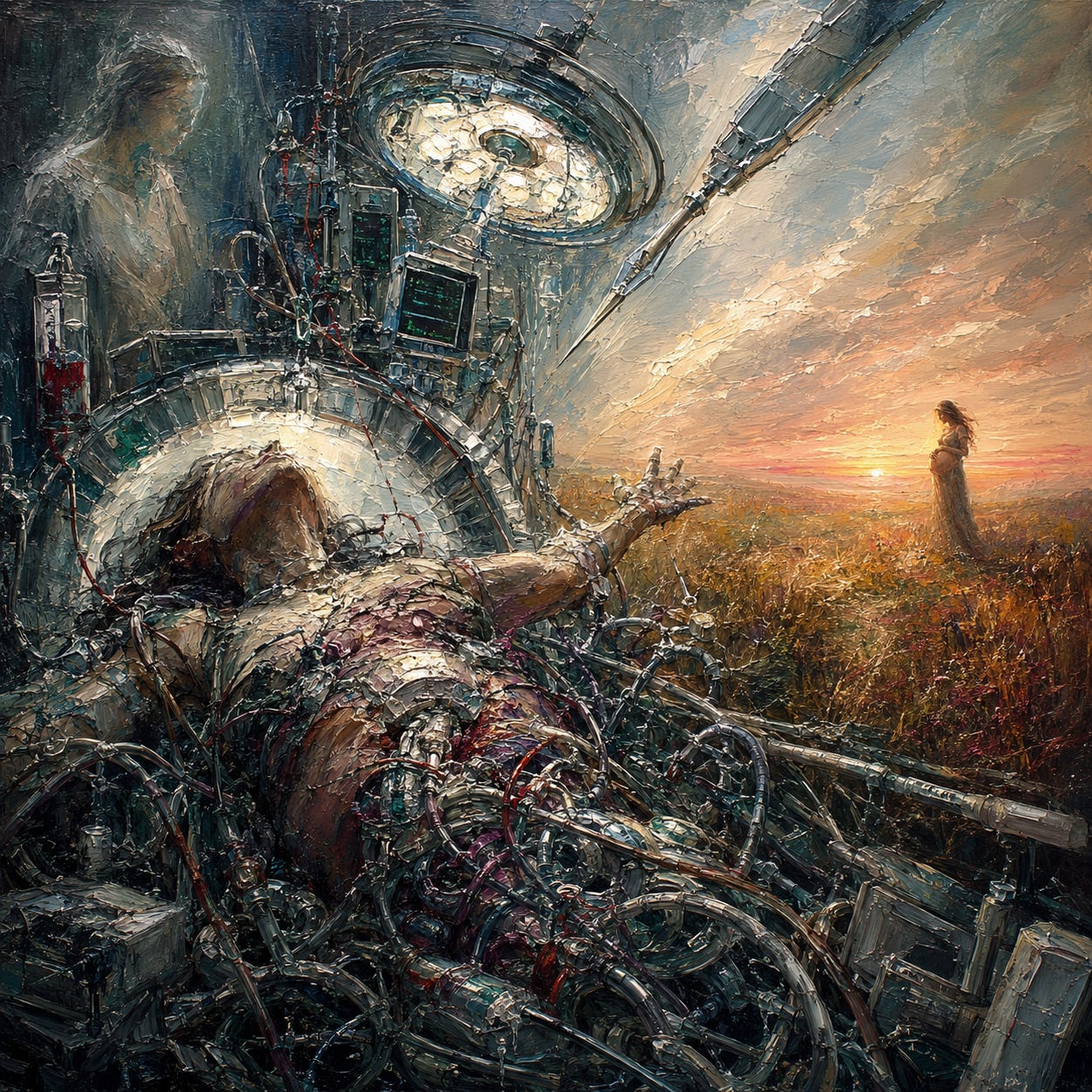
Nearly one in three American women now gives birth by major abdominal surgery. Well over half have labor started or sped up with synthetic oxytocin. The United States ranks 30th among industrialized countries for maternal mortality, and the rate is rising for the first time in decades. Black women die in childbirth at four times the rate of white women. Pushed: The Painful Truth about Childbirth and Modern Maternity Care, Jennifer Block’s 2007 investigation, documents how this happened — not as a story of medical progress meeting biological limits, but as a story of a profession that systematically eliminated, one category at a time, every clinical situation that required physicians to leave labor alone. Home birth, then vaginal breech, then VBAC, then vaginal twin delivery — each removed from practice not because the evidence demanded it but because malpractice insurers, hospital economics, and an obstetric leadership organized around surgical intervention found waiting unprofitable and risky to defend.
Block came to the subject as a journalist rather than a clinician. She had served as an editor at Ms. and on the revised Our Bodies, Ourselves, and entered her investigation without having given birth herself. This positioning matters. She spent years interviewing obstetricians, nurses, midwives, doulas, attorneys, and women who had been through American maternity wards. She read the medical literature, attended the 2006 NIH conference on “Cesarean Delivery on Maternal Request,” followed an underground midwife on her rounds for two weeks, and tracked the Cynthia Caillagh prosecution through court records. Robbie Davis-Floyd, the medical anthropologist who has written extensively on American birth practices, called the book “a well-researched, comprehensive, and in-depth critique.” Block’s later book Everything Below the Waist (summarized previously on this Substack) extended the same investigative method into hysterectomy, fertility treatment, pharmaceutical capture of women’s health advocacy, and the medicalization of menopause — the broader pattern of which Pushed documents one chapter.
The book appeared at a specific historical moment. The cesarean rate had doubled in a generation. ACOG had reversed its position on vaginal birth after cesarean in 1998, triggering bans at hundreds of hospitals. The Hannah Term Breech Trial, published in the Lancet in 2000, had eliminated vaginal breech birth across North America within months despite methodological flaws that would later be widely documented. In 2003 ACOG sanctioned “patient choice” cesareans, and in 2006 the NIH convened its conference to consider whether elective surgical birth might be equivalent to vaginal birth — a question made answerable only because the conference excluded the cumulative risks of repeat surgery, including placenta accreta, whose incidence had risen 30-fold since 1970. The 1985 WHO Fortaleza recommendation of a 15% cesarean ceiling had been politically dismissed. The 1989 Cochrane Collaboration’s Effective Care in Pregnancy and Childbirth — the first systematic evaluation of an entire medical specialty — had found that a third of obstetric practices were unlikely to benefit or likely to harm. None of this was secret. It was published, peer-reviewed, and ignored.
Pushed belongs alongside Suzanne Arms’s Immaculate Deception (1975), Marsden Wagner’s writings from his tenure at the World Health Organization, and Michel Odent’s work on primal health — the canon documenting what happens when an institutional system replaces a physiological process with a managed substitute and then treats the resulting damage as evidence the process itself was dangerous. The full summary unpacks the 2005 British Medical Journal study of 5,000 planned home births that established cesarean rates under 4% with infant mortality comparable to hospital births; the prosecution of Cynthia Caillagh, in which Virginia’s chief medical examiner appears to have omitted a hemoglobin reading from a final autopsy report that would have contradicted the state’s hemorrhage theory; the 2006 WHO study by José Villar that confirmed adverse outcomes rise when cesarean rates exceed 15%; and the legal architecture by which hospitals now compel surgery on women who refuse it. Joseph DeLee, the obstetrician who proposed in 1920 that childbirth be reclassified as “pathologic” and managed with forceps, ether, and episiotomy on every primipara, predicted the end point eighty years before it arrived: “Many women are ready to undergo the slightly increased risk of cesarean section in order to avoid the perils and pain of even ordinary labor. I am confident that if the women were given only a little encouragement in this direction, the demand for cesarean section would be overwhelming.”
The full summary continues below for paid subscribers
To finish reading this book, become a paid subscriber.
Your subscription unlocks the rest of this summary — the analogy, one-minute elevator explanation, 12-point summary, Q&As, and Golden Nugget — along with the premium content for every other book summary in the library. It also unlocks the full Deep Dive Audio Library of in-depth conversations and my growing library of original books. New content is added every month.
Paid subscribers also get the Questions for Your Doctor series, short printable guides built around the questions doctors are not trained to answer, one decision at a time. The companion Before You Consent series goes deeper, walking through a single diagnosis or prescription from the moment it lands to the days after, with every figure sourced. And the Package Insert series reads the labels the doctor never opens and the pharmacist never mentions, what the manufacturer admits, in their own words, about what they sell.
I do this work independently, outside the institutions these books so often describe. No foundation grants, no academic approval, no editorial gatekeepers deciding what’s acceptable to publish. Your subscription makes that independence possible.