

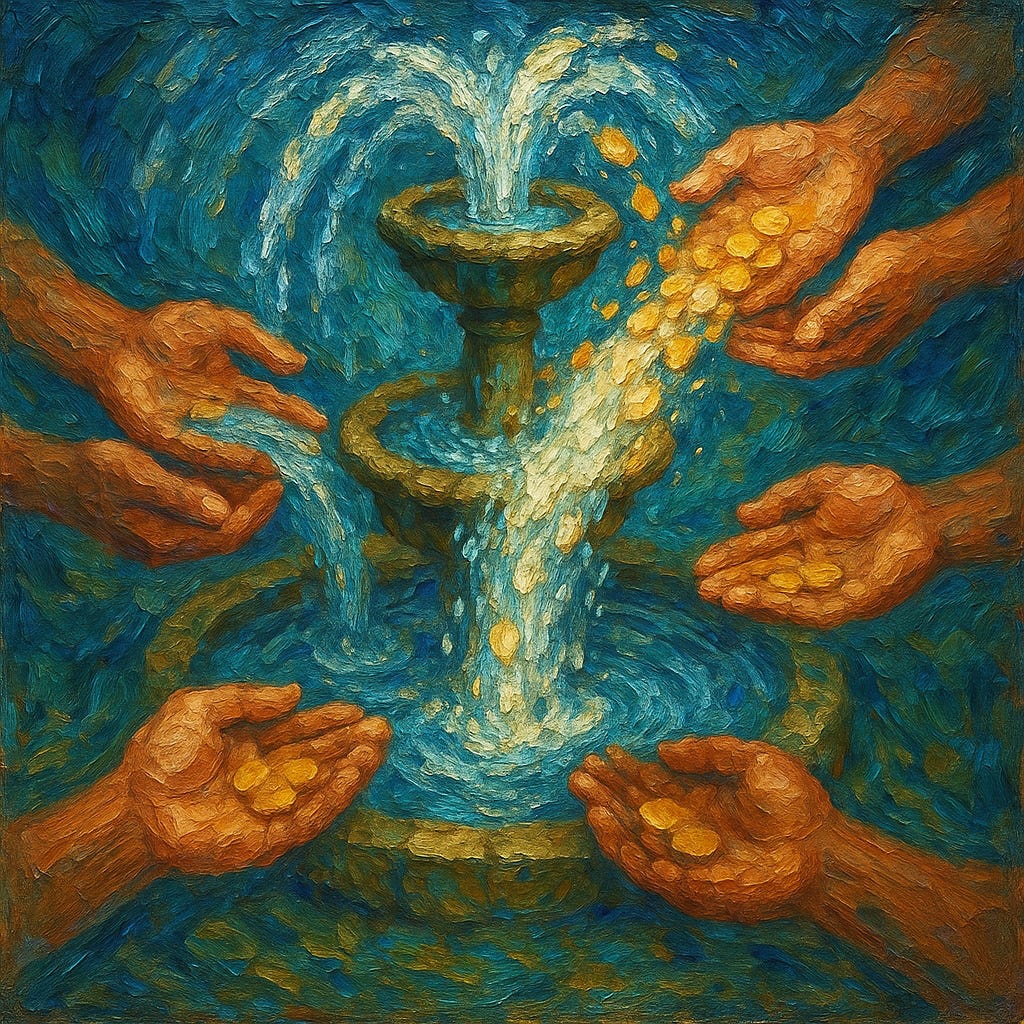
We live in a world of fundamental contradiction: the earth provides abundantly—the sun delivers thousands of times more energy than we need, soil naturally regenerates, human creativity is limitless—yet we experience pervasive scarcity, with most people anxious about money and struggling to meet basic needs. Charles Eisenstein’s “Sacred Economics” reveals that this scarcity is not natural but artificially created by our money system itself. Interest-bearing debt mathematically guarantees there’s never enough money for everyone to prosper, since debts grow exponentially while the money to pay them back is never fully created. Even if technology could provide everything freely—infinite energy, automated production, universal access to digital goods—our current monetary system would still generate poverty and force endless competition. The tragedy isn’t that we lack resources but that we’ve built a system whose mathematics require exponential growth forever, converting every gift of nature and community into property that must be bought and sold, creating scarcity where abundance naturally exists.
Eisenstein’s vision transcends the tired capitalism-versus-socialism debate by identifying a deeper problem both systems share: the structure of money itself and the story of separation it embodies. This isn’t a call for revolution or state control—he explicitly rejects both corporate capitalism and communism as two faces of the same extractive coin. Instead, he draws from diverse sources—Silvio Gesell’s free-money that helped Depression-era Austrian towns thrive, ancient gift economies that built community through reciprocity, Henry George’s insights about economic rent, and the emerging peer-to-peer networks that create value outside traditional markets. His solution preserves entrepreneurship and market exchange while transforming their foundation: negative-interest currency that circulates rather than concentrates, shortened patents that return innovation to the commons, land-value taxes that prevent profiting from mere ownership, and gift circles that meet needs through voluntary sharing rather than state redistribution.
The transition is already underway, not through political movements but through practical innovations arising spontaneously as the old system fails. Open-source software creates billions in value while charging nothing. Time banks and local currencies keep wealth circulating in communities rather than being extracted to distant financial centers. Gift economies flourish online where people share knowledge, creativity, and connection without monetary exchange. Benefit corporations and worker cooperatives demonstrate that business can serve broader purposes than maximizing shareholder returns. These aren’t idealistic experiments but rational responses to the irrationality of a system that creates homeless people amid empty houses, destroys food while people hunger, and forces us to work jobs that add nothing to human wellbeing just to “earn a living” in a world of natural abundance.
This isn’t another book about economic reform but about economic metamorphosis—transforming money from a force that creates artificial lack to one that enables natural plenty. Eisenstein shows that the choice isn’t between free markets and government control, growth and austerity, or prosperity and sustainability. These are false dichotomies created by a money system that makes us choose between bad alternatives. Sacred economics offers a different path entirely: an economy that honors both human creativity and natural abundance, where money serves gift-giving rather than hoarding, where wealth means having enough to share rather than having more than others. The question isn’t whether such an economy is realistic—the Wörgl experiment proved it works, modern gift circles demonstrate it daily, and technology makes it increasingly inevitable as artificial scarcity becomes harder to maintain. The question is whether we’ll embrace this transformation or cling to a dying system that turns abundance into scarcity and makes us poor in the midst of plenty.
With thanks to Charles Einstein.
Sacred Economics: Money, Gift & Society in the Age of Transition: Eisenstein, Charles
Support Independent Research
This work remains free because paid subscribers make it possible. If you find value here, consider joining them.
What paid subscribers get: Access to the Deep Dive Audio Library — 170+ in-depth discussions (30-50 min each) exploring the books behind these essays. New discussions added weekly. That’s 100+ hours of content for less than the price of a single audiobook.
[Upgrade to Paid – $5/month or $50/year]
Get in touch Essay ideas, stories, or expertise to share: unbekoming@outlook.com
Deep Dive Conversation Library (Bonus for Paid Subscribers Only)
This deep dive is based on the book:
Discussion No.128:
Insights and reflections from “Sacred Economics”
Thank you for your support.
Analogy
Imagine our economy as a vast garden that humanity tends together. Under the current system, we’ve built walls dividing the garden into private plots, where those with the biggest sections charge rent to those who need to grow food. We’ve created a peculiar form of water that multiplies in storage tanks while evaporating from the irrigation channels, so the water tends to accumulate with those who already have the most, leaving others parched despite abundant rain. We spray chemicals that make plants grow faster but poison the soil, achieving impressive harvests today while destroying fertility for tomorrow.
Sacred economics removes the walls, recognizing the garden as a commons we all inherit and must steward together. It introduces a new kind of water that naturally flows rather than stagnates—if you try to hoard it in tanks, it slowly evaporates, but when you share it through irrigation channels, it remains fresh and abundant. Instead of chemicals that force growth, we return to composting, where what dies enriches what lives, creating cycles of regeneration rather than depletion. In this garden, everyone has access to land, water flows to where it’s needed, and the soil grows richer each year. The gardeners work not from fear of starvation but from love of the garden and joy in sharing its abundance. The beauty of what grows reflects the care with which it’s tended, and the harvest, though perhaps smaller in quantity, is infinitely richer in nourishment and meaning.
The One-Minute Elevator Explanation
We’ve built an economic system based on the illusion that we’re separate from each other and from nature, which has created artificial scarcity through interest-bearing money that must grow forever on a finite planet. This system forces us to convert every aspect of life—nature, culture, relationships—into money just to survive, leaving us materially richer but socially and spiritually impoverished.
The solution isn’t revolution but evolution: shifting to money that decays like everything in nature, which encourages sharing over hoarding; reclaiming the commons from private property so everyone can access humanity’s collective inheritance; rebuilding gift economies where generosity creates community bonds; and recognizing that our wellbeing is inseparable from each other and the earth.
This isn’t idealistic fantasy—it’s already happening through local currencies, gift circles, open-source collaboration, and the sharing economy. As our current system’s crises intensify, these alternatives will become necessities. We’re transitioning from humanity’s adolescent phase of taking to our mature phase of giving, creating an economy where money serves life rather than life serving money.
[Elevator dings]
If you want to explore further, look into: the Wörgl experiment that proved negative-interest currency works, the growing gift economy movement in your local community, or how places like North Dakota use public banking to serve people rather than extract from them.
12-Point Summary
1. The Illusion of Separation Creates Scarcity Our economic system stems from a worldview that sees humans as separate individuals competing for survival in a hostile universe. This “Story of Separation” creates artificial scarcity even amid potential abundance. When we believe we’re alone and must fight for resources, we hoard wealth, convert nature into property, and monetize human relationships. But scarcity isn’t natural—it’s a product of our beliefs and the systems we’ve built from them. The sun provides thousands of times more energy than we use, the earth could feed everyone abundantly, and human creativity is limitless. We live in poverty amid plenty because our money system and property rights create scarcity where none need exist.
2. Money as the Corpse of the Commons Everything we buy with money was once freely available—land, water, stories, songs, even social functions like child care and entertainment. Through enclosure movements, intellectual property, and commodification, the commons has been privatized and monetized. Money represents the accumulated death of the living commons, transformed into abstract units that can be hoarded. This process continues today as genetic sequences, traditional knowledge, and even air (through carbon credits) become property. Each conversion makes us more dependent on money for survival while destroying the gift economies and natural abundance that once sustained us.
3. Interest Forces Eternal Growth Compound interest creates debts that grow exponentially, requiring economic growth to service them. If debt grows at 5% yearly, the economy must also grow 5% to avoid mass defaults. This mathematical imperative forces us to convert ever more nature and culture into money—forests become lumber, songs become intellectual property, friendships become social networking. We face an impossible choice between economic collapse (when growth stops) and ecological collapse (when growth continues). No amount of efficiency or innovation can solve this while interest-bearing money exists.
4. Negative-Interest Currency Reverses the Flow Money that decays over time (demurrage) would transform economic behavior completely. Instead of hoarding money to collect interest, people would lend it eagerly even at zero interest rather than watch it decay. This would ensure abundant credit for productive enterprises, end the artificial scarcity that causes recessions, and reverse wealth concentration. The Wörgl experiment proved this works—a small Austrian town thrived using stamp scrip during the Great Depression until central banks banned it. This isn’t a radical idea; even mainstream economists like Keynes praised it.
5. Gift Economy Creates Community Gifts create ongoing relationships through gratitude and reciprocity, weaving communities together through webs of mutual obligation. Market transactions create efficiency but isolation—once you pay, the relationship ends. Traditional societies understood that wealth circulated through giving, not accumulation. Today’s Gift Circles, time banks, and sharing economies are rebuilding these practices. When we share rides, tools, skills, and space, we meet needs without money while creating the community bonds that truly sustain us.
6. The Commons Must Be Reclaimed Economic rents—profits from merely owning land, resources, or money—concentrate wealth without creating value. These should return to the people through land-value taxes, public ownership of resources, and shortened patents. Alaska demonstrates this by distributing oil revenues to all citizens. When we treat the commons as our shared inheritance rather than private property, everyone benefits from nature’s and culture’s gifts. This isn’t socialism but recognition that what no one created belongs to everyone.
7. Work Should Express Our Gifts In sacred economics, work means expressing our unique talents in service to the community, not “making a living” through drudgery. The social dividend would free people from unnecessary jobs, allowing them to pursue callings that don’t generate monetary returns but create enormous social value—art, restoration, caregiving, community building. When basic needs are met, people naturally want to contribute their gifts. The question shifts from “How can I profit?” to “How can I serve?”
8. Degrowth Means Richness Economic shrinkage sounds frightening only because we equate GDP with wellbeing. But degrowth can mean working less, sharing more, and enjoying life rather than consuming products. Technology should create leisure, not more consumption. Local production, durable goods, and gift economies meet needs with far less money flow. We can be richer—in time, community, beauty, and meaning—while the money economy shrinks. This is already happening through open-source production and peer-to-peer networks that create abundance outside the money system.
9. Beauty and Function Unite Industrial economics separated beauty from function, creating ugly efficiency and useless decoration. Sacred economics reunites them, recognizing that truly functional objects are inherently beautiful and genuine beauty always embodies right relationship. When we value materials, connect makers with users, and prioritize durability over disposability, we create objects that are both practical and sacred. The world should be filled with things made so perfectly they seem divine—everyday objects that remind us matter and spirit are one.
10. Local Currencies Build Resilience Local currencies keep wealth circulating in communities rather than being extracted to distant financial centers. They’re most successful during crises when conventional money becomes scarce. Modern examples include time banks, LETS systems, and municipal currencies. Combined with local production and consumption, they create resilience against global economic disruption. The challenge is achieving critical mass—enough participation to make them useful. Success requires embedding them in broader relocalization movements.
11. The Transition Has Already Begun The sacred economy isn’t a utopian future but an emerging reality. Open-source software, Wikipedia, gift circles, community gardens, credit unions, benefit corporations, the sharing economy—all demonstrate alternatives to the dominant system. As financial and ecological crises intensify, these marginal experiments will become mainstream necessities. The transition happens through evolution, not revolution, as millions of people simultaneously change their economic behavior and consciousness.
12. A More Beautiful World Is Possible The convergence of crises is pushing humanity through an evolutionary transition from adolescence to maturity, from taking to giving, from separation to reunion. We’re remembering that individual wellbeing is inseparable from collective and ecological health. The new economy will feature regenerating ecosystems, vibrant communities, meaningful work, and lives rich in beauty and connection. This isn’t fantasy but the logical outcome of aligning economics with reality—that we are interdependent beings on a living planet capable of supporting all life abundantly.
The Golden Nugget
The most profound and least known idea in the book is that money itself creates scarcity through the mechanism of interest, regardless of actual material abundance. Even if technology could provide everything freely—infinite energy, automated production, digital abundance—our current money system would still create poverty because interest ensures there’s never enough money for everyone to repay their debts. The money to pay interest is never created when loans are made, only the principal, guaranteeing systemic scarcity that forces competition, concentration of wealth, and endless growth. This mathematical certainty means that no amount of productivity, innovation, or hard work can create abundance for all within our current system—someone must always lose for others to win. This isn’t a flaw in the system but its fundamental feature, which is why reforms that don’t address interest inevitably fail. The implication is revolutionary: true abundance requires not just resource availability but a transformation in money itself from something that grows through interest to something that flows through demurrage.
30 Questions & Answers
Question 1: What is the fundamental difference between the “separate self” and the “connected self,” and how does each relate to economic behavior?
Answer: The separate self views itself as a discrete individual in a hostile universe, fundamentally alone and in competition with others for scarce resources. This self sees relationships in terms of “more for me is less for you,” leading to hoarding, accumulation, and the drive to convert everything into property and money as protection against an uncertain future. The connected self recognizes that we are our relationships—that individual wellbeing is inseparable from the health of community and nature, understanding that “more for you is more for me.”
This shift profoundly changes economic behavior. The separate self generates our current system of compound interest, endless growth, and the conversion of commons into private property. It treats everything as a commodity to be owned and controlled. The connected self naturally shares abundance, knowing that gifts create bonds of gratitude and reciprocity that ensure future security better than any hoard. It recognizes that true wealth lies not in accumulation but in the richness of relationships and the flow of giving and receiving that sustains all life.
Question 2: How does negative-interest currency (demurrage) work, and what would be its effects on saving, lending, and investment?
Answer: Negative-interest currency loses value over time, typically through a system where stamps must be periodically affixed to maintain validity, or through electronic deduction of perhaps 5-8% annually from account balances. This reverses our current system where money grows through interest while real goods decay, rust, or become obsolete. Under demurrage, money becomes subject to the same laws of entropy as everything else in nature, eliminating the unfair advantage that money holders have over producers of real goods.
The effects would revolutionize economic behavior. People would eagerly lend money even at zero interest rather than watch it decay, ensuring abundant credit for productive enterprises. Investment would flow toward genuinely useful projects rather than speculation, since holding money becomes costly. The artificial scarcity of money that causes recessions—when there are willing workers and needed work but no money to connect them—would end. Wealth concentration would reverse, as the rich could no longer live off interest but would need to use their money productively or watch it disappear.
Question 3: What does Eisenstein mean by calling money “the corpse of the commons,” and how has this conversion happened historically?
Answer: Money represents the accumulated transformation of the commons—everything that was once free and shared—into private property that can be bought and sold. The commons originally included land, water, forests, culture, stories, and even social relationships. Through enclosure movements, intellectual property laws, and commodification, these shared inheritances have been privatized and monetized. Money is thus the “corpse” because it represents the death of the living commons, transformed into abstract, standardized units of exchange.
Historically, this began with the enclosure of common lands in Europe, forcing peasants who once had usage rights into wage labor. It expanded to include forests, rivers, and minerals through property laws. Today it encompasses genetic sequences, electromagnetic spectrum, and even social functions once performed freely in communities—childcare, entertainment, food preparation. Each conversion removes something from the gift economy and places it in the money economy, making us more dependent on money for survival while impoverishing the commons that once sustained us freely.
Question 4: How does the gift economy create community bonds differently than market transactions?
Answer: Gift transactions create ongoing relationships because they leave obligations open-ended. When someone gives you a gift, you feel gratitude and a desire to reciprocate, but the return gift isn’t specified in amount or timing. This creates a web of mutual obligation and gratitude that binds communities together. Market transactions, conversely, are closed loops—once you pay, the relationship ends. No future obligation remains, no gratitude lingers, and no community forms. You walk away from the cashier as strangers, the relationship complete.
Gifts also carry something of the giver—their story, effort, and care—creating personal connections between people. A tomato from your neighbor’s garden carries their labor and thoughtfulness, unlike a supermarket tomato that’s anonymous and interchangeable. Gift economies thus create rich webs of story and meaning, where each transaction strengthens social bonds. Market economies create efficiency but also isolation, as we become independent of anyone we know personally while dependent on anonymous strangers through money.
Question 5: Why does compound interest create a growth imperative, and what are its systemic consequences?
Answer: Compound interest means that debts grow exponentially over time, creating claims on future wealth that exceed what currently exists. If total debt grows at 5% annually through interest, then the economy must also grow at 5% just to service existing debts without default. This mathematical reality forces the conversion of ever more nature, culture, and human relationships into monetized commodities—forests become timber, songs become intellectual property, friendships become social networking—to generate the growth needed to pay interest.
The systemic consequences are catastrophic. We must choose between economic collapse (when growth fails) or ecological collapse (when growth continues). The system drives competition rather than cooperation, since interest ensures scarcity—there’s never enough money for everyone to repay their debts. It concentrates wealth inexorably, as those with money earn interest while those without pay it. Most perniciously, it forces us to discount the future, making a forest worth more as lumber today than as a living ecosystem forever, ensuring short-term thinking dominates all economic decisions.
Question 6: Who was Silvio Gesell, and what happened in the Wörgl experiment with free-money?
Answer: Silvio Gesell was a German-Argentine businessman and economic theorist who developed the concept of “free-money” (Freigeld) in his 1906 work “The Natural Economic Order.” He recognized that money’s ability to be hoarded without cost gave it an unfair advantage over real goods that decay or incur storage costs. His solution was stamped scrip—currency requiring periodic stamps to maintain validity, effectively creating negative interest that encouraged rapid circulation rather than hoarding.
The Austrian town of Wörgl implemented Gesell’s system in 1932 during the Great Depression. The mayor issued local currency requiring a 1% monthly stamp, creating 12% annual demurrage. The results were spectacular: unemployment plummeted, back taxes were paid, bridges and roads were built, and the economy thrived while surrounding communities remained depressed. The currency circulated 14 times faster than the national schilling. Over 200 other Austrian communities prepared similar systems before the central bank, threatened by this success, banned the currency. The town immediately returned to depression, demonstrating both the power and political vulnerability of monetary reform.
Question 7: What are economic rents, and how do they contribute to wealth concentration?
Answer: Economic rents are profits derived solely from owning something rather than producing anything—income from land ownership, resource extraction rights, intellectual property, or money itself through interest. These differ from legitimate profits earned through actual contribution of labor, creativity, or risk-taking. The classical economists like Adam Smith and David Ricardo recognized rents as parasitic extraction that adds no value while claiming the fruits of others’ productivity.
Rents inevitably concentrate wealth because they allow owners to claim increasing shares of economic output without contributing to it. A landowner in a growing city gets richer simply by owning land that appreciates through others’ efforts. Patent holders extract royalties from innovations built on previous discoveries. Money-lenders claim interest from productive enterprises they didn’t create. Since ownership concentrates (the rich buy more assets), rents flow increasingly to fewer hands. This parasitic extraction explains why wealth polarizes even in supposedly meritocratic market economies—those who own collect rents from those who work.
Question 8: How does the Story of Separation manifest in our economic system, and what would a Story of Reunion economy look like?
Answer: The Story of Separation sees humans as isolated individuals in a hostile universe, separate from nature and each other, destined to conquer and control the world for survival. This manifests economically as private property, competition, the conversion of nature into resources, and money that grows through interest while creating scarcity for others. It treats the world as a collection of objects to be exploited rather than relationships to be nurtured. Success means maximum accumulation by the separate self at others’ expense.
A Story of Reunion economy would recognize our fundamental interdependence—that individual wellbeing is inseparable from collective and ecological health. Money would decay like everything in nature, encouraging sharing over hoarding. The commons would be protected and expanded rather than privatized. Economic activity would aim to enhance rather than deplete natural and social capital. Gift transactions would complement market transactions, creating community bonds. Instead of growth at any cost, the economy would seek right relationship—enough for all within planetary boundaries. Work would express our gifts rather than merely “make a living.”
Question 9: What role does artificial scarcity play in maintaining the current monetary system?
Answer: Artificial scarcity is essential to maintaining profits and property values in a system capable of producing abundance. We create scarcity through intellectual property laws that restrict access to digital goods that could be freely copied, through planned obsolescence that ensures products break, through advertising that creates dissatisfaction with what we have, and through monetary policies that keep money scarce even when goods are plentiful. Without enforced scarcity, most modern profits would evaporate because true abundance makes things free or cheap.
The monetary system itself creates artificial scarcity through interest, which ensures there’s never enough money for everyone to pay their debts, forcing competition and preventing cooperation. Banks create money as debt but not the interest to pay it back, guaranteeing systemic scarcity. This scarcity mindset becomes self-reinforcing: because we experience scarcity, we hoard, creating more scarcity for others. The system makes abundance impossible even when technology and nature could easily provide enough for all, protecting the privileged position of owners and lenders.
Question 10: How would a social dividend or universal basic income function in a steady-state economy?
Answer: In a steady-state economy without growth, technological productivity increases would translate into less work rather than more production. A social dividend would distribute the wealth created by our collective inheritance—technology, culture, and natural resources—to everyone as a birthright rather than requiring “jobs” that may no longer serve genuine needs. Funded through taxes on economic rents, resource extraction, and financial transactions, or through demurrage on currency itself, it would provide basic security without means-testing or work requirements.
This would liberate human creativity for gift activities that don’t generate monetary returns but create enormous social value—art, open-source programming, community building, ecological restoration, elder and child care. Rather than creating dependency, it would enable people to refuse degrading work, forcing employers to make jobs meaningful and fairly compensated. Combined with the elimination of economic rents, it would allow the economy to shrink gracefully as we automate production and share more, ensuring prosperity without growth while freeing humans for the work of reunion and healing that our age demands.
Question 11: What is the paradox of leisure, and why hasn’t technological progress reduced our work hours?
Answer: The paradox is that despite technology multiplying productivity hundreds-fold since industrialization began, we work nearly as much as ever. A single farmer now produces what required dozens of workers, yet we haven’t gained leisure but instead consume far more. This happens because the money system demands growth to service compound interest. When technology increases productivity, we must either create new needs (through advertising and planned obsolescence) or face recession as employment falls. The system cannot tolerate the abundance that technology makes possible.
Additionally, the conversion of gift economy functions into paid services means we must earn money for things once freely shared in communities—childcare, entertainment, food preparation, even friendship through social media. Technology’s promise of leisure is also betrayed by artificial scarcity that keeps us competing for positional goods and by the anxiety of separation that drives us to accumulate rather than enjoy. Until we change the growth imperative built into interest-bearing money and restore gift economy relationships, technology will create more consumption rather than more leisure.
Question 12: How would internalizing environmental and social costs transform economic decision-making?
Answer: Currently, businesses profit by externalizing costs onto society and nature—pollution, resource depletion, worker health, community disruption. A factory that dumps waste in a river appears more “efficient” than one that cleans its effluent, though the real costs are simply shifted onto those downstream. Internalizing these costs through taxes, regulations, or liability would make destructive practices uneconomical. Suddenly, organic farming would be cheaper than chemical agriculture, renewable energy than fossil fuels, and durable goods than disposable ones.
This transformation would reverse most current economic incentives. Local production would become competitive when transportation’s true ecological costs are included. Labor-intensive practices would replace resource-intensive ones when natural capital is properly valued. Restoration and recycling would become profitable industries. The economy would shift from maximizing throughput to optimizing wellbeing with minimal material flow. Products would be designed for durability, repairability, and beauty rather than rapid replacement. Economic “efficiency” would align with ecological efficiency for the first time since industrialization began.
Question 13: What is the P2P (peer-to-peer) revolution, and how does it contribute to economic degrowth?
Answer: The peer-to-peer revolution replaces hierarchical, centralized production and distribution with horizontal networks where participants both produce and consume. Open-source software, Wikipedia, file-sharing, citizen journalism, peer lending, and collaborative consumption all bypass traditional intermediaries. People share knowledge, creativity, and resources directly, often without money changing hands. This gift economy operates on principles of voluntary contribution and free access, generating enormous value while shrinking GDP.
P2P contributes to degrowth by eliminating entire industries without reducing wellbeing. Craigslist destroyed billions in classified ad revenue while providing better service for free. Wikipedia eliminated encyclopedia sales while creating a far superior resource. File-sharing makes cultural goods universally accessible while devastating entertainment industry profits. This isn’t economic inefficiency but its opposite—meeting needs with radically less money and resource flow. As P2P principles spread to physical production through fab labs, tool libraries, and open-source design, ever more economic activity will shift from the money economy to the gift economy.
Question 14: What challenges do local currencies face, and how can they overcome the “catch-22” of acceptance?
Answer: Local currencies face a fundamental catch-22: businesses won’t accept them unless customers want to spend them, but customers won’t want them unless businesses accept them. Additional challenges include legal restrictions, the inconvenience of managing multiple currencies, and lack of confidence in their stability. Most local currencies remain marginal, used more for ideological statement than economic necessity, circulating mainly among already-committed supporters rather than transforming the broader economy.
Solutions include backing local currency with national currency initially, then gradually shifting to local goods and services as acceptance grows. Demurrage features encourage rapid circulation, making the currency more attractive to receive. Municipal governments can create demand by accepting local currency for taxes or paying employees partially in it. Economic crises make alternative currencies more attractive as conventional money becomes scarce. Modern electronic payment systems can reduce transaction costs. Most importantly, local currencies work best when embedded in broader movements toward relocalization, where communities consciously choose to support local production and exchange.
Question 15: What are “sacred professions,” and why should they operate outside normal market dynamics?
Answer: Sacred professions include artists, healers, teachers, counselors, and others whose gifts involve intimate human connection, creativity, or spiritual service. These vocations are “sacred” because their true value is unquantifiable—a song sung specifically to you, a teacher who sees your unique potential, a healer who addresses your whole being. When subjected to market dynamics, these professions become corrupted. Art becomes commercial entertainment, healing becomes symptom management, teaching becomes standardized information delivery. The sacred essence—the personal, unique, transformative quality—is lost.
These professions should operate primarily through gift exchange because their value cannot be captured in price. A true healer or teacher gives something priceless; any monetary exchange can only be a token of gratitude, not payment in the market sense. When practitioners must maximize income, they’re incentivized to create dependency rather than empowerment, to extend treatment rather than cure, to please rather than challenge. Operating in the gift allows sacred professionals to give what’s truly needed rather than what’s profitable, maintaining the integrity of their calling while trusting that gratitude will meet their needs.
Question 16: How has the monetization of social relationships “strip-mined” community?
Answer: Community once consisted of webs of mutual aid—neighbors helping with barn-raising, sharing childcare, preparing meals together, entertaining each other with stories and music. These gift exchanges created bonds of gratitude and reciprocity that defined belonging. Now we pay professionals for these services—contractors, daycare centers, restaurants, entertainment industries. Each monetization removes a thread from the community web, making us independent of neighbors but dependent on money. We don’t need each other anymore, only income to purchase services from strangers.
This “strip-mining” extracts social capital and converts it to financial capital, leaving communities barren. We’re materially wealthier but socially impoverished, lonely despite being surrounded by people. The very activities that once created community—helping, sharing, creating together—have become market transactions that leave no ongoing relationship. Children grow up in age-segregated institutions rather than mixed-age communities. Elderly people are warehoused rather than integrated. Entertainment is consumed privately rather than created collectively. The result is an epidemic of isolation, depression, and anxiety—the predictable result of converting social wealth into money.
Question 17: What is the historical relationship between property rights and the destruction of the commons?
Answer: Property rights emerged from the enclosure of commons—shared resources that communities managed collectively for millennia. European enclosure movements from the 15th century onward converted common lands into private property, forcing peasants who had ancient usage rights into wage labor. This process, often violent and always traumatic, destroyed sustainable management practices that had maintained the commons for generations. The same pattern repeated globally through colonialism, as indigenous peoples’ collective land management was replaced with private ownership.
The destruction continues today as every remaining commons is enclosed. Water rights are privatized, genes are patented, traditional knowledge becomes intellectual property, and even air becomes property through pollution credits. Each enclosure follows the same pattern: what was once freely available to all, managed through custom and reciprocity, becomes scarce and must be purchased. The process appears economically rational because property owners have incentives to maximize short-term extraction rather than long-term sustainability. Thus property rights, presented as protecting resources, actually accelerate their destruction by removing them from community management and placing them under the logic of profit maximization.
Question 18: How would resource-backed currencies differ from fiat money in protecting natural capital?
Answer: Resource-backed currencies would tie money creation to ecological limits rather than political decisions or banking profits. Instead of backing currency with gold, it would be backed by baskets of renewable resources—fishing rights, forest reserves, carbon sequestration capacity, aquifer withdrawal rights. Creating new money would require setting aside more natural capital in protected reserves. This directly links economic activity to ecological capacity, making it impossible to expand money supply beyond what nature can sustain.
Such currencies would automatically appreciate as resources become scarcer, creating powerful conservation incentives. Holding money would be equivalent to preserving nature rather than exploiting it. Unlike fiat money that can be created infinitely, fueling endless growth, resource-backed currency would enforce steady-state economics within planetary boundaries. It would also democratize wealth, as communities with healthy ecosystems would literally be able to create money by protecting them, reversing the current system where destroying nature creates money. The currency itself would become a commons held in trust for future generations.
Question 19: What role does gratitude play in gift economics versus obligation in market economics?
Answer: In gift economics, gratitude is the fundamental force that ensures reciprocity. When we receive a gift, we naturally feel grateful and desire to give in return—not as calculated repayment but as expression of appreciation and relationship. This gratitude is inexact and creative; the return gift might be completely different from what was received, given to someone else entirely, or offered much later when the opportunity arises. Gratitude creates warm, flexible bonds that adapt to changing needs and circumstances.
Market economics replaces gratitude with obligation—exact, calculated, and impersonal. When you buy something, you owe a specific amount immediately. Once paid, no relationship remains; indeed, continued gratitude would be inappropriate. Obligation is cold and precise, creating anxiety rather than warmth. It can be enforced through violence (debt collection, foreclosure) while gratitude cannot. The shift from gratitude to obligation parallels the shift from community to isolation, from abundance to scarcity, from trust to anxiety. Sacred economics seeks to restore gratitude as a fundamental economic force.
Question 20: How does technological disintermediation contribute to economic shrinkage rather than growth?
Answer: Disintermediation eliminates middlemen through technology, allowing direct peer-to-peer exchange. Craigslist destroyed billions in classified ad revenue, travel websites eliminated travel agents, blogs replaced journalists, file-sharing bypassed record labels. Each innovation provides better service at a fraction of the cost, shrinking GDP while improving lives. This challenges conventional economics that equates GDP growth with progress. We’re experiencing abundance—universal access to information, entertainment, communication—while the economy shrinks.
This process accelerates as technology enables gift economies that need no monetary exchange at all. Open-source software, Creative Commons content, Wikipedia, and social media create enormous value outside the money economy. People share rides, tools, skills, and space through digital platforms, meeting needs without purchasing products. 3D printing and fab labs will extend this to physical production. The result is economic degrowth that represents not poverty but abundance—meeting more needs with less money, liberating human creativity from the constraints of monetization.
Question 21: What’s the difference between “prosperity programming” and genuine abundance mentality?
Answer: Prosperity programming teaches that positive thinking and visualization will attract wealth, but it operates within scarcity consciousness—seeking to grab a bigger share of a limited pie. It says “I can be rich” but implicitly accepts that others must be poor. It focuses on individual accumulation rather than collective wellbeing, using spiritual language to pursue material goals that perpetuate separation. Under current money systems, this is actually true—interest ensures that one person’s wealth requires others’ poverty, making prosperity programming a form of magical thinking that ignores systemic reality.
Genuine abundance mentality recognizes that true wealth is relational, not accumulative. It understands that hoarding creates scarcity while sharing creates abundance, that isolation impoverishes while community enriches, that taking depletes while giving regenerates. It doesn’t seek to attract more money but to need less of it by rebuilding gift economies and commons. True abundance means everyone has enough, not that some have excess. It requires systemic change—negative interest, restored commons, gift culture—not just individual visualization. Genuine abundance trusts that giving creates flows of reciprocity more reliable than any hoard.
Question 22: How does Eisenstein envision the transition from our current system to a sacred economy occurring?
Answer: The transition will be evolutionary rather than revolutionary, driven by the convergence of multiple crises that make the current system untenable. Financial crises will intensify as debt exceeds the earth’s capacity to monetize remaining commons. Ecological crises will force internalization of environmental costs. Social crises of isolation and meaninglessness will drive people toward gift economies and community. These pressures will make reforms that seem impossible today become inevitable tomorrow. The transition has already begun with local currencies, gift circles, open-source production, and sharing economies emerging worldwide.
Policy changes will include implementing demurrage on currency, shifting taxation from income to resource use and land values, distributing social dividends from common wealth, shortening intellectual property terms, and creating public banks. But the deeper transition is consciousness—from separation to reunion, scarcity to abundance, accumulation to flow. This happens one person at a time as we experience the emptiness of consumer culture and discover the joy of giving. Each act of generosity, each choice of beauty over efficiency, each restoration of commons weakens the old system while strengthening the new.
Question 23: What is the relationship between beauty, function, and sacredness in material production?
Answer: In sacred economics, beauty and function are not separate qualities but expressions of the same underlying wholeness. A truly functional object—one that perfectly serves its purpose—is inherently beautiful, while genuine beauty always embodies rightness of relationship and purpose. This unity appears in nature, where the most efficient forms are also the most elegant, and in traditional crafts, where millennia of refinement produced objects that are simultaneously practical and sublime. Sacredness emerges when human creativity aligns with this natural unity, producing objects that seem both inevitable and miraculous.
Industrial production severed beauty from function by prioritizing efficiency and standardization. We produce ugly objects that technically “work” but deaden the soul, and decorative objects with no real purpose. Sacred production reunites them by infusing care, attention, and love into creating objects that serve genuine needs. When makers are connected to users, when materials are valued, when durability replaces disposability, beauty naturally emerges. The sacred economy would fill our lives with objects like the emperor’s teapot Eisenstein describes—things so perfectly made they seem to harbor divinity, reminding us that material and spiritual are one.
Question 24: How do Gift Circles work as a practical application of gift economy principles?
Answer: Gift Circles gather people regularly (weekly or monthly) to share needs and offerings without money exchange. Participants sit in a circle, each stating what they need and what they can give—skills, objects, time, connections. Others respond spontaneously, offering what they have. Someone needs a ladder, another offers one; someone offers piano lessons, another needs them. No tracking or accounting occurs; gifts flow freely based on genuine needs and authentic impulses to give. The circle witnesses these gifts, creating community acknowledgment that encourages continued generosity.
The practice rebuilds gift culture by making visible the abundance within any group while creating bonds of gratitude and interdependence. Unlike market transactions that end when payment is made, gifts create ongoing relationships and obligation to the community rather than individuals. Regular meetings maintain momentum and trust. As people experience their needs being met through generosity, scarcity mentality dissolves. Gift Circles can expand into networks, sharing resources across wider communities. They demonstrate that much of what we need is already available if we create structures for sharing rather than selling.
Question 25: What does “the more beautiful world our hearts tell us is possible” look like concretely?
Answer: This world features economies where work means expressing our gifts rather than “making a living.” Cities are filled with food forests and community gardens. Products are beautiful, durable, and repairable, made by people we know. Energy is abundant and clean. Prisons are obsolete because restorative justice heals rather than punishes. Education nurtures each child’s unique genius rather than standardizing them. Medicine addresses whole beings rather than managing symptoms. Politics operates through collective wisdom rather than concentrated power. Borders are places of welcome rather than exclusion.
The physical world is being restored—forests returning, soils rebuilding, oceans recovering. Technology serves beauty and connection rather than efficiency and control. People work fewer hours but accomplish more because they’re doing what they love. Entertainment is participatory and local rather than consumed passively. Elders are treasured for their wisdom, children for their wonder. Mental illness is rare because everyone belongs. The loudest sounds are birdsong and laughter. This isn’t fantasy but the logical result of aligning economics with ecological reality and human nature. Every reform Eisenstein proposes leads toward this world.
Question 26: How did the enclosure movement transform common resources into private property?
Answer: The enclosure movement, primarily in Britain from the 15th to 19th centuries, systematically converted common lands into private property through acts of Parliament. Previously, villagers had complex customary rights—to graze animals, gather wood, hunt game, and farm strips of land. These rights, evolved over millennia, created sustainable management systems where individual and collective interests aligned. Enclosure extinguished these rights, consolidating land under single owners who could exclude others. Justified as increasing agricultural efficiency, it actually served to create a landless proletariat forced to work for wages.
The human cost was devastating—displaced peasants faced starvation, criminalization as “vagrants,” or emigration. The Peasants’ War in Germany saw hundreds of thousands killed resisting enclosure. The pattern repeated globally through colonialism, as indigenous commons were privatized using the same justifications. Today’s enclosures are less visible but equally profound—patenting genes, privatizing water systems, copyrighting traditional knowledge. Each enclosure follows the same logic: common resources managed sustainably through custom become private property managed for profit, creating artificial scarcity where abundance once existed.
Question 27: What is the relationship between usury and the concentration of wealth over time?
Answer: Usury—lending money at interest—mathematically guarantees wealth concentration because money grows exponentially through compound interest while the real economy grows linearly at best. Those with surplus money collect interest from those who need it, creating a one-way flow from poor to rich. Since ancient times, this dynamic has been recognized—Aristotle called usury unnatural because money, being “barren,” shouldn’t reproduce. Every major religion originally prohibited usury because its consequences were so obviously destructive to community and justice.
The mathematics are inexorable: at 5% interest, wealth doubles every 14 years without any productive contribution from its owner. Meanwhile, entrepreneurs and workers who create actual value must surrender much of it to creditors. Over time, debt claims grow to exceed the entire productive capacity of society, leading to mass defaults, revolution, or jubilee. Modern economies obscure this through growth that temporarily outpaces interest, but as growth slows, the underlying dynamic reasserts itself. Today’s extreme inequality isn’t a market failure but the predictable result of interest-bearing money systems operating over time.
Question 28: What is the credit commons, and why is its reclamation important for economic democracy?
Answer: The credit commons refers to society’s collective capacity to create money through mutual agreement to honor it. Currently, private banks monopolize this capacity, creating money as interest-bearing debt when making loans, thereby extracting economic rents from society’s need for a medium of exchange. This privatization of the credit commons parallels historical enclosures of physical commons—what belongs to all of us has been seized by a few who profit from our need to use it.
Reclaiming the credit commons means restoring democratic control over money creation through public banks, local currencies, and mutual credit systems. Communities could create money for productive purposes without paying interest to private banks. Credit allocation would reflect social and ecological values rather than maximum bank profits. The trillions currently extracted through interest would remain in communities for schools, infrastructure, and restoration. Economic democracy is impossible without monetary democracy—as long as private banks control money creation, they effectively control society. Various models exist for reclamation: public banks like North Dakota’s, mutual credit systems like Switzerland’s WIR, or peer-to-peer lending networks.
Question 29: What role might free energy technologies play in creating an economy of abundance?
Answer: Free energy—whether from suppressed technologies or emerging innovations like fusion—would eliminate scarcity’s foundation, making impossible the control systems that depend on energy limitation. Energy scarcity justifies centralized control, resource wars, and economic inequality. Abundant energy would make possible massive ecological restoration, universal material prosperity, and the liberation of human creativity from survival concerns. It would render obsolete the entire fossil fuel infrastructure and its associated geopolitical power structures. This explains the fierce resistance to free energy research despite numerous claims of breakthrough discoveries.
However, Eisenstein suggests humanity isn’t ready for free energy until we’ve transitioned to gift consciousness. In scarcity mentality, unlimited energy would accelerate consumption and ecological destruction. We would mine the entire planet, build bigger weapons, and amplify existing inequalities. Free energy requires spiritual maturity—understanding that true abundance isn’t unlimited taking but balanced giving and receiving. When we’ve learned to live within limits by choice rather than compulsion, when gift culture has replaced accumulation culture, then free energy technologies might emerge naturally as reflection of consciousness that experiences the universe’s infinite generosity.
Question 30: How does sacred economics address both material and spiritual poverty simultaneously?
Answer: Sacred economics recognizes that material and spiritual poverty share the same root: the ideology of separation that disconnects us from community, nature, and our true selves. Material poverty arises from the privatization of commons and concentration of wealth through interest. Spiritual poverty arises from monetizing relationships and converting unique, ensouled creation into standardized commodities. Both forms of poverty serve the money system—material poverty forces participation in wage labor, while spiritual poverty drives consumption to fill the void where community and purpose once resided.
The solutions address both simultaneously. Negative interest and restored commons eliminate material scarcity by ensuring money circulates to those who need it. Gift culture and relocalization rebuild the community bonds that provide spiritual wealth—belonging, purpose, recognition. When work expresses our gifts rather than merely earning survival, it becomes spiritually fulfilling. When products are made with care by people we know, material life becomes sacred. When everyone has enough, the anxiety of scarcity that impoverishes spirit dissolves. Sacred economics creates a world rich in both ways—materially secure and spiritually connected, abundant in things that matter and freed from things that don’t.
Support Independent Research
This work remains free because paid subscribers make it possible. If you find value here, consider joining them.
What paid subscribers get: Access to the Deep Dive Audio Library — 170+ in-depth discussions (30-50 min each) exploring the books behind these essays. New discussions added weekly. That’s 100+ hours of content for less than the price of a single audiobook.
[Upgrade to Paid – $5/month or $50/year]
Get in touch Essay ideas, stories, or expertise to share: unbekoming@outlook.com
New Biology Clinic
For those of you looking for practitioners who actually understand terrain medicine and the principles we explore here, I want to share something valuable. Dr. Tom Cowan—whose books and podcasts have shaped much of my own thinking about health—has created the New Biology Clinic, a virtual practice staffed by wellness specialists who operate from the same foundational understanding. This isn’t about symptom suppression or the conventional model. It’s about personalized guidance rooted in how living systems actually work. The clinic offers individual and family memberships that include not just private consults, but group sessions covering movement, nutrition, breathwork, biofield tuning, and more. Everything is virtual, making it accessible wherever you are. If you’ve been searching for practitioners who won’t look at you blankly when you mention structured water or the importance of the extracellular matrix, this is worth exploring. Use discount code “Unbekoming” to get $100 off the member activation fee. You can learn more and sign up at newbiologyclinic.com.