

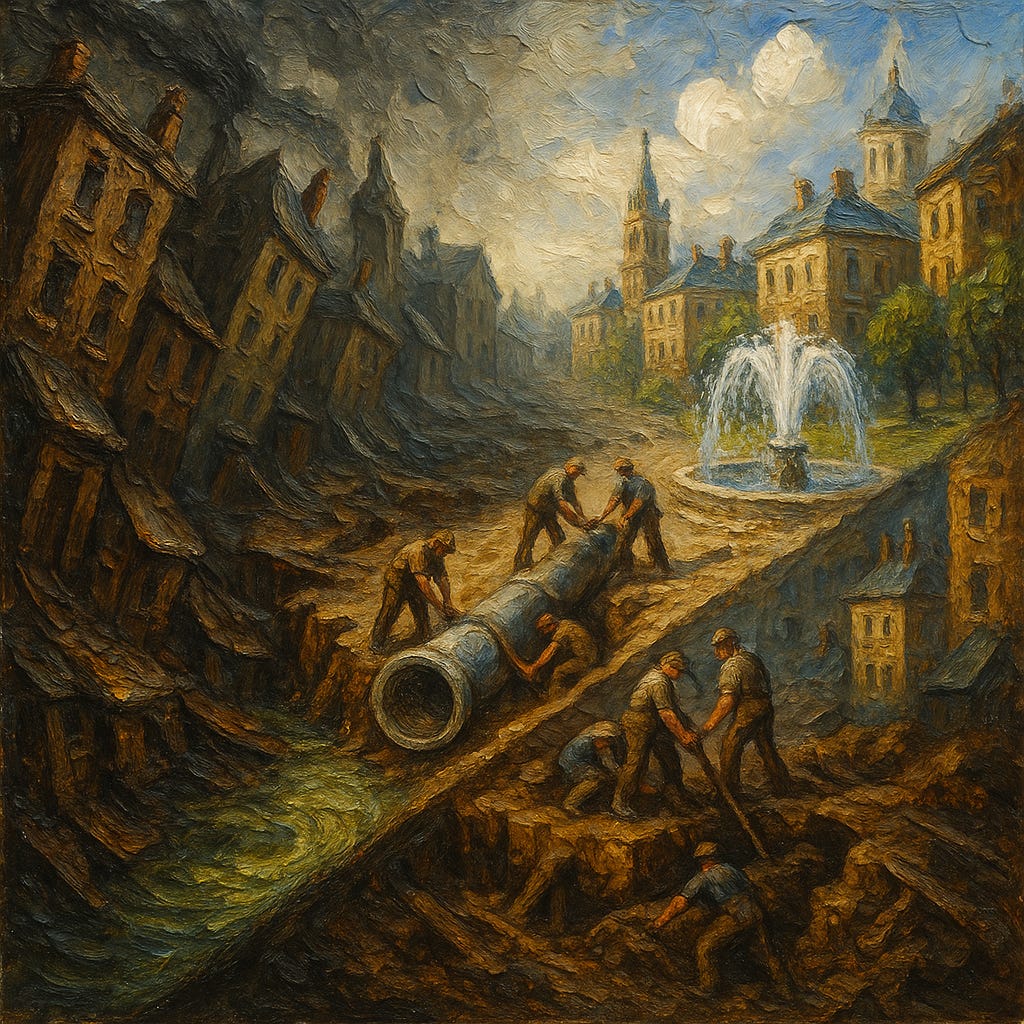
In October 1881, as delegates from across Europe and America gathered in Cologne for the Second International Anti-Vaccination Congress, William Tebb stood before them with a paper that would crystallize decades of observation into a single, devastating argument. “Sanitation, Not Vaccination, The True Protection Against Small-Pox” challenged not merely the efficacy of vaccination but the entire edifice upon which compulsory medical intervention had been built. Tebb, serving as Honorary Secretary for the London Society for the Abolition of Compulsory Vaccination, brought to this international gathering evidence that would resonate far beyond the conference halls—evidence that the decline of smallpox owed less to Jenner’s celebrated discovery than to the unglamorous work of improving sewers, water supplies, and living conditions. The Congress itself, which had grown from eighteen delegates in Paris the previous year to forty in Cologne, represented a remarkable coalescence of medical dissent, bringing together physicians, statisticians, and reformers who saw in vaccination not humanity’s salvation but its systematic poisoning.
At the heart of Tebb’s argument lay a simple yet profound observation: wherever sanitation improved, disease retreated, regardless of vaccination rates. He presented data from Leicester, where smallpox had become “about the least dangerous of all diseases” through isolation and hygiene despite having thousands of unvaccinated children. He detailed the Prussian experience, where 124,978 vaccinated citizens died of smallpox in 1871-72 after thirty-five years of the most stringent compulsory vaccination in Europe, only to see the disease virtually disappear following comprehensive sanitary reforms—better water, proper drainage, improved barracks. The contrast was stark: while vaccination had been enforced with increasing severity since 1853 in England, culminating in fines, seizure of goods, and imprisonment for non-compliant parents, smallpox mortality in London had actually increased 80 percent in the decade ending 1880. Meanwhile, typhus and other zymotic diseases, which received no special prophylactic attention beyond general sanitation, showed dramatic declines.
The Congress revealed vaccination’s failures to be neither isolated nor accidental but systematic across nations. Delegates presented maps and statistical tables from Sweden showing smallpox epidemics arriving and departing wholly irrespective of vaccination rates, with the heaviest epidemics sometimes following the most thorough vaccination campaigns. Dr. Oidtmann’s testimony from the Franco-Prussian War proved particularly damning: German forces, who maintained superior hygiene and sanitation, suffered far less from smallpox than French forces, despite both armies being equally vaccinated. The improved dwellings associations in London provided perhaps the most compelling evidence—model housing developments with proper sanitation reported virtually no smallpox deaths over decades, while surrounding slums with similar vaccination rates but poor sanitation remained hotbeds of disease. These were not theories but documented observations that vaccination advocates struggled to explain away.
Tebb’s presentation joined a growing chorus of scientific dissent that included some of the era’s most rigorous minds. Alfred Russell Wallace, co-discoverer of natural selection, was already preparing his devastating statistical analysis that would prove vaccination “both useless and dangerous” using forty-five years of registration data. Dr. Walter Hadwen would soon deliver lectures exposing how Jenner—who never passed a medical examination in his life and obtained his degree through what his own biographer called “little less than fraud”—had built his entire theory on essentially one experiment with James Phipps. These Victorian critics laid the foundation for what would become, over a century later, comprehensive works like “Dissolving Illusions” by Suzanne Humphries and Roman Bystrianyk, which would use the same historical evidence Tebb and his contemporaries gathered to demonstrate that vaccination had simply “waltzed in” after sanitation had done the real work of disease reduction, claiming credit for improvements it had not created. Even respected medical authorities of Tebb’s time were fracturing; Dr. Creighton and Dr. Crookshank, who began as conventional practitioners, became vocal critics after investigating vaccination’s actual evidence base. These were not cranks or conspiracy theorists but serious scientists applying the era’s emerging statistical methods to claims that had previously escaped scrutiny.


What makes Tebb’s 1881 address remarkable is not merely its prescience—though history would vindicate his emphasis on sanitation over vaccination—but its exposure of patterns that would repeat with uncanny precision 140 years later. The manipulation of statistics, the classification of cases to support predetermined conclusions, the punishment of dissent, the elevation of medical dogma over empirical observation, the sacrifice of individual liberty to claimed collective benefit—all these elements that Tebb documented would resurface virtually unchanged during recent events. His closing words ring with particular poignancy: that vaccination represented “a gross infraction of the liberty of the citizen and of parental rights,” enforced through “a cruel and criminal despotism” that ignored mounting evidence of harm while enriching those who administered it. The delegates who applauded his presentation could hardly have imagined that their struggle against what they called medical tyranny would need to be fought again by their descendants, using remarkably similar arguments against remarkably similar opponents, in an age that had promised to be more enlightened but proved merely to be more technologically sophisticated in its methods of coercion.
With thanks to William Tebb.
The rest of this summary — the analogy, one-minute elevator explanation, 12-point summary, Q&As, and Golden Nugget — is for paid subscribers.
Your subscription also unlocks every other book summary in the library, the Deep Dive Audio Library, my original books (new ones added monthly), and three series for the moments when a real decision is in front of you: Questions for Your Doctor, Before You Consent, and Package Inserts.