

Author’s Note
This essay belongs to a series on the plain remedies of the kitchen apothecary, of which Fire Cider, bone broth, poultices, and the lemon-honey-thyme cough syrup have been earlier subjects. Sauerkraut is a different substance. The architecture is the same: a whole food, a simple method, an outcome the pharmaceutical industry cannot replicate and does not want you to remember.
The recipe is at the end.
Sixty barrels of sauerkraut went aboard the Resolution in July 1772. Cook was setting out on his second circumnavigation, three years at sea through southern latitudes with no fixed route home. Twenty-seven months later, fifteen days short of England, he opened the last of the sixty barrels. He shared it with a party of Portuguese noblemen who had come aboard. They took the rest away with them to share with friends. The cabbage was still good.
Not one man in his crew had died of scurvy on the voyage. In an age when the disease routinely killed a third of a long-voyage crew, that outcome was not a small result. Cook wrote it up. His paper, “The Method Taken for Preserving the Health of the Crew of His Majesty’s Ship the Resolution,” was read to the Royal Society on 7 March 1776. Later that year, on 30 November, the Society awarded him its Copley Medal for the work. Sauerkraut was named specifically among the measures he described.¹
The standard modern explanation credits ascorbic acid: the vitamin in cabbage, preserved through fermentation, kept the crew from scurvy. That explanation was retrofitted onto the phenomenon a century and a half after the fact. Ascorbic acid was not identified as vitamin C until 1932. Cook died in Hawaii in 1779. Neither he nor the women who packed his barrels had heard of a vitamin. What they had was a preparation, and generations of testimony that the preparation kept people well.
That distinction, between the preparation and the isolated compound, is what this essay is about.
This work stays free because paid subscribers make it possible. They get the full book library, the Deep Dive Audio Library, and the Questions for Your Doctor, Before You Consent, and Package Insert series. No grants, no gatekeepers — your subscription is what keeps it that way.
Audio Deep Dive (for Paid Subscribers)
Before “Vitamin C”
Sauerkraut is old. Pliny the Elder described two methods for making it in the first century AD, one using earthenware jars, the other salt water and mixed herbs.² Roman authors regarded fermented cabbage as easy on the stomach and protective against what they called intestinal illness. Before Rome, before Athens, the Chinese were fermenting cabbage. In villages where nobody had a laboratory, people had already discovered that if you shred a plant, salt it, press it into a vessel, and leave it alone, something happens.³
Nobody knew the biochemistry. Everybody knew the result. Children who ate what fermented in the wide-mouthed ceramic crock in the family cellar got sick less often. Peasant families made it through winters that killed their neighbors’ unfermented children. That kind of observation, sustained across thousands of years, produces a data set. Modern nutrition science is barely a century old and has never accumulated anything close to that much observed outcome.
The vitamin C reduction arrived in the twentieth century. The ascorbic acid in cabbage, preserved through fermentation, was said to be doing the work. The explanation was elegant. It was also unable to survive its own timeline.
Lind’s Failed Concentrate
James Lind ran the first controlled trial for scurvy aboard HMS Salisbury on 20 May 1747. He took twelve sailors with the disease, divided them into six pairs, and gave each pair a different treatment. The two men given oranges and lemons recovered so rapidly that one was fit for duty within six days. Lind published his Treatise of the Scurvy in 1753. The result was clear.
The Royal Navy took another forty-eight years to make citrus a standard part of provisioning.⁴
Some of the delay was institutional resistance. More of it was revealing. Lind’s own preservation solution, a boiled-down concentrate he called the “rob,” proved less reliable than fresh fruit. Ships carrying rob still lost men to scurvy. The standard modern explanation is that heating the juice destroyed the ascorbic acid.
That explanation concedes the point that matters. If the compound is the active agent, extracting it from its living matrix should not have destroyed its function. If boiling and bottling reliably degraded its capacity to prevent scurvy, then the compound in isolation was never doing all the work. Something about the intact fruit was necessary. The whole matrix, everything surrounding the isolated molecule, was participating in what the isolated molecule could not accomplish alone. The reduction to ascorbic acid was incomplete from the start.
Cook’s sauerkraut is the same case in a different substrate. After twenty-seven months at sea through equatorial heat and tropical storms, how much of the original ascorbic acid remained in the barrel? The molecule degrades under prolonged exposure to heat and oxygen. Two years and three months of storage in barrels below deck should have destroyed most of it. Yet the barrel worked.
Something else was in the barrel. Something else was in the fresh citrus. Whatever it was, molecular chemistry in 1932 could not describe it. It was not a molecule. It was a matrix.
Fourteen Cultures, One Design
A Korean household a hundred years ago put its kimchi into onggi jars and buried the jars in the ground below the frost line. The cold held the fermentation to a crawl, and the buried jars kept a family in fermented cabbage from October through April. In Bavaria and Alsace, the same function was served by wooden crocks in stone cellars. In Ethiopia, injera starter was passed down through generations of a single family, kept alive by daily feeding. On Vanuatu, breadfruit and taro went into leaf-lined pits and fermented for months.
Every settled continent found its way to the same architecture. Sauerkraut across the Germanic and Baltic lands. Kimchi in Korea, present at every meal. Tsukemono in Japan, made from cabbage, turnip, eggplant, cucumber, and pickled plum. In Russia, kvass and pickled beets. In Latin America, cortido, with cabbage, carrots, onions, oregano, and chile. In Georgia, pickled tarragon and cabbage. Across India, spiced fermented chutneys. Across the Levant, torshi. Through West Africa, fermented cassava, millet, and sorghum porridges. In the American colonies before industrial pickling arrived, corn relish and cucumber relish and watermelon rind, all originally lacto-fermented before the shelf-stable jar replaced them.⁵
None of these peoples was in communication with the others when they arrived at the practice. There was no committee, no textbook, no professor of fermentation, no patent office. Fourteen unrelated cultures, working entirely independently across thousands of years, found their way to the same technique: shred the vegetable, salt it, press it under its own liquid, leave the ambient bacteria to do the work. This is what convergent evidence looks like at civilizational scale. When peoples separated by oceans and languages all arrive at the same conclusion through independent trial and error, over enough generations, the conclusion is worth taking seriously.
Weston Price spent the 1930s traveling to isolated traditional peoples across five continents. He documented lacto-fermented foods in every traditional diet he studied. His photographs show broad dental arches, absence of chronic disease, and vigorous physical development in populations whose diets included fermented milk in the Swiss Alps, fermented fish among the Arctic coastal peoples, fermented root vegetables in Melanesia, and fermented grain porridges across Africa.⁶ What these peoples shared was not any particular food. They ate wildly different foods. What they shared was that a portion of what they ate was always fermented.
The Greeks called what happened in the crock alchemy.⁷ They meant it. They were watching one substance become another under conditions they controlled without fully understanding. They knew the result served them. They did not need molecular chemistry to trust the process, and their trust was not misplaced.
What Happens in the Jar
Lactobacilli are already on the cabbage. They live on plants that grow near the ground, on soil that has not been chemically sterilized, on the skin of every living human, and inside every healthy human digestive tract. Annelies Schoneck, the French fermentation researcher whose work Fallon draws on extensively, calls what these bacteria form around every higher organism an “acid sheath.” Wherever the body meets the outside world, this protective coat of lactic-acid-producing organisms maintains the terrain.⁸
Shred a cabbage. Pound it briefly to release the juices. Salt it. Press it into a jar under its own liquid so no air can reach it. The salt holds back the putrefying organisms for a few days. The lactobacilli, unbothered by the salt, feed on the sugars in the cabbage and multiply. Their metabolic byproducts accumulate. Lactic acid dominates, along with hydrogen peroxide, small amounts of benzoic acid, choline, acetylcholine, and various enzymes.⁹ The pH drops. Below a certain acidity, no putrefying organism can survive. The vegetable is preserved. That is the surface story.
The deeper story is that the cabbage that goes in the jar is not the cabbage that comes out. What comes out is a living inoculant, dense in the metabolic products of a completed fermentation and dense in the organisms themselves.
When eaten, the lactobacilli survive transit through the stomach and arrive alive in the small intestine. They colonize. They continue the work they began in the jar. Their acid displaces putrefying organisms. Their byproducts support the pancreas, normalize stomach acidity (lifting it when too low, dampening it when too high), aid iron absorption, and help the liver process fats.¹⁰ Choline in fermented cabbage helps regulate blood pressure. Acetylcholine engages the parasympathetic nervous system, slowing the pulse and promoting sleep.¹¹ None of this is pharmaceutical. This is what digestion looks like when the gut receives its historical companion food.
Béchamp described the terrain in the nineteenth century as the internal environment of the body that determines whether microorganisms behave as caretakers of tissue or as fermenters of decay. When the terrain is intact, the organisms maintain it. When it breaks down, the same organisms become the agents of putrefaction. Every fermenting grandmother in Europe, Asia, Africa, and Latin America had the practice in her cellar for thousands of years before Béchamp arrived at the vocabulary.
The modern microbiome literature has now come at the same phenomenon from another direction and described it in institutional language. When lactobacilli colonize the gut, the ecology shifts. Absorption improves. What the establishment calls “immune function,” meaning the body’s cleansing and repair capacity, measurably strengthens. Conditions the establishment classifies as inflammatory bowel disorders shift with the state of the microbial community, as do the disorders it labels autoimmune and allergic. All track the terrain, not any invading agent. The rediscovery comes without any acknowledgment that the knowledge was never lost among the people who kept the practice, or that the practice was systematically undone by the industry the same institutions have spent their careers defending.
One Objection
Most modern people who eat no fermented food appear healthy. If the practice mattered, the argument goes, they would be sick.
The population that eats no fermented food is the same population that reports historically unprecedented rates of what the establishment labels autoimmune conditions, inflammatory bowel disorders, allergic sensitivities, chronic fatigue, and mood disorders.¹² The average American adult now takes four prescription medications. Roughly one in three children is on a chronic prescription of some kind. What passes for healthy in this population is a baseline that would have looked like sub-clinical illness to any of the peoples Weston Price examined. Price’s photographs of unmedicated traditional populations, taken before the industrial food system reached them, show something modern observers rarely see: complete dental arches, straight teeth without orthodontic intervention, absence of the chronic conditions that define the modern chart.
The observed absence of the food does not establish the food’s dispensability. It establishes a different baseline against which the food’s contribution is now hard to see.
The Substitution
Fallon states the mechanism of the substitution plainly:
Lacto-fermentation is an artisanal craft that does not lend itself to industrialization. Results are not always predictable. For this reason, when the pickling process became industrialized, many changes were made that rendered the final product more uniform and more saleable but not necessarily more nutritious. Chief among these was the use of vinegar for the brine, resulting in a product that is more acidic and not necessarily beneficial when eaten in large quantities; and of subjecting the final product to pasteurization, thereby effectively killing all the lactic-acid-producing bacteria and robbing consumers of their beneficial effect on the digestion.¹³
Two operations, both required by industrial logistics, both fatal to the active preparation.
Vinegar-brining skips the fermentation entirely. The result looks and tastes acid, but nothing has been transformed. It is a raw cabbage soaked in dilute acetic acid, uniform enough to ship the day it was made. Pasteurization then sterilizes the finished product so it can sit on a warehouse shelf for two years without changing. What remains looks and tastes something like sauerkraut. It contains no living organisms and none of the metabolic products of a completed fermentation. The active preparation has been removed. What is sold as sauerkraut is now packaging.
An institutional counterargument has emerged over the last decade. Postbiotics research shows that the metabolic products of a completed fermentation can retain some benefit even after the live bacteria are killed by heat. If this is true, then a pasteurized live-fermented product still delivers something. The counterargument does not describe the industrial pickle. Vinegar-brining skips the fermentation entirely, so nothing was created that pasteurization could preserve. What sits on the supermarket shelf is a raw cabbage soaked in dilute acetic acid and then sterilized. The postbiotic argument, whatever its merit for genuine pasteurized ferments, has no bearing on the shelf-stable jar labeled “sauerkraut,” because the shelf-stable jar was never fermented.
Walk down the pickle aisle of any American supermarket and read the labels. The shelf-stable jars are all vinegar-brined and all pasteurized, with shelf lives measured in years. This is what the word “pickle” now signifies for the American consumer who has never spoken with a grandmother who kept a crock. The refrigerated section carries a small number of small-producer alternatives (Bubbies, Farmhouse Culture, Wildbrine, occasionally a local kimchi) that are genuinely lacto-fermented. They cost several times what the shelf-stable jar costs. They exist because a consumer segment has learned to ask for what everyone’s great-grandmother ate.
For most people, the substitution is complete. Two generations ago, in millions of American households, the crock in the cellar was normal. Not now.
What Nobody Could Patent
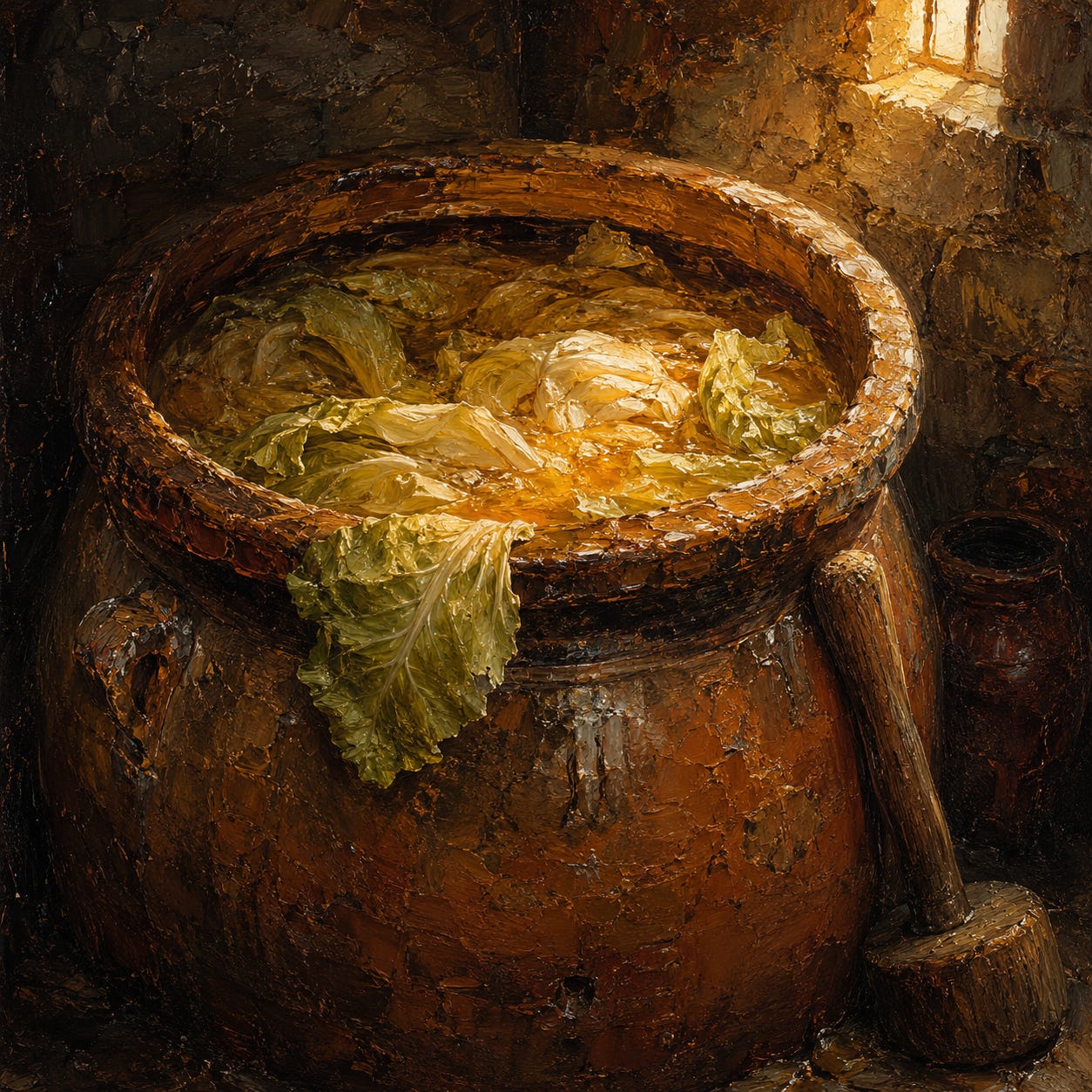
Sauerkraut cannot be patented. The organisms responsible for the transformation are already on the cabbage before you touch it. Nobody owns the process. Salt, cabbage, a jar, a wooden pounder. What would you patent, the pressing motion?
This is the practical shape of the erasure. Products of nature are not patentable. The principle has held in American patent law since the nineteenth century and was reaffirmed by the Supreme Court in 2013.¹⁴ The result is structural. A pivotal clinical trial of the kind that qualifies a treatment as “evidence-based” costs between twenty million dollars for a modest indication and several hundred million for cardiovascular or oncology endpoints. Bringing a compound from discovery to approved drug now averages roughly two and a half billion dollars in capitalized cost.¹⁵
No rational actor will spend that capital on a preparation any Polish grandmother can sell for three dollars a quart. The trials that would put lacto-fermented vegetables into standard clinical practice will not be funded. The absence of trials will then be used to justify their absence from standard clinical practice. The circle is complete, and it was built to close.
When a nutrition textbook or a gastroenterology journal omits lacto-fermented vegetables from its list of first-line interventions for gut disorders, this is not evidence that they do not work. It is evidence that no one who could fund the trials had a reason to. Economic structure is doing the selection. The selection is then presented as science.
What Remains
The crock does not require permission. A cabbage costs three dollars. Sea salt lasts a year. A wide-mouth jar and a wooden pounder, both stocked at any hardware store, complete the equipment. Three days on a kitchen counter and the transformation is under way. Three months in a root cellar or on the top shelf of a refrigerator and the preparation is ready. The bacteria are already on the vegetable. The transformation is latent in the substrate, waiting for conditions to release it. Nothing about the practice requires regulatory permission or a proprietary molecule. It is peasant technology, and peasant technology is the only kind that outlasts institutional collapse without a supply chain.
What was lost when the American cellar emptied and the crock disappeared was not the recipe. Recipes are trivially recoverable, and Fallon prints hers in one paragraph. What was lost was the recognition that the preparation is the point. The matrix is a living thing that must be tended, not manufactured. Vinegar and pasteurization is not an equivalent replacement but a different food entirely. Thousands of years of accumulated observation across every settled culture on earth were pointing at something real. That nobody could patent it was never a reason to conclude it did not matter.
Cook opened the last barrel fifteen days from England and shared it with strangers who came aboard. The men who ate from it went home. Six thousand years of cellar barrels and clay jars had made this particular voyage possible.
The crock survived every empire that rose and fell before the industrial one arrived. The industrial supply chain, when it arrived, could not compete with a food anyone with a cabbage and a jar could make. It replaced the crock rather than competing with it. The replacement sits on the supermarket shelf. The original sat in your great-grandmother’s cellar.
Both are called pickle. Only one of them is the food.
The Method
Sally Fallon’s basic sauerkraut recipe, from Nourishing Traditions:¹⁶
1 medium cabbage, cored and shredded
1 tablespoon caraway seeds
1 tablespoon fine sea salt
4 tablespoons whey (if unavailable, add an additional tablespoon of salt)
Combine the shredded cabbage with the salt, caraway, and whey in a large bowl. Pound with a wooden mallet, or with the base of a heavy jar, for about ten minutes. The cabbage will release its juice as you pound. Continue until there is enough liquid to submerge the vegetable when pressed.
Pack the mixture into a wide-mouth quart mason jar, pressing down firmly with each addition. When packed, the juice should cover the vegetable completely. Leave at least an inch of space between the surface of the vegetable and the top of the jar. Seal tightly. Leave at room temperature for three days, then transfer to cool storage.
The sauerkraut improves for the first month and keeps for many months in a root cellar or the top shelf of a refrigerator. A tablespoon or two at each meal is what most traditional diets used it for.
Equipment cost: about fifteen dollars once, for the jar and the pounder. Recurring cost per quart: about three dollars for the cabbage. Time: thirty minutes of active work, three days of countertop patience.
That is the whole method. It has not changed in thousands of years. It has never needed to.
How to Explain It to a Six-Year-Old
A long time ago, every family had a jar in the cellar. Grandma put cabbage in it with some salt, squished it down, and left it alone for a few days. After a while, the cabbage got sour, and it stayed good all winter.
The sour cabbage has tiny helpers in it that are alive. The helpers make the cabbage taste sour, and they also live in your tummy after you eat them, and help you turn your food into you.
Some clever people worked out that they could sell sour cabbage in a jar too, but the way they made it was different. They used vinegar instead of waiting, and they cooked their jars so the cabbage would last a long time on the shelf. That killed all the helpers. The cabbage in the store looks like Grandma’s cabbage. It even tastes a little bit like Grandma’s cabbage. But the helpers aren’t in it.
Grandma’s jar was full of helpers. The store’s jar is full of nothing.
References
¹ Cook’s paper was read to the Royal Society on 7 March 1776 and published in the Philosophical Transactions of the Royal Society of London, Volume 66 (1776). The Copley Medal was awarded at the Society’s anniversary meeting on 30 November 1776, with Sir John Pringle’s presentation address specifically praising the health-preservation methods, sauerkraut prominent among them. On the sauerkraut ration and the outcome of the voyage, see Claude Aubert, Les Aliments Fermentés Traditionnels, quoted in Sally Fallon, Nourishing Traditions (Washington DC: NewTrends Publishing, 2001), fermented vegetables section.
² Pliny the Elder, Naturalis Historia, completed circa AD 77, referenced in Annelies Schoneck, Des Crudités Toute L’Année, quoted in Fallon, Nourishing Traditions, introduction to fermented vegetables.
³ Schoneck, quoted in Fallon, on the antiquity of Chinese cabbage fermentation.
⁴ James Lind, A Treatise of the Scurvy (Edinburgh: Sands, Murray and Cochran, 1753). Lind’s Salisbury trial was conducted on 20 May 1747. The Royal Navy did not adopt lemon juice as a standard ration until 1795. On the reduced effectiveness of the boiled “rob” concentrate compared with fresh fruit, see Kenneth J. Carpenter, The History of Scurvy and Vitamin C (Cambridge: Cambridge University Press, 1986).
⁵ Fallon, Nourishing Traditions, on the cultural inventory of lacto-fermented preparations across Europe, Asia, Latin America, Africa, and the Pacific.
⁶ Weston A. Price, Nutrition and Physical Degeneration, first edition 1939 (La Mesa, CA: Price-Pottenger Nutrition Foundation, sixth edition 2003). Price’s photographic and dietary documentation of isolated traditional peoples across five continents, including his findings on fermented foods in every traditional diet he examined, constitutes the essential comparative record for terrain-based nutrition.
⁷ Fallon, Nourishing Traditions, on the Greek use of alchemy to describe the fermentation transformation.
⁸ Schoneck, quoted in Fallon: “A protective coat of acid, truly an acid sheath, envelopes all higher organisms. In the mouth, the stomach, the intestine and in the reproductive organs one finds a flora that produces lactic acid.”
⁹ Fallon, Nourishing Traditions, on the metabolic byproducts of lacto-fermentation, including lactic acid, hydrogen peroxide, benzoic acid, choline, acetylcholine, and various enzymes.
¹⁰ Schoneck, quoted in Fallon, on the effect of lactic acid on stomach acidity, protein breakdown, iron absorption, and pancreatic function.
¹¹ Ibid., on choline and acetylcholine in sauerkraut and their effects on blood pressure and the parasympathetic nervous system.
¹² For epidemiological data on the rising prevalence of what mainstream medicine classifies as autoimmune, allergic, inflammatory, and chronic conditions in industrialized populations over the past half century, see the sustained tracking by the CDC’s National Center for Health Statistics and the Autoimmune Registry. For the comparative record of unmedicated traditional populations before industrial food systems reached them, see Price, Nutrition and Physical Degeneration, throughout.
¹³ Fallon, Nourishing Traditions, on the industrialization of pickling.
¹⁴ Association for Molecular Pathology v. Myriad Genetics, Inc., 569 U.S. 576 (2013), reaffirming the long-standing principle that products of nature are not patentable subject matter.
¹⁵ Joseph A. DiMasi, Henry G. Grabowski, and Ronald W. Hansen, “Innovation in the pharmaceutical industry: New estimates of R&D costs,” Journal of Health Economics 47 (2016), placing the total capitalized cost of bringing a new drug to market at approximately USD 2.6 billion.
¹⁶ Fallon, Nourishing Traditions, basic sauerkraut recipe.
In Print
Two of my books are now available as paperbacks. The Unvaccinated: What a Forbidden Comparison Reveals About the True Cost of Vaccination is, as far as I know, the only book of its kind — the completely unvaccinated as a comparison group, laid out across twenty chapters and five appendices. Alongside it is Medicalized Motherhood: From First Pill to Permanent Patient, which follows a woman through 123 documented interventions from teenage pill to postpartum discharge. Both are printed to order through Lulu, shipped worldwide, USD $19.99 each. A physical book reaches the person a Substack post never will — the sceptical relative, the friend who won’t click a link but might open a book, the visitor whose eye lands on a coffee table. Buy one to keep, and one to give away.
This one brings back good and bad memories...Some ten years ago, in Eastern Market in Detroit, I went looking for maple syrup, which I found at the table of a guy with a wide brimmed hat and suspenders who was only selling maple syrup, honey, and sauerkraut. He insisted I buy a jar of his 'kraut...he said it was like no other I would ever try. Just like this article mentions, he noted that his was the real thing: he didn't use vinegar. When I busted open that jar and tasted his kraut, I was hooked. I would buy case after case of it, and eat it for a meal. My young daughter would eat it by the fistful; it was that good. After a few years, the guy told me he had to move his prep operations from the house to the barn, because his wife didn't like the smell. His children had no interest in the process, or the product. A few years ago, when I went back to replenish my stash, his table was gone. I asked around; he had passed on. I think he died of a broken heart; the new ways, and lack of interest in the old, was just too much for him. He left me with a couple of jars that I am hanging on to, afraid to lose the last link to that little bit of a happy past.
You have inspired me to give it a shot myself. I don't know if there is a traditional food preparer hidden away somewhere inside of me, but I'll do my best. I miss my 'kraut, I miss my farmer friend, and I miss a way of life that prioritized quality and life over fast and fake.
God bless ya! A tip of the hat from Detroit!
Unbekomming!!!! Spot ON my dude, or dudette!!!
You should investigate what the poor people do in SE Asia, Japan, and China! My Thai wife even makes Issan Sausage which ferments rice with a lactobacillus culture!!! We consume sun dried fish, Kimchi (procured from Korean Town, and Chinatown here in Chicago - special variety), and "Palaha" which is sourced from Thailand from a dear sister-in-law. It's a special Chili Paste made from fermented fish! Soon to experiment with "Natto". My "Nong" sister is a "healthy Foodie"!!!! Pickles (naturally preserved), I prefer dill, no sugar!!! If it's sour, we eat it! My wife (who is Thai) and an RN, grew up in a village before they could afford the refrigerator! Both of us are Ketogenic, and she still eats some "sticky rice", at 45 kilo, I don't EVER COMPL:AIN!!!! We eat allot of prawns, mussels, and fish cooked everyway to Sunday! I showed her that she can make her sausage with raw sauerkraut, and have the acid convert the meat to sour, "same day"! She made it, and it was AMAZING! (No iodine deficiency here!) Carry On!