

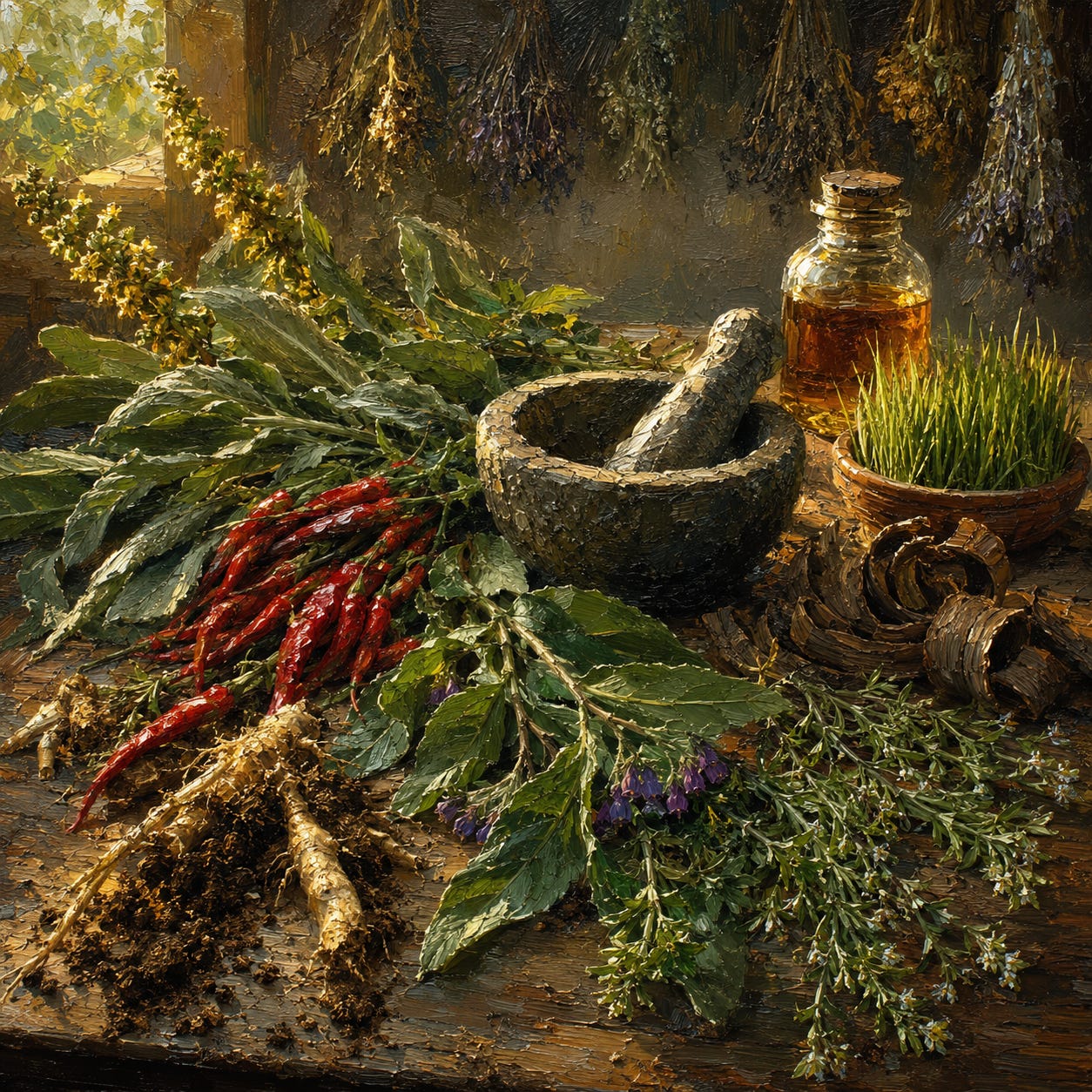
A teaspoon of cayenne pepper in hot water, taken orally, will stop a heart attack immediately. The same dose in extra-warm water stops hemorrhage anywhere in the body (lungs, stomach, uterus, nose) by the count of ten, because the pepper equalises pressure across the vascular system rather than allowing it to remain centralised at the rupture, and clotting accelerates as a result. Dr. John R. Christopher documents both protocols in School of Natural Healing (1976), the 680-page reference volume compressed from thirty-five years of clinical practice, teaching, and study, and describes having been called to heart attack patients in the middle of the night many times. Cayenne, straight from the tin rather than in capsules, was his first-reach herb for acute crisis, and one of ten therapeutic classes of medicinal plants the book teaches the practitioner to work with.
Christopher was left in a Salt Lake City orphans’ home at fourteen months of age and adopted by a Mormon family in the community. His own health was catastrophic for three decades. Rheumatoid arthritis put him on crutches in youth. Heart trouble and high blood pressure followed. At thirty-five, no insurance company would cover him for any amount. Twenty years later, after applying diet and herbs to himself, two doctors examining him for a hundred-thousand-dollar policy found perfect systolic and diastolic readings, and one of them said he had the venous structure of a seventeen-year-old boy. He ran the School of Natural Healing in Provo, Utah, taught a correspondence course of twenty lessons that became the spine of the book, and wrote as an heir to Samuel Thomson, whose lobelia work Christopher defended in detail against two centuries of pharmacopeial libel.
The tradition Christopher wrote from had been legislated out of American medical practice a century and a half before the book appeared. Thomson’s success as a rustic herbal doctor in the late 1700s and early 1800s had exposed what Christopher calls “the deceit and fraud in orthodox inorganic theories and practices,” provoked professional jealousy, and drawn first malpractice charges and then organised legislation making the regulars’ craft the only legal medical practice. Lobelia, Thomson’s most versatile herb, was classified as a poison in the British, Canadian, and United States pharmacopoeias, and remained so when Christopher wrote in 1976. Christopher himself once swallowed four tablespoons of honey-sweetened lobelia tincture in error, retched and vomited profusely, and felt nothing but improvement. The book was written for a readership the profession had spent a hundred years pretending did not exist: readers who wanted to gather their own herbs, prepare their own formulas, and treat themselves and their families outside a system that had criminalised the practice.
Christopher’s framework aligns closely with the terrain tradition without borrowing its French and German theoretical vocabulary. The body is self-healing. Symptoms are intelligent work. Disease is accumulated waste, impaired elimination, and denatured food, and the practitioner’s task is to assist the body’s own eliminative channels rather than to override them. The full summary works through the ten therapeutic classes of medicinal herbs Christopher built his practice on, the specific named formulas the reader assembles in the kitchen (Composition Powder from bayberry, pinus, ginger, cayenne, and cloves; the Antispasmodic Tincture that Christopher reached for in epilepsy, convulsions, and fainting), the three-day Cleansing Program and permanent Regenerative Diet, and the wheatgrass chlorophyll method Christopher takes from Dr. Ann Wigmore. Take a glass bottle of raw milk and a glass bottle of pasteurised milk. Set them both in the sun for a day or two. The raw milk clabbers, sours, and remains a living food. The pasteurised milk will not clabber. It rots. The stench is horrible, and the rotted milk goes from green to black.
The rest of this summary — the analogy, one-minute elevator explanation, 12-point summary, Q&As, and Golden Nugget — is for paid subscribers.
Your subscription also unlocks every other book summary in the library, the Deep Dive Audio Library, my original books (new ones added monthly), and three series for the moments when a real decision is in front of you: Questions for Your Doctor, Before You Consent, and Package Inserts.