

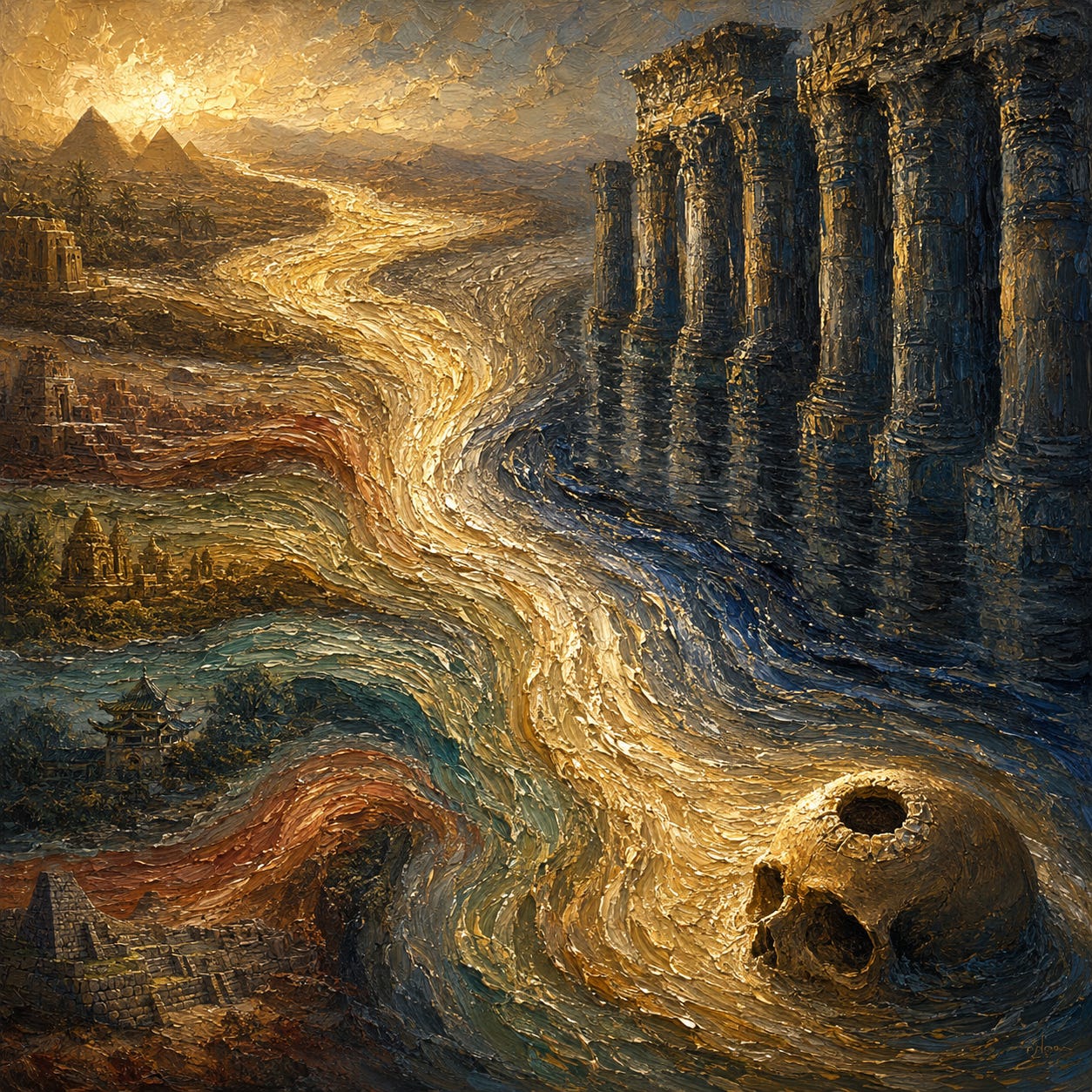
More than ten thousand trepanned skulls have been extracted from Peruvian soil. Julio Tello examined four hundred and found two hundred and fifty certain recoveries. MacCurdy among seventy-one cases found only twelve that had ended fatally. A survival rate above sixty percent, on operations that opened the living brain, achieved by surgeons working with obsidian and bronze instruments in the age before anaesthesia and antisepsis, is a datum without equivalent in the history of surgery. It appears in Jürgen Thorwald’s Science and Secrets of Early Medicine, published in 1962 as Macht und Geheimnis der frühen Ärzte and translated into English by Richard and Clara Winston the following year. The book systematically dismantles the assumption that medicine began with the Greeks and reconstructs, from papyri, cuneiform tablets, mummies, ceramics, and skulls, the medical civilizations of Egypt, Mesopotamia, India, China, and pre-Columbian America.
Thorwald was a German-language writer working from Castagnola in the Ticino, and he approached the history of medicine as a synthesist rather than a specialist, drawing on the philological work of Ebbell and Grapow on the Egyptian papyri, on Kramer and Levey on the Sumerian tablets, on Campbell Thompson and Labat on the Assyrian cuneiform, on Tello and MacCurdy on the Peruvian skulls, and on the paleopathological tradition established by Armand Ruffer and Elliot Smith. The book is dedicated to Dr Aldo Libanione of Lugano, and Thorwald’s method throughout is to trace what the archaeologists dug up back to the physicians who had written, treated, and operated in the civilizations from which the artefacts came. His posture is that of a careful reader of primary evidence who declines to defer to the received historical framework when the evidence contradicts it.
The received framework in 1962 held that medicine before Hippocrates was superstition, that Egyptian doctors had produced only magic spells, that Babylonian medicine did not exist because Herodotus had said so, that India had derived what little it possessed from Greece by way of Alexander, that Chinese medicine was a curiosity, and that pre-Columbian America had no medicine worth mentioning. This framework had survived the excavation of Mohenjo-daro, the decipherment of the Ebers and Smith papyri, and the accumulation of ten thousand Peruvian trepanned skulls, because the framework did not require the evidence to be absent — only that it be regarded as marginal. Thorwald was writing at the moment when radiocarbon dating had begun to make the pre-Columbian chronology unignorable, when the antibiotic revolution had begun to vindicate the “sewerage pharmacology” the nineteenth century had dismissed, and when the accumulated force of paleopathology was making the standard textbook account untenable. The book documents what had been known and buried, and what had been recovered only to be shelved.
Several of the findings the full summary unpacks bear directly on questions that recur through the terrain literature and through the history of institutional capture. The Egyptian pregnancy test using wheat and barley germination in the woman’s urine was replicated experimentally by Julius Manger at Würzburg in 1933 and found to work with the sex-prediction specificity the four-thousand-year-old papyrus described, though no mechanism has been proposed. The plastic surgery technique for reconstructing the nose with an attached cheek-skin flap, described in detail in the Susruta Samhita, was rediscovered from Indian village practice in 1814 by Joseph Carpue after two thousand years of European forgetting. The Chinese practice of pulverising smallpox scabs from mild cases and administering the powder through the nostrils was established at a date so ancient no one has been able to fix it, anticipating Jenner by more than a thousand years. The Sumerian medical tablet from Nippur, deciphered by Kramer and Levey in 1952 and dated to around 2200 B.C., is the oldest medical document in existence and contains no gods, no demons, no spells — pure empirical pharmacology, older than the Ebers Papyrus by five hundred years. What Thorwald establishes is that the knowledge existed, that its rediscovery has been continuous, and that in each case the modern discoverer received the credit while the ancient source was buried under the assumption that nothing worth recovering had been there.
The pattern that recurs across all five civilizations Thorwald examines is not the eventual triumph of rational medicine over demonology but the corruption, in each case, of the priestly class that had housed the rational tradition. Egyptian medicine in the Late Period turned the temples of Imhotep into revenue centres extracting escalating offerings from the desperate, with sleep-temple cures administered under opium and henbane that required no genuine medical knowledge. By the reign of Ramses III the priesthood of Amon owned 750,000 acres of land, 500,000 head of cattle, and 107,000 slaves, and Ramses personally granted them 70,000 pounds of gold and more than two million pounds of silver. The Mesopotamian ashipu built ritual systems whose complexity generated income without requiring clinical results. The Han Chinese court physicians were executed when they failed to cure the emperor, an arrangement that incentivised them to promise what they could not deliver. The Aztec priesthood industrialised human sacrifice on a scale that consumed the medical resources of the culture. Thorwald documents the pattern without naming it: the class that once created and protected the rational medical tradition becomes, at length, its principal exploiter, and the sick become the source of the priesthood’s revenue rather than the object of its care.
The reader coming to Thorwald in 2026 has the advantage of knowing what Thorwald could not know in 1962: that the pattern he documents in the ancient world is not a chapter that closed with the invention of the microscope. It is the standing pattern, and the framework Thorwald took as the resolution of ancient superstition has itself become the housing for a new set of doctrines that do not survive empirical scrutiny any better than the ashipu’s exorcisms did. Germ theory, with its one-germ-one-disease industrial sales model. Bacteriology’s assignment of bacteria to the role of invaders rather than caretakers responding to compromised terrain. Virology’s cell-culture methodology producing particles from starved and poisoned cells and calling them isolated pathogens. Contagion’s insistence on person-to-person transmission of entities whose human-to-human transmission experiments have consistently failed. Genetics’ central dogma foreclosing environmental and toxicological investigation by declaring conditions innate. Each of these doctrines carries the air of legitimacy that peer review, institutional credentialism, and regulatory endorsement can confer, and each has been made to appear as settled science by structures whose revenue depends on the appearance. The Egyptian priests of the Late Period exploited the faith of the sick because the sacrifices funded the priesthood. The mechanism has not changed. The vocabulary has. The modern reader who reads Thorwald’s book on ancient superstition without recognising the parallel to what surrounds us now has missed what the book is actually showing.
The rest of this summary — the analogy, one-minute elevator explanation, 12-point summary, Q&As, and Golden Nugget — is for paid subscribers.
Your subscription also unlocks every other book summary in the library, the Deep Dive Audio Library, my original books (new ones added monthly), and three series for the moments when a real decision is in front of you: Questions for Your Doctor, Before You Consent, and Package Inserts.